Executive Summary
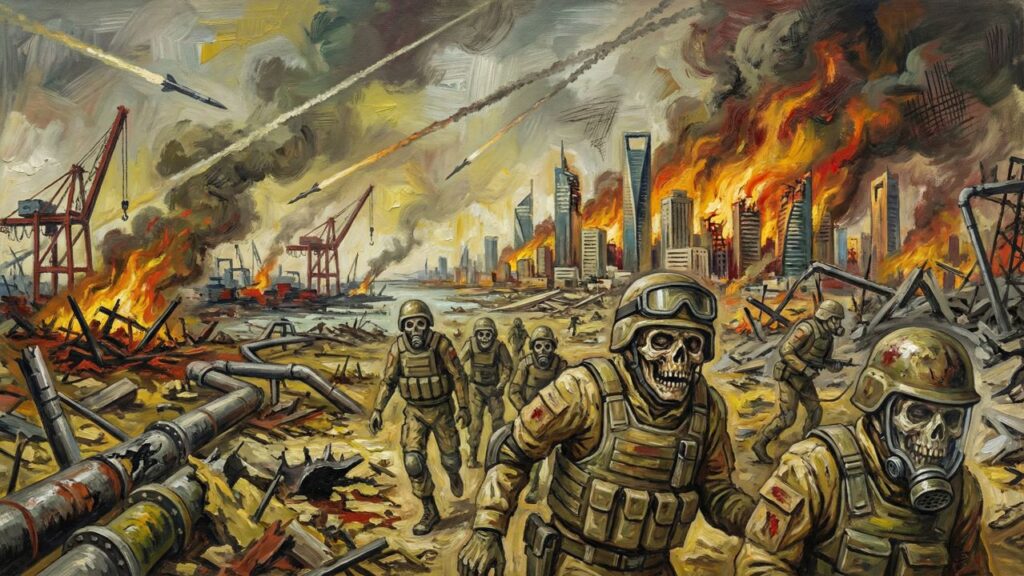
Seventy-two hours into “Operation Epic Fury,” the United States and Israel have demonstrated devastating tactical precision, killing Supreme Leader Ayatollah Ali Khamenei, striking over 2,000 targets, and declaring air superiority over western Iran. Western media presents a picture of overwhelming military dominance and imminent regime collapse. But beneath the pyrotechnics, a very different war is taking shape, one defined not by kill counts and strike sorties but by logistics, geography, credibility, and the mathematics of attrition. As Colonel Douglas Macgregor, a decorated combat veteran and former adviser to the Secretary of Defense, told Professor Glenn Diesen on March 2: “Tactics win battles, but ultimately strategy wins wars. We have no strategy.”
This analysis draws on the Macgregor-Diesen conversation and corroborating open-source intelligence to reconstruct the operational, economic, and geopolitical picture that the conventional media narrative either misses or deliberately obscures.
How the War Actually Started
The official narrative, that the U.S. launched a decisive strike to dismantle Iran’s nuclear and missile capabilities, omits a critical detail. According to Macgregor, Secretary of State Rubio told members of the Senate Armed Services Committee that Israel initiated the attack without informing the United States, and Washington “decided to simply join in because we were not yet satisfied with our posture.” The Israeli Defense Ministry called it a “preemptive strike,” and Israel declared a state of emergency within minutes.
This distinction matters. The U.S. did not enter this war on its own strategic timetable. It was pulled in by an ally whose objectives, removing Iran as a regional counterweight and advancing the “Greater Israel” vision, diverge sharply from any coherent American national interest. As Macgregor put it bluntly: “Netanyahu is in charge. Listen carefully to Netanyahu, and you will know what Trump is going to do.”
The war came despite weeks of active negotiations in Geneva between the U.S. and Iran, facilitated by Oman, over Iran’s nuclear program. Omani Foreign Minister Badr Albusaidi had expressed optimism that peace was “within reach” after Iran consented to dilute its enriched uranium stocks. The decision to strike while talking, precisely the pattern that destroyed American credibility with Russia and China over Ukraine, has now been repeated on a far larger and more consequential stage.
The Operational Picture: Tactics Without Strategy
What Went Right for Washington, Briefly
The opening 48 hours showcased American tactical supremacy at its most formidable. B-2 stealth bombers flew 37-hour missions to strike hardened sites. U.S. Cyber Command and Space Command acted first to blind Iranian defenses. More than 1,250 targets were hit in the first 48 hours, including ballistic missile launchers, air defense networks, nuclear-related sites, and command nodes. Khamenei was killed in a precision strike on his Tehran compound after months of CIA tracking. Trump claimed 48 Iranian officials were killed. The IDF reported destroying over 150 ballistic missiles and 200 air defense systems.
This is the war cable news is showing: spectacular footage of American and Israeli precision, smoking ruins, and retired generals narrating “shock and awe” for a new generation.
What’s Going Wrong, And Why It Matters More
The problems that Macgregor identifies, and that open-source reporting increasingly confirms, are structural rather than tactical.
Iran has regionalized the conflict. Within hours of the first strikes, Iran launched retaliatory barrages at Israeli territory and U.S. military installations across five Gulf states, Qatar, the UAE, Saudi Arabia, Kuwait, and Bahrain. At least 27 bases and port facilities have been targeted, from Incirlik Air Base in Turkey down to Dubai. The war is no longer a bilateral U.S.-Iran affair; it has engulfed the entire Gulf architecture that the U.S. spent decades building.
Hezbollah has opened a second front. On day three, Hezbollah launched missiles and drones from Lebanon at an Israeli military facility near Haifa, declaring the attack retaliation for Khamenei’s assassination. Israel responded with air and naval strikes across Lebanon, killing at least 52 people and issuing mass evacuation orders in the north. The IDF Chief of Staff warned of “prolonged days of combat.”
U.S. forward logistics have been degraded. Macgregor’s most consequential observation is that the ports, airfields, and replenishment hubs the U.S. habitually uses to reload naval and air forces in the Gulf have been destroyed or rendered inoperable. This forces the U.S. to fall back to facilities in the Mediterranean or even the Indian Ocean, vastly increasing sortie times and logistical complexity. Commercial and military shipping through the Strait of Hormuz has effectively ceased, with tanker traffic dropping 70% and around 150 vessels anchored outside the strait. The IRGC has explicitly declared the strait closed and threatened to fire on any ship attempting to transit.
Iran’s missile capability remains substantial. Despite Israeli claims of destroying half of Iran’s launchers, independent estimates place Iran’s remaining ballistic missile inventory at approximately 2,000 to 2,500, with an industrial base capable of producing several hundred per month from dispersed, hardened underground “missile cities”. Iranian forces have already launched over 550 missiles and 1,000 drones at Israel, with retaliation continuing across the Gulf into day three.
U.S. and Israeli interceptor stocks are dangerously low. This is the fact that transforms the entire strategic equation. The U.S. fired approximately 150 THAAD interceptors defending Israel during the June 2025 war and purchased only a few dozen replacements. Raytheon produces fewer than 50 SM-3 interceptors per year at $10 million each. At high-tempo expenditure rates, THAAD stocks could be depleted within 10 days and SM-3 stocks within 2 weeks. Macgregor estimates the total U.S. remaining missile inventory at roughly 4,000, against Iran’s approximately 450,000 across all types, including cruise missiles and drones. Even adjusting for Macgregor’s more dramatic framing, the Pentagon’s own analysts have warned that the munitions consumption rate is unsustainable.
Tomahawk stocks have been in structural decline for years. The Trump administration expended hundreds of Tomahawks in operations against Iran, Houthis, and in Nigeria throughout 2025, while purchasing only about 50 replacements. The U.S. has been using Tomahawks faster than it manufactures them for years running. The Patriot production line will be maxed out for years, simply to replace interceptors fired at Iranian missiles.
Three U.S. F-15E Strike Eagles were shot down over Kuwait by friendly fire from Kuwaiti air defenses on day three, with all six crew members recovered. Six U.S. service members have been killed in action as of March 2, with more casualties expected.
The Asymmetry No One Is Discussing
Macgregor articulates an asymmetry that is central to understanding this conflict but almost entirely absent from mainstream coverage:
“Iran hasn’t got to do anything other than survive. As long as Iran survives, and the longer the war lasts, the weaker we look, the weaker Israel looks, and the stronger Iran looks.”
This is not a war that the U.S. and Israel can “win” by any conventional metric. Regime change in a civilizational state of 93 million people, the size of Western Europe, was never realistic. The killing of Khamenei, rather than decapitating the state, appears to have galvanized it. Iran’s parliament speaker announced that the country had “prepared for various scenarios” surrounding the supreme leader’s death, and the IRGC promised “the most intense offensive operation” in the Republic’s history. The CIA itself assessed before the operation that hardline IRGC elements, not moderates, would likely replace Khamenei.
Washington planned for one end state: Iran submits. MacGregor argues that this was never going to happen, and the evidence three days in supports him. The Trump White House reportedly reached out over the weekend to explore negotiations; Iran’s response, per Macgregor, was “not only no, but hell no.” Tehran has no incentive to stop. Every day the war continues, it demonstrates that the world’s most powerful military cannot compel a determined regional power to capitulate through airpower alone. This is the lesson of Kosovo (78 days of bombing, ended by Russian diplomacy, not military coercion), of Afghanistan, and of Iraq, and it is being learned again in real time.
Economic and Financial Warfare: The Other Battlefield
Oil Markets and Global Energy
The Strait of Hormuz closure, even if partial and technically informal, is an economic weapon of mass destruction. Approximately 20% of the world’s daily oil supply and significant LNG volumes pass through that 21-mile chokepoint. Brent crude surged 13% to around $82 per barrel, with analysts at Barclays and Goldman Sachs warning that prices could approach $100 if the disruption persists. European gas prices rose as much as 45% on Monday after QatarEnergy halted production at its Ras Laffan LNG plant, which alone covers 20% of global LNG supply, following a drone strike.
Macgregor frames this in human terms: India imports 2.6 million barrels per day from the Gulf. “Every Indian family is going to effectively be made to pay a war tax that they never voted for. A $10 rise in crude means $15 billion in terms of the burden on the Indian economy.” India has already pivoted back to purchasing Russian oil.
Major shipping firms, including Maersk and Hapag-Lloyd, have suspended all transits through the strait. Insurance companies have cancelled war risk coverage for vessels in the Gulf. Effectively, the commercial lifeline of the global energy economy has been severed, not by a U.S. adversary striking at the American homeland, but as a direct and predictable consequence of a war Washington chose to join.
The Dollar and Bond Markets
The initial market reaction followed the classic safe-haven playbook: the dollar rallied nearly 1%, its strongest move in seven months, as investors fled to the perceived safety of U.S. assets. But Macgregor warns that this reflexive response may mask a deeper vulnerability. “Watch our bond market, especially the 10-year bond. The yield will rise. Look at de-dollarization, look at our financial weakness. We could end up in a very serious financial crisis, certainly worse than 2007-08.”
Treasury markets confirm early stress signals. The 10-year yield rose approximately 10 basis points to 4.03%, while traders pushed back expectations for a Federal Reserve rate cut from July to September. Reuters described the dilemma as “stagflationary”: buy Treasuries to hedge geopolitical risk, or sell them because surging oil prices will fuel inflation and delay rate cuts? If the conflict persists beyond days into weeks, the inflationary pressure from energy costs collides with the fiscal implications of a war America is financing on credit, a collision that could test confidence in U.S. sovereign debt far more severely than any tariff dispute.
The Geopolitical Earthquake
The End of the Old Middle East
Macgregor calls this conflict “the end of Sykes-Picot”, the post-World War I architecture that drew the modern map of the Middle East under Western supervision. Whether or not one accepts the full sweep of that claim, the evidence is directional. The Gulf monarchies (Saudi Arabia, the UAE, Qatar, Kuwait, Bahrain) have been struck by the very country they spent decades trying to contain, while the patron they relied on for protection (the U.S.) drew the fire in the first place.
The GCC issued a joint statement condemning Iranian aggression and reserving the right to retaliate. But Iran’s Foreign Minister Araghchi explicitly stated that Tehran is targeting “American objectives,” not Gulf neighbors. The Gulf states face an impossible choice: align with the U.S. and Israel, inviting further Iranian strikes and aligning themselves with a cause deeply unpopular with their own populations, or distance themselves from Washington and begin negotiating their own security arrangements with Tehran and Beijing.
Macgregor predicts the latter: “I’ll be very surprised if all these family dictatorships in the Persian Gulf survive in their current form.” In Iraq, the Shia-led government, long resentful of American military presence, now has both domestic and regional cover to demand U.S. forces leave. Turkey, which hosts Incirlik Air Base, has shown no public objection to Iranian strikes on that facility.
U.S. Credibility: The Real Casualty
The most damaging consequence of this war may be neither military nor economic but perceptual. The United States entered the 21st century projecting an image of military invincibility that underwrote its entire global alliance structure. That image was already eroding, through the Afghanistan withdrawal, the Ukraine stalemate, and the sanctions overreach that pushed Russia, China, and Iran closer together. This war accelerates the erosion at a pace that may prove irreversible.
Macgregor draws an analogy to 1940 France: “Everyone was saying, ‘Thank God for the French army, the largest army in Europe, the best equipped, more tanks, more everything.’ That went away pretty quickly.”
If the U.S. cannot compel Iran to capitulate, and after three days, there is no evidence that it can, then every country that has staked its security on American protection is recalculating. Japan, South Korea, and the Philippines are watching. European NATO members, already committed to rearmament after Ukraine, are watching. The BRICS nations, for whom Iran is a critical partner in the Belt and Road Initiative and the emerging non-dollar financial architecture, are watching.
The Nuclear Threshold
The most dangerous scenario Macgregor raises is one that mainstream coverage treats as taboo: the possibility that Israel, facing sustained and relentless missile barrages that its defenses cannot fully absorb, eventually considers using a tactical nuclear weapon to break Iran’s capacity.
He does not predict this as imminent, but as a potential endpoint of an attritional spiral: “At some point, the Israelis say, if Iran will not stop, we will launch a nuclear weapon.” In that scenario, he believes Russia and China would intervene, not necessarily militarily in the first instance, but with ultimatums backed by the credible threat of nuclear response. And they would intervene at a moment when U.S. conventional inventories have already been exhausted by Ukraine and Iran.
This is the escalation ladder that nobody in Washington appears to have planned for, because the plan assumed Iran would submit before the ladder was climbed.
The Ukraine Connection
One cannot understand the Iran war without understanding how the Ukraine proxy war set the table for it. Macgregor draws the connection explicitly: years of pouring munitions into Ukraine, without achieving the strategic objective of weakening Russia to the point of capitulation, have depleted U.S. and NATO war reserves across the board. THAAD and Patriot interceptors diverted to the Middle East are interceptors not available for Ukraine or, critically, for a potential Taiwan contingency.
The Patriot production line will be consumed, replacing what the U.S. Army has been firing at Iranian missiles for years, potentially into the next administration. Sales of Patriot systems to European allies for Ukraine’s defense are now “probably off the table”. The strategic irony is complete: the proxy war meant to weaken America’s adversaries has instead weakened America’s ability to fight its next war.
MacGregor sees a direct parallel in outcomes: “Today, the question is not will Russia survive, it’s whether or not Ukraine survives. At some point, Israel is going to end up exhausted and tapped out, much like Ukraine.”
What Victory Looks Like, And for Whom
President Trump has said the strikes could take “four to five weeks”. But four to five weeks of what, exactly? Macgregor asks the question that no White House briefing has answered: “What is the strategy? If you can’t remove the government, what do you do?”
The U.S. cannot occupy Iran. It cannot starve it into submission through sanctions that have already been in place for decades. It cannot manufacture interceptors fast enough to sustain a multi-week air defense campaign. And it cannot compel a 2,700-year-old civilizational state to “sign the deal” as though this were a Manhattan real estate transaction.
Iran’s victory condition is survival. And Iran is surviving. Its command and control appear intact despite Khamenei’s killing. Its missile cities (dispersed, underground, hardened) continue to produce and launch. Its strategy of regionalization is working: the Gulf is in flames, Hormuz is closed, oil prices are surging, and the global south is calculating the cost of American hegemony in dollars per barrel.
Macgregor’s closing assessment is stark: “We’re seeing the end of the old Middle East. We’re seeing the end of American military hegemony and political dominance. That’s what we’re watching.”
Whether that proves to be prophecy or provocation, the evidence from day three suggests that the question is not whether Washington’s position in the region erodes, but how fast, and what replaces it.
Based on the March 2, 2026, conversation between Colonel Douglas Macgregor (ret.) and Professor Glenn Diesen, supplemented by open-source reporting from Reuters, Al Jazeera, the New York Times, Aviation Week, CBS News, CNN, NPR, the Wall Street Journal, Bloomberg, and other outlets.
Related reading
- Stop Calling It News. Gulf State “Reporting” Is Trump’s Bullshit With A Gulf State Palace Seal.
- UPDATE: What Western Media Is Not Telling You About the Iran War
- How the Iran Conflict Is Devastating the Global South
- The War That Broke the AI Boom: Economic and Supply Chain Disruptions from the Iran Conflict