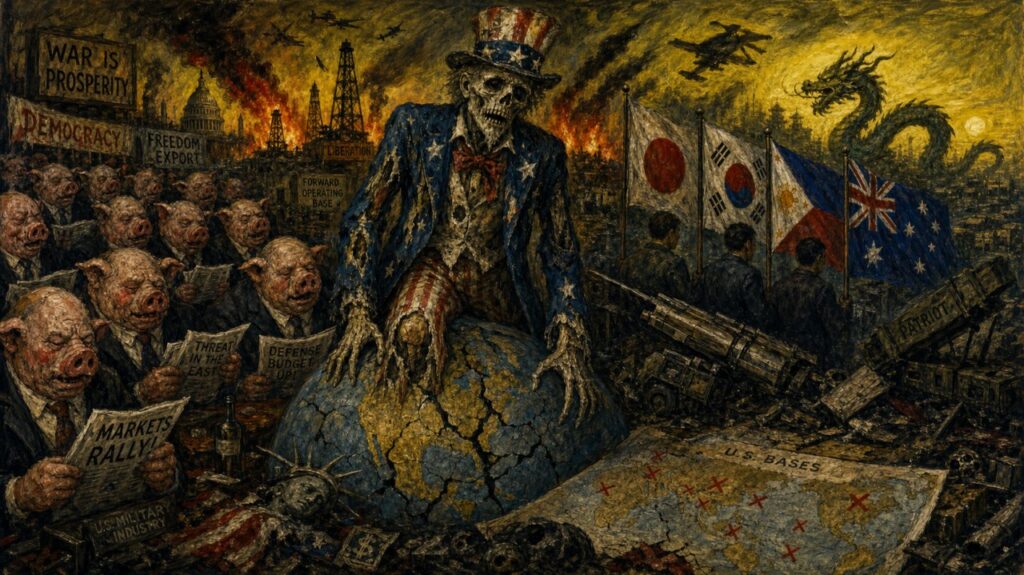
Self-Ruin and

By Scott Ortkiese | June 10, 2026
The Conversation You Weren’t Supposed to See
While American cable news has spent the months since February 28, 2026 debating whether the Trump administration’s war on Iran is “winning,” cycling between sanitized Pentagon briefings, indignant Democrats, and think-tank cheerleaders who built careers on the illusion of American primacy, a pair of analysts with actual regional expertise were quietly dismantling the entire framework through which the conflict has been sold to Western audiences.
Warwick Powell, an adjunct professor at Queensland University of Technology and senior fellow at the Taihe Institute in Beijing, and Glenn Diesen, a professor at the University of South-Eastern Norway and expert in Eurasian geopolitics, sat down to discuss something the American media has treated as a footnote: what the Iran war means for East Asia, and what it reveals about the structural decline of American power in the Pacific.
The resulting conversation is, in a word, extraordinary. Not for its inflammatory rhetoric (it is notably sober and analytical) but for its ruthless willingness to follow facts and logic to their natural conclusions, without the ideological guardrails that domesticate so much of what passes for geopolitical analysis in Washington’s media ecosystem.
The View from Washington: A House of Mirrors
Before engaging Powell and Diesen’s analysis, it is worth briefly mapping what American audiences have actually received from their media.
The initial coverage of the U.S.-Israeli strikes on Iran was predictably bifurcated. The New York Times editorial board published a piece titled “Trump’s assault on Iran is reckless,” criticizing the president’s “vague objectives” and “disregard for both domestic and international laws governing warfare.” The Wall Street Journal focused on strategic targeting of Iran’s internal security apparatus, publishing analysis suggesting the strikes might catalyze internal revolt. The Washington Post tracked the rapid geographic spread of the conflict, while USA Today concentrated on evacuations of American civilians.
What was almost entirely absent from this coverage: a serious reckoning with what the war meant for America’s strategic position in Asia, for the 80,000-plus troops stationed in Japan and South Korea, for the supply chains of manufacturing nations that run their industrial economies on Middle Eastern diesel, for the slow-motion collapse of the “hub and spoke” alliance system upon which America’s post-WWII Pacific order was built. The Washington Post noted, in a single article published nearly a month into the conflict, that Asian allies were “bracing” for a distracted America, a sentence that in a less domesticated press corps would have been the headline of every foreign affairs section since Day One.
American news organizations were, additionally, operating under explicit White House pressure to provide “favorable” coverage of the war. Journalists reported being called unpatriotic for emphasizing casualties and economic dislocation. With more Trump-friendly billionaires acquiring media properties and direct executive pressure on newsrooms, the structural conditions for the kind of honest multipolar analysis Powell and Diesen offered simply do not exist in mainstream American media.
The Energy Shock: What the Region Is Actually Experiencing
Powell begins where honest analysis must begin: the material consequences of disrupted oil flows on the economies of East and Southeast Asia.
The straightforward but systematically underreported reality is that Asia runs on Middle Eastern oil in a way that has no American parallel. Countries across Southeast Asia, as well as Japan, South Korea, and Australia, depend heavily on Persian Gulf crude and the distillate fuels, particularly diesel, refined from it. The Strait of Hormuz, through which roughly 20% of the world’s oil supply transits, was effectively shut to normal commercial operations at multiple points during the conflict, sending energy costs surging across the Indo-Pacific. Between February 23 and March 23, the Philippines registered the largest increase in petrol prices of any nation on earth.
The regional responses have been pragmatic and revealing. Malaysia, Indonesia, and Japan all moved quickly to shore up alternative supply arrangements, with Japan specifically working to secure its position in the Sakhalin-2 project with Russia, prizing Ural crude in part because its chemical composition is a functional substitute for the diesel-producing Middle Eastern grades that drive industrial economies. Singapore, which publicly refused Russian oil, has been left scrambling for workarounds, a diplomatic posture that has come at genuine economic cost.
The Japanese naphtha market, and the petrochemical industries dependent upon it, have experienced severe supply constraints, forcing Japanese manufacturers to source from Chinese suppliers, a supply chain reorientation with long-term implications for how Japan’s industrial economy is configured and oriented. None of this is especially complicated to report. None of it has received meaningful coverage in the American press.
The Philippines’ response has been especially significant. In mid-to-late March, President Marcos Jr., until recently a reliable American proxy on South China Sea policy, told Bloomberg Television that he was “open to restarting talks with China on joint oil and gas development” in contested South China Sea waters, citing the “energy emergency” as providing “impetus for both sides to come to an agreement.” He simultaneously indicated that the Philippines was in talks with China on fuel and fertilizer supply, saying: “They’ve been very helpful with fertilizers.” Chatham House analysts assessed that the Hormuz crisis represented a unique opportunity for ASEAN to advance constructive dialogue with Beijing on South China Sea issues. In a single energy shock, the careful architecture of American-Philippine alignment, painstakingly constructed over years of arms sales and maritime patrol agreements, has developed cracks that will not simply heal when the fighting stops.
The Military Exposure: The Myth the Pentagon Needed to Maintain
The most important section of Powell’s analysis concerns the structural military consequences of the Iran war for American deterrence in Asia, and it lands with particular force because it was not invented for this conversation. The vulnerabilities Powell describes were already being documented by American lawmakers and defense analysts before a shot was fired.
As early as May 2024, thirteen members of Congress sent a letter to the Air Force and Navy secretaries warning that “China can attack all US bases in the region” and that Chinese missile capabilities “significantly weaken our ability to respond in a conflict.” A Hudson Institute report from January 2025 found that U.S. airfields in the Pacific were “generally unhardened and highly vulnerable,” concluding that China could “neutralize” U.S. military aircraft at key facilities with “as few as 10 submunition-armed missiles.” The Stimson Center’s Kelly Grieco assessed that Chinese missile attacks could prevent the U.S. Air Force from conducting fighter operations from Japanese bases “for about the first 12 days of a conflict.”
These were the pre-war assessments. The Iran conflict made the picture considerably worse.
By April 2026, a CSIS report confirmed that the United States had expended at least 45% of its Patriot missile interceptors and over 53% of its THAAD interceptors during the war on Iran. The report cautioned: “A war against a capable peer competitor like China will consume munitions at greater rates than in this war. Pre-war inventories were already insufficient; the levels today will constrain U.S. operations should a future conflict arise.” The U.S. burned through more Patriot missiles in three days of the Iran conflict than Ukraine received from the United States throughout the entire duration of Russia’s war, over 800 interceptors in 72 hours, according to Zelensky. By May, the U.S. had expended more than 1,300 Patriot interceptors total, depleting stockpiles that will take years to replenish at current production rates.
Powell frames this with elegant directness: “The last thing a hegemon would ever want to do, partly to be a bully, partly is to never have to act as a bully, you just need to make sure that people are fearful that you could.” The Iran debacle has shattered that fear economy. Asian allies now have empirical data, not speculation, about the depth of American arsenals. The Diplomat noted that the concentration of U.S. military assets in the Middle East forced the redeployment of THAAD launchers from South Korean bases and roughly one-third of the U.S. naval surface fleet out of the Pacific, sending, as it noted, “a very different message” than the reassurances of administration officials.
The United States has also been quietly repositioning forces in ways that validate Powell’s reading. Troops have been moved out of Okinawa, some to Guam before the Iran conflict, more to the Persian Gulf after it began. This is not the footprint of a power projecting confidence. It is the footprint of a power managing exposure.
The Hegseth Moment: When the Language of Hegemony Changes
One of the genuinely remarkable moments Powell flags is the language used by Defense Secretary Pete Hegseth at the May 2026 Shangri-La Dialogue in Singapore. Hegseth told the assembled defense ministers and strategic analysts that the United States sought a “stable equilibrium” in Asia where “no single state, China included, can exert its dominance.”
Powell’s observation about this formulation deserves to be quoted directly: “In my living memory, the United States has always insisted that it is the sole hegemon in Asia and that no one else will be.” This is not a minor rhetorical shift. It is an acknowledgment, under pressure of events, that the American unipolar moment in Asia is over. The aspiration is no longer dominance; it is balance-of-power management. Pete Hegseth, notably, did not mention Taiwan once during his speech.
For those who have built careers, institutions, and strategic frameworks on the premise of permanent American primacy in the Pacific, this is an existential concession. The formulation “no single state, including China” would have been unthinkable from any senior American defense official as recently as 2020.
The Arithmetic of Power: China’s Industrial Position
One of the most important contributions Powell makes, and one of the most systematically ignored by American media, is simple quantitative context about the regional balance of economic power.
China’s economy represents approximately 60% of the GDP of the Indo-Pacific region, encompassing the ten ASEAN states plus Japan, South Korea, Australia, and New Zealand. China’s manufacturing value-added accounted for 27.71% of global manufacturing output in 2024, and the country has maintained its position as the world’s largest manufacturer for 15 consecutive years. China contributed over 30% of global manufacturing growth during the 14th Five-Year Plan period (2021-2025). Powell’s projection that this share will approach 40% by 2035 is consistent with the trajectory of Chinese industrial development.
To put this in historical context: in 1985, China and India had roughly comparable GDPs. Today, China’s economy is five to six times larger than India’s. The idea that Japan, Australia, the Philippines, or South Korea, individually or collectively, can mount a meaningful military “balancing act” against this industrial mass is, as Powell says, “foolhardy and dangerous.” It is also an idea that requires willful innumeracy to sustain.
The “containment through energy chokepoint” strategy that Powell identifies as a long-running American ambition has also been rendered obsolete by structural changes in China’s energy economy. China reached peak diesel consumption approximately two years ago; aggregate diesel use has fallen since. China is building more coal-fired and nuclear power stations than the rest of the world combined. Terrestrial oil and gas supply routes across Eurasia, from Russia and the Central Asian states, are far harder to interdict than maritime chokepoints. The Arctic shipping route is becoming commercially viable for more months of the year as climate change proceeds. As CSIS itself acknowledged, despite reduced Middle Eastern crude flows, China’s economy “hasn’t missed a beat” over the conflict’s first 100 days.
The horse, as Powell bluntly puts it, has bolted.
The Nuclearization Pressure: What Nobody on CNN Is Discussing
The knock-on security consequences in North Asia are receiving almost no serious treatment in American media, even though the data has been in plain sight.
The 2025 Asan Poll found that 76.2% of South Koreans now support indigenous nuclear armament, a record high, and 66.3% support the redeployment of U.S. tactical nuclear weapons to the Korean Peninsula. An East Asia Institute analysis found that perceptions of growing U.S.-China rivalry have a “significant impact” on South Korean support for nuclear armament, and that this support has become robust enough that “even substantial drops in support no longer fall below majority support.”
Japan’s remilitarization trajectory is similarly unaddressed with analytical depth. The country has been engaged in a sustained military buildup for approximately a decade, and the Iran conflict has accelerated domestic debates about the viability of American security guarantees. As Powell notes, Beijing is caught in a genuine bind: while it would prefer reduced American forward presence in Asia, the Americans have historically served the function of keeping Japanese rearmament within limits. The “strategic stability” of the post-WWII Pacific order was, in no small part, a product of Japanese subordination to American military authority. If that subordination weakens, China faces a Japan that is militarizing without the constraint of American control, which no party in the region, including Beijing, regards as unambiguously favorable.
These are genuinely complex strategic dynamics. They require the kind of non-ideological, historically informed analysis that Powell and Diesen provide. They are essentially absent from American cable news.
The AUKUS Cracking: Australia’s Reckoning
Powell notes that the Shangri-La Dialogue produced significant changes to the AUKUS submarine deal structure, and that these changes catalyzed a “very cynical response from the Australian public.”
This understates the severity of the political rupture. Former Labor minister and Midnight Oil frontman Peter Garrett launched a crowd-funded independent public inquiry into AUKUS on June 2, 2026, described as the first such inquiry ever initiated by civil society specifically because parliament had “singularly failed” to conduct meaningful oversight. Garrett characterized AUKUS as “the most costly and risky measure ever undertaken by any Australian government,” questioning whether the United States or United Kingdom could actually deliver submarines on schedule and within the A$368 billion budget commitment. Former ADF chief Admiral Chris Barrie joined as a commissioner.
The inquiry will examine whether AUKUS enhances Australian security, a question that Australia’s parliament has, remarkably, never been required to address through formal hearings. It will also examine how the deal affects Australia’s relationship with China, its largest trading partner. These are questions that could only be asked out loud because the Iran war made it impossible to sustain the fiction that Washington’s security guarantees are reliable and permanent.
India: The Indispensable Swing State
The conversation’s treatment of India is nuanced in ways that most American commentary on the “Quad” and the “Indo-Pacific” partnership is not. Diesen frames India’s historical non-alignment tradition correctly: it is not vacillation, but a deliberate institutional posture designed to preserve strategic autonomy and prevent the kind of excessive dependency on any single great power that has repeatedly destroyed smaller states used as proxies.
Powell diagnoses India’s central vulnerability with precision: its economic growth has been powered primarily by a services economy heavily dependent on American IT outsourcing, a structural exposure that makes the Indian economic elite tilt heavily toward Washington, even as the Indian political elite recognizes the unavoidability of China as a neighbor, a land-border partner, and an increasingly dominant force in the regional economy. India walked away from the Regional Comprehensive Economic Partnership at the moment of signature, forfeiting access to the world’s largest free-trade framework, partly due to domestic protectionism and partly due to concerns about Chinese manufacturing competition. As Powell notes, China’s GDP is now five to six times larger than India’s, a gap that has widened, not narrowed, under Modi’s industrialization agenda.
The Iran conflict has not resolved India’s strategic ambivalence; it has intensified it. India faces significant fertilizer and energy supply disruptions. Its services-economy tether to the United States is being tested by Washington’s erratic trade and technology policy. Its BRICS membership and SCO participation push toward multipolarity, while its security anxieties about China pull toward the American alliance framework. As Diesen notes, the danger is that India is “captured” into a de facto anti-China bloc, which would undermine its strategic autonomy, invite Chinese countermeasures, and reduce India to the role of a frontline state. The alternative, genuine non-alignment in a multipolar system, requires the kind of political leadership willing to transcend the historical grievances and emotional residues that continue to shape Indian elite attitudes toward Beijing.
ASEAN and the Multipolar Architecture: The Story Nobody Is Telling
The most forward-looking portion of the Powell-Diesen conversation concerns the institutional architecture that might undergird an Asian multipolar order. This is, in American media terms, completely invisible, not because it is speculative, but because it names frameworks and institutions that do not fit the “free world vs. authoritarian bloc” narrative through which American outlets organize international affairs.
Powell makes a striking and underappreciated case for ASEAN as a successful model of inclusive regional security management, one that has maintained relative peace across an extraordinarily diverse region for decades through consensus-based diplomacy, that brokered the Regional Comprehensive Economic Partnership (the world’s largest free-trade agreement by membership at the time of signing, approximately four years ago), and that is developing multilateral payment infrastructure enabling regional economies to settle trade in national currencies, reducing exposure to dollar-denominated liquidity crises of the kind that devastated the region in 1997.
The RCEP, which includes China, Japan, South Korea, Australia, New Zealand, and all ten ASEAN states, and which Latin American countries are reportedly seeking to join, represents exactly the kind of inclusive economic architecture that bloc politics is designed to prevent. India’s absence from the RCEP, it walked away at the signing ceremony, is the single most consequential strategic self-limitation any large power in the region has imposed on itself in recent decades.
Powell identifies Indonesia as the key variable: the one ASEAN state with the population, resources, and economic trajectory to emerge as a major regional power over the next half-century, a ballast for multipolar stability that could, if properly cultivated, provide the gravitational center for an Asian security framework not dependent on American military hegemony. This is not a fringe view; it is a fairly standard assessment among serious students of Southeast Asian political economy. It is simply invisible in American media, which has never developed the institutional capacity to cover ASEAN seriously.
The Shanghai Cooperation Organization, which Powell proposes as a model for broader Asia-Pacific security architecture, extending to Southeast Asia, North Asia, and potentially including Russia as a Pacific power, similarly occupies zero column inches in American foreign policy coverage, except when it can be framed as a “rival bloc” for the purposes of adversarial narrative construction.
The Bloc Politics Cancer
Both Powell and Diesen invoke former Australian Prime Minister Paul Keating’s formulation: East Asia needs a NATO security architecture “like it needs cancer.” It is a line worth dwelling on, because it captures what is genuinely at stake in the choices being made right now.
Bloc politics, the division of a region into hardened, mutually hostile alliance systems, does not stabilize; it accelerates. It transforms local security concerns into great-power confrontations. It removes the diplomatic space in which smaller states can maneuver, compromise, and pursue their actual interests. It creates security dilemmas that generate arms races, miscalculations, and ultimately wars that none of the original parties wanted. Europe’s experience in the early twentieth century, and its more recent experience in Ukraine, offers the clearest possible demonstration of this dynamic.
The alternative, indivisible security, the principle that no state’s security can be purchased at the expense of another’s, was once a stated aspiration of the post-Cold War European order. It is now, as Diesen notes with rueful irony, considered “controversial” in Europe, treated as a “Russian ploy” rather than a foundational principle of sustainable peace.
The Asia-Pacific is at an inflection point. The Iran war has accelerated the timeline on which these choices must be made. American primacy is receding, not because of Chinese aggression or any particular act of American weakness, but because the structural conditions that sustained it (overwhelming military-industrial advantage, unrivaled financial infrastructure, uncontested manufacturing dominance) no longer obtain. The question is not whether Asia’s security architecture will change; it is whether the transition will be managed through inclusive, multipolar institutions that reduce the risk of catastrophic miscalculation, or whether it will be governed by the logic of bloc politics, which, as Europe can attest, does not end well for the frontline states.
The Media Failure and Its Costs
The gap between what Powell and Diesen are discussing and what appears in American media is not a minor discrepancy. It is a chasm.
American media coverage of the Iran war has been almost entirely organized around domestic political categories, what it means for Trump, what it means for the 2026 midterms, whether the war is “winning” by metrics defined within Washington’s epistemological horizon. The structural consequences for American alliance architecture in Asia, the empirical data on missile stockpile depletion, the growing pressure toward nuclear acquisition in South Korea and Japan, the realignment of Philippine foreign policy in real time, the AUKUS crisis in Australia, these are treated as exotic footnotes, if they appear at all.
The reason is not, primarily, White House pressure, although that is real. The reason is that American media has never developed the regional expertise, the editorial willingness to engage non-Western analytical frameworks, or the institutional incentives to cover a world in which America is one significant power among several rather than the organizing principle of all geopolitics. Powell and Diesen are reporting from the world as it actually is. American cable news is reporting from the world as the defense establishment, the Beltway think-tank complex, and four decades of unipolar habit have taught it to see.
The cost of that gap is not academic. Nations are making consequential choices right now, about security alignments, energy infrastructure, currency arrangements, and military postures, based on assessments of American power and reliability that the American media is systematically refusing to convey to American audiences. When those choices compound over the years ahead, the Americans most insulated from their consequences will be the pundits who chose the comfortable narrative. The Americans least insulated will be everyone else.
Warwick Powell can be found at warwickpowell.substack.com and is the author of “Thermoeconomics in a Time of Monsters.” Glenn Diesen hosts the Greater Eurasia Podcast and is a professor at the University of South-Eastern Norway.
Related reading
- American Empire in Ruins: The Unprovoked, Unconstitutional, and Catastrophic US-Israeli War on Iran
- The Last Blunder: How the US-Israel Attack on Iran Killed the American Empire's Operating System
- The Iran War’s Hidden Toll on Asia-Pacific: A War of Choice, a Region in Collapse, and a Bill Every American Will Pay
- Trump’s Iran War, China Trip and the Vanishing Empire