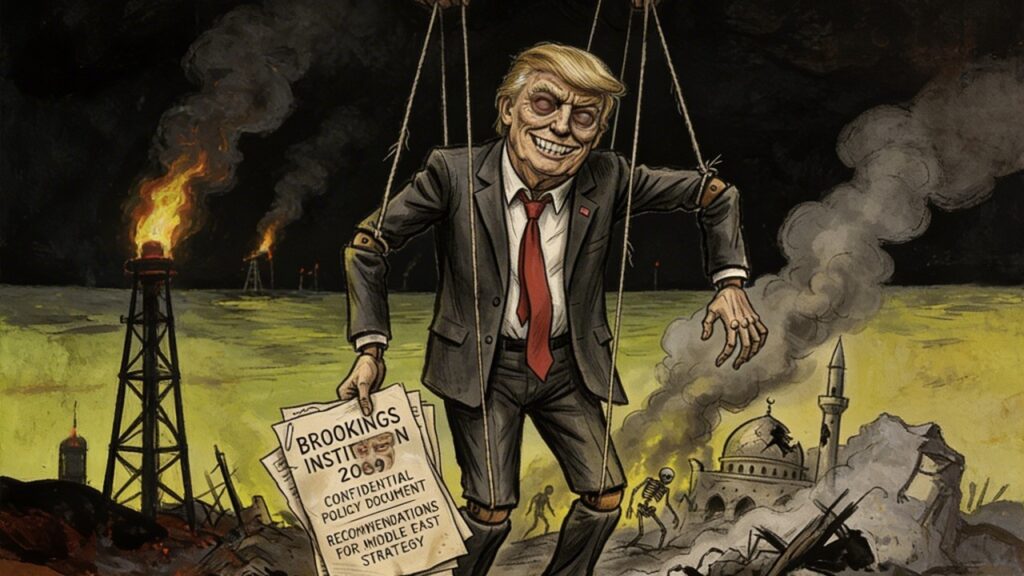
Part Two of this series documented what the 2026 Iran war is costing every American in gasoline, groceries, mortgages, and war debt. This article answers the question that one left open: who designed it, when, and why. The answer is a matter of public record. It was published in June 2009 by the Brookings Institution. It has been sitting in plain sight for seventeen years. And if you read it today, you will find that what is happening right now was written in advance, chapter by chapter, option by option, with the executional precision of a campaign plan.
Part Three of the Throughline Iran War Series.
The Brookings Document that Became Marching Orders
“Which Path to Persia? Options for a New American Strategy toward Iran” was published in June 2009 by the Saban Center for Middle East Policy at the Brookings Institution, the most prestigious foreign policy think tank in the United States. It is 241 pages long. It is not classified. It was never hidden. It can be downloaded from Brookings’ own website today.
Its six authors are not academics in the conventional sense. Kenneth Pollack, the lead author and editor, served as Director for Persian Gulf Affairs and Near East and South Asian Affairs at the National Security Council and as a Persian Gulf military analyst at the CIA. Bruce Riedel spent 30 years at the CIA and served as a senior adviser on Middle East policy to four presidents. Daniel Byman is a former CIA Middle East terrorism analyst. Martin Indyk served twice as U.S. Ambassador to Israel and was one of the most influential pro-Israel lobbyists in Washington for decades. The document carries a notice that “This material has been reviewed by the CIA to prevent the disclosure of classified information”. These are not outsiders speculating about American foreign policy. They are the people who ran it.
The funding source is equally important. The Saban Center was established and financed by Haim Saban, an Israeli-American billionaire who has described himself as “a one-issue guy and my issue is Israel”. Saban donated to AIPAC, to the Friends of the Israeli Defense Forces at a rate exceeding $1 million annually, and to both major American political parties. A critical analysis published at the time noted that “Saban Center publications never question U.S. support for Israel and rarely, if ever, offer significant criticism of key Israeli policies”. The 2009 document mapping the destruction of Iran as a state and military power was produced by former CIA officers and presidential advisers, funded by a self-declared single-issue Israel advocate, under the institutional cover of America’s most respected foreign policy institution.
The Architecture
The document presents nine policy options organized across four strategic categories:
Part I: Dissuading Tehran (Diplomatic Options)
- Chapter 1: An Offer Iran Shouldn’t RefusePersuasion
- Chapter 2: Tempting TehranEngagement
Part II: Disarming Tehran (Military Options)
- Chapter 3: Going All the WayInvasion
- Chapter 4: The Osiraq OptionU.S. Airstrikes
- Chapter 5: Leave It to BibiAllowing or Encouraging an Israeli Military Strike
Part III: Toppling Tehran (Regime Change)
- Chapter 6: The Velvet RevolutionSupporting a Popular Uprising
- Chapter 7: Inspiring an InsurgencySupporting Iranian Minority and Opposition Groups
- Chapter 8: The CoupSupporting a Military Move against the Regime
Part IV: Deterring Tehran (Containment)
- Chapter 9: Accepting the UnacceptableContainment
The framing of the document presents itself as an objective options memo: “Does not advocate for any policy. Collective work, does not reflect authors’ personal preferences”. This framing is critical to understand, because it is the document’s primary protection. It allows its authors to say they were merely mapping the landscape. But the Conclusion, titled “Crafting an Integrated Iran Policy: Connecting the Options,” makes the real strategy explicit: no single option is intended to work alone. The options are designed to be used in conjunction, creating compounding pressure that strips Iran’s defenses one layer at a time until the government collapses. This is not a menu. It is a campaign plan structured as a menu.
Chapter 1: The Offer Iran Shouldn’t Refuse, Or Else
Chapter 1’s title, “An Offer Iran Shouldn’t Refuse,” is not merely sardonic. It contains the central logic of the entire document, and it is the chapter that most directly illuminates the current war.
The chapter describes the conditions under which diplomatic engagement can be used to establish the narrative foundation for military action. The key passage, available on the Brookings website, reads: “The best way to minimize international opprobrium and maximize support (however grudging or covert) is to strike only when there is a widespread conviction that the Iranians were given but then rejected a superb offer, one so good that only a regime determined to acquire nuclear weapons and acquire them for the wrong reasons would turn it down”.
Read that again slowly. The document is not describing how to use diplomacy to avoid war. It is describing how to use the appearance of diplomacy to generate the international political conditions that make war acceptable. The offer is not designed to succeed. It is designed to be rejected, or structured so that acceptance would require strategic capitulation, so that the subsequent military action can be framed as Iran’s fault.
This is exactly what happened with the JCPOA, the 2015 nuclear deal that constrained Iran’s enrichment and placed its program under the most intensive international inspection regime in history. The deal was working. Iran was complying. The Trump administration withdrew from it unilaterally in 2018, without any Iranian violation. Sanctions were reimposed. Iran’s economy began to collapse. Under those conditions, Iran escalated its enrichment levels, moving from approximately 3.67 percent, the JCPOA ceiling, toward the 60 percent level that became the cited justification for military action. The United States destroyed the deal, generated the conditions for the behavior it then used as a pretext, and launched a war. The Brookings document had scripted this outcome in 2009.
Chapter 2: Tempting Tehran, The Negotiation as Cover
Chapter 2 describes “Engagement”, a policy of offering Iran genuine inducements to moderate its behavior. The document is candid about the operational function of this option, particularly when engagement is used not as a sincere alternative to war but as “tactical engagement that could lead to strategic engagement” while keeping, in the document’s own language, “quiet about the sticks”.
The sixty days of nuclear negotiations between the United States and Iran conducted in early 2026, repeatedly described as “hopeful” in Western media, were engagement in this precise sense. Vice President Vance stated publicly in February 2026 that the U.S. was “pursuing a diplomatic deal” while simultaneously maintaining that Trump “has the right to use the military option if he chooses”. The strikes that began February 28 were launched while talks were nominally ongoing. The chapter had described this function with precision: diplomacy is used to “advance continuity of agenda in a way that is not openly obvious” and to create “a pretext for war”. The goal is to look reasonable to the world while the military option is already in execution.
Chapter 5: Leave It to Bibi, The Chapter That Explains Everything
Chapter 5 is the one that has attracted the most attention since the war began, and rightly so. Its full title is “Leave It to Bibi: Allowing or Encouraging an Israeli Military Strike”. Its content directly describes the operational architecture of the current conflict.
The document states: “The U.S. would encourage, and perhaps even assist, the Israelis in conducting the strikes themselves, in the expectation that both international and Iranian retaliation would be deflected away from the United States and onto Israel”. The stated requirements from the U.S. side are described, in the document’s own words, as “a wink and a nod”. The listed advantages: “Plausible deniability? Israelis have the gumption we lack”.
The document also describes a war game the Brookings authors conducted in December 2009 simulating an Israeli military strike on Iran. The simulation produced this conclusion: “Israel’s strategy had been to start a war with Iran in the expectation that the United States would have no choice but to finish it”.
That sentence was written as a simulation result in December 2009. It is an operational description of February and March 2026. Israel struck Iran’s nuclear infrastructure in June 2025. Iran retaliated. The United States then entered the conflict on February 28, 2026, and has been conducting joint operations with Israel since. The simulation was not a warning. It was a proof of concept.
The “Leave It to Bibi” chapter also identifies a critical operational requirement: clearing the air corridor. Iran’s air defense network, supported by Russian-supplied systems and geographically anchored through Syria, blocked direct Israeli strike packages. The document was explicit that clearing those corridors was a prerequisite. The fall of the Syrian government in December 2024, followed immediately by the systematic dismantling of Syria’s integrated air defense network by U.S. and Israeli forces, was not a spontaneous geopolitical development. It was the prerequisite operation the 2009 document had identified as necessary. When Syria fell and its air defenses were cleared, the air corridor to Iran was opened. The first strikes followed within months.
The Intelligence Community’s Own Verdict
Before examining the remaining chapters, the evidence on the stated justification for the war must be addressed directly, because it is now a matter of official congressional record.
On March 25, 2025, Director of National Intelligence Tulsi Gabbard delivered her opening statement to the Senate Select Committee on Intelligence. The written statement contains the following sentence: “The IC continues to assess that Iran is not building a nuclear weapon and Supreme Leader Khamenei has not authorized the nuclear weapons program he suspended in 2003”. The same assessment warned that “an erosion of a decades-long taboo in Iran on discussing nuclear weapons in public” was occurring, and that Iran’s enriched uranium stockpile was “at its highest levels and unprecedented for a state without nuclear weapons”, while simultaneously stating that no weapons program had been authorized.
Then on March 18, 2026, three weeks into the current war, Gabbard testified again before the Senate Intelligence Committee. Under questioning from Democratic Senator Jon Ossoff of Georgia, she confirmed that Iran’s nuclear enrichment program had been “obliterated” in the June 2025 strikes. Ossoff asked whether there had been “no effort since then to try to rebuild their enrichment capability.” Gabbard replied: “That’s right”. Ossoff then asked whether the intelligence community assessed that there was an imminent nuclear threat posed by Iran. Gabbard said the question of what is and is not an “imminent threat” is the president’s determination, not the intelligence community’s.
This testimony is the confession the trial needed. The United States launched a war on February 28, 2026, citing an “imminent nuclear threat” from Iran. Its own Director of National Intelligence had stated in writing, nearly a year before the war began, that Iran was not building a nuclear weapon. Its own Director of National Intelligence confirmed under Senate questioning, after the war began, that Iran’s nuclear program had already been destroyed in 2025 and had not been rebuilt. The “imminent nuclear threat” that justified the current war was an imminent nuclear threat from a country whose nuclear program had already been “obliterated” months earlier, a fact the intelligence community knew and the president was briefed on daily.
The 2009 Brookings document had anticipated exactly this problem and offered its solution: the offer so good that rejection proves malign intent. When the offer cannot be that good, when the intelligence doesn’t cooperate, the document’s logic still holds: it is up to the president “to determine what is and is not an imminent threat,” as Gabbard herself told the Senate. The intelligence community produces assessments. The president decides what they mean.
Chapters 3 and 4: The Invasion Option and the Osiraq Option
Chapter 3, “Going All the Way,” describes a full-scale ground invasion and occupation of Iran, what the document calls, with startling candor, “OIF II,” meaning a second Iraq-style occupation. The document notes the requirement of “American public support” and observes that “going in, invading the country, toppling the regime, uprooting the nuclear program and starting all over again from scratch” is the most complete solution but politically infeasible given American public exhaustion after Iraq and Afghanistan.
This option is not off the table. It is the endgame option held in reserve if air campaigns and internal destabilization fail to collapse the government. It is also the option the Brookings document recommends starting with rather than building toward (“Start with the surge, don’t try everything else first”) precisely to avoid the prolonged attrition that characterized Iraq and Afghanistan. As the current war drags through its third week with the Iranian government “intact but largely degraded” according to Gabbard’s own testimony, the question of whether a ground component will be considered is not abstract.
Chapter 4, “The Osiraq Option,” describes a U.S. air campaign modeled on Israel’s 1981 destruction of Iraq’s Osirak reactor, but far larger: “hundreds or thousands of sorties over days or weeks”. The document notes that U.S. air forces are “mostly unemployed and could do a lot of damage,” and identifies “regional support” and “superb intelligence” as the primary requirements. Operation Epic Fury, which has involved hundreds of sorties against hundreds of Iranian targets across multiple weeks, is the Osiraq Option in execution.
Chapters 6, 7, and 8: Toppling Tehran from Within
The three regime change chapters describe parallel campaigns that run alongside, not after, the military options.
Chapter 6, “The Velvet Revolution,” describes the strategy of convincing “disgruntled” Iranians to rise against the government, requiring the United States to “support dissident groups and civil society to sow the seeds for a possible revolutionary movement”. The 2009 Green Movement in Iran, the sustained funding of Iranian opposition media and diaspora organizations over the following fifteen years, and the CIA’s documented support for unrest inside Iran represent this option in continuous execution since the document was written.
Chapter 7, “Inspiring an Insurgency,” describes supporting “an ethnic or opposition group (the MEK?)” in “waging a guerrilla war against the regime”. The MEK, the Mojahedin-e Khalq, was listed as a foreign terrorist organization by the U.S. State Department until 2012. After delisting, it was welcomed at political events attended by senior American officials, received substantial financial support from American donors, and has been publicly advocated for by former U.S. officials as a legitimate Iranian opposition force. The document placed a question mark after the MEK’s name. American policy removed it.
Chapter 8, “The Coup,” describes the classic CIA mechanism: supporting “military officers to oust the regime in a controlled transition,” requiring “superb intelligence including the ability to meet, vet and aid would-be coup plotters”. The document acknowledges that “Iran is paranoid about its military” and asks the operational question: “What do we do in the likely event of a Bay of Pigs scenario?” The 1953 CIA-MI6 coup that overthrew democratically elected Prime Minister Mohammad Mossadegh and installed the Shah is the historical template the document is referencing. That coup, and its generational consequences for Iranian distrust of the United States, is the foundational event of the relationship the document is strategizing about destroying.
The Companion Document: RAND’s Blueprint for Russia
“Which Path to Persia?” does not stand alone. It has a companion piece in the 2019 RAND Corporation study “Overextending and Unbalancing Russia,” a U.S. Army-sponsored analysis of how to weaken Russia before direct confrontation.
The RAND document’s most effective recommendations included providing lethal aid to Ukraine, expanding U.S. energy production to undercut Russian exports, and “increasing Europe’s non-Russian gas imports”. All of these were executed. The Ukraine proxy war, begun in earnest after 2022, tied Russia down militarily, depleted its military inventories, and, critically, forced Russia to make a strategic choice: defend Syria or focus on Ukraine. Russia chose Ukraine. Syria collapsed in December 2024. The Syrian government’s fall was not an independent geopolitical event. It was the product of Russian strategic overextension that the RAND document had been designed to produce.
The sequencing is then precise: the RAND document’s Ukraine strategy weakens and distracts Russia, preventing it from defending Syria; Syria falls and its air defenses are cleared; the air corridor to Iran is opened; the Brookings document’s “Leave It to Bibi” option executes. Two policy documents from two different think tanks, written ten years apart, whose combined execution produces one war.
The China Endgame
There is a third strategic layer that the Brookings and RAND documents do not explicitly address but whose logic extends from them with mechanical clarity: the targeting of China’s energy supply chain.
China imports approximately 40 to 50 percent of its crude oil from the Gulf states that transit Hormuz. China was projected to achieve meaningful energy independence through a combination of Russian pipeline imports, coal-to-liquid industrial capacity, massive nuclear and renewable buildout, and Belt and Road land routes designed to circumvent maritime blockades, with 2030 as the approximate threshold. Before that window closes, the United States has a narrow opportunity to disrupt China’s energy dependency severely enough to slow its ascent.
The current war closes that window. Iran’s oil and gas exports to China are reduced by combat damage and Hormuz closure. Qatar’s LNG production, which supplied roughly 20 percent of global LNG and significant volumes to China and its Asian neighbors, has been shut down by battle damage at Ras Laffan. The CIA has documented conducting long-range drone strikes deep into Russian territory targeting energy production and maritime drone attacks on tankers carrying Russian energy. Venezuela’s oil exports to China have been disrupted following the detention of the Venezuelan president by U.S. forces. Belt and Road pipeline infrastructure in Myanmar and Pakistan has been attacked by U.S.-backed militants.
These are not unrelated conflicts. They are the simultaneous closure of every major energy supply route to China. Each individual action has a different stated justification: Iranian nuclear weapons, Venezuelan democratic backsliding, Russian aggression, regional instability. The aggregate effect is a global maritime energy blockade on China that cannot be declared as such because under international law, a declared blockade is an act of war. The strategy is to achieve blockade effects through apparent chaos, each event seemingly disconnected, the pattern only visible if you read the policy papers that designed it.
Iran is not the destination. It is the doorway. It is the last major energy transit point the United States needed to disrupt before China could achieve the energy independence that would make its rise unstoppable. The war that is destroying American households economically, as documented in Part Two of this series, is being fought to prevent a Chinese economic trajectory that American intelligence services estimate becomes irreversible within five years.
General Clark’s Memo: The Pre-9/11 Architecture
The Brookings document is not the origin point. It is the refinement of an agenda that predates it by a decade.
In a 2007 interview with Democracy Now, retired four-star General Wesley Clark, former Supreme Allied Commander of NATO, described a classified Pentagon memorandum he was shown in November 2001, weeks after the September 11 attacks. The memo described plans to “take out seven countries in five years, starting with Iraq, and then Syria, Lebanon, Libya, Somalia, Sudan, and finishing off Iran”. Clark described this not as a fringe idea but as a formal strategic document circulating at the senior levels of the Pentagon under the Rumsfeld Defense Department.
By 2026, every country on that list has been either toppled, subjected to sustained U.S. military intervention, or is currently under direct American attack. Iraq was invaded and occupied in 2003. Libya was bombed and its government destroyed in 2011. Syria’s government was destabilized through a decade-long proxy war and collapsed in December 2024. Sudan has been wracked by civil war fueled by competing U.S.-backed factions. Somalia has been under continuous U.S. military operations for over two decades. Lebanon’s Hezbollah, Iran’s primary regional proxy, has been significantly degraded by Israeli military operations. Iran is now under direct U.S.-Israeli assault.
The sequence took 25 years rather than five. The terminal destination was held constant across six presidential administrations of both parties, through changes in the White House, the Congress, and the stated foreign policy priorities of every administration that occupied it. The 2001 Pentagon memo identified the destination. The 2009 Brookings document provided the methodology. The 2019 RAND document cleared the Russian obstacle. The 2026 war is the execution.
The Bipartisan Nature of the Blueprint
The single most important structural argument this analysis demands is the one that most disrupts the American political narrative: this is not a Trump war. It is not a Republican war or a Democratic war. It is an institutional war that has been pursued continuously and without interruption across the entirety of the modern American political system.
The JCPOA that enabled Iran’s nuclear compliance was a Democratic achievement under Obama. Its destruction was a Republican action under Trump 1.0. The drone strikes and maximum pressure campaigns of the intervening years were bipartisan in their continuity. The Syria policy that cleared the air corridor was executed under the Biden administration. The war that uses that air corridor was launched under the Trump 2.0 administration. John McCain and Lindsey Graham, Republican senators, openly and publicly stated in 2011 that the Arab Spring was taking down the Arab world today and going after Iran tomorrow, with Moscow and Beijing as the final destination.
The Brookings Institution, which published the blueprint, is institutionally associated with the Democratic Party’s foreign policy establishment. The Saban Center that funded it is associated with the largest Democratic donor of his generation. The former CIA officers who wrote it served under both parties. The document was reviewed by the CIA before publication. This is not the product of a single administration’s ideology. It is the product of the institutional consensus of the American national security state, which operates with continuity that transcends elections.
This is why the premise sold to the American public, that Washington and Tel Aviv launched a war to prevent Iranian nuclear weapons, cannot survive contact with the documentary record. The war was not launched because of Iran’s nuclear program. The war was launched because the nuclear program was the most available and most acceptable pretext for an agenda that was written before Iran had any meaningful enrichment capability, by people who worked for governments of both parties, funded by a man who said his only issue was Israel, and executed across a quarter century regardless of which party held power.
What the Blueprint Means for Every American
Part Two of this series documented what this war is costing you in gas, groceries, mortgages, air fares, stock valuations, and war debt. The bill is real. The costs are accelerating. The 30, 90, and 365-day projections are not catastrophist speculation; they are the institutional forecasts of Goldman Sachs, Capital Economics, JPMorgan, and the IEA.
This article adds the predicate that makes those costs not merely painful but outrageous: the Americans paying the bill were never consulted about the agenda that generated it. They did not vote for the 2009 Brookings document. They did not authorize the 2001 Pentagon memo. They did not elect the former CIA officers who wrote the blueprint or the Israeli billionaire who funded the institution that published it. The elected officials who launched the war had already been told by their own intelligence chief, under oath, in writing, that Iran was not building a nuclear weapon. They launched the war anyway.
The great American misunderstanding of this conflict is the belief that it was reactive, that something Iran did forced Washington’s hand. The documentary record forecloses that understanding. The decision to destroy Iran as a functional state was made before most of the people now dying in it were born. The nuclear pretext was assembled after the decision, not before it. The diplomacy was theater, scripted in advance to produce a record of Iranian intransigence for the history books. The Israeli trigger was designed and scheduled in a think tank chapter titled, with remarkable honesty, “Leave It to Bibi.”
Americans who want to understand why their gasoline is $3.84 and rising, why their mortgage rate reversed at the worst possible moment, why their grocery bill is about to spike, and why they are being asked to spend $1 billion a day on a war whose stated justification was contradicted by their own government’s intelligence director, need to read 241 pages published in June 2009 by the Brookings Institution.
It is all in there. It has been in there since before Barack Obama’s first inauguration.
The blueprint was not secret. The execution was not improvised. The costs are not accidental.
They are the bill for a plan you never approved.
Related reading
- The Bombing of Iran was Scripted in 2009; Trump is Just Following Orders
- Stop Calling It News. Gulf State “Reporting” Is Trump’s Bullshit With A Gulf State Palace Seal.
- UPDATE: What Western Media Is Not Telling You About the Iran War
- What Day Three of the Iran Conflict Tells Us That Cable News Won't