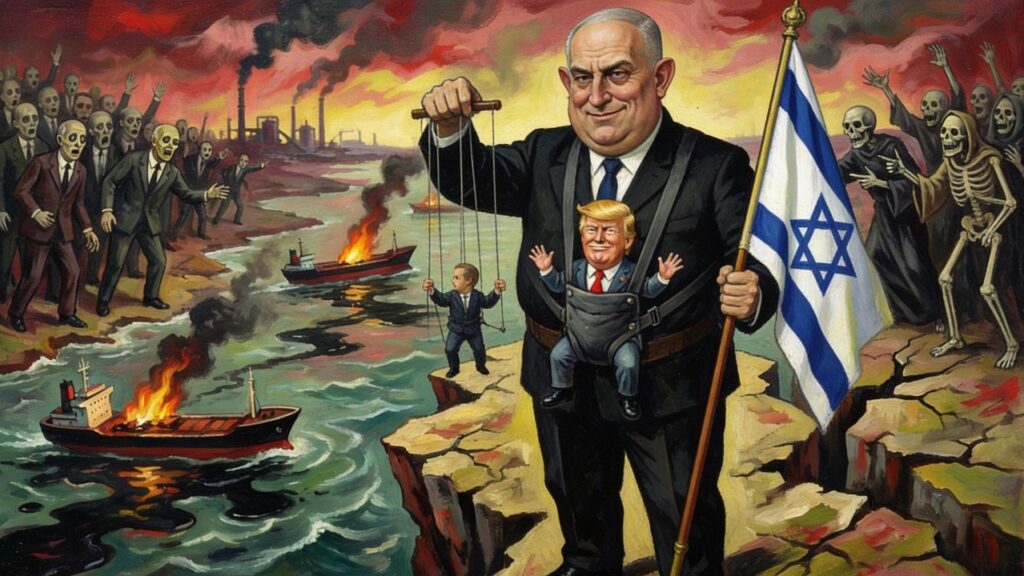
Mini-Me without a plan drives the markets, for the moment.
April 28, 2026
By Scott Ortkiese | so@throughlinesynthesis.com | www.throughlinesynthesis.com
Look at all the news and forecasting yesterday in the composite. What do you see? I see anodyne market spinners competing with geopolitical “realists” waiting for news to satisfy their polarized camps. Both are making wine from water, which means the precipice is getting higher and the slope steeper as we approach the “event.”
Every major crisis eventually produces two analytical guilds. One guild insists the data will resolve favorably. The other insists catastrophe is already locked in. Both camps have been doing this for months now, across financial terminals and geopolitical briefings alike, and both are making the same fundamental error: substituting conviction for observation. The Strait of Hormuz is still not fully open. The peace talks have stalled again. The Mag 7 just reported, and Wall Street is having a blockbuster week. All three of those statements are simultaneously true, and the fact that most analysts cannot hold all three in mind at once is precisely the problem.
Why Camps Form
The polarization visible in yesterday’s news composite is not accidental, and it is not unique to this crisis. It is structurally produced by how professional analysis is organized, financed, and distributed.
Financial markets operate within institutional incentive architectures that reward narrative coherence over diagnostic accuracy. A strategist at a major bank who says “we don’t know, and the range of outcomes is genuinely wide” is not useful to a client who needs to deploy capital this week. The market ecosystem therefore selects for analysts who project confidence, and confidence most naturally expresses itself as a thesis held with conviction. The result is not dishonesty. It is something more insidious: the professional manufacture of certainty in conditions that do not warrant it.[1][2]
The geopolitical analyst community faces a structurally similar but inverse pressure. Its credibility is built on identifying what others miss, which means there is a reputational premium attached to being right about the dangers the market ignores. When you have publicly argued that the Hormuz closure represents an existential inflection point in global energy architecture, you are no longer a neutral interpreter of daily signals. Every piece of ambiguous evidence gets filtered through the interpretive lens that protects the thesis. Research on confirmation bias among institutional investors is unambiguous on this point: selective exposure to disconfirming information does not merely slow updating, it actively reinforces the original position through what behavioral economists call “belief perseverance.”[3][2][^1]
These are not pathologies of bad actors. They are rational responses to institutional environments. The market spinner has clients to retain. The geopolitical realist has a publication record to defend. Both are making rational choices within their constraint sets. The problem is that those rational choices aggregate into an analytical landscape that is systematically unable to process genuine uncertainty at the moment it matters most.[4][5]
The Anodyne Machine
The bull case being circulated this week has a coherent internal logic. The S&P 500 recorded its 10th record close of 2026 on Sunday. Q1 earnings beat consensus at a high rate. Big Tech is reporting this week, the Federal Reserve is meeting Wednesday, and the weight of institutional narrative is firmly behind the view that the geopolitical backdrop is a “known risk” that has been absorbed.[6][7][8][9]
The specific intellectual instrument being deployed here is the historical base rate argument. Markets, the argument runs, have consistently shaken off geopolitical shocks. State Street’s April note put it plainly: geopolitical events tend to produce sharp but brief dislocations, and investors who exit during conflict headlines typically re-enter at worse levels. This is empirically accurate as a description of past behavior. The S&P 500 has been higher twelve months after the onset of armed conflict in roughly 70% of historical cases. The argument is not fabricated. It is, however, being applied to a situation that does not fit its premises.[10][11]
The historical base rate argument works when the underlying economic architecture is intact and the conflict is geographically isolated. It does not work when approximately 21% of global oil trade has been disrupted at its physical chokepoint for more than a month. It does not work when Brent crude is above $107 and WTI is approaching $100 and Q2 corporate guidance has not yet reflected the full downstream cost pass-through. And it particularly does not work when the Federal Reserve is navigating a simultaneous supply shock and monetary tightening cycle with no clean policy instrument available. The spinners are not wrong about history. They are applying historical patterns to conditions that history has not previously produced at this scale.[12][13][14][15][^16]
There is a second layer to the anodyne case that deserves scrutiny. Several institutional voices have framed the current situation as analogous to “Liberation Day” in the spring 2025 tariff cycle: a moment of maximum apparent danger that Trump navigated by escalating and then de-escalating at precisely the inflection point. The implicit argument is that this administration has demonstrated the capacity to manage brinkmanship and that markets have learned to price that capacity as a stabilizing factor. BCA Research’s chief strategist stated directly on CNBC that this is a misread: “Iran has a greater pain tolerance now.” That is not a realist talking point. It is a structural observation about the asymmetry of incentives between a country that has already absorbed maximum sanctions and a domestic political system in Washington that has limited appetite for a third simultaneous conflict.[17][18][^19]
The Realist’s Temptation
The geopolitical realist camp has been directionally correct about the magnitude of the Hormuz disruption and its structural implications. The IMF’s April World Economic Outlook documented three scenarios: a brief disruption producing 4.4% global inflation, a prolonged closure producing 5.4%, and a carry-into-2027 scenario producing 6% inflation against 2% global growth, the textbook definition of a stagflationary trap. None of those scenarios is priced into equity multiples that assume 18.6% earnings growth for 2026. Asia, which absorbs 84% of Hormuz-transiting crude, is facing an energy shock that Fortune described as “existential” for several import-dependent economies. Reuters analysts have calculated that the disruption has already flipped the global oil market from surplus to deficit for 2026. The structural case is sound.[20][21][9][22]
The realist’s error is different, and it is worth auditing honestly. The consistent mistake has been conflating structural accuracy with operational precision. Being right that the Hormuz closure represents a historic shock is not the same as being right about the timing or the specific mechanism of the financial repricing. The realist camp has called for that repricing at least five times since late February, each time a peace signal emerged and failed, each time an Iranian counter-proposal was floated and withdrawn. Each failed prediction is absorbed not as evidence that the thesis requires refinement but as further proof that the market is in denial, which makes the thesis unfalsifiable in its current form.[10][17]
This is a diagnostic problem, not just an epistemic one. When a thesis cannot be falsified by the data it is supposedly tracking, it has ceased to be analysis and has become advocacy. The realist who says “the market is wrong and will eventually have to reprice” is making a statement that is almost certainly true in the long run but operationally vacuous in the near term. Markets can remain structurally mispriced for longer than the mechanisms of disruption allow, and the specific shape of the eventual correction is not predetermined by the structural thesis. The Kharg Island amphibious assault scenario that ZeroFox has identified as a live possibility would produce a very different repricing than a negotiated interim deal that partially reopens the Strait but maintains the U.S. port blockade. These are not equivalent outcomes that confirm the same thesis. They are structurally different futures with very different implications for energy markets, equities, and global monetary architecture.[23][24][25][17]
The Precipice Gets Higher
The compounding danger of the current polarization is not that one camp is wrong. It is that both camps are consuming uncertainty as raw material for their respective certainties, which means the diagnostic capacity of the analytical ecosystem is degrading precisely as the stakes are rising.
Three structural forces are making the eventual repricing steeper rather than smoother.
The earnings wall. Q1 beat rates are a lagging indicator. The cost pass-through from Brent above $100 had not fully worked its way into supply chains during Q1. Q2 guidance, emerging over the next six weeks, will be the first honest accounting of margin compression under sustained energy disruption. When that guidance lands, the gap between the current consensus earnings trajectory and the probable reality will not be absorbed gradually. It will be absorbed in a repricing event.[8][26][9][20]
The Fed’s constraint. The Federal Open Market Committee meets Wednesday in conditions it was not designed to navigate: an external supply shock driving inflation up while growth momentum faces a ceiling from energy costs, with a political environment that makes the institution’s independence structurally uncertain. The interest rate tool is not calibrated for stagflation originating from a physical chokepoint disruption. The market’s current assumption of at most one cut in 2026 may itself be optimistic if Q2 data arrives worse than expected.[15][12]
The optionality problem. The genuine analytical difficulty in this situation is that the range of plausible near-term outcomes has widened, not narrowed, since the April 7 ceasefire attempt. The gap between a negotiated Strait reopening and a Kharg Island military operation represents an enormous range of economic consequences. When the range of outcomes widens while prices narrow, a market is not approaching clarity. It is compressing risk premium in ways that make the eventual release larger, not smaller. The precipice gets higher every day that the situation remains undecided and both camps continue filling the analytical void with their respective certainties.[25][20][^23]
An Honest Assessment
For those who share the realist framework, the productive audit is not whether the structural thesis is correct. It almost certainly is, in the dimensions that matter most: the Hormuz disruption is historic in scale, its downstream consequences are underpriced, and the IMF’s stagflation scenario is not a tail risk but a base case under a prolonged closure. The productive audit is whether the operational conclusions being drawn from that thesis are being held with appropriate epistemic humility.[26][22]
The specific shape and timing of the repricing is genuinely uncertain. The diplomatic pathway remains active, however narrowly. Iran’s backchannel proposal to reopen the Strait in exchange for lifting the port blockade is structurally rational for Tehran, and rational proposals sometimes get accepted. A partial resolution that leaves the structural energy shock intact but removes the acute maritime standoff would produce a very different immediate market signal than the thesis anticipates. That outcome would not mean the realist framework was wrong. It would mean the crisis resolves into a slower-burning form of the same disruption, which in some respects is more dangerous for the global economy than a sharp, visible event that forces the repricing.[27][18][22][17]
The wine-from-water dynamic that characterizes the current composite is not merely a communication failure. It is a structural feature of how professional analysis operates under extended uncertainty. Both camps need the event to resolve in order to know whether their framework was correct, and in the meantime, they manufacture confirmation from the same ambiguous daily flow. The precipice does not announce itself. It simply gets higher until it doesn’t.
Throughline Synthesis Group | April 28, 2026
References
1. A Narrative Review of Empirical Findings and Behavioral Interactions – Overconfidence and confirmation bias are among the most pervasive cognitive distortions in financial…
2. The Impact of Behavioral Biases on Financial Decision…
3. Top investment banks, confirmation Bias, and the market pricing of forecast revisions – We investigate the impact of top investment banks (hereafter top IBs) on the pricing of forecast rev…
4. Understanding Investor Behavior in Times of Geopolitical Conflict – Research shows that investors react almost instantaneously to rising geopolitical risk, often trigge…
5. How Geopolitical Forces Impact the Market | Sequoia Financial Group – Uncertainty tends to drive volatility. When geopolitical tensions rise, investors often reassess ris…
6. This session marked the 10th record close of 2026 for the S&P 500… – Nasdaq Composite ( $IXIC): Advanced 50.50 points (0.20%) to finish at a record 24,887.10, fueled by…
7. ‘Mag 7’ earnings, Fed meeting will test a stock market near all-time highs. Here’s what’s ahead – Stocks are set to close out April with major gains even as a war in the Middle East is ongoing, and…
8. Wall St Week Ahead Soaring US stocks face pivotal week of tech-led… – Wall St Week Ahead Soaring US stocks face pivotal week of tech-led earnings, Fed meeting; (.SPX) ·…
9. Big Tech Earnings Will Set The Tone For Markets This Week – Forbes – Notably, the expected earnings growth rate for calendar year 2026 is 18.6%, while the estimated grow…
10. Markets tend to shake off geopolitical shocks | State Street – Geopolitical tensions have lifted volatility, but history shows markets recover. Headline swings mat…
11. How to Invest Steadily During Geopolitical Market Volatility – Forbes – When global headlines turn alarming, investors often feel an urge to overhaul their portfolios, but…
12. April 2026 Economic and Market Update: Geopolitics at the Forefront – The U.S.-Iran conflict escalated in late February, shifting from a geopolitical risk to a real suppl…
13. Current price of oil as of April 27, 2026 – Fortune – As of 9 a.m. Eastern Time today, oil sold for $106.73 per barrel (using Brent as the benchmark, whic…
14. Chart of the day: OIL (27.04.2026) – XTB.com – Brent crude opened the new week with gains, trading at $101.56 per barrel (+1.81%), with a daily hig…
15. FOMC decision, GDP, PCE, and Big Tech earnings, all in the next 2… – Four of the world’s largest companies report Q1 2026 earnings on Wednesday evening, the same day as…
16. The Strait that Moves the Market: The 2026 Strait of Hormuz Crisis… – On 28th February 2026, the United States and Israel launched Operation Epic Fury, a coordinated camp…
17. U.S.-Iran peace talks stall. What’s next for global markets – CNBC – Iran reportedly proposes Hormuz Strait deal to U.S. Here’s where things stand, and what’s next for…
18. US-Iran talks stalled over several key issues, US official says – A U.S. official close to the U.S.-Iran negotiations tells ABC News that the two sides went home Satu…
19. Investors are misreading Iran conflict news: analysts – CNBC – Investors are misreading developments in the Iran war as the status of the Strait of Hormuz continue…
20. Iran war shock to flip market to deficit in 2026, analysts say | Reuters – Eight analysts polled by Reuters expect oil market demand will outpace supply by 750000 barrels per…
21. How the Strait of Hormuz poses an existential threat to Asia’s… – “Asia is at the heart of this drama.”
22. IMF warns of inflation surge, growth slump if Strait of Hormuz disruptions continue – The International Monetary Fund paints three economic outlook scenarios that each get progressively…
23. Monthly Geopolitical Report: April 2026 – ZeroFox – Additionally, key European elections in April, led by those in Hungary, are likely to expose Russia’…
24. What does geopolitical uncertainty mean for investors? – APG – Investment theory says that countries with a high risk of explosive situations carry a higher risk p…
25. How Rising Geopolitical Risks Weigh on Asset Prices – Heightened uncertainty is a key channel for asset price reactions. Geopolitical shocks tend to raise…
26. Iran’s Strait Closure Triggers Permanent Energy Shock, Markets… – – Financial markets underprice the prolonged risk, as oil prices surge 50% and global stocks decline…
27. Iran Faces Trump’s Hormuz Blockade Heat, Rolls Out… – YouTube – While peace talks remain stalled after Iran refused direct talks… The Last Word With Lawrence O’D…
Related reading
- The SpaceX IPO Grift: An Anatomy of the Most Ridiculous Overreach in Capital Markets History
- Where’s the Business Plan for Trump's $200 Billion Iran "Ask"?
- Wagering Without Risk: How Washington and Tel Aviv Insiders Bombed Iran on the American Taxpayer's Dime
- Генерал «Предай-США» (Betray-U.S.), он же Дэвид Петреус, идеально иллюстрирует оксюморон: военная разведка