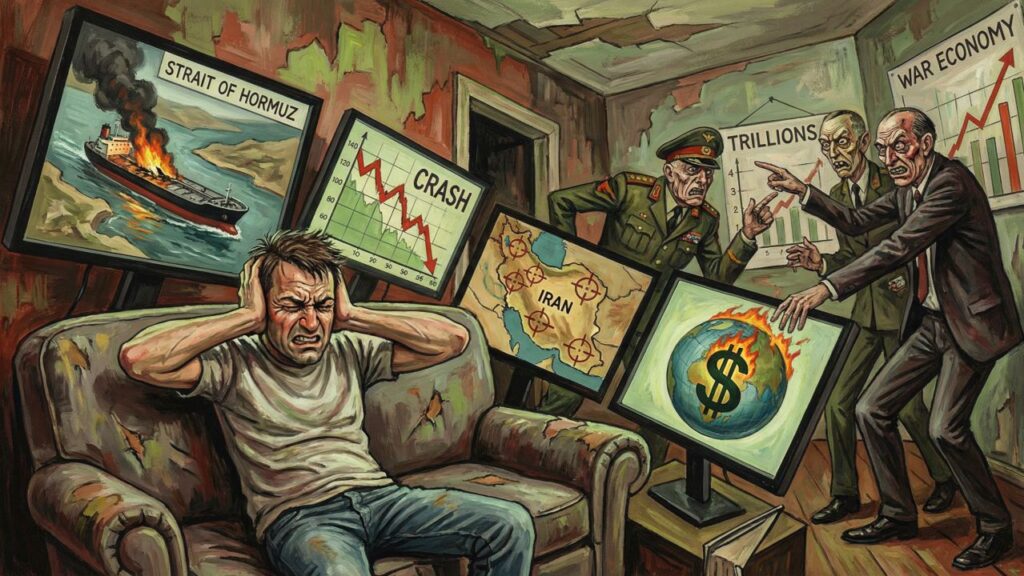
A second response to an optimistic friend who still hasn’t touched the evidence.
There is a difference between a disagreement and a refusal to engage with reality. Over the course of two extended text exchanges about the Iran war, my friend and I have managed to demonstrate both.
In our first round, which I wrote about in “The Deus Ex Machina That Isn’t Coming,” my friend offered the usual interventionist catechism: short term disruption, long term stability, world risk reduced once we “get through this.” He had not read the scholarship on regime change, the post 9/11 cost figures, the petrodollar’s slow motion erosion, or the Istanbul peace framework we helped kill. He was instead operating on faith, a belief that America can bomb its way back to equilibrium because, somehow, it always has.
After that article, we went another few rounds over text. Those exchanges are the subject of this piece, not because our friendship is uniquely important, but because the pattern it reveals is everywhere in American foreign policy discourse: one side brings receipts, the other brings vibes. One side cites Brown University, Cato, the IMF, the Carnegie Endowment, and the Atlantic Council. The other side says, “I doubt it,” “we’ve been here before,” and, when cornered, complains about tone.
At some point, that is not a debate anymore. It is the intellectual equivalent of covering your ears.
What I Said, and Why
I began by stripping away the euphemisms.
The policy my friend has been defending is not some abstract “risk reduction strategy.” It is bombing our way to a desired geopolitical outcome. That is not caricature, that is the operational definition of what the White House has branded Operation Epic Fury. It is a campaign to degrade Iran militarily and topple its government under the banner of “liberation” and “world risk reduction.” The language is new. The structure is not.
I laid out the record.
The 2003 Iraq invasion was sold on the same logic my friend is now repeating: take the short term pain, blood, treasure, oil shocks, for a safer, more stable world on the other side. Brown University’s Costs of War Project calculates that the post 9/11 wars have cost about 8 trillion dollars and killed more than 900,000 people, with Iraq alone accounting for roughly 2.2 trillion dollars and 190,000 deaths, and Afghanistan consuming another 2.3 trillion over twenty years. Those trillions did not buy stability. They bought a power vacuum ISIS walked into, a resurgent Taliban that retook Kabul in days, and a strengthened Iran that expanded its influence across Iraq, Syria, and Lebanon.
I pointed out that Iran is not Iraq. It is nearly four times the geographic size, with over eighty million people, triple Iraq’s pre invasion population. Operation Epic Fury is already burning close to 900 million dollars per day, roughly 3.7 billion was spent in the first hundred hours, most of it outside existing Pentagon budgets and now requiring emergency appropriations if the war drags on. If a smaller, weaker country like Iraq swallowed 8 trillion dollars and two decades, what exactly does my friend think a far larger Iran will cost?
I reminded him that this is not conjecture. The Cato Institute’s survey of the academic literature on regime change concluded that “regime change missions rarely succeed regardless of the strategy utilized and they often produce unintended consequences, such as humanitarian crises and weaker internal security within the targeted state.” The same review notes a psychological pattern: overconfidence is a prerequisite to launching regime change, and once policymakers commit they become less receptive to new information about costs and outcomes. Desire for the goal substitutes for scrutiny of the path.
That is precisely what I was watching play out in miniature on my phone.
Receipts, Again
Because the war on Iran is not happening in a vacuum, I also walked my friend through the systemic context he was ignoring.
In March and April 2022, Ukraine and Russia had a near complete peace framework on the table in Istanbul: Ukrainian neutrality, limits on its military, a Russian withdrawal to pre February lines, security guarantees from Western powers, and continued EU accession. Zelensky’s own chief negotiator, David Arakhamia, has since confirmed that Russia was prepared to end the war if Ukraine accepted neutrality “like Finland once did.” The deal died after Boris Johnson flew to Kyiv on April 9, 2022 and reportedly urged Zelensky to stop negotiating and “just fight,” while Western capitals refused to provide the security guarantees that would have made the framework viable.
What followed was not peace but a prolonged proxy war that killed hundreds of thousands of Ukrainians, hollowed out the country’s demographic future, and prompted Washington to freeze 300 billion dollars in Russian sovereign reserves. That freeze taught every central bank on earth that dollar denominated assets are only conditionally theirs, that the United States can appropriate reserves at will.
That one move, self congratulatory in Washington at the time, was the most consequential blow to dollar credibility in the system’s history. It accelerated a process already underway: de dollarization. The dollar’s share of global foreign exchange reserves has fallen from roughly 71 percent in 2000 to around 56 percent by mid 2025, the lowest since the mid 1990s, as countries diversify into gold, the euro, the yuan, and regional currencies. Iran already conducts a majority of its oil trade outside the dollar. Saudi Arabia has joined China’s mBridge cross border digital currency platform. The Hudson Institute has acknowledged that Russia and Iran are building parallel financial systems that demonstrate to would be BRICS partners that commerce can continue outside the dollar, even under heavy U.S. pressure. The Atlantic Council warns that the United States “cannot afford to lose dollar dominance,” while in the same breath noting that the weaponization of that dominance is what is driving others away from it.
Then there is the physical system that underwrites the petrodollar: energy corridors.
Today, the Strait of Hormuz, a 33 kilometer choke point that carries roughly a quarter of global maritime oil trade and a fifth of LNG shipments, is effectively closed. Shipping traffic has collapsed, war risk insurers have pulled coverage, premiums have spiked from 0.2 to 1 percent of hull value in days, turning a 200,000 dollar premium on a 100 million dollar tanker into a 1 million dollar one. Major carriers like Maersk and MSC have suspended Gulf operations. Former White House energy advisor Bob McNally has said that a prolonged closure of Hormuz is a “guaranteed global recession.” Oil is already over 110 dollars a barrel and climbing. Qatar has halted LNG output at the world’s largest export facility after Iranian strikes. The U.S. government is now offering 20 billion dollars of federal reinsurance for tankers because the private market has priced the risk as unacceptable.
In other words, our war, our sanctions, and our financial coercion are simultaneously undermining the credibility of the dollar and the stability of the very shipping lanes that make dollar denominated energy trade possible.
This is not risk reduction. It is structural vandalism.
What My Friend Said Instead
Faced with this, my friend’s replies fell into three categories.
First, reflexive doubt. “I doubt it.” Not a counter source, not an alternative data set, not even a question about methodology. Just doubt, as if skepticism, deployed selectively and without work, were its own argument.
Second, historical cliché. “We’ve been here before.” The line is supposed to reassure: we have weathered wars and oil shocks and crises, and we will weather this too. But the examples I cited are precisely the “before” he gestures toward: Iraq, Afghanistan, Libya, 1953 Iran, Venezuela. The “we’ve been here before” case is not a rebuttal of my argument, it is my argument. We have been here before, and every time, the intervention promised to restore stability and instead produced blowback, power vacuums, humanitarian catastrophe, and long term strategic erosion.
Third, tone policing. When I pressed the point, that he had not engaged Brown’s 8 trillion dollar figure, or Cato’s findings on regime change failure, or the IMF’s reserve data, or the Istanbul framework, or the collapse of tanker insurance in Hormuz, he complained that my language was too sharp, that I was being dramatic, that I thought “the sky is falling.” As if the real problem was not the largest energy choke point on earth being shut, or the post 1945 prohibition on aggressive war being openly discarded, but my insufficiently gentle diction.
At no point did he answer a simple question: which specific claim do you believe is wrong, and what evidence would you accept to change your mind?
That is the line between disagreement and denial. Once someone is unwilling to name a falsifiable claim, you are no longer talking about policy. You are talking about identity.
Evidence Versus Vibes
My friend is not stupid, cruel, or uniquely blinkered. He is a type.
He believes, deeply, that American power is self correcting, that however badly we mismanage a war, abuse the dollar, or dismantle international law, “the system” will snap back. He believes that we can invade countries, sabotage peace deals, freeze sovereign reserves, and close energy arteries and that some unseen deus ex machina, a technological breakthrough, a diplomatic masterstroke, a sudden change of heart in Tehran or Moscow or Beijing, will appear to clean up the mess.
But the “machine” he is counting on has already been stripped for parts. The post 1945 order, the United Nations, Bretton Woods, the legal prohibition on aggressive war, the petrodollar recycling mechanism, was the thing that kept snapping us back. We dismantled it ourselves. We vetoed UN resolutions, used NATO for wars of choice, shredded treaties, weaponized the IMF and SWIFT, and treated international law as a menu. We sabotaged the Istanbul peace deal. We normalized sanctions as a first resort. We turned dollar dominance from a structural privilege into an overt weapon.
There is no backstage crane waiting to lower a god into the play.
What remains is a world of sovereign anarchy. The Carnegie Endowment warned in 2025 that as more states conclude that international law no longer protects them, they will “self insure” by building up their own military capability, driving “a spiral of declining cooperation and rising militarization.” The Munich Security Report described the rules based order as “under destruction,” not just “under stress.” Senior European officials now concede that we live “in an era of power politics,” not law.
In that world, the question is not whether America can muddle through the next crisis. The question is how many pillars of its own system it can knock out before the ceiling finally falls.
Friendship in a Failing Order
I wrote all of this to my friend not because I enjoy arguing, but because, at some level, I still believe persuasion is possible. I still believe facts matter. I still believe that if you show someone that every prior iteration of their preferred strategy has failed on its own terms, with trillions spent, hundreds of thousands killed, and our strategic position worse, they might reconsider cheerleading for the next one.
But persuasion presupposes a shared standard. It requires both parties to agree that if the evidence goes a certain way, the conclusion has to change. What this second exchange with my friend revealed is that we no longer even agree on that.
He has not engaged Brown’s 8 trillion dollar ledger, or Cato’s regime change autopsies, or the IMF’s reserve data, or the Istanbul minutes, or tanker insurance reports out of Hormuz. He has not produced counter evidence. He has produced feelings: doubt, optimism, faith in American resilience. When those collide with the record, he reaches for the last refuge of someone out of arguments, complaints about tone.
I care about my friend, which is why I keep answering. I care about my country, which is why I keep writing. But at a certain point, I have to name what I am seeing.
When you respond to documented costs, institutional erosion, and systemic risk with “I doubt it,” “we’ve been here before,” and a tantrum about tone, you are not rebutting anything. You are refusing to hear it. You are practicing the intellectual equivalent of covering your ears and hoping the next bomb will finally make it all work out.
It never has. It will not this time.
Related reading
- Stop Calling It News. Gulf State “Reporting” Is Trump’s Bullshit With A Gulf State Palace Seal.
- Olympian Stupidity: The IOC’s Twisted Double Standard
- Russophobia and The West’s Forgery That Launched Two Centuries of War
- The Calm Before the Spike: What the WSJ Purposely Got it Wrong About Oil Prices and What’s Coming. Why?