By Scott Ortkiese | July 8, 2026 |so@ThroughlineSynthesis.com
The Confession Nobody Wanted to Hear
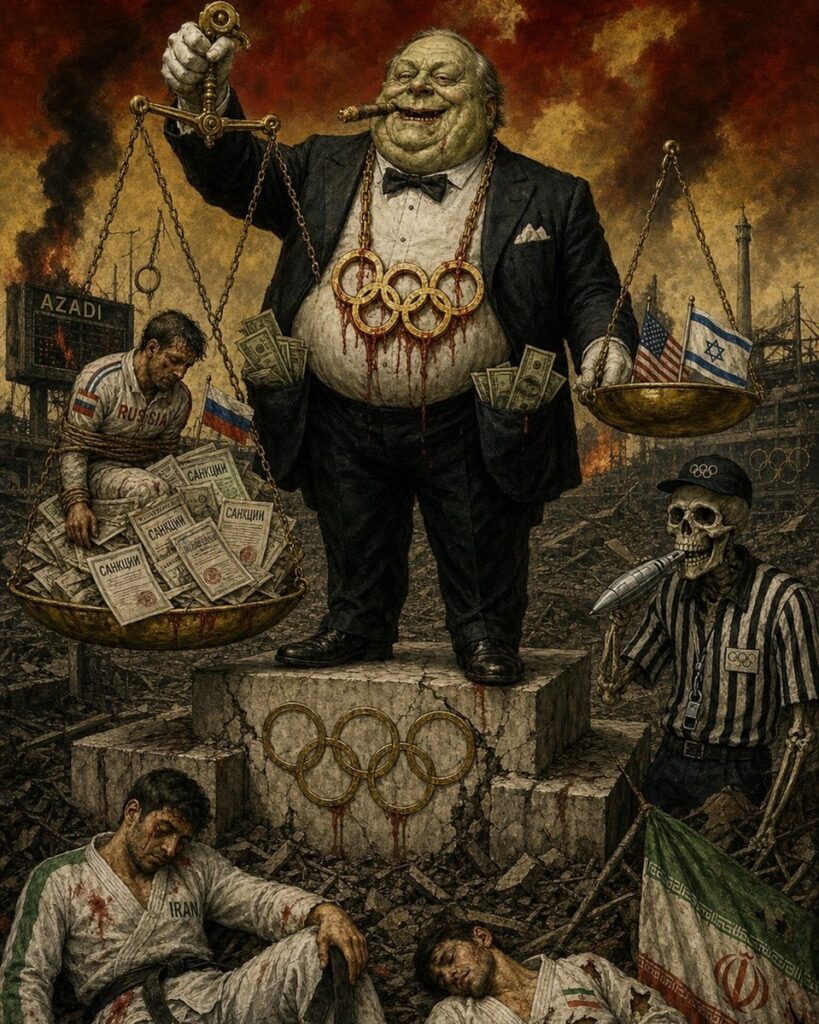
On March 3, 2026, the International Olympic Committee issued a statement about the US and Israeli bombing campaign against Iran that had begun four days earlier. The statement did not mention the United States. It did not mention Israel. It did not mention Iran. It described the Olympic Truce, the same instrument the IOC had invoked to justify sanctioning Russia and banning its athletes across two Olympic cycles, as an “aspirational and non-binding resolution” that the IOC has “no means of enforcing.”
That single paragraph is one of the most consequential admissions in the history of global sport governance. The IOC did not make a judgment call. It did not weigh competing considerations and arrive at a principled distinction. It simply told the world, in diplomatic language thin enough to read through, that the rules apply when Washington permits them to, and when Washington is the belligerent, the rules evaporate.
The contrast is not nuanced. It is not complicated. It is arithmetically precise. Russia invaded Ukraine on February 24, 2022, four days after the close of the Beijing Winter Olympics. The IOC condemned Russia’s violation of the Olympic Truce within 24 hours and urged international federations to impose sweeping sanctions. The United States and Israel launched coordinated air strikes on Iran on February 28, 2026, six days after the close of the Milan-Cortina Winter Olympics, during an active Olympic Truce period. The IOC issued a statement three days later that did not name a single party to the conflict.
Two wars. Two identical timelines relative to the Olympic calendar. Two outcomes with nothing in common except the identity of the aggressor protected.
Who Is Thomas Bach, and Who Did He Serve?
Thomas Bach, the German lawyer and former fencer who ran the IOC from 2013 to June 2025, is the architect of the anti‑Russia sanction regime. He is also the man who, in October 2022, told an audience at the Association of National Olympic Committees that Russia was being sanctioned not on the basis of sport, but on the basis of geopolitics, an admission that his own organization’s record confirms.
Bach called European governments “deplorable” in March 2023 for opposing the re‑entry of Russian and Belarusian athletes under neutral status, accusing those governments of “double standards” for not commenting on athletes from other conflict zones. The irony of this accusation is staggering in retrospect. When the next war arrived, it was Bach’s institution, not the European governments, that refused to apply consistent standards.
Bach’s personal relationship with the financial ecosystem that insulates the United States from accountability is not incidental. The IOC’s revenue model is built on a single structural dependency: American broadcast rights. NBCUniversal has paid approximately $7.65 billion for US broadcast rights through 2032, later extended by a further $3 billion through 2036. Broadcast agreements account for roughly 60 percent of the IOC’s total revenues. The United States Olympic and Paralympic Committee received nearly $800 million in IOC distributions in a single five‑year cycle. In 2024 alone, USOPC received $320.9 million from the IOC’s revenue pool.
To sanction the United States from Olympic competition would be to sanction the IOC itself into insolvency. That is not neutrality. That is a protection racket with a five‑ring logo.
The Olympic Truce: A Weapon With One Firing Direction
The Olympic Truce is a United Nations resolution, adopted by consensus of all 193 member states, calling for a cessation of hostilities from seven days before each Olympic opening ceremony through seven days after the close of the Paralympics. Russia violated it three times in fourteen years: by invading Georgia during the 2008 Beijing Summer Olympics, by annexing Crimea during the 2014 Sochi Winter Olympics, and by launching the full‑scale invasion of Ukraine four days after the close of the 2022 Beijing Winter Olympics.
The IOC’s response to the 2022 violation was immediate and comprehensive. It condemned Russia within 24 hours, urged 37 international federations to impose sanctions, stripped Russian and Belarusian athletes of the right to compete under national colors, and expelled Russian teams from World Cup qualification.
The United States and Israel launched their attack on Iran on February 28, 2026, six days after the Milan-Cortina closing ceremony and inside the active Truce period. The IOC’s response was to remind the world that the Truce is “aspirational.”
This is not a legal distinction. It is a political one, dressed in legal language. The Truce’s legal status did not change between 2022 and 2026. The power relationship of the parties did. When the perpetrator was Russia, the Truce was a binding moral obligation that justified unprecedented sanctions. When the perpetrators were the United States and Israel, it became a symbolic aspiration that the IOC has no means of enforcing.
The IOC’s own academic defenders cannot explain this away without resort to power analysis. Simon Chadwick, Professor of Afro‑Eurasian Sport at EMLyon Business School, said plainly that the US accounts for roughly one‑third of the global sport industry and that “boycotting, excluding and banning countries from global sport is an outcome of power, which the United States has in abundance.” Pim Verschuuren, a specialist in sports management and geopolitics at the University of Rennes II, was even more direct: “In 2022, the political pressure was so intense that the IOC was forced to exclude the Russians. Today it can’t afford to single out and antagonise the United States.”
There is the admission. The IOC did not choose to sanction Russia because Russia violated the Truce. It sanctioned Russia because Western political pressure was intense enough to force it. When Western political pressure is applied in the opposite direction, the IOC retreats behind legalism. The Truce is not a principle. It is a tool.
The Doping Double Standard: Carl Lewis, USADA, and the Art of Looking Away
The doping framework that Russia was punished under for its state‑sponsored program at the 2014 Sochi Games deserves close examination, because the United States has its own doping history, and the institutional response has been categorically different.
Carl Lewis, nine‑time Olympic gold medalist and perhaps the most decorated American track athlete in history, failed three drug tests during the 1988 US Olympic Trials. The US Olympic and Paralympic Committee covered it up, and Lewis competed at Seoul, where he won gold in the 100 meters after Ben Johnson was stripped of his. Lewis admitted this publicly only in 2003.
The United States Anti‑Doping Agency allowed athletes who had committed serious anti‑doping violations to continue competing for years in exchange for serving as undercover informants, a practice WADA said was “a blatant violation of the World Anti‑Doping Code.” WADA identified at least three such cases and confirmed it had immediately instructed USADA to stop the practice when it discovered it in 2021, years after it had started.
American sprinter Erriyon Knighton tested positive for the banned anabolic agent trenbolone before the 2024 Paris Olympics. USADA cleared him on a contaminated‑meat defense and he competed in Paris. WADA publicly criticized the decision and noted the disparity with how other nations’ athletes have been treated for equivalent violations.
WADA’s own president, Witold Banka, noted at a session of the IOC that 90 percent of American athletes in professional leagues and college sports do not compete under the World Anti‑Doping Code, and that 75 percent of US elite Olympic athletes come from the collegiate system, which operates outside globally recognized clean‑sport standards. Chinese athletes, by contrast, were tested 21 times each in the months before the Paris Games, compared to six times for US swimmers.
The state‑sponsored doping program Russia built, and which was comprehensively documented, was genuinely serious and genuinely wrong. But the IOC used that doping program as partial justification for political bans that went far beyond what any other nation has faced for equivalent or worse conduct within its own borders. When the violator carries a US passport, the institutional machinery produces explanations. When the violator carries a Russian passport, it produces bans.
The Human Cost the IOC Chose Not to See
In the days and weeks following the US and Israeli strikes on Iran, a documented and devastating toll was visited on Iran’s athletic community. The IOC received formal notification of all of it and responded with silence.
A US missile strike using the PrSM precision strike munition hit a crowded sports hall in Lamerd, Fars Province, killing 21 teenage athletes. A girls’ elementary school in Minab was struck, killing 168 students. Four taekwondo athletes were killed in Tabriz. Two elite judokas from Isfahan Province, Hossein Poursaeidi and Hamidreza Jahanbakhsh, were killed. The 12,000‑seat hall at the Azadi Sports Complex was completely destroyed. In total, 287 sports facilities were damaged across Iran. More than 200 athletes, 16 of them women, were killed in strikes across the country.
Iran’s National Olympic Committee sent a formal letter to IOC Secretary General James Macleod and the Olympic Council of Asia describing these events in documented detail, citing the Olympic Charter’s explicit protections for human dignity and athletes, and calling for action against the United States and Israel. Iran’s Sports Minister Ahmad Donyamali followed with a direct letter to IOC President Kirsty Coventry calling for suspension of Israeli sports activities and an independent investigation into the damage.
The IOC’s response: a statement calling for “support” for Paralympians from “war‑affected nations,” without naming any party to the conflict.
Compare this to 2022, when the IOC’s rationale for sanctioning Russia included the claim that Ukrainian athletes could not compete safely due to the invasion. The IOC invoked the disruption of Ukrainian sport as a moral justification for unprecedented measures. When American and Israeli strikes physically destroyed Iranian sports infrastructure, killed Iranian athletes on their training grounds, and prevented an Iranian Paralympic athlete from reaching Milan-Cortina, the IOC saw nothing that required comment.
Gianni Infantino: FIFA’s Surrender in a Tuxedo
If Bach’s IOC represents institutional cowardice dressed in Olympic idealism, Gianni Infantino’s FIFA represents something more nakedly transactional. In December 2025, Infantino presented Donald Trump with the inaugural FIFA Peace Prize at the draw for the 2026 World Cup in Washington, calling Trump someone who “definitely deserves” the award and pledging him “my support, the support of the entire football community.”
Trump received this prize one month after FIFA created it, without consultation with FIFA’s Council vice presidents, in violation of FIFA’s own political‑neutrality statutes. The human‑rights group FairSquare filed a formal ethics complaint identifying four distinct violations of FIFA’s neutrality guidelines.
Infantino was simultaneously courting a man who had launched strikes on Iran less than three months after the prize ceremony, and whose administration subsequently suggested, per reporting, that Iran should be excluded from the 2026 World Cup “for their own safety,” a transparent attempt to leverage the sport as a geopolitical weapon against a country the United States had just attacked.
In 2022, FIFA banned Russia from the World Cup within four days of the Ukraine invasion, acting in concert with the IOC. In 2026, with America as the belligerent host nation for the World Cup, FIFA secretary general Mattias Grafstrom said the organization was “monitoring the situation.”
FIFA had stripped Indonesia of the right to host the Under‑20 World Cup for refusing to host Israel. It then handed its most prestigious new prize to the president of the country actively bombing Iran during an active Olympic Truce. The contradiction is not a policy failure. It is a policy.
The 2003 Precedent Nobody Was Allowed to Mention
When Bach and other IOC officials were challenged in 2022 about why Russia was being treated differently from other nations that had violated international law, the standard defense was that Russia’s invasion of Ukraine violated the Olympic Truce specifically. This framing conveniently erased the United States’ 2003 invasion of Iraq.
The Iraq War was broadly condemned as illegal under international law, including by UN Secretary‑General Kofi Annan, who called it “not in conformity with the UN Charter.” The United States launched that war on March 19, 2003, approximately one year and seven months before the 2004 Athens Summer Olympics. There was no Olympic Truce in effect, technically, but the broader argument, that states that commit illegal wars of aggression should face sporting consequences, was not applied. No American athlete was banned. No American team was expelled. No FIFA suspension was issued.
The IOC did suspend Iraq in May 2003, but for the domestic political restructuring of its National Olympic Committee by the post‑invasion Baghdad government, not because the United States invaded. The invaded country was sanctioned. The invading country was untouched. This logic, absurd in 2003, became institutionalized template by 2022 and explicit policy by 2026.
Loughborough University research published in February 2026 put the point in language too plain to misread: “The US faced no Olympic‑wide ban after the 2003 invasion of Iraq, widely argued to be illegal under international law.” The same institution noted that “deciding which countries are recognized and eligible to compete is inherently political,” making the IOC’s claims of neutrality incoherent by definition.
What This Tells the Rest of the World
Russia’s Foreign Ministry spokesman Dmitry Peskov articulated the geopolitical conclusion with precision: “I look at this as the right position. And I do not understand why a different position applies to us and Belarus. The IOC is obliged to clarify these discrepancies.”
Peskov is right, and the IOC has no coherent answer. The discrepancies cannot be explained by law, by Charter provisions, by Truce mechanics, or by any neutral principle of sport governance. They can only be explained by the raw distribution of financial and geopolitical power.
The message this sends to the non‑Western world is not subtle. Mearsheimer’s structural realism predicted exactly this: in a unipolar or declining‑unipolar system, the dominant power weaponizes international institutions to advance its own interests while insulating itself from the consequences it imposes on others. The IOC is not an exception to this dynamic. It is one of its cleaner examples.
From Beijing to Riyadh, from New Delhi to Brasilia, governments watching the IOC’s response to Iran will draw the same conclusion that they have drawn from Western sanctions regimes, International Criminal Court indictments, and UN Security Council vetoes: these institutions do not enforce rules. They enforce the preferences of the states that fund them.
The IOC does not just fail its own stated principles when it takes this posture. It actively accelerates the delegitimization of the multilateral rules‑based order it claims to embody. Every time it invokes Olympic Truce against Russia and goes silent about Iran, it hands another brick to the architects of parallel institutions, the SCO, the BRICS sport frameworks, the non‑Western Olympic equivalents that are now being discussed with increasing seriousness in precisely the capitals the IOC cannot afford to lose.
The July 7, 2026 Reinstatement: What It Actually Means
On July 7, 2026, the IOC’s executive board provisionally lifted the suspension of the Russian Olympic Committee, allowing Russian athletes to begin qualifying for the Los Angeles 2028 Games. IOC President Kirsty Coventry, who succeeded Bach in June 2025, framed the decision as athlete‑centered, saying it was “really important for athletes to have that possibility.”
The technical rationale is narrow: the ROC was suspended in October 2023 specifically because it had recognized sports bodies in Russian‑occupied Ukrainian regions as members of the ROC, which the IOC said violated the Olympic Charter by infringing on Ukraine’s National Olympic Committee’s territorial jurisdiction. The IOC says the ROC has since removed those bodies from membership and confirmed it will not operate in those territories. On those terms, the specific grounds for suspension are resolved.
The decision does not resolve the question of whether Russia can display its flag or play its anthem at LA 2028. That remains undecided. Russian athletes still face strict anti‑doping conditions and must be enrolled in programs overseen by the International Testing Agency, with RUSADA’s non‑compliance with WADA still a live issue. Many individual federations maintain separate bans that the IOC’s decision does not override.
But the symbolic significance is substantial and the timing is telling. The reinstatement comes four months after the US and Israel bombed Iran, with no sanction issued against either country, and three years after Russia began the process of diplomatic rehabilitation that the IOC is now formalizing. The war in Ukraine continues. Nothing on the ground has changed. The IOC is simply following the logic of its own commercial calendar: with LA 2028 approaching, Russia’s exclusion has become commercially and politically inconvenient, and so the legal rationale for ending it has been found.
This is not a principled return. It is a scheduled thaw, driven by the same power calculus that drove the original sanctions.
The Verdict
The IOC told the world in March 2026 that it cannot enforce the Olympic Truce when America is the belligerent. Then in July 2026 it lifted Russia’s suspension while the Ukraine war continues unabated, having apparently enforced the Truce long enough to satisfy Western political pressure and short enough to avoid disrupting LA 2028’s commercial framework.
The institution has, through its own conduct, documented every element of the critique its defenders claim is propaganda:
-
It imposed sanctions on Russia invoking the Olympic Truce, then declared the Truce unenforceable when Washington went to war.
-
It leveraged WADA doping enforcement against Russia while looking away from USADA’s documented practice of allowing doped American athletes to compete as undercover informants.
-
It received documented evidence of 200‑plus Iranian athletes killed, sports halls bombed, and facilities destroyed during an active Truce period, and called for “support” for athletes from “conflict zones” without naming the country responsible.
-
It watched FIFA’s president award a Peace Prize to the American president who launched those strikes, within the same institutional ecosystem that claims sport must remain above politics.
-
It lifted Russia’s suspension not because the war ended, not because any principle was satisfied, but because the commercial clock said so.
The principle has been plainly stated by the people who study this for a living: “Sport is in the hands of the United States, with funding from its Gulf allies.” That is the rule. Everything else is decoration.
The Olympic rings do not represent five continents united in peaceful competition. They represent five continents bound to an institutional order that protects the powerful and sanctifies that protection with the language of peace. When a country with a $3 billion broadcast deal bombs a sports hall full of teenagers and the governing body of world sport cannot find the words to name them, the rings have told you everything you need to know about what they actually stand for.
Scott Ortkiese is the founder of Throughline Synthesis Group, a geopolitical and financial analysis consultancy. He publishes at throughlinesynthesis.com.
Related reading
- Stop Calling It News. Gulf State “Reporting” Is Trump’s Bullshit With A Gulf State Palace Seal.
- Russophobia and The West’s Forgery That Launched Two Centuries of War
- The Calm Before the Spike: What the WSJ Purposely Got it Wrong About Oil Prices and What’s Coming. Why?
- Two Russias, One Reality: There is Only One Truth, and It Isn’t The West’s (or Trump’s)