The WSJ served the White House, Wall Street, and OPEC simultaneously, ignoring its obligation to American consumers holding the bill.
June 17, 2026
By Scott Ortkiese | so@throughlinesynthesis.com
Three WSJ reporters. Three masters served, everyone except the public. They wrote a story that tells half the truth on purpose. If I had zero respect for the bamboozlers and spinners at the WSJ before, as journalists, I’d now place them right up there with the faint coverage that allows the crimes of Trump, Bessent, Wikoff and Kushner to continue.
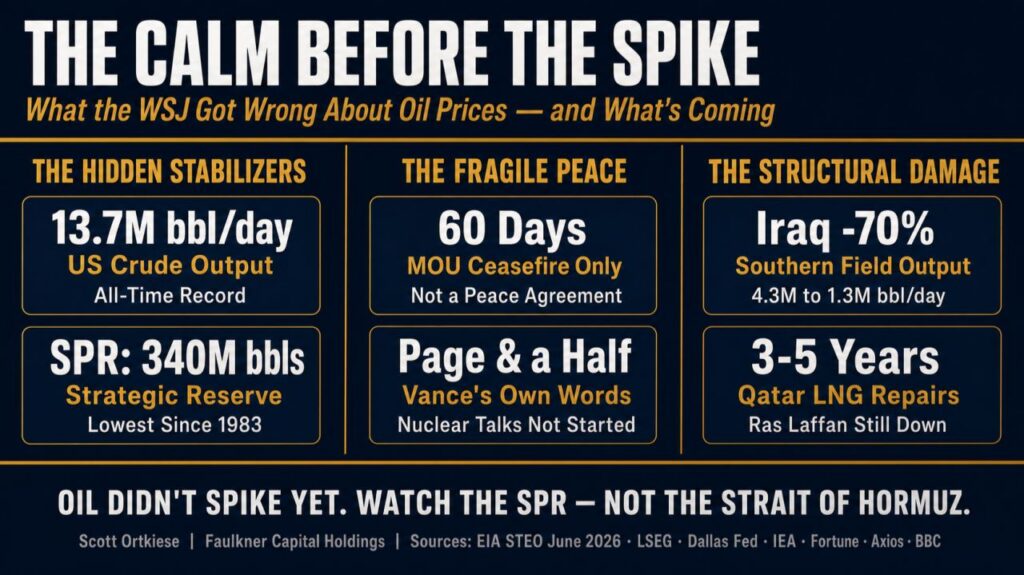
The U.S. SPR now sits at 340.3 million barrels, its lowest level since 1983, drained at 9 million barrels per week to hold pump prices down while voters watch. The MOU with Iran is a page-and-a-half ceasefire framework, not a peace agreement, with nuclear talks, Lebanon, and the Supreme Leader’s buy-in all still unresolved. And Gulf production damage isn’t a pause: Iraq’s southern fields lost 70% of output, Qatar’s LNG infrastructure faces 3-5 years of repairs, and Ras Tanura, the world’s largest crude terminal, is still shuttered.
Oil didn’t spike yet. The Shale Floor is real. But the SPR floor has a bottom, the peace has no foundation, and the supply damage is permanent. The WSJ missed the biggest stabilizer, and then missed the biggest risks hiding behind it. The question isn’t just what they missed. It’s why, and who benefits.
“Why Oil Hasn’t Gone Through the Roof”(WSJ, June 13-14, 2026) reads like serious analysis, right until you notice what’s missing.
Three of the Journal’s top energy reporters assembled impressive graphics and credited a familiar roster of minor variables for keeping Brent in the mid-$80s during an active U.S.-Iran shooting war: China’s demand pullback, White House rhetoric, a handful of tankers threading the Strait of Hormuz, global efficiency gains. ⚡
Not one word about the two structural forces that actually explain the price, or the three structural time bombs hiding behind it. That omission is not accidental. It is, in the precise sense of the term, functional: it serves three powerful masters simultaneously, at the expense of one unrepresented party, and ultimately at the expense of the reader.
What’s Actually Holding Prices Down
First: the United States is producing approximately 13.7 million barrels per day, the highest output in American history, while running a net petroleum export surplus of 4.2 million b/d (EIA, June 2026 STEO). In 2025, the U.S. became the first nation to export 100+ million metric tons of LNG in a single year, capturing roughly 25% of global LNG supply. OPEC+’s share of world production has collapsed from 53% in 2016 to 46% today, because American barrels filled the gap. Dallas Fed research has documented shale’s role as the effective ceiling on long-run oil prices, anchoring futures markets through its rapid drill-to-production cycle.
Second, and entirely unmentioned by the WSJ: the Trump administration has been draining the Strategic Petroleum Reserve at 9 million barrels per week, suppressing pump prices while voters watch the Iran conflict unfold. The SPR is now at 340.3 million barrels, its lowest level since Ronald Reagan was in his second year in office. This is not energy policy. This is political price management with a finite shelf life, and writing about it would mean writing that the price stability the White House is taking credit for is borrowed time, paid for with America’s emergency reserve. The WSJ left that grenade on the floor.
Together, these two factors explain the price. Neither was in the WSJ story.
What’s Coming
The Shale Floor is real, but it is not a ceiling on risk, and confusing the two is the WSJ’s second and more consequential error.
The MOU signed between the U.S. and Iran is, in VP Vance’s own words, “about a page and a half” and “very general.” It is a 60-day ceasefire extension, not a peace agreement. Nuclear talks have not begun. The Supreme Leader has not fully sanctioned the deal. Israel’s ongoing operations in Gaza and Lebanon remain a live tripwire capable of collapsing the framework before permanent terms are negotiated. An MOU is a long way from a peace agreement, and the energy markets are beginning to price that in.
Meanwhile, the Gulf supply damage is not temporary. Iraq’s southern fields, producing 4.3 million bbl/day before the conflict, dropped 70% in March alone to 1.3 million bbl/day. Qatar’s Ras Laffan LNG facility, the backbone of global LNG supply, faces 3-5 years of repairs. Ras Tanura, the world’s largest crude export terminal, remains shuttered. Sovereign wealth reserves across Gulf states have been drawn down to sustain domestic budgets through 100 days of disruption. These are not supply pauses. They are structural, long-duration damage events, and their full price impact has not yet reached global markets.
The SPR cannot be drained indefinitely. The shale rig count responds to price signals, not geopolitical emergencies. And the fragile MOU has no enforcement mechanism, no regional security architecture behind it, and no Israeli buy-in.
Three Masters, One Omission
The stability narrative the WSJ constructed serves three powerful audiences simultaneously, with remarkable precision.
It serves the Trump White House, which needs voters to believe the Iran war is not destroying their purchasing power. An article that identifies the SPR drawdown as the primary price suppression mechanism would be politically catastrophic: it would tell every American voter that the “stable” price at the pump is a one-time expenditure of their emergency national reserve, not a durable policy outcome. The WSJ spared the administration that exposure.
It serves Wall Street and financial markets, which have every institutional reason to embrace a stability narrative. Panic pricing triggers margin calls, forces portfolio rebalancing, and creates the kind of volatility that costs institutional players real money. A “prices are contained, here’s why” story is worth billions in avoided liquidations to the banks, funds, and trading desks that are also, not incidentally, among the WSJ’s core subscribers and advertisers.
It serves Gulf state sovereign funds and OPEC, which are quietly drawing down reserves and need time before markets fully price the structural damage to their production infrastructure. Saudi Aramco, Kuwait Petroleum, ADNOC: these are the prestige sources that return WSJ energy reporters’ calls, grant exclusive interviews, and provide the intelligence that makes the energy beat function. OPEC has literally banned the WSJ from its Vienna meetings for coverage it considered unfavorable. The relationship is symbiotic, and symbiosis has a price.
The unrepresented party in all of this is the American consumer, who is being told that the pump price is stable because of energy efficiency and Chinese demand signals, not because their government is burning through a 43-year emergency reserve to hold the number down until the next news cycle.
The Error of Omission, Twice
The WSJ committed the same journalistic sin twice in one article.
The first omission: crediting minor variables for price stability while ignoring America’s record production and the SPR drawdown, the two actual stabilizers.
The second omission: framing current price stability as durable while ignoring the SPR’s hard floor, the MOU’s paper-thin foundation, and the permanent structural damage to Gulf production capacity.
Neither omission required a conspiracy. It only required institutional incentives, access dependencies, deadline pressure, and reporters who didn’t ask the second question: if shale is America’s greatest energy asset and the SPR is being drained at record speed, why are neither of those facts in this story?
We cannot build credible energy policy, or credible energy journalism, on analysis that serves three masters while omitting the dominant variables. It distorts the risk calculus that investors, policymakers, and treaty negotiators depend on to make consequential decisions.
Oil didn’t spike yet. Watch the SPR level, not the Strait of Hormuz.
Data: EIA STEO June 2026 | Reuters/LSEG LNG export data 2025 | Dallas Fed Energy Survey | IEA | Fortune/CNBC SPR data June 2026 | Al Jazeera, Axios, BBC MOU reporting June 2026 | Le Monde, DW Gulf production damage reporting | Columbia Journalism Review | Ad Fontes Media
Scott Ortkiese | Faulkner Capital Holdings
Related reading
- Manufacturing Crisis: The ConocoPhillips "Shutdown" Media Lie
- Brute Force Is Not Progress: The Trillion Dollar AI Bill Everyone Else Is Paying
- Stop Calling It News. Gulf State “Reporting” Is Trump’s Bullshit With A Gulf State Palace Seal.
- Olympian Stupidity: The IOC’s Twisted Double Standard