Introduction: The Pattern Hidden in Plain Sight
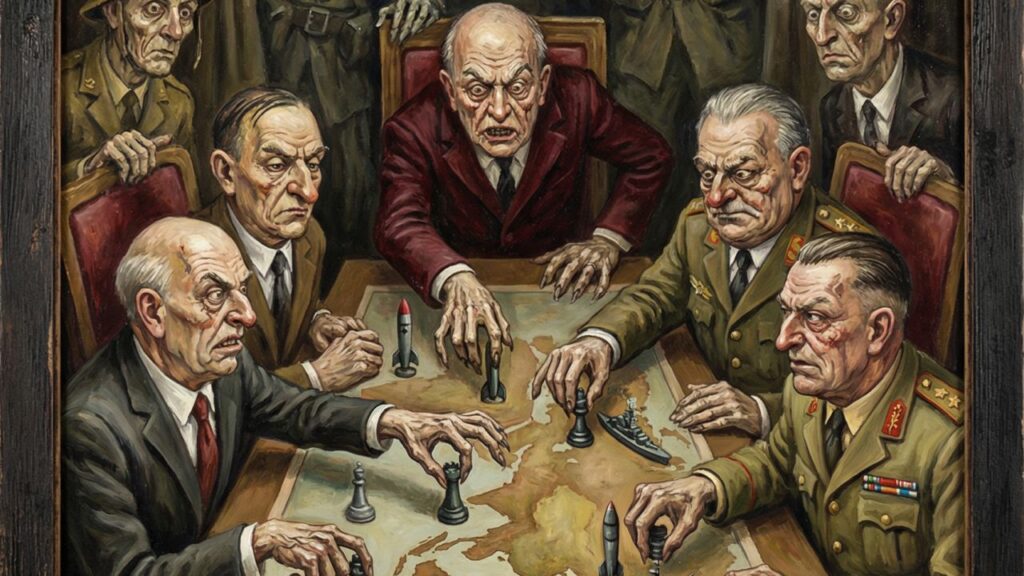
There is a through-line connecting Anna Chennault’s back-channel messages to Saigon in 1968, Boris Johnson’s flight to Kyiv in April 2022, and the current militarization of the Taiwan Strait. It is not ideology, though ideology provides the justification. It is not incompetence, though incompetence abounds among the executors. It is method, a deliberate, repeatable strategy for sabotaging peace whenever peace threatens to break out.
The neoconservative project does not merely prefer war to diplomacy. It requires the perpetual possibility of war to sustain the institutions, budgets, careers, and intellectual frameworks that justify its existence. Peace is not the goal deferred; peace is the outcome systematically prevented. From Vietnam through Iraq, Afghanistan, Libya, Ukraine, and now the simultaneous targeting of China and Iran, the pattern repeats with mechanical precision: encourage confrontation, arm proxies, inflate threats, and, at the critical moment when negotiated settlement becomes possible, Loss that path with the same saboteur’s toolkit deployed for sixty years.
This is not a conspiracy theory. It is documented history, exposed in declassified cables, recorded phone calls, on-the-record admissions, and the exposed trail of corpses stretching from the Mekong Delta to the Donbas. The question is not whether the pattern exists. The question is whether Americans will recognize it before the saboteurs engineer a war with China that makes every previous catastrophe look like a skirmish.
I. The Chennault Precedent: Peace as Treason
In October 1968, with Lyndon Johnson’s Paris peace talks on the verge of a breakthrough that could have ended the Vietnam War, Richard Nixon committed what Johnson privately called treason. Through intermediary Anna Chennault, widow of the Flying Tigers commander and well-connected Republican operative, Nixon sent word to South Vietnamese President Nguyen Van Thieu: boycott the peace talks. A Nixon administration would deliver better terms.
Thieu withdrew from negotiations three days before the American election. Nixon won by less than one percentage point. The war continued for seven more years, claiming an additional 22,000 American lives and over a million Vietnamese.
The mechanics bear examination. Nixon faced a closing window, peace would have guaranteed Hubert Humphrey the presidency. His intervention required:
- Back-channel communication bypassing official diplomatic apparatus
- A credible promise of better terms under a future administration
- Exploitation of the ally’s insecurity about American commitment
- Timing calibrated to the electoral cycle rather than battlefield realities
Johnson knew. The FBI had Chennault under surveillance. The NSA intercepted cable traffic. LBJ told Senate Republican leader Everett Dirksen that Nixon’s actions constituted treason. Yet Johnson stayed silent publicly, unwilling to reveal intelligence sources or trigger a constitutional crisis.
Nixon’s sabotage became the template. Not the improvisation of a desperate candidate, but the proof of concept that peace could be derailed by those who profited from war, and that the saboteurs would face no consequences.
II. Istanbul 2022: The Template Perfected
Fifty-four years later, Boris Johnson flew to Kyiv and executed the identical play.
By April 2022, Russian and Ukrainian negotiators had reached the framework of a settlement in Istanbul. The terms: Russia would withdraw to pre-invasion lines; Ukraine would adopt neutrality, forswearing NATO membership; Donbas would receive autonomy within Ukraine; international guarantors would provide security assurances. Both sides were prepared to sign. The war, then barely six weeks old, could have ended with Ukrainian sovereignty intact and perhaps 15,000 dead rather than the hundreds of thousands who would follow.
Then Johnson arrived. According to Ukrainska Pravda and subsequently confirmed by multiple sources including David Arakhamia, head of Zelensky’s parliamentary faction, Johnson delivered a two-part message: first, the West would not sign any guarantees with Russia; second, “let’s just fight”.
Within days, Ukraine withdrew from negotiations. The war that could have ended in April 2022 continues in February 2026, with Ukrainian forces now being annihilated in multiple cauldrons across the eastern front, the country’s infrastructure systematically destroyed, and casualty figures that may never be fully known.
Johnson was not acting alone. Victoria Nuland, the same State Department official caught on tape selecting Ukraine’s post-Maidan government in 2014, had been the architect of U.S. Ukraine policy. Her husband Robert Kagan and his network of neoconservative think tanks had spent years building the intellectual framework for confrontation with Russia. Johnson was the messenger; the message originated in Washington.
The Chennault precedent had been perfected:
ElementVietnam 1968Ukraine 2022Back-channel saboteurAnna ChennaultBoris JohnsonTarget governmentSouth Vietnam (Thieu)Ukraine (Zelensky)Promise delivered“Better terms under Nixon””The West will back you to victory”Actual outcome7 more years of war, 22,000+ U.S. dead4+ years of war, hundreds of thousands deadAccountabilityNoneNone
The pattern is not coincidence. It is method.
III. The Pivot Proceeds: From Nuland to Campbell
In March 2024, Victoria Nuland announced her retirement from the State Department. The neoconservative press mourned her departure. But Nuland was not being purged, she was being repositioned. The Ukraine project had served its purpose: NATO expanded, Europe’s energy independence from Russia destroyed, the military-industrial complex gorging on appropriations. Now the infrastructure of confrontation needed to pivot toward the main event.
Her replacement as the dominant voice on great-power competition? Kurt Campbell, elevated to Deputy Secretary of State, the number-two position in American diplomacy.
Campbell is the architect of Obama’s “pivot to Asia,” the designer of the AUKUS submarine deal, and the intellectual godfather of the strategy that treats China as an existential threat requiring permanent confrontation. Where Nuland built the framework for war in Europe, Campbell has spent a decade building the framework for war in Asia.
This is not personnel rotation. It is the controlled handoff of the saboteur’s portfolio from one theater to the next.
The timing reveals the strategy. As Ukraine collapses (its forces encircled, its infrastructure destroyed, its Western supporters quietly searching for exits) the neoconservative apparatus has already moved on. Ukraine was never the point. Ukraine was the rehearsal. The main performance is Taiwan.
IV. The Porcupine Strategy: Ukraine’s Fate, Taiwan’s Future
The playbook being applied to Taiwan replicates the Ukraine model with disturbing precision.
Since 2020, U.S. policy has pressured Taiwan to adopt a “porcupine strategy”, transforming the island into a fortress bristling with asymmetric weapons designed to make any Chinese invasion catastrophically costly. The explicit premise: Taiwan cannot win a conventional war with China, but it can “inflict heavy casualties against the Chinese mainland” while accepting “even greater levels of destruction for Taiwan itself.”
Read that formulation again. American strategists are designing a war in which Taiwan’s destruction is the acceptable price for inflicting costs on China. This is not a plan for Taiwan’s defense. It is a plan for Taiwan’s sacrificeidentical to the strategy that has reduced Ukraine to a depopulated ruin while American think tanks declare the investment worthwhile.
The military architecture being constructed around China mirrors NATO’s eastward expansion:
- AUKUS: Nuclear submarine technology transfer to Australia, placing attack submarines within range of Chinese shipping lanes
- The Quad: Military coordination between the U.S., Japan, Australia, and India, an alliance structure that dare not speak its name
- Integrated Air and Missile Defense: THAAD batteries in South Korea linked to Japanese Aegis destroyers, creating a unified targeting network
- First Island Chain fortification: Missiles, sensors, and prepositioning of equipment across Japan, the Philippines, and Guam
Each element is presented as defensive. Each element, from Beijing’s perspective, represents encirclement, the same encirclement that Russia warned about for thirty years before acting in Ukraine.
The parallel extends to the information environment. Just as Western media spent years portraying Russia as an irrational aggressor while ignoring NATO expansion, Minsk violations, and the shelling of Donbas, the current narrative frames China as inexplicably hostile while erasing the provocations that drive Chinese responses. The Taiwan Relations Act’s deliberate ambiguity is being systematically replaced by commitments that make war more likely while claiming to preserve peace.
V. Xi’s Brittleness: Opportunity for Provocation
The recent purge of senior PLA figures (including Zhang Youxia, vice-chairman of the Central Military Commission) has triggered Western speculation about instability in Beijing. Some analysts see reduced risk: a system paralyzed by internal mistrust is less likely to launch complex military operations. Others see opportunity.
The dangerous interpretation, circulating in neoconservative circles, is that Xi’s purges have created a window for pressure. A brittle system, the argument runs, might be pushed into overreaction, a Sarajevo moment manufactured through incremental provocation.
This misreads the actual risk. Systems trapped in what political scientists call the “dictator’s dilemma” are indeed prone to miscalculation, not because they are reckless, but because they are brittle. Information flows are distorted. Candid advice becomes career-ending. The leader sees threats everywhere and trusts no one’s judgment but his own.
In such an environment, provocations that Western planners consider “manageable” (a high-profile congressional visit, a arms package announcement, a freedom of navigation operation) may trigger responses calibrated to domestic political imperatives rather than strategic rationality. The escalation ladder becomes unpredictable precisely because the system selecting responses is itself unpredictable.
The neoconservative instinct is to exploit perceived weakness. But what looks like weakness from Washington may be volatility from Beijing, and volatility in a nuclear-armed state with the world’s largest navy is not an opportunity. It is a catastrophe waiting for a spark.
VI. Iran: The Third Front Opens
While the infrastructure for confrontation with China matures, the neoconservatives have simultaneously reopened the campaign for regime change in Iran.
The January 2025 “Vandenberg Coalition” manifesto, signed by familiar names from the Iraq War era, explicitly calls for permanent U.S. military presence in the Middle East, rejection of any accommodation with Tehran, and preparation for military action against Iranian nuclear facilities. The language of democracy promotion has returned: Iran’s government is “illegitimate,” its people “yearning for freedom,” its overthrow merely a matter of sufficient American will.
This is the Iraq playbook, undisguised. The same think tanks. The same rhetorical framework. The same indifference to the consequences of implementation.
Trump’s recent rhetoric, “help is on the way” to Iranian dissidents, signals alignment with this agenda. The administration’s approach treats “democracy promotion” as cover for destabilization, identical to the logic that produced the Iraq catastrophe. That the Iranian population has seen this movie before, that previous U.S. interventions in Iran (1953, the support for Saddam in the Iran-Iraq war, the assassination of Soleimani) have consistently strengthened hardliners, appears nowhere in the analysis.
The strategic incoherence is breathtaking. The United States simultaneously pursues confrontation with Russia (a declining power with a GDP smaller than Italy’s), China (the world’s largest economy by purchasing power parity and its largest manufacturing base), and Iran (a regional power with significant asymmetric capabilities and proxy networks across the Middle East). This is not strategy. It is the institutional expression of an apparatus that requires enemies to justify its existence and cannot distinguish between threats that merit response and threats it has manufactured for bureaucratic convenience.
VII. The Permanent Interests Behind Perpetual War
Why does this pattern persist across administrations, across decades, across theaters?
The answer is not ideological commitment, though ideology provides useful cover. The answer is institutional. The neoconservative project is embedded in structures that profit from confrontation and would be diminished by peace:
The defense industry requires threat inflation to justify budgets. Lockheed Martin, Raytheon, Northrop Grumman, and General Dynamics do not manufacture products for which peace creates demand. Their institutional interest lies in identifying enemies, or manufacturing them.
The think tank ecosystem (AEI, Heritage, Hudson, the Foundation for Defense of Democracies) depends on foundation grants and defense contractor funding that flow in proportion to perceived danger. A world without existential threats is a world without six-figure sinecures for failed policymakers.
The intelligence community expands its authorities, budgets, and freedom from oversight in direct proportion to threat levels. The seventeen agencies that constitute the U.S. intelligence apparatus have institutional interests in identifying dangers that require their unique capabilities to address.
The foreign policy establishment (the revolving door between government, consulting firms, and corporate boards) profits from relationships built during crises. Robert Gates rotates from CIA Director to Defense Secretary to the boards of defense contractors. Generals retire to “strategic advisory” positions with the firms whose weapons they procured. The wars may fail, but the careers flourish.
The media conglomerates whose largest shareholders include defense investors have no institutional interest in challenging narratives that benefit their ownership structure. When BlackRock, the largest investor in Lockheed Martin, is also among the largest shareholders of the corporations that own NBC, CNN, and significant stakes in newspaper chains, editorial independence becomes structurally impossible.
This is not conspiracy. It is structure. The incentives align toward confrontation because confrontation serves the interests of everyone with power over the relevant decisions. Peace threatens budgets, careers, influence, and self-conception. War, or the perpetual preparation for war, sustains them all.
VIII. The Saboteur’s Toolkit
Across six decades and multiple theaters, the methods remain consistent:
Threat inflation: Transform manageable competitors into existential dangers. China’s economic rise becomes a civilizational threat. Russia’s regional concerns become plans for European conquest. Iran’s nuclear program becomes an imminent mushroom cloud.
Proxy armament: Provide weapons sufficient to sustain conflict but insufficient to achieve victory. Ukraine receives enough to die heroically but not enough to force Russian withdrawal. Taiwan receives enough to guarantee Chinese retaliation but not enough to deter attack.
Alliance entrapment: Create commitments that transform local disputes into great-power confrontations. Article 5 guarantees to states on Russia’s border. Strategic ambiguity formulations that might, or might not, commit American forces to Taiwan’s defense.
Peace sabotage: When negotiations threaten to succeed, intervene to prevent settlement. Chennault in 1968. Johnson in 2022. The next saboteur is already being positioned.
Narrative control: Ensure that mainstream discourse frames every conflict as unprovoked aggression against freedom-loving peoples, while erasing the provocations, broken agreements, and strategic calculations that preceded hostilities.
Consequence evasion: Guarantee that those who design catastrophes never face accountability. Wolfowitz becomes World Bank president. Nuland becomes the State Department’s number-three official. The architects of Iraq write op-eds criticizing the management of subsequent disasters.
IX. Why China Is Different, And Why That Won’t Stop Them
The neoconservative apparatus is applying its standard playbook to China, but China is not Iraq, Afghanistan, Libya, or even Russia. The asymmetries that enabled American dominance in previous confrontations do not exist.
Economic interdependence: The United States and China are enmeshed in ways that make decoupling economically suicidal. Apple, Boeing, Caterpillar, and thousands of other American companies depend on Chinese manufacturing, Chinese markets, or both. The cost of hard decoupling approaches $200 billion annually in lost GDP.
Manufacturing capacity: China produces more steel, ships, electronics, and increasingly semiconductors than the United States. In a protracted conflict, production capacity matters more than existing stockpiles. The United States has outsourced the industrial base that won World War II.
Geographic reality: Taiwan is 100 miles from mainland China and 6,000 miles from California. The logistics of defending Taiwan against Chinese invasion are the inverse of the logistics China would face, yet American planners discuss the scenario as if distance were irrelevant.
Nuclear deterrence: Unlike Iraq or Libya, China possesses a nuclear arsenal capable of devastating American cities. The escalation ceiling that permitted “shock and awe” against non-nuclear states does not exist.
These factors would counsel caution in any rational strategic assessment. But the neoconservative apparatus does not make rational strategic assessments. It produces threat inflation calibrated to institutional needs, then retrospectively justifies whatever disasters follow.
The pattern predicts the outcome: the encirclement will continue, the provocations will escalate, and when China responds (whether over Taiwan, the South China Sea, or some incident not yet imagined) the same voices who created the crisis will declare it unprovoked aggression requiring maximum response.
Conclusion: The Saboteurs Must Be Named
The architects of perpetual war depend on anonymity and euphemism. They are “the foreign policy establishment,” “serious people,” “adults in the room.” Their catastrophes are “intelligence failures,” “tragic miscalculations,” “lessons learned.” They float above accountability while their policies fill graves from Saigon to Severodonetsk.
They must be named.
The Kagans who built the intellectual architecture. The Nulands who executed the provocations. The Sullivans who calibrated the escalations. The Campbells now positioning the pieces for the next war. The editors and correspondents who launder their narratives. The generals who retire to defense contractor boards. The think tank scholars whose funding depends on the threats they inflate.
These are not patriots misled by bad intelligence. They are architects of a system designed to produce exactly the outcomes it has produced: perpetual conflict, perpetual appropriations, perpetual careers built on the corpses of other nations’ sons.
The sabotage of the 1968 Paris talks extended Vietnam by seven years and killed a million people. The sabotage of Istanbul 2022 has already produced casualties in the hundreds of thousands, with no end in sight. The sabotage being prepared for any future accommodation with China could produce casualties measured in tens of millions, and potentially the end of human civilization if escalation reaches nuclear exchange.
At every juncture, peace was possible. At every juncture, peace was preventednot by the enemy, but by those within the American establishment who profit from its absence.
The question Americans must ask is simple: How many more must die before the saboteurs face consequences? How many more nations must be destroyed before the pattern is recognized as policy rather than accident?
The Chennault precedent established that peace sabotage carries no penalty. Sixty years of subsequent history confirms it. Until that changes, until the architects of these catastrophes face accountability proportional to the destruction they cause, the sabotage will continue.
From Saigon to Taipei, the method is the same. Only the names on the graves are different.
Scott Ortkiese writes on geopolitics, institutional corruption, and the permanent failures of America’s foreign-policy establishment.
Related reading
- The Hubris of Hegemony: Why the Neoconservative Approach to China Is Futile Lunacy
- The G7’s Relevance Problem: How Russia, China, India, and South Korea See the Club They’re Not In
- The Bahrain Parable: A Cautionary Tale for South Korea, Japan, Singapore, Indonesia, Malaysia, Vietnam, and Thailand
- Dear South Korea, You Have Been Diagnosed with a Fatal American Dependency Cancer