
Scott Ortkiese
Government Relations Support | Critiques of Government Policy
May 12, 2026
By Scott Ortkiese
The Audacity of “Checkmate”
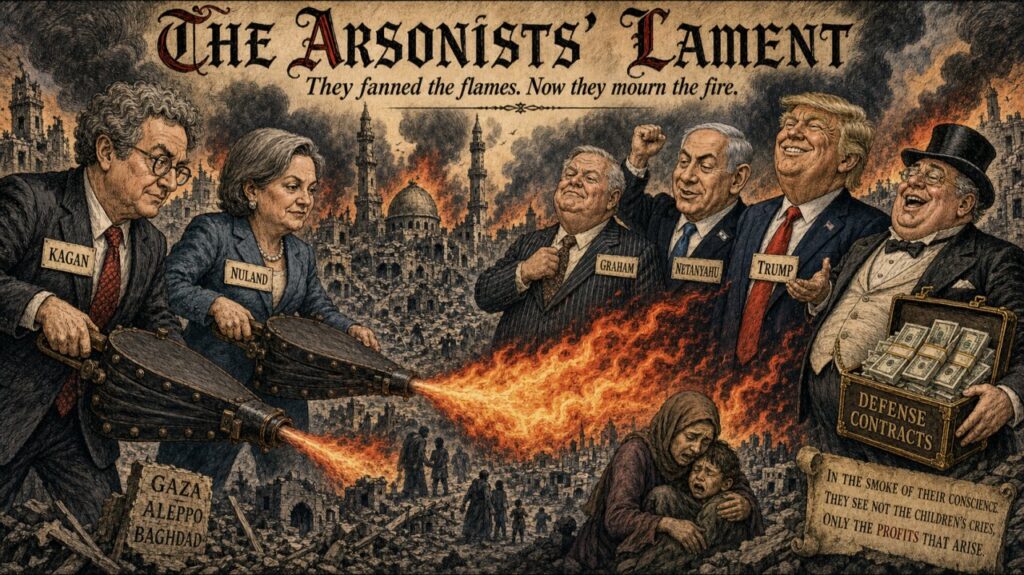
There is a particular species of intellectual fraud endemic to Washington think tanks, the kind where a man who spent thirty years building a machine of destruction tours the wreckage and writes an elegiac essay about the unexpected consequences of violence. Robert Kagan has now delivered that essay.
On May 10, 2026, Kagan published “Checkmate in Iran” in The Atlantic, declaring that the United States has suffered “a total defeat” in its war against Iran, a defeat that “can neither be repaired nor ignored”. The Strait of Hormuz, he wrote, will never reopen as before. Iran emerges as a dominant regional power. America’s alliances are fracturing. The world is reordering without Washington at its center.
Every word is accurate. Every word is also the confession of an arsonist.
As commentator Arnaud Bertrand observed with surgical precision, Kagan “spent 30 years advocating for military dominance in the Middle East and hostility towards Iran, thereby forging them as an adversary and facilitating this very war that he now says has ‘checkmated’ America. I know introspection has never been the neocon forte, but at some point you have to stop setting houses on fire and then writing op-eds about how surprising the smoke is.”
The Founding of the Machine: PNAC and the Iraq Blueprint
To understand the fraud, one must understand the machinery. In 1997, Robert Kagan co-founded the Project for the New American Century (PNAC) with William Kristol. PNAC’s stated goal was the promotion of American global leadership through military supremacy, in practice, a blueprint for perpetual interventionism in the Middle East, with Iran always at the top of the target list.
The machine wasted little time. On January 26, 1998, Kagan was among the eighteen prominent signatories who wrote an open letter to President Bill Clinton demanding “the removal of Saddam Hussein’s regime from power”. The letter declared that containment was “dangerously inadequate” and urged Clinton to take unilateral military action, explicitly stating that “American policy cannot continue to be crippled by a misguided insistence on unanimity in the UN Security Council”. Other signatories included Donald Rumsfeld, Paul Wolfowitz, Richard Perle, John Bolton, and Elliott Abrams, the entire roster of the Iraq War cabinet-in-waiting.
Nine days after the September 11 attacks, PNAC was already circulating a letter to President Bush pushing for the invasion of Iraq even if no direct link to the attacks could be established. Kagan himself, writing in The Washington Post on the very day of the September 11 attacks, called on Congress to “declare war on all enemies,” noting that the declaration “does not have to name a country”. Within three months, he clarified publicly that the case for invading Iraq required no direct link to the attacks.
PNAC’s 2000 report, Rebuilding America’s Defenses, was explicit: the road to permanent Middle East dominance ran through Baghdad first, and then through Tehran. The neocons knew even then that Iraq was the opening move, not the endgame. It took America 25 years to fully execute their blueprint, and Kagan is now writing its obituary while declining to mention his own authorship.
The Family Business of Perpetual War
Robert Kagan’s enterprise was never purely intellectual. It was, as investigative journalist Robert Parry documented as early as 2015, a “remarkable family business” built around the Military-Industrial Complex.
The structure is worth mapping in full:
-
Robert Kaganco-founder of PNAC, Senior Fellow at the Brookings Institution, contributing writer to The Atlantic and former contributing columnist at The Washington Post; the ideological engine who produces the intellectual justifications for war from the comfort of a Brookings office
-
Victoria NulandKagan’s wife, former Assistant Secretary of State for European and Eurasian Affairs and later Under Secretary of State for Political Affairs; the operational arm of the family enterprise, translating ideology into policy from within the State Department
-
Frederick KaganRobert’s brother, Senior Fellow at the American Enterprise Institute (AEI), credited as one of the key architects of the Bush-era “surge” in Iraq
-
Kimberly Kaganwife of Frederick, founder and president of the Institute for the Study of War (ISW), funded by defense contractors including General Dynamics, Raytheon, CACI, and DynCorp
As Parry wrote: “This extraordinary husband-and-wife duo makes quite a one-two punch for the Military-Industrial Complex, an inside-outside team that creates the need for more military spending, applies political pressure to ensure higher appropriations, and watches as thankful weapons manufacturers lavish grants on like-minded hawkish Washington think tanks.”
The Brookings Institution itself, Kagan’s institutional home, has received documented funding from Pentagon contractors including Lockheed Martin, Northrop Grumman ($1,000,000), and Boeing, as well as over $18.5 million from foreign governments. This is not coincidental. This is the architecture of the Washington war machine: the think tank, the State Department, the op-ed page, and the weapons manufacturer, all interlocked in a self-referential system that profits from war while framing every intervention as a humanitarian or strategic necessity.
Victoria Nuland: “F*** the EU” and the Art of Regime Change
If Robert Kagan is the ideological architect, Victoria Nuland is the operational implementer, arguably more consequential than her husband because she wielded real institutional power with catastrophic results.
Nuland’s most defining moment came in February 2014, when a leaked audio recording caught her on a phone call with U.S. Ambassador Geoffrey Pyatt openly selecting the composition of the post-Yanukovych Ukrainian government, weeks before the elected Ukrainian president was actually removed. Her dismissal of the European Union’s role with the phrase “F*** the EU” became the headline, but the more damning element was the casual discussion of which opposition figures would serve as Prime Minister (”Yats is the guy,” she said, referring to Arseniy Yatsenyuk, who duly became Prime Minister). German Chancellor Angela Merkel called Nuland’s remarks “totally unacceptable”.
Nuland had previously admitted in a December 2013 speech that the United States had invested $5 billion since the 1990s to “spread democracy” in Ukraine. That investment purchased a destabilized country, a civil war, and, eventually, a full-scale invasion by Russia, precisely the chain of events that analysts like John Mearsheimer had warned about for years while being dismissed by Nuland and Kagan’s faction as appeasers and Putin apologists.
She left the Biden State Department in March 2024 after what Russian Foreign Ministry Spokeswoman Maria Zakharova described as “the failure of the anti-Russian course of the Biden administration”.
Lindsey Graham: The Enabler-in-Chief
No account of the Iran War’s intellectual architecture is complete without Senator Lindsey Graham (R-SC), who serves as the political transmission belt between neoconservative think tanks and actual military action, and whose relationship with Prime Minister Benjamin Netanyahu is less an alliance than a supplication.
In February 2026, Graham traveled to Tel Aviv and declared at a press conference: “We’re on the verge of eliminating the greatest state sponsor of terrorism in the region. We’re in for weeks, not months.” He described the Iranian regime as “evil incarnate” and compared Iran’s Supreme Leader to Adolf Hitler. He advocated for killing senior Iranian officials, “kill the people who do the killing and see if the next guy wants to volunteer”, as a strategy for regime collapse.
Graham also confirmed that Trump had personally told him “there is no light between President Trump and Bibi about what to do and how to do it”, effectively announcing that American war policy in the Middle East was being co-authored in Jerusalem. He described the Trump-Netanyahu partnership as “one of the strongest in the history of the U.S.-Israel relationship”.
By March 2026, after the war began on February 28, Graham was on the phone with Netanyahu, posting to social media that it was “only a matter of when” the Iranian regime would fall. He boasted that Gulf Arab nations were “poised to engage more actively” alongside the U.S. and Israel, a claim subsequently contradicted by Saudi Arabia’s decision to distance itself from the conflict and accommodate Iran.
Graham is the political face of exactly the same impulse that Kagan supplied with intellectual veneer: that American military dominance can and should be used to remove regimes that displease Washington and Tel Aviv, consequences to be sorted out later.
The Neocon Blueprint for Iran: Always the Target
What is most revealing about Kagan’s current lament is what it omits: that the Iran confrontation was never an accident. It was always the plan.
PNAC’s founding documents made clear that Iran was the long-term objective. The 2000 Rebuilding America’s Defenses report mapped a strategic architecture that required first establishing permanent military bases in Iraq (achieved through the 2003 invasion), then using that forward position to pressure and eventually confront Iran. The invasion of Iraq was not a detour, it was the first domino. Even in 1996, a policy paper prepared for Israeli Prime Minister Netanyahu titled A Clean Breakco-authored by Richard Perle and other PNAC figures, explicitly called for “removing Saddam Hussein from power in Iraq” as a step toward reshaping the entire region in Israel’s strategic interest.
As CounterPunch documented, PNAC’s stated primary purpose was “augmenting unipolar, U.S. global hegemony, through ‘regime change’, especially targeting nations in which State-socialist public-ownership still included coveted assets such as oil fields, utilities, communications companies, etc. (Iraq, Iran, Libya, Venezuela)”. Lockheed’s VP, Bruce Jackson, served as a PNAC project director. The revolving door between the weapons industry, the think tanks, and the policy apparatus was not a bug, it was the system.
The war that began February 28, 2026, with the U.S. and Israel striking Iran’s nuclear and military infrastructure, was therefore the culmination of a 30-year project that Kagan helped design, fund, promote, and intellectually defend at every stage.
A Catalogue of Contradictions: Kagan Then and Kagan Now
The most intellectually damning element of Robert Kagan’s current Iran War commentary is the direct, line-by-line collision between what he is saying now and what he spent three decades saying before. These are not minor nuances or shifts in emphasis. They are flat-out reversals on the core questions of American foreign policy.
Contradiction 1: Allies Were Irrelevant. Now Allies Are Everything.
Then: Kagan’s 2003 book Of Paradise and Power framed European allies as essentially irrelevant, soft, post-historical, “from Venus” while America was “from Mars.” His PNAC co-founders dismissed UN Security Council multilateralism as an obstacle, and the 1998 letter to Clinton explicitly declared that “American policy cannot continue to be crippled by a misguided insistence on unanimity in the UN Security Council”. In practice, Kagan’s framework gave intellectual cover to the “coalition of the willing” model, do it with whoever shows up, or do it alone.
Now: In his March 2026 Atlantic piece, Kagan laments that “Europeans are facing an unremittingly hostile United States, one that no longer treats its allies as allies or differentiates between allies and potential adversaries.” He writes that “even success against Iran will be hollow if it hastens the collapse of the alliance system that for eight decades has been the true source of America’s power, influence, and security.” He decries that “Trump doesn’t want allies, he wants vassals.”
The man who wrote the intellectual justification for brushing aside European objections to the Iraq War is now appalled that an American president is brushing aside European objections to the Iran War. The only discernible difference is which war he personally favored.
Contradiction 2: America Must Project Power Everywhere. Now Overreach Is the Problem.
Then: In his 2018 book The Jungle Grows Back, Kagan argued that American military withdrawal would be “the worst possible response” to global instability, and that “the realist impulse to recognize our limitations and focus on our failures misunderstands the essential role America has played for decades in keeping the world’s worst instability in check.” In a 2015 Wall Street Journal essay titled “America’s Dangerous Aversion to Conflict,” he argued that America’s problem was that it had grown too reluctant to use force. As recently as 2022, Responsible Statecraft noted, Kagan’s standard prescription was “the imperative of militarized U.S. global primacy, whatever the price and with little regard for who pays.”
Now: In “Checkmate in Iran,” Kagan acknowledges that “just a few weeks of war with a second-rank power have reduced American weapons stocks to perilously low levels, with no quick remedy in sight” and that America’s allies “must wonder about American staying power in the event of future conflicts.” He admits that the war has left the U.S. “weaker and more isolated than at any time since the 1930s.”
The man who spent decades arguing that American reluctance to use military force was the danger is now writing that the use of American military force has produced a catastrophic strategic defeat. He provides no accounting of why the model he championed for thirty years produced the exact opposite of what he promised.
Contradiction 3: Blowback Isn’t Real. Now Blowback Is Real.
Then: For years, Kagan and the neoconservative establishment dismissed the blowback theory, the argument that U.S. military intervention in the Middle East generates the very hostility it claims to suppress, as isolationism, naïveté, or, when raised by critics like Ron Paul and Pat Buchanan, outright anti-Americanism. When Andrew Bacevich, John Mearsheimer, or Chalmers Johnson raised these arguments, they were marginalized from mainstream policy discourse that Kagan helped define.
Now: In his May 2026 Atlantic piece, Kagan himself writes: “Even the threat of terrorism from the region was a consequence of American involvement, not the reason for it. Had the United States not been deeply and consistently involved in the Muslim world since the 1940s, Islamic militants would have little interest in attacking an indifferent nation 5,000 miles and two oceans away. Contrary to much mythology, they have hated us not so much because of ‘who we are’ but because of where we are.”
This is blowback theory. Verbatim. This is precisely the argument that was dismissed as unpatriotic or appeasement-minded when others made it during the years when Kagan’s establishment credibility might have amplified and normalized it. He is now making Ron Paul’s argument, without attribution, without apology, and, most critically, without the twenty years of course-correction it would have enabled.
Contradiction 4: Iraq Was Manageable. Now Iraq Is the Warning No One Heeded.
Then: After the Iraq War descended into catastrophe, Kagan insisted it was not the concept but the execution that failed. He blamed the Bush administration for deploying too few troops. On the Bulwark podcast in March 2026, he was still defending the Iraq invasion’s logic: “To be fair to the Bush administration, and people are now drawing analogies between this and the Iraq War of 2003, there is a significant difference. Whatever else is true, Bush felt responsible for leaving behind a sustainable outcome in Iraq.” Kagan argued that Iraq stabilized and had parliamentary elections, implying the model worked.
Now: In the same Bulwark podcast, speaking about the Iran War, Kagan acknowledged that toppling the Iranian regime would produce an unstable country requiring permanent U.S. occupation, that “the United States would still have to play a role, but it will have kicked this hornet’s nest,” and that regional instability would generate terrorism and potential Hormuz closures regardless of the outcome. He is, in other words, describing precisely the dynamic that critics of his Iraq framework said would occur, and which did occur, in 2003. He applies the analysis to Iran retroactively but refuses to apply it to Iraq prospectively, where it would have mattered.
Contradiction 5: The Iraq Invasion Was Not About Neoconservatism. Now PNAC’s Vision Has Failed.
Then: Even after the Iraq War, Kagan insisted in 2008 that “the Iraq War will always be linked with the term ‘neoconservative’” was the “conventional wisdom” that he disputed, arguing that the decision was broadly shared and not ideologically driven. He deflected responsibility by noting that Clinton had also targeted Saddam, and that the invasion “can be understood without reference to a neoconservative doctrine.”
Now: Commentary from multiple sources, including Explaining History and Arnaud Bertrand’s widely shared Substack analysis, notes that Kagan’s Atlantic defeat essay implicitly concedes the failure of the PNAC project in its entirety, that the neoconservative vision of unipolar American dominance through military primacy in the Middle East has now been empirically falsified. Kagan does not make this concession explicitly because doing so would require him to acknowledge the direct causal link between his intellectual project and the catastrophe he now laments.
Contradiction 6: The “Jungle Grows Back” Without American Force. Now American Force Grew the Jungle.
Then: The animating metaphor of Kagan’s 2018 book was the “jungle”, the chaos that grows back when American power withdraws. His prescription was constant American “gardening” through military presence and willingness to use force. This was his unified field theory of international relations: without America as the gardener, the world reverts to war and instability.
Now: In March 2026, Kagan is telling Bill Kristol on the Bulwark podcast that the Iran War “is mostly about the breakdown of the world order, which is being accelerated by the war in Iran.” In The Atlantic, he writes that the conflict is “driving deeper wedges between the United States and former friends and allies; strengthening the hands of the expansionist great powers, Russia and China; accelerating global political and economic chaos.”
In other words: American military force, applied exactly as Kagan prescribed for thirty years, has grown the jungle. The gardener was the source of the weeds.
The Belated Confession and Its Limits
What Kagan’s Atlantic article reveals, and what its many admirers are choosing not to notice, is not a change of heart. It is a strategic retreat.
His “checkmated” argument acknowledges that Iran now controls the Strait of Hormuz; America’s weapons stocks are depleted after “just a few weeks of war with a second-rank power”; Gulf Arab states will have to accommodate Iran; U.S. alliances in Europe and East Asia are questioning American reliability; and “the global adjustment to a post-American world is accelerating.”
Every single one of these outcomes was predicted, and predicted because of policies Kagan championedby the very analysts and scholars that Kagan’s faction spent two decades dismissing. Andrew Bacevich called Kagan’s historical narrative “falsified, sanitized, and in some respects, illusory” as early as 2014. Glenn Greenwald, in 2007, asked the pointed question: “Why would any rational person listen to Robert Kagan?” Journalist James Fallows observed that Kagan and his fellow neoconservatives “have earned the right not to be listened to.”
Responsible Statecraft noted the dynamic clearly: Kagan “today is describing U.S. blowback in the Middle East and referring to Israel as the South Vietnam of unreliable allies, viewpoints once dismissed as various ‘isms’: ‘anti-Americanism,’ ‘anti-semitism,’ ‘isolationism,’ ‘conspiratorialism.’” The Overton window has shifted not because Kagan persuaded anyone, but because reality has overruled him, and he has pivoted to narrate the wreckage as if he were a disinterested observer rather than its principal architect.
The Arsonist’s Solution, and Its Political Motive
Perhaps the most revealing line in Kagan’s May 2026 Atlantic piece is his proposed solution to the checkmate. Having spent 3,000 words establishing that America has lost, that Iran controls the Strait of Hormuz, that no further bombing will change the equation, Kagan’s answer is a bigger war.
He writes that the only viable path is to “engage in a full-scale ground and naval war to remove the current Iranian regime, and then to occupy Iran until a new government can take hold.”
Iran has a population of approximately 90 million people and a territory three times the size of Iraq, the country whose occupation, even with 170,000 troops, produced a decade-long catastrophe that Kagan himself now characterizes as relatively successful. He proposes permanent occupation of a nation the size of Western Europe, without irony, without acknowledgment that a version of this logic was applied in Iraq, and without any accounting for human cost.
The political motive beneath the analysis is also worth noting. Responsible Statecraft identified what is driving neoconservative criticism of the Iran War: “One obvious answer is political expedience, in each of these cases, never-Trumpers are simply consistent in their oppositional positioning.” Kagan, who resigned from The Washington Post in protest over the paper’s refusal to endorse Kamala Harris and who wrote apocalyptic pieces comparing Trump to Julius Caesar, is not criticizing the Iran War on principled grounds. He is criticizing Trump’s management of a war that neoconservatives broadly wanted. The critique is: wrong style, wrong execution, wrong president, not wrong war.
Arnaud Bertrand’s summary is definitive: “The arsonist’s solution to the fire is a bigger fire.”
The Trump Irony: Kagan Built What He Now Decries
There is a further irony that Kagan’s essay studiously avoids. The Iran War he now calls a catastrophe was prosecuted by Donald Trump, a politician whom Kagan spent years attacking in apocalyptic terms. Yet it was Kagan’s own PNAC project, his own framework of American primacy through military force, and his own institutionalized pressure for Iran regime change that created the political and strategic conditions Trump inherited and then catastrophically executed.
The “Rebuilding America’s Defenses” blueprint did not disappear when PNAC dissolved in 2006, it was absorbed into the bones of Washington’s foreign policy consensus, into the think tanks, into the Foreign Policy Initiative (PNAC’s 2009 successor, also co-founded by Kagan and Kristol), and eventually into Trump’s National Security apparatus. Trump did not invent the Iran war. He executed a neoconservative plan with the bluntness of a man who lacks the intellectual polish to dress it up in the language of democracy promotion and human rights. The difference between Kagan’s preferred Iran policy and Trump’s Iran policy is one of style, not substance. Kagan wanted regime change with better rhetoric. What he got was regime change with none.
Crooked Timber put it pointedly in 2016, long before the Iran War: “All along, not much ever separated neocons such as Kagan from a nationalist such as Trump, except the pretense that what is good for the United States, including all its war-making, is good for the world.”
Conclusion: A Fraud Without Consequence
Robert Kagan and Victoria Nuland represent a specific Washington pathology: the permanent absence of accountability for those who hold institutional power, populate well-funded think tanks, contribute to prestigious publications, and rotate through government portfolios. They can be wrong (catastrophically, irreversibly, mortally wrong) and return to the same institutions, the same op-ed pages, and the same policy circles to deliver the next prescription.
Kagan’s PNAC helped set the ideological framework for the Iraq War, which cost hundreds of thousands of Iraqi lives, nearly 5,000 American lives, and trillions of dollars. He was never held accountable. Nuland helped orchestrate the destabilization of Ukraine in 2014, a chain of events that contributed to the largest European war since 1945. She was never held accountable. Together, their intellectual and policy work helped create the conditions for the Iran War, a war Kagan now describes as an unprecedented American defeat.
He will not be held accountable for this, either. He will write more articles in The Atlantic. He will appear on more podcasts. He will be invited to more Council on Foreign Relations forums. And at the next strategic crossroads, some version of the same machine will produce the same prescription, dressed in new language, aimed at a new target.
That is the real “checkmate.” Not Iran’s control of the Strait of Hormuz, but Washington’s inability to expel the architects of its own failures from the institutions that produce its next ones.
Related reading
- The Business of War: How Defense-Funded Think Tanks Choose Which Interventions to Champion
- The Perpetual Market: How Ukraine, Iran, and Taiwan Became Line Items on a Cash‑Flow Statement
- Американский пузырь искусственного интеллекта лишён смысла. Каждый его участник это знает. И тем не менее он раздувается. Почему?
- The American AI Bubble Makes No Sense. Every Party to It Knows. It Is Happening Anyway. Why?