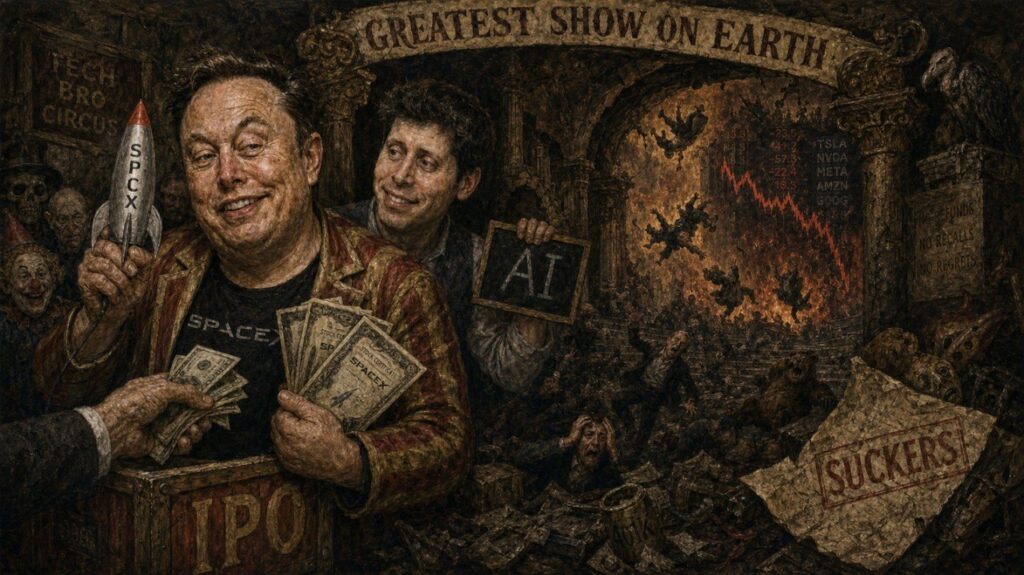
Musk slammed his IPO fraud through while Trump covered for him and Altman watched.

By Scott Ortkiese | Throughline Synthesis | July 14, 2026
“History shows that buying companies at over 10 times revenues usually ends very badly. This is 120 times revenues.”George Noble, former Fidelity analyst for Peter Lynch
Executive Summary
On June 12, 2026, SpaceX ticker SPCX made its Nasdaq debut in what was breathlessly proclaimed the largest initial public offering in human history. The company raised $75 billion at $135 per share, briefly vaulting Elon Musk into the pantheon of trillionaires and generating enough CNBC chyrons to wallpaper a stadium. Within a month, the story had curdled. The stock collapsed 39% from its post-IPO peak of approximately $225, sinking back toward its IPO price with institutional momentum that no amount of Grok 4.5 press releases, Katie Miller tweets, or Mars colonization rhetoric could arrest. By July 10, SPCX closed at $145.30 a 52-week low and the market cap had hemorrhaged from $2.5 trillion to roughly $1.9 trillion, erasing nearly $600 billion in paper wealth in the span of weeks.
The most ominous detail? Not a single insider had yet been permitted to sell.
This report dissects the SpaceX IPO from every analytical angle available to serious economists and financial scholars: the obscene valuation multiples, the engineered float scarcity, the ticking lockup time bomb, Trump’s documented complicity in timing the offering with federal contract awards, the systematic neutering of the SEC and FCC as oversight bodies, the conflict-of-interest-riddled corporate ecosystem, the Chinese competitive threat, and the broader AI malinvestment bubble into which this offering was so carefully injected. This is not a story about a rocket company. It is a story about how presidential power, narrative engineering, and regulatory complicity combine to manufacture a capital extraction machine of staggering proportions with Grandma’s 401(k) positioned as the exit liquidity.
I. The Numbers That Should Have Stopped the Party Cold
An Offering Priced on Faith, Not Fundamentals
The SpaceX IPO priced at $135 per share, producing a $1.77 trillion valuation at launch making it the seventh most valuable public company in the United States at that moment, above Tesla, above Walmart, above virtually the entire productive economy of several sovereign nations. To put that in perspective: Saudi Aramco, which controls the largest hydrocarbon reserves on Earth and generates tens of billions in annual free cash flow, raised a “mere” $29.4 billion in its 2019 record IPO. SpaceX raised more than double that from a company that reported a net loss of $4.9 billion in fiscal 2025 and another $4.3 billion net loss in just the first quarter of fiscal 2026.
This is not a company in temporary distress pivoting toward profitability. S&P Global Ratings formally projected that SpaceX’s free cash flow will remainnegative through at least 2029, even after absorbing the $75 billion IPO proceeds. The company carried $29.1 billion of long-term debt at the close of Q1 2026, including a $20 billion bridge loan. Immediately after the IPO, it launched a $25 billion bond sale to repay that bridge facility. The sequencing is worth pausing on: raise $75 billion from the public, then issue $25 billion in bonds, all while projecting negative free cash flow for three more years. This is not a growth story. This is a capital consumption story and investors who did not read the S-1 fine print were not warned about that distinction in any headline.
The revenue multiple tells the starkest tale. At its IPO valuation of $1.77 trillion, SpaceX was priced at approximately120 times revenues. To borrow George Noble’s framing a man who served as Peter Lynch’s auto analyst at Fidelity since 1981 and has witnessed every market cycle this century has conjured history shows that buying any company at over 10 times revenues “usually ends very badly.” Scott McNeely of Sun Microsystems, now immortalized in every valuation course taught at every business school in the world, once asked shareholders what they were thinking when they paid 10 times revenues for his company. SpaceX went public at twelve times that threshold.
Morningstar’s chief equity strategist Michael Field assessed SpaceX’s fair value at$63 per shareless than half the IPO price stating: “We recognize the company has significant strengths, especially with Starlink, but given the numerous unknowns and untested technologies that influence much of the valuation particularly in the AI sector we consider the valuation to be highly speculative.” Senator Elizabeth Warren, applying a different kind of institutional scrutiny, formally urged the SEC to delay the offering, citing “unprecedented risks to investor protection and market integrity.” Both voices were ignored, and the machinery rolled forward.
II. The Float Engineering: Scarcity as a Manipulation Tool
The 4.3% Shell Game
When SpaceX opened for trading on June 12, 2026, approximately4.3% of shareswere available for public trading. The largest IPO in human history made roughly four cents of every dollar of market capitalization actually tradable. The remaining 95.7% was locked behind an elaborate staggered release calendar extending to December 2026 for standard insiders and June 2027 for Musk himself.
This is not accident. This is architecture. By releasing a sliver of the float, the underwriting syndicate Goldman Sachs, Morgan Stanley, Bank of America, Citigroup, and JPMorgan Chase created the conditions for an artificial price discovery environment. With only 4.3% of shares tradable, even modest retail buying pressure could send the stock parabolic. And it did: SPCX opened at $150, closed its first day near $161, and within two weeks was trading above $225 a 67% premium to IPO price on almost no fundamental news whatsoever. This manufactured euphoria served a critical purpose: it generated the “momentum” narrative that drew in the retail wave, the CNBC segments, the TikTok traders, and the 401(k) investors who were told, by everyone from Wall Street analysts to the wife of a senior White House official, that they were “missing out.”
George Noble, the Fidelity veteran, described this structure bluntly: “In the old days when a company went public, it took its shares public and maybe kept a little stub private. Now we’re unloading 5% to the public. To me, it’s manipulative. Should regulators step in? 100%. It’s not a question of what’s legal or illegal. It’s just not right. Society is not well served by allowing this. Grandma’s 401(k) is the exit liquidity for this manipulation.” He added that the regulators are “asleep at the wheel they only jump into action after the car crash has occurred.”
The NASDAQ Inclusion Trap
Adding a second layer of mechanical complexity to the offering, SPCX was fast-tracked into the NASDAQ-100 Index, with forced buying by passive ETF trackers including QQQ and every vehicle mirroring the index scheduled to execute on July 6, 2026. If massive index-inclusion buying had pushed SPCX through the $175.50 price trigger baked into the lockup agreement, an early unlock would have been tripped, potentially arming a short-squeeze feedback loop capable of producing a dangerous melt-up.
It did not happen. What transpired on July 6 was arguably more revealing. The NASDAQ-100 forced buying described as the biggest forced buying event in NASDAQ index history managed to move SPCX by exactly$5.10 in the last thirty minutes of trading, lifting it from $155.22 to $160.32 at the close. The trigger needed $15 more to fire. It never fired. The next morning, with inclusion effective and the institutional buying complete, the stock sold hard. By Friday, July 10, SPCX had closed at $145.30, down 12% for the week, with an intraday low of $145.70. The anemic response to the most powerful mechanical buying event ever engineered for a NASDAQ stock was, in effect, a vote of no confidence from the open market: “The open market said, ‘Well, this thing was worth less than where we bought it.’”
III. The Lockup Avalanche: A Supply Tidal Wave Still Loading
A Calendar of Reckoning
The most structurally dangerous feature of the SpaceX offering worse than the valuation, worse than the negative cash flow, worse than the manipulative float engineering is the lockup release calendar that now stretches from mid-August to December 2026. This is not one cliff. It is a cascading series of trapdoors, each releasing another tranche of supply into a market that has already demonstrated insufficient demand at present prices.
DateEventShares ReleasedCumulative Unlock~August 11, 2026Q2 Earnings unlock20% of insider holdings20%August 20, 2026 (Day 70)Rolling tranche7%27%September 10, 2026 (Day 90)Rolling tranche7%34%September 25, 2026 (Day 105)Rolling tranche7%41%October 10, 2026 (Day 120)Rolling tranche7%48%October 25, 2026 (Day 135)Rolling tranche7%55%~November 9, 2026Q3 Earnings unlock28%83%December 9, 2026Full 180-day releaseRemaining non-Musk shares~100%~June 2027Musk + major holdersLongest lockup expires100%
By the time the five rolling 7% tranches are completed, the tradable float will have roughly doubled from its current level. The Q3 earnings unlock of 28% is the largest single wave, and it arrives at a moment when the stock will have already weathered five prior unlock events and two earnings calls. One market analyst summarized the structural trajectory with clinical precision: “Every unlock date bleeds a little more squeeze out of the fuel tank. The borrow costs drop. The trade gets cleaner and safer as the supply grows.”
The critical insight is this: SpaceX is already trading near its IPO floorbefore a single insider has liquidated a position. The 95.7% of shares still locked belong to employees, early investors, and institutional backers who got in at prices far below $135. When the calendar compels their release, even partial selling by a fraction of those holders will represent a volume shock against a market that has already demonstrated it cannot absorb mechanical index-buying at historically unprecedented scale. As one of the July transcripts captured it succinctly: “I’m pretty sure a lot of these people are going to cash out. I think you guys know it. I know it.”
IV. Trump’s Complicity: When the Presidency Becomes a Valuation Tool
The Golden Dome Gambit
No examination of the SpaceX IPO is complete without confronting its most politically explosive dimension: the systematic use of the executive branch of the United States government to inflate the valuation of a company controlled by the president’s largest campaign donor, at the precise moment that company was selling shares to the American public.
The sequencing is surgical. On May 26, 2026 days after SpaceX filed its IPO prospectus the U.S. Space Force awarded SpaceX a $2.29 billion contract for the Space Data Network Backbone, a secure satellite communications layer tied to Trump’s $185 billion Golden Dome missile-defense initiative. Three days later, the Space Force announced a second Golden Dome contract worth $4.16 billion to build the Space-Based Advanced Moving Target Indicator satellite constellation the orbital sensor array at the heart of America’s next-generation missile defense system. Two contracts. One week.$6.45 billionin newly minted government revenue, awarded during the exact window when Musk was preparing to sell Wall Street on a $1.77 trillion valuation. SpaceX already generated one-fifth of its 2025 revenue from government contracts at the time of its IPO filing.
This was not coincidental timing. Elon Musk had donated approximately$300 millionto Trump’s election campaign the largest individual donor contribution in American political history. He subsequently served as de facto director of the Department of Government Efficiency (DOGE), with access to budget processes, personnel decisions, and regulatory frameworks across every agency that both regulates and contracts with SpaceX. Congressional investigators documented that Musk and his companies had received at least$38 billionin contracts, loans, subsidies, and tax credits from federal and state governments. SpaceX alone held $9.5 billion in direct DOD contract funds and $13.5 billion in total federal defense benefits since 2003. The $6.45 billion in Golden Dome awards landed into the IPO roadshow atop that already staggering base, providing institutional investors with precisely the government revenue stability narrative that underwrites a $1.77 trillion valuation on zero free cash flow.
The structural tension was impossible to ignore: Elon Musk was simultaneously the largest financial backer of the sitting president, the CEO of the company receiving the contracts, and the controlling 82 to 85% shareholder of the entity being sold to the American public. Forty-two Democratic lawmakers had already written to the Defense Department’s Inspector General in May 2025 warning that Golden Dome contracts could give Musk “unacceptable ongoing leverage” over U.S. national security while enriching him personally. Their letter flagged SpaceX’s proposal to operate Golden Dome as asubscription servicea model that would allow Musk to control the cadence and terms of access to America’s missile-defense sensor network, as he had allegedly done previously with Starlink in Ukraine. The DOD Inspector General overseeing related SpaceX compliance reviews had been removed by President Trump shortly after his inauguration.
The Feud That Exposed the Architecture
The most instructive episode in the entire Trump-Musk-SpaceX nexus unfolded not before the IPO but in the weeks surrounding it, revealing with unusual clarity that this arrangement was transactional rather than ideological. When Musk publicly attacked Trump’s “Big Beautiful Bill” budget reconciliation package in June 2025, calling it a vehicle for “the largest debt increase in history,” Trump responded on Truth Social by suggesting that “the simplest method to cut expenses in our Budget, saving billions and billions of dollars, is to end Elon’s Government Subsidies and Contracts.”
The administration then launched a formal review of SpaceX’s federal contracts, requesting that DOD, NASA, and at least five other agencies compile scorecards evaluating whether SpaceX’s contracts could be terminated or replaced. The review produced a finding that should unsettle every investor who bought SPCX above its IPO floor:the U.S. government concluded it could not exit SpaceX. SpaceX’s integration into the Pentagon’s launch infrastructure, its Starlink networks, its classified Starshield programs, and its Golden Dome sensor constellation had made it functionally irreplaceable. One government review could not identify alternative vendors capable of performing the same tasks.
Read that slowly. The United States government even when motivated by explicit political retaliation, with the full weight of the executive branch applied could not exit its dependency on SpaceX. That is not a growth-stage company. That is a monopoly. And the public purchased equity in that monopoly at 120 times revenue, with no meaningful governance rights, into a market that has already demonstrated it cannot absorb mechanical index-buying at historically unprecedented scale. The captured regulator waved it through. The captured executive branch decorated its S-1 with billions in freshly signed contracts. And the captured analyst community called it a Buy.
V. The SEC: Institutional Independence Surrendered
A Watchdog That Chose Not to Watch
The SEC, under its Trump-appointed chairman Paul Atkins, was the last institutional backstop capable of slowing the SpaceX offering. It chose not to use it. Senator Warren sent a formal 12-page letter to the SEC on June 10, 2026 two days before trading opened demanding a delay, citing SpaceX’s acquisition of xAI as a source of “inaccurate or misleading valuations,” Musk’s “uniquely unchecked” authority as an 82 to 85% majority shareholder, and the accelerated index-inclusion rules quietly modified to accommodate large new listings. Her letter was received. It was not acted upon.
The SOC Investment Group, which advises union pension funds with over $250 billion in assets, had separately written to Chairman Atkins in May 2026 raising concerns about the “accuracy and reliability” of SpaceX’s financials specifically revenue recognition for long-term Starlink contracts, goodwill impairment on the xAI acquisition, and inter-company transactions between SpaceX and other Musk-controlled entities. SOC’s most pointed demand was structural: aformal firewallensuring that no SEC staff with connections to DOGE or former Musk associates would participate in reviewing the registration statement, asking explicitly whether the SEC could conduct its review “without fear of political retribution.”
SEC Commissioner Uyeda’s public response to these concerns was telling in its brevity: investors who disliked SpaceX’s governance structure were free not to buy the stock. Chairman Atkins, a committed deregulatory ideologue since his first SEC tenure under George W. Bush, had made clear his priority was reversing what he viewed as regulatory overreach and easing the path to public markets not adding friction to the largest IPO in history simply because it involved the most politically entangled CEO in modern American corporate history. The American Federation of Teachers, whose pension funds hold hundreds of billions in index-tracked assets, called for “extraordinary scrutiny” to protect members’ retirement savings including the systemic risk that SpaceX’s inevitable S&P 500 inclusion would force millions of passive investors to hold a cash-negative company at 120 times revenue with no governance rights. That call, too, was ignored.
VI. The FCC: Regulatory Capture Dressed in Spectrum Policy
When the Regulator Becomes the Enabler
FCC Chairman Brendan Carr appeared on Bloomberg in mid-July 2026 speaking enthusiastically about “boosting America’s space economy” and accelerating approval timelines for satellite systems and orbital data centers the precise regulatory environment most critical to SpaceX’s revenue projections. He framed deregulation as pro-consumer, despite the fact that its primary beneficiary in the orbital market is the company whose CEO had been given effective oversight authority over the FCC’s budget and personnel through DOGE.
The legal record is damning. An advocacy group sued the FCC in 2025 alleging FOIA violations, specifically seeking documentation of how “DOGE’s activities at the FCC may have created conflicts of interest related to Elon Musk’s SpaceX and Starlink, which are seeking various FCC licenses and authorizations.” When documents were eventually produced, they revealed DOGE personnel including a former Tesla executive embedded within the FCC for months, accessing systems whose specific contents the agency refused to disclose. The FCC was accused by the court of acting “in bad faith by withholding documents” and concealing the FCC Chairman’s use of Signal for government business. As the plaintiffs argued: “The evidence strongly suggests that Musk bought his way into the White House and used his government authority and access to information to earn huge profits for himself and his companies.”
The regulatory environment SpaceX presented to investors in its S-1 defined by accelerating approval timelines, deregulated spectrum access, and a favorable FCC framework was in material respects manufactured through the very mechanisms now under legal challenge.
VII. The Elon Ecosystem: Conflicts of Interest on an Industrial Scale
One Man, Seven Companies, Zero Firewalls
Perhaps no aspect of the SpaceX IPO has received adequate scrutiny from mainstream financial media: the extraordinary degree to which Elon Musk engineered his corporate empire to function as a single capital extraction machine in which every company feeds every other company and where the public shareholder is positioned as the last, least-informed participant in every transaction.
When SpaceX acquired xAI the parent of the Grok AI chatbot and merged it into the listed entity, it brought with it the entire accumulated conflict-of-interest architecture that xAI had developed with Tesla. The documented entanglements are extensive:
-
Tesla mandates Grok: In early July 2026, Musk instructed Tesla staff to switch to Grok 4.5 for internal AI work, simultaneously capping competing tools (Claude, ChatGPT, Gemini) at $200 per week while Grok remained entirely exempt from that cap. Independent benchmarks showed Grok 4.5 ranked ninth overall with a 53% success rate on coding tasks versus Claude’s 70%. The policy steered shareholder resources toward a product owned by the CEO while throttling demonstrably superior alternatives.
-
SpaceX/Tesla capital circularity: The S-1 filing confirmed SpaceX as a major Tesla energy customer, purchasing $697 million in Tesla Megapacks. Tesla simultaneously invested $2 billion in xAI the entity rolled into SpaceX’s listed structure creating a closed loop in which Tesla shareholders funded the capitalization of a company now competing with their own portfolio.
-
DOGE and the NASA/DOD nexus: Musk served simultaneously as SpaceX CEO and as a Special Government Employee overseeing restructuring at NASA and the DOD the two agencies constituting SpaceX’s most critical federal contracting relationships. Reps. Lynch and Connolly formally opened a congressional oversight investigation in April 2025 noting that “SpaceX’s role as a significant government contractor and DOGE’s authority over agencies that manage SpaceX contracts, bidding processes, and regulatory frameworks” constituted “an intrinsic conflict of interest.”
The Lonsdale testimony captured from the July 13, 2026 transcripts is instructive. When the Palantir co-founder appeared on television to discuss SpaceX exit strategy while the stock was crashing in real time, he declared “we’re not really thinking about selling” while visibly shifting in his seat. He was among the institutional stakeholders whose interests are most directly served by the artificial float scarcity and who will be first in line when the lockup calendar permits their exit.
VIII. The Chinese Competitor: The Existential Risk Nobody Priced In
Beijing’s Net Capture
One of the most revealing moments across these transcripts was the opening of the July 12 commentary: footage of a Chinese rocket performing a net capture landing an explicit technical replication of SpaceX’s signature booster recovery methodology. The commentary was pointed: “This was a direct challenge to SpaceX. Now that China has this capability, what does Elon Musk have to say?” The answer, as of mid-July 2026, was: nothing. Musk’s public communications were consumed by his feud with Sam Altman, allegations of “scamming” directed at OpenAI, and litigation against Apple. A CEO overseeing a $2 trillion public company remained silent on the single most important competitive development in his industry.
This silence is symptomatic of a CEO whose attention is splintered across seven companies, three government-adjacent roles, one social media platform, and an AI model feuding on multiple competitive fronts simultaneously. SpaceX’s moat the Starship system, reusable booster technology, the Starlink constellation was priced in the IPO as if it existed in a vacuum of uncontestable American technological supremacy. It does not. China’s orbital rocket programs are advancing rapidly, and the CNBC analyst who noted that “Musk has bitten off more than he can chew” was not engaging in hyperbole.
The SpaceX valuation story is premised entirely on Starship reaching reliable orbital operations what Bank of America and Morgan Stanley have jointly called “the great unlock.” As the July 14 transcript noted: “If Starship doesn’t get to space, if Starship doesn’t eventually, consistently provide a way to space the company’s great, but it’s not going to be as great.” Starship Version 3 theoretically capable of carrying 60 satellites per launch, each delivering the bandwidth equivalent of 3,000 legacy satellites is the revenue multiplier on which the $2 trillion valuation is effectively predicated. That system has not yet achieved consistent orbital launch cadence. And a Chinese competitor has now demonstrated the core booster recovery technology that was supposed to make SpaceX’s cost structure unassailable.
IX. The AI Bubble Context: 17 Times Larger Than the Dot-Com Collapse
When the Bubble Has a Name
The SpaceX IPO did not occur in isolation. It was the capstone offering of what multiple analysts have begun characterizing as the most extreme financial bubble in recorded capital markets history. Julian Garrett of Macro Strategy Partners calculated that the current AI malinvestment cycle is17 timesthe size, in relative economic terms, of the dot-com bubble of 1999 to 2000. CNBC’s own historical comparisons placed the current market deviation above the Roaring 1920s, above Black Monday, above the dot-com era exceeded only, in some measures, by the Mississippi Company bubble of 1718.
The S&P 500 is currently trading at 62% above its 200-day moving average trend line. Every valuation measure the Buffett Index, trailing and forward P/E ratios, the Shiller CAPE is at or near extreme historical readings. Into this environment, Google raised $85 billion in a secondary offering, SK Hynix raised $26 billion, and SpaceX raised $75 billion. Veteran investors who recognized this pattern described it plainly: “When things are overvalued and you have stock in a company that’s overvalued time to get out. Time to start dumping. Time to print stock. People are willing to give me a bunch of money for this overvalued thing. I’m totally selling.”
The AI paradox haunting all of these valuations was captured with unusual clarity in the July 12 transcript: “If it works, you all lose your job. If it doesn’t work, we wasted all this money on a bunch of data centers we’re never going to use. It doesn’t look good either way.” SpaceX’s AI segment generated $3.2 billion in revenue in fiscal 2025 while posting a $6.4 billion operating loss. The company invested $12.7 billion in AI capex in fiscal 2025 and another $7.7 billion in just Q1 2026 funded in material part by the very IPO proceeds now sitting on retail balance sheets.
X. The Governance Vacuum: 82% Control, Zero Accountability
When Public Markets Finance a Private Kingdom
SpaceX’s IPO allocated 30% of the offering to retail investors an “unusually large retail tranche aimed at tapping into Musk’s cult-like following,” as Reuters described it at launch. Yet Musk retained approximately 82 to 85% control of the company through his share structure. The public received the financial exposure including the downside risk of a cash-negative company trading at 120 times revenues without receiving meaningful governance rights.
This is not a technical distinction. Musk has demonstrated across his portfolio a willingness to make decisions at one company that benefit another he controls, without shareholder disclosure sufficient to allow informed consent. When multiple xAI co-founders exited between February and March 2026 including Jimmy Ba, Zihang Dai, Guodong Zhang, and Toby Pohlen Musk’s public response was to declare the entire entity “not correctly constructed the first time” and announce it was “undergoing a complete rebuild from the ground up.” This was the AI subsidiary now embedded in the company retail investors had purchased at 120 times revenues. A former xAI safety engineer simultaneously filed a wrongful termination lawsuit alleging he had been fired for attempting to implement Grok safety protocols raising governance questions that no board with independent directors would have permitted to linger.
The propaganda architecture reinforcing all of this deserves a final note. Out of 35 analyst ratings on SPCX at the time of the July 13 crash,27 had issued Buy ratings, 7 Holds, and exactly one analyst had the professional courage to issue a Sell. This near-unanimous Buy consensus was cited by Katie Miller wife of White House Senior Policy Adviser Stephen Miller in a social media post promoting a consensus target price of $239, implying 65% upside from a stock approaching its IPO floor. The fact that a senior White House official’s spouse was actively amplifying buy-side ratings for a company whose CEO had served as the de facto head of a government restructuring agency with authority over that company’s federal contracts is a sentence that should occupy more than a footnote in financial regulatory history. The transcript noted the historical comparison with precision: “When you start hearing these people talking about how you have to buy the stock it’s time to get out.”
XI. The Road Forward: Three Signals, One Clock
What August 20 Will Reveal
The trajectory of SPCX through the remainder of 2026 will be defined less by technical innovation or AI benchmark releases than by how the market absorbs each incremental unlock wave. Three variables are diagnostic:
-
Volume on August 20: If volume spikes on the Day 70 tranche, insiders are moving. Early exit by even a small percentage of locked holders will be interpreted as a signal about how early investors view long-term prospects at current prices.
-
Borrow costs: As more shares enter the tradable float, the cost to borrow SPCX for short positions will decline. Falling borrow costs signal increasing short supply a structural shift that makes bearish positioning progressively safer and cheaper.
-
Price recovery cadence: If the stock fails to recover within two sessions after each 7% tranche hits, that reveals insufficient buy-side demand. The Q3 earnings unlock of 28% the largest single wave arrives into whatever pricing equilibrium the preceding five tranches have established.
The Elon wildcard remains unmodeled. A transformative Starlink government contract, a successful Starship orbital launch validating the revenue thesis, or a single viral statement could generate a short-covering rally that temporarily reverses supply pressure. Musk has moved markets with single sentences before “Tesla funding secured” cost short sellers billions overnight. That possibility is real and must be sized into any position.
But even the bull case has hard limits. As one market commentator observed during the July 13 crash: “SpaceX right now is valued at about $2 trillion. Let’s say one day it gets to $4 trillion. But you’re taking all the risk of a company at over 100 times revenue multiples right now. Why does that make any sense?”
Conclusion: The Toll on Public Trust
The SpaceX IPO is not merely a financial story. It is a governance story, a conflict-of-interest story, a regulatory capture story, and most consequentially a story about what happens when the institutional infrastructure designed to protect ordinary investors is systematically dismantled by the very actors it was meant to constrain.
The full architecture of complicity is now on the table. A president whose campaign was funded by the issuer’s controlling shareholder awarded $6.45 billion in contracts to that issuer during its IPO roadshow. A SEC chairman ideologically committed to deregulation ignored formal delay requests from a senator, a pension fund coalition, and a teachers’ union. An FCC chairman with documented DOGE entanglements shaped spectrum policy to benefit the same issuer. A DOD Inspector General overseeing SpaceX compliance was removed before the contracts were signed. And after all of that, the U.S. government itself determined it was too dependent on SpaceX to ever walk away.
George Noble stated the moral accounting most directly: “Perhaps only Tesla is surpassed by SpaceX as the biggest misallocation of capital at scale in the history of stock markets.” That judgment may ultimately be too harsh or too lenient history will adjudicate. What is not in dispute is that the public offering of a cash-negative company at 120 times revenues, via a 4.3% float designed to manufacture artificial scarcity, marketed by analysts whose institutions collected billions in underwriting fees, into a regulatory environment shaped by the issuer’s own CEO and decorated with presidential contract awards timed to the roadshow, constitutes a stress test of investor protection mechanisms that those mechanisms have visibly failed.
The lockup calendar does not lie. The float math does not lie. The revenue multiples do not lie. By December 9, 2026, when 100% of standard insider shares become freely tradable, the market will have its most honest price discovery event in the history of SPCX. That number whatever it is will tell us far more about the true value of this enterprise than any target price issued by any of the twenty-seven Buy-rated Wall Street analysts who were paid to believe.
This analysis draws on transcripts from market commentary recorded July 12 to 14, 2026, and cross-referenced against financial disclosures, IPO documents, regulatory filings, congressional correspondence, and reporting from Reuters, Bloomberg, the Financial Times, CNBC, The Guardian, The New York Times, TechCrunch, and Morningstar.
Scott Ortkiese is the founder of Faulkner Capital Holdings and writes on geopolitics, international finance, and capital markets for Throughline Synthesis on Substack.