News used to come by slow mail, with fingerprints on it and a stamp; somebody had to find it, and there was always a place for them. You waited for letters, with expensive calls in between, the way they wait for rain in those old Dust Bowl movies, checking the mailbox, thinking the postman might have arrived while you went to the freezer for a popsicle, walking back empty handed, living with the ache of not knowing and placing that good ache of need on a shelf. Phone calls were events. You dialed one number at a time, waited for the dial to circle back so you could pick another; you could not hurry it. You stood in a hallway just beyond your parents’ ears, twirled the cord, listened to the faraway ring, and accepted that no answer meant “try again later, not now,” not “you have been ignored.” Privacy was thin but human and roughly polite; neighbors breathed on the party line to make sure you knew they were there, or they hid and listened; the milkman’s quiet clink was the census of who was home and who was not; the cab you flagged at the airport with your arm arrived only after a long walk through your own thoughts. You got to a hotel and decided: payphone first, or put off home and office until you had a room. Messages were delivered at the front desk, scribbled in some stranger’s handwriting. There was time between all these things. Time to be invisible. To think. To do what you wanted to do; fuck you.
There were gaps back then. Gaps between questions and answers, departures and arrivals, impulse and action. Time to get someplace convenient. Time to hide. We all need to hide. In those gaps, character and imagination had room to live and to misbehave. You had to decide who you really were in silence, without a crowd, no performance until it was scheduled, nothing inflicted without a ring you could ignore, and nobody knew.
Then the machines closed the gaps.
The idea that you should be reachable anywhere escaped its cage. First came mobile phones with a conventional handset, a cord, and a battery the size of a shoebox that only bigshots carried. Then sleeker handsets and pagers; you remember pagers, the buzz on your belt that said work had found a way into Saturday, back when there were no junk pages until there were. You negotiated with yourself: only in emergencies, only this once, only until things calm down; finish walking the dog, pick up my kid, have a drink, conduct a tryst, get laid. Things never did calm down.
A little Blackberry slipped into your palm and finished the job. Messages followed you out of the office and into the taxi, the bar, the bed. The blinking light in the corner of that device was a tiny red eye saying: you are never done. You thought you had been given an advantage over others by carrying this efficient sin in your pocket; you told yourself you had bought the edge. Desktop computers became laptops while you struggled to conquer new software and general protection faults, watched pinwheels of unsaved document death, and tried to keep business in the machine. The computer left the desk and colonized your lap and the tray table; you carried it everywhere with remnant paper, because electrons were not everything yet. Suddenly, the hotel room was not an elsewhere but an annex of the same electronic life, with the same inbox waiting behind the same password. Your wife, your office, and your friends knew where you were and what the fuck you were doing. Oh, dear God.
A brief “What the fuck is the Internet?” fog drifted past, along with the hope that maybe this thing was too complicated to really fuck up your life in a practical way. The moment of crossing into “online” disappeared, and with it the sense that you were entering a different space. All that Windows shit and some more conversion to Apple shit happened with a pile of heartburn and a lot of feverish “I will get through this” hypershit. The network slid into the background. You stopped going to the internet and simply lived inside it before you knew what was happening. Then the glass slab arrived and fused phone, mail, camera, newsstand, confessional, casino, and agora into one object you were told to keep within reach while you slept, drank, chased pussy, sort of raised your kids, and went to the bank and post office.
Huxley warned us about this, though we thought he was writing science fiction. He imagined a world where nobody had to burn a book because nobody wanted to read one, where the state controlled its people not with a boot on the neck but with pleasure, a pill called soma and a carousel of shallow sensation that made rebellion feel unnecessary. Bradbury picked up the same thread and ran it further: in his world the firemen did not put out fires, they started them, but the real damage was already done before the first match was struck, because the population had voluntarily swapped literature for wall sized television and earpiece chatter, drowned their interior lives in noise until a book became a threat to their comfort rather than a window into it. What neither man could have predicted is that we would build both dystopias at once, the surveillance state Orwell feared and the pleasure prison Huxley described, and fuse them into a single glass slab that fits in your pocket.
Somewhere in all that chaos and glow, another change took hold: the record. Calls, messages, purchases, movements, bits of you that would once have evaporated over time started to accumulate. Forgetting stopped being automatic; anonymity became a kind of error state. Everything you did left a faint, permanent echo in systems you did not see and would never understand. What happened to letter writing and its projection of you and your values as a thinking beast among all your ambition, hubris, bling, flotsam, and decay?
Power noticed.
Old empires had moats, drawbridges, castles, and coronations. The new one has hard disks, cloud storage, bandwidth, encryption, bytes, funds, fiber, and firewalls. Instead of garrisons and gunboats, knights and lances and swords, it has drones, missiles, and stealth bombers to keep war at a distance and rain its suffering from the atmosphere. Before we bomb, we sanction; first, we impoverish them with economic statecraft so we can justify labeling them a sponsor of terrorism, a dictatorship, or the West’s favorite evil-soaked label these days, a regime. The declining American Empire built data centers and conjured AI dreams that produced nothing tangible, having deindustrialized itself. Nobody wants to work, they tell us, while the capital class sits on assets and clips coupons.
Now the United States has its one percent rentier oligarch class that owns and controls almost everything. A rentier class, for the uninitiated, is a layer of people who live not by building anything but by controlling what already exists: money managers, fund barons, private equity chiefs, the whole clerisy of fee skimmers and influence brokers who extract unearned income from other people’s capital and labor. They do not create wealth; they sit atop it like ticks on a dog. Orwell wrote the manual for this in Animal Farm: the pigs did not build the farm, they seized it from the animals who did, rewrote the commandments on the barn wall while everyone slept, and ended up walking on two legs, indistinguishable from the humans they had overthrown. “All animals are equal, but some animals are more equal than others.” That is the rentier class in one sentence. They steer elections and the elected alike with a staggering concentration of OPM, other people’s money, that they do not own, did not earn, but absolutely control. Instead of citizens in a serious democracy, we have boards and managing directors operating inside an Empire that masquerades its phony bologna as a constitutional republic with rule of law and a judicial branch and something less than an orange haired dictator called a president with hypothetically limited powers, all spelled out in a constitution, alongside a legislative branch that is itself bought and sold by the rentiers.
That is what creates the mature republic, the Blob, the Uniparty States of America, no longer united. The Uniparty divided us with craziness and sold it as progressive democracy, a craziness so profound it cannot tell one sex from another and cannot tell business from DEI. Money that once built railroads and aircraft carriers now builds networks and financial contraptions where state and private ownership are so intertwined you cannot tell them apart, so intricate that even insiders can no longer describe them without AI.
This is a world that once created art that inspired and awed, and now recasts Snow White for Christ’s sake, calls that “interpretation,” and refuses to admit it appeals to no one, not even the tiny splinters it tries to flatter. They cannot make the masses bend to their message. So they run the orange-haired bombosity against the giggling imbecile and tell us these are two worthy candidates, when everybody knows it is the Uniparty of America running both sides of the table. Really, America, can you not see the open sore of a bad joke that was Kamala versus Trump, offered up as the proud product of a two-party system? Just look at the result.
At the top of this order sits concentrated wealth: individual fortunes, funds, and firms whose balance sheets dwarf nations, along with overpaid corporate chieftains, think tank priests of new dogma, placed directors, and all the social and business flotsam, jetsam, and detritus that clings to power like barnacles. They tilt currencies, dictate terms, rob shareholders, and starve or feed governments with a handful of decisions made in quiet rooms. They do not need to own countries outright when they can steer politicians, capture all three branches of government, and enrich themselves further. Debt, dependence, and the threat of capital flight do the work.
Between these people and the formal state hover the institutions of explanation and blessing: universities, foundations, councils, respectable journals, glossy conferences. They turn appetite into argument. They distill profit, fear, and the will to dominate into doctrines and position papers about order, stability, and responsibility, pumped out as relentless twenty-four-seven propaganda and virtue feeds. Bright young people learn to speak this bullshit language; many even believe it. Orwell would recognize the machinery instantly: Newspeak dressed in a blazer and a TED Pablum Talk, the Ministry of Truth with a nonprofit charter, language stripped of meaning so that “rules based international order” can justify any crime and “strategic partnership” can paper over any atrocity.
Below them, most people strain to keep pace with rules that change faster than they can read them. Wages flatten, prices climb, and loyalty to the truth earns you a pink slip. The man who once knew the owner of his factory or the manager of his bank now faces portals and phone trees and hears vague references to private equity and hedge fund ownership he does not understand. The future is explained to him in the vocabulary of the rentier class and its management consultants, all abstract, ethereal descriptions of products and indices, until it all blurs into a single heavy shrug and blah, blah, blah.
The worker, the producer, keeps working, loving, paying bills. But when he looks up at the images that claim to represent his world, the hearings, summits, and panels, he does not see himself. The distance between their tableau stage and his own chair has grown too wide to cross with anger alone. Into that gap crawls one little sentence: “It is what it is.” A tautology, technically. In reality, a verbal shrug. Not wisdom; just the sound a person makes when he understands that the steering wheel is nowhere near his hands. Vonnegut’s Billy Pilgrim said it differently, “So it goes,” but it is the same shrug, the same exhausted acceptance that the machine grinds on and individual will counts for nothing.
Meanwhile, the game matured.
The old Cold War sold us an illusion of two choices, red flag on one side, stars and stripes on the other, each camp wrapped in a story about saving man from the other. That spectacle at least admitted there were two blocs and a visible front line, a wall you could point to, missiles you could count, a hotline that said the madness was real but contained. Today, the Uniparty has dropped even that pretense and kept the machinery. There is one war party with two brands, one permanent establishment that feeds on tension abroad and managed disorder at home. The map still shows countries and alliances; the real divide runs between the people who live with consequences and the people who move pieces on screens.
The Uniparty is not an R or a D. It is a fusion: capital, rentiers, a Pax Silica built on platforms and chips, bought American politicians of both parties, corporate chiefs, outside directors, academics, media outlets, think tanks, and consultancies. Together they form the Blob. The Blob does not need barbed wire or a Berlin Wall. Its wall is a signal. Its checkpoint is your login. Its patrol is the algorithm that decides what you can say and who will hear it. Its blocs are not drawn on maps; they are stacks of dependencies: cloud contracts, chip supply chains, app stores, sanctioned banks, undersea cables, and shells of satellites in orbit. You do not cross from one “side” to another with a passport. You cross, or fail to cross, depending on whether the Blob marks you as compliant or expendable. And if you are marked expendable, you vanish from the feed as surely as an unperson vanishes from the archives of Orwell’s Oceania.
Nations that once wore their ideology on their sleeves now wear brands and buzzwords. “Openness” and “security.” “Rules based order.” “Sovereign tech.” “Resilience.” Underneath, the logic is simple and old: keep your own population placid, keep rivals off balance, keep the chokepoints, the sea lanes, the data pipes, the payment systems, under the Uniparty thumb.
The Blob learned to run the machine from the inside. It linked its weapons industries to its asset managers, its intelligence agencies to its platforms, its diplomats to its venture capital. It discovered that you can fight wars without calling them wars: sanctions, software updates, quiet coups, remote strikes. It calls this peace. It calls this stability. It calls this leadership.
Others watched and copied. They built their own censorship engines, their own surveillance grids, their own oligarchies, part mirror, part mutation. The result is a Second Cold War driven by bipartisan neocons the Democrats pretend to resist, a conflict without the courtesy of an honest map, just overlapping spheres of control in which each side insists that an ever tighter grip is necessary because the other side exists. The Blob needs the enemy. Without the enemy, the budgets collapse, the consultancies close, the think tanks go dark.
Certain places became shoes thrown into these gears. Peace was sabotaged in Istanbul. Ukraine, perched between continental ambitions, was turned into a test battlefield for artillery, drones, sanctions, and narrative warfare, generating Forever War-style recurring income for neocon ambitions. Iran, sitting atop old hydrocarbons and old humiliations, became the laboratory for assassination programs, “surgical” strikes, and economic strangulation. A rising nation of ninety million people was ringed by bases, bans, and hostile supply chains, forced into nuclear development while being crucified with economic statecraft, pushed toward building a parallel system rather than accepting permanent vassalage.
Inside this machine of capital, code, and captured states, war stopped being an exception and became a function. The Blob needs conflict the way a body needs blood.
Who the fuck are the United States and its Western allies to climb onto their high horse and shove down the throats of sovereign nations their vile and sanctimonious notions of democracy, statecraft, economics, and social structure? What gives Washington the right to dictate how Iran governs itself, how Russia defines its borders, how China runs its economy? Nothing, except boundless sanctimony, drones, and dollars.
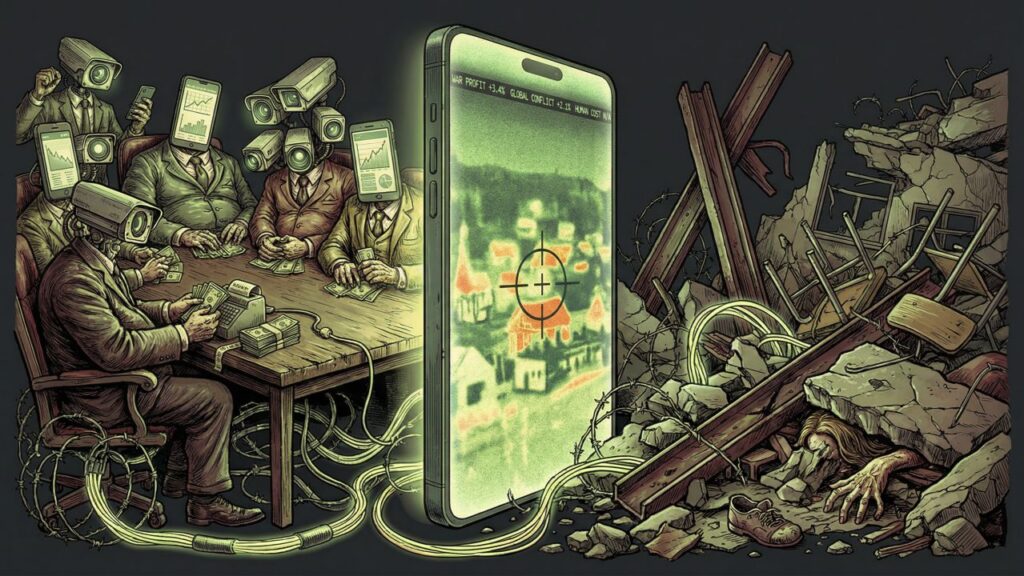
Once, if a ruler wanted a war, he had to imagine his own dead, had to picture his own cities burning, faces he recognized screaming. The king rode with his men. The senator’s son carried a rifle. Now a minister signs a memo, an operator clicks a mouse, and a human being on the other side of the planet becomes a smear of light on a thermal screen. Remarque described that distance a century ago in the trenches, young Paul Baumer watching his humanity drain away until he became, in his own words, a human animal, and that was with bayonets and mustard gas, face to face. Imagine what the distance does when the killer never sees the killed, never smells the blood, never hears the scream, just watches a pixel flare and fade on a monitor in an air conditioned room.
What began as a promise, “precision” that would supposedly make killing less barbaric, ripened into something worse than barbarism: easy wars, fought at a distance, managed like risk portfolios, pitched as sterile “options” in a slide deck by the haves against the have-nots. The haves have no interest in competing, sacrificing, or embracing the utilitarian will that the have-nots live every second of every day. They prefer managed slaughter from altitude.
The twisted steel and scattered flesh at the other end never appear in the spreadsheet. The people who die exist as coordinates, metadata, probabilities, “signatures” in the ether. Sons, daughters, lovers, reduced to patterns and eliminated as anomalies. Think of the girls’ school in Iran, blown apart by an American Tomahawk. Think of all the economic and collateral wreckage inflicted on an innocent Iran, over and over, to satisfy the Blob’s need to feel in control.
The distance is not just physical; it is moral. The screen filters out the blood, the smell, the pleading. In that filtered space, conscience survives only as theater: checklists, legal reviews, post-strike assessments drafted in the passive voice. Props to wave around when the ghosts show up at three in the morning. Conscience becomes a performance, not a wound. Vonnegut knew this. “So it goes” was not flippancy; it was the sound of a man who had walked through the charnel house of Dresden and understood that the people who order the fire never stand in it.
On the home front, war is no longer a rupture in normal life; it is one of the ways normal life is kept going. Missiles are manufactured in districts that need jobs. Spyware and cameras are marketed as growth sectors. “Security” programs pour contracts into universities and startups. War creeps into pension funds, index funds, university endowments, and campaign war chests, a trickle down lattice of blood and dividends. Like Huxley’s soma, the dividends keep the populace docile; you do not bite the hand that feeds your 401(k), even when that hand is covered in someone else’s blood.
The same hand that taps a screen to summon a ride can, in another context, tap a screen that erases a family line. The same companies that map your cravings for advertisers map “patterns of life” for targeting. The same undersea cables and satellites that carry lullabies and love notes carry kill orders and sanction lists. It all feels seamless, frictionless, inevitable, as if history itself had become a user interface, smoothing away the feel of consequences. That mailbox, that rotary dial phone, that letter in the mail, have been replaced with the efficiency of electrons, awaiting the full bloom of AI.
No one at the command end needs to see the other end. They see dashboards: threats reduced, exposures hedged, volatility managed. The dead are not absent; they are background noise, “collateral,” a variable to be minimized in the next software release.
Underneath all of this, the oldest question keeps scratching at the door: Is this just what we are?
Generations before us watched trenches fill, camps expand, cities vanish in fire, men yanked from crowds and shot in pits. Some concluded that cruelty was the rule and kindness the exception, a brief glitch in the code. Golding put a batch of schoolboys on an island and watched civilization peel off them like wet paint, the conch smashed, Piggy murdered, the hunters howling with pig blood on their faces, and when the naval officer finally arrived on the beach in his crisp uniform with his big ship, he was not salvation; he was only a larger, better armed version of the same animal. Others, standing at podiums with medals still warm on their chests, insisted that man would not merely endure but prevail because he possessed something beyond the sum of his fears: a soul, a spirit, a voice. Faulkner said that in Stockholm in 1950, and he meant it, and it was beautiful, and it may have been wrong.
They worried, rightly, that the great new weapons would terrify us into silence, that writers and artists would forget the old truths of the heart and spend their days circling the bomb. They believed that if we could hold onto those truths, love, honor, pity, pride, compassion, and sacrifice, the future might still be written in human language rather than actuarial tables. Shute wrote On the Beach to show what happens when we fail: the radiation drifts south, Melbourne waits, nobody riots, nobody storms the parliament, they just garden and fish and take the government pills and die politely, because by then there is nothing left to do. That is the real horror of his book. Not the war. The resignation after.
They did not live long enough to see this part. The bomb turned out not to be the only way to drain the heart. The network did its own slow work. It did not explode over cities; it seeped into bedrooms. It did not force anyone to be silent; it trained them to talk constantly without ever saying anything that would threaten the wiring. It did not have to ban hope; it smothered hope under a constant, low grade avalanche of stimulation and managed outrage. Bradbury’s Captain Beatty explained the method a half century early: speed up the film, quicken the pace, pack in the fun, cram the pages with factoids and sensation until nobody has time to think, and then the firemen are barely necessary because the people have done the burning themselves.
The result is a particular kind of person, call him anonymous, call him Holden shaped, call him Billy Pilgrim unstuck in time, who walks through all this unable to stop noticing the phoniness and the savagery but unable to find a ledge to stand on. He sees the scam, feels the toothache of its wrongness, knows at some level that the boys on the island have turned into hunters and that the grownups arriving on the beach with their crisp uniforms and big ship are only a different species of the same animal. He knows the god in the machine is just another officer asking, “Who will save the vessel,” while the smoke of another forest fire curls into the sky. He knows that Bluto’s answer, the pie in the face, the middle finger, the parade float through the homecoming crowd, is satisfying for exactly five minutes before the dean and the Omegas reconsolidate and nothing changes.
He also knows he is not special. He is old enough now to see the end of his own road. The slogans about prevailing and enduring have worn thin. The phrase that sits most comfortably on his tongue is that tautology: it is what it is. So it goes. A perfect circle. Nothing enters, nothing escapes.
And yet, in the same breath, something in him still swings for the fence. The instinct to fight, to testify, to scratch on the wall of his cell remains. Not because he believes it will work, not because he believes in some inevitable arc of justice, but because something in his wiring will not let him go completely limp while the lights are still on. Montag ran from the firemen with a book in his hands, not because he had a plan, but because something in him refused to watch one more page burn. Winston Smith wrote in his diary, knowing the Thought Police would find it, knowing it was futile, because the act of writing was itself the rebellion. The impulse is older than strategy. It is biological. It is what Faulkner called the puny inexhaustible voice, still talking.
That is where this piece I am writing lives: in the contradiction between “I do not give a fuck” and the fact that I keep talking anyway. Between Faulkner’s faith that man would “not merely endure” but “prevail” and the creeping suspicion that the voice may turn out to be puny after all, that it will endure only as a sound, not as a victory, still talking when the last worthless rock hangs tideless in the last red and dying evening.
It is going to get ugly from here. The systems are too entrenched, the incentives too misaligned, the tools too potent, the brakes too weak. The empires of silicon and steel will drive themselves forward until they hit the limits of physics, biology, or both. The people at the consoles will tell themselves they had no choice. The people under the flight paths will say they never had one.
In the end, there may be no grand vindication, no last minute turn, no chorus rising in the name of man. There may be only a few scattered voices on forgotten channels, saying, as clearly as they can before the signal dies: this is what we built, this is what it did to us, this is how it felt to be here while it happened.
You are one of those voices. This is one of those channels.
Related reading
- A Bill of Indictment for Murder and Genocide Against the American Military and Trump, as its Commander and Chief
- Обвинительное заключение по делу об убийстве и геноциде против американских вооружённых сил и Трампа как их Верховного главнокомандующего
- Stop Calling It News. Gulf State “Reporting” Is Trump’s Bullshit With A Gulf State Palace Seal.
- American Empire in Ruins: The Unprovoked, Unconstitutional, and Catastrophic US-Israeli War on Iran