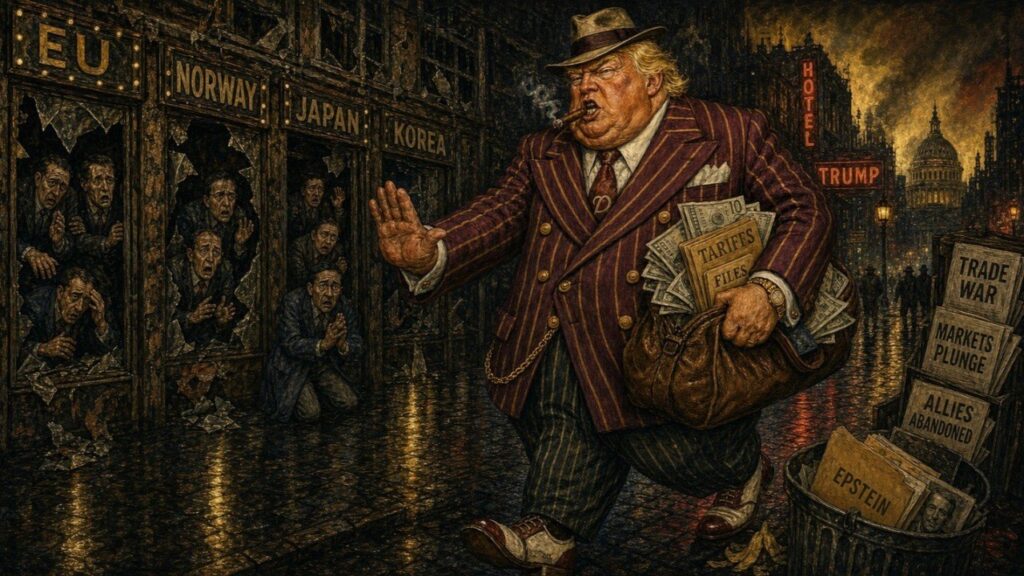
“Ya got nuttin’ on me wit dat Epstein you can prove; besides, we took care of him.”

Trump imposed tariffs on sixty allied economies while his Justice Department buried the Epstein files at home. The same instrument, leverage, runs both operations. This article indicts a twisted president who extorts foreign governments in public and behaves, in his own capital, like a blackmail victim.
By Scott Ortkiese | July 24, 2026 | Email: so@throughlinesynthesis.com
There is a particular kind of American absurdity in watching a president extort sixty foreign governments in the morning and stonewall his own base about a sex trafficker’s client list in the afternoon. It is the same instrument in both hands. Leverage held, leverage denied, leverage laundered through legal fictions. The country that lectured the world for eighty years about the rule of law now runs foreign and domestic policy on the mechanics of a shakedown.
On July 24, 2026, the Office of the United States Trade Representative imposed Section 301 tariffs of 10 percent or 12.5 percent on sixty economies, covering 99.4 percent of American imports, on the stated ground that these countries had failed to enforce prohibitions on goods produced with forced labor (USTR; Reuters). The list includes the United Kingdom, the European Union, Japan, South Korea, Canada, Mexico, India, Norway, New Zealand, Australia, and Israel, alongside China, Russia, and Vietnam (White House). Kaja Kallas, the European Union’s foreign policy chief, put the reaction plainly: “You can’t say that for the European Union. If you compare our labour laws to the ones of the United States, I mean, we have paid vacations, we have very good labour conditions for our employees, so it’s not really grounded” (TVP World). Australia, Brazil, Norway, and New Zealand rejected the rationale as unjustified or without basis (CNBC).
Trade economist Caroline Freund said the quiet part into a BBC microphone. The tariffs are “not about forced labour.” The administration was “looking for a legal reason to put the tariffs in” after the Supreme Court struck down the emergency-powers version in February 2026 (Peterson Institute). The Peterson Institute’s Chad Bown reached the same conclusion: the administration has cycled through three separate legal rationales for the same policy in eighteen months, each one a search for a statute that will let the president do what Congress has not authorized (Peterson Institute).
That is the definition of the thing. When the stated reason is a pretext, when trading partners are handed a bill and told the surcharge can be renegotiated bilaterally, when the “violation” is announced against countries with better labor protections than the accuser, the tariff is not a tariff. It is a demand letter. The real ask is unstated, which is the classical structure of extortion. Norway, whose labor code is the envy of the industrial world, is being told that its 12.5 percent penalty can be discussed. Discussed in exchange for what, precisely, is left to the imagination and to the phone call.
This is blackmail of nations. It is coercion under color of law. And it is being conducted by a president who cannot, or will not, produce the Epstein files.
The domestic ledger is where the irony bites. On July 3, 2026, the Department of Justice declined to turn over additional Epstein documents to Congress, defending its own redactions and asserting compliance with the Epstein Files Transparency Act on terms the department itself narrowed (ABC News; Democracy Defenders Fund). Attorney General Pam Bondi, who last year waved a binder in front of cameras and promised the client list, spent late June being grilled in the Senate over a Trump-Epstein email that surfaced in the record and over her own shifting account of what the department holds (Eastern Herald). Deputy Attorney General Todd Blanche, Trump’s former personal lawyer, told his confirmation hearing that “no investigations are closed” while simultaneously defending the department’s refusal to release material (PBS; Fox News). Vice President Vance conceded on July 15 that the administration “screwed up” its communications on the files and separately volunteered, in an interview flagged by Al Jazeera, that Epstein was linked to Israeli and American intelligence (Boston.com; Al Jazeera). One does not concede a foreign intelligence connection to the client list of a dead sex trafficker unless the client list is doing work.
The pattern from the White House is not the pattern of a man in control of his own file. It is the pattern of a man managing exposure. Susie Wiles runs the West Wing schedule around a client-list story that will not die. Bondi is deployed as the shield and, when the shield cracks, as the deflection. Blanche is installed to keep the door closed at DOJ. Ghislaine Maxwell’s counsel, David Oscar Markus, negotiates with the same Blanche who represented Trump. Every operational choice reads as a coverup, and coverups are how blackmail victims behave.
Set the two ledgers side by side.
Abroad, Trump uses a pretextual statute to squeeze allies for concessions he has not defined. The Peterson Institute expects the Supreme Court to strike this version down too, because Congress did not delegate global tariff authority to the president and cannot constitutionally do so (Peterson Institute). The tariffs are meant to run until they are stopped, and the running is the point. Every week the levy is in place is a week Norway, Japan, Korea, and the European Union are negotiating with a gun on the table.
At home, someone else appears to be holding the gun. Whether the leverage is documentary, financial, personal, or all three, the behavior is legible. A president who genuinely had nothing in the file would release the file. A Department of Justice that genuinely had nothing to protect would not need to narrow the definition of “compliance” until the statute becomes decorative. A vice president who did not want the intelligence angle in the story would not volunteer it.
The irony is not that a blackmailer can also be blackmailable. Blackmailers are almost always blackmailable, because the same personality that reaches for leverage over others has usually left leverage lying around for someone to pick up. The irony is that the American system, which was built to prevent exactly this kind of concentrated, personalized, extortionate authority, is now being run by a man who exercises it against sixty foreign governments and submits to it in his own capital.
Kallas asked, in Manila, on what basis the tariffs were imposed. It is a question the Congress, the courts, and the American press should be asking about a great deal more than trade. The answer, in both directions, is the same. Leverage. Held when it is his. Applied when it is others’. Denied when it is against him. This is not statecraft. It is a protection racket with a flag on the door.
The Republic that spent eighty years telling the world that no one is above the law is now governed by a man who is neither above it nor beneath it, but outside of it entirely. That is the empire in its final register. Not the rule of law. The rule of the file.
Scott Ortkiese is President and CEO of Faulkner Capital Holdings. Underlying long-form analysis and documentation is available on request at so@throughlinesynthesis.com. Archive: throughlinesynthesis.com.
Sources
-
Office of the United States Trade Representative, “USTR Takes Action in Forced Labor Section 301 Investigations,” July 23, 2026. https://ustr.gov/about/policy-offices/press-office/press-releases/2026/july/ustr-takes-action-forced-labor-section-301-investigations
-
The White House, “Actions by the United States in the Investigations under Section 301 of the Trade Act of 1974,” July 23, 2026. https://www.whitehouse.gov/presidential-actions/2026/07/actions-by-the-united-states-in-the-investigations-under-section-301-of-the-trade-act-of-1974-of-the-acts-policies-and-practices-of-60-economies-related-to-the-failure-of-each-economy-to-impose-and/
-
Reuters, “Trump imposes new global tariffs, drawing protests from trading partners,” July 24, 2026. https://www.reuters.com/world/us/trump-imposes-forced-labor-duties-60-trading-partners-as-10-us-tariffs-expire-2026-07-24/
-
CNBC, “Trump’s new global tariff draws rebukes from trade partners,” July 24, 2026. https://www.cnbc.com/2026/07/24/trump-global-tariffs-trade-imbalance-forced-labor.html
-
TVP World, “EU questions new US tariffs over forced-labor claims,” July 24, 2026. https://tvpworld.com/94502143/kaja-kallas-says-us-tariffs-on-eu-goods-are-unfounded
-
Peterson Institute for International Economics, “Trump’s new tariffs over forced labor are unlikely to survive court,” July 23, 2026. https://www.piie.com/blogs/realtime-economics/2026/trumps-new-tariffs-over-forced-labor-are-unlikely-survive-court
-
ABC News, “DOJ declines to turn over additional Epstein files, says redactions were appropriate,” July 3, 2026. https://abcnews.com/Politics/doj-declines-turn-additional-epstein-files-redactions/story?id=134430675
-
Democracy Defenders Fund, “DOJ Claims Full Compliance with Epstein Transparency Act While Limiting Its Review of Record,” July 3, 2026. https://www.democracydefendersfund.org/news/doj-claims-full-compliance-with-epstein-transparency-act-while-limiting-its-review-of-record/
-
Eastern Herald, “Bondi Grilled Over Epstein Files as Trump Email Surfaces,” July 1, 2026. https://easternherald.com/2026/07/01/bondi-epstein-files-congress-clinton-aide-trump-email/
-
PBS NewsHour, “3 major takeaways from Todd Blanche’s attorney general confirmation hearing,” July 15, 2026. https://www.pbs.org/newshour/politics/what-blanche-said-about-trump-epstein-files-during-confirmation-hearing
-
Fox News, “Todd Blanche says ‘no closed investigations’ in Epstein case, vows DOJ will pursue new suspects,” July 15, 2026. https://www.foxnews.com/politics/todd-blanche-says-no-closed-investigations-epstein-case-vows-doj-pursue-new-suspects
-
Boston.com, “Vance: Administration ‘screwed up’ communications on Epstein files,” July 15, 2026. https://www.boston.com/news/politics/2026/07/15/vance-administration-screwed-up-communications-on-epstein-files/
-
Al Jazeera, “Epstein linked to Israeli ‘deep state’, US intel, says Vance,” July 16, 2026. https://www.aljazeera.com/news/2026/7/16/epstein-linked-to-israeli-deep-state-us-intel-says-vance-what-we-know
Related reading
- A Bill of Indictment for Murder and Genocide Against the American Military and Trump, as its Commander and Chief
- Susie Wiles Can’t Restrain Trump, So She Covers for the Malignant Orange Baby
- Holy Trump or Evangelical Scholar? Neither. Just a Nincompoop Babbling to Morons on the 4th of July
- Altman's Desperation & The Shakedown Republic: How Trump and the AI Oligarchy Turned a Bubble Into a Protection Racket