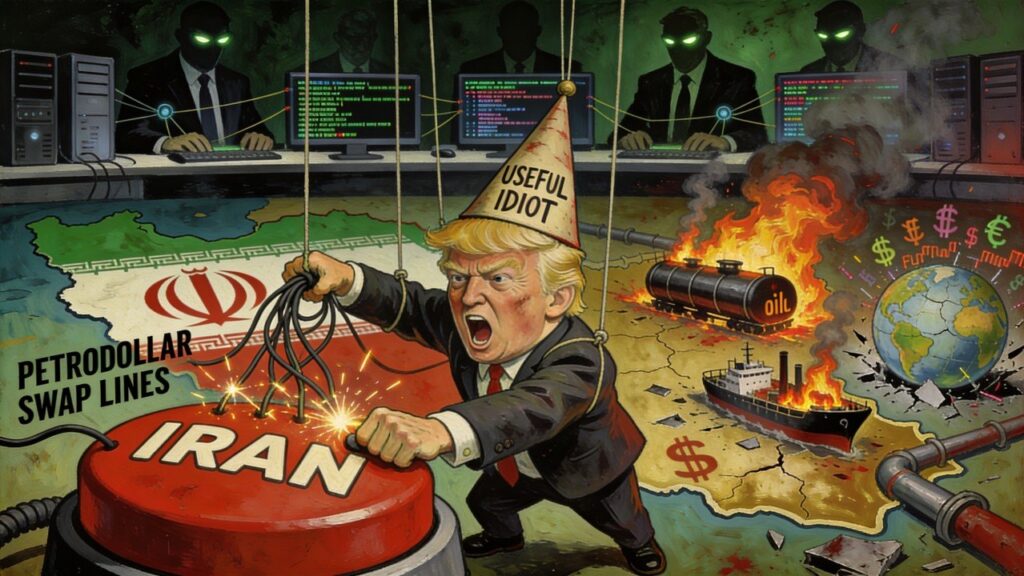
Clueless and bellicose by design.
April26, 2026
By Scott Ortkiese | so@throughlinesynthesis.com | www.througlinesynthesis.com
Let’s stop flattering ourselves. Let’s stop hiding behind euphemisms, policy jargon, market language, and the narcotic little phrases that make catastrophe sound like a weather event. The American people elected Donald Trump, and in doing so they placed sovereign power in the hands of a vulgar, impulsive, easily purchased man who was perfectly suited for one historical function: to serve as the useful idiot of oligarchic capital at the exact moment that artificial intelligence, financial power, militarized logistics, and imperial decay fused into a single system of accelerated predation. Trump did not invent that system. He was chosen because he could carry it forward while the public remained stupefied by spectacle, grievance, branding, and the endless sugar-pellet distractions of consumer life.
This is not merely a story about one man’s defects. It is a story about alignment. Trump is the loud, stupid, theatrical face of an order whose real center of gravity lies with men like Peter Thiel, David Sacks, Scott Bessent, JD Vance, and the transatlantic managerial class that includes figures like Ursula von der Leyen. Some of them are financiers, some are ideological entrepreneurs, some are political salesmen, some are the respectable laundering layer that explains to the public why the obscene must be accepted as necessary. Together they form a structure. The structure is sovereign in scale. It wants to govern through code, capital, infrastructure, executive power, emergency law, military compulsion, and managed narrative. It does not want to govern through democratic consent because democracy is slow, messy, unpredictable, and morally inconvenient for people who want to reorder the world faster than citizens can resist.
That is why it is a mistake to treat Trump as a freak interruption inside an otherwise functioning republic. He is not an interruption. He is a revelation. He shows what American power looks like when its restraints have rotted away and when the money behind it has decided that normal constitutional procedure is too cumbersome for the tasks at hand. Artificial intelligence is one of those tasks. The destruction and replacement of older forms of financial sovereignty is another. Permanent war remains another. The dismantling of state-level resistance and the bypassing of legislatures is another. Trump is useful because he has no principled attachment to anything outside himself. He can sign whatever is put in front of him. He can shout whatever story is needed. He can turn savagery into patriotic theater.
The title of this piece says “for AI,” and that matters, because the AI revolution is not some separate technological subplot running alongside imperial decline. It is one of the central engines of the current order. The same people who want data centers at continental scale, energy access at military scale, surveillance reach at civilizational scale, and labor replacement at social scale also want a political environment in which public oversight is an afterthought and local resistance can be crushed. AI in this context is not primarily a convenience product. It is a command infrastructure. It is a tool for concentrating power, speeding decisions, enclosing data, disciplining labor, automating war, and making all of that look inevitable.
The political architecture around it is not subtle. Trump rescinded prior constraints, pushed an “AI leadership” agenda, and empowered figures like David Sacks, the PayPal Mafia venture capitalist turned White House AI and crypto czar, to shape policy in sectors where money and state power now bleed into each other. Peter Thiel’s networks supply ideology, personnel, and a worldview in which democracy is at best a bottleneck and at worst a sentimental obstacle to elite control. Sacks supplies the fusion of venture capital arrogance and state access. Trump supplies the signature and the circus. JD Vance supplies the adolescent rhetoric of strength and civilizational mission. Bessent supplies the financial cleanup, the emergency plumbing, the calm voice that says the blood loss can be managed after the arteries have already been cut. Ursula von der Leyen supplies the sanitized European version, the managerial face that claims to regulate while repeatedly bending the spine of public authority around the requirements of concentrated technological and financial power.
That entire alignment sits inside a larger imperial crisis. The American empire is not merely making mistakes. It is in accelerated decline. The petrodollar system that helped anchor American supremacy for half a century is not fraying, not weakening slowly, not facing “headwinds.” It is being burned alive by conscious American actions carried out by fools, oligarchs, sycophants, and imperial managers who either do not understand what they are breaking or do understand and think they can ride the collapse while ordinary people absorb the cost.
This is where the economic contagion comes in, and it is astonishing how many people still refuse to see it. The International Monetary Fund has already cut global growth forecasts and directly linked that downgrade to the widening Middle East war. The Federal Reserve’s 2026 stress scenarios contemplate a severe global recession, sharp moves in Treasury yields, major asset-price declines, and financial instability. Industry and market reporting has warned that the Iran war threatens key parts of the global economy through oil disruption, shipping stress, supply-chain breakdown, and broader funding strains. These institutions and outlets use technical language because they are institutionally incapable of speaking like honest human beings in the middle of a fire. They speak of “stress,” “downside risks,” and “headwinds.” In plain language, Trump and his team have pushed the world economy toward another systemic convulsion, and this one tears through energy, sovereign finance, currency markets, employment, and geopolitics all at once.
To understand how the catastrophe unfolds, start with the petrodollar mechanism. For decades, Gulf states sold oil and gas in dollars, accumulated dollar surpluses, and recycled those surpluses into U.S. Treasuries, Wall Street assets, and the wider architecture of dollar hegemony. This was not a natural law. It was a political arrangement built on coercion, alliance, dependency, military guarantees, and energy centrality. Gulf sovereigns did not simply earn money. They became a structural pillar of American financial supremacy. Their export revenue helped finance the deficits, bubbles, market valuations, and geopolitical posture of the United States.
Now look at what Trump has done. By widening war against Iran, threatening the Strait of Hormuz, and destabilizing the very region that generates those dollar flows, he has attacked the revenue base of the sovereigns whose recycling behavior long helped sustain the U.S. system. Scott Bessent now publicly defends swap lines and emergency dollar support for Gulf and Asian partners because the administration knows exactly what comes next if those sovereigns cannot get dollars through ordinary export channels.
The mechanics are brutal and simple. A sovereign that earns dollars from oil exports and owes debts in dollars expects its incoming revenues to service its obligations. If the revenue stream is blocked, but the debt remains due, the sovereign must find dollars somewhere else. That is not a matter of opinion. That is balance-sheet reality. If Gulf sovereigns cannot count on uninterrupted dollar income because war and blockade conditions have impaired normal trade, then they face a dollar shortage. If they face a dollar shortage, then they need liquidity immediately. If Washington does not provide that liquidity through swap lines or equivalent emergency facilities, then those sovereigns must raise dollars by liquidating assets.
And what assets do they hold? U.S. Treasuries. U.S. equities. Dollar claims. Financial instruments embedded in the very markets that form the symbolic and material core of American power. If they begin selling Treasuries, prices fall and yields rise. Rising yields tighten credit across the entire American economy, increase the federal government’s own debt service burden, and hit mortgages, consumer loans, business credit, and investment at the same time. If they sell equities, valuations crack. Other holders of dollar assets begin reassessing their own exposure. Funding conditions worsen. Financial instability spreads.
That is not a local Gulf story. That is the pathway from war shock to sovereign funding stress to Treasury market turbulence to global contagion. That is why the G20 is not “vulnerable.” The G20 is in the blast radius. Japan, South Korea, Germany, Italy, India, Saudi Arabia, Turkey, Brazil, South Africa, Indonesia, and much of the rest of the world are tied into the same web of energy dependence, trade finance, debt exposure, currency pressure, and asset-market interdependence. When Washington destabilizes the energy artery and the dollar-recycling mechanism at the same time, it is not merely endangering “allies.” It is detonating a chain reaction through the core institutions and balances of the world economy.
Japan and South Korea are staring at imported energy stress, maritime insecurity, and deeper dependence on an American security architecture that has itself become a source of instability. Europe faces yet another wave of industrial pain, inflationary pressure, and strategic humiliation after years of self-destructive obedience to Washington’s escalatory posture. The Gulf states are cornered inside a system they helped stabilize, now reduced to seeking direct access to dollars so they do not have to blow up the markets of the hegemon they spent decades subsidizing. The Global South is again lined up for devastation through higher food and fuel costs, tighter financing, weaker currencies, and the collapse of already narrow social margins.
That is what global contagion means in practice. First the war threatens oil flows. Then prices rise and shipping becomes more expensive and less predictable. Then import-dependent states face worsening trade balances and inflation. Then central banks get trapped between supporting growth and defending currencies. Then debt service becomes more punitive. Then capital seeks safety, sovereigns seek dollars, and markets begin to wobble. Then credit tightens, layoffs spread, investment stalls, and recession ceases to be a forecast and becomes lived social reality. By the time policy elites admit contagion, the damage has already torn through households, firms, and governments.
Trump, Bessent, and their defenders want the public to imagine that swap lines are evidence of prudent management. No. In this context, a swap line is an emergency transfusion because the empire itself severed the circulation system. Reporting in April 2026 described Gulf requests for dollar support and Bessent’s defense of such support as an extraordinary measure in response to war pressure. The administration is not rescuing innocent partners from an external shock. It is trying to prevent those partners from liquidating the American assets that symbolize U.S. financial dominance after Washington itself helped trigger the shortage.
The old aura of effortless supremacy disappears the moment the world sees that reserve-currency privilege now depends on emergency discretion from a panicked hegemon. Once the system requires behind-the-scenes dollar lifelines to keep allied sovereigns from dumping Treasuries, the mystique is gone. The message to every serious state on earth is obvious: dependence on the U.S.-centered order is now a strategic liability. The issuer of the reserve currency is no longer merely domineering. It is erratic, militarized, self-destructive, and politically governed by fools.
If all of this remained “over there,” the danger would already be immense. But it does not remain over there, because the empire is rotting from the inside at the same time. This is one of the most morally disgusting features of the present moment. The same American ruling class willing to gamble with global economic contagion has already hollowed out the domestic economy and then trained the population to mistake fragility for normalcy. Young people, including advanced degree holders, are entering a labor market that increasingly offers gig work humiliation where careers once existed. The cost of living continues to outpace wage growth in the only way ordinary human beings actually experience economics: rent, food, transport, insurance, debt service, and everyday survival. A society already running on debt, precarity, emotional exhaustion, and permanent distraction does not absorb a financial and geopolitical shock with resilience. It cracks.
This is why the disappearing job market matters so much. It is not a side note. It is part of the same imperial decomposition. For decades, American elites gutted productive capacity, fetishized finance, offshored industry, inflated asset values, and sold the public the fantasy that paper wealth and elite consumption could substitute for broad-based material stability. Now the educated young contemplate a lifetime of Uber and Lyft work, not because they lack ambition, but because the economy no longer generates dignified pathways for ordinary competence and effort. Meanwhile, politicians continue to boast about growth, market highs, and strategic strength while households are crushed by prices and stagnating wages.
That domestic decay is what makes the external shock so devastating. This is not an empire at the peak of industrial vitality facing a temporary geopolitical storm. This is a decaying imperial system layered over a hollowed-out social foundation. When yields rise, when energy costs climb, when credit tightens, when portfolios wobble, the pain does not land on a healthy public. It lands on a population already battered by inflation, insecurity, and the collapse of expectations. That is why “recession” is far too mild a word for what can unfold. This is the convergence of financial contagion, imperial overreach, labor-market collapse, and political delirium.
Now place that beside the forever wars. Trump sold himself as a man who would end them. Instead, he has widened them. Ukraine drags on. Iran is added. Cuba has moved into his crosshairs as another possible site of compensatory aggression now that Iran refuses to yield a clean victory narrative. This is the rhythm of a decaying empire. When one theater becomes expensive, humiliating, or strategically stuck, the ruling class looks for another place to perform dominance, punish a weaker target, or create the illusion of momentum. It cannot stop because stopping would mean confronting reality. And reality is precisely what a declining empire has the least capacity to endure.
JD Vance embodies this moral and intellectual collapse perfectly. In the viral remarks circulating around the Iran war, Vance reduced the difference between Trump and prior presidents to one idiotic line: earlier presidents were “too dumb” to do what Trump is now doing. That is the vice president of the United States explaining war as though it were a schoolyard dare. No analysis of constraints. No understanding of deterrence, blowback, regional architecture, sovereign funding, oil chokepoints, or strategic costs. Just childish swagger. This is not a rhetorical slip. It is the distilled essence of the governing mentality. They confuse recklessness with intelligence. They believe limits are cowardice. They think history is a stage on which their own aggression proves manhood.
That same governing mentality drives the hypocrisy around Iran. Western media and diplomats compulsively count the violence of Iran while refusing an honest accounting of American violence over the same decades. The United States spent the last half century waging war, maintaining bases, carrying out interventions, supporting occupations, and participating in killing on a global scale. Yet its representatives can still appear on television and scold Iran as if Washington were the custodian of peace. This is more than hypocrisy. It is a symptom of imperial madness. A state that cannot truthfully measure its own violence cannot rationally assess its own decline. It loses the ability to distinguish self-defense from aggression, deterrence from fantasy, and strategic realism from propaganda.
The same applies to anti-Russian demonization. One of the reasons the public cannot understand the new global alignment is that historical memory itself has been manipulated into absurdity. Western publics increasingly forget, or are taught to forget, the central Soviet role in defeating Nazi Germany, the complexity of twentieth-century alliances, and the long arc of strategic tensions that shape contemporary Eurasia. Instead they are fed a cartoon moral universe in which Russia is pure evil, Western expansion is pure innocence, and every crisis is caused by the innate wickedness of official enemies. That is propaganda, not analysis. It prevents populations from understanding why Russia, China, Iran, India, and much of the Global South are now converging around alternative institutions, payment systems, and strategic alignments. Those states are not merely being “difficult.” They are responding rationally to a hegemon that has turned sanctions, finance, and war into instruments of systemic instability.
China in particular has read the American condition with far more clarity than the American elite has. Beijing sees a declining hegemon that still possesses enormous coercive capacity but increasingly uses that capacity in self-defeating ways. The more Washington weaponizes the dollar, destabilizes trade routes, bullies sovereigns, and requires emergency swap lines to hold the structure together, the more attractive non-dollar settlement, BRICS expansion, Eurasian corridors, and diversified reserve strategies become. Russia sees it. Iran sees it. India sees it. Much of the Global South sees it with the clarity born of experience. They have lived through Western lectures about rules while absorbing the consequences of Western wars, sanctions, and financial crises. They know that dependence on this order is now dangerous.
That is why even if Trump’s stupid, unprovoked war stopped today, the empire would still be dead on an accelerated decline. This must be said without hedging. The war is not the sole cause of collapse. It is the accelerant poured onto a structure already weakened by deindustrialization, elite theft, sanctions addiction, permanent militarization, political corruption, civic sedation, and a domestic economy that no longer produces broad dignity. The destruction of the petrodollar architecture is simply the first unmistakable sign that the old operating system is failing in full public view.
Once the sovereign allies of the United States require emergency access to dollars so they do not liquidate the very assets that represent American financial primacy, the game is up. Once markets understand that the hegemon cannot wage war, weaponize the dollar, and preserve its own monetary architecture at the same time, confidence changes form. It does not disappear in a single cinematic collapse. It shifts, reallocates, hedges, diversifies, and quietly votes against the future of the old order. Reserve managers notice. Sovereign wealth funds notice. Energy exporters notice. Import-dependent states notice. The memory of this episode enters strategic planning from Riyadh to Tokyo to Beijing to New Delhi.
The public, however, is being told to sleep through imperial death. Keep shopping. Keep scrolling. Keep tapping the little paddle for sugar tablets. Keep believing that a stock market held up by emergency support and elite panic management is proof of national health. Keep believing that if Trump stages one more theatrical victory, raises one more flag somewhere, bombs one more target, or shouts one more lie into the camera, then the system is still under control. It is not under control. It is in decomposition.
There is no kindness waiting at the end of this for ordinary human beings. Efficiency does not contain kindness. Venture logic does not contain kindness. Emergency financial engineering does not contain kindness. Trump does not contain kindness. Bessent’s swap lines do not contain kindness. Vance’s stupidity does not contain kindness. Thiel’s worldview does not contain kindness. Sacks’s AI regime does not contain kindness. Ursula von der Leyen’s polished managerial euphemisms do not contain kindness.
Related reading
- The Humans Elected a “Useful Idiot” for AI; They Will Be Repaid with Everything But Kindness
- The American People Are More Objective About President Trump's Actions Than Democratic Party Leadership
- Altman's Desperation & The Shakedown Republic: How Trump and the AI Oligarchy Turned a Bubble Into a Protection Racket
- Diogenes Found His Honest Man, Elon Musk, And the Uni-Party Promptly Destroyed Him