Note to my readers:
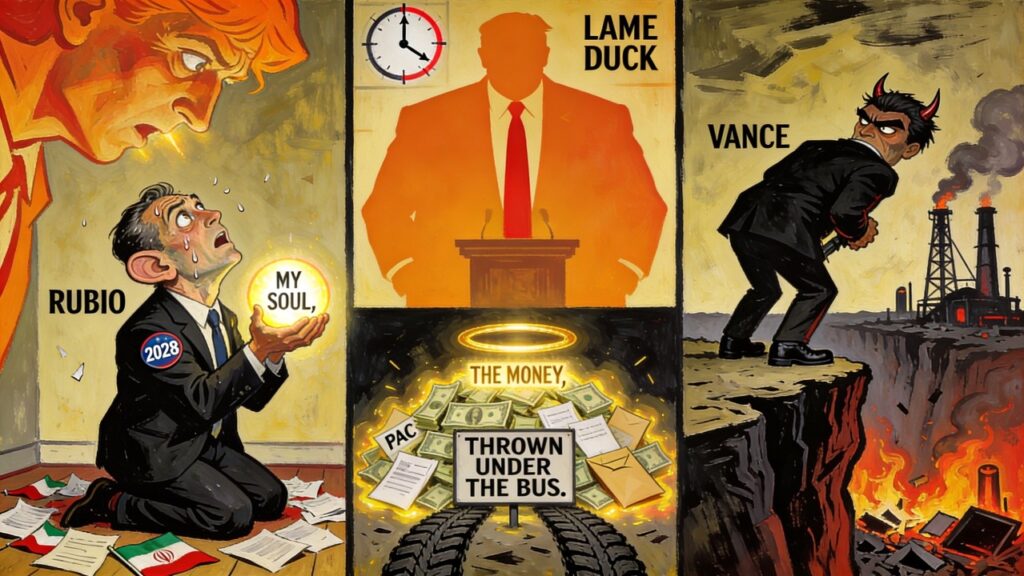
The entertainment value of watching Rubio dance for the Donald would be hilarious if Trump weren’t using Rubio’s obedience to blow up Iran and the global economy. Meanwhile, the Big Orange Farce isn’t talking about inflation, Epstein, his polling numbers, or the midterms. Life will be as unkind to that lame duck as he was to Joe Kent on his way out the door. Strong message to follow. Chuck you, Farley.
Scott Ortkiese March 26, 2026
Marco Rubio made his bet. He looked at the wreckage of his 2016 campaign, the moment he called Donald Trump a con man and a fraud on a debate stage in front of the entire country, and then got humiliated in his own state, and he decided that the path back ran straight through complete, unconditional submission. He became Secretary of State. He became National Security Adviser simultaneously, a consolidation of roles with no precedent in American history, the kind of power grab that, in any functioning republic, would have triggered immediate congressional hearings. He made himself the sole funnel through which all intelligence reached a man who believes he understands geopolitics because he once built a golf course in Scotland. And then he used that position to ensure that a peace deal with Iran, one that the Omani foreign minister described as hours away from completion, one in which Tehran had made sweeping concessions on enrichment and put UN inspectors on the table for the first time in history, went nowhere. The bombs fell instead.
That is Marco Rubio’s legacy now. Not the immigration work. Not the Cuba hawkishness. Not the earnest young senator from Florida who was supposed to be the future of a diverse, modern Republican Party. His legacy is this war. His legacy is 163 schoolgirls in Minab, between the ages of six and twelve, dead. His legacy is the Strait of Hormuz closed, oil markets detonating, and the entire Middle East in flames, started by a president who, as Steve Witkoff confirmed on camera, genuinely believed that parking an aircraft carrier near Iran’s coast would cause 90 million people to immediately surrender. This is the man Rubio chose. This is the war Rubio enabled. He was the funnel. He made sure nothing else got through.
And let us be precise about what Rubio has become, because euphemism does not serve the historical record. This is a man who stood on a national stage and diagnosed Trump with the accuracy of a forensic pathologist, the con man, the fraud, the man who inherited his father’s money and burned through it, and then, when the diagnosis proved correct and the patient became president anyway, decided that the correct response was to become the most devoted tongue-bather in the American cabinet. He didn’t just bend the knee. He dissolved. He became a political substance with no independent shape, no discernible spine, and no remaining identity except his proximity to power and his usefulness as a vector for delivering war to a president too intellectually incurious to ask what it was for. Marco Rubio is what happens when ambition is not disciplined by either principle or self-respect. He is the cautionary tale that future political science professors will use to explain what a man looks like after he has fully consumed himself. The GOP nomination he craves? He won’t get it. The base doesn’t reward servants. It rewards killers. And everyone can smell the servility on him from across the room.
And then there are Lindsey Graham and Ted Cruz, two men who deserve not a mention but a monument to moral bankruptcy, erected at the intersection of cowardice and calculation, open 24 hours, admission free. Lindsey Graham, the man who called Trump a race-baiting, xenophobic bigot and unfit for office, all on the record, all on camera, who then spent the next eight years perfecting the art of the complete and total self-erasure, reinventing himself as Trump’s caddy, his hype man, his golf partner, his obsequious little shadow at Mar-a-Lago. Graham didn’t just sell his soul. He donated it, gift-wrapped it, and asked for nothing in return except continued access to a man he privately despises and publicly worships. He bragged, on camera, that he worked directly with Netanyahu to coach him on how to convince Trump to attack Iran. He is, in the plainest possible English, a foreign government’s lobbyist wearing a United States Senator’s lapel pin, and he has never faced a single consequence for it. Ted Cruz, the man whose wife Trump insulted, whose father Trump baselessly linked to the Kennedy assassination, who called Trump a “sniveling coward” and a “pathological liar” on the record, crawled back so fast and so completely that the skid marks are still visible on the Senate floor. Cruz has spent years auditioning for the role of Trump’s most enthusiastic endorser, most aggressive defender, and most shameless apologist, apparently operating on the theory that if he humiliates himself completely enough, loudly enough, and for long enough, the base will eventually mistake self-abasement for strength. It has not worked. It will not work. What Graham and Cruz have accomplished together is a remarkable political achievement: they have made themselves simultaneously ridiculous and dangerous, too craven to be respected, too powerful to be ignored, and too compromised to ever be trusted with anything that matters again.
And for what, for Rubio, for Graham, for Cruz, the answer is the same: the GOP nomination in 2028. The brass ring. The thing they’ve each wanted with a desperation that has curdled into something ugly and visible. Here’s the problem: they’ve made themselves unelectable in the same transactions. The Republican base that will decide that nomination wants a fighter, not a functionary. They want someone who dominates, not someone who manages the optics of a catastrophe. Rubio has spent three years being Trump’s most useful instrument, carrying his water, filtering his intelligence, absorbing his humiliations and calling it statesmanship. Graham has spent eight years being his most reliable sycophant. Cruz has spent eight years being his most embarrassing supplicant. None of them has a record a serious candidate can run on. All of them are chained to a war that 71% of Americans oppose, prosecuted by a president with the strategic depth of a demolition derby. The soul-selling was visible, it was public, and it was permanent.
JD Vance is a different story, and here’s where it gets interesting.
Vance was thrown under the bus before the war even started. The Omani mediator, fresh from Geneva, flew to Washington and went straight to the Vice President’s office. “We almost have a deal.” Within hours, the bombs were falling. Vance wasn’t consulted. Vance wasn’t in the room. Rubio had made sure of that. The Vice President of the United States learned about his own administration’s war the same way the rest of us did, after the fact, from the news. Trump, the self-proclaimed dealmaker, blew up an actual deal and sent his own Vice President to find out about it on television.
If that doesn’t clarify your position in this White House, nothing will.
So Vance faces the oldest question in politics: do you go down with the ship, or do you get off while you still can? The calculus here is not complicated. He has no loyalty left to honor, it wasn’t reciprocated. He has no intelligence access to protect, he’s already been cut out. He has no political future inside Trump’s orbit, Rubio has consumed it. What he has is a platform, a national profile, a reputation as the working-class intellectual of the American right, and, crucially, the one thing that Trump, Rubio, Graham, and Cruz currently share in common: none of them can say “I told you so” and be believed. Vance still can.
The midterms are coming. The math is unforgiving. A war the majority of Americans oppose, an oil shock feeding into inflation, body bags arriving home from a theater with no exit strategy, and an economy already wobbling before the first Tomahawk was fired. That is the Republican Party’s electoral environment in November. The losses will be significant. The recriminations will be vicious and personal. Someone will need to be the adult in the room who saw it coming, who said something, who stood apart from the catastrophe while there was still time.
That someone could be JD Vance. The window is closing fast. If he’s already on record, measured, constitutionally grounded, invoking the very principles of restraint and non-interventionism that got Trump elected in the first place, when the wreckage comes in, 2028 is his. Not Rubio’s. Not Graham’s. Not Cruz’s. His. If he waits, he goes down with the ship like every other senator, general, and cabinet secretary who decided that loyalty to Donald Trump was a sound long-term investment. History has a perfect record on that question, and it is not encouraging.
Rubio sold his soul and got a war named after his silence. Graham sold his dignity and got to keep his Senate seat, his defense contractor donors, and the satisfaction of watching a country he helped light on fire burn from a safe distance. Cruz sold his self-respect and got reelected, richly funded, and thoroughly insulated from every consequence of every catastrophe he cheered on. All three of them collected their real reward along the way: the stamp of approval from a poll-neutered president who is already a lame duck waddling toward irrelevance, and the only thing all four of them have ever truly worshipped, the thing that makes the flag-waving and the Constitution-quoting and the democracy-defending nothing more than a stage performance staged for rubes: the money. The contracts. The donors. The PACs. The speaking fees. The insider advantages. The portfolios quietly appreciating while the bombs fall. All of it wrapped in the flag of a democracy they have committed treason against with every vote cast, every peace deal sabotaged, every foreign government lobbied, and every constituent lied to from a podium draped in the very symbols they have spent their careers desecrating. The only people who paid were the ones who always pay, the ones without lobbyists, without PACs, without Mar-a-Lago memberships: the schoolgirls in Minab, the soldiers without interceptors, the families watching their heating bills detonate while these men count their blessings and talk about freedom. Vance still has his soul. The question is whether he has the nerve to use it, because the man who threw him under the bus is running out of road, the bus is on fire, and the passengers who jumped off early are the only ones who will be in any condition to drive what comes next.
If I’m lying, I’m dying.
Related reading
- Trump, Rubio, Vance, and the Midterm Reckoning
- The Kimi K3 Reckoning: The AI IPOs Didn’t See It Coming
- Генерал «Предай-США» (Betray-U.S.), он же Дэвид Петреус, идеально иллюстрирует оксюморон: военная разведка
- General Betray-Us, aka David Petraeus, Perfectly Illustrates the Oxymoron: Military Intelligence