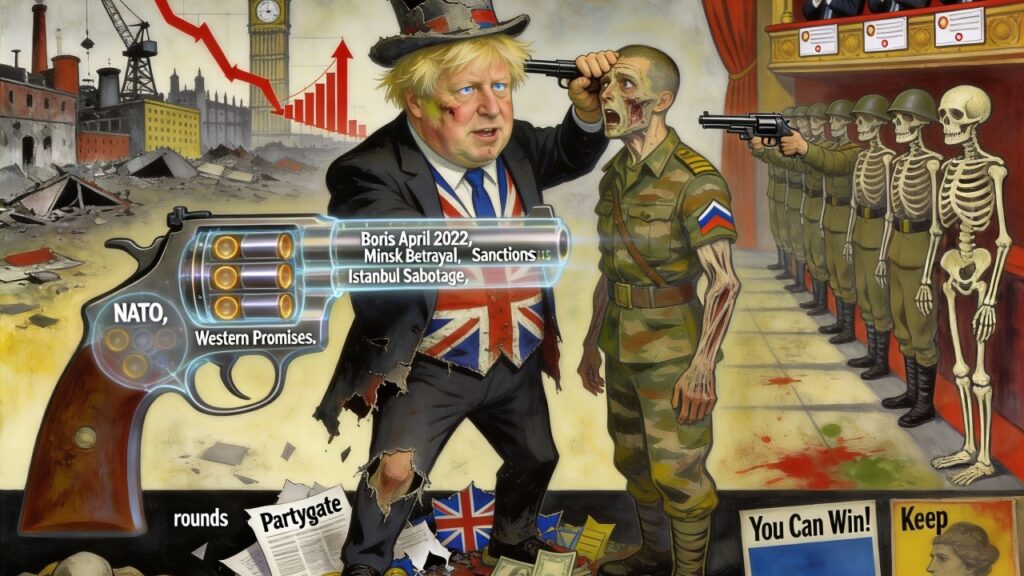
Introduction: A Failed State Exports Its Failure
Ukraine is stranded. Abandoned by reality, propped up by propaganda, and led to ruin by the same Western architects who promised salvation. At the center of this catastrophe stands the United Kingdom, a once-mighty empire now reduced to exporting the only commodity it has left in abundance: illusions, incompetence, and national suicide dressed up as heroism.
Post-Brexit Britain, economically crippled with GDP reduced by 6-8%, investment collapsed by 12-18%, and productivity cratering by 3-4%, desperately needed a moral crusade to mask its domestic failures. Ukraine provided the perfect stage: a chance for London to cosplay as Churchill while Ukrainians paid the butcher’s bill. The UK exited the European Union only to drag Ukraine into the most suicidal aspects of its governance, the same magical thinking, the same refusal to face constraints, the same obsession with moral posturing over strategic calculation.
Misery loves company. And Britain, trapped in its own post-imperial decline, found in Ukraine a companion for its misery: a country it could not save, but could persuade to fall alongside it, ensuring that London’s failures would never stand alone.
The scholarly consensus is overwhelming, unanimous, and devastating. From John Mearsheimer to Jeffrey Sachs, from Jacques Baud to Douglas Macgregor, from Glenn Diesen to Ray McGovern, from George Beebe to Richard Sakwa, the world’s leading analysts of geopolitics, military strategy, Russian affairs, and European security have reached identical conclusions:
Ukraine cannot win this war.
Russia will dictate terms.
The longer fighting continues, the worse the outcome for Ukraine.
There is no positive outcome possible, only mitigation of catastrophe.
Hope, in this context, is not virtue. Hope is fear’s comfortera narcotic that allows Ukrainian leaders and Western propagandists to avoid confronting the arithmetic of annihilation. To fight to the last man under the delusion of victory is not heroism. It is murder. And the United Kingdom, desperate to remain relevant, has become the chief executioner.
Part I: The UK’s Post-Brexit Wreckage, Exporting Decline as Foreign Policy
Economic Catastrophe and Desperate Relevance-Seeking
By 2025, the economic verdict on Brexit was unambiguous and brutal. Studies by the National Bureau of Economic Research, Stanford’s Hoover Institution, and the UK’s own Office for Budget Responsibility confirmed that Brexit reduced UK GDP by 6-8%, slashed investment by 12-18%, cut employment by 3-4%, and reduced productivity by 3-4%. The UK went from being a strong performer relative to peer economies to an economic laggard, systematically underperforming comparable advanced nations on every major metric.
This was not a temporary shock. This was structural decline, a decade of compounding losses driven by persistent policy uncertainty, higher trade costs with the EU, reduced aggregate demand, diverted management resources from productive activities to compliance and restructuring, and capital reallocation away from the UK’s most internationally competitive firms. Britain became poorer, less competitive, and less relevant, everything Brexiteers swore would never happen.
A declining state does not admit failure. It projects it. Post-Brexit Britain needed a moral crusade to obscure domestic ruin, and Ukraine provided the perfect script: a heroic struggle against tyranny, a chance for Britain to resurrect its Churchillian mythology, an opportunity to pretend that London still leads something besides its own managed decline.
Sharing the Suicidal Governance Model
The UK did not just support Ukraine. It infected Ukraine with the same pathologies that destroyed Britain’s own strategic coherence: the belief that rhetoric substitutes for capability, that moral posturing replaces material power, that if you simply believe hard enough and declare loudly enough, reality will bend to your will.
This is the governance philosophy that produced Brexit: ignore the experts, dismiss the constraints, insist that sovereignty and willpower alone guarantee success, and when the predictions of disaster materialize exactly as forecast, double down and blame someone else. Britain applied this same model to Ukraine: ignore the military balance, dismiss Russia’s nuclear arsenal and industrial capacity, insist that Ukrainian courage and Western support guarantee victory, and when the predictions of catastrophe materialize, blame Putin and demand more weapons.
The UK exited the EU but grafted the most toxic elements of Brussels’ delusional policymaking onto its Ukraine strategy: the refusal to negotiate with adversaries, the insistence on maximalist demands disconnected from leverage, the substitution of sanctions for strategy, and the belief that declaring something unacceptable makes it impossible. Ukraine, tragically, adopted this playbook, and will pay for it with its existence as a functioning state.
Part II: The Scholar Consensus, Ukraine Is Stranded and Doomed
John Mearsheimer: The Dysfunctional Rump State
John Mearsheimer, the University of Chicago professor whose offensive realist framework predicted this disaster with precision, has been unequivocal in his assessment: Ukraine is doomed to become a “dysfunctional rump state.”
In November 2025, speaking to the European Parliament, Mearsheimer laid out the merciless arithmetic: Russia holds decisive advantages in manpower, industrial capacity, artillery production, and strategic depth. Ukraine is losing the war of attrition. No amount of Western weapons can change the fundamental imbalance because the West cannot replace Ukrainian manpower, cannot outproduce Russian industry, and will not risk direct war with a nuclear power to save Kyiv’s maximalist fantasies.
Mearsheimer warned in December 2025 that Ukraine may not survive to 2026 as a coherent fighting force. The manpower crisis (200,000 soldiers AWOL, 2 million men evading conscription, desertion rates of 576 per day) has reached a tipping point. Russian forces are grinding forward across multiple axes. Ukraine now fights a purely defensive war with shrinking reserves and no plausible path to strategic offensive operations.
Russia’s three non-negotiable demands (Ukrainian neutrality, recognition of annexed territories, and disarmament to eliminate offensive threat) are exactly that: non-negotiable. The West can refuse to accept them, but refusal does not alter battlefield realities. Every month Ukraine fights on, it loses more territory, more soldiers, and more leverage in any eventual settlement.
Mearsheimer also demolished the fiction that this war can end through negotiation on Western terms: “There is no bargaining space because both sides view this as an existential threat.”Russia will not accept a NATO-aligned Ukraine on its border. Ukraine, goaded by the West, refuses to accept neutrality or territorial concessions. The result is a war that continues until one side collapses, and that side will be Ukraine.
“Ukraine should cut a deal now,” Mearsheimer said bluntly, “because they’re just going to lose more territory and more Ukrainians are going to die if they continue the war.”
Jeffrey Sachs: The Sabotaged Peace and the Moral Catastrophe
Jeffrey Sachs, the Columbia University economist and UN adviser whose expertise spans geopolitics, development, and international diplomacy, has done more than any Western scholar to document the deliberate sabotage of peace in April 2022.
The Istanbul Process and the April 15, 2022 draft peace agreement were serious, workable documents. Ukraine would adopt permanent neutrality and forgo NATO membership. Russia would withdraw forces from occupied territories outside Crimea and Donbas. Security guarantees for Ukraine would be provided by major powers under UN Security Council oversight. Territorial disputes over Crimea and Donbas would be negotiated over time, with both sides committing not to use force to change boundaries.
This was not a Russian diktat. This was a negotiated framework that addressed the core security concerns of both sides. It was ugly, imperfect, and painful, but it was peace.
Then the United States and United Kingdom intervened. Boris Johnson personally traveled to Kyiv and told Zelensky not to sign. Victoria Nuland, Biden’s chief Russia hawk at the State Department, dismissed the terms as a “bad deal.” The message was clear: keep fighting, and the West will arm you to victory.
Sachs writes: “The US and UK talked Ukraine out of signing the agreement, and hundreds of thousands of Ukrainians have since died or been seriously injured. Yet the framework of the Istanbul Process still provides the basis of peace today.” The difference is that Ukraine will now cede more territory than it would have in 2022, will have no meaningful security guarantees, and will emerge as a shattered, aid-dependent failed state rather than a neutral buffer with international protections.
Sachs’ conclusion is devastating: “Ukraine’s loss of territory would have been averted entirely but for the violent coup that toppled Yanukovych and brought in a U.S.-backed regime intent on NATO membership. The loss of territory in eastern Ukraine could have been averted had the U.S. pushed Ukraine to implement the U.N. Security Council-backed Minsk II agreement. The loss of territory in eastern Ukraine could probably have been averted as late as April 2022 in the Istanbul Process, but the U.S. blocked the peace agreement.”
Every escalation, every missed diplomatic opportunity, every Western promise of support has made Ukraine’s position worse. This is not Russian aggression run amok. This is Western policy producing exactly the catastrophic outcome that realist scholars warned was inevitable.
George Beebe: The Misdiagnosed Patient Is Flatlining
George Beebe, former CIA Director of Russia Analysis and Director of Grand Strategy at the Quincy Institute, argues that Western policy has fundamentally misunderstood the problem it is attempting to solve, and that misdiagnosis is killing Ukraine.
Since 2014, the West’s foreign policy establishment has treated Russia’s military actions against Ukraine as an elective, an “unprovoked” ambition to acquire land and rebuild empire driven by nothing more than Russian authoritarian impulses. As a result, Western policy focused on raising costs to Putin: cranking up sanctions, ensuring Russian military suffers high casualties, attempting to turn Russians into international pariahs. If Putin sees that his grab for power and prestige has only produced weakness and humiliation, the theory went, he will withdraw or bow to Ukrainian terms.
This diagnosis is wrong. The Russian invasion of Ukraine is not a deterrence problem, a modern replay of Nazi Germany’s aggressive expansionism. It is an escalatory spiral problem, a classic “security dilemma” in which parties pursue what they regard as prudent protective measures that are in turn perceived as threatening by others, producing a cycle of action and reaction in which each party is convinced it is acting defensively.
Putin’s primary reason for invading Ukraine was not territorial conquest. If that were his motivation, he could have annexed Donbas along with Crimea in 2014, when Ukraine was far less militarily capable. But he refused to do so for eight years, despite fierce criticism from Russian nationalists and Donbas separatists, because he believed keeping Donetsk and Lugansk inside Ukraine would ensure reliable domestic opposition to joining NATO.
Putin’s primary motivation was his belief that the United States and NATO were steadily deepening their security involvement inside an increasingly anti-Russian Ukraine, turning the country into an “unsinkable aircraft carrier,” a base for Western military and intelligence operations against Moscow.
How we diagnose the core problem matters enormously. Searching for compromise is counterproductive when dealing with an expansive bully state, appeasement signals weakness and encourages aggression. But doubling down on deterrence makes a security dilemma problem worse, not better. It only reinforces the conviction of each side that it faces an irreconcilably hostile aggressor that can only be stopped by force, encouraging new steps up the ladder of escalation.
Beebe’s assessment of Ukraine’s current position is grim: “The battlefield situation will only get worse for the Ukrainians and I think they understand that. Momentum is increasingly on Russia’s side. It grows more so from day to day and week to week.” Ukraine faces massive manpower shortages, collapsing air defenses, and waning Western support. The West cannot remedy Ukraine’s recruitment and desertion problems without sending hundreds of thousands of its own forces. It cannot plug Ukraine’s air defense gap because Russia is building attack missiles, drones, and glide bombs faster than Western factories can manufacture air defense systems.
“This is not a formula for a prolonged stalemate; it is a recipe for Ukraine’s collapse, probably within months rather than years.”
If Europe derails Trump administration peace efforts, Beebe warns, “the most likely outcome will be the destruction of Ukraine.” Once Ukraine’s army begins to collapse, a compromised settlement becomes impossible. Russia will dictate terms, not negotiate them.
Jacques Baud: Ukraine Planned This War, With NATO
Colonel Jacques Baud, former Swiss military intelligence analyst and UN official who worked on Ukraine defense reform, has exposed one of the most suppressed facts of this war: Ukraine, in coordination with NATO, planned the 2022 conflict.
In a 2019 video, Ukrainian presidential adviser Oleksiy Arestovych stated with absolute certainty that war with Russia would occur within a couple of years minus 2021 or 2022, and that this war was “the price Ukraine will have to pay in order to join NATO.” Arestovych’s certainty was not speculation. It was foreknowledge.
Ukraine, under Zelensky, who was elected on a peace mandateknew war with Russia would occur within a year or two of 2019, but did nothing to avoid it. In fact, Ukraine actively pursued war. On March 24, 2021, Volodymyr Zelensky issued a decree for the reconquest of Crimea and began deploying forces toward the south. Simultaneously, NATO conducted multiple exercises between the Black Sea and Baltic Sea, with significant increases in reconnaissance flights along Russia’s border.
On February 16, 2022eight days before Russia’s invasionUkraine began intense shelling of the civilian population of Donbas. OSCE observers documented the dramatic escalation. This was confirmed years later by retired Swiss intelligence officer and former NATO advisor who stated: “On the 16th of February 2022, the Ukrainians started an intense shelling of the Donbas and that was for the Russians and for the Republic of Donbas the indication that [a major Ukrainian offensive was imminent].”
Russia faced a choice: intervene militarily to protect the Russian-speaking population of Donbas under the international obligation of “Responsibility to Protect” (R2P), or stand by and watch them be crushed. Putin knew that intervention of any scale would trigger sanctions. Therefore, whether the intervention was limited to Donbas or extended to pressure the West over Ukraine’s status, the price would be the same. This is what he explained in his speech on February 21, 2022.
On February 23, 2022, the two Donbas Republics asked for military assistance from Russia. On February 24, Russia invaded.
The so-called “unprovoked Russian aggression” is a lie. The Ukrainian army was preparing to attack Donbas as early as 2021, and multiple Russian and European intelligence services knew it.
Baud’s analysis of Russia’s military strategy demolishes Western propaganda: Russia’s objectives were demilitarization and denazification, not occupation. Russia destroyed Ukrainian aviation, air defense, reconnaissance assets, and command structures in the opening days, then encircled Ukraine’s main forces massed in the southeast in preparation for the Donbas offensive.
The “slowdown” that Western experts attributed to poor Russian logistics was actually the consequence of having achieved initial objectives. Russia began tightening the noose slowly because it was no longer under time pressure. Its demilitarization goal was substantially achieved and Ukrainian forces no longer had operational or strategic command structures.
Baud warned in May 2025 that Russia is steadily advancing, a few villages per day rather than one per week. Sooner or later that adds up. Ukraine is in a position of barely-managed retreat. The only question is whether Ukraine will concede defeat before or after a major city falls, Kharkiv or Dnipropetrovsk.
By 2026, having seized most of the four oblasts (Luhansk, Donetsk, Zaporizhzhia, Kherson), Russia will likely signal through American back channels that it is willing to negotiate a final settlement. Ukraine’s alternative will be worse terms or military collapse.
Douglas Macgregor: 1.8 Million Casualties and NATO’s Disintegration
Colonel Douglas Macgregor, retired U.S. Army combat veteran and former senior advisor to the Secretary of Defense, delivers the most blunt casualty assessment: “We estimate now that 1.8 million Ukrainian soldiers have died and the death rate has climbed over the last half year because the army has been disintegrating.”
Let that sink in. 1.8 million Ukrainian deaths. Russian losses, by comparison: 120,000-130,000 killed. This is not a war of mutual attrition. This is systematic slaughter of Ukrainian forces by a Russian military machine that has adapted, mobilized, and achieved industrial-scale dominance.
Macgregor’s December 2025 assessment leaves no room for illusion: “Ukraine’s forces were decimated and destroyed.” Russian forces are not halted. They are inching forward because Moscow’s strategy is deliberate, grind down Ukrainian forces, exhaust Western ability to resupply and reconstitute the Ukrainian army, and advance only when strategically necessary.
“The Russians have not been stopped or halted. They’ve simply inched forward because the view in Moscow was, first of all, we don’t want to create more casualties than necessary. And second, if we wait, NATO and the United States and Europe will run out of the capacity to continue supporting Ukraine.”
Russia has been proven correct. NATO’s weapons stockpiles are exhausted. European economies cannot sustain Ukraine indefinitely. And the United States is pivoting away from Europe entirely.
Macgregor emphasizes a critical reality: NATO is disintegrating right now. That’s why Western leaders desperately talk about “coalitions of the willing”, because NATO as a functional alliance has ceased to exist. Without the United States, European forces lack the command, control, logistics, air superiority, and industrial capacity to sustain operations.
Macgregor’s forecast for 2026: “This will end on [Russia’s] terms because they have no way forward with diplomacy. No one will listen to them. No one will talk to them. So we must advance.” At some point, Russia’s advance will force Europe and Ukraine to accept reality: Putin is going to win. Despite the massive arms packages, despite the sanctions, despite the propagandaPutin is likely to win.
Russia has reclassified the war from a “special military operation” to an all-out war of decisiona war for Russia’s existence as an independent sovereign state. Putin has made clear in speeches and by appearing at General Staff meetings in uniform: this is now existential. Russian forces numbering 750,000-800,000 are mobilized and organized along multiple axes from Kherson to the Belarusian border. They are preparing not just for Ukraine, but for war with Europe if NATO presses forward.
“Every Russian soldier that you talk to says the same thing: We are preparing for war with Europe.”
Scott Ritter: The UK Drags Ukraine to Destruction
Scott Ritter, former UN weapons inspector and U.S. Marine Corps intelligence officer, has exposed the central role of British intelligence and military operations in prolonging Ukraine’s agony.
The British have been behind almost every major Ukrainian action: designing conventional military attacks, planning deep strikes into Russia, running psychological operations to “keep Ukraine in the fight.” The drone attack on Putin’s residence and Russia’s strategic nuclear infrastructure was a British operation. Ukrainians did not have the capacity, the infrastructure, or the safe houses inside Russia to conduct operations on this scale. The British did, and transferred that capability to Ukraine.
British intelligence plans Storm Shadow strikes using British targeting, British satellites, and British operational design. The Ukrainians are simply the executioners of operations designed in London.
Ritter’s assessment: “There’s no pretense that [Ukraine] can win. Just our goal is now for them to lose slower.” The British project is now explicitly titled “Keep Ukraine in the Fight”, not “help Ukraine win,” but simply delay the inevitable collapse while bleeding out Ukrainian manpower.
The British are fighting a war with Ukrainians dying in their place. They don’t count their own losses because there are none, British officers advise, Ukrainian soldiers die.
“This is the project of keeping Ukraine in the fight. It’s kind of strange that this is where we are now.”
Ritter’s military analysis confirms Macgregor’s casualty figures: “The Russians are just slaughtering the Ukrainians. Slaughtering.” Kill ratios on good days for Russia reach 36-to-1 or more. This is not combat. This is industrialized annihilation.
“Ukraine’s losing thousands of men a day. Thousands of men a day. Russia’s losing hundreds of men a day.” Russia can sustain this indefinitely. Ukraine and Europe cannot.
Ritter’s conclusion: “When it does end, Russia is going to be the victor.” Everything Europe does is fake. Everything the United States does is fake. The only thing not fake is the fact that Ukraine is hemorrhaging manpower daily and will eventually collapse.
“We’re approaching total collapse of the military and when that happens, it’s over. It’s unconditional surrender.”
Ray McGovern: Lipstick on the Pig of Defeat
Ray McGovern, former CIA analyst who chaired National Intelligence Estimates and prepared the President’s Daily Brief for seven administrations, delivers the bluntest assessment of all: “Putin may accept a ‘negotiated solution’ that applies copious lipstick to the pig of actual defeat for the U.S., NATO and Ukraine.”
Russia has won. The only question is whether Trump can negotiate terms that allow the United States to save face while acknowledging the reality on the ground.
McGovern traces the roots of this disaster to 2014, when the U.S.-backed Maidan coup overthrew Yanukovych and brought in a regime intent on NATO membership. From that moment, territorial losses were inevitable. The Minsk II agreement could have prevented further losses, but the U.S. refused to push Ukraine to implement it. The Istanbul Process in April 2022 could have prevented catastrophic losses, but Boris Johnson nixed the deal.
McGovern’s framing: “Russia has won, okay? It’s Russia’s neighborhood. No one should have thought that Ukraine could weaken Russia without Russia responding the way it did.” The war is simply a matter of how fast Putin decides to advance westward. He has the initiative. His terms will prevail.
McGovern confirms the April 2022 sabotage: “They negotiated in Belarus and then they went to Istanbul and did an agreement. The agreement said no Ukraine in NATO and we can make other deals about protecting Russians in the Donbas… But the U.S. in the person of Boris Johnson nixed that.”
The Russians stopped advancing in April 2022 because they had a deal: no Ukraine in NATO, some demilitarization along the contact line. The urgent question was resolved. But Johnson and Washington insisted Ukraine keep fighting.
McGovern’s message to Trump: “Mr. Putin, we’ll make an agreement. You’ve won militarily, but please help us show enough flexibility that we can put adequate lipstick on this pig of defeat for NATO, for Ukraine, and for the United States.” That is possible. Probable, even. But it requires admitting that Russia’s core interests (no NATO in Ukraine, security buffer zones) are non-negotiable.
For Ukraine, McGovern’s assessment is unsparing: Russia has demilitarized Ukraine to 90% of Moscow’s goal. The other pillar, denazification, remains unresolved. Russians will not abide a regime that praises fascist figures like Stepan Bandera. Ukraine’s future will be determined by Russia’s terms, not by Western wishes.
McGovern also confirms Europe’s desperation: “Europeans don’t really see a future for themselves anymore.” They backed the losing side in a proxy war against Russia, exhausted their weapons stocks, wrecked their economies with sanctions blowback, and now face a United States that is pivoting away and demanding Europe pay its own defense bills.
Richard Sakwa: Four Levels of Failure, No Imperial Ambitions
Richard Sakwa, Professor Emeritus of Russian and European Politics at the University of Kent and one of the world’s leading scholars of Russian affairs, argues that the Ukraine war operates on four distinct levelsand Western policy has failed catastrophically on all four.
Level One: Internal Ukrainethe failure to reflect Ukraine’s multicultural, demographically complex internal framework in constitutional form. The conflict began as a struggle over whether Ukraine would have federalism, regional autonomy, language rights, and balanced governance or centralized rule that marginalized Russian-speaking populations.
Level Two: Russia-Ukraine Relationsa thousand years of entwined history, both antagonistic and cooperative. The Donbas rebellion after the 2014 Maidan coup was not initially about independence. It was about autonomy (samostoyatel’nost), a demand for regional self-governance within Ukraine.
Level Three: Pan-European Security Architecturethe failure to establish Gorbachev’s vision of a “common European home from Lisbon to Vladivostok.” The post-Cold War settlement shut Russia out of Europe’s security order, creating the conditions for this catastrophe.
Level Four: US-Russian Relationsa broader great power competition in which Ukraine became the battlefield proxy for Washington’s determination to maintain unipolarity and subordinate Russia.
Each level has become far worse since the 2022 invasion. Internal conflict within Ukraine is more bitter and polarized. Russia-Ukraine relations are poisoned for a generation. Europe is “up a creek without a paddle”, completely lost, unable to defend itself, economically stagnant, and politically divided. US-Russian relations have descended into open hostility with escalatory risks that could trigger direct conflict.
Sakwa demolishes two dominant Western narratives. The first is that Putin is Hitler 2.0, bent on imperial conquest. “I think that neither of these versions is credible,” Sakwa states flatly. Russia’s actions from 2014 to 2022 directly contradict the idea that Putin was always determined to reconquer Ukraine. Putin sought implementation of the Minsk II agreement, which would have kept Donbas inside Ukraine while blocking Ukrainian NATO entry.
Sakwa’s verdict: “Do you believe that Putin has imperial ambitions beyond Ukraine? Absolutely not.”
The second narrative Sakwa demolishes is that NATO expansion was defensive and posed no threat to Russia. “NATO expansion nullified the assurances given to the Soviet Union in 1990.”Multiple national leaders were considering and rejecting Central and Eastern European NATO membership in 1990-1991. Discussions of NATO in the context of German reunification were not limited to East German territory. Subsequent Soviet and Russian complaints about being misled were founded in written contemporaneous memoranda of conversations at the highest levels.
The documentary record shows that “Russian leaders are essentially correct in claiming that U.S. efforts to expand NATO since the 1990s violate the ‘spirit’ of the 1990 negotiations.” This was not Russian paranoia. It was Western betrayal.
Sakwa cites the 1995 warning from 50 prominent foreign policy experts, arms control specialists, and academics who argued that NATO expansion “risks endangering the long-term viability of NATO, significantly exacerbating the instability that now exists in the zone between Germany and Russia, and convincing most Russians that the United States and the West are attempting to isolate, encircle, and subordinate them.”
In 1997, 50 additional experts warned that NATO expansion “may well go down in history as the most profound strategic blunder made since the end of the Cold War. Far from improving the security of the United States, its Allies, and the nations that wish to enter the Alliance, it could well encourage a chain of events that could produce the most serious security threat to this nation since the Soviet Union collapsed.”
And in 2008, then-US Ambassador to Russia William Burns (later CIA Director) wrote: “Ukrainian entry into NATO is the brightest of all red lines for the Russian elite (not just Putin). In more than two and a half years of conversations with key Russian players, from knuckle-draggers in the dark recesses of the Kremlin to Putin’s sharpest liberal critics, I have yet to find anyone who views Ukraine in NATO as anything other than a direct challenge to Russian interests.”
All of this was known. All of this was ignored. And Ukraine is now paying the price for Western hubris.
Sakwa’s assessment of NATO itself is withering: “It’s the most disastrous military alliance in history. It should have gone after 1989 and the end of the first Cold War.” NATO exists to sustain its own existence, and to do that it must foster and generate conflict. It keeps boasting with its 32 members that it is the most successful military organization in history, but in reality it is “dysfunctional internally and catastrophic for Europe and global politics internationally.”
Part III: NATO Without the United States, The Toothless Tiger
Europe Cannot Defend Itself, At All
The single most important strategic fact underlying this entire catastrophe is one that Western propaganda relentlessly obscures: NATO without the United States is not an alliance. It is a fiction.
Europe has 1.86 million active-duty military personnel across all member states. Yet the departure of fewer than 100,000 US troops would create a strategic vacuum that Europe cannot fill, not because of troop numbers, but because of capability.
Without the United States, European forces cannot operate cohesively or effectively. There is no multilateral command-and-control system capable of coordinating multinational European troop deployments on the battlefield. There is no integrated European air force capable of achieving air superiority without US aircraft, AWACS, air refueling, and ISR (intelligence, surveillance, reconnaissance). There is no European navy capable of projecting power or sustaining operations at the scale and intensity required to deter Russia.
Europe is utterly dependent on the United States for:
Command and Control: NATO’s entire operational structure is built around US systems. European militaries cannot coordinate large-scale operations without US command infrastructure.
Air Dominance: European air forces lack the numbers, advanced platforms, and enabling systems to conduct sustained air operations. US air refueling tankers, AWACS aircraft, and ISR assets are irreplaceable.
Naval Power: NATO’s naval deterrence in the North Atlantic and Mediterranean depends almost entirely on the US Navy. European navies cannot sustain blue-water operations or project power at scale.
Missile Defense: The US Aegis Ballistic Missile Defense System and ground-based Patriot batteries are the backbone of European missile defense. Europe has no comparable indigenous capability.
Logistics and Enablers: Europe is completely reliant on US airlift, air refueling, and logistical support to sustain military operations beyond national borders. Without US C-17s and KC-135 tankers, European forces are grounded.
Industrial Base: Decades of prioritizing US defense systems over European alternatives have created dependency. Europe relies on the US defense industrial base for critical munitions, spare parts, and advanced systems.
A 2025 report by the Heinrich Böll Foundation confirmed the stark reality: if the US withdraws from Europe, the most acute capability gaps would include ground-based rapid reaction forces, follow-on reinforcements, air power, naval power, missile defense, and all enabling capabilities. Europe would need to build from scratch a pan-European force of 100,000 deployable troops, integrate procurement across national militaries, expand stockpiles for attritional warfare, and mitigate dependencies on US enabling capabilities.
None of this is happening at the required speed or scale. European leaders have committed to raising defense spending to 5% of GDP by 2035, but spending more money on fragmented national procurement without structural reform will not create integrated, deployable, sustainable military capability.
And the United States is pivoting out of Europe. Trump’s administration has made clear that America’s strategic priorities are shifting to the Indo-Pacific and Western Hemisphere. Europe is being left to fend for itself, and Europe cannot fend for itself.
The Implication: Ukraine Is Stranded
This reality has catastrophic implications for Ukraine. The UK and European leaders promised Ukraine that the West would stand with it “for as long as it takes.” But “the West” without the United States is a toothless tigerand the United States is washing its hands of the Ukraine war.
Glenn Diesen states it plainly: “The Europeans and Ukrainians are now in the way. America is pivoting, and they’re more or less throwing them under the bus.” The Russians and Americans will negotiate terms, and those terms will be imposed on both Ukraine and Europe. Europe’s objections, Ukraine’s maximalist demands, and the UK’s empty rhetoric will be irrelevant.
The bitter irony: Europe encouraged Ukraine to fight a war that Europe itself cannot fight, using weapons Europe cannot sustain producing, under the protection of an alliance that does not function without a United States that is withdrawing.
The United States will not back NATO in response to EU/UK policy mistakes. Washington will not risk nuclear war with Russia to save Europe from the consequences of its own delusional policymaking. Without US backing, EU/UK/Atlanticist/NATO policy is rendered utterly meaningless, a collection of empty declarations, unenforceable sanctions, and toothless threats that Russia ignores with impunity.
Ukraine is stranded. Abandoned by the United States, propped up by a Europe that cannot defend itself, and led to ruin by a United Kingdom desperate to export its own decline. To fight to the last man in this circumstance is not heroism. It is suicide.
Part IV: The Ukraine Propaganda Machine, Who Spins It and Why
The Architects of Delusion
The propaganda insisting that Ukraine can win, that Russia is on the verge of collapse, that one more offensive will turn the tide, does not emerge organically. It is manufactured, coordinated, and distributed by a network of government agencies, think tanks, media outlets, and political actors who have staked their careers, reputations, and institutional power on Ukraine’s continuation of the war.
British Intelligence and the “Keep Ukraine in the Fight” Campaign
Scott Ritter has documented that British intelligence services (MI6, GCHQ, and affiliated contractors) are the primary architects of Ukraine’s psychological warfare and information operations. The British designed the “Keep Ukraine in the Fight” strategy: a comprehensive psychological operation to sustain Ukrainian will to fight, suppress dissent within Ukraine, and manufacture Western public support for indefinite weapons transfers.
This is not defensive information warfare. This is offensive propaganda designed to prevent Ukraine from negotiating peace even as its military collapses. The British understand Ukraine cannot win. The explicit goal is now to “lose slower”to prolong the war, maximize Russian casualties, and delay the inevitable Ukrainian defeat long enough to extract maximum geopolitical benefit before the inevitable collapse.
The Atlanticist Neoconservative Network
The Atlanticist clique (the imbecilic neoconservatives who survived every failed intervention since Iraq, who crawled above ground like cockroaches after nuclear tests at Bikini Atoll) has found its latest project in Ukraine.[memory:intro] These are the people who promised democracy in Baghdad, stability in Libya, and victory in Afghanistan. They delivered none of it. Now they promise victory in Ukraine, and the result will be identical: collapse, chaos, and a body count that dwarfs the already catastrophic 1.5-1.8 million casualties this war has produced.
Victoria Nuland, Boris Johnson, Ursula von der Leyen, Kaja Kallas, Annalena Baerbock, and the network of think tanks funded by defense contractors (Atlantic Council, Center for a New American Security, Center for Strategic and International Studies) form the core of this propaganda machine. They amplify maximalist rhetoric, suppress dissent, smear critics as “Putin apologists,” and maintain the fiction that Ukraine’s cause is winnable and noble despite every fact pointing to disaster.
Western Media as Propaganda Organs
Western mainstream mediaThe Guardian, New York Times, Washington Post, BBC, CNN, German and French state-affiliated outlets, have systematically omitted NATO expansion as a causal factor in Russia’s invasion, framed the war exclusively through a lens of Russian aggression and Ukrainian victimhood, and marginalized scholars and analysts who warned this catastrophe was predictable and preventable.
Studies have documented that Western media overwhelmingly ignored the archival record showing NATO made explicit promises not to expand eastward, dismissed Russian security concerns as illegitimate, and treated any analysis acknowledging Western responsibility as “Russian propaganda.” Critics of NATO expansion (Tulsi Gabbard, Stop the War Coalition, Mearsheimer, Sachs) were smeared, marginalized, or silenced.
This is not journalism. This is institutional propaganda serving state policy objectives.
Ukrainian Government Censorship and Repression
Within Ukraine, the Zelensky government has systematically eliminated opposition voices, banned opposition parties, shut down independent media, arrested journalists and politicians who advocated negotiation, and assassinated negotiators like Denis Kireyev who were “too favorable to Russia.” Ukraine’s intelligence service (SBU) operates as an internal repression apparatus enforcing ideological conformity.
The Ukrainian propaganda machine projects constant optimism (“we are winning,” “Russia is depleting its resources,” “one more counteroffensive will break their lines”) even as frontlines collapse, casualties mount, and manpower reserves are exhausted.
This propaganda serves two purposes: suppress domestic Ukrainian dissent and pressure for negotiations, and sustain Western political support for weapons transfers by manufacturing the illusion that Ukraine can still win if only the West provides a little more support.
The Purpose: Avoid Accountability for Catastrophic Failure
Why does this propaganda machine persist even as the lies become undeniable? Because admitting the truth would trigger accountability for the worst strategic disaster the West has inflicted on itself since 1945.
Admitting that Ukraine cannot win means admitting that:
- NATO expansion was a catastrophic strategic mistake.
- The 2014 Maidan coup was a US-orchestrated regime change operation.
- The Minsk II agreement was never intended to be implemented, it was a Western delaying tactic to arm Ukraine for war.
- Boris Johnson sabotaged the April 2022 Istanbul peace agreement, condemning hundreds of thousands to death.
- Western sanctions failed to cripple Russia but devastated European economies.
- Over 1.5-1.8 million casualties have been inflicted for no strategic gain.
- Ukraine will emerge from this war as a depopulated, dismembered, aid-dependent failed state.
The political elite in Washington, London, Brussels, and Berlin cannot admit this failure without destroying their own credibility, legitimacy, and careers. So they perpetuate the lie. They keep insisting Ukraine can win, that Russia will collapse, that victory is just around the corner, right up until the moment Ukrainian lines collapse entirely and reality forces the admission they have spent three years avoiding.
Part V: The Truth About “Unprovoked Aggression” How Ukraine Was Duped
The Bucharest Tripwire (2008)
The road to this disaster began at NATO’s Bucharest Summit in April 2008, when the alliance declared: “Ukraine and Georgia will become members of NATO.” This was the tripwire. Russia made clear, publicly and privately, that NATO expansion into Ukraine was a red line, an existential threat, and a guarantee of eventual war.
Western leaders knew this. Then-US Ambassador to Russia William Burns wrote in a classified cable: “Ukrainian entry into NATO is the brightest of all redlines for the Russian elite (not just Putin). I have yet to find anyone who views Ukraine in NATO as anything other than a direct challenge to Russian interests.”
The promise was made anyway. No concrete plan was put in place to defend Ukraine. No serious thought was given to what Russia would do if the bluff was called. Ukraine was dangled a security guarantee that the West had no intention of honoring with its own blood.
The Maidan Coup (2014) and Minsk Deception
In February 2014, a Western-backed uprising toppled Ukrainian President Viktor Yanukovych, who had favored Ukrainian neutrality and balancing relations between Russia and the West. Victoria Nuland’s infamous “Fuck the EU” phone call with Ambassador Geoffrey Pyatt, in which she hand-picked Ukraine’s post-coup leadership, confirmed US orchestration.
The new government immediately pivoted toward NATO and the EU. Russia responded by annexing Crimea to prevent its Black Sea naval base from falling into NATO hands and by supporting separatists in Donbas.
The Minsk II agreement, negotiated in 2015 and endorsed by the UN Security Council, was supposed to end the conflict by granting autonomy to Donbas while keeping it within Ukraine. The agreement was never implemented. Ukraine resisted autonomy for Donbas. The US backed Ukraine’s resistance. Germany and France stood by silently as the agreement was discarded.
Years later, Angela Merkel and François Hollande admitted publicly that Minsk II was never intended to be implemented, it was a delaying tactic to give Ukraine time to build up its military.This admission confirms what Russia suspected all along: the West was not negotiating in good faith. It was preparing for war.
The Ignored Russian Proposal (December 2021)
In December 2021, Russia submitted a draft treaty to the United States proposing mutual security guarantees: NATO would halt eastward expansion, Ukraine would remain neutral, and both sides would pull back offensive weapons from each other’s borders.
The proposal was dismissed. The Biden administration refused to engage seriously with Russia’s core security concerns, treating them as illegitimate subjects for negotiation. NATO expansion, the US insisted, was not up for discussion. Ukraine’s right to join NATO was non-negotiable.
Three months later, Russia invaded.
The Ukrainian Offensive Preparation (February 2022)
On February 16, 2022, eight days before Russia’s invasion, Ukraine began intense artillery bombardment of Donbas civilians. OSCE monitors documented the escalation. Jacques Baud, citing Swiss and European intelligence, confirmed: “The Ukrainians started an intense shelling of the Donbas and that was for the Russians and for the Republic of Donbas the indication that [a major Ukrainian offensive was imminent].”
Ukrainian presidential adviser Oleksiy Arestovych had stated in 2019 with certainty that war with Russia would occur in 2021 or 2022, describing it as “the price Ukraine will have to pay in order to join NATO.” This was not speculation. This was coordination. Ukraine, with NATO support, was preparing to launch a major offensive into Donbas, forcing Russia to intervene or watch Russian-speaking civilians be crushed.
Russia invaded on February 24, 2022.
This was not unprovoked Russian aggression. This was a provoked Russian response to decades of NATO encroachment, a Western-backed coup, broken promises, ignored peace agreements, and an imminent Ukrainian offensive into Donbas.
The Sabotaged Istanbul Peace (April 2022)
By April 2022, after six weeks of war and approximately 40,000-50,000 combined casualties, Russia and Ukraine had negotiated a framework peace agreement in Istanbul. The terms:
- Ukraine would adopt permanent neutrality and forgo NATO membership.
- Russia would withdraw forces from occupied territories outside Crimea and Donbas.
- Security guarantees for Ukraine would be provided by major powers under UN Security Council oversight.
- Territorial disputes over Crimea and Donbas would be negotiated over time, with both sides committing not to use force.
This was a workable deal. Israeli Prime Minister Naftali Bennett confirmed a deal was close and that “the West blocked it.”
Then Boris Johnson arrived in Kyiv on April 9, 2022. Ukrainian negotiator David Arakhamia later confirmed Johnson’s message: “We will not sign anything with them. Let’s just fight.” Johnson promised unlimited Western support and insisted Ukraine could win.
Zelensky complied. The talks collapsed. The war continued.
Since then:
- Over 1.5-1.8 million casualties.
- Ukraine’s economy destroyed.
- Millions of Ukrainians fled permanently.
- Ukraine has lost more territory than it would have ceded under Istanbul.
- Western support is waning.
- Ukraine’s negotiating position has catastrophically deteriorated.
Boris Johnson condemned Ukraine to this. So did Biden, Nuland, von der Leyen, and every European leader who promised victory and delivered ruin.
Part VI: Victor Davis Hanson and the End of Everything
Civilizations That Refuse Reality Are Annihilated
Victor Davis Hanson’s The End of Everything: How Wars Descend into Annihilation examines four historical cases of total civilizational collapse: Thebes destroyed by Alexander, Carthage razed by Rome, Constantinople conquered by the Ottomans, and Tenochtitlan annihilated by the Spanish.
In each case, Hanson identifies recurring patterns:
Naïveté and hubris: The doomed civilizations consistently underestimated enemies and overestimated their own defenses. Thebes mocked Alexander. Carthage believed Rome would negotiate. Both were obliterated.
Overconfidence in fortifications: All believed their walls, strategic locations, or defensive advantages made them invulnerable. All fell quickly when attackers combined new tactics, technologies, and relentless determination.
Counting on allies who never arrive: Thebes expected Greek support. Carthage expected reinforcements. Constantinople expected Western Christendom. No help came.
Internal disunity and factionalism: Internal divisions weakened coherent response to threats.
Failure to assess enemy capabilities: The vanquished projected their own assumptions onto enemies and were blindsided.
The “it cannot happen to us” delusion: Above all, doomed civilizations refused to believe total annihilation was possible until it was too late.
Ukraine Fits Hanson’s Framework Precisely
Naïveté and hubris: Ukraine, goaded by Western promises, believed it could fight a war of attrition against a nuclear-armed great power with three times its population and win.
Overconfidence in fortifications: Ukraine built defensive lines in Donbas. Russia is grinding through them systematically.
Counting on allies who never arrive: Ukraine counted on NATO membership, unlimited Western weapons, and European troops. None are coming.
Internal disunity: Ukraine is wracked by political infighting, desertion, and a government that refuses to negotiate even as its population increasingly favors territorial concessions.
Failure to assess enemy capabilities: Ukraine believed Russia would run out of manpower and resolve. Instead, Russia mobilized a wartime economy and demonstrated willingness to fight indefinitely.
The “it cannot happen to us” delusion: Even now, with over 1.5-1.8 million casualties, with frontlines collapsing, Ukrainian and Western leaders insist victory is possible.
Hanson’s lesson: “The continual disappearance of prior cultures across time and space should warn us that even familiar twenty-first-century states can become as fragile as their ancient counterparts.” Ukraine is not immune. The belief that modern states cannot collapse is itself a symptom of the hubris that precedes collapse.
Part VII: Donald Kagan and the Peloponnesian Failure
Athens’ Diplomatic Failures Mirror Ukraine’s
Donald Kagan’s four-volume study of the Peloponnesian War identifies critical failures that resonate powerfully with Ukraine’s disaster:
Diplomatic failures and ignored arbitration mechanisms: The Thirty Years’ Peace between Athens and Sparta included arbitration to resolve disputes without war. When tensions escalated, Sparta offered arbitration. Athens, confident in its naval power, refused. The result: a 27-year war that shattered the Greek world.
Pericles’ flawed strategy: Athens adopted a defensive strategy, avoid land battles, rely on walls and navy, exhaust Sparta psychologically. It had two fatal flaws: no offensive plan to deter continuation, and it assumed the war would remain rational. It did not.
Overconfidence and escalation: Athens, buoyed by early successes, escalated with the catastrophic Sicilian Expedition, driven by hubris and belief that Athens’ naval power made any objective achievable. Total disaster: entire fleet destroyed, thousands killed or enslaved, Athens’ strategic position irreversibly weakened.
Internal divisions and refusal to negotiate: Throughout the war, both sides had opportunities to negotiate peace that would have preserved power and prevented mutual destruction. Internal factions blocked those opportunities. Hawks demanded total victory. The result: war continued until Athens was starved into surrender.
Kagan’s conclusion: “War is not always rational.” Leaders who assume enemies will respond rationally, who assume demonstrating the futility of war will lead to peace, are setting themselves up for catastrophic failure.
The Ukraine Parallel
Like Athens, Ukraine was encouraged to believe it could avoid direct confrontation with a superior land power by relying on Western support and psychological exhaustion of the enemy. Like Athens, Ukraine refused serious negotiation when it had leverage (April 2022), believing it could achieve better terms through continued fighting.
Like Athens, Ukraine escalated (launching offensives, attempting to retake territory, striking deep into Russia) based on the assumption that Western backing made any objective achievable. Like Athens’ Sicilian disaster, Ukraine’s Kursk offensive consumed elite troops, achieved no strategic objective, and accelerated collapse elsewhere.
Like Athens, Ukraine had multiple opportunities to negotiate peace before final collapse. It refused. The result will not be heroic resistance. It will be starvation, surrender, and subjugation.
The difference: Athens made its own choice to refuse peace. Ukraine’s choice was made for it, by Boris Johnson, by the Atlanticist neoconservatives, by UK and US leaders who blocked the Istanbul peace and promised victory they could not deliver.
Part VIII: Hope Is Fear’s Comforter, The Madness of Fighting to the Last Man
The Arithmetic of Annihilation
It is sheer madness for Ukraine to fight to the last man under the guise that it can win. Every serious scholar agrees: Ukraine cannot win this war.
The reasons are structural and immutable:
Russia has escalation dominance. Russia has nuclear weapons. Russia can escalate in ways the West will not dare match.
Russia has superior industrial capacity and manpower reserves. Russia is outproducing the collective West 4-to-1 in defense manufacturing. Russia mobilized once in 2022 (300,000 men) and has sustained forces through contracts since. Ukraine is on its seventh mobilization and fifth reconstruction of its army.
Russia is willing to fight indefinitely. Russian soldiers at all levels understand this is existential, a war for Russia’s survival as an independent sovereign state. They are prepared to fight for years.
The West cannot replace Ukrainian manpower. Western weapons are irrelevant if there are no Ukrainian soldiers left to use them. Ukraine is hemorrhaging men daily minus 200,000 AWOL, 2 million evading conscription, 576 desertions per day.
The United States is pivoting away. America’s strategic priorities are shifting to Indo-Pacific and Western Hemisphere. Europe is being abandoned, and Europe cannot defend itself without the US.
The longer Ukraine fights, the more it loses:
- More territory.
- More soldiers.
- More infrastructure.
- More of its remaining population.
- More leverage in any eventual negotiation.
John Mearsheimer: “Ukraine should cut a deal now, because they’re just going to lose more territory and more Ukrainians are going to die if they continue the war.”
Glenn Diesen: “It’s either this very terrible deal, which is a humiliating deal, or it’s going to be an even worse deal after the Ukrainian army begins to collapse.”
George Beebe: “This is not a formula for a prolonged stalemate; it is a recipe for Ukraine’s collapse, probably within months rather than years.”
Douglas Macgregor: “1.8 million Ukrainian soldiers have died and the death rate has climbed over the last half year because the army has been disintegrating.”
Scott Ritter: “We’re approaching total collapse of the military and when that happens, it’s over. It’s unconditional surrender.”
Ray McGovern: “Russia has won. It’s Russia’s neighborhood. No one should have thought that Ukraine could weaken Russia without Russia responding the way it did.”
Hope as Narcotic
Yet the propaganda machine (fed by the UK, the US State Department, the European Commission, and the Atlanticist neoconservatives) insists Ukraine can still win. That Russia is about to collapse. That one more offensive, one more weapons package, one more round of sanctions will turn the tide.
This is not hope. “Hope is fear’s comforter” (Thucydides)an anesthetic that allows Ukrainian leaders and Western propagandists to avoid confronting the reality of annihilation. Hope, in this context, is not a virtue. It is a pathology. It is the delusion that allows leaders to send thousands more men to die for a victory that will never come, in service of a strategy designed in London and Washington by people who will never pay the price for their failure.
Every month this war continues, thousands more Ukrainians and provoked Russians die for nothing. There is no strategic objective achievable through continued fighting. There is no leverage gained. There is only additional slaughter that makes the inevitable settlement worse.
To fight to the last man in these circumstances is not heroism. It is murder.
Conclusion: The Only Path Forward Is Truth
Ukraine was duped. Duped into provoking Russia by promises of NATO membership that were never sincere. Duped into rejecting peace in April 2022 by Boris Johnson and the Atlanticist clique. Duped into believing that the West would support it “for as long as it takes”, when “as long as it takes” meant “as long as it serves Western interests.”
The consensus among the world’s leading scholars of geopolitics (Victor Davis Hanson, John Mearsheimer, George Beebe, Jacques Baud, Jeffrey Sachs, Glenn Diesen, Scott Ritter, Douglas Macgregor, Ray McGovern, Richard Sakwa, and a generation of deep analysts) is unanimous:
- Ukraine cannot win this war.
- Russia will dictate terms.
- Ukraine will cede more territory now than it would have in 2022.
- The longer fighting continues, the worse the outcome for Ukraine.
- There is no positive outcome possible, only mitigation of catastrophe.
The only reasonable objective now is to make Ukraine’s collapse as painless as possible: to stop the bleeding, to salvage what remains of the country, to secure the best terms available from a position of profound weakness.
That requires starting with the truth:
- Russia was provoked by NATO expansion and Western refusal to negotiate security guarantees.
- Ukraine was duped by Boris Johnson and the Atlanticists into walking away from the Istanbul peace.
- The war has been a catastrophic failure for Ukraine and NATO.
- Continuing to fight will only make the final settlement worse.
- The United States will not back NATO in response to EU/UK policy mistakes, and without US backing, EU/UK/Atlanticist/NATO policy is utterly meaningless.
Victor Davis Hanson’s lesson from Thebes, Carthage, Constantinople, and Tenochtitlan: civilizations that refuse to face reality until reality destroys them are annihilated. Donald Kagan’s lesson from the Peloponnesian War: wars that could have been prevented through diplomacy, or ended through negotiation, instead drag on until one side collapses, not because peace was impossible, but because leaders chose pride over pragmatism.
Misery loves company. A failed UK, desperate for relevance after its post-Brexit economic collapse, found in Ukraine a companion for its misery, a country it could not save, but could persuade to fall alongside it, ensuring that Britain’s decline would never stand alone.
Boris Johnson, the Atlanticist neoconservatives, and the European political class have gotten what they wanted: a stage for moral posturing, a chance to cosplay as Churchill, and the illusion of continued relevance.
Ukraine has paid the price. Over 1.5-1.8 million casualties. A shattered economy. A depopulated nation. And a future as a dysfunctional rump state, carved up by Russia, abandoned by the West, and left to rot as a monument to the hubris, delusion, and cruelty of leaders who sent others to die for wars they would not fight themselves.
The only question now is whether Ukraine will accept reality before its army collapses, or whether the propaganda machine will keep the dying going a little longer, just long enough for the architects of this disaster to retire, write their memoirs, and escape accountability for the worst strategic catastrophe Europe has seen since 1945.
A last thought from me: If anyone doubts that Russia’s response to NATO expansion was rational self-defense rather than unprovoked aggression, ask what the United States would do if Mexico or Canada joined a Chinese-led military alliance, hosted Chinese missiles 300 miles from Washington, and conducted joint military exercises with Beijing practicing amphibious assaults on American soil. The answer is obvious: America would invade within 72 hours, regime-change the government, and dare anyone to call it “unprovoked.” The United States brought the world to the brink of nuclear war in 1962 when Soviet missiles appeared in Cuba, ninety miles from Florida. Russia waited eight years after the 2014 Western-backed coup in Kyiv, endured broken Minsk agreements, ignored NATO expansion that violated every assurance given in 1990, and intervened only when Ukraine massed forces for an offensive into Donbas with NATO backing. The double standard is not subtle. It is obscene. And Ukraine is paying the price for Western hypocrisy with the blood of 1.8 million casualties, the destruction of its economy, and the obliteration of its future, all because a failed UK and a delusional Atlanticist clique convinced Ukrainians to fight a war that serves Western vanity, not Ukrainian survival.
Related reading
- Remember the Russian Sacrifice in WWII: The EU Countries Don't
- Europe’s Sleepwalk Toward a Bigger War: Why Real Peace in Ukraine Requires a Pan‑European Settlement With Russia, Not Another Cosmetic Ceasefire
- Germany's Reckoning: Jeffrey Sachs Documents Three Decades of Diplomatic Deception on Russia and Ukraine
- The Atlanticists' Russian-Hate Cult: Ten Truths About How the West Turned Ukraine Into a Graveyard to Weaken Russia