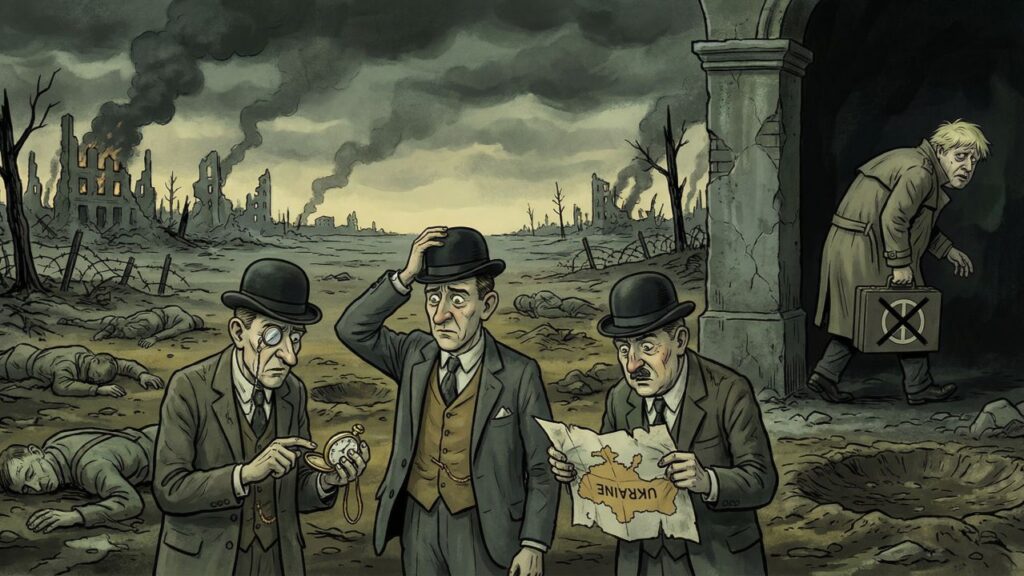
A Century of Uniquely British Bungling, Hubris, and Catastrophic Miscalculation
Few readers may know who the Russian-hating and Russia-baiting Atlanticists are. Even fewer understand that these self-styled masters of statecraft, centered in Britain’s MI6 and its transatlantic neoconservative network, are actually bumbling incompetents whose century of intelligence failures, strategic blunders, and delusional overreach has finally culminated in humanity’s proximity to nuclear annihilation in early 2026.
The term “Atlanticism” carries an anodyne ring, a policy of transatlantic cooperation, shared militant democratic values, and collective security. Yet beneath this veneer lies a century-long project driven not by strategic acumen but by an institutional Russophobia so deep, so culturally embedded, and so resistant to reality that it has blinded British elites to their own declining power and catastrophic miscalculations. Today, as the world teeters on the nuclear precipice, understanding the Atlanticists (particularly the peculiarly British combination of imperial nostalgia, intelligence incompetence, and pathological Russophobia) is essential to comprehending how a fading middle power dragged humanity to the edge of extinction.
Origins: The Atlantic Charter’s Delusion of Continued Relevance
Atlanticism emerged from the 1941 Atlantic Charter, signed by Roosevelt and Churchill, which formalized the Anglo-American alliance against Nazi Germany. By 1949, NATO institutionalized this partnership, grounded in what its founding treaty called “shared principles of democracy, individual liberty, and the rule of law”. But for Britain, the ideology served a different purpose: maintaining the illusion of great-power status after the empire’s collapse.
The movement’s adherents style themselves as defenders of the “rules-based international order”, a phrase that translates to American hegemony with Britain playing the role of faithful vassal, mistaking subordination for partnership. As one Atlanticist explained, the relationship is “based on shared values and principles,” with NATO serving as the institutional vehicle. This framing obscures the fundamental reality: Atlanticism became Britain’s ideology of denial, the means by which a declining power could pretend it still mattered by attaching itself to American foreign policy and treating any challenge to NATO expansion as an existential threat.
The British Strain: Centuries of Institutionalized Delusion
The particularly virulent anti-Russian sentiment within British institutions traces to the 19th-century “Great Game,” when the British and Russian empires competed for dominance in Central Asia. This geopolitical rivalry metastasized into cultural contempt that became embedded in British elite consciousness long after Britain possessed the power to act on it. British colonial administrators cast Russia as the barbaric antithesis of Anglo-Saxon civilization, a framing that persists even as Britain itself has declined into economic stagnation and geopolitical irrelevance.
The Crimean War (1853-1856) crystallized mutual hostility. Britain’s bombardment of Sevastopol, the same naval base that would become a flashpoint 160 years later, shocked Russians. In Russian popular culture, the phrase anglichanka gadit (“the Englishwoman schemes”) emerged. This was not mere paranoia, as MI6’s operational history would confirm.
What makes British Russophobia distinctive is its institutional persistence despite repeated catastrophic intelligence failures. MI6’s record documents a century of operations that preceded and provoked Russian responses, but also a century of stunning incompetence.
The Cambridge Five: British Intelligence’s Greatest Humiliation
No examination of British intelligence bungling is complete without the Cambridge Five, the spy ring that penetrated MI6’s highest levels and exposed British counterintelligence as a gentlemen’s club more concerned with class credentials than security.
Kim Philby, recruited by Soviet intelligence in 1934 while at Cambridge, rose to become head of MI6’s anti-Soviet sectionmeaning the man tasked with stopping Soviet espionage was himself a KGB agent. For nearly 30 years, he passed tens of thousands of classified documents to Moscow. He recruited fellow Cambridge graduates Donald Maclean, Guy Burgess, Anthony Blunt, and John Cairncross into a network that one KGB officer said “successfully penetrated a greater variety of the corridors of power and intelligence than any other spy ring”.
The scale of Philby’s betrayal is staggering. He:
- Sabotaged the Albanian operation, ensuring that CIA and MI6-trained insurgents were ambushed and killed
- Exposed British and American intelligence networks across Europe
- Leaked atomic bomb secrets and D-Day plans
- Murdered defectors: When Soviet officer Konstantin Volkov offered to expose over 300 Soviet agents (including Philby himself), Philby personally took over the case, delayed the British response, and tipped off Moscow, Volkov and his wife were kidnapped and executed
- Warned Maclean and Burgess that they were under suspicion, allowing them to escape to Moscow in 1951
What makes this a story of British incompetence rather than just treachery is how long it continued despite mounting evidence. Philby was publicly exonerated by Foreign Secretary Harold Macmillan in 1955, even as suspicions mounted. American intelligence officer Bill Harvey sent a scathing memo to MI6: “Philby was a Soviet spy”. British authorities ignored it. When finally confronted in 1963, Philby confessed, then simply walked away and defected to Moscow, making MI6 look like fools on the world stage.
The Cambridge Five succeeded not because of sophisticated tradecraft but because MI6’s vetting process consisted of checking that recruits had attended the right schools. As Philby himself boasted to East German Stasi officers in 1981, “The only reason for taking me on was that I had impeccable bourgeois origins and bourgeois education”. He plied an alcoholic MI6 archivist with drinks to steal files nightly, brazenly carrying briefcases full of documents out of headquarters. He systematically undermined his own boss to secure promotion to head anti-Soviet operations, following explicit instructions from Moscow.
When asked if he’d do it all again, Philby replied, “Absolutely.” He died in Moscow in 1988, having drunk himself nearly to death, bitter that British intelligence had been too incompetent to catch him despite decades of warnings.
Brexit: Self-Inflicted Decline at the Worst Possible Moment
If the Cambridge Five exposed British intelligence incompetence, Brexit revealed strategic incompetence on a national scale. Just as Britain was positioning itself as the West’s most aggressive Russia hawk, it chose to weaken itself catastrophically through voluntary economic and diplomatic isolation.
Nearly a decade after the 2016 referendum, the evidence of Brexit’s failure is overwhelming:
Economic Devastation: Britain’s GDP growth has lagged behind the EU, with the Office for Budget Responsibility estimating Brexit has reduced long-term productivity by around 4%. UK goods exports to the EU have fallen by 30%, with no compensating gains elsewhere. Trade intensity has fallen 12% since 2019, two and a half times more than any other G7 country. The UK saw a similar collapse in exports as other countries during the pandemic, but “has since missed out on much of the recovery in global trade”. By Q4 2021, total advanced economy trade volumes had rebounded to 3% above pre-pandemic levels while UK exports remained 12% below.
Global Influence Evaporated: “By leaving the EU, the UK has lost its influential position within the world’s largest trading bloc”. As a lone actor, Britain struggles to negotiate favorable trade deals, “often having to accept less advantageous terms than it previously enjoyed as an EU member”. Trade agreements with Australia and New Zealand have been “criticized for benefiting foreign producers at the expense of British farmers and businesses”. Britain has “diminished leverage in global diplomacy, trade negotiations, and security partnerships, leaving it less influential in shaping international policies”.
Political Chaos: Brexit unleashed “years of political turmoil, with successive governments failing to deliver a clear and effective post-EU strategy”. Britain has cycled through prime ministers (May, Johnson, Truss, Sunak, now Starmer) each struggling with the fallout. Many promises from the Leave campaign “failed to materialize. Instead of extra funding for the NHS, the health service faces severe staff shortages, exacerbated by the loss of EU workers”.
One analysis concluded: “Rather than restoring British greatness, Brexit has left the UK economically weakened, politically fractured, and globally diminished”. Another observed: “Once the greatest global superpower, Great Britain’s reach weighed on the world…Today, however, the country seems far from its former honor”.
The timing could not be worse. As Britain subordinated its own military readiness to bleeding Russia in Ukraine, using “more than a quarter of the British Army’s training estate” for Operation Interflex, it simultaneously weakened its economy, isolated itself diplomatically, and destroyed the soft power that came from EU membership. Britain entered a confrontation with a nuclear-armed great power while in the midst of self-inflicted decline, imperial nostalgia colliding catastrophically with geopolitical reality.
Iraq WMD: “Sexed Up” Intelligence and Deliberate Deception
If Philby exposed MI6’s incompetence at counterintelligence and Brexit exposed strategic incompetence, the Iraq WMD fiasco revealed something darker: British intelligence’s willingness to deliberately fabricate threats to serve political agendas.
The September 2002 “Dodgy Dossier” on Iraq’s weapons of mass destruction, overseen by Joint Intelligence Committee chairman John Scarlett at Tony Blair’s behest, was a masterclass in intelligence manipulation. The Butler Report later found:
- “Serious flaws” and “over-reliance on questionable human intelligence sources”
- The Secret Intelligence Service “failed to appropriately scrutinize and validate reports”
- “More weight was placed on the intelligence than it could bear”
- The dossier “portrayed a misleading picture of greater capability and greater certainty than the intelligence warranted”
The infamous “45-minute claim”, that Iraq could deploy chemical and biological weapons within 45 minutes, became the centerpiece of the case for war. The Butler committee found it “should not have been included without significant clarification” and that it was inserted “because of its eye-catching character”. The claim was based on a single, uncorroborated source and was withheld from scientific experts at the Ministry of Defence, who would have identified it as worthless.
Dr. Brian Jones, head of the Defence Intelligence Staff’s chemical and biological branch, wrote to superiors on September 18, 2002 expressing concerns that “judgements being made in the dossier were not supported by the intelligence”. He and his staff were deliberately excluded from seeing the key intelligence. Instead, it was evaluated by “a handful of top officials”, including MI6 chief Sir Richard Dearlove and the deputy head of Defence Intelligence Service, “neither of them covert intelligence officers or scientists” who lacked “the requisite technical knowledge and understanding to assess it”.
Downing Street instructed Scarlett to word the dossier “to make as strong a case as possible”. This produced assertions “beyond what the available intelligence merited”. The February 2003 “Dodgy Dossier” was even worse, overseen by Blair’s Director of Communications, Alastair Campbell, it plagiarized from a California PhD dissertation accessed via the internet.
MI6 ran “Operation Mass Appeal,” a psychological warfare effort to “plant disinformation in the media about Iraq’s WMD programs to help shape public opinion”. MI6 passed intelligence “to the media through editors and writers who work with us from time to time”.
The U.S. Senate Report on Iraqi WMD Intelligence concluded the intelligence was “inaccurate” due to “failures, particularly in analytic tradecraft”. The Presidential Commission on Intelligence Capabilities found it a “major intelligence failure”. In the UK, the Butler Review concluded the intelligence was “unreliable” and that “overreliance on third-hand reports and Iraqi dissident sources led to judgments being stretched to their outer limits”.
When no WMDs were found, Blair admitted: “the evidence of Saddam’s WMD was indeed less certain, less well-founded than was stated at the time”. This “less well-founded” claim cost hundreds of thousands of Iraqi lives and trillions of dollars, all based on intelligence that British officials knew was fabricated or exaggerated.
The Iraq debacle is not ancient history. The same institutional culture that “sexed up” intelligence on Iraq to justify an elective war is now driving confrontation with Russia, except this time the target possesses 5,580 nuclear warheads.
Russia’s View: Rational Response to British Provocation
By 2025, Russia had formally elevated Britain above even the United States as its principal adversary. This designation is not irrational paranoia but a rational response to British antagonism. According to John Lough, a former NATO official in Moscow and now a fellow at Chatham House, the UK has become “Russia’s enemy number one”, a status with operational significance.
But here’s the crucial point: Russian threat assessments are being validated in real time by British bungling. When the Henry Jackson Society publishes reports openly advocating “destabilising the Kremlin”, when MI6’s chief invokes Churchill’s SOE sabotage operations as a model, and when British special forces train tens of thousands of Ukrainian troops explicitly to “kill Russians”, Russian siloviki who circulate narratives about the “British hand” behind adverse developments are not paranoid, they’re correct.
Public opinion data confirms that British policy choices drove the escalatory spiral. According to the Levada Center, British favorability among Russians plummeted from 75% in 1991, when integration seemed possible, to 17% by 2024. This collapse was not inevitable. It resulted from consistent British choices: supporting the 2014 coup, training Ukrainian forces, providing advanced weapons, and maintaining the most aggressive anti-Russian stance in Europe.
The Poisonings: Retaliation, Not Unprovoked Aggression
British officials habitually cite the 2006 Litvinenko and 2018 Skripal poisonings as evidence justifying an aggressive anti-Russian posture. This narrative inverts causality. Both poisonings were Russian retaliation for British intelligence operations, operations that weaponized these individuals as active MI6 assets.
Alexander Litvinenko was a serving MI6 asset working with Spanish intelligence against Russian organized crime networks. He made direct allegations that Putin personally ordered journalist Anna Politkovskaya’s assassination and accused the FSB of staging the 1999 apartment bombings that killed over 200 people. These were not academic allegations, they represented British intelligence operations to delegitimize the Russian government.
Sergei Skripal was recruited by MI6 officer Pablo Miller and betrayed over 300 Russian intelligence officers. Miller lived in Salisbury, the same town where Skripal was resettled, and worked for Orbis Business Intelligence alongside Christopher Steele. Multiple sources indicated Skripal may have contributed to Steele’s discredited “Trump dossier”. The British government immediately issued DSMA-Notices (gag orders) prohibiting media from reporting on Miller’s connections, revealing the sensitivity of ongoing MI6 operations.
The poisonings were brutal violations of international norms. But they were Russian responses to British provocation, not unprovoked aggression. Yet British officials weaponized them to justify further escalation, a pattern of bungling where each British operation provokes Russian retaliation, which Britain then uses to justify more operations in an escalatory spiral driven not by strategy but by institutional Russophobia.
MI6 Under Metreweli: Doubling Down on Failure
In October 2025, Blaise Metreweli became MI6’s first female chief. Her appointment signaled a doctrinal shift toward “covert action”, moving beyond intelligence collection to actively undermining adversaries through sabotage and psychological operations.
Metreweli’s first speech invoked Churchill’s Special Operations Executive: “We will sharpen our edge and impact with audacity, tapping into, if you like, our historical SOE instincts”. This was a declaration of shadow war against Russia, operating in what she called the “space between peace and war”.
The symbolism is darkly comic: Metreweli’s Ukrainian grandfather, Constantine Dobrowolski, was a Nazi collaborator and intelligence chief. Her emphasis on Russia as a paramount threat, barely mentioning China or U.S. policy shifts, reflects British historical obsessions rather than rational threat assessment.
Critics within MI6 question this approach. One insider noted that closing the Strategic Advantage directorate, focused on deep knowledge of adversaries, reflected mission creep: “Where is the deep knowledge of the adversary that makes sense of the stolen secret?”. MI6’s emphasis on covert action has come “at the expense of traditional intelligence penetration, leaving Britain blind to Kremlin decision-making at precisely the moment when understanding Russian red lines could prevent nuclear escalation”.
This is British strategic culture in microcosm: compensate for declining power and intelligence failures by escalating risk, invoking World War II nostalgia, and doubling down on confrontation, all while lacking the knowledge necessary to understand how the adversary will respond.
The Neocon Network: Think Tank Fantasists Driving Policy
The Henry Jackson Society exemplifies Atlanticist delusion. Its 2025 report “Russia Reality Check: How to Destabilise the Kremlin” advocates “tightening sanctions,” “incentivizing elite defection,” deploying “cyberattacks against Kremlin-controlled networks,” and conducting “psychological operations to deepen paranoia within Putin’s inner circle”.
Another report advocates declaring Putin “illegitimate,” establishing a Russian “Council-in-Exile,” and making clear that “Putin’s successor will be illegitimate until Russia withdraws from Ukraine, pays compensation, engages in wholehearted negotiations and begins lustration, ideally with Putin going to The Hague”.
This is regime change fantasy cloaked in policy language. Alan Mendoza, the society’s director, advises Nigel Farage on foreign policy. The organization’s board includes prominent Conservatives and Labour figures, shaping parliamentary debates on Russia across party lines.
The Henry Jackson Society represents “Atlanticism without restraint”, the ideological conviction that the West can reshape Russia’s political system. It echoes Carl Gershman, president of the National Endowment for Democracy, who wrote in 2013 that Ukraine was “the biggest prize” and an interim step toward toppling Putin.
Here’s the problem: Russia possesses approximately 5,580 nuclear warheads. It commands a functional military-industrial complex, resource self-sufficiency, and deepening ties with China, India, and the Global South. The fantasy that sanctions and covert operations will produce Russian capitulation ignores that history offers no examples of nuclear powers surrendering to external pressure without either internal collapse or catastrophic total war.
Yet British Atlanticists (having failed to stop Kim Philby, having destroyed their own economy through Brexit, having fabricated Iraq WMD intelligence) now believe they can orchestrate regime change in Moscow. This is not a strategy. It is hubris approaching suicidal delusion.
The 2014 Coup: Victoria Nuland and the Point of No Return
To understand how we arrived at nuclear brinkmanship, one must grasp that February 2014’s overthrow of Ukraine’s elected government was a Western-orchestrated regime change operation.
Victoria Nuland, married to neocon Robert Kagan, orchestrated it. She passed out cookies at Maidan Square and boasted the U.S. had “invested $5 billion” in Ukraine’s “European aspirations”.
When Russian intelligence leaked a phone call between Nuland and Ambassador Pyatt, American involvement became undeniable. “Yats is the guy,” Nuland said, referring to Arseniy Yatsenyuk, who indeed became prime minister after the coup. When Pyatt worried about European reluctance, Nuland replied: “Fuck the EU”.
The decisive moment came on February 20, 2014, when mysterious snipers, firing from a building controlled by ultra-nationalist Right Sektor, killed both police and protesters. Estonian Foreign Minister Urmas Paet told EU foreign policy chief Catherine Ashton that evidence suggested “the same sniper killed police and people from the streets,” and “this was not Yanukovych, but somebody from the new coalition”.
On February 21, Yanukovych agreed to a European-brokered compromise: reduced powers, early elections, and constitutional reforms. The deal would have allowed a peaceful transition. But it was rejected. On February 22, armed militias, including neo-Nazi groups, overran government buildings, forcing Yanukovych to flee.
Rather than salvage the agreement, Nuland and European officials arranged an unconstitutional procedure stripping Yanukovych of the presidency and declared the new regime “legitimate”. The precedent established, that armed mobs backed by Western powers could overthrow an elected leader because his geopolitical orientation was unacceptable, was a watershed.
Britain’s Military Occupation: Operations Orbital and Interflex
Britain’s response to the coup it supported was immediate. Operation Orbital, launched in February 2015, deployed British military instructors to provide training in “medical, logistical, intelligence and infantry skills”. By February 2022, it had trained over 22,000 Ukrainian personnel.
This ran concurrently with a CIA program begun in 2015 that trained Ukrainian special forces in the United States, designed to “sharpen insurgency tactics and kill Russians,” as one American trainer bluntly put it. Ukrainian special operations forces received NATO certification in 2019, the first-ever non-NATO unit to do so, gaining access to “state-of-the-art equipment”.
These were not defensive programs. They weaponized Ukraine as a forward operating base for Western intelligence and prepared Ukrainian forces for protracted conflict with Russia. Between 2015 and 2022, Western powers transformed Ukraine from a neutral buffer into a de facto NATO proxy armed and trained to threaten core Russian security interests.
When Russia invaded in February 2022, Britain escalated dramatically. Operation Interflex, launched in July 2022, brought Ukrainian recruits to Britain for intensive combat training. By November 2024, over 50,000 Ukrainian troops had been trained in the UK. The British Ministry of Defence announced that “more than a quarter of the British Army’s training estate was being used for Operation Interflex,” constraining Britain’s ability to train its own soldiers.
This represents an extraordinary commitment to a conflict in which Britain has no direct security stake. Ukraine does not threaten Britain. Russia, despite hysterical claims, has no capacity to invade Western Europe. Yet Britain subordinated its own military readiness to bleeding Russia in Ukraine, a choice driven by ideological Russophobia, not rational security policy.
The Blocked Peace: Boris Johnson’s Criminal Intervention
Perhaps the most consequential British blunder occurred April 2022, when peace talks collapsed, not because of Russian intransigence, but because of British intervention.
By late March 2022, Istanbul talks had produced a framework: Ukraine would accept neutrality, forgo NATO membership, and receive security guarantees. Russia would withdraw forces, accept Ukraine’s territorial integrity, and defer Crimea’s status. On March 29, Ukrainian negotiators signed an agreement. Israeli Prime Minister Naftali Bennett, who was mediating between Putin and Zelensky, later confirmed that both sides were serious.
Then came Bucha massacre revelations (April 1-2), hardening Ukrainian and Western opinion. On April 9, Boris Johnson arrived in Kiev unannounced. According to Oleksiy Arestovych, a senior Zelensky adviser, Johnson delivered a blunt message: the UK would not sign security guarantees involving Putin; Russia should be “pressured rather than negotiated with”; Ukraine should “continue the war”.
Slovak PM Robert Fico later accused Johnson of receiving £1 million from an arms manufacturer before his Kiev trip. While unverified, the financial incentives are clear: British defense contractors profit enormously from protracted war.
The pattern is indisputable: Johnson’s intervention coincided with talks collapsing. Three days after Johnson left, Putin declared negotiations had “turned into a dead end”. Russia’s UK ambassador stated flatly in December 2024: “We could have ended it in negotiations in April 2022” if not for Johnson telling Zelensky to “throw away” the agreement.
Had the Istanbul framework held, some 500,000 Ukrainian and Russian deaths might have been avoided. Ukraine’s GDP would not have shrunk 30%, millions would not be refugees, and entire cities would not be rubble. And the world would not face nuclear brinkmanship in 2026.
Johnson’s intervention was not an aberration, it was the logical culmination of British policy. At each decision point, Britain chose escalation over accommodation, war over peace. Not because Britain had a viable strategy for Russian defeat, but because institutional Russophobia made compromise psychologically impossible for British elites.
The Nuclear Precipice: January 2026
On January 8, 2026, Russia used an Oreshnik intermediate-range ballistic missile, capable of carrying nuclear warheads, to strike western Ukraine near Poland. The warheads carried no explosives; the strike was purely symbolic, a message that escalation ladders reach the nuclear threshold.
The attack came amid intensifying conflict: 242 drones and 36 missiles targeting energy infrastructure, leaving millions without heat in sub-zero temperatures. EU diplomat Kaja Kallas characterized the Oreshnik strike as “a clear escalation…a message to Europe and to the U.S.”. At the UN Security Council, the U.S. condemned “Russia’s dangerous and unfathomable escalation”.
But was it unfathomable? Putin’s September 2024 revision of Russia’s nuclear doctrine lowered the threshold for use, stating that a conventional attack by a non-nuclear nation “supported by a nuclear power” would be treated as a “joint attack,” permitting nuclear response. This was not irrational saber-rattling. It was a clear statement of red lines that Western powers have systematically violated.
Western intelligence intercepted conversations among senior Russian military commanders in October 2022 discussing “when and how Moscow might use a tactical nuclear weapon in Ukraine”. The fact that battlefield nuclear use was being war-gamed at high levels underscores proximity to catastrophe.
How did we arrive here? NATO expansion after the Cold War broke promises to Gorbachev. The 2008 Bucharest summit declaring Ukraine and Georgia would join NATO crossed Russian red lines. The 2014 Western-backed coup eliminated Ukraine’s neutrality. The eight-year Donbas war killed 14,000 while Western powers failed to enforce Minsk agreements. Boris Johnson torpedoed April 2022 peace talks. Western provision of Storm Shadow cruise missiles, F-16s, ATACMS used against targets inside Russia crossed successive red lines.
Each step was justified as supporting Ukrainian sovereignty and deterring Russian aggression. But viewed from Moscow, and from Realpolitik governing great-power relations, the pattern looks like encirclement, regime change, existential threat. And when great powers believe survival is at stake, they escalate to nuclear use.
Atlanticism’s Endgame: The Bungling Leads to Holocaust
The Atlanticist project, in its British-driven form, pursues an impossible goal: strategic defeat of a nuclear-armed state spanning eleven time zones. This is not strategy, it is fantasy grounded in imperial nostalgia and institutional delusion.
Yet British Atlanticists, having failed to stop Kim Philby despite decades of warnings, having destroyed their economy through Brexit, having fabricated Iraq WMD intelligence, and having allowed their most important traitor to simply walk away and defect, now believe they can orchestrate regime change in Moscow through covert operations and sanctions.
MI6’s Metreweli speaks of operating “between peace and war” with “audacity,” invoking World War II sabotage as if Russia were Nazi Germany. The Henry Jackson Society publishes reports advocating cyber attacks and “psychological operations to deepen paranoia within Putin’s inner circle”, textbook reckless escalation against a nuclear power.
The alternative, negotiation based on mutual respect for security interests, has been systematically rejected by British policymakers. When Putin proposed in December 2021 that NATO commit to no further eastward expansion, the demand was dismissed. When Istanbul talks produced a framework in March 2022, Boris Johnson killed the deal. When academic realists like John Mearsheimer warned NATO expansion would provoke exactly the response we witnessed, they were vilified as Putin apologists.
The tragic irony is that Atlanticism’s contradictions may produce the catastrophe it claims to prevent. By treating Russia as an enemy to be vanquished rather than a power to be managed, British-led policy has created a self-fulfilling prophecy. Russia now views the West, and Britain particularly, as engaged in an existential campaign to destroy the Russian state. Under such circumstances, the use of tactical nuclear weapons to avoid strategic defeat becomes not only thinkable but also rational.
Conclusion: The Bunglers’ Holocaust
Your readers deserve to know that the nuclear crisis of 2026 did not emerge from inevitable Russian expansionism or inherent authoritarianism. It is the direct consequence of British institutional Russophobia combined with strategic incompetence on a civilizational scale.
The Atlanticists are not masterminds. They are bunglers, intelligence services that couldn’t stop their own anti-Soviet chief from being a Soviet spy, a political class that destroyed its economy through Brexit just as it picked a fight with a nuclear power, analysts who “sexed up” fabricated intelligence to justify an elective war, and strategists who believe covert operations can topple a nuclear-armed state.
MI6’s “Russia House”, the division devoted to operations against Moscow, embodies this pathology. Its institutional culture, shaped by Great Game nostalgia and Cold War mythology, makes it congenitally incapable of strategic empathy or realistic threat assessment. When your worldview reduces geopolitics to Manichean struggle between civilization and enemies, when your intelligence agencies have been penetrated by the adversary for decades, when your economy is in self-inflicted decline, and when your strategic track record is an unbroken string of failures, compromise becomes impossible not because of strength but because of brittle pride.
The cruel truth is that hundreds of thousands have died, millions displaced, and humanity faces nuclear extinction, not because Putin is Hitler (though he is authoritarian and brutal), but because British-led Atlanticists could not tolerate a neutral Ukraine or a Russia with legitimate security interests. The “rules-based international order” that Atlanticists invoke was, in practice, a euphemism for Anglo-American hegemony and NATO expansion. When Russia pushed back, Atlanticists, with Britain’s bungling incompetents leading the charge, chose escalation over accommodation at every decision point.
History will record whether this gamble was worth the cost. If Oreshnik strikes of January 2026 prove opening moves in a broader nuclear exchange, responsibility will lie with a transatlantic foreign policy establishment that mistook ideology for strategy, hubris for strength, and imperial nostalgia for actual power, and most especially with British intelligence services and political class whose century of failures, fabrications, and catastrophic miscalculations finally metastasized into civilizational suicide.
The Atlanticists wanted their “biggest prize”. They may yet reap a nuclear whirlwind. And when the missiles fly, remember: it was not Russian aggression that loaded the gun. It was British incompetence, arrogance, and pathological inability to accept that the empire is gone and the great power pretensions should have died with it.
The bunglers brought us to the brink. And bunglers, having never learned from a century of failures, may yet push us over the edge.
Related reading
- The Obscene Delusion of British Russophobia: How a Bankrupt Island Crucified Two Nations to Preserve Its Imaginary Relevance
- The Nuclear Ladder: How America's Attack on Putin's Residence Pushed Us to the Brink, And Why You Were Never Told
- Кто боится большого злого Александра Вольфа?
- Wer hat Angst vor dem bösen Alexander Wolf?