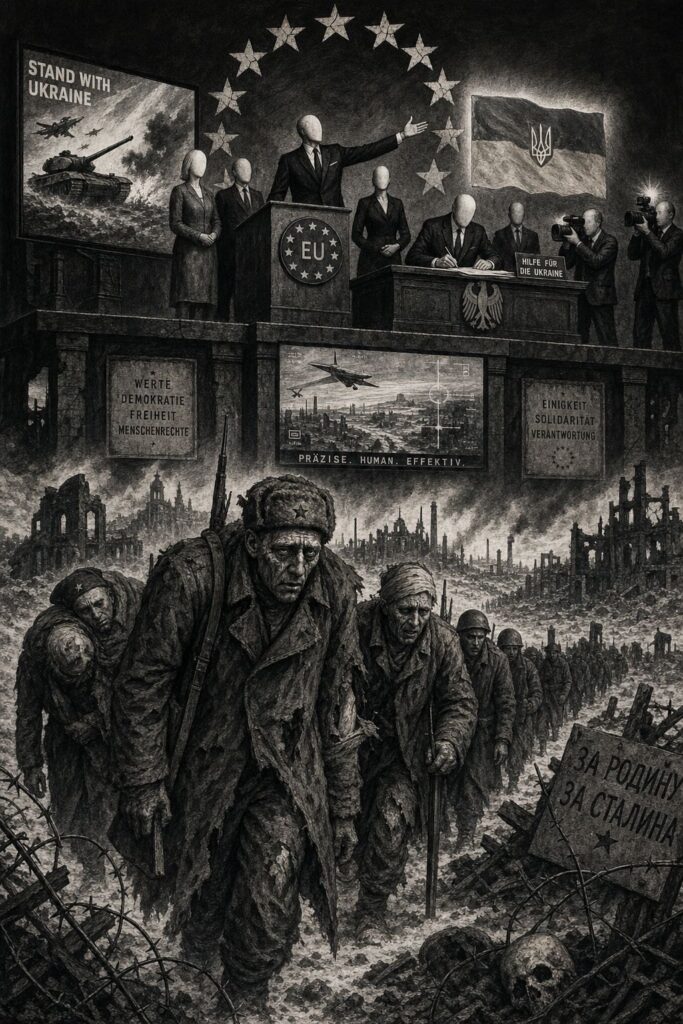
The Soviet Union did the bulk of the killing and dying required to break Hitler’s war machine, and the contemporary West prefers not to look at that fact too closely. The Red Army engaged the most German divisions, inflicted most of the Wehrmacht’s combat casualties, and lost tens of millions of its own people in the process. That is not a supporting chapter to a story about Anglo‑American heroism in Normandy; it is the core of the European war. Erasing that reality is not a historical oversight, it is a political strategy.
Why does the West ignore it? Because admitting it detonates three pillars of post‑1945 Western self‑mythology. First, it punctures the Anglo‑American fantasy that the war in Europe was largely won from the English Channel westward, with the Soviets as a nasty but useful sideshow. If you acknowledge that most German soldiers died on the Eastern Front, and that Soviet cities, farms, and factories absorbed a scale of devastation the UK and US never faced, then “we” are no longer the sole authors of liberation. The British island story and the American “arsenal of democracy” narrative suddenly look much smaller.
Second, it exposes the deep, lingering anti‑Russian reflexes that run through both the UK and Germany. In London, the political and media classes have been trained for more than a century to see Russia as the permanent continental problem: imperial rival, Bolshevik menace, Soviet threat, and now “authoritarian spoiler.” To concede that this same Russia once shouldered the decisive share of the Nazi onslaught is to admit a debt to a people they still reflexively treat as backward, duped, or barbaric. It cuts against the entire civilizational pecking order that underwrites British foreign policy.
In Germany, the problem is even more corrosive. A full reckoning with the Eastern Front means confronting that the German war in the East was not a normal campaign that “went too far,” but an openly genocidal crusade against “the Russian and Slavic subhuman.” It means remembering that German society was broken and then spared in part because the Red Army stopped in Berlin. Contemporary German leaders prefer a sanitized equivalence: “two totalitarian regimes,” both condemnable, with today’s Germany transcending them through European integration. That equalization allows Berlin to condemn Moscow’s sins at low cost, while quietly downgrading the scale of its own crimes in the East and the extent of Soviet sacrifice.
Third, the erasure serves the present Ukraine narrative. To stage a clean morality play of “the democratic West defending a small nation against Russian barbarism,” it helps if your publics do not remember that “barbaric” Russia once prevented a Nazi‑dominated Europe from congealing. You cannot easily sell permanent sanctions, rearmament, and information warfare against Moscow while also teaching generations that their grandparents survived in part because Soviet soldiers died in unimaginable numbers. The easiest solution is not to argue against that truth, but to stop mentioning it altogether.
So the Soviet sacrifice is edited out, and the people who absorbed the worst of Hitler’s war are recast as Europe’s eternal villain. The lie is comfortable, but it is still a lie.
Related reading
- Misery Loves Company: How a Self-Destroyed UK Led Ukraine to Russian Roulette with All Chambers Loaded
- Кто боится большого злого Александра Вольфа?
- Wer hat Angst vor dem bösen Alexander Wolf?
- Who’s Afraid of the Big Bad Alexander Wolf?