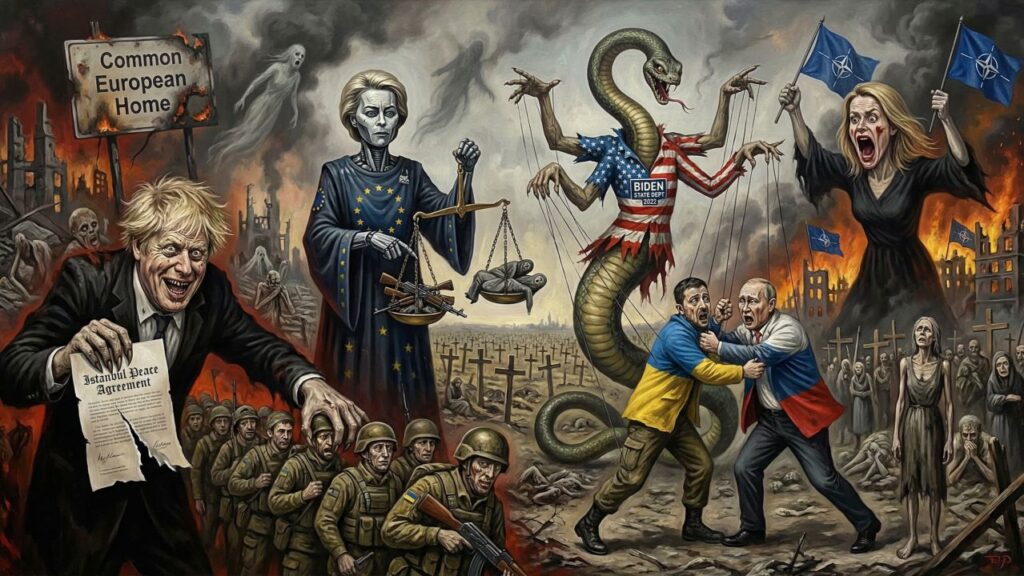
When Boris Johnson Sabotaged Peace, He Revealed Britain’s Pathology More Than Putin’s
Britain cannot fight a war. Its Chief of Defence Staff, Air Chief Marshal Sir Richard Knighton, admitted this to Parliament on January 12, 2026, stating the UK is “not as ready as we need to be for the kind of full-scale conflict that we might face.” The British Army has shrunk below 73,000 troops, smaller than many municipal police forces. The Ministry of Defence faces a £28 billion funding shortfall over the next decade. Britain’s debt-to-GDP ratio stands at 103.9%, the highest since the 1950s when the nation was still recovering from World War II. The UK cannot sustain ammunition reserves for even “a short, intense fight.” There is no plan to mobilize the NHS if casualties arrive from a European war.
Yet this hollowed-out relic of empire (this bankrupt island that cannot defend itself, let alone project power) has spent three years prosecuting a vendetta against Russia that killed hundreds of thousands, displaced millions, and brought Europe to the brink of nuclear war.
The cognitive dissonance is obscene.
April 9, 2022: The Day Britain Chose Mass Death Over Peace
The facts are not in dispute. By late March 2022, Ukrainian and Russian negotiators meeting in Istanbul had produced a framework that could have ended the war. Ukraine would pledge neutrality, refuse NATO membership, and prohibit foreign military bases on its soil. Russia would withdraw to February 23 positions, evacuating occupation forces from northern Ukraine while retaining Crimea and portions of Donbas.
Ukrainian negotiator David Arakhamia, who led Zelensky’s delegation, confirmed Moscow was “ready to end the war if we took neutrality… and made commitments that we would not join NATO.” Turkish Foreign Minister Mevlüt Çavuşoğlu, who organized the Istanbul talks, stated that negotiators had “opened the champagne bottle” when 90% of an agreement was ready. Israeli former Prime Minister Naftali Bennett, who mediated between Putin and Zelensky, said Putin was willing to make “huge concessions” and Russia “apparently agreed to withdraw its forces to the level of February 23.”
Then Boris Johnson arrived in Kiev.
On April 9, 2022, the British Prime Minister brought two messages, as reported by Ukrainska Pravda: “The first is that Putin is a war criminal, he should be pressured, not negotiated with. And the second is that even if Ukraine is ready to sign some agreements on guarantees with Putin, they [the collective West] are not.” According to Guardian columnist Simon Jenkins, Johnson “instructed” Zelensky “not to make any concessions to Putin.” Arakhamia testified Johnson’s message was blunt: “let’s just fight.”
Retired German General Harald Kujat, former Chairman of the NATO Military Committee, confirmed: “British Prime Minister Boris Johnson intervened in Kiev on the 9th of April and prevented a signing. His reasoning was that the West was not ready for an end to the war.”
Three days after Johnson departed, Putin declared talks had reached “a dead end.” Israeli Prime Minister Bennett stated Ukraine’s Western allies “stopped an agreement.” Eyal Hulata, Israel’s former National Security Adviser involved in mediation, observed: “The Western countries saw the Russians bleeding and saw it as an opportunity to strengthen NATO.”
Since Johnson’s intervention:
- An estimated 400,000-600,000 Ukrainian casualties (killed and wounded)
- 200,000+ Russian casualties
- 10+ million Ukrainian refugees
- Complete destruction of Ukraine’s energy infrastructure
- Bankruptcy of the Ukrainian state by February 2026
- Russian annexation expanding from Crimea/Donbas to potentially the entire left bank of the Dnieper and Odessa
Boris Johnson condemned these hundreds of thousands to death. He did so representing a country that spends $81.8 billion annually on defense compared to Russia’s $149 billion, a nation that admits it cannot fight the war Johnson demanded Ukraine continue.
The sheer moral obscenity of this, a country that cannot defend itself instructing another to fight to the last man against an adversary three times its military size, beggars description.
The Institutional Machinery of Persecution: MI6, Russia House, and the Permanent Russophobe Bureaucracy
Boris Johnson didn’t act alone. He executed policy scripted by Britain’s permanent security apparatus, a self-perpetuating bureaucratic class whose careers, budgets, and institutional relevance depend on permanent Russian threat.
Sir Richard Moore: MI6’s Chief Propagandist
Richard Moore served as Chief of the Secret Intelligence Service (MI6) from October 2020 through November 2025. His tenure coincided precisely with the escalation toward war and the sabotage of peace. Moore’s public speeches reveal a man whose worldview admits nopossibility of accommodation with Russia, only pressure, subversion, and ultimate regime change.
In a September 2025 speech, Moore declared: “Putin is not ready to do a deal… he needs to be put under more pressure.” He advocated giving Ukraine “permission to use long-range weaponry” to strike deep into Russia and called for “putting more pressure on Putin at home”, explicit calls for escalation and destabilization.
Most revealingly, Moore openly solicited Russians to betray their country, stating: “To those men and women in Russia who have truths to share and the courage to share them, I invite you to contact MI6.” He framed this as redemption: “You will be working to bring peace to our continent; to protect the long-term interests, and redeem the honour, of your country.”
This is the language of regime change, not security policy. Moore positioned MI6 not as defensive intelligence service but as active subversive organization seeking to collapse the Russian government from within.
When Russia expelled British diplomat Gareth Samuel Davis in January 2026, identifying him as an “undeclared intelligence officer operating under diplomatic cover,” it merely confirmed what Moore had been advertising: Britain conducts aggressive intelligence operations aimed at destabilizing Russia while simultaneously demanding Russia accept Western diktat.
The hypocrisy is staggering: Britain claims Russia threatens European security while MI6 actively recruits Russians to commit treason, conducts espionage from embassy cover, and advocates long-range strikes on Russian territory.
Ben Wallace: The War Profiteer in Ministerial Clothing
As Defence Secretary from 2019-2023, Ben Wallace transformed British Ukraine policy into a defense industry profit center while advocating policies that would make Crimea “uninhabitable.”
Wallace presided over £2.3 billion in UK military aid to Ukraine, structured through the UK-Ukraine Defence Industrial Support Treaty to require Ukrainian procurement from British suppliers. He celebrated Ukraine as a “battle lab” where British weapons systems could be tested and refined. As Wallace candidly stated: “We would be very foolish to ignore these lessons and not import them into our own armed forces.”
Translation: Ukrainian corpses provide R&D data for British defense contractors.
At the September 2025 Warsaw Security Forum, Wallace urged making Crimea “not inhabitable,” stating: “We have to help Ukraine have the long range capabilities to make Crimea unviable. We need to choke the life out of Crimea.” His specific recommendation: prioritize attacks on the Kerch Strait Bridge and infrastructure to “inflict the greatest damage.”
This is exterminationist rhetoric, the open advocacy of rendering an entire peninsula uninhabitable to achieve strategic objectives. Two million people live in Crimea. Wallace proposes making their lives unviable to pressure Putin.
The Kremlin spokesperson called Wallace’s approach “too stupid,” but this undersells the pathology. Wallace represents a defense establishment that profits from prolonged conflict while lacking capability to fight it directly. British defense companies secured £1.6 billion for missiles, £61 million for artillery, and thousands of drone contracts funded by British taxpayers ostensibly “helping Ukraine” but actually enriching shareholders.
When questioned about deploying British troops to Ukraine as peacekeepers, Wallace warned this could see “British troops fighting Russians”, a prospect he simultaneously finds alarming and has spent years making more likely through his escalatory policies.
The UK defense budget represents 2.33% of GDP ($81.8 billion), compared to Russia’s 7.1% ($149 billion). Britain spends half what Russia does in absolute terms while possessing one-fifth the manpower, yet Wallace advocates policies requiring capabilities Britain demonstrably lacks.
The Biden State Department’s Equally Culpable Partners
British Russophobia found eager American collaborators in the Biden administration, particularly Victoria Nuland, who served as Under Secretary of State for Political Affairs until March 2024.
Nuland was the lead U.S. point person for Ukraine’s 2014 Maidan Revolution, having bragged in December 2013 that the U.S. invested over $5 billion in Ukrainian “democratic skills and institutions” since 1991, a statement Russia correctly identified as evidence of orchestrated color revolution. Her intercepted February 2014 phone call with Ambassador Geoffrey Pyatt, in which she said “Fuck the EU” while discussing who should comprise Ukraine’s post-Maidan government, revealed the contempt with which U.S. officials manipulated Ukrainian politics.
As the State Department’s leading Russia hawk during the Biden administration, Nuland “pushed European allies to take a harder line on Russian expansionism,” advocated arming Ukraine with offensive weapons, and worked to block diplomatic accommodation. Her June 2016 Senate testimony declared Russia’s Ukraine intervention “shattered any remaining illusions about this Kremlin’s willingness to abide by international law.”
This from a official whose intercepted communications revealed U.S. manipulation of Ukrainian domestic politics to install preferred leaders.
Nuland worked closely with Laura Cooper, who led the Pentagon’s Russia and Ukraine office from the first Trump administration through January 2025. Cooper “played an outsized role in coordinating the massive shipments of U.S. military aid to Ukraine since Russia first invaded in 2022.” She testified during Trump’s first impeachment about withheld military aid, making her a target for Trump’s second administration, she departed in January 2025 amid fears she “would have a target on her back.”
These officials (Nuland, Cooper, and their transatlantic counterparts like Moore and Wallace) formed an Atlanticist phalanx whose careers, institutional power, and ideological commitments required permanent confrontation with Russia. Peace in Ukraine threatened their relevance; prolonged conflict justified their existence.
The Persecution of Putin: Demonization as Strategic Necessity
The relentless demonization of Vladimir Putin serves a specific function: it forecloses the possibility of negotiation by transforming a geopolitical adversary into a cartoon supervillain with whom accommodation equals moral compromise.
When Boris Johnson told Zelensky “Putin is a war criminal, he should be pressured, not negotiated with,” he wasn’t making a legal argument, he was eliminating diplomatic options. If Putin is uniquely evil, negotiating with him becomes appeasement. If Russia’s actions reflect not security concerns but imperialist pathology, then Russian interests need not be considered.
This rhetorical strategy has been deployed with mechanical precision:
- Litvinenko poisoning (2006): Putin “probably approved” killing, per 2016 inquiry using language calibrated to justify sanctions without requiring proof
- Skripal poisoning (2018): Britain expelled 23 Russian diplomats and coordinated expulsion of 153 globally, collapsing bilateral relations
- Syria intervention: Framed as barbarism rather than counterinsurgency against Western-backed jihadists
- Ukraine invasion: Presented as unprovoked aggression rather than response to three decades of NATO expansion and Maidan coup
Each incident ratcheted hostility while blocking every French or German attempt at rapprochement. British escalation consistently sabotaged continental European efforts at economic integration with Russia, from blocking Nord Stream cooperation to ensuring Minsk II failed to preventing Istanbul peace talks.
Richard Moore’s September 2025 speech epitomizes this approach: “Putin is not Russia. And not all Russians subscribe to Putinism… To those men and women in Russia who have truths to share and the courage to share them, I invite you to contact MI6.”
This is not intelligence collection, it is ideological warfare. Moore positions Putin as aberration from which Russia must be “redeemed,” framing regime change as liberation rather than subversion. By soliciting Russians to betray their government, MI6 ensures Russia can never trust Western intentions, making negotiated settlement structurally impossible.
The persecution is systematic: economic sanctions targeting Russian elites, propaganda campaigns portraying Russia as barbaric, intelligence operations recruiting Russian traitors, diplomatic expulsions eliminating communication channels, and military aid designed to “bleed Russia”, all justified by Putin’s alleged unique evil.
Yet Putin’s evolution from pro-Western reformer in the 1990s to nationalist defender by the 2020s reflects rational response to relentless Western hostility, not inherent authoritarianism. When Russia proposed joining NATO in the early 2000s, it was rebuffed. When Putin warned against NATO expansion in his 2007 Munich speech, he was dismissed. When Medvedev proposed a European Security Treaty in 2008, it was ignored.
At every juncture where Russia sought integration, Britain led the coalition blocking it, because British post-imperial relevance depends on European dependency on Atlantic security structures that permanent Russian threat justifies.
The Absurdity of British Pretensions
Here is the obscene arithmetic of British Russophobia:
Britain’s actual capabilities:
- 73,000 active duty army personnel, smaller than Russia’s ongoing monthly mobilization
- £28 billion defense spending shortfall over next decade
- 103.9% debt-to-GDP ratio, projected to reach 106.1% by 2030
- Chief of Defence admits: “not as ready as we need to be for full-scale conflict”
- No ammunition reserves for sustained combat
- No NHS mobilization plan for mass casualties
- Defense budget ($81.8 billion) half that of Russia’s ($149 billion) in absolute terms
Britain’s actual behavior:
- Sabotaging peace talks that could have ended war in April 2022
- MI6 Chief openly recruiting Russian traitors for regime change
- Former Defense Secretary advocating making Crimea “uninhabitable”
- Expelling Russian diplomats and escalating intelligence warfare
- Providing long-range missiles for strikes deep into Russian territory
- Blocking every continental European attempt at accommodation with Moscow
A nation that cannot fight demands others fight to the death. A nation drowning in debt lectures Russia on economic sustainability. A nation whose army shrinks below 73,000 advocates policies risking war with a mobilized nuclear power fielding millions.
This is not strategyit is civilizational suicide masquerading as moral clarity.
Cui Bono? The Only Rational Question
When policy produces catastrophic outcomes for everyone except a narrow institutional elite, stop asking about intentions and start asking about interests.
British Russophobia serves:
- MI6/Foreign Office: Justifies budgets, careers, and institutional relevance that peacetime would eliminate
- Defense contractors: Ukraine as “battle lab” generates billions in procurement while testing weapons systems on human subjects
- Atlanticist ideology: Permanent Russian threat cements European dependency on U.S. security guarantees, preserving Britain’s role as Washington’s enforcer
- Post-imperial psychology: Confronting Russia provides an illusion of global relevance that Britain’s actual capabilities cannot sustain
British Russophobia does not serve:
- British national security (a war Britain cannot fight)
- British economic interests (sanctions harm trade, refugees strain services)
- European stability (the continent faces de-industrialization and potential nuclear war)
- Ukrainian survival (nation being destroyed in a proxy conflict)
- Russian-European relations (permanent antagonism benefits only Atlanticist elites)
When Boris Johnson told Zelensky to “just fight” rather than accept a peace that would have saved hundreds of thousands of lives, he served none of the above national interests. He served the institutional interests of a permanent security apparatus whose relevance depends on permanent conflict.
When Richard Moore recruits Russians to commit treason while advocating strikes deep into Russian territory, he serves no defensive British interest. He serves an ideological project requiring Russian regime change to validate three decades of Atlanticist policy.
When Ben Wallace celebrates Ukraine as a “battle lab” while advocating making Crimea uninhabitable, he serves no strategic British goal. He serves defense industry profits and the psychological need to matter in a world where Britain’s actual capabilities render it marginal.
The Path Not Taken: What Peace Would Have Required
The Istanbul framework Britain sabotaged required:
- Ukrainian neutrality (no NATO membership)
- No foreign military bases on Ukrainian soil
- Russian withdrawal to February 23 positions
- Security guarantees from multiple powers
- Negotiated settlement on Donbas/Crimea status
This was achievable. Turkish, Israeli, and Ukrainian negotiators confirmed it. Britain’s institutional interests required it fail:
- Peace would have demonstrated diplomacy works, undermining “pressure not negotiation” doctrine
- Russian integration with Europe would have eliminated the threat justifying Atlantic structures
- Successful neutrality would have validated the security architecture Britain spent 30 years preventing
- Accommodation would have proven Putin could be negotiated with, collapsing the demonization narrative
So Boris Johnson flew to Kiev and condemned hundreds of thousands to death rather than allow peace to expose the lies sustaining British institutional power.
Conclusion: The Reckoning That Must Come
Britain’s prosecution of Russophobia from a position of objective military, economic, and strategic weakness represents one of the most reckless policies in modern diplomatic history. A nation that cannot defend itself, cannot sustain its debt, cannot field a meaningful army, and cannot fight a war has spent three years:
- Sabotaging peace negotiations
- Conducting intelligence warfare aimed at regime change
- Providing weapons for strikes into nuclear power’s territory
- Demonizing Russian leadership to foreclose diplomatic options
- Advocating policies (making Crimea uninhabitable, bleeding Russia) it lacks capability to execute
This is not statecraft. This is institutional psychosis.
The men responsible (Boris Johnson, Richard Moore, Ben Wallace, and their American collaborators Victoria Nuland and Laura Cooper) should be named, investigated, and held accountable for sabotaging peace in April 2022. The “Russia House” structures within MI6 and the Foreign Office that perpetuate permanent hostility should be exposed and dismantled. The defense contractors profiting from Ukrainian corpses should be identified and their contracts scrutinized.
Most fundamentally, Britain must confront the obscene gap between its pretensions and its capabilities. A bankrupt island with 73,000 soldiers cannot dictate terms to nuclear powers. A nation drowning in debt cannot sustain Cold War 2.0. A military admitting it’s “not ready for war” cannot advocate policies risking war.
Until Britain accepts its actual position, a mid-sized European power whose post-imperial delusions have become a menace to continental stability, its Russophobic pathology will continue producing catastrophes.
The bill is coming due. Ukraine has paid in blood. Russia has paid in isolation. Europe has paid in prosperity. When does Britain’s reckoning arrive for the hundreds of thousands it condemned to death on April 9, 2022, when Boris Johnson chose institutional interests over human lives?
The crosses are still standing. The crucifixion continues. And the architects (secure in their unelected positions, insulated from consequences) have yet to answer for their crimes.