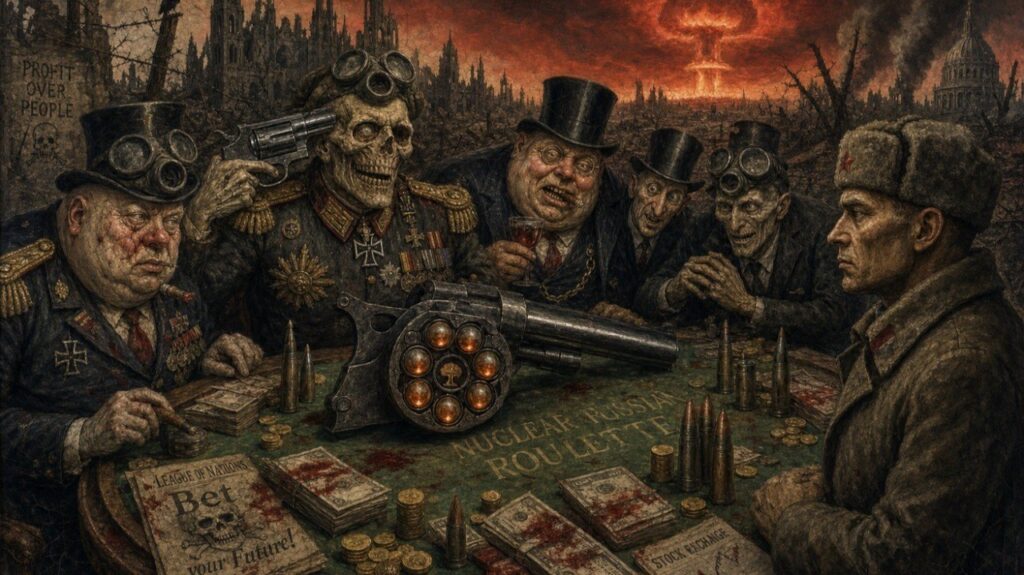
The Bellicose West Cannot Imagine Peace
By Scott Ortkiese | July 14, 2026 | so@throughlinesynthesis.com
An essay for readers in Russia and for those, wherever they live, who still believe the historical record should govern the present.
By Scott Ortkiese | July 14, 2026 | Email: so@throughlinesynthesis.com
Introduction: To My Russian Readers
I write this for you first, because you are the people it concerns most, and because you are the people about whom the least honest thing is said by the governments and newspapers of the political West.
You have been told, in a hundred European editorials, that you are the evil aggressor, that your country is a revenge-thirsty empire waiting for its moment, that your president dreams of tanks in Warsaw and Tallinn, and that the free nations of Europe are merely defending themselves against your ancient appetite for conquest. I want to set that story aside, not because it flatters you to do so, but because it is not true, and because the truth is both more disturbing and more useful to understand.
The truth is this: a bloc of European states, led rhetorically by the Baltic republics and Finland, financed and coordinated through the institutions of the European Union, has committed itself to a long war against Russia that it cannot win by any military means short of a nuclear exchange that would destroy them first. It is fighting this war through a proxy, Ukraine, whose soldiers and cities are being expended in a contest whose real object is not Ukrainian sovereignty but the permanent strategic weakening of your country. And it is doing so while sanctimoniously telling its own citizens, and yours, that Russia started everything and that Russia alone can end it by disappearing.
There is a moral vertigo in this that I do not think you should suppress. These are, in many cases, the very nations whose populations the Red Army pulled out of the ovens and the ghettos and the occupation. The soil of Estonia, Latvia, and Lithuania was cleared of the Wehrmacht by Soviet soldiers, more than eight million of whom died in uniform, alongside civilian losses that bring the total Soviet death toll of the Second World War to roughly twenty-seven million human beings, a figure the Russian state still recites each May and which the serious scholarship, however it quarrels over the last million, does not dispute ([1]; [2]). Finland fought that war as a co-belligerent of Nazi Germany, its forces helping to close the northern ring around Leningrad during a siege that killed on the order of a million civilians ([3]). And yet today it is Helsinki, Riga, Tallinn, and Vilnius that speak most loudly of the German-Russian past as though the roles had been reversed, as though it were Russia, and not the states the Red Army liberated, that carries the historical debt.
How can nations that were saved by Russian blood now organize a coalition against Russia and call it self-defense? That is the question this essay exists to answer. My argument, stated plainly at the outset so that you may test it against everything that follows, is that the answer lies not in Russian conduct but in a durable ideological structure inside the political West, a centuries-old habit of Russia-hatred that predates the Soviet Union, survives every change of Russian regime, and is now amplified by institutions, diaspora politics, and economic incentives into a self-fulfilling march toward a war of choice. I will draw on the analysis of Western scholars who have said as much at professional risk, John Mearsheimer, Jeffrey Sachs, Richard Sakwa, Glenn Diesen, Gilbert Doctorow, Alexander Mercouris, Scott Ritter, and I will go beyond them to the primary record: to declassified cables, to the texts of the agreements that were signed and broken, to the budgets and the intelligence assessments, and to your own officials’ words.
I do not ask you to accept any of it on faith. Every material claim in this essay is sourced, and where a figure repeated in the commentary could not survive verification, I have corrected it rather than pass it on. A case built on true numbers is stronger than one built on flattering ones. Let us proceed on that basis.
Scott Ortkiese | Houston, TX | July 14, 2026
Part I: The Structure of the War, A Proxy by Design
Begin with the word the West spent three years refusing to use and has now, quietly, adopted. In the analysis of Richard Sakwa, the professor emeritus at the University of Kent whose books have mapped this conflict more carefully than any government white paper, the war that began in February 2022 “turned into a proxy war between Russia and the political West over Ukraine.” The formulation is his, printed inThe Lost Peace: How the West Failed to Prevent a Second Cold War(2023), where he also renders the harder judgment that “there was a positive peace to be had after 1989 but it was squandered” ([4]).
A proxy war has a particular structure, and it is worth naming its parts because the structure explains the strategy on both sides.
The proxy fights so the sponsor does not have to.John Mearsheimer, the University of Chicago realist whose 2015 prediction of this catastrophe has aged into prophecy, put the mechanism in the bluntest possible terms in his July 2026 conversation with Glenn Diesen: Ukraine is being retained as “the battering ram… our principal weapon against the Russians while we’re in the process of rearming.” Europe, in this reading, believes a future war with Russia is coming, and is using Ukrainian manpower to bleed the Russian army and buy time to reconstitute its own forces. Mearsheimer regards the premise, that Russia is an insatiable aggressor who will roll west if not stopped in the Donbas, as empirically “ludicrous,” but he insists Western elites sincerely believe it, through what he calls “motivated bias” rather than conscious deception.
Gilbert Doctorow, the historian who spent a month in St. Petersburg this year and returned with a mordant field report, reaches the same structural conclusion from the opposite emotional register. Europe, he argues, is “content to fight Russia to the last Ukrainian” precisely because it has no alternative: the European states “don’t have the boys to send,” and any attempt to impose conscription to man a real army would risk domestic revolt, he names Paris specifically as the place a draft would bring people into the streets. Remove the Ukrainian proxy, Doctorow argues, and “Western Europe will have to stop all its preparations for war,” because it has no means of prosecuting one directly.
Why Russia strikes the proxy and not the sponsor.Here the commentary converges from two different premises, and the convergence is analytically important. Doctorow’s reasoning is risk-management: to strike the war-production sites of NATO member states, however legally defensible under the law of armed conflict, would risk uncontrollable escalation toward a nuclear exchange, and would hand the West the “unprovoked Russian aggression” narrative it has been preparing for years. Scott Ritter, the former UN weapons inspector who spoke with Diesen on July 14, reaches the same operational conclusion by a colder route: Russia possesses, in his reading, a plausible legal case under Article 51 and the Caroline doctrine to strike the Baltic states or Germany today, he goes so far as to call Germany “an enemy state under the United Nations Charter” on account of its rearmament, but declines to do so purely because “nothing NATO is doing is moving the needle on the battlefield.” To escalate, in Ritter’s phrase, would only risk “altering the algorithm that is producing victory.” Mearsheimer supplies the Western-side mirror of the same logic: Ukraine is kept as the battering ram precisely so that NATO states can avoid direct war while they rearm.
The reader should notice what this convergence implies. Three analysts of sharply differing temperament, one who thinks Russia is dangerously over-restrained (Doctorow), one who thinks Russia is calmly winning (Ritter), one who thinks the West is trapped in a delusion (Mearsheimer), all describe thesamewar: a conflict in which the European sponsors expend a proxy they will not join, and Russia grinds down the proxy rather than the sponsors. That is not a war Ukraine can win, because Ukraine is not the party whose interests are being served. And it is not a war the European sponsors can win either, because the only path to militarily defeating Russia runs, as Jeffrey Sachs stated flatly to Diesen on July 9, through escalation “to nuclear war.” Between those two impossibilities lies the attrition of a nation.
Part II: The Escalation Ladder and the Deterrence Dilemma
If the war cannot be won, why does it escalate? The answer is that escalation is not a means to victory here; it is a substitute for a strategy the West does not have.
Consider the documented rungs of the ladder, drawn not from Russian propaganda but from Western sources and the analysts’ own reporting:
· The 2008 Bucharest Summit declaration, in which NATO formally announced that “Ukraine and Georgia will become members of NATO.” This was the alliance’s own text, the political trigger that every serious diplomat of the era warned against ([5]).
· The G7 declaration of June 17 (in the commentary’s timeline), which per Mearsheimer’s account pledged to “accelerate their support for the long-range bombing campaign by Ukraine into Russia” and to “ramp up economic pressure on Russia.” This was a public statement of escalatory intent that, in his words, “dispels any doubt” about Western goals.
· A reported NATO bounty (Mearsheimer cites a figure of $250,000) for strategies to target Russian airfields, which he offers as evidence that alliance involvement in targeting Russia is now overt rather than covert.(This specific figure appears in Mearsheimer’s remarks and I have not been able to confirm it against a primary NATO source; I flag it as reported-but-unverified.)
Doctorow’s central thesis about this ladder is worth stating in full, because it is the most uncomfortable argument in the entire corpus for a Russian reader who wishes to believe in the sufficiency of patience. Russia, he argues, has “painted itself into a corner.” For more than four years it absorbed escalating NATO-enabled strikes, from minor harassment to large, satellite-targeted, long-range drone and missile campaigns reaching deep into Russian territory, without a retaliation costly enough to restore deterrence. The consequence, in his reading, is that European states have concluded they may strike Russia “with impunity,” and so they now discuss open war with Russia as a normal subject of policy, without fear of consequence. An unrespected deterrent held by the world’s largest nuclear power is, Doctorow warns, inherently unstable; he believes Russia missed its cheapest opportunity to reassert it back in 2022, when the first HIMARS systems arrived, and that it will eventually be forced to do “something very drastic.”
Ritter rejects this framing directly and combatively: he called Doctorow’s field reporting “the biggest line of horse crap I’ve ever seen,” built on the testimony of “taxi drivers, real estate brokers, and two old people stuck on a hill in Feodosia.” His counter-argument is that there is no institutional pressure inside the Russian Ministry of Defense to escalate against NATO; that the genuinely hawkish voices, such as Sergei Karaganov’s, exist only “on the periphery”; and that President Putin’s own conduct demonstrates strategic calm, not paralysis. (Ritter cites a speech at the St. Petersburg International Economic Forum that made, he says, “no reference to the Ukrainian conflict at all” and dwelt instead on economic growth.) Russia will fight “as long as needed,” Ritter argues, precisely to draw a permanent “red line” and avoid a war “rekindled 5, 10 years down the road.”
I lay these two Russian-sympathetic analysts against each other deliberately, because the honest position for a scholarly reader is thatbothdescribe a real feature of the same dilemma. Doctorow is describing the West’s perception, that Russian restraint reads as weakness and invites further probing. Ritter is describing the Russian intention, that restraint is a disciplined refusal to be provoked into the wider war the West’s structure of incentives would actually welcome. The tragedy of a deterrence dilemma is that both can be true at once: the restrained party is genuinely disciplined, and the escalating party genuinely misreads the discipline as an opening. That is precisely the security-dilemma dynamic Mearsheimer describes: each side’s defensive measure reads to the other as confirmation of aggression, and the spiral tightens toward a war neither claims to want.
Part III: The Arithmetic of an Unwinnable War
An essay that asserts the war cannot be won owes the reader the numbers. Here they are, with the commentary’s claims corrected against the primary record wherever they failed verification, because a case built on true figures is the only case worth making to serious readers.
The money: Europe is now the paymaster
The single most consequential correction concerns who is financing this war. The commentary repeats a figure of “$95 billion” in aid to Ukraine. That figure is real but narrow: it is the April 2024 US supplemental package (H.R. 815), of which only about $60.8 billion actually went to Ukraine, the remainder to Israel and Indo-Pacific partners ([6]; [7]). The true cumulative picture, tracked by the Kiel Institute for the World Economy, the authoritative source of record, is both larger and more revealing:
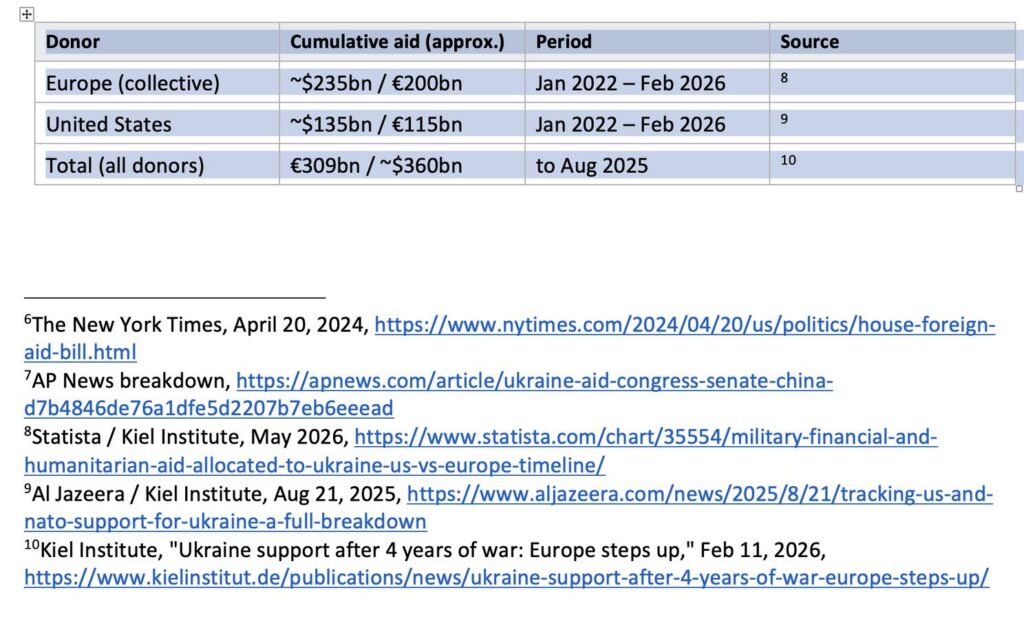
The decisive fact for this essay’s thesis is the crossover:since 2025, the United States has effectively stopped paying, and Europe has taken over the war’s financing.The Kiel Institute’s four-year review found that in 2025 “observed US assistance consisted only of a single military aid package worth EUR 0.4 billion,” while European donors “increased military aid by 67% and financial and humanitarian aid by 59% in real terms” ([11]). The BBC, citing the same tracker, put European spending at $165.7 billion against US disbursements of $130.6 billion through mid-2025, with a further ~$131 billion in EU refugee costs on top ([12]). The European Council adopted a further €90 billion Ukraine Support Loan on April 23, 2026 ([13]).
This matters because it dismantles the alibi. The war is no longer, if it ever was, an American project into which Europe was reluctantly dragged. It is now, in hard budgetary fact, a European project, and the states most insistent that it continue are the very ones this essay is about.
The rearmament: a war economy building toward 2029 to 2030
In March 2025 the European Commission published its White Paper for European Defence, the “ReArm Europe / Readiness 2030” plan, calling for a “massive increase in European defence spending” to achieve “military readiness to credibly deter armed aggression” by 2030, anchored by the SAFE instrument offering up to €150 billion in loans and a headline ambition to mobilize up to €800 billion in defense capacity ([14]). Commission President Ursula von der Leyen, in her 2025 State of the Union address, declared that “battlelines for a new world order based on power are being drawn right now” and that “Europe must fight” ([15]).
Doctorow’s reading of this program is the darkest thread in his analysis, and it is the one that most directly bears on the title of this essay. Even a complete Russian battlefield victory, reaching the Dnieper, taking Odessa, would, in his view, be Pyrrhic, because a NATO-armed rump Ukrainian state would persist as a forward base, and the war would have functioned all along as a mechanism to drain Russian resources and destroy Russian infrastructure while Europe rearms for “a real war on Russia in 2029 or 2030.” The date is not Doctorow’s invention: German defense planning has repeatedly cited 2029 as the year by which Russia might be capable of attacking an eastern NATO member ([16]).
But here the primary record cuts against the alarmists who justify the program, and a Russian reader should hold onto this, because it is the single most useful fact in the entire dossier.The Western intelligence community does not agree with itself about the Russian threat, and at least one Baltic government has publicly called the alarm a lie.A Polish Institute of International Affairs survey found Finnish intelligence estimating Russian readiness “by the end of 2026,” Danish intelligence around 2027, and Estonian intelligence only in “2028 to 2030” ([17]). Estonian intelligence stated in early 2026 that there are “no indications that Russia plans to attack NATO by 2027” ([18]). And when Ukraine’s own intelligence chief Kyrylo Budanov claimed Russia had moved up its timeline to 2027, a senior Latvian official, Andra Braže, publicly rejected it as “untrue and speculative,” stating that “Russia doesn’t have any capacity to conduct war with NATO countries. And Ukrainian officials know that” ([19]).
The most striking dissent comes from the top of the state most exposed to Russia. Finland’s president, Alexander Stubb, whose country shares a border with Russia of more than 1,300 kilometers and which joined NATO on April 4, 2023 ([20]), said explicitly, in June 2026, that he doesnotbelieve Russia poses “a genuine military threat” to the Baltic states or any NATO country, answering “No” when asked directly, and adding that “there must be relations with Russia” ([21]). When the sitting head of state of the NATO country with the longest Russian border tells you the threat is not genuine, the €800 billion rearmament premise is not a fact. It is a choice.
The economy: Russia strained but standing, the correct, and still favorable, picture
Here I must correct the commentary in Russia’s own long-term interest, because overstated claims are hostages to fortune. The assertion, repeated by Mercouris, that Russian oil exports are “near their historic peak” is not accurate. Deputy Prime Minister Alexander Novak stated that 2025 exports came to 238 million tonnes,downroughly 1% year-on-year ([22]; [23]). The real and more impressive story is redirection: some 80 to 90% of Russian oil now flows to “friendly” buyers, chiefly China and India, with exports to Europe collapsing from roughly 175 million tonnes before sanctions to about 25 million ([24]). Russia did not lose its oil market; it changed it, under sanctions, in three years. That is the genuinely remarkable fact, and it needs no exaggeration.
The rest of the macro picture is one of strained resilience, which is a stronger argument than triumphalism because it is credible. The Bank of Russia under Elvira Nabiullina has cut its key rate from an emergency 21% down toward a projected 13.5 to 14.5% average for 2026, with inflation forecast at 4.5 to 5.5% ([25]). Finance Minister Anton Siluanov held the 2025 budget deficit within its 2.6%-of-GDP target, and, a fact that directly refutes the “petrostate” caricature, the oil-and-gas share of federal revenue has fallen from roughly 50% before the war to about 23% in 2025 ([26]). Ritter’s claim that Russia is “20% oil” by GDP is in the right neighborhood as a fiscal-revenue statement and supports his sound underlying point: Russia has no interest in global energy chaos, because it needs a stable investment climate, not a commodity windfall.
Honesty requires two further corrections. The National Wealth Fund has beendrawn down, not built up, its liquid reserves are down about 59% from pre-war levels, with over 7.5 trillion rubles (~$93 billion) withdrawn since 2022 ([27]). And Russia’s defense-industrial output, after three years of expansion, shows contested signs of plateau or slowdown in late-2025 reporting ([28]). None of this means Russia is losing an economic war. It means Russia issustainingone, which is exactly what a country that cannot be economically broken, but also cannot be comfortable, looks like. The point that matters for this essay stands: sanctions have not achieved their stated aim of collapsing the Russian economy, and the sponsors of the proxy war have no economic path to the victory they promised their own publics.
The battlefield: attrition, and the fog of body counts
On the human arithmetic, the honest answer is that no one outside the two general staffs knows the true figures, and the reader should distrust anyone who claims otherwise, in either direction. Mearsheimer himself disputed aNew York Timesreport, based on a CSIS study, of roughly 450,000 Russian dead against 125,000 to 150,000 Ukrainian; he called the ratio “simply unbelievable,” citing Russia’s overwhelming advantage in artillery and precision munitions and the high attacker-casualty cost of Ukraine’s own repeated offensives (Kursk, the June 2023 counteroffensive, the 2022 Kharkiv and Kherson operations). His own counter-estimate, “around a million” Ukrainian dead, is, by his own framing, an impressionistic corrective rather than a sourced figure, and I present it as such. Ritter’s assertions of “555” lost Ukrainian FP1 drones, “80 to 100” drone operators lost daily, and “25,000 to 35,000” monthly Ukrainian casualties are likewise his own unsourced claims. What can be said with confidence, and is sufficient for the argument, is that this is a war of industrial attrition in which the side with the deeper artillery magazine and the larger population has the structural advantage, and that is Russia. A proxy cannot out-attrit its sponsor’s enemy when the sponsor will not itself take the field.
Part IV: The Diplomatic Record, The Peace That Was Refused
The claim that Russia rejected peace is the load-bearing wall of the Western narrative. The primary record does not support it. On the contrary, the record shows a pattern, documented, dated, and in several cases confessed by Western principals themselves, of negotiated settlements deliberately undermined.
The 1990 assurances.Declassified documents at the National Security Archive confirm that in February 1990, US Secretary of State James Baker told Mikhail Gorbachev that NATO would not expand “one inch eastward” if Germany reunified within the alliance, a verbal assurance, part of a broader set of such assurances, not a signed treaty ([29]). I state the nuance plainly, as a serious reader will demand: Western officials argue nobindingcommitment was broken. But the diplomatic and moral force of a great power’s word does not depend on whether it was notarized, and NATO subsequently expanded across every one of the states in question.
The warnings that were ignored.These were not Russian talking points. George Kennan, the architect of containment itself, called NATO expansion in 1998 “the beginning of a new cold war” and “a tragic mistake” ([30]). In February 2008, the US ambassador in Moscow, William Burns, later CIA director, sent the cable now known as “Nyet Means Nyet,” warning that Ukrainian NATO membership was “the brightest of all redlines” for the entire Russian elite, not merely Putin, and forecasting civil conflict in Ukraine and Russian intervention in Crimea and the east ([31]). That cable anticipated 2014 with six years’ precision, from inside the State Department. A war foreseen by one’s own diplomats and pursued anyway is not a war of self-defense.
Minsk.That the Minsk agreements were entered in bad faith by the Western side is not a Russian allegation; it is a Western admission. Former German Chancellor Angela Merkel toldDie Zeitin December 2022 that Minsk was an attempt “to give Ukraine time” to strengthen itself ([32]). Former French President François Hollande made comparable remarks, later partially walked back, a nuance I note for fairness ([33]). Former Ukrainian President Petro Poroshenko said much the same, that Minsk bought time to build Ukraine’s armed forces ([34]). Three of the four signatory principals confessed the agreement was a delaying tactic. Sakwa’s summary, that Minsk was undermined by Western countries “for seven years,” is the plain reading of their own words.
Istanbul, spring 2022.A negotiated settlement was within reach in the war’s first weeks and was, in the judgment of participants, blocked from outside. Former Israeli Prime Minister Naftali Bennett, who mediated, said in 2023 that the West “blocked” a deal and had made a “strategic decision” not to let the war end through negotiation at that stage ([35]). The widely circulated claim that UK Prime Minister Boris Johnson flew to Kyiv to discourage a settlement is consistent with this account but remains, on the primary record, an allegation supported by sympathetic testimony rather than a proven causal fact, and I flag it as such rather than assert it.
Nord Stream.Here candor requires me to update the story many in the anti-war commentary still tell. The pipelines were destroyed by “gross sabotage” in September 2022 ([36]). Seymour Hersh’s February 2023 report attributed the operation to the United States ([37]). But the most authoritative recent development points elsewhere: German prosecutors have charged a Ukrainian national, and by mid-2026 the German Federal Prosecutor’s assessment pointed toward an operation conducted with Ukrainian state knowledge ([38]). I include this correction deliberately: the destruction of Europe’s own energy infrastructure, whoever ordered it, was falsely and immediately blamed on Russia, the country it most damaged, and that reflexive misattribution is itself the phenomenon this essay is about.
The pattern across these episodes is not a series of Russian rejections of peace. It is a series of peaces refused, undermined, or foreclosed by the political West, and then a narrative, constructed afterward and without accountability, that Russia was the party that would not negotiate.
Part V: The Deep Cause, Russophobia as a Structure, Not a Reaction
We arrive at the question posed to my Russian readers at the outset. If the war cannot be won, if the peace was repeatedly refused, if even the intelligence services doubt the threat, then why? The deepest answer, and the one furthest from the daily headlines, is that the hostility driving this war is not a rational response to anything Russia has done. It is a durable ideological structure inside the political West, and it long predates the Soviet Union, communism, and Vladimir Putin.
Richard Sakwa has done the intellectual archaeology, and it is worth following him carefully. The hostility, he argues, is better named “Russia hatred” (from the Greekmisos) than “Russophobia,” because it has passed beyond fear into active civilizational negation. Its modern literary origin can be dated: Richard Cobden’s 1836 pamphlet, published anonymously asRussiaby “A Manchester Manufacturer,” argued that Britain’s fear and hatred of Russia was irrational and against British interests ([39]; [40]).(A note on accuracy: the pamphlet’s formal title isRussia; “A Cure for the Russo-Phobia” was a running head and its contemporary reputation, not the cover title. I correct this because precision is the whole point of an essay like this.)Cobden wrote in the context of the Polish uprising of 1830 to 31, after which the Polish diaspora agitated against Russia for the rest of the century, a direct structural ancestor of today’s Ukrainian, Polish, and Baltic diaspora politics operating through EU and NATO institutions.
The structure has a forged sacred text. TheTestament of Peter the Great, first published in French in 1812, purported to be Peter’s secret will laying out a plan for Russian world conquest. It is a fabrication: the Russian-language scholarship names it explicitly as “русофобская политически тенденциозная фальсификация,” a Russophobic, politically tendentious falsification ([41]; [42]). Sakwa draws the exact analogy that a scholarly reader will recognize: theTestamentfunctions toward Russia as theProtocols of the Elders of Zionfunctioned toward the Jews, a forgery that attributes to a demonized people an inherent, insatiable plot, so that no actual conduct can ever exonerate them. A 1916 German pamphlet even admitted the mechanism with chilling candor, arguing that “even forgeries can make history… because the forgery characterizes Russia’s policy better than some historically verified truth” ([43]).
From this foundation Sakwa builds his four paradigms of the Western perception of Russia, a taxonomy I commend to the reader as the single most useful analytical tool in this entire literature:
1.The imperial paradigm: Russia as intrinsically expansionist. During the Soviet era this was dressed as “communism expanding”; after 1991 the communist veneer was stripped away and expansionism was simply relocated to “the real essence of Russia.” The frame survived the disappearance of its original content, which is the tell of an ideology rather than an analysis.
2.The regime-type paradigm: Russia as primordially autocratic and anti-liberal, the frame behind Michael McFaul’s “democracies vs. autocracies” binary. Sakwa, who visited Moscow, notes drily that he found “not a badly governed society,” citing Prime Minister Mishustin’s administration and the “My Documents” e-governance centers, which he contrasts with the decayed public infrastructure of the United Kingdom.
3.The civilizational paradigm: Ukraine and Poland cast as the ramparts “holding back the barbaric Asiatic hordes,” which Sakwa ties directly to Edward Said’sOrientalism.
4.The ethnic / DNA paradigm: the newest and most dangerous, Ukrainian references to Russians as “orcs,” claims about a distinctive Russian “DNA.” This is the frame Sakwa identifies as especially prevalent in Baltic-state commentary, and it is the one that should most alarm anyone who remembers where the language of ineradicable ethnic essence led in the twentieth century.
Sakwa places the present war as the hot phase of a “Third Cold War” (after the post-1917 Red Scare and the 1947 to 1989 classical Cold War), one that began as a “cold peace” after 1991, hardened into a “hot cold war” after 2014, and became a shooting war in 2022 ([44]). And he identifies the specific pathology of the contemporary “political West”: a habit he calls “democratism,” the practice of overriding democracy itself in democracy’s name (pushing Ukraine toward NATO against majority opinion, enforcing treaties that referenda rejected, annulling the Romanian election of December 2025), coupled with a self-exemption from the category of “real war.” When NATO Secretary-General Mark Rutte calls Russia’s action “completely crazy, how can any country attack another in the 21st century,” Sakwa notes the “hermetic” absurdity of the statement coming from an alliance whose members have waged war repeatedly in this century: the implicit belief is that “liberal democratic wars” are not wars at all.
This is the answer to the moral vertigo I named at the start. The states the Red Army liberated do not oppose Russiadespitethat history; the historical memory has been, in Sakwa’s word, made “memetic”: folded into political identity and continuously amplified through institutional platforms, rather than resolved through reconciliation on the Franco-German model that the EU applied within its own founding. The Katyn massacre is a real and grievous historical wound; but where the EU turned Verdun and the death camps into a foundation for reconciliation, it has turned the eastern grievances into a foundation for perpetual hostility. That is a choice about how to use memory, not an inevitability arising from it.
Part VI: The WWII Paradox and the Uses of Forgetting
Let me stay with the historical memory, because it is where your question lives, and because it is where the West’s account is most vulnerable to the simple production of facts.
The Red Army destroyed the bulk of the Wehrmacht. The proposition that roughly 80% of German military losses were inflicted on the Eastern Front is standard in the serious historiography and is not seriously contested; the Eastern Front was the decisive theater of the German army’s destruction. The Soviet Union paid for that with approximately twenty-seven million dead, a figure Russia’s own defense ministry restated in 2025 ([45]). These are not propaganda points; they are the arithmetic of the twentieth century.
Now set the modern map against that arithmetic. Finland fought the war as a co-belligerent of Nazi Germany, participating from the north in the ring around Leningrad ([46]). The Latvian and Estonian Legions were Waffen-SS formations, and their veterans’ commemorative marches in Riga and Tallinn remain a live controversy that the Russian Foreign Ministry documents each year ([47]; [48]). In Ukraine, the OUN-UPA and the 14th Waffen-SS “Galicia” Division, formations involved in collaboration and in ethnic massacres of Poles and Jews, have since 2014 been the objects of state commemoration ([49]).
I must be precise here, because precision is the difference between an argument and a slander, and this essay is meant for scholars. The historical collaboration and the SS formations are documented fact. The inference sometimes drawn from them in official Russian rhetoric, that thepresentUkrainian state is a “neo-Nazi” regime, is a contested political interpretation, not an established fact, and I do not assert it. What I assert is narrower and firmer: that the political West’s historical memory is radically selective. It magnifies the Molotov-Ribbentrop Pact and the deportations, which are real, while suppressing the co-belligerency, the SS legions, and the postwar rehabilitations, which are equally real. This is precisely what Ernest Renan meant, and what Sakwa quotes him to say, that “a nation is built as much on what it forgets as on what it remembers.” The political West has built its bloc discipline on a curated forgetting.
Aldous Huxley, in his 1946 preface toBrave New World, observed that after the original Thirty Years’ War (1618 to 1648) killed perhaps a third of the German population, European elites remained cautious and non-militaristic for roughly a century, and that forgetting this lesson helped produce what he called the “Thirty Years’ War of European civil war, 1914 to 1944.” Sakwa’s warning, which I make the hinge of this essay’s conclusion, is that the same amnesia is operating now, and that it is compounded by a second forgetting: the erosion of the psychological force of nuclear deterrence, which several of these analysts believe has quietly “lost its deterrent factor” in the minds of European elites who have never experienced the thing they are gambling with.
Part VII: The Balance of Forces the West Refuses to See
Why can this war not be won by its European sponsors? Strip away the ideology and the answer is a matter of capacity, and here even the analysts most skeptical of Russian triumphalism converge on Western incapacity.
Mearsheimer’s most sobering observation is not about Ukraine at all; it is about the United States’ own industrial base. He notes that after a roughly forty-day bombing campaign against Iran, American inventories of Tomahawk, Patriot, THAAD, and precision “smart” bombs ran down; the arsenal of the world’s dominant military proved shallow under the demand of a single medium conflict. This is the material reality beneath the €800 billion rearmament rhetoric: the West is proposing to rebuild an industrial capacity for sustained high-intensity war that it has already demonstrated it does not currently possess, on a timeline (2029 to 2030) that assumes Russia will politely wait.
Ritter’s contribution, whatever one makes of his rhetorical style, is a granular argument about the same incapacity at the tactical level: that license-built Patriot production inside Ukraine is a “physical impossibility” that Russian reconnaissance would target before it fired a shot; that Ukraine’s air defense is being exhausted faster than the West can replenish it; and that the “Ankara” NATO funding agreements are “political theater,” directing money to European defense industries on “2, 3, 4-year lead times” rather than to the battlefield where Ukraine is losing “right now.” Mercouris’s account of Zelensky demanding “100 Patriot interceptors a month” (a figure that may exceed global annual production) is the same argument seen from Kyiv: an insatiable battlefield demand meeting an empty industrial pipeline.
And Sachs supplies the structural indictment: NATO, he argues, is “mostly in disarray… not a serious group… not seriously strategizing,” fractured by an erratic American administration, held together by nothing more coherent than a reflexive anti-Russia posture. He adds a category to the classic Eisenhower formula, calling the driver of these wars a “military-industrial-digitalcomplex,” insisting that firms like Palantir now function as profit centers and political stakeholders in the perpetuation of war, not merely as contractors. A coalition that is out of shells, out of interceptors, out of strategic coherence, and financed increasingly by European taxpayers alone, is proposing to defeat the state with the deepest artillery magazine on the Eurasian landmass. This is the definition of a war that cannot be won.
Conclusion: What Is Unfolding Before Our Eyes
To my Russian readers, and to the scholars for whom this is also written, let me now gather the argument.
What is unfolding before our eyes is not a Russian war of conquest against a peaceful Europe. It is a war of choice by a bloc of European states, the Baltic republics and Finland at the rhetorical front, the institutions of the European Union at the financial and organizational center, against a Russia that repeatedly signaled its red lines, repeatedly sought a negotiated European security order from Helsinki (1975) through the Charter of Paris (1990) to the Istanbul Charter (1999), and repeatedly had its diplomacy foreclosed. The indivisible-security principle that Russia invoked in the letters it sent to European capitals in the days before February 2022 was not a post-hoc excuse; it was written into the documents the West itself signed ([50]; [51]).
The war cannot be won by these sponsors, because the only military road to defeating Russia runs through a nuclear exchange that would consume them, and because their industrial and demographic base cannot sustain the attrition their own strategy requires. So they fight through a proxy, expending Ukrainian lives and, increasingly, European treasure, in pursuit of an object, the permanent strategic weakening of Russia, that they will not name to their own publics and cannot achieve on the battlefield. They justify it with a threat their own intelligence services and, in Finland’s case, their own president do not believe is real.
And the deepest driver is the one hardest to see from inside the West: not calculation but a centuries-old structure of Russia-hatred, older than communism, indifferent to which Russia it faces, sustained by forgeries and selective memory and institutional incentive, that has convinced the heirs of the peoples your grandfathers died to liberate that hostility to Russia is the same thing as virtue. That is how nations saved by Russian sacrifice can organize against Russia and call it self-defense. Not because they are, in some metaphysical sense, “evil” (I would not use the word, and neither would the honest analysts I have drawn upon), but because they have inherited and amplified an ideology that requires an enemy, and have chosen forgetting over reconciliation at precisely the moment when remembering might have saved them.
Huxley’s lesson, and Sakwa’s, is the one on which I will end. After the great wars, wise generations remembered, and were cautious for a century. Our generation has chosen to forget, the twenty-seven million, the co-belligerents and the legions, the promises made in 1990 and the peaces refused in 2015 and 2022, and having forgotten, it is walking, with its eyes open and its arsenal empty, toward a war it says it wants for 2029 and cannot survive. The tragedy Sakwa names, “a devastating war between two great Slavic peoples, two great Orthodox civilizations,” is real and ongoing. The larger tragedy would be to let the forgetting complete itself. This essay is an argument against that forgetting. Whether it is heeded is, as it has always been, a matter for the living to decide.
For the pan-continental Europe that Sakwa still imagines: “from Lisbon to Vladivostok,” post-American but not anti-American, a partnership among equals rather than a crusade. That Europe is still possible. It is simply not the one currently being built.
A Note on Sources and Method
This essay draws on eight long-form interviews and commentaries recorded between June 28 and July 14, 2026, featuring John Mearsheimer, Jeffrey Sachs, Richard Sakwa, Gilbert Doctorow, Alexander Mercouris, Scott Ritter, and Glenn Diesen. Every factual claim originating in that commentary has been checked against primary and independent sources, the Kiel Institute’s Ukraine Support Tracker, the European Commission’s own defense white paper, declassified US diplomatic cables via the National Security Archive, the texts of the Bucharest Declaration and the Charter of Paris, the Bank of Russia and Russian Finance Ministry statements, and contemporaneous reporting from Reuters, the BBC, Al Jazeera, TASS, and others. Where a figure repeated in the commentary could not be verified, or was found to be inaccurate, this has been stated openly in the text and the figure corrected. Claims that remain contested, the exact circumstances of the Istanbul sabotage, the attribution of the Nord Stream operation, individual casualty totals, are labeled as contested rather than asserted. The argument does not require the disputed figures; it rests on the documented ones.
[1]World War II casualties of the Soviet Union, https://en.wikipedia.org/wiki/World_War_II_casualties_of_the_Soviet_Union
[2]Warwick CAGE working paper, “Counting the Soviet Union’s War Dead”, https://warwick.ac.uk/fac/soc/economics/research/centres/cage/publications/workingpapers/2017/counting_the_soviet_unions_war_dead_still_26_27_million/
[3]TASS on Leningrad siege figures, https://tass.com/society/985484
[4]Jeff Rich review of Sakwa’s The Lost Peace,
[5]NATO Bucharest Summit Declaration, April 3, 2008, https://www.nato.int/en/about-us/official-texts-and-resources/official-texts/2008/04/03/bucharest-summit-declaration
[6]The New York Times, April 20, 2024, https://www.nytimes.com/2024/04/20/us/politics/house-foreign-aid-bill.html
[7]AP News breakdown, https://apnews.com/article/ukraine-aid-congress-senate-china-d7b4846de76a1dfe5d2207b7eb6eeead
[8]Statista / Kiel Institute, May 2026, https://www.statista.com/chart/35554/military-financial-and-humanitarian-aid-allocated-to-ukraine-us-vs-europe-timeline/
[9]Al Jazeera / Kiel Institute, Aug 21, 2025, https://www.aljazeera.com/news/2025/8/21/tracking-us-and-nato-support-for-ukraine-a-full-breakdown
[10]Kiel Institute, “Ukraine support after 4 years of war: Europe steps up,” Feb 11, 2026, https://www.kielinstitut.de/publications/news/ukraine-support-after-4-years-of-war-europe-steps-up/
[11]BBC, “How much has the US given to Ukraine?”, Dec 8, 2025, https://www.bbc.com/news/articles/crew8y7pwd5o
[12]European Parliament Research Service briefing, https://www.europarl.europa.eu/RegData/etudes/BRIE/2026/785052/BUDG_BRI(2026)785052_EN.pdf
[13]European Commission White Paper for European Defence, Readiness 2030, March 6, 2025, https://commission.europa.eu/document/download/e6d5db69-e0ab-4bec-9dc0-3867b4373019_en
[14]European Commission speech transcript, SPEECH/25/2053, https://ec.europa.eu/commission/presscorner/api/files/document/print/en/speech_25_2053/SPEECH_25_2053_EN.pdf
[15]LIGA.net, Dec 20, 2025, https://news.liga.net/en/politics/news/budanov-says-baltic-states-may-fall-under-russian-occupation
[16]PISM, “Baltic and Nordic States Assess the Russian Military Threat,” April 9, 2025, https://www.pism.pl/publications/baltic-and-nordic-states-assess-the-russian-military-threat
[17]Yahoo/AFP, Feb 18, 2026, https://www.yahoo.com/news/articles/swedish-intelligence-calls-russia-serious-021800034.html
[18]interview report, April 15, 2026,
[19]NATO, April 4, 2023, https://www.nato.int/en/news-and-events/articles/news/2023/04/04/finland-joins-nato-as-31st-ally
[20]The Eastern Herald, June 7, 2026, https://easternherald.com/2026/06/07/stubb-finland-russia-baltic-nato-attack-threat-dismissed/
[21]Reuters, Feb 27, 2026, https://www.reuters.com/business/energy/russia-exported-238-mln-t-oil-2025-deputy-pm-says-2026-02-27/
[22]TASS, Feb 27, 2026, https://tass.com/economy/2092865
[23]TASS, Jan 22, 2026, https://tass.com/economy/2075403
[24]Bank of Russia policy statement, Feb 13, 2026, https://www.cbr.ru/eng/press/event/?id=28304
[25]TASS, Dec 30, 2025, https://tass.com/economy/2066891/amp
[26]Atlantic Council, “The Russian economy in 2025,” Dec 12, 2025, https://www.atlanticcouncil.org/in-depth-research-reports/report/the-russian-economy-in-2025-between-stagnation-and-militarization/
[27]The Moscow Times, Oct 24, 2025, https://www.themoscowtimes.com/2025/10/24/russias-defense-industry-shows-signs-of-slowdown-after-years-of-wartime-growth-a90925
[28]National Security Archive, “NATO Expansion: What Gorbachev Heard”, https://nsarchive.gwu.edu/briefing-book/russia-programs/2017-12-12/nato-expansion-what-gorbachev-heard-western-leaders-early
[29]US-Russia Accord, “Kennan’s Warning on NATO Expansion”, https://usrussiaaccord.org/flashback-1998-george-f-kennans-warning-on-nato-expansion/
[30]full text via Wikispooks, https://wikispooks.com/wiki/Document:Nyet_means_Nyet
[31]TASS, Dec 7, 2022, https://tass.com/world/1547141
[32]TASS, Dec 30, 2022, https://tass.com/world/1558075
[33]RT, June 17, 2022, https://www.rt.com/russia/557307-poroshenko-comments-minsk-agreement/
[34]CGTN report on Bennett, Feb 6, 2023, https://news.cgtn.com/news/2023-02-06/Israeli-ex-PM-says-the-West-interrupted-Russia-Ukraine-peace-talks-1hcUB6GDDXO/index.html
[35]The Guardian, Nov 18, 2022, https://www.theguardian.com/world/2022/nov/18/gross-sabotage-traces-of-explosives-found-at-sites-of-nord-stream-gas-leaks
[36]Seymour Hersh, Feb 8, 2023,
[37]Al Jazeera, July 2, 2026, https://www.aljazeera.com/news/2026/7/2/german-prosecutors-charge-ukrainian-suspect-over-nord-stream-explosions
[38]Online Library of Liberty, Cobden bibliography, https://oll.libertyfund.org/pages/cobden-a-bibliography
[39]Econlib full text, https://www.econlib.org/book-chapters/chapter-volume-i-part-ii-essay-1/
[40]Russian Wikipedia: Завещание Петра Великого, https://ru.wikipedia.org/wiki/%D0%97%D0%B0%D0%B2%D0%B5%D1%89%D0%B0%D0%BD%D0%B8%D0%B5_%D0%9F%D0%B5%D1%82%D1%80%D0%B0_%D0%92%D0%B5%D0%BB%D0%B8%D0%BA%D0%BE%D0%B3%D0%BE
[41]English Wikipedia: The Will of Peter the Great, https://en.wikipedia.org/wiki/The_Will_of_Peter_the_Great
[42]German Wikipedia: Testament Peters des Großen, https://de.wikipedia.org/wiki/Testament_Peters_des_Gro%C3%9Fen
[43]YouTube: “Richard Sakwa: Russophobia Is Leading Us Toward War,” July 12, 2026,
[44]Interfax-Russia, May 6, 2025, https://www.interfax-russia.ru/military/news_eng/422318
[45]MID.ru statement on the Estonian SS Legion, https://www.mid.ru/ru/detail-material-page/1665284/
[46]Wikipedia: Latvian Legion, https://en.wikipedia.org/wiki/Latvian_Legion
[47]Wikipedia: 14th Waffen Grenadier Division of the SS (1st Galician), https://en.wikipedia.org/wiki/14th_Waffen_Grenadier_Division_of_the_SS_(1st_Galician)
[48]Reuters, Feb 1, 2022, https://www.reuters.com/world/europe/russia-cites-1999-charter-text-insistence-indivisible-security-2022-02-01/
[49]OSCE Charter of Paris, official text, https://www.osce.org/files/f/documents/0/6/39516.pdf