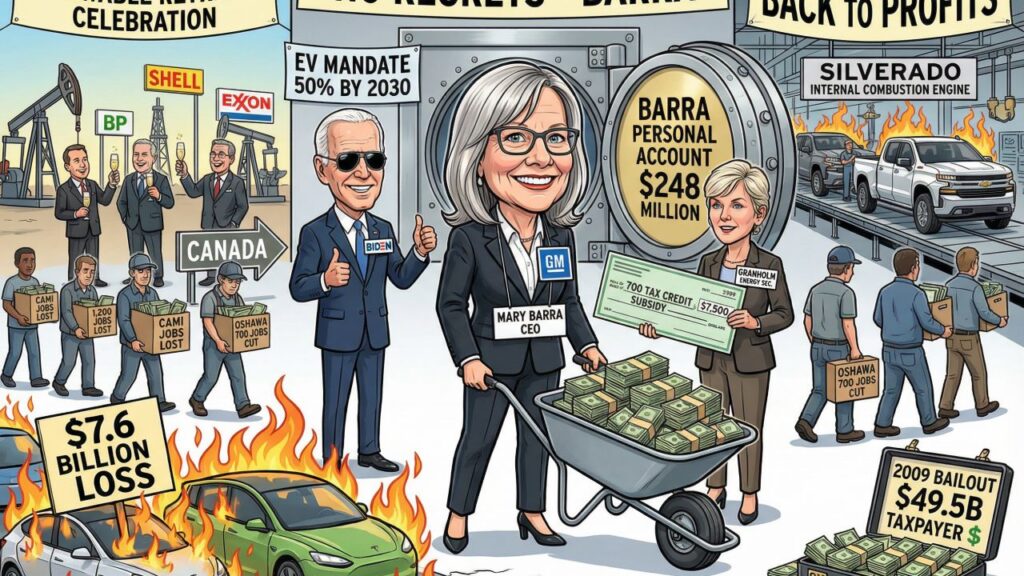
Mary Barra has just confessed to one of the most spectacular wealth destruction episodes in American corporate history, and her response is that she has “no regrets.” The General Motors CEO, speaking from the company’s newly opened Detroit headquarters, acknowledged that GM is absorbing roughly $7.6 billion in charges, nearly 10% of the company’s $78 billion market capitalization, to unwind electric vehicle investments that collapsed the moment federal subsidies and regulatory mandates evaporated.
Her assessment of this debacle? “Looking back, with all the information we had at the time, we would have made the same choices.”
Barra’s disaster follows a now-familiar corporate script perfected by Big Oil: chase a politically fashionable “energy transition,” pour billions into showcase projects to collect ESG accolades, book massive writedowns when subsidies disappear, then quietly retreat to legacy businesses while deflecting blame onto external forces, and let someone else absorb the carnage.
Between 2015 and 2023, the world’s nine largest international oil companies sold $290 billion worth of assets as they publicly committed to renewable energy transitions. BP slashed more than $5 billion from planned green energy investments after calling U.S. offshore wind “fundamentally broken” and booking $1.64 billion in writedowns. Shell cut renewable spending from $3.5 billion to $2.7 billion while ramping oil and gas investment back to $10 billion annually. TotalEnergies divested wind and solar assets across Asia while quietly refocusing on deepwater oil.
Meanwhile, these same companies redirected capital into the exact fossil fuel projects they had publicly demonized. ExxonMobil committed more than $60 billion to Guyana’s offshore oil expansion, with production expected to reach 1.7 million barrels per day by 2030. And following the Trump administration’s capture of Venezuelan dictator Nicolás Maduro, ExxonMobil and ConocoPhillips are pursuing $32 billion in combined claims for oil assets seized in 2007, positioning to retake control of the hemisphere’s largest proven reserves.
GM is following the identical pattern: virtue signal on EVs, incinerate shareholder capital when the politics shift, retreat to profitable internal combustion trucks and SUVs, and deflect blame, this time, onto Trump’s tariffs and Canadian workers. The only positive financial and industry press Barra can now claim comes from her common-sense return to internal combustion engines, the exact products she spent years condemning and promising to phase out.
This is not merely incompetence. It is a case study in how the corrupted relationship between government and industry, forged in the 2009 bailout and maintained through coordinated lobbying and political donations, replaced market discipline with political theater, and predictably delivered disaster for everyone except the executives and politicians who engineered it.
The Numbers: $7.6 Billion in Capital Destruction
The Trump administration’s elimination of the $7,500 federal EV tax credit in September 2025 and the relaxation of fuel economy standards exposed the artificiality of GM’s entire strategy. U.S. EV sales plummeted approximately 40% in November following the tax credit’s expiration, and GM’s own EV sales fell 43% in the fourth quarter of 2025.
The financial reckoning has been brutal:
$7.6 billion in total EV-related charges$1.6 billion in Q3 2025, approximately $6 billion in Q4 2025, equivalent to nearly 10% of GM’s market capitalization.
$4.2 billion in cash costssupplier contract cancellations, settlements, and related payments that represent real money leaving shareholder pockets.
$1.8 billion in non-cash impairmentswrite-downs of stranded battery plant investments and EV capacity built for demand that never materialized.
43% decline in GM EV sales in Q4 2025, despite GM still ranking as the second-largest U.S. EV seller behind Tesla with 169,887 annual units sold.
Canadian plant casualtiesCAMI Assembly Plant in Ingersoll, Ontario permanently closed (1,200+ jobs eliminated), and Oshawa plant reduced from three shifts to two (700 jobs cut).
Barra is now redirecting billions back into combustion-engine vehicles, the very products she had positioned GM to abandon, and has said GM would “happily” ramp up internal combustion production beyond current plans if EV demand continues to disappoint.
GM’s “record pretax earnings of $14.9 billion” in 2024 that justified Barra’s $29.5 million compensation package came entirely from gasoline trucks and SUVs, not the EV transition she championed. This is not adaptation. This is capitulation after a strategic failure of historic proportions.
Big Oil’s Silent $330 Billion Renewable Retreat: The Template
While Barra incinerated $7.6 billion on EVs, Big Oil was executing an even larger strategic reversal, silently withdrawing from hundreds of billions in renewable commitments while re-engineering their portfolios around Guyana, Venezuela, and the fossil fuel assets they had publicly renounced.
BP’s “Beyond Petroleum” Collapse
After spending more than a decade branding itself around renewable energy, BP slashed planned renewable investments by more than $5 billion in February 2025, dropping annual spending from previous guidance to just $1.5-2 billion. The company simultaneously increased oil and gas spending to $10 billion annually and raised production targets to 2.4 million barrels per day by 2030, a 60% jump from its 2020 commitment.
CEO Murray Auchincloss admitted the company went “too far, too fast” and that renewable investments were “wickedly capital-inefficient.” BP wrote down $1.64 billion in U.S. offshore wind projects after calling the sector “fundamentally broken,” sold its American wind business to LS Power, and ended its partnership with Equinor.
Shell’s Capital Reallocation
Shell cut renewable and energy solutions capital spending from $3.5 billion in 2022 to $2.7 billion in 2023, representing only 11.7% of total capex versus 15.3% the prior year. Analysis by Common Wealth found Shell invested 4.7 times as much in oil and gas as renewables, while shareholder payouts, $23.8 billion in dividends and buybacks, were 8.9 times renewable investment. Shell’s renewable energy business reported losses in 2024, and the company scrapped multiple offshore wind projects while backing away from plans to reduce oil and gas production.
TotalEnergies’ Asian Exit
TotalEnergies announced plans to divest all renewable power holdings except those in the United States, Brazil, and Europe, offloading wind and solar assets across Asia worth hundreds of millions to reduce debt. The company sold its Adani Green stake and divested wind and solar assets in France and Argentina.
The Pattern: Virtue Signal, Collect ESG Awards, Book Writedowns, Retreat
Make bold net-zero commitments. Overpay for showcase renewable projects. Collect accolades from activists and ESG-focused investors. Book massive writedowns when returns disappoint or subsidies evaporate. Quietly retreat to high-margin oil and gas. Reward executives and shareholders with profits from fossil fuels. Blame market conditions or government policy shifts.
Between 2015 and 2023, the nine largest international oil companies divested $290 billion worth of assets as they publicly committed to renewable transitions, then reversed course and poured capital back into oil and gas.
The Guyana and Venezuela Oil Grabs: Where the Money Really Went
While publicly committing to renewable transitions and net-zero targets, Big Oil was simultaneously engineering one of the largest offshore oil expansions in modern history, and positioning to reclaim Venezuelan assets worth tens of billions.
ExxonMobil has committed more than $60 billion across seven sanctioned projects in Guyana’s Stabroek block, with production expected to reach 1.7 million barrels per day by 2030. The company’s latest approval, the $6.8 billion Hammerhead project, will add 150,000 barrels per day starting in 2029. ExxonMobil is currently producing approximately 650,000 barrels per day and anticipates growing to more than 900,000 barrels per day by the end of 2025.
Following the Trump administration’s capture of Venezuelan dictator Nicolás Maduro in January 2026, ExxonMobil and ConocoPhillips are pursuing combined claims totaling approximately $32 billion for oil assets seized by Venezuela in 2007 under Hugo Chávez’s nationalization campaign. Trump announced that major U.S. oil companies will invest $100 billion to rebuild Venezuela’s “rotting” oil infrastructure, though industry executives warned the sector remains “uninvestable” without legal and commercial reforms.
The contrast is stark: Big Oil executives condemned fossil fuels publicly, divested $290 billion in assets to signal climate commitment, then silently pivoted tens of billions into Guyana’s offshore oil boom and positioned to reclaim Venezuelan reserves, the largest proven oil deposits on earth.
Mary Barra followed this exact playbook. She committed GM to selling only electric vehicles by 2035, pledged to overtake Tesla as the leading EV seller by 2025, collected accolades from the Biden administration, and is now booking $7.6 billion in writedowns while “happily” ramping internal combustion production.
The Co-Dependency That Failed Both Sides: How Bailouts Corrupted Strategy
The $7.6 billion GM writedown is not merely the failure of one CEO’s judgment. It is the inevitable outcome of a corrupted relationship between the federal government and the Detroit automakers, a co-dependency forged in the 2009 bailout that replaced market discipline with political coordination, and that predictably delivered disaster for everyone except the executives and politicians who engineered it.
The Bailout Created Permanent Leverage and Moral Hazard
In 2009, the U.S. Treasury invested $49.5 billion to acquire a 60.8% ownership stake in General Motors as part of a Chapter 11 reorganization directed by the Obama administration. The government sold its final shares in December 2013, recovering $39 billion and leaving taxpayers with a $10.5 billion loss.
But the damage extended far beyond the direct financial loss. The bailout fundamentally altered the relationship between government and the auto industry:
It created moral hazard. As Wharton professor Kent Smetters noted, “Big companies can take bigger risks if they assume that a bailout will be available if needed.” When GM committed to an all-electric future dependent on subsidies and mandates while maintaining the option to retreat to profitable gasoline trucks if the bet failed, the company was operating with an implicit government backstop.
It undermined the rule of law. The Obama administration rearranged creditor priorities to reward politically favored stakeholders, particularly the UAW, while shortchanging bondholders and secured lenders in violation of normal bankruptcy law. This “flouting of bankruptcy law essentially signals to future lenders that should they loan money to private companies, they can’t count on the standing rule-of-law to protect them.”
It established government as an ongoing industrial policy coordinator. Even after the Treasury sold its GM stake in 2013, the bailout established a precedent and ongoing relationship. The Biden administration explicitly invoked this partnership when coordinating EV policy, holding multiple meetings with GM CEO Mary Barra, Ford CEO Jim Farley, and other executives to align on electric vehicle targets, charging infrastructure, and regulatory timelines.
The EV Coordination: Mandates, Subsidies, and $85 Million in Lobbying
The Biden administration’s EV push was not imposed on unwilling automakers. It was a coordinated effort in which government set ambitious targets, automakers lobbied for subsidies to support those targets, and both sides used the arrangement to deflect responsibility for voluntary strategic choices.
In April 2022, the Biden administration held a virtual meeting with senior White House officials, Tesla CEO Elon Musk, GM CEO Mary Barra, Ford CEO Jim Farley, and executives from Stellantis to discuss “how to work together to make electric vehicles more affordable and accessible.” The administration set a target of making zero-emission vehicles 50% of all new vehicles sold by 2030, and automakers publicly endorsed the goal. President Biden visited the Detroit Auto Show in September 2022 to announce $900 million in federal funding for EV chargers.
Between 2019 and 2023, General Motors spent $48.6 million on federal lobbying, more than any other automaker, including extensive lobbying on EPA emissions rules, NHTSA fuel economy standards, and the Inflation Reduction Act’s EV tax credits. Ford spent $20.8 million, and the Alliance for Automotive Innovation spent $19.3 million lobbying on these same issues. In 2023 alone, as the EPA and NHTSA finalized new emissions and fuel economy rules, the automotive industry spent a record $85.5 million on federal lobbying.
Critically, automakers lobbied in favor of the IRA’s $7,500 EV tax credits and battery manufacturing subsidies, the same subsidies they now claim were essential to their EV investments and whose elimination caused their strategies to collapse.
The regulatory stick accompanied the subsidy carrot: The EPA’s 2024 emissions rule required automakers to cut passenger vehicle emissions nearly in half by 2032, which would have forced EV sales to between 35% and 56% of new vehicles by 2030-2032. GM and Ford executives warned that failure to meet fuel economy proposals could result in $10.5 billion in combined CAFE fines through 2032, with GM alone facing potential penalties of $6.5 billion. Barra admitted the Biden-era rules created a scenario in which GM would have been forced to cut gasoline-vehicle production and “potentially close plants” if EV demand fell short.
The UAW Completes the Triangle
The United Auto Workers union provided the political fuel that kept this arrangement running. Between 1990 and 2024, the UAW directed 99% to 100% of its political contributions to Democratic candidates in most election cycles. In the 2024 election, the UAW spent millions mobilizing its 1 million active and retired workers to vote for Kamala Harris, with UAW President Shawn Fain stating the union’s influence in Michigan alone accounted for 9.2% of President Biden’s votes in 2020.
When the EV strategy began collapsing in 2025, the UAW blamed Trump’s tariffs and the elimination of EV tax credits, never questioning whether the underlying strategy of mandate-driven EV investments was sound. UAW leadership framed the CAMI plant closure in Canada as “the latest Trump policy casualty,” deflecting attention from the fact that GM had over-invested in EV capacity entirely dependent on subsidies that proved temporary.
The Outcome: Nobody Faces Market Discipline
This triangular arrangement (government mandates, automaker lobbying for subsidies, and UAW political mobilization) creates a system in which none of the key actors face market discipline for strategic failures:
Government officials do not pay for failed mandates. When the EPA emissions rules and $7,500 tax credits drove automakers to pour billions into EV capacity that collapsed the moment subsidies were removed, the Biden administration officials who coordinated the policy faced no financial consequences.
Automaker executives do not pay for following government mandates instead of market signals. Mary Barra destroyed $7.6 billion in shareholder value, shut down Canadian plants, and booked massive writedowns, then claimed she has “no regrets” because the decisions were justified by the regulatory environment. She collected $29.5 million in 2024 compensation based on profits from gasoline trucks and SUVs, not from the EV strategy she championed.
Union leadership does not pay for supporting a failed industrial strategy. Shawn Fain backed Biden’s EV mandates and mobilized millions in UAW resources to elect Democrats who imposed those mandates. When the mandates failed and Canadian workers lost 1,200+ jobs at CAMI and 700+ jobs in Oshawa, Fain blamed Trump rather than questioning whether a subsidy-dependent EV transition was ever sustainable.
Shareholders and workers absorb the losses. GM shareholders saw $7.6 billion in capital destroyed. Canadian workers at CAMI lost their jobs entirely. Suppliers had contracts canceled, costing $4.2 billion in cash settlements. Taxpayers are left with the $10.5 billion loss from the 2009 bailout and the precedent that future failures will also be socialized.
This government-auto co-dependency is not an anomaly. It is a structural feature that guarantees failures like GM’s $7.6 billion writedown will recur. Until the relationship is broken (no more bailouts, no coordinated industrial policy, no lobbying-subsidy cycle) executives and politicians will continue to escape accountability while taxpayers, workers, and shareholders pay the price.
The Political Bet That Failed: “You Electrified the Entire Automobile Sector”
Barra’s EV strategy was never grounded in consumer demand or market fundamentals. It was constructed entirely on the scaffolding of government mandates, taxpayer subsidies, and regulatory coercion, scaffolding she helped lobby into place.
In January 2021, President Biden stood at a GM facility in Michigan and told Barra, “You’ve changed the whole story, Mary… You electrified the entire automobile sector.” What Biden praised, and what Barra eagerly embraced, was not innovation but compliance with the Biden administration’s de facto electric vehicle mandate.
Rather than resist this regulatory overreach, Barra doubled down. She declared that GM would sell only electric vehicles by 2035 and would overtake Tesla as the leading EV seller by 2025. There was no visible market research to justify these proclamations, only political alignment with a Democratic administration determined to use federal power to force a technological transition regardless of economic viability.
The moment the Trump administration eliminated the $7,500 tax credit and relaxed emissions standards, the entire structure collapsed. EV sales plummeted 40% in November following the tax credit’s expiration, and GM’s own EV sales fell 43% in Q4 2025.
This was not a market shift. It was the exposure of an artificial market created and sustained entirely by government intervention, intervention Barra counted on to justify investments she would never have made in a competitive environment.
Poor Canada: Thrown Under the EV Bus While Barra Deflected to Trump
As Barra unwound her EV strategy, Canadian workers absorbed the costs, and she let the Trump administration take the political heat.
In October 2025, GM announced it would permanently cease BrightDrop electric delivery van production at its CAMI Assembly Plant in Ingersoll, Ontario, eliminating more than 1,200 jobs. GM had spent $2 billion retooling the facility for EV production in 2021, with approximately $500 million coming from Canadian federal and provincial governments. The company halted BrightDrop production in May 2025 due to insufficient demand, then announced the permanent closure while citing “slower demand than anticipated” and the Trump administration’s elimination of the $7,500 EV tax credit.
GM also eliminated one of three shifts at its Oshawa, Ontario plant in January 2026, cutting roughly 700 jobs as it adjusted to Trump’s 25% tariff on imported vehicles. GM cited “the evolving trade environment” and updated demand forecasts, though the company delayed the shift cut from fall 2025 to January 30, 2026 after intense pressure from Unifor, the Canadian autoworkers union.
Lana Payne, president of Unifor, stated bluntly: “The reality is that CAMI faced challenges from both sides due to Trump’s aggressive actions to dismantle EV supports and impose a 25% tariff on Canadian auto assembly plants.” The union called GM’s CAMI shutdown “the latest Trump policy casualty” and urged Canadian Prime Minister Mark Carney to take stronger action against automakers relocating operations.
GM’s public messaging attributed the Canadian plant closures to tariffs, demand shifts, and the “evolving trade environment”, never to Barra’s strategic miscalculation in over-investing in EV capacity entirely dependent on subsidies and mandates. By framing the closures as responses to external trade policy rather than internal strategic failure, Barra successfully deflected accountability onto the Trump administration while quietly retreating to the profitable internal combustion trucks and SUVs that Canadian plants no longer produce.
Ironically, the UAW, representing U.S. workers, praised Trump’s tariffs as ending the “free trade disaster that has devastated working class communities for decades,” while Canadian workers bore the costs of both the tariffs and GM’s failed EV bet.
The Chinese Ate GM’s Lunch While Detroit Chased Mandates
While Barra was virtue signaling about an all-electric future, Chinese automakers were actually building one, and dominating it. BYD sold 2.26 million electric vehicles globally in 2025, surpassing Tesla for the first time and commanding 27.2% of China’s new energy vehicle market. Tesla’s China sales fell 4.8% year-over-year, and its global deliveries dropped 9% as federal incentives vanished.
The broader Chinese EV ecosystem (including Geely, Changan, Xiaomi, and others) now controls the global supply chain, from lithium processing to battery production to vehicle assembly. BYD’s sales growth in Latin America, Southeast Asia, and Europe continues despite punitive tariffs, because Chinese manufacturers offer EVs at prices American automakers cannot match while remaining profitable.
GM, Ford, and Stellantis lose thousands of dollars on every EV they sell. A 2024 analysis found automakers were still losing approximately $6,000 on each $50,000 EV sold. Stellantis CEO Carlos Tavares stated that EVs cost his company 50% more to make than internal combustion vehicles, a premium that cannot be passed to consumers. Ford announced a $19.5 billion writedown in December 2025 after canceling multiple EV programs.
Even Tesla, the lone profitable American EV manufacturer, depended heavily on selling regulatory credits to legacy automakers, credits that accounted for 43% of Tesla’s profit and are now evaporating as regulatory penalties are eliminated.
The inescapable conclusion: GM and the Big Three should have stuck to internal combustion engines, where they maintained competitive advantages, rather than chasing a political mandate into a market dominated by Chinese state capitalism and Tesla’s vertically integrated model. Just as Big Oil executives discovered that offshore wind and solar projects could not compete with their core oil and gas businesses, Detroit’s automakers are learning that politically driven EV investments cannot overcome structural cost disadvantages and subsidized Chinese competition.
The Compensation Scandal: $29.5 Million for Destroying $7.6 Billion
While GM shareholders absorbed $7.6 billion in EV write-downs and Canadian workers lost their jobs, Barra collected $29.5 million in total compensation for 2024, a 5.9% increase from 2023 and 310 times the $95,111 median pay of a GM employee. Over the four-year period from 2019 to 2022, Barra personally banked $248.3 million in total compensation, of which $180.7 million (73%) came from realized gains on stock awards and stock options.
Her base salary has been frozen at $2.1 million since 2017, but stock awards and performance bonuses have soared. In 2024 alone, she received $19.5 million in stock awards, a 33% surge from 2023, and $6.7 million in incentive pay, a 27% increase.
GM’s compensation committee justified the pay by citing “record pretax earnings of $14.9 billion” in 2024 and a 50% stock price jump over the prior year. But this performance was driven almost entirely by a return to high-margin gasoline trucks and SUVs, the very products Barra had committed to phase out. The metrics ignore the $7.6 billion in capital destruction from the failed EV strategy and the billions more in stranded battery plant investments.
During the 2023 UAW strike, the union pointedly noted that during an eight-and-a-half-minute CNN interview, Barra “earned more money than any autoworker makes in a full work day.” UAW President Shawn Fain characterized the strike as a fight against corporate executives who demand sacrifice from workers while enriching themselves, and Barra became a focal point of that critique.
While workers struck for higher wages and job security, GM announced in February 2025 that it was launching a $6 billion share buyback program, its third major repurchase since 2023, bringing the total to $16 billion. The company also raised its quarterly dividend by 25%, to $0.15 per share.
These shareholder returns are funded by profits from the very internal combustion vehicles Barra spent years demonizing and promising to eliminate, the only source of positive press she can now legitimately claim.
The Grid Contradiction: If AI Needs 12% of U.S. Electricity, Why Add Millions of EVs?
The GM disaster cannot be understood in isolation from the broader incoherence of American energy policy. Barra’s EV strategy rested on the premise that governments would permanently subsidize electric vehicles and mandate a technological transition regardless of cost. That framework, in turn, rested on the claim that decarbonization posed an existential emergency requiring immediate action.
But the policy was always contradictory. China, the world’s largest emitter and the architect of EV dominance, continues to expand coal-fired power generation to support its grid. Meanwhile, the United States is dismantling domestic fossil fuel infrastructure and electrifying transportation even as artificial intelligence data centers are projected to consume 9% to 12% of U.S. electricity by 2030, nearly triple current levels, and strain an aging grid already struggling to meet baseline demand.
By 2030, data centers are expected to require between 100 and 134 gigawatts of additional power capacity. Deloitte estimates AI data center power demand could grow more than thirtyfold by 2035, reaching 123 gigawatts. AI companies are already bypassing the grid entirely, deploying natural gas turbines and small modular nuclear reactors on-site to avoid waiting years for utility approvals.
If AI is going to soak up 9-12% of U.S. electricity by 2030, does it make sense to put additional pressure on the grid by mandating mass EV adoption, especially when the United States is swimming in oil and gas reserves that could reliably power both transportation and computation?
The United States is simultaneously pushing millions of electric vehicles onto a grid that cannot handle the load while demanding that the same grid absorb exponentially growing AI infrastructure, all while sitting on vast reserves of oil and natural gas that could power both transportation and computation far more reliably and affordably.
This is not an energy transition. It is an elite-driven reallocation of capital and industrial capacity that destroys competitive American manufacturing, enriches Chinese state enterprises, and impoverishes consumers and workers who bear the cost. Barra positioned GM at the vanguard of this project, and when the political winds shifted, she incinerated nearly $8 billion in shareholder value rather than admit the strategy was flawed from the outset.
The Pattern of Failure: GM’s Executive Succession
Barra is hardly GM’s first CEO to embrace government-directed industrial policy over market discipline. Her immediate predecessor, Dan Akerson, predicted in 2011 that “by 2020, 10 percent of GM’s vehicles will have electric as a major part of their propulsion” and pushed the Chevrolet Volt plug-in hybrid. Before him, Rick Wagoner led GM into bankruptcy in 2009, requiring a $77 billion federal bailout largely funded through the misuse of TARP funds intended for the financial sector.
The Obama administration forced Wagoner’s ouster in March 2009 and directed both GM and Chrysler into Chapter 11 bankruptcy. The resulting “new GM” emerged with the federal government holding a significant ownership stake and creditors treated in brazenly preferential ways depending on political expediency rather than legal priority.
Barra rose through this system. She was named CEO in January 2014 by Akerson, inheriting a company still marked by the bailout’s stigma and just weeks away from the ignition switch recall scandal that would be linked to at least 124 deaths and cost GM an estimated $1.5 billion in settlements. She was promoted through the product development side of GM, not finance, and was elevated to the combined chairman and CEO role in 2016, consolidating power.
Her tenure has been characterized by the same pattern that destroyed her predecessors: mistaking government support for market validation, and conflating regulatory compliance with competitive strategy.
Where Are the Shareholders?
Despite the magnitude of the failure, Barra faces no organized shareholder revolt. GM stock dipped only about 2% when the $6 billion fourth-quarter charge was announced, and shares had rallied roughly 47% in 2024, outpacing both Ford and the S&P 500. That strong prior-year performance, combined with aggressive share buybacks and dividend increases, has muted investor anger.
Some activist investors did push GM in 2015 to return capital through buybacks, backed by hedge fund figures including David Tepper and Kyle Bass, who collectively owned about 2% of the company. But that pressure was focused on financial engineering, share repurchases and dividends, rather than strategic accountability.
Barra also serves on the Walt Disney board of directors, where she is now facing potential legal action from shareholders over the company’s handling of the Jimmy Kimmel suspension controversy. Disney has been “mired in conflict” for years, and corporate governance experts question whether Barra has the “appropriate time to devote” to both GM’s challenges and a large, troubled board role at Disney.
Yet GM’s board has not only retained Barra but rewarded her with compensation increases and unchecked authority over a failed strategic pivot.
The explanation is straightforward: as long as GM can retreat to profitable gasoline trucks and SUVs, and as long as share buybacks prop up the stock price, financial markets tolerate strategic incompetence. Institutional investors care about quarterly returns, not whether GM is positioned to compete in a decade. And Barra has mastered the art of socializing losses across time, booking charges gradually, maintaining dividends, and narrating every failure as a temporary adjustment rather than a fundamental miscalculation.
The Objective Case for Her Departure
Mary Barra must go. The case is simple, objective, and numerical:
She misread political risk. Barra bet GM’s future on the permanence of Democratic climate policy and the durability of federal subsidies. Both collapsed within months of a change in administration, exposing the fragility of her entire strategy.
She ignored market signals. Consumers never demanded the EV transition at the scale and speed GM planned. EV sales growth was entirely a function of $7,500 tax credits, state mandates, and regulatory penalties, all of which proved temporary.
She destroyed shareholder capital. GM is absorbing $7.6 billion in charges to reverse investments made under Barra’s leadership, equivalent to nearly 10% of the company’s market capitalization.
She subordinated GM’s competitive position to political alignment. Rather than defending the product categories where GM held advantages, trucks, SUVs, internal combustion engines, Barra chased a mandate-driven EV transition that enriched Chinese competitors and left GM billions behind Tesla in technology and scale.
She showed no accountability. Barra’s public posture is that the EV strategy was correct and that she would make the same decisions again, despite the objective evidence of failure.
She followed the Big Oil renewable energy playbook. Like BP’s offshore wind disaster ($1.64 billion in writedowns), Shell’s renewable retreat ($5+ billion cuts), and the oil majors’ collective $290 billion divestment from renewable commitments, Barra pursued politically fashionable showcase projects, booked massive writedowns when reality intervened, retreated to legacy businesses, and deflected blame onto external forces.
She sacrificed Canadian workers to deflect blame. Barra shut down the CAMI Assembly Plant (1,200+ jobs) and cut Oshawa shifts (700 jobs), then let Trump’s tariffs take the political heat for closures driven fundamentally by her strategic EV miscalculation.
Her only successful performance metrics come from internal combustion engines, the products she promised to eliminate. GM’s $14.9 billion in pretax earnings that justified her $29.5 million compensation came from gasoline trucks and SUVs, not EVs.
She perpetuated the government-auto co-dependency that guarantees future failures. By following government mandates instead of market signals, lobbying for subsidies instead of competing on fundamentals, and escaping accountability when the strategy failed, Barra reinforced the moral hazard created by the 2009 bailout.
GM’s board should remove her and install leadership that understands the difference between compliance and competition, between political favor and market demand, and between public relations and fiduciary duty.
The workers whose jobs were sacrificed in Canada, the suppliers whose contracts were canceled, the shareholders whose capital was incinerated, and the states that subsidized battery plants now facing closure all deserve better than a CEO who spent billions on virtue signaling, delivered performance metrics indistinguishable from Big Oil’s renewable energy debacles, let Trump absorb the blame for her Canadian plant shutdowns, and has “no regrets” about the wreckage.
Related reading
- The Bill Has Arrived: How €8 Trillion in EU Green Policy and $91 Billion in U.S. Pension Losses Enriched the Consultants Who Designed the Catastrophe
- Not Stagflation. A Just Depression
- US-Israeli Attack on Iran Will Trigger Global Starvation
- The Consulting-Industrial Complex: How McKinsey, BlackRock, and the ESG Cartel Engineered Irreversible Industrial Destruction for Profit