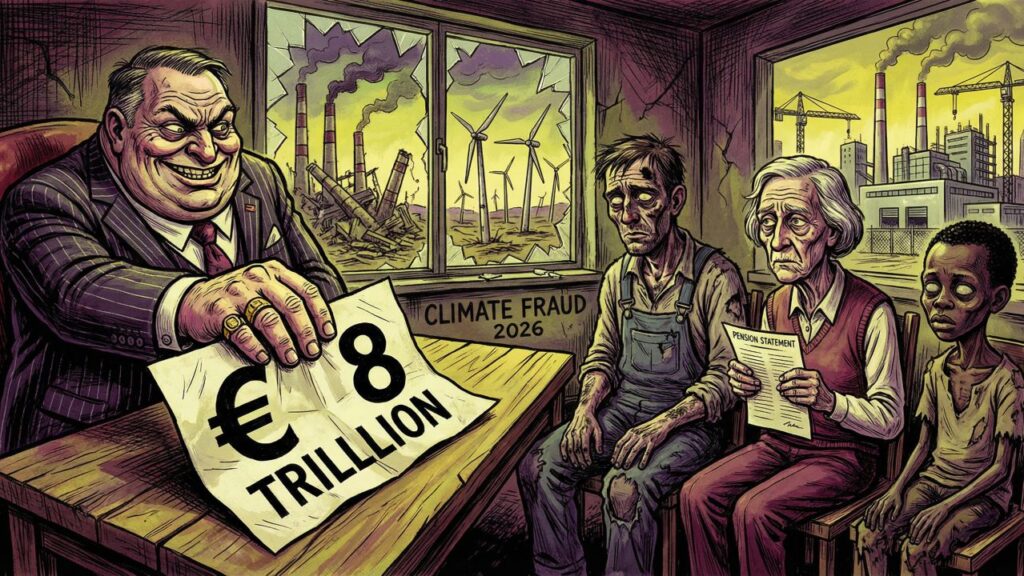
A Companion Investigation to The Dead Science That Ate €8 Trillion
The Economic Consequences of the Climate Movement Are No Longer Theoretical. They Are Arriving. In Real Time. Measured in Closed Factories, Bankrupt Companies, Fleeing Capital, and Farmers Driving Tractors to the Gates of Parliaments.
Scott Ortkiese Principal, Throughline Synthesis Group Investigative Journalism | Government Relations Support | Critiques of Government Policy February 2026
Preface: From Theory to Wreckage
In a companion article to this investigationThe Dead Science That Ate €8 TrillionI documented how MIT Professor Emeritus Richard Lindzen and Princeton Professor Emeritus William Happer proved, at the level of fundamental radiation physics, that the entire scientific foundation of Net Zero policy is false: CO₂ is a weak greenhouse gas, climate models fail 101 of 102 predictions, the 97% consensus is a statistical impossibility requiring coordination, and the IPCC publishes government opinion rather than science.
That article proved why the money should never have been spent. This article proves what happened when it was.
This is the economic autopsy. Every number is sourced. Every company is named. Every victim is counted. The evidence is not speculative, it is drawn from Eurostat data, European Central Bank reports, the European Commission’s own publications, the Draghi Report on European Competitiveness, corporate filings, industry association reports, IEA energy data, and the U.S. Congressional Budget Office. Where my forthcoming book The Impossible Consensus provides additional documentation, particularly on the consulting-industrial complex and the elite coordination network, those sources are cited with full endnote references.
The economic consequences of the climate movement divide into seven categories, each representing a distinct mechanism of wealth destruction. Together, they constitute the most comprehensive economic fraud in modern history.
I. THE EUROPEAN ENERGY PRICE GUILLOTINE
The Price Gap That Killed European Industry
Every industrial economy runs on energy. The price of energy is the price of everything, every manufactured good, every chemical compound, every ton of steel, every kilowatt-hour powering a factory floor. When one continent’s industrial energy prices are multiples higher than its competitors’, that continent doesn’t just lose market share. It loses the industrial base itself.
In 2024, industrial electricity prices in the European Union reached €0.199 per kWh, compared to €0.082 in China and €0.075 in the United States. EU industrial electricity is 2.65 times more expensive than in the United States and 2.4 times more expensive than in China. According to the Bruegel Institute, in 2023, industrial electricity and gas prices in the EU were 158% and 345% higher than in the United States, respectively. EU gas wholesale prices were, on average, nearly five times those in the US.
According to the International Energy Agency, Germany has the highest domestic electricity prices in the developed world, and the United Kingdom has the highest industrial electricity rates. The average electricity prices for heavy industry in the EU are twice those in the U.S. and 50% above those in China. The European Commission’s own Energy Prices and Costs report confirmed that industrial gas and electricity prices, while lower than during the 2022 crisis peak, are “still 2-4 times higher than in the EU’s main trading partners, which threatens the long-term competitiveness of European industry”.
These are not temporary dislocations. They are structural consequences of deliberate policy choices: the accelerated phase-out of nuclear energy, the forced abandonment of Russian gas without adequate alternatives, the expansion of the EU Emissions Trading System and carbon pricing, and the mandated shift to intermittent renewable sources without sufficient storage or backup.
The result is precisely what the COIN Brief documentary describes: “a silent transfer of competitiveness”, not an immediate collapse, but a slow-motion economic execution.
The Data Center Test: Europe Can’t Power Its Own Future
The energy price gap doesn’t merely disadvantage the existing industry. It prevents new industries from forming. Jerome Evans, CEO of a German data center operator, attempted to expand two data centers in Frankfurt, the heart of European finance. His local power provider told him he would have to wait a decade, until 2035, for the energy to power them.
Europe is not only losing the industries of the 20th century. It is structurally incapable of building the industries of the 21st. AI data centers, the infrastructure of the next economic revolution, require cheap, reliable, abundant electricity. Europe has none of these. The continent that claims to lead the green technology revolution cannot power the computers that would make that revolution possible.
Britain’s Grid: £2.7 Billion to Keep the Lights On
On January 8, 2025, Britain’s 22 gigawatts of installed wind power provided just 2.5 GW during peak demand. Total power demand was nearly 19 times higher at approximately 47 GW. To keep the lights on, Britain fired up every available gas plant and imported every available gigawatt regardless of cost. British consumers paid £2.7 billion in 2024 to “balance” the grid, a cost expected to hit £8 billion by 2030. Half of British consumers reported planning to ration energy use.
The offshore wind industry that was supposed to provide Britain’s energy future produced zero bids at the government’s offered price of £44/MWh in 2023. The UK raised the price ceiling by 66% to attract any bidders at all. No offshore windfarms were commissioned in the UK in all of 2024.
The promise was cheap, clean energy independence. The delivery is the most expensive electricity in the industrial world, powered by emergency gas imports, at prices consumers cannot afford.
II. THE GERMAN CATASTROPHE: EUROPE’S ENGINE STALLS
Five Years of Stagnation, Two Years of Recession
Germany (Europe’s largest economy, the continent’s industrial engine, the nation whose engineering prowess defined 20th-century manufacturing) is in its greatest crisis in post-war history, according to the Handelsblatt Research Institute.
The numbers tell the story of collapse:
- GDP contracted 0.9% in 2023the worst performance of any major economy globally that year.
- GDP contracted a further 0.5% in 2024Germany’s first two-year recession since 2004.
- Growth in 2025 was just 0.3% after leading institutes cut their forecast from 0.8% to 0.1%, with the economy contracting 0.2% in Q2 alone.
- Industrial production is nearly 10% below pre-COVID levels and 15% below for energy-intensive industries.
- Manufacturing capacity utilization fell to 76.5% in October 2024, a decline of 5.5 percentage points year-over-year. The automotive sector fell 10.3 percentage points to 75.5%. The electrical industry fell 7.1 percentage points to 74.5%.
- The manufacturing PMI fell to 42.1its 26th consecutive month of contraction.
The Weil European Distress Index (a comprehensive survey of 3,750 European listed companies) reported in April 2024 that Germany had become “the most distressed market in Europe”.
Economists no longer debate whether Germany has a problem. They debate whether the problem is permanent. The Handelsblatt Research Institute projected a third consecutive year of recession in 2025. Economists described Germany as being in “permanent crisis mode”. Germany has reclaimed its 1990s reputation as the “sick man of Europe”, except this time, the sickness was self-inflicted through energy policy.
The Consequences: Named Companies, Real Workers
The consequences are not abstractions. They are measured in named companies closing named factories and laying off named workers:
- BASF, the world’s largest chemical company, cut 2,600 jobs, shut down plastic chemical plants and two ammonia plants, and moved operations outside Germany, citing “prohibitively bureaucratic permitting processes, overregulation, and higher production costs”. BASF committed €10 billion (including its €8.7 billion Zhanjiang facility) to new factories in China.
- Volkswagen announced the elimination of 35,000 jobs by 2030more than one in four positions, with production capacity slashed by 734,000 vehicles per year and annual savings targets of €15 billion. Dresden car production ceased in 2025. VW was considering closing plants for the first time in 87 years.
- Continental AG and Robert Bosch GmbH announced plant closures and job cuts.
- Michelin and Goodyear planned to close several German plants.
- Lanxess AG significantly reduced its workforce.
- A 124-year-old steel pipe factory in Düsseldorf closed, with 1,600 workers losing their jobs.
- German companies nearly tripled their investments in the United States in 2023 to $15.7 billion, driven by the IRA’s incentives and Germany’s deteriorating conditions.
This is not “adjustment.” This is the dismantling of an industrial civilization built over 150 years.
III. THE CHEMICAL INDUSTRY: “THE MOTHER OF ALL INDUSTRIES” IS BREAKING
Sixfold Increase in Closures, 80% Investment Collapse
The European chemical industry (which Cefic head Marco Mensink calls “the mother of all industries” because it supplies materials to automotive, defense, pharmaceuticals, construction, and every other manufacturing sector) is collapsing.
According to the European Chemical Industry Council (Cefic) and a Roland Berger study commissioned in January 2026:
- Chemical plant closures in Europe surged sixfold since 2022, reaching a cumulative 37 million tons of lost capacity by 2025, approximately 9% of total European chemical production.
- Closures doubled between 2024 and 2025 alone, from 2.9 million tons per year in 2022 to 17.2 million tons per year in 2025.
- 20,000 direct jobs were lost, with an additional 89,000 indirect jobs at risk.
- Investments plummeted 80% in a single yearannual announced investment capacity fell from 2.7 million tons in 2022 to just 300,000 tons in 2025.
- Europe’s global market share in chemicals declined from over 27% in 2004 to 12.6% by 2024.
- The net capacity reduction from 2022-2025 was -30.2 million tons when comparing closures against new investments, and this asymmetry is understated because investments take 2-5 years while closures happen in 1-2 years.
Mensink’s warning to the Financial Times could not be more blunt: “It’s no longer a question of being five minutes before or after twelve. The sector is under severe stress and breaking. The rate of closures has doubled in a year, and even worse, annual investments are half and close to zero. On both sides, the speed is accelerating, not slowing”.
The defense implications are staggering. “If you want a defense sector or an automotive sector, it is entirely reliant on chemicals for material supply. This creates a significant vulnerability for Europe,” Mensink stated. “It is breaking down as we speak”.
Europe is destroying the industrial base that makes its defense industry possible, in the middle of the largest land war on the continent since 1945.
IV. THE GREEN PROJECT GRAVEYARD
Northvolt: $15 Billion to Produce 6% of Target
Northvolt (Europe’s flagship battery manufacturer, backed by Volkswagen (21% stake), Goldman Sachs (19%), BMW, and over $15 billion in total equity) filed for bankruptcy in Stockholm in March 2025.
The Swedish company was supposed to break Europe’s dependence on Chinese battery manufacturers. Instead:
- Its Skellefteå gigafactory produced 1 GWh of its 16 GWh targeta 94% shortfall.
- It accumulated over $8 billion in debt across nine subsidiaries.
- BMW cancelled a $2.1 billion supply agreement in June 2024.
- CEO Peter Carlsson stepped down. Assets are now being liquidated at auction.
The collapse represented one of the most significant corporate failures in Sweden’s history and opened the door for Chinese, South Korean, and Japanese battery producers to seize control of the European market, the precise outcome the Green Deal’s industrial strategy was designed to prevent.
ArcelorMittal: Turning Down €1.3 Billion in Free Money
ArcelorMittal, the world’s second-largest steel producer, announced in June 2025 that it would not proceed with plans to convert two German plants to hydrogen-powered production, rejecting €1.3 billion in government subsidies because energy costs made the technology economically unviable.
The company pointed to a recent electric arc furnace investment in nuclear-powered Francean implicit but devastating indictment of Germany’s renewable-dependent Energiewende.
ArcelorMittal issued a statement that should be carved above the entrance of every European parliament: “It is increasingly well-documented that there has been slower than expected progress on all aspects of the energy transition, including green hydrogen not yet being a viable fuel source and natural gas-based DRI production not being competitive as an interim solution”.
When a company turns down €1.3 billion in free government money because the technology doesn’t work, the technology doesn’t work. Full stop.
The Steel Industry in Retreat
ArcelorMittal’s rejection was not isolated:
- ThyssenKrupp Steel suspended its green hydrogen procurement tender for its Duisburg direct reduction plant.
- Salzgitter AG announced a three-year delay to its €2.5 billion Salcos Green Steel Project, backed by €1 billion in state funding.
- SSAB postponed green steel plans in Luleå, Sweden.
- ArcelorMittal shut down its No. 3 blast furnace at its Poland Dąbrowa Górnicza plant, citing rising energy costs, CO₂ emission allowance prices, and falling steel prices.
The green steel revolution, the centerpiece of European decarbonization strategy for heavy industry, has not merely stalled. It has been rejected by the companies it was designed to serve.
Offshore Wind: Zero Bids Across Four Countries
The offshore wind industry experienced systematic auction failures in 2023-2025:
- United Kingdom (AR5, 2023): Zero bids at £44/MWh.
- Germany (August 2025): Zero bids on 2.5 GW across two sites.
- Netherlands (2025): Zero bids for 1 GW Nederwiek I-A.
- Denmark (2024): Zero bids for 3+ GW subsidy-free capacity.
The UK was forced to raise its price ceiling by 66% to attract any developers at all. No offshore windfarms were commissioned in the UK in 2024. Germany’s offshore wind industry warned in a joint letter that the country was becoming “less attractive for investment than other global locations”.
The promised cost trajectory, that offshore wind would become cheaper than fossil fuels through economies of scale, has been comprehensively falsified by the auction results. Four countries. Zero bids. The market has spoken.
V. THE INFLATION REDUCTION ACT: AMERICA’S VERSION OF THE FRAUD
From $370 Billion to $4.67 Trillion
When Congress passed the Inflation Reduction Act in August 2022, the Congressional Budget Office estimated its energy provisions would cost $369 billion to $383 billionover ten years.
That estimate was a fiction, and the fiction is now documented.
The Cato Institute, using transparent budget scoring methodology, estimates the IRA’s actual cost at between $936 billion and $1.97 trillion over ten yearsand between $2.04 trillion and $4.67 trillion by 2050. The CBO itself revised its estimate upward to approximately $786 billion for the 2024-2033 window, more than double its original score. The Penn Wharton Budget Model estimated just over $1 trillion by 2032. Goldman Sachs estimated $1.2 trillionmore than triple the original CBO score.
By 2050, the annual cost of IRA energy subsidies reaches $180 billion per yearnearly half of the original CBO estimate for the entire ten-year program.
The cost explosion occurred because several of the IRA’s largest subsidies, including the Production Tax Credit and Investment Tax Credit, are uncapped, meaning potential costs are essentially unlimited. Congress passed a bill it was told would cost $370 billion. The actual cost may exceed $4.67 trillion. And every dollar goes to the same consulting-validated, model-justified green projects that are failing across Europe.
All to avoid, as Lindzen and Happer calculated0.02°F of warming.
The IRA as Capital Magnet: Europe’s Loss Is America’s Gain
The IRA’s subsidies created a gravitational pull that accelerated European deindustrialization. German companies nearly tripled their U.S. investments in 2023 to $15.7 billion. The United States posted record inbound FDI in 2024 to 2,259 projects, the highest of any year on record.
The IRA did not merely subsidize American green energy. It systematically drained European industrial capital by offering what Europe’s Green Deal cannot: cheap energy, large subsidies, and regulatory simplicity. The irony is devastating: the same climate ideology driving Europe’s deindustrialization is being used in America to attract the factories Europe is losing.
VI. PENSION FUND DESTRUCTION: ROBBING TEACHERS TO PAY CONSULTANTS
CalPERS: 71% Loss on Clean Energy, Congressional Investigation Launched
The California Public Employees’ Retirement System, the largest public pension fund in the United States, has lost 71% of a $468 million investment in its Clean Energy and Technology Fund. The fund, launched in 2007, was valued at just $138 million as of March 31, 2025.
If CalPERS had invested the same $468 million in a simple S&P 500 index fund, it would have grown to approximately $3 billiona difference of nearly $2.9 billion in destroyed retirement wealth.
In February 2026, three senior House Republicans launched a formal congressional investigation into CalPERS, requesting detailed records on whether “environmental, social and governance strategy is consistent with common law fiduciary duties.” The lawmakers argued that “using pension assets to advance social or political objectives could jeopardize” the fund’s tax-exempt status.
CalPERS manages retirement and health benefits for more than 2 million California public employees, retirees, and their families. Beyond the clean energy debacle, the congressional letter highlighted CalPERS’ broader $100 billion Climate Action Plan, questioning whether such initiatives align with requirements that pension funds be managed solely to provide benefits.
CalPERS has refused to disclose key details about the clean energy investments, citing legal exemptions. When a pension fund loses 71% of half a billion dollars in retirement savings and refuses to explain where the money went, the word for that is not “strategy.” The word is negligence, or worse.
ESG Underperformance: Paying More for Less
The broader ESG investment picture confirms what CalPERS demonstrates in miniature. ESG funds have systematically underperformed conventional benchmarks:
- Morningstar identified 2023 as the worst year on record for ESG stocks, with ESG trailing traditional stocks in both 2022 and 2023.
- Kiplinger’s ESG 20 yielded an average return of 4.3% over the past year, compared to the S&P 500’s 15.9%a gap of over 11 percentage points.
- Only six of 15 selected ESG stocks outperformed the S&P 500, and only one ESG fund beat the index.
- Over intermediate and long-term periods, four of five MSCI ESG Leaders equity benchmarks underperformed their conventional counterparts over 3-, 5-, and 10-year intervals through January 2025.
ESG funds charge average fees of approximately 0.62% compared to 0.03-0.09% for standard index funds, meaning investors pay premium fees for inferior performance. The ESG apparatus extracts wealth from pension beneficiaries in two ways simultaneously: lower returns and higher fees.
The total pension losses documented in The Impossible Consensus across major funds (CalPERS, NYSCRF, UK USS, UK LGPS, European funds, and other U.S. state and teacher pensions) reach $91 billion, affecting 24 million beneficiaries. These are teachers, firefighters, nurses, and municipal workers whose retirement security was sacrificed to fund the virtue signaling of trustees who face no personal financial consequences for their decisions.
VII. THE FORGOTTEN VICTIMS: FARMERS, THE POOR, AND THE PLANET ITSELF
4,000 Farmer Protests: The Streets Speak
In 2024, European farmers staged more than 4,000 protestsa 300% increase over the previous year. Belgian farmers set fire to a subway station entrance and assaulted police with eggs during a demonstration outside EU headquarters. French protesters attempted to storm a government building. Road blockades paralyzed highways across France, Germany, Belgium, and Poland.
Farmers cited the Green Deal as too complicated, expensive, and bureaucratic. They face a triple squeeze: stricter environmental mandates, external competition from subsidized imports, and skyrocketing input costs driven by the energy and fertilizer prices that climate policy elevated. The EU’s Nature Restoration Law, requiring restoration of 20% of land and sea areas by 2030, removes productive farmland without compensation.
The political consequences were immediate. Parties critical of climate policies gained ground in the 2024 EU elections. In Germany, the Alternative für Deutschland emerged as a leading contender in eastern state elections, while the governing coalition’s support collapsed to 34%. The farmers’ message was clear: they reject income loss, not environmentalism.
Sri Lanka: The Preview Nobody Connected
In 2021, Sri Lankan President Rajapaksa banned synthetic fertilizer imports, forcing millions of farmers to go organic overnight. The results:
- Rice harvests dropped 32%.
- Tea production fell 18%, with an estimated $425 million in lost tea exports.
- Food inflation soared to 55%.
- Nine in ten families were skipping meals.
- 300,000 protesters took over the president’s home. Rajapaksa fled the country.
Sri Lanka’s organic mandate was precisely the policy that global Net Zero requires at planetary scale: the elimination of synthetic nitrogen fertilizer produced through the Haber-Bosch process, which depends entirely on fossil fuels and feeds billions. The press covered Sri Lanka’s collapse as a failure of local governance. They never connected it to the identical policy prescription embedded in the Net Zero agenda.
The Emissions Fraud: Climate Policy Made the Planet Worse
The ultimate irony, the fact that should end every climate policy debate permanently, is that climate policy increased global emissions while destroying Western economies.
Global emissions increased 11,367 Mt during the entire period of Western climate leadership.
The EU claims 32% territorial emission reductions, but consumption-based accounting shows only 7.5% reduction78% of claimed progress is accounting fraud from offshoring production to countries with worse environmental standards. The UK claims 50.3% territorial reduction but only 7.5% consumption-based85% fraud. The US claims 12.7% reduction but only 6.0% consumption-based49% fraud.
China’s emissions increased 10,182 Mt from 1990-2023, mechanically correlating with Western manufacturing declines. The steel production ArcelorMittal shut down in Europe moved to Hebei Province, China, where 80,000-120,000 people die annuallyfrom air pollution at concentrations 17-24 times WHO guidelines. The textile production Europe offshored went to Bangladesh, where 14 million Dhaka residentsare exposed to river contamination from 4,500 factories.
Climate policy did not save the planet. It relocated pollution from countries with environmental standards to countries without them, killed tens of thousands of the world’s poorest people, and enriched the consulting firms that designed the relocation strategy. A March 2009 McKinsey email, document GE-SEC-004782, calculated that “China production generates approximately 2.8× emissions per unit vs. U.S.” and recommended: “Frame as global optimization… Focus Scope 1&2 reductions”.
They knew. They did it anyway. They got paid.
VIII. THE NEW STRATEGIC DEPENDENCIES
From Russian Gas to Chinese Minerals
The Green Deal promised energy independence. It delivered strategic dependency transfer. The European Union now depends on China for processing 70-90% of critical minerals (lithium, rare earths, and graphite) essential for batteries, wind turbines, and electric vehicles.
Mining takes years. Processing requires industrial scale and cheap energy. Cheap energy is exactly what Europe lost. If geopolitical tensions with Beijing intensify, the impact won’t be symbolic. It would be physical: batteries, electric cars, solar panels, everything depends on Chinese supply chains.
Europe replaced dependence on an adversary it recognized (Russia) with dependence on a competitor it refuses to acknowledge (China). The press calls this progress.
The CBAM: Europe’s Next Self-Inflicted Wound
As of January 1, 2026, the EU’s Carbon Border Adjustment Mechanism entered its compliance phase. CBAM requires importers of steel, aluminum, cement, fertilizers, electricity, and hydrogen to pay for the embedded carbon emissions of their imports, matching the price of the EU Emissions Trading System.
The EU is simultaneously phasing out free ETS allowances for domestic producers in CBAM sectors from 2026 to 2034. This means European industry loses its cost protection at exactly the moment when ArcelorMittal, ThyssenKrupp, and Salzgitter have already announced that green alternatives don’t work.
CBAM will raise costs for every European manufacturer that imports raw materials. It will add compliance costs requiring, inevitably, consulting services to manage. It will not reduce global emissions, because production will simply shift to non-EU trade routes. And it will accelerate the capital flight already underway.
The consulting firms are already marketing CBAM advisory services. The circle completes itself.
IX. THE €620 BILLION ANNUAL BILL: WHO PAYS?
The Fiscal Spiral
The European Commission estimates €620 billion per year in additional investment needed to meet climate goals by 2030. Over the decade, the total reaches into the trillions. A significant portion doesn’t come from organic growth, it comes from public debt, tax incentives, state guarantees, and direct subsidies.
Eurozone average debt already exceeds 90% of GDP. Italy remains above 140%. France surpassed 110%. In February 2025, the Commission proposed the Clean Industrial Deal with €100-150 billion in new funds and an Industrial Decarbonisation Bank with a €100 billion budget. This is money spent to fix the problems created by the last round of spending, validated by the same consulting firms that profited from the original failures.
When growth slows and debt rises, the system relies on what the COIN Brief documentary calls “permanent trust”, the assumption that debt-funded investments will eventually generate returns sufficient to service the debt. But when the investments produce Northvolt bankruptcies, zero-bid wind auctions, and rejected hydrogen subsidies, trust erodes. And when trust erodes, currencies feel it.
The Zombie Economy
The ECB has published studies on the growing presence of low-productivity firms sustained by cheap creditzombie companies that survive only because of government subsidies and near-zero interest rates. The Green Deal accelerates zombie creation: firms that cannot compete at market energy prices survive through climate subsidies, consuming capital that would otherwise flow to productive enterprises.
This is not economic transition. It is economic life support, paid for by taxpayers who never voted for it, administered by consultants who profit regardless of outcome, and justified by science that two MIT and Princeton professors have proven is false.
X. THE CAPITAL VERDICT: WHERE THE SMART MONEY IS GOING
The Numbers Don’t Lie
Foreign direct investment tells the definitive story of which economic model the world’s capital allocators believe in:
- EU FDI experienced net divestments of over €350 billion in 2023 and €15 billion in divestments in 2024.
- Western European FDI declined for a third consecutive year into 2025.
- Newly initiated projects showed a 44% year-over-year decline in H1 2025.
- The United States posted 2,259 FDI projects in 2024the highest on record.
- German companies tripled U.S. investments to $15.7 billion in 2023.
Big investors don’t wait for dramatic headlines. They watch long-term trends. And the trend is unambiguous: capital is leaving Europe for jurisdictions with cheaper energy, lower regulation, and industrial policy that works.
As RWE CEO Markus Krebber explained when announcing his company’s $15 billion U.S. investment plan: while Europe had similar intentions to incentivize manufacturing, it lacked the comprehensive policy measures seen in the U.S..
The capital verdict is in. Europe lost.
XI. THE CONSULTANTS: PAID TO FAIL
$19.8 Billion to Design a Catastrophe
Seven firms (McKinsey, BCG, Deloitte, PwC, EY, KPMG, and Accenture) extract $19.8 billion annually in climate and sustainability consulting revenue. They designed the Green Deal architecture. They validated the hydrogen projects that ArcelorMittal rejected. They projected the battery economics that Northvolt couldn’t achieve. They certified the offshore wind feasibility that produced zero bids.
Their accountability for these failures: zero.
- McKinsey earned €78 million advising the German Energiewende.
- BCG earned €49 million on the same project.
- Germany now has the highest domestic electricity prices in the developed world.
- Its manufacturing PMI has contracted for 26 consecutive months.
- Its chemical industry has lost 37 million tons of capacity.
The consulting model is self-perpetuating: firms are paid to design policies, paid to implement policies, paid to evaluate policies when they fail, and paid to redesign replacement policies. The EU’s proposed Clean Industrial Deal, €100-150 billion to fix Green Deal failures, will generate billions more in consulting fees for the same firms whose advice produced the failures.
Internal documents obtained through securities litigation confirm the consulting firms’ knowledge and intent:
- A 2009 McKinsey email calculated that offshoring to China increases emissions by 2.8× while recommending the client “Frame as global optimization”.
- A 2016 BCG presentation identified $420-840 million in annual revenue from Scope 3 complexity and noted that “all players benefit from complexity, simpler standards would commoditize services”.
- A 2019 Deloitte training instructed auditors: “Do NOT quantify excluded emissions” and explicitly prioritized “client relationship management” over audit quality.
These documents, from litigation discovery and employment tribunals, prove that the consulting industry designed accounting loopholes, knew offshoring increased emissions, and deliberately maintained complexity to protect revenue. This is not incompetence. It is a business model built on enabling fraud.
XII. THE NUCLEAR CONTRADICTION: THE TECHNOLOGY THAT WORKS IS THE ONE THEY OPPOSE
France generates 70% of its electricity from nuclear with zero emissions. French per-capita emissions are 40% lower than Germany’s. French industrial electricity costs 30% less than Germany’s€0.19-0.22/kWh versus €0.32-0.37/kWh.
ArcelorMittal itself pointed to nuclear-powered France when explaining why it chose an electric arc furnace investment there rather than hydrogen in Germany. France built 54 reactors in 15 years for €330 billion. Germany spent comparable sums on Energiewende, and got the highest electricity prices in the developed world, 26 consecutive months of manufacturing contraction, and a chemical industry losing 37 million tons of capacity.
Climate NGOs with $800 million in combined annual budgetsSierra Club, Greenpeace, NRDC, Friends of the Earth, 350.org systematically oppose nuclear expansion despite claiming climate urgency. The one technology that demonstrably works, that provides zero-emission, baseload, affordable electricity, is the one the climate establishment fights hardest to prevent.
This opposition is not explained by environmental concern. It is explained by economics. Nuclear doesn’t require $19.8 billion in annual consulting services. Nuclear doesn’t create ESG compliance mandates generating $47-68 billion in financial sector fees. Nuclear doesn’t produce intermittency requiring grid-balancing services, battery storage consulting, and demand-response advisory. Nuclear solves the problemand solving the problem eliminates the revenue stream.
The climate movement doesn’t oppose nuclear because it doesn’t work. The climate movement opposes nuclear because it does work.
Conclusion: The Bill
The economic consequences of the climate movement are now documented with the precision of a forensic audit:
In Europe:
- €8 trillion mobilized for the Green Deal
- Industrial production down 6% since 2022
- Germany in its worst post-war economic crisis, with GDP contracting in 2023 and 2024
- Chemical industry capacity closures up sixfold, 37 million tons lost, investments down 80%
- Northvolt bankruptcy: $15 billion raised, $8 billion in debt, 94% production shortfall
- ArcelorMittal rejected €1.3 billion in free subsidies: hydrogen doesn’t work
- Zero offshore wind bids across four countries
- FDI net divestments exceeding €350 billion
- 4,000+ farmer protests
- Industrial electricity 2.65× US prices, 2.4× China
In the United States:
- IRA true cost: up to $1.97 trillion over 10 years, $4.67 trillion by 2050
- CalPERS lost 71% of $468 million clean energy investment, now under congressional investigation
- $91 billion in total pension fund losses affecting 24 million beneficiaries
For the world’s poorest:
- 608,000 annual malaria deaths, preventable for $8-12 billion/year
- 80,000-120,000 annual deaths in Hebei Province from offshored steel pollution
- Global emissions increased 11,367 Mt during Western “climate leadership”
- Sri Lanka’s fertilizer ban: 32% rice harvest decline, 55% food inflation, government collapse
For the consulting firms:
- $19.8 billion in annual revenue
- Zero accountability for project failures
- New contracts to fix the problems their advice created
The climate movement was built on dead science, manufactured consensus, and institutional capture. Its economic consequences are measured in trillions of dollars destroyed, millions of jobs lost, tens of thousands of lives ended prematurely, and an entire continent’s industrial base dismantled.
The bill has arrived. It is payable by you.
Sources
This article is sourced to:
- EurostatEU industrial production data, energy price statistics (2022-2025)
- European Central BankForeign direct investment data, zombie company research
- European CommissionEnergy Prices and Costs reports, Green Deal documentation, Clean Industrial Deal proposal, CBAM regulations
- BusinessEuropeIndustrial energy price comparisons (2024)
- Bruegel InstituteEU-US energy price analysis
- The Draghi ReportEU competitiveness assessment (September 2024)
- International Energy AgencyEnergy price data, European industrial competitiveness
- Cefic / Roland BergerEuropean Chemical Closures & Investments Radar 2022-2025
- German Federal Statistics Office (Destatis)GDP, industrial production, employment data
- Roland BergerGerman economy analysis 2025
- ReutersArcelorMittal, Volkswagen, BASF corporate announcements
- Forbes / Chemistry WorldNorthvolt bankruptcy reporting
- BCGOffshore wind industry update
- Cato InstituteIRA budgetary cost analysis (March 2025)
- Congressional Budget OfficeIRA scoring and revisions
- Penn Wharton Budget Model / Goldman Sachs / BrookingsIRA cost estimates
- House Committee on Education and the WorkforceCalPERS investigation (February 2026)
- MorningstarESG fund performance data
- COIN Brief documentary transcript (February 2026)
- The Impossible ConsensusNetwork documentation, consulting industry analysis, pension fund losses, emissions accounting fraud
- 100 Fully Documented Climate Facts with EndnotesSupporting statistical evidence
- Wikipedia: German economic crisis (2022-present)Comprehensive crisis documentation with cited sources