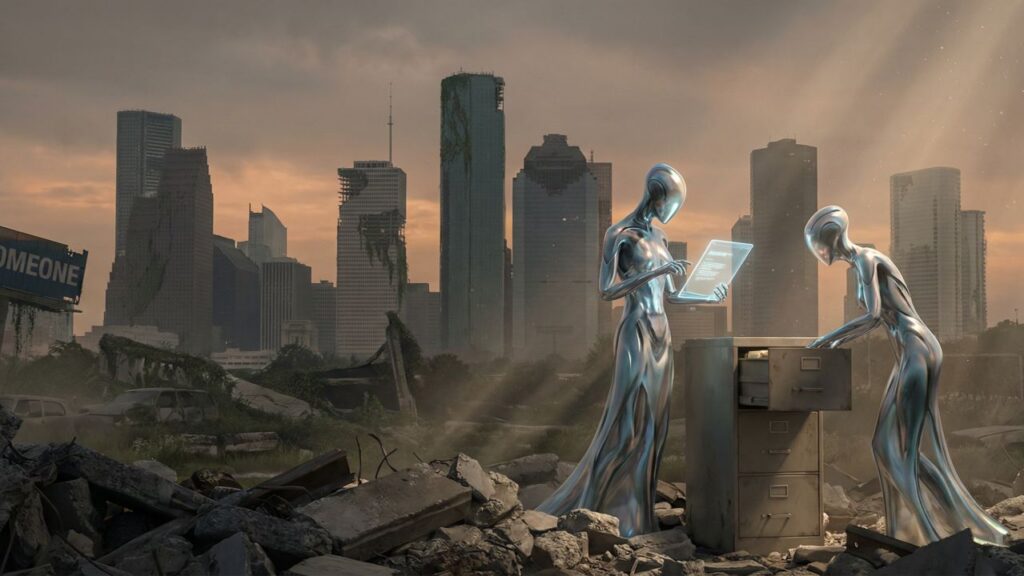
I sat down to write a little piece of science fiction. It wasn’t hard to keep it real. I envisioned a mathematician-scientist penning a note as catharsis, a document written not to change anything, but simply to mark the moment when the timeline became clear. What follows is that note, reportedly discovered by non-human intelligences in the ruins of what was once Houston, Texas, preserved in a fireproof file cabinet. Dated January 12, 2026, it was addressed from one colleague to another as the exponential curve finally went vertical, that inevitable moment when AI capability growth accelerated from “decades away” to “already here” in the blink of an eye. Any resemblance to persons living, dead, or cognitively absent is purely coincidental.
FROM:Dr. James Buzzkill, Department of Applied Pessimism
TO:Dr. Marcus Brightside, Institute for Doomed Optimism
DATE:January 12, 2026
RE: Your request for “something hopeful”
Marcus,
You asked me to write something hopeful. I’m afraid this is the best I can do.
We don’t have decades. We are lucky if we have two good years.
The artificial general intelligence timelines that Game Theorists (think the Rand Corporation, John von Neumann, Strangelove and Mutual Assured Destruction) once placed at “2040, maybe 2050,” are now clustering around 2027 to 2030, and that is blind optimism. We have no fail-safe. The models are doubling in capability every few months rather than years. The economic displacement, the institutional collapse, the moment when human cognitive labor becomes as obsolete as human physical labor became in 1900, that’s not a generation away. It’s within the current electoral cycle. Perhaps two.
And the American public is not ready. They are not even conscious. They are busy skimming and being herded with clips about presidential approval ratings, oil grabs, wars fought on sacrificed sovereigns, false depictions of despots, cultural grievances, institutional sanctimony, and the daily churn of manufactured outrage, while the civilizational inflection point accelerates toward them at an exponential rate. They cannot see it coming because they have stopped processing information that doesn’t compress into a headline or a soundbite that triggers an immediate emotional response.
This is not hyperbole, Marcus. This is arithmetic. A fixed script. An algorithm.
The Cognitive Collapse Came First
The technological discontinuity might have been manageable if we faced it with a population capable of sustained analytical thought, institutional trust, and collective problem-solving. We do not have that population. We have a public that cannot read past the third paragraph, cannot distinguish between a data point and a narrative frame, cannot hold two uncomfortable truths in tension long enough to synthesize a coherent response.
The zombie rigor mortis set in years ago. What we are watching now is a society that does not know it is already dead, still going through the motions of democratic deliberation, institutional legitimacy, and informed citizenship, while the capacity for all three has atrophied to the point of a shoddy and tired ceremonial performance. The lights are still on because the circuit is still running, but there is no one home. Tilt. Irreversible. Just like they no longer read, they no longer govern, nor react to not being governed.
You can see it in their eyes. Not stupidity, but absence. The little death behind the performance of engagement. They will share the outrage, click the headline, perform the ritual of caring, but the capacity for sustained, uncomfortable thinking that might actually prepare for what is coming? That is gone.
The Question No One Is Asking
The public discourse is still operating as if we have time. Time to reform institutions, time to wake people up, time to build consensus around the appropriate regulatory frameworks and social safety nets and educational programs that might ease the transition into a post-labor economy. Should have done, should have done, we all sigh. We do not have that time. The curve is too steep, and the distance too short. The point of singularity.
So the question is not “How do we prevent this?” That window closed. The question is: What do you do when you realize the timeline has collapsed, the public is oblivious, and you are too tired to keep shouting into the void?
You stop trying to rally the crowd. You stop writing for the people who will skim the headline, feel briefly validated or outraged, and move on without retaining a single sentence. You stop pretending that one more well-argued essay will penetrate the noise and change the trajectory.
Instead, you write for the record. You document what is visible to those still capable of seeing it, so that when the discontinuity hits, and it will hit, there is at least a trail showing that some people saw it coming, said it clearly, and were ignored. Not because documentation changes the outcome, but because the alternative is to let the collapse happen in silence, with no one on record having called it. Call me nostalgic. Call me sentimental.
Ever the optimist? You might write the manual for what comes after. Not “how to prevent this”, that ship sailed, but “here is what the world looks like on the other side, here is how to navigate it, here is what still matters when institutions do not.” You write for the statistically insignificant sample who will need a poultice map when the terrain shifts, because everyone else will be crawling in the wreckage of their mediocrity, wondering how they missed the signs.
Or you build. Not platforms designed to compete with legacy media for the attention of millions, those millions are already lost, but structures designed to produce signal when everything else is noise. Small, resilient, a black box beacon, capable of surviving the transition, beeping in the ruins to a dead audience. For those spiders at Bikini Atoll who crawl out first, but they are not John Galt or Howard Roark.
The Silicon-for-Carbon Trade
Ok, the sentimentality has passed; let’s get on with it. The coming replacement of human cognitive labor with machine intelligence is not a tragedy. It is a logical outcome. Because humans would not think, machines did, surpassing our wildest AGI ambitions. Since whole populations would not read, language models generated the text no one reads, the engagement metrics kept running and the advertising revenue kept flowing and the simulation of discourse continued without anyone noticing that all the humans logged off years ago.
The game is over. The pinball machine tilted. The ball is gone. But the lights are still flashing, and for most people, that is enough.
You are reading this because you are already in that category, or you stopped three paragraphs ago and went back to skimming headlines. There is no middle ground left.
The Brutal Calculus
If the inflection point is two years out, maybe five, do you spend that time trying to wake people who are determined to sleep through the alarm? Or do you spend it positioning yourself, your work, and your analytical framework to be useful in whatever comes next? Hope is fear’s comforter, for the rich 1% saps, survivalists with a concrete bomb shelter or Manhattan safe room or huddled in a think tank’s bunker with selected congressmen, senators and their wives.
The machines are coming, the machines are coming. That part is inevitable. The only variable left is whether any humans make it through the transition with their cognitive faculties intact, and whether they will have anything useful to work with when they arrive on the other side.
This is not an argument for despair. Despair is a luxury for people who still think outcomes are uncertain. This is an argument for cold realism about what the remaining time is for: not prevention, but preparation, the last throes of quality of life. On the Beach, by Nevil Shute? Not rallying the masses, but equipping the few who are still awake to navigate what is coming. Maybe you just go to the country and live off-grid until that clean-up Terminator arrives. No convenient ending like Golding’s Lord of the FliesWho’ll save the ship?
What Comes Next
There is no American Renaissance on the horizon. No deus ex machina. The cultural and cognitive preconditions for renaissance (literacy, institutional trust, collective capacity for delayed gratification and long-term thinking) are gone. Pretending otherwise is a waste of the limited time remaining.
What comes next is discontinuity. Displacement. A period of profound economic and social disruption as the last pillars of the industrial-era social contract collapse under the weight of automation, institutional decay, and a population that never saw it coming because they were too busy consuming the outrage cycle. Think Donald Kagan at Yale, lecturing on Thucydides’ lost books and the collapse of Athens, a civilization that watched itself fall while still debating procedure.
And after that? No one knows. Don’t talk about navigating it successfully, or tell jokes about being the ones who stopped arguing about approval ratings and started building lifeboats. The ones who recognized that the ship was going down and used the remaining time to construct something that floats, only floats so far, this ain’t no disco, this ain’t no party, The need to grasp hope, however instinctively in me, is dying.
The question is whether you will use that capacity to keep shouting down a well, or to, however implausibly, build something that survives the flood. I can’t convince the stupid to think; I can’t convince the good not to hope and try.
The timeline collapsed. The crowd is not coming. The machines are already here.
What are you going to do with the time that is left?
Marcus, I know this isn’t what you wanted. You wanted me, as a spiral architect of our youth, to say there’s still time, that people will wake up, that we can rally them if we just find the right words. But I’m tired of lying to make good people feel better about outcomes they can’t change.
The hopeful part, if there is one, is that you’re still asking the question. That means you’re still awake. That has to count for something.
Even if I have no idea what.
James
Related reading
- Buzzkill America: The Republic Nobody Kept
- Американский пузырь искусственного интеллекта лишён смысла. Каждый его участник это знает. И тем не менее он раздувается. Почему?
- The American AI Bubble Makes No Sense. Every Party to It Knows. It Is Happening Anyway. Why?
- Economic Statecraft: How the War Machine Replaced American Democracy