WOW, they told us not to worry; it’s only stagflation.
By Scott Ortkiese | July 2, 2026 | so@throughlinesynthesis.com
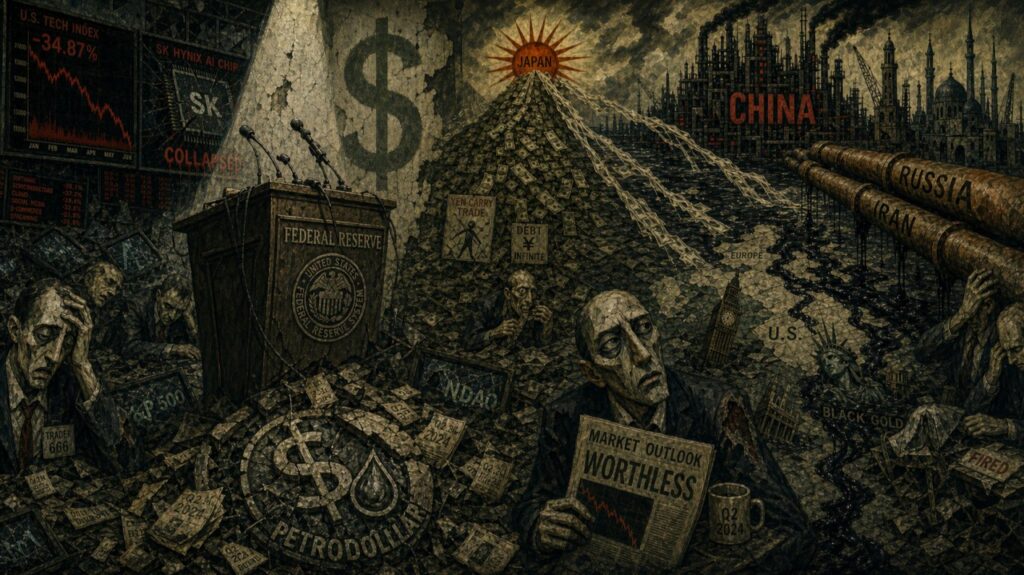
The consensus has settled on “grinding stagflation” as the terminal diagnosis for the U.S.-led order. That framing is both analytically lazy and politically convenient, because it implies continuity, a bad decade rather than a break in the system. The data points toward something far less forgiving.
The KOSPI has returned over 100 percent in the first half of 2026, yet fewer than three percent of its constituent stocks sit at 52-week highs while nearly a third trade at 52-week lows. The entire rally is Samsung and SK Hynix, meaning the world’s most watched AI hardware proxy is a two-stock index dressed up as a national market. Foreign institutions have pulled over $30 billion in June alone. Retail investors, financed by margin and nearly 350 listed leveraged products, have absorbed every share. That is not a bull market. That is a transfer of loss from sophisticated sellers to leveraged buyers at the top of a cycle. When it breaks, it will not clear quietly. Circuit breakers have already been triggered. The next dislocation will transmit directly into U.S. AI hardware valuations, EM indices that are covertly concentrated in the same names, and the credit underwritten on the assumption of permanent AI capex expansion.
That is the first leg of the storm. The second is the U.S. AI complex itself, which has functioned not just as an equity narrative but as a global collateral story. AI capex is embedded in hyperscaler balance sheets, in data center REITs, in semiconductor supply chains, and in the forward guidance that anchors credit spreads across investment grade tech. A Korean memory crash does not stay in Korea. It reprices the entire demand model. And when the demand model breaks, the collateral chain that runs through it breaks with it.
This is where “stagflation” becomes a sedative rather than a diagnosis. The 1970s stagflation was supply-driven, oil-priced, and ultimately resolved by Volcker discipline and a dollar reset. What is approaching is a demand, balance sheet and confidence shock layered on top of a reserve currency that has been used as a sanctions weapon, a deficit-financing tool and a political instrument for long enough that its principal creditors have begun building exits. That is not a stagflation setup. It is a depression setup with an inflationary surface.
The capital response is already visible in the margins. Japan, sitting on the deepest pool of surplus savings outside China, has no reason to recycle that capital into wounded Western tech or U.S. Treasuries yielding real negatives against a credible de-dollarization trend. The rational destination is China’s industrial and technology base, Russian and Iranian hydrocarbons priced in non-dollar terms, and the sovereign wealth flows of Gulf states that are quietly building alternative reserve and settlement infrastructure. This is not speculation. BRICS payment corridors, the mBridge cross-border CBDC pilot, Gulf sovereign diversification out of dollar assets, and China’s yuan-denominated oil contracts are not footnotes. They are the foundation of a parallel financial architecture that gets more attractive every time Washington weaponizes the dollar or promises a soft landing it cannot deliver.
What Kindleberger called the “stability of the hegemon” rests on the creditor nations believing the hegemon will behave predictably and subordinate short-term domestic politics to systemic responsibility. That belief is gone. When it goes, the adjustment is not gradual. Discipline elsewhere, Korea rebuilding around regional capital markets, Japan reallocating, Indonesia and Malaysia deepening intra-Asian trade finance, India settling in rupees, Russia and Iran monetizing energy outside the dollar circuit, is not economic nationalism. It is rational portfolio behavior by countries that watched the petrodollar system weaponized against anyone who challenged it. The petrodollar is not being dismantled by ideology. It is being abandoned by arithmetic.
The scholars who model this as stagflation are extrapolating from a world where the dollar anchor holds, where U.S. asset markets remain the global safe haven, and where the AI earnings cycle merely pauses rather than breaks. All three assumptions are now contestable at the same time. That is the perfect storm. And unlike the polite, managed decline the wonks are selling, this one redistributes power in real time, toward economies that spent the last twenty years building productive capacity instead of financial entitlement.
Related reading
- US-Israeli Attack on Iran Will Trigger Global Starvation
- The Bill Has Arrived: How €8 Trillion in EU Green Policy and $91 Billion in U.S. Pension Losses Enriched the Consultants Who Designed the Catastrophe
- GM's EV Escapade: How Mary Barra Followed Big Oil's Playbook and Incinerated $7.6 Billion
- The Consulting-Industrial Complex: How McKinsey, BlackRock, and the ESG Cartel Engineered Irreversible Industrial Destruction for Profit