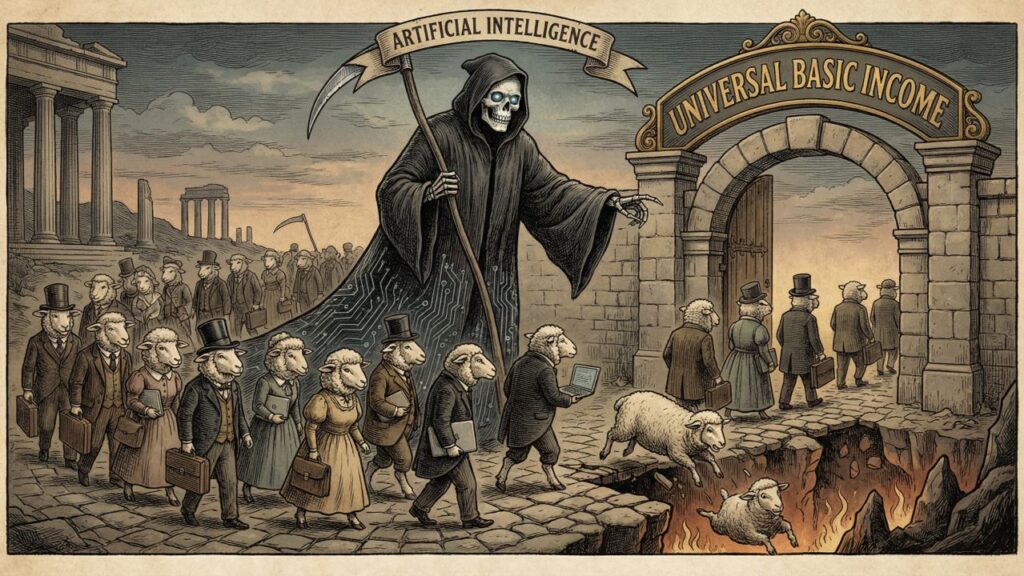
The Thebans spent their final days in sophisticated debate. Their generals discussed tactics, their philosophers contemplated strategy, while their politicians weighed diplomatic options. They believed their walls would hold because they always had. They believed their military tradition (glorious victories over Sparta, generations of hoplite excellence) would matter when the Macedonian phalanx arrived. They were having learned discussions about battlefield geometry while Philip’s son was rewriting the rules of warfare itself.
The walls fell in weeks. The city was razed. The survivors were sold into slavery. The sophistication of their final debates is now a footnote to their annihilation. History remembers only that Alexander won, the city burned, and a new world order emerged from the ashes.
Today’s knowledge workers are the Thebans. AI is Alexander. And like the Thebans, they’re having sophisticated debates (about hallucination rates, integration challenges, regulatory frameworks) while the siege engines roll into position. The difference is that this time, the walls are already breached. They just don’t know it yet.
Who Are The Knowledge Workers?
Knowledge workers are the professional class whose primary capital is information and cognitive skill rather than physical labor or material resources. They’re the lawyers analyzing case law, the accountants reconciling balance sheets, the software developers writing code, the financial analysts building models, the actuaries calculating risk, the engineers designing systems, the researchers compiling data, the content creators producing copy, the administrators coordinating workflows.
They represent roughly 45% of total US employment in non-routine cognitive occupations, approximately 70 million jobs. They’re the people who were told that education was the path to security, that automation would only threaten “low-skill” work, that their expertise and judgment made them irreplaceable. They’re college-educated, professionally credentialed, often highly compensated. They thought the moat around their careers was deep enough to protect them.
They were spectacularly wrong.
The knowledge economy promised that as machines took over physical labor, humans would ascend to higher-order cognitive work. That was true for about 40 years. The problem is that AI doesn’t just replace physical labor. It replaces cognitive labor directly, and does it faster, cheaper, more accurately, and at infinite scale. The very thing that was supposed to protect knowledge workers from automation is precisely what AI targets first.
The Order of Execution: Who Dies First?
The killing field has a sequence. The weakest fall first, then the floor collapses upward until only a tiny elite remains.
Phase 1 is already complete. Entry-level positions are evaporating. Job postings for entry-level roles in the US have declined 35% since January 2023. In tech specifically, new graduate hiring has dropped by over 50% compared to 2019. Entry-level positions in marketing are down 75.6%, HR down 72.3%, engineering down 72.2%, product down 69.8%, operations down 66.7%, finance down 63%, data down 62.1%.
These aren’t just cyclical hiring freezes. Companies are explicitly stating they’re using AI instead of hiring humans. Salesforce and Shopify have publicly said they’re meeting growth needs with AI rather than people. Amazon cut 14,000 corporate employees while expanding AI investments. A study by SignalFire analyzing 2019-2024 data across major tech companies found a 50% drop in opportunities for individuals with less than one year of post-graduate experience.
Stanford research shows workers aged 22-25 in AI-exposed occupations experienced a 13% employment decline since late 2022, while older workers in the same sectors saw gains. AI isn’t replacing all workers equally, it’s systematically eliminating the bottom rungs of the career ladder.
Companies aren’t even hiding it anymore. In June 2025, a manager posted on Reddit that leadership asked them to “evaluate teams and flag any roles or tasks that could be replaced by AI within 12-24 months”. Another manager reported scheduling a demonstration that “will probably replace the work my team does”. The IBM CEO explicitly announced 30% of non-customer-facing roles will be eliminated by 2028. A CIPD survey of 2,019 senior HR professionals found 62% of employers predict junior, clerical, managerial, and administrative positions are most likely to be eliminated by AI.
This creates a catastrophic pipeline problem. Senior developers come from junior developers. Senior analysts come from junior analysts. When you eliminate the entry level for 3-5 years, you create a talent vacuum that collapses the entire profession. As one commenter noted: “Where do senior developers come from? Junior developers. What happens in 10 years when we haven’t trained any juniors?”
Phase 2 is beginning now. Mid-level roles are compressing. AI doesn’t just do the tasks of junior workers, it does them well enough that you need one senior person managing 10 AI agents instead of one senior person managing 5-10 mid-level humans. That’s a 70-80% headcount reduction even in “augmented” workflows. Companies deploying agentic AI expect 171% ROI, with early adopters seeing 5x revenue increases and 3x cost reductions. These returns don’t come from making existing workers marginally more productive. They come from eliminating most of them.
Phase 3 is the senior transformation. Within 2-4 years, even senior roles won’t be “doing the work.” They’ll be “managing AI that does the work.” Your value becomes judgment, client relationships, and quality control. But you’re overseeing AI agents, not leading teams of people. The role remains, but 90% of the humans in that role disappear. This is the “AI-native operator” model, a tiny elite commanding massive leverage while everyone else becomes structurally obsolete.
The World Economic Forum projects 92 million jobs displaced by 2028. By 2040, mainstream predictions settle around 50-60% of jobs automated or transformed. Anthropic’s CEO warns that half of all entry-level white-collar positions could vanish within 1-5 years, driving unemployment to 10-20%. Stuart Russell, a leading AI researcher, warns AI could eliminate 80% of jobs.
The timeline is compressing. The Industrial Revolution took decades. This transition is happening in years, sometimes months. And unlike previous technological shifts that created new jobs as they destroyed old ones, this time the displacement is vastly outpacing the creation. Companies are explicitly stating they prefer hiring new AI-ready talent over retraining existing staff minus 3.1x preference. The path forward for displaced workers isn’t reskilling. It’s unemployment.
Why AI Wins: The Capability Asymmetry By Profession
The question isn’t whether AI will replace knowledge workers. The question is why anyone thought knowledge workers could compete. The capability gap isn’t marginal, it’s total.
Coding: Speed, Scale, and Sleepless Perfection
Half of developers surveyed in 2025 believe AI can already code better than most people. Not “will someday”, already can. Claude Opus 4.5 scores 80.9% on SWE-bench Verified, which measures performance on real-world software engineering problems. GPT-5.2 Codex scores 80.0%. These systems achieve perfect 100% scores on advanced mathematical reasoning tests.
The advantages are structural. AI doesn’t get tired. It doesn’t have “blank page” paralysis. It can write boilerplate code instantly. It can refactor entire codebases in minutes. For simpler tasks like restructuring and test creation, AI-enhanced workflows show speed increases up to 90%. It can process documentation, understand context across multiple files simultaneously, and generate solutions 24/7.
Anthropic’s CEO predicts 90% of code will be AI-written. This isn’t speculation, tech companies are already using AI to write production code and feeding the results back into training, creating a recursive improvement cycle. As one experienced developer noted: “AI is way better in coding especially front-end web development. It can generate UI and animation way better and faster”.
Yes, AI makes mistakes. So do junior developers. The difference is improving AI code takes minutes. Training a junior developer takes months. The economic math is brutal: why hire an undergraduate when AI is cheaper and quicker?
Legal: Comprehensive, Instant, Tireless Research
AI legal research platforms deliver comprehensive case analysis within minutes while often exceeding the accuracy of manual research. The advantages are overwhelming:
Semantic analysis: AI recognizes conceptual relationships between legal principles, identifying relevant authorities even when exact terminology differs. A human researcher might miss a precedent because it uses different phrasing. AI doesn’t.
Comprehensive coverage: AI systems search exhaustively across all relevant databases simultaneously, eliminating the selective coverage that characterizes time-pressured manual research. A human can search one database at a time. AI searches everything at once.
Citation verification: Automated checking ensures research accuracy while identifying potential Shepardizing issues that manual research might miss. AI doesn’t forget to check if a case has been overturned. Humans do.
Bias elimination: Systematic AI analysis eliminates researcher bias that influences source selection in manual approaches. A human might unconsciously favor precedents supporting their theory. AI examines everything neutrally.
Speed acceleration: AI identifies relevant authorities within seconds, completing research in a fraction of traditional time requirements, organizations report 75% reduction in research time. What took an associate 8 hours now takes 20 minutes.
Clifford Chance, one of the world’s leading law firms, cut 10% of its London legal staff citing AI. Microsoft eliminated 32 lawyers and 5 paralegals. These aren’t low-skill roles, these are experienced professionals making six-figure salaries, eliminated because AI does their work better and costs 96% less.
Accounting and Finance: Error-Free, Real-Time, Predictive
AI’s impact on accounting and financial analysis is perhaps the most straightforward: machines are simply better at processing numbers than humans. The advantages compound:
Error elimination: AI algorithms process vast financial data from multiple sources with near-perfect accuracy, minimizing human error in data entry and complex calculations. Machine learning algorithms reduce error risk by several orders of magnitude.
Time efficiency: Tasks that took days now complete in hours or minutes. Automated data entry, reconciliation, and report generation eliminate bottlenecks in monthly closes and free finance teams from manual processing. Organizations see 75% faster data processing.
Real-time insights: Traditional financial modeling relies on periodic updates, leaving businesses with outdated information. AI provides real-time monitoring of financial transactions, allowing proactive responses to problems before they become serious.
Fraud detection: AI excels at identifying subtle patterns humans miss, making it ideal for detecting financial fraud. Anomaly detection algorithms flag unusual transactions in real-time while predictive models assess default likelihood before traditional warning signs appear. These systems continuously learn from new data, improving accuracy and staying ahead of evolving fraud tactics.
Enhanced forecasting: AI considers multiple variables and historical patterns automatically, resulting in more accurate cash flow forecasts than manual methods. By analyzing historical data alongside external factors like market trends and economic indicators, machine learning transforms financial forecasting.
Compliance automation: AI-powered software continuously monitors transactions to ensure adherence to regulatory requirements and accounting standards. It identifies compliance risks in real-time, helping businesses avoid legal penalties while streamlining audit preparation.
The result: 80% of banks globally are using AI to improve operations, with measurable benefits in fraud detection and cost savings. AI accounting platforms handle reconciliation, invoicing, expense classification, and reporting automatically, operational bookkeeping is being fully automated.
Engineering, Actuarial, and Beyond: The Pattern Repeats
The story is the same across knowledge professions. AI demonstrates systematic advantages in tasks requiring information processing, pattern recognition, calculation, and iterative analysis.
Engineering: AI can simulate complex systems, optimize designs, and identify flaws faster than human engineers. It processes sensor data in real-time, monitors infrastructure continuously, and predicts maintenance needs before failures occur.
Actuarial science: Risk calculation, mortality modeling, and probabilistic forecasting are exactly the domains where AI excels, processing massive datasets to identify patterns invisible to human analysts. What took an actuary weeks of calculation now happens in minutes.
Market research and analysis: AI processes consumer data, identifies trends, segments markets, and generates insights at speeds and scales humans cannot match. Sentiment analysis across millions of social media posts happens instantaneously.
Content creation: AI generates blogs, newsletters, product descriptions, and marketing copy at industrial scale. Human writers remain valuable for editorial direction, but the volume of manual writing is collapsing.
The common thread: AI has superhuman advantages in speed, scale, consistency, and cost. It works 24/7, never gets tired, processes information exponentially faster than humans, and costs a fraction of a salary. An AI agent costs $0.006 per interaction; a human costs $6.00, a 1,000x differential.
When the cost advantage is 1,000x, when the speed advantage is 10x to 100x, when the consistency advantage is total, and when the scale advantage is infinite, there’s no competition. There’s just a countdown to replacement.
Hope Is Fear’s Comforter
The ancient Greek historian Thucydides wrote that “hope is an expensive commodity” and that it serves as “the comforter of fear.” When humans face threats they cannot psychologically bear, they construct hopeful narratives to make the unbearable bearable. The Thebans hoped Alexander would negotiate, that their walls would hold, that their martial tradition mattered. These hopes were comforts against the terror of acknowledging what was coming.
Modern knowledge workers engage in the same psychological defense. The counterarguments to AI displacement, “AI hallucinates! Integration is hard! We need human oversight! Creative work is safe!”, aren’t analytical objections. They’re psychological comforts against existential fear.
Yes, AI hallucinates. The latest reasoning models show hallucination rates of 33-79% in some tests. But earlier models are down to 1-2% on factual benchmarks. And critically: companies don’t need perfection. When you’re saving 90% on costs with human oversight catching the remaining errors, you’ve still transformed your cost structure. The economics work even with imperfect AI. Hoping that hallucinations will prevent adoption is fear’s comforter, a way to avoid confronting the reality that “good enough and 90% cheaper” wins.
Yes, integration is hard. 52% cite data quality issues, 49% lack internal expertise, 45% of employees are resistant. These are real obstacles. They’re also temporary and surmountable. Every technological transition faced similar barriers. The companies that overcome them get 5x revenue growth and 3x cost reductions. The ones that don’t get driven out of business by competitors who did. The hope that “it’s too hard to implement” will stop AI adoption is comforting, but it ignores that existential competitive pressure makes the “hard” thing mandatory, not optional.
Yes, AI needs human oversight. For now. Agentic AI already operates with minimal human intervention. Each model generation requires less oversight. And even with oversight, you need one human managing ten AI agents instead of ten humans. That’s still 90% headcount reduction. The hope that “oversight will save jobs” is a misunderstanding of the math. Oversight doesn’t preserve the workforce, it decimates it while keeping a tiny elite.
Yes, creative work feels safer. But 77% of companies expect no net workforce reduction from AI because they’re redesigning jobs, not just eliminating them. Your job becomes “prompt engineer managing AI outputs” rather than “analyst doing analysis.” That still requires vastly fewer humans. And as models improve, even the oversight role compresses further. The hope that “my work is too creative/complex/nuanced” is the same hope every displaced worker in history told themselves. Weavers thought their skill was irreplaceable. Switchboard operators thought their judgment was necessary. Bank tellers thought their customer service mattered. They were all wrong.
The counterarguments are all variants of “this time will be different” or “surely it won’t be that bad.” These are the exact arguments that failed to save Kodak, Blockbuster, Borders, BlackBerry, Nokia, Sears, and every other incumbent that faced exponential technology shifts. Thucydides understood: hope is not analysis. It’s fear’s comforter. It’s what people reach for when they cannot bear to look directly at their own obsolescence.
The Thebans hoped until the walls fell. Then it was too late for anything but regret.
The Regulatory Vacuum: Politicians Fiddle While Rome Burns
If ever there was a case for government intervention to manage technological disruption, AI is it. The speed of displacement vastly exceeds the economy’s capacity to adapt. The social consequences of 10-20% unemployment are catastrophic. The national security implications of ceding AI dominance to China are existential. By every measure, this should trigger comprehensive regulatory frameworks to manage the transition, retrain workers, and prevent social collapse.
Instead, we get the opposite: a race to deregulate, a competition to see which jurisdiction can remove guardrails fastest, and explicit federal efforts to block states from implementing any meaningful oversight.
Elon Musk’s Cassandra Warnings
Elon Musk has been warning about AI risks since 2018. At South by Southwest in 2018, he called the lack of AI oversight “insane,” stating that “AI is far more dangerous than nukes”. He argued: “There needs to be a public body that has insight and oversight to confirm that everyone is developing AI safely. The danger of AI is much greater than the danger of nuclear warheads by a lot. Nobody would suggest that we allow anyone to just build nuclear warheads if they want, that would be insane. Mark my words, AI is far more dangerous than nukes”.
In 2023, Musk joined over 1,000 tech leaders and researchers in signing an open letter calling for a six-month moratorium on AI development beyond GPT-4, citing “profound risks to society and humanity”. The letter stated: “AI labs are locked in an out-of-control race to develop and deploy ever more powerful digital minds that no one, not even their creators, can understand, predict, or reliably control”. It called for government-imposed moratoriums if industry couldn’t self-regulate.
Also in 2023, Musk told Tucker Carlson that AI “has the potential (however you may regard that probability, but it is non-trivial) for civilizational destruction”. He stated: “Once AI is in control, it may be too late to regulate”. Musk advocated for establishing a regulatory body that would “start with a team that seeks to understand AI, then gather insights from industry, and subsequently propose regulations”.
At the Vivatech conference in 2023, Musk reiterated: “If we are not careful with creating artificial general intelligence, we could have potentially a catastrophic outcome. I’m in favor of AI regulation because I think advanced AI is a risk to the public, and anything that’s a risk to the public, there needs to be some kind of referee”.
The warnings were clear, specific, and came from someone with deep expertise in the technology. They were ignored.
The Political Response: Active Deregulation
Rather than heeding warnings, politicians chose the opposite path: removing what little oversight existed and blocking states from implementing their own protections.
On July 23, 2025, the Trump administration released “America’s AI Action Plan,” explicitly prioritizing “AI dominance” through “minimal oversight” and “industry self-regulation”. The plan recommends withholding federal funding from states with “burdensome” AI regulatory frameworks, while still allowing states to pass laws “so long as they do not obstruct technological progress”. Translation: states can regulate AI only if the regulation doesn’t actually regulate anything.
On December 11, 2025, President Trump signed an executive order titled “Ensuring a National Policy Framework for Artificial Intelligence”. The order explicitly states: “To win, United States AI companies must be free to innovate without cumbersome regulation. But excessive State regulation thwarts this imperative”.
The executive order creates an AI Litigation Task Force “whose sole responsibility shall be to challenge State AI laws”. It threatens to withhold Broadband Equity Access and Deployment funding from states with “onerous” AI laws. It calls for federal legislation establishing a “minimally burdensome national policy framework” that would preempt state AI laws.
Specifically, the order criticizes Colorado’s AI Act for allegedly banning “algorithmic discrimination” in a way that may compel AI models to produce “false results”. The implication: regulations requiring fair treatment across protected classes are “onerous” barriers to innovation that must be eliminated.
Congress attempted to go even further. Senator Ted Cruz led an effort to include a 10-year moratorium on all state AI laws in the “One Big Beautiful Bill” budget reconciliation package. This would have suspended existing and future state AI frameworks across employment, healthcare, financial services, and all other sectors without creating any replacement federal standards.
The provision collapsed in the Senate by a vote of 99 to 1 (not because senators suddenly got serious about AI regulation, but because even Republicans from states that had passed AI laws objected to federal preemption. Texas, Utah, and Montana) solidly red states, have been at the vanguard of AI regulation. Preempting their laws without offering federal alternatives proved politically toxic even to the President’s own party.
The message is clear: the federal government will not regulate AI. It will actively prevent states from regulating AI. The explicit policy is “minimal oversight,” “industry self-regulation,” and removal of any “barriers” to AI deployment. This isn’t benign neglect, it’s active deregulation in service of a “race to dominance” against China.
The China Excuse
The justification offered is competition with China. The Trump administration’s AI Action Plan and executive order repeatedly invoke the need to “win the AI race” and maintain “global AI dominance”. The argument: any regulation will slow American AI development, allowing China to pull ahead, which would be an unacceptable national security risk.
This framing is catastrophically dishonest. Yes, China is investing heavily in AI. Yes, there are genuine national security concerns about AI capabilities falling under authoritarian control. But the choice isn’t between “deregulate everything” and “cede the field to China.” Other frameworks exist.
The EU is implementing comprehensive AI regulation through frameworks that distinguish between high-risk and low-risk applications, require transparency for certain uses, and mandate risk assessments. This hasn’t stopped European AI development, it’s created clearer operating parameters that may actually accelerate adoption by establishing trust.
The “China excuse” is just that, an excuse to prioritize corporate profits and “innovation” (i.e., rapid deployment without safety testing) over worker protections, social stability, and the catastrophic unemployment that unchecked AI adoption will cause. It’s the same argument used to oppose environmental regulations (“China will just pollute more!”), labor protections (“We’ll lose manufacturing to China!”), and every other policy that might constrain corporate behavior.
The reality: China will develop AI regardless of US regulatory choices. The question is whether the US manages its domestic transition in a way that preserves social stability and retrains workers, or whether it sacrifices tens of millions of workers to a “race” that prioritizes deployment speed over human welfare.
Politicians chose the latter. They’re letting AI deployment proceed at maximum speed with minimal oversight, promising that “innovation” will create new jobs to replace the ones destroyed, that economic growth will solve the displacement problem, and that somehow everything will work out.
Which brings us to their other promise: Universal Basic Income will save everyone.
The UBI Delusion: Why “Free Money” Won’t Save You
As knowledge workers face mass unemployment, a seductive answer keeps surfacing: Universal Basic Income (UBI). Give everyone a guaranteed payment regardless of employment status. Problem solved, right? The displaced workers get income, they can still consume, the economy doesn’t collapse, and we sail smoothly into the AI future.
This is lunacy. UBI is not a solution to AI displacement, it’s a fantasy that delays confronting the actual problem until it’s too late to fix.
The Economic Death Spiral
The fundamental problem with UBI is arithmetic. A genuine UBI that provides a livable income (say $12,000-15,000 per year per adult) costs between $2.4 trillion and $3 trillion annually. For context, that’s close to the entirety of federal tax revenue currently collected. It’s more than half the current federal budget.
Where does this money come from? Three options, all catastrophic:
Option 1: Eliminate existing social programs. Charles Murray’s UBI proposal finances the payment by eliminating Social Security, Medicare, Medicaid, food stamps, housing subsidies, and all other transfer payments. The result: a single parent with three children could lose up to $19,000 in annual benefits on net. UBI redistributes resources away from those who need help most to provide universal payments to people who don’t need them, including billionaires.
Option 2: Massive tax increases. Funding a meaningful UBI requires consumption tax increases of 10-15 percentage points, or income tax increases of similar magnitude. This tanks consumer spending, drives inflation, and crashes economic growth. And it’s politically impossible, no constituency will vote for tax hikes of that scale.
Option 3: Explode the deficit. Just print the money and add trillions to the national debt. This accelerates inflation, devalues currency, and triggers a sovereign debt crisis. Also politically toxic and economically suicidal.
There is no fourth option. The money doesn’t exist. UBI at a meaningful level is unaffordable. Every serious economic analysis reaches the same conclusion: the costs vastly exceed available resources.
The Labor Participation Collapse
Even if you could somehow fund it, UBI creates a second catastrophic problem: it destroys labor force participation, which shrinks the economy, which reduces tax revenue, which makes UBI even more unaffordable in a death spiral.
The evidence is overwhelming. Studies of UBI-like programs in Seattle and Denver found that substantial unconditional payments caused a 14% decline in labor force participation and a 27% reduction in hours worked by women. A UK simulation found that full UBI scenarios decreased employment from 78.9% to 74.1% and reduced mean weekly hours worked by 1.76 to 2.31 hours. Cleveland Fed research found that a $1,000 monthly UBI leads to “an overall decrease in macroeconomic aggregates, stemming from a drop in labor supply”.
This isn’t speculation, it’s basic economics. When people receive income without working, some portion will reduce work hours or exit the labor force entirely. This is especially true for secondary earners in households. Eduardo Porter calculated that for households making less than $25,000 annually (nearly 25% of US households), a $10,000 payment to each of two parents could change decisions about balancing work, childcare, and other obligations, resulting in less full-time labor participation.
The macroeconomic consequences are devastating. Economic growth depends on three factors: capital increases, technology advances, and labor force growth. UBI directly decreases labor force participation, which shrinks GDP, which reduces tax revenue, which creates fiscal crisis. As the economy contracts, there are fewer resources to help the disadvantaged or invest in the future, resulting in lower overall prosperity.
The UBI advocate response: “But that’s the point! UBI frees people from bad jobs!” Sure. But when labor participation drops by 5-10%, GDP contracts accordingly. A 5% GDP drop in a $25 trillion economy is $1.25 trillion in lost annual output. That’s wealth that no longer exists to tax, to distribute, to support UBI itself. The program becomes fiscally unsustainable from its own labor market effects.
The Inflation Trap
Third problem: UBI likely triggers significant inflation, which erodes the purchasing power of the payment itself, requiring increases in the UBI amount, which drives more inflation in a feedback loop.
When millions of people suddenly have additional thousands of dollars in income, aggregate demand increases substantially. If productive capacity and labor supply are both shrinking (because UBI decreased work), you get classic demand-pull inflation. Prices rise. The $15,000 UBI that seemed adequate becomes insufficient. Political pressure mounts to increase payments. The cycle repeats.
Some UBI advocates argue there’s no inflation risk because “we’re not at full employment.” That was arguably true in 2020. It’s not true when AI has displaced 20-40% of the workforce and labor participation has dropped from UBI effects. In that scenario, you have reduced productive capacity meeting increased consumer demand. That’s textbook inflation.
The result: UBI becomes an expensive way to deliver declining real purchasing power to recipients while accelerating currency devaluation. Countries that have tried similar approaches (Venezuela’s social spending spirals) demonstrate the outcome. It doesn’t end well.
The Political Impossibility
Even if you solved the funding problem, the labor participation problem, and the inflation problem, you still face a fourth barrier: UBI is politically toxic and likely impossible to implement at the necessary scale.
The Swiss rejected UBI in a 2016 referendum. The UK government ruled it out as unaffordable in 2016. The US Congress stripped a 10-year state AI law moratorium from legislation by a 99-1 vote when it became clear the bill lacked replacement federal protections, and that was just blocking state regulations, not implementing a $3 trillion federal program.
The political obstacles are structural. Conservatives oppose UBI as welfare expansion that destroys work ethic and creates government dependency. Progressives oppose it as a replacement for targeted programs that help those most in need. Fiscal hawks see unaffordable costs. Socialists see a capitalist bribe to accept inequality rather than restructuring power.
John Cruddas, former Labour MP, described UBI as “importing a passive citizenship with no sense of contribution. It doesn’t contest the sphere of production, and it just retreats into hyper-consumption”. Critics on the left see it as Silicon Valley elites buying off the “precariat” to accept insecure work and disconnecting large swaths of the population from the positive aspects of employment.
Jon Kay, an economist, calls UBI “a distraction from sensible, necessary and feasible welfare reforms”. Critics across the spectrum view it as a technical solution to what are fundamentally political problems related to work, inequality, and power.
Getting a $3 trillion program through Congress that faces opposition from left, right, and center, that requires massive tax increases or deficit spending, that reduces work incentives, and that redistributes resources away from those who need them most toward universal payments, good luck. It’s not happening.
The Timeline Mismatch
Even if, somehow, you solved all the previous problems, you still face the fatal flaw: the timeline mismatch between AI displacement and any plausible UBI implementation.
AI is eliminating entry-level jobs now. Entry-level hiring is already down 35% since January 2023. By 2027-2028, mid-level compression hits hard with potential unemployment reaching 10-20%. The social crisis arrives in 2-4 years.
UBI implementation would require: building political consensus (3-5 years minimum given current polarization), designing the program (1-2 years), passing legislation (1-2 years in optimistic scenarios, potentially never given political opposition), then phasing in implementation (1-2 years). You’re looking at a 6-10 year timeline at minimum, more likely never.
The displacement happens in 2-4 years. The UBI solution arrives in 6-10 years if you’re wildly optimistic, never if you’re realistic. This is like planning to build a levee after the hurricane makes landfall. By the time UBI might conceivably be implemented, the social catastrophe has already occurred. Tens of millions are unemployed. Social unrest is widespread. Political instability makes passing major legislation nearly impossible.
UBI is not a solution to AI displacement. It’s a vague gesture toward a future that might make people feel better while doing nothing to prepare for or prevent the crisis. It’s hope as fear’s comforter, a way to avoid confronting that we have no plan, no mechanism, and no political will to manage the transition.
The Thebans also had plans for what they’d do after they defeated Alexander. Those plans didn’t matter because the premise was wrong. UBI advocates have plans for a post-displacement economy supported by universal payments. Those plans don’t matter because the displacement happens long before any conceivable UBI implementation, and the economic/political prerequisites for funding UBI likely evaporate during the displacement itself.
Counting on UBI to save knowledge workers from AI displacement is like counting on Thebes to negotiate terms after Alexander razes the city. It’s a fantasy that prevents preparation for the actual catastrophe.
The Bitter Truth: What This Means For You
Alexander didn’t hate Thebes. He wasn’t cruel for cruelty’s sake. He simply had overwhelming military superiority, strategic objectives that Thebes opposed, and no reason to show mercy when they refused to surrender. The destruction of Thebes wasn’t personal, it was inevitable given the balance of forces.
AI doesn’t hate knowledge workers. Companies deploying AI aren’t evil. Politicians refusing to regulate aren’t monsters. They’re all responding to overwhelming incentives in a system where failure to adopt AI means bankruptcy, where regulatory caution means ceding global leadership to China, where promises of UBI defer hard choices, and where the economic gravity of a 1,000x cost advantage pulls inexorably toward mass displacement.
You can be as sophisticated, educated, credentialed, and excellent at your job as you want. The Thebans were excellent warriors. They still lost. Excellence in the old game means nothing when someone rewrites the rules.
If you’re a knowledge worker, you have maybe 24-36 months before the wave hits your sector directly. Customer service, entry-level coding, routine financial analysis, junior legal work, they’re going now. More complex knowledge work has slightly more time. But the direction is set and the timeline is compressing.
Your options are limited and mostly bad:
Become AI-native. Master prompt engineering, AI workflow design, agent orchestration. Position yourself as the one human managing ten AI agents instead of being one of the ten humans replaced by agents. This is a narrow path that will save perhaps 10-15% of current knowledge workers. It’s the best option available, but the math only works for a small elite.
Shift to AI-resistant work. Physical labor requiring manual dexterity, hands-on healthcare, skilled trades, personal services that demand physical presence or genuine human connection. Yes, this is downward mobility. A lawyer becoming an electrician is a massive income drop. But employed at $60,000 beats unemployed at zero.
Build wealth now. You’re in a narrow window where you have income before mass displacement drives down wages. Save aggressively. Invest. Build a buffer. When unemployment hits 10-20%, financial cushion might be the difference between weathering the storm and disaster.
Get political. Organize. Demand meaningful regulation. Push for worker retraining programs. Advocate for social safety nets that might actually materialize (not UBI fantasies, but expanded unemployment insurance, healthcare, retraining programs). This is a long shot, but collective political action might buy time that pure market forces won’t provide.
What won’t work: Pretending this isn’t happening. Believing your specific job is “too complex” for AI. Assuming companies will be humane. Waiting for someone to save you. Hoping the technology will plateau. Counting on UBI. These are psychological comforts, fear’s comforters. They’re what people reach for when they cannot bear to look directly at their own obsolescence.
The Thebans hoped until the walls fell. Then it was too late for anything but regret.
Knowledge workers are deader than dead. Most just don’t know it yet. They’re still inside the walls, having sophisticated debates about AI hallucination rates, integration challenges, and regulatory frameworks, while the siege engines roll into position and politicians actively dismantle what little defense exists.
The gates of Thebes are already open. Alexander is already inside. The sophistication of your credentials, the complexity of your work, the decades you spent building expertise, none of it will matter when the economic arithmetic says you cost $100,000 and the AI costs $5,000, when your competitor deploys AI and undercuts your pricing by 50%, when shareholders demand optimization and executives need to deliver 171% ROI to keep their jobs.
Welcome to the fall of Thebes. History doesn’t remember the eloquence of the Thebans’ final arguments. It remembers only that Alexander won, the city burned, and a new world order emerged from the ashes.
The question isn’t whether knowledge work survives. It doesn’t. The question is whether you’ll be among the tiny remnant that adapts, or part of the vast majority that hoped, waited, and fell.
Related reading
- The AI Problem Exhibited by Perplexity but Common to All: Why Institutional Consensus Amplification Is Not Knowledge
- American AI Domination? Not So Fast.
- Not an AI Cold War: Rather, A Market Rotation in Favor of China.
- Американский пузырь искусственного интеллекта лишён смысла. Каждый его участник это знает. И тем не менее он раздувается. Почему?