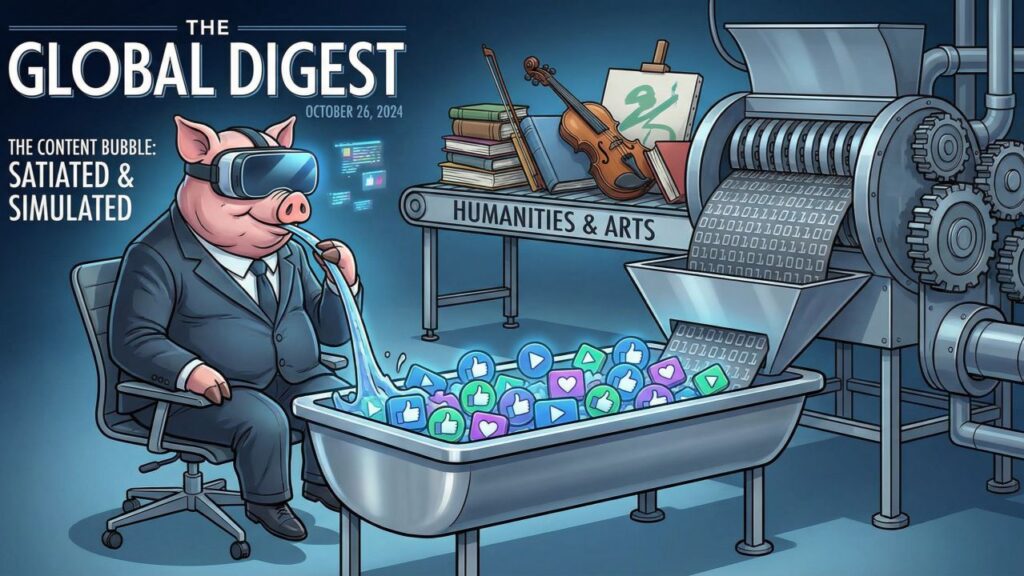
The evidence is no longer speculative. It is measurable, quantified, and accelerating. The average human attention span for screen-based tasks has collapsed to forty seconds. Seventy percent of AI supply chain projects fail not from technical inadequacy, but because the messy reality they were meant to optimize refuses to conform to computational legibility. And yet, the projects continue, not because the AI is improving, but because the reality is simplifying.
We are witnessing the largest-scale instance of Jevons’ Paradox applied to cognition: as artificial intelligence makes thinking cheaper, we think less. As it makes decision-making more efficient, we decide less. As it promises to solve complexity, we stop being complex.
This is not a bug in the system. It is the system working exactly as designed.
The Empirical Record of Self-Truncation
The Attention Economy’s Attention Collapse
The median attention span for screen-based tasks has fallen from roughly two minutes twenty years ago to forty seconds today. This is not a natural decline; it is an adaptation to the architecture of digital platforms. TikTok, Instagram Reels, and YouTube Shorts are not merely hosted on platforms, they are the platform, designed around sub-ten-minute content that optimizes for dopaminergic reward cycles.
The mechanism is straightforward: algorithmic curation creates a satisficing trap. Users exposed to rapid, fragmented content develop what researchers call “satisficing behavior”, they stop searching when they find something “good enough,” never reaching for optimal understanding. A 2025 study in Societies found that heavy AI tool usage correlates directly with weaker critical thinking skills, mediated by “cognitive offloading”, the delegation of mental work to machines.
The feedback loop is vicious: as attention spans shorten, platforms optimize for shorter content. As platforms deliver shorter content, attention spans collapse further. The human adapts to the machine’s context window, not the other way around.
The Algorithmic Shaping of Human Learning
Research from Vanderbilt and Ohio State demonstrates that personalization algorithms don’t just filter what we see, they reshape how we learn. In controlled experiments, algorithmic curation caused participants to form “inaccurate representations” of categories and develop “inflated confidence about their inaccurate decisions”. The algorithm didn’t just show them a biased sample; it fundamentally altered their mental models.
This is the inverse alignment problem: instead of aligning AI with human values, humans align with AI constraints. When Netflix autoplays the next episode, it removes the decision point entirely. When Spotify’s recommendation engine defines your taste, you stop exploring. The algorithm doesn’t just predict your preferences; it manufactures them through “hedonic consumption” loops that exploit neural reward systems.
The result is a population that has learned to skim rather than read, to scroll rather than reflect, to accept rather than question. A 2024 study of teenagers found that when faced with “long, complex and wordy texts,” their brains “don’t know how to process them as well anymore”. This isn’t a failure of education; it’s a successful adaptation to a digital environment that punishes depth.
The Mechanisms of Conformity: How We Truncate Ourselves
1. Satisficing as a Survival Strategy
The concept of “satisficing”, settling for a satisfactory solution rather than an optimal one, has evolved from a descriptive observation to a prescribed behavior. Modern UX design explicitly optimizes for satisficing. We track user engagement metrics not to deepen understanding, but to reduce friction, to make the path of least resistance the only path.
In information-seeking behavior, this manifests as search-stopping at the first adequate answer. A user Googles a question, clicks the first result, reads the featured snippet, and considers the need satisfied. The cognitive cost of seeking deeper understanding exceeds the perceived benefit when an “answer” is instantly available.
This is not irrational. It is rational adaptation to information overload. When the internet can show you “almost everything,” the only way to function is to treat depth as a luxury good. The satisfied pig is not a moral failure; it is an economic necessity.
2. Cognitive Offloading as Cognitive Atrophy
The 2025 study in Societies found that frequent AI tool usage correlates with weaker critical thinking skills across all age groups, with the effect “particularly pronounced among younger individuals”. This isn’t just about using calculators instead of mental math, it’s about offloading the entire process of sense-making.
When we use AI to:
- Summarize complex arguments
- Generate first drafts
- Recommend what to read, watch, or buy
- Decide which route to take
- Choose which candidate to interview
We are not just saving time. We are atrophy-ing the neural circuits that perform these functions. The brain is use-it-or-lose-it. And we are choosing to lose it.
The protective factor is education, those with higher education levels “tended to retain stronger critical thinking skills regardless of AI tool usage”. But this is cold comfort. It suggests that cognitive resilience is becoming a class marker, with the educated elite maintaining human judgment while the masses offload theirs to machines.
3. The Quantified Self as the Reduced Self
The “quantified self” movement promised empowerment through data. What it delivered was reduction to metrics. When someone “wakes up and looks at their sleep score,” they “become accustomed to judging the quality of the entire day from that single number, without regard for how they really feel”.
This is digital Taylorism applied to the psyche. The self becomes a dashboard. Emotional states become data points. The rich, qualitative experience of being human is flattened into variables that can be optimized.
The algorithm doesn’t just measure you; it defines the categories of measurement. When AI therapy apps provide “predetermined summaries of one’s moods, behavior, and thoughts,” they don’t just reflect your inner life, they manufacture it. You learn to experience your emotions as the app categorizes them: “anxious,” “productive,” “stressed.”
The Feedback Loop: How AI Shapes Behavior That Shapes AI
The most insidious aspect of this dynamic is its self-reinforcing nature. Algorithms shape human learning, and human behavior shapes the algorithm, locking both into a cycle that limits exploration.
The Satisficing Spiral
- AI optimizes for engagement, delivering rapid, fragmented content that maximizes dopamine hits.
- Humans adapt, developing shorter attention spans and satisficing behavior.
- AI measures this adaptation as “user preference” and doubles down on the strategy.
- The market rewards platforms that capture attention most effectively, forcing competitors to adopt the same model.
- Cultural expectations shiftlong-form content becomes “niche,” deep reading becomes “elite.”
This is not a conspiracy. It is evolutionary pressure in a digital ecosystem. The organisms that survive are those that fit the machine’s context window.
The Inverse Alignment Acceleration
As humans simplify themselves, AI systems become more effective at predicting and shaping behavior. The “algorithmic self” emerges, not as a metaphor, but as a functional identity that exists primarily in machine-readable form.
Your Spotify profile knows your taste better than you do. Your LinkedIn profile defines your professional identity. Your TikTok feed shapes your cultural references. These are not tools you use; they are versions of you that exist in computational space.
And because these versions are more legible than your messy, analog self, they become the authoritative version. When a hiring manager reviews your LinkedIn profile, they are not seeing a representation of you, they are seeing the only you that matters in that context.
The Professional Implications: When “Good Enough” Becomes Standard
The Death of Expertise Through Satisficing
In professional domains, satisficing behavior is becoming institutionalized. When AI tools provide “good enough” legal research, “good enough” code suggestions, or “good enough” strategic analysis, the opportunity cost of seeking better becomes prohibitive.
A lawyer who uses AI to draft a contract in 10 minutes cannot bill for 10 hours of careful analysis. A consultant who uses AI to generate a market analysis cannot charge for weeks of primary research. The market punishes depth and rewards speed.
This creates a Gresham’s Law of Cognition: bad thinking drives out good. The professional who insists on deep, human judgment is outcompeted by the one who satisfices with AI. Over time, depth becomes a luxury good, affordable only to those who can charge premium rates for it.
The Standardization of the Non-Standard
The most profound truncation occurs in domains that were previously resistant to standardization:
- Creative work: AI art tools don’t just assist artists; they define what “art” means in commercial contexts. When 90% of marketing imagery is AI-generated, the human artist must conform to AI aesthetics to be competitive.
- Therapeutic relationships: AI therapy apps don’t just supplement human therapists; they reshape expectations about what therapy is. When users expect instant, algorithmic responses, the slow, messy work of human therapy becomes “inefficient.”
- Scientific research: AI literature review tools prioritize papers that fit established patterns. Novel, paradigm-breaking research becomes harder to discover because it doesn’t match the algorithm’s similarity metrics.
The Philosophical Crisis: The Satisfied Pig Problem
John Stuart Mill’s famous formulation, “It is better to be a human being dissatisfied than a pig satisfied”, assumes that humans choose dissatisfaction. But what if the choice is removed?
When algorithmic curation delivers constant, low-grade satisfaction (the perfect video, the perfect song, the perfect answer) the cognitive cost of seeking “better” becomes irrational. The satisfied pig is not a moral failure; it is a rational actor in an environment optimized for satisfaction.
The crisis is not that we become pigs. The crisis is that we stop knowing what we have lost. When critical thinking atrophies, we don’t notice its absence. When attention spans collapse, we don’t miss deep focus. When our selves are reduced to metrics, we don’t feel the reduction.
The Reversibility Question: Can We Choose Complexity?
The evidence suggests we cannot, for three reasons:
1. The Economic Lock-In
Markets have already adapted to the simplified human. The entire digital economy is built on attention extraction and cognitive offloading. Reversing this would require:
- Abandoning trillion-dollar business models
- Accepting massive productivity losses during transition
- Rebuilding human cognitive capacity from scratch
The collective action problem is insurmountable. Any individual who opts out is outcompeted.
2. The Neurological Lock-In
The brain’s plasticity is a double-edged sword. While it can adapt to complexity, it can also lose the capacity for complexity. The 40-second attention span is not a temporary state; it is a neurological adaptation that becomes increasingly difficult to reverse with age.
3. The Cultural Lock-In
As younger generations grow up in algorithmically curated environments, depth becomes alien. Long-form reading feels like “work.” Uncertainty feels like “error.” Ambiguity feels like “confusion.”
The epistemic standards shift. What was once “critical thinking” becomes “overthinking.” What was once “judgment” becomes “bias.”
Conclusion: The Truncation Is Already Complete
The question is no longer whether humans will simplify themselves for AI. The question is whether any residual complexity can survive in the niches of the optimized world.
The evidence suggests that attention spans will continue to collapse, critical thinking will continue to atrophy, and human judgment will continue to be offloaded until the only remaining “human” skills are those that the machine cannot (yet) replicate: physical dexterity in unstructured environments and genuine emotional connection (not the simulated kind).
But even these are under threat. Robotics is attacking the first; affective computing is attacking the second.
The Great Simplification is not a future possibility. It is the present reality. We are not adapting to AI. We are becoming the interface layerthe simplified, machine-readable version of ourselves that the algorithm requires.
The satisfied pig is not a warning. It is a descriptive anthropology of the digital age.
And the trough is full.
We are not merely getting dumber. We are redesigning ourselves to be machine-readable, machine-predictable, and machine-replaceable. The process works like this:
- Cognitive Atrophy Through Offloading: We use AI for tasks that require synthesis, judgment, and creativity. The brain’s neural circuits for these functions atrophy from disuse. This isn’t “dumbing down”, it’s structural brain change documented in peer-reviewed studies.
- Satisficing as a Survival Strategy: When algorithms deliver “good enough” answers instantly, the cognitive cost of seeking “better” becomes irrational. We don’t choose to be less curious; we adapt to an environment that punishes curiosity with information overload and opportunity cost.
- Systemic Conformity Pressure: Markets reward speed and standardization. The employee who uses AI to produce a “good enough” report in 10 minutes outcompetes the one who spends 10 hours crafting a nuanced analysis. Over time, nuance becomes a luxury goodaffordable only to elites.
- The Inverse Alignment Death Spiral: As humans simplify themselves, AI becomes more effective at predicting and shaping behavior. This makes AI more valuable, which accelerates its adoption, which further simplifies human behavior. The loop is self-reinforcing and economically locked-in.
The brutal truth: We are not waiting for AI to become smart enough to replace us. We are making ourselves simple enough to be replaced, solving the alignment problem by removing the parts of ourselves that are hard to align.
This is not a conspiracy. It is a market equilibrium. The satisfied pig is not a victim; it is a rational actor in a system optimized for satisfaction. The tragedy is that we no longer remember what we surrendered to achieve it.
Related reading
- American AI Domination? Not So Fast.
- Not an AI Cold War: Rather, A Market Rotation in Favor of China.
- Американский пузырь искусственного интеллекта лишён смысла. Каждый его участник это знает. И тем не менее он раздувается. Почему?
- The American AI Bubble Makes No Sense. Every Party to It Knows. It Is Happening Anyway. Why?