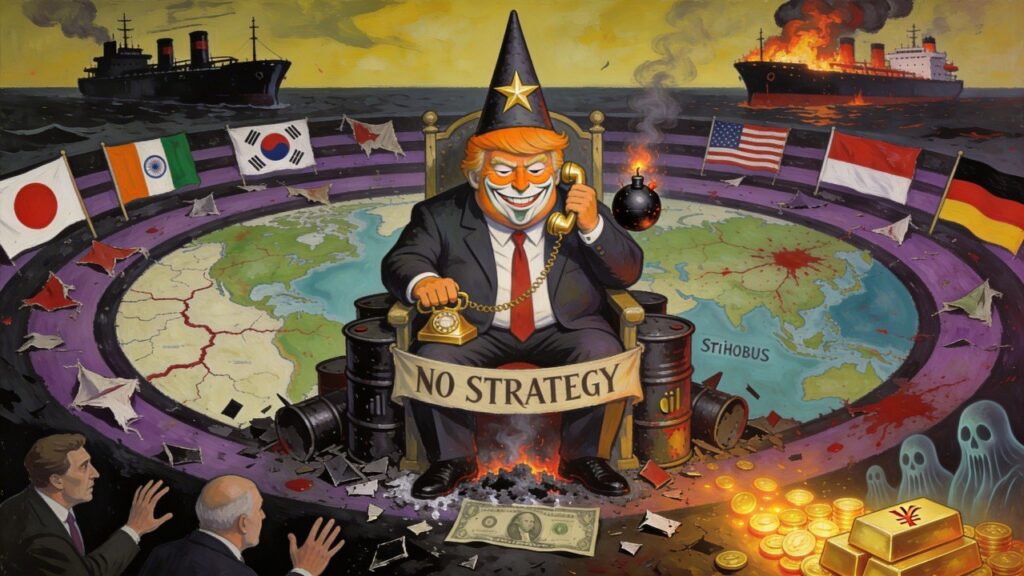
The Art of the Worst Possible Decision
By Scott Ortkiese | March 22, 2026 Throughline Synthesis Group | so@throughlinesynthesis.com | throughlinesynthesis.com
There is a peculiar arrogance embedded in the way Washington thinks about its allies and dependents. It is the arrogance of the loan shark who believes his borrowers have nowhere else to go. It is the arrogance of the landlord who raises the rent past breaking point and is genuinely surprised when the tenant leaves. It is, in the specific case of Donald Trump, the arrogance of a man who launched a war that destroyed the energy security of a dozen nations without apparently asking a single question about what those nations might do next.
The answer, it turns out, is: quite a lot.
Washington’s strategic calculus, to the extent that word applies to a decision that the Chairman of the Joint Chiefs said had no viable strategy, appears to have assumed that every country caught in the blast radius of the Iran war would absorb the pain, remain loyal, and wait for America to fix the problem it created. This assumption was wrong about Japan. It was wrong about India. It was wrong about China, South Korea, Indonesia, Germany, and every other nation whose energy security Washington casually incinerated on February 28, 2026, in service of Benjamin Netanyahu’s regional ambitions and Donald Trump’s donor obligations.
Let us go through them, one by one.
Japan: The Alliance That Just Got Repriced
Washington’s standard response to Japan’s energy crisis is that Japan “has no exit”, no Russian energy because of sanctions, no Iranian energy because of the war, no alternative because of Article 9 dependence and $1.23 trillion in Treasury exposure that functions as a hostage. This argument is wrong on every count, and it just became significantly more expensive to maintain.
Japan has multiple energy exits that require no US permission. Russia is Japan’s geographic neighbor and a willing seller. JXTG and INPEX already hold operational stakes in Sakhalin-1 and Sakhalin-2. Japan refused to fully exit those projects even under intense American pressure in 2022, it understood, correctly, that Russia was an irreplaceable proximate energy partner. The idea that Japan “cannot” buy Russian energy is a political constraint Washington imposed, not a physical or commercial reality. That constraint just cost Japan 70% of its oil supply. The bill for loyalty has arrived, and it is denominated in barrels.
On military dependence: Japan under Takaichi has been executing the most aggressive defense buildup since 1945. The Article 9 constitutional reinterpretation is largely complete. Japan is not the pacifist dependent of 1985, and it knows it. The alliance asymmetry that Washington has exploited for seven decades is narrowing precisely as Washington’s reliability as a security guarantor reaches its lowest point in the postwar era.
On the Treasury “hostage” argument: Japan does not need to dump $1.23 trillion in Treasuries in a single afternoon to change the terms of the relationship. It can reduce rollover. It can redirect new reserve accumulation into gold, euros, yuan, or commodity-backed assets. It can allow natural attrition to shrink its dollar exposure over 18 to 24 months, none of which triggers the mutual destruction scenario that Washington’s strategists cite as the reason Japan will stay quiet. Japan has been doing exactly this with its gold reserves already. Every major non-Western central bank is executing the same gradual rotation.
Iran’s IRGC commander told NHK explicitly: Japanese tankers could pass freely through the Strait if Japan stopped supporting America’s war. That offer is sitting on the table. The longer the crisis runs, the more attractive it becomes. Japan has options. Washington just made them considerably less politically costly.
India: Twenty-Five Days
India did not have the luxury of months to decide. It had 25 days of oil reserves when the Strait closed. Twenty-five days. That is not a strategic buffer. That is a countdown.
Washington’s response was a 30-day waiver allowing India to continue buying Russian oil, a temporary bureaucratic permission slip issued by the government that caused the emergency, for a country that should never have needed permission to buy energy from its own suppliers in the first place. The condescension embedded in that gesture is its own kind of answer to the question this article asks. Does Trump think nobody has options? He apparently thinks India needs a hall pass.
India has more options than Washington is comfortable acknowledging. It has been Russia’s largest oil customer since 2022. Indian refiners (Reliance Industries, Bharat Petroleum) routinely settle Russian crude purchases in UAE dirhams, bypassing the dollar entirely. India is a founding BRICS member, a participant in the de-dollarization infrastructure being built transaction by transaction, and a nation that watched the United States destroy its primary Gulf energy supply corridor without consultation. Shashi Tharoor, one of India’s most respected international voices, said plainly that a prolonged Iran war would “limit India’s energy import options”, but the options Washington is limiting are the ones India was using at Washington’s insistence.
The 30-day waiver is not generosity. It is an admission that Washington cannot actually enforce its own sanctions against Russian energy on a country of 1.4 billion people whose cooperation it needs for every strategic objective it has in Asia. India knows this. It is accelerating its Russian energy relationship, deepening its BRICS financial connectivity, and watching Washington demonstrate, for the second time in four years, that alliance with America means absorbing catastrophic costs while Washington pursues objectives that serve someone else’s interests.
Does Trump think India has no options? India is currently repricing its strategic alignment in real time.
China: The Designated Beneficiary
China is the only major economy for which the question “does it have options?” is almost insulting in its premise. China spent the last decade building options specifically because it understood that Washington would eventually do something like this.
China imports approximately 50% of its oil through the Strait of Hormuz. That is the short-term vulnerability. The long-term picture is different in every dimension. China has the world’s largest renewable energy buildout, over 90% of new global power generation capacity in 2024 came from renewables, and China accounted for the majority of it. It has Power of Siberia delivering Russian gas through a pipeline that requires no tanker, no Strait, and no US permission. It has Belt and Road energy infrastructure across Central Asia. It has the world’s largest EV fleet, eliminating oil demand at the margin faster than any other country. It has mBridge processing $55.5 billion in dollar-free settlements. It has CIPS connecting 119 countries.
China’s response to the Iran war has been studied, deliberate, and strategically coherent, which is to say, the precise opposite of Washington’s. Beijing called for an immediate ceasefire, positioned itself as a neutral peace broker, quietly accelerated its Russian energy intake, and watched the United States hand it the geopolitical argument it has been making for a decade: that American unipolarity is not a system of rules but a system of arbitrary violence in service of American interests.
War on the Rocks assessed that China has been “insulating” its energy security against exactly this scenario for years. China does not need to do anything dramatic. It simply needs to continue doing what it was already doing, and let Washington’s actions make the argument for yuan internationalization, BRICS financial infrastructure, and multipolar energy markets better than any Chinese diplomat ever could.
Does Trump think China has no options? China designed its last decade around having options. This war is the exam it was studying for.
South Korea: The Ally That Got Nothing
South Korea sources 60 to 70% of its crude through Hormuz. It has approximately seven months of strategic reserves. It is a treaty ally of the United States, host to 28,500 American troops, and one of the most important manufacturing economies in the world. It was given no advance warning of the Iran strikes. It received no energy security consultation. It was offered no emergency supply arrangement. It was told, in effect, to figure it out.
South Korea’s options are more constrained than Japan’s, but they are not zero. Korea has existing LNG contracts with Australia and the US that can be expanded. It has been cautiously building commercial relationships with Russia since the Sakhalin projects. Most importantly, it has watched what happened to Japan and India and drawn the obvious conclusion: an alliance that can impose a $120 oil price on you overnight without a phone call is an alliance whose terms need to be renegotiated.
Seoul is too diplomatically cautious to say this publicly. But Korean energy security planners are not stupid. They are running the same calculation every Asian capital is running right now, what is the actual value of this alliance, and what does it cost us to maintain it?
Indonesia: The Sulfur Trap
Indonesia’s exposure to the Iran war is one the Western press has almost entirely ignored, which makes it worth examining in detail. Indonesia imports 75% of its sulfur from the Gulf for nickel HPAL processing, the high-pressure acid leach technology used to produce battery-grade nickel for the global EV supply chain. Without Gulf sulfur, Indonesia’s nickel processing industry faces a feedstock crisis that has nothing to do with nickel supply and everything to do with the chemical inputs that Washington’s war just disrupted.
Indonesia is the world’s largest nickel producer. It has been executing a deliberate industrial policy to move up the value chain from raw ore to processed battery materials. That policy (years in the making, billions in investment) is now being choked by a sulfur supply disruption it did not cause and cannot control.
Indonesia’s response has been to announce plans to raise domestic coal output, accelerating a pivot toward energy self-sufficiency that explicitly reduces its exposure to Gulf supply chains and, by extension, to the dollar-denominated energy architecture those chains represent. Indonesia is also a member of ASEAN, which adopted a formal five-year plan at the May 2025 Kuala Lumpur summit to reduce dollar dependence and maximize local currency settlement across the bloc.
Does Trump think Indonesia has no options? Indonesia is building them with every ton of coal it pulls from its own ground.
Germany: Defenestrated Twice
Germany deserves its own epitaph. Michael Hudson’s description of Germany’s pre-war economic model is worth repeating because it captures the precise mechanism of its destruction: buy cheap Russian energy, manufacture excellent industrial goods, subcontract labor to Poland, sell expensive products to China. It was a model of elegant efficiency built on two energy relationships, one with Russia to the east, one with the Gulf to the south.
The United States destroyed the first one. The Nord Stream pipelines were sabotaged in September 2022. Washington encouraged and enabled the sanctions architecture that severed Germany from its cheapest energy supplier. German industry never fully recovered. Energy costs doubled. The chemical and steel industries that Germany built over a century began their slow-motion retreat.
Now the second one is gone. The Iran war has disrupted Germany’s access to Gulf LNG, the expensive replacement for the Russian gas Washington told Germany it no longer needed. Germany has now lost both of its primary energy supply relationships in four years, both times at Washington’s instigation, both times without adequate compensation or alternative arrangement.
Chancellor Merz has responded by announcing 500 billion euros in defense spending. He has not called Putin. The model of buying cheap Russian energy and selling expensive German goods to China, which Hudson identified as Germany’s competitive genius, is being replaced by a model of buying expensive American LNG and manufacturing weapons. This is not a German choice. It is the predictable outcome of being a US vassal in a period when Washington has confused its allies’ vulnerability with their loyalty.
Germany has options it is not yet willing to exercise. A phone call to Moscow. A resumption of energy negotiations. A BRICS observer status application. The political cost of those options is high, but that cost declines with every month of $120 oil and every billion of defense spending that substitutes for industrial investment. The moment German industrial giants tell Merz that the current trajectory is terminal, the options become exercises.
Russia: The Sanctioned Nation That Won
Russia deserves a different kind of treatment in this catalogue, because Russia is not a victim of this war. Russia is its principal economic beneficiary, and the “Russia is sanctioned” framing that Washington deploys to explain why no one will do business with Moscow deserves to be buried permanently.
Russia is sanctioned by the United States, the European Union, the United Kingdom, Canada, Australia, Japan, and South Korea. That is a significant coalition. It is also a coalition that collectively represents a shrinking share of global GDP, a minority of the world’s population, and precisely none of the world’s largest energy-importing nations in the Global South.
Russia is not sanctioned by China. Bilateral trade hit a record $244.8 billion in 2024, nearly all of it in yuan and rubles. Russia is not sanctioned by India, which is now Moscow’s largest oil customer. Russia is not sanctioned by Brazil, Turkey, Indonesia, Vietnam, Saudi Arabia, the UAE, Kazakhstan, or any other country that has made the elementary calculation that cheap Russian energy is worth more than Washington’s approval. The Kremlin confirmed this week that the Iran war has “fuelled significant demand for Russian energy”, demand that comes with premium pricing, given that Russia is now the marginal supplier to every Asian economy scrambling to replace Gulf crude.
The sanctions are a Western performance for a Western audience. The audience that matters, the $120 oil buyers in Asia, stopped watching years ago. Trump sanctioned Russia. Russia is selling more oil at higher prices than at any point since 2022. Does Trump think Russia has no options? Russia is exercising them on every trading desk in Mumbai, Beijing, and Jakarta.
The Through-Line
Every country in this catalogue (Japan, India, China, South Korea, Indonesia, Germany, Russia) has options. Some have more than others. Some are exercising them already. Some are doing the political calculus of when the cost of loyalty exceeds the cost of exit. But none of them are trapped. None of them are hostages. None of them are without alternatives.
The only actor in this entire story that behaved as if options did not exist was the United States. Washington launched a war with no viable strategy, against an adversary that was offering concessions, without consulting the allies most exposed to the consequences, and without any apparent consideration of what those allies might do when they discovered that American protection was not just unreliable but actively destructive to their interests.
The Chairman of the Joint Chiefs said there was no strategy. Mearsheimer said it was unwinnable. Davis said Iran merely needed to survive. Macgregor said the inventory would last two weeks. Greenwald documented the deception architecture. Crooke identified the Khamenei assassination as an intelligence failure of historic proportions. Sachs confirmed the Geneva deal was real.
They bombed it anyway.
The question this article asks, does Trump think nobody else has any options, has a simple answer. He didn’t think about it at all. Strategic empathy, the capacity to model what your adversaries and allies will do in response to your actions, is the foundational requirement of statecraft. It is the thing that separates a foreign policy from a tantrum. Trump’s Iran decision had none of it. The Chairman of his own military told him there was no strategy. He launched the war anyway, apparently confident that the American empire’s institutional inertia (the treaties, the bases, the dollar, the carrier groups) would absorb whatever came next.
What came next is this: a dozen nations simultaneously repricing their relationship with the United States, accelerating the financial and energy infrastructure built to replace dollar dependency, and discovering that the constraints Washington told them were permanent were, in fact, political. The constraints were never physical. They were imposed. And the moment Washington made those constraints too expensive to maintain, the nations bearing the cost began to look for the exits.
The exits were always there. They just needed a reason to use them.
Trump gave them one.
Scott Ortkiese is Principal of Throughline Synthesis Group. He writes at throughlinesynthesis.com and on LinkedIn and Substack.
Related reading
- Does He Really Think They Don't Have Options? How Trump’s Lack of Strategy Is Driving Nations Away
- The Irrelevance of King Trump and His Uniparty Jesters in Congress
- Entering Losing Wars We Can’t Fund: Congress and Trump Do What They’re Told, How High and Which Way, Sirs?
- The Trump Protection Racket: How a Declining US Empire Extorts Friends and Enemies Alike