Author’s Note
My previous articles in this series examined the military folly of the Iran war, the game-theoretic impossibility of its success, the three betrayals that manufactured an enemy, the architecture of silence that keeps think tanks from naming the architects, and the deterrence crisis now consuming Russia’s foreign-policy establishment. This piece covers entirely different territory.
It is about what happens at home and among allies when an empire can no longer produce but still needs to consume. It draws heavily on a March 6, 2026, conversation between Michael Hudson, professor of political economy, and Glenn Diesen, in which he laid out the structural economics driving the United States to cannibalize the very allies it claims to protect, and on Gilbert Doctorow’s March 5 conversation with Diesen, in which Doctorow described a psychological earthquake within Russia’s foreign-policy establishment and its implications for every country now recalculating its relationship with Washington.
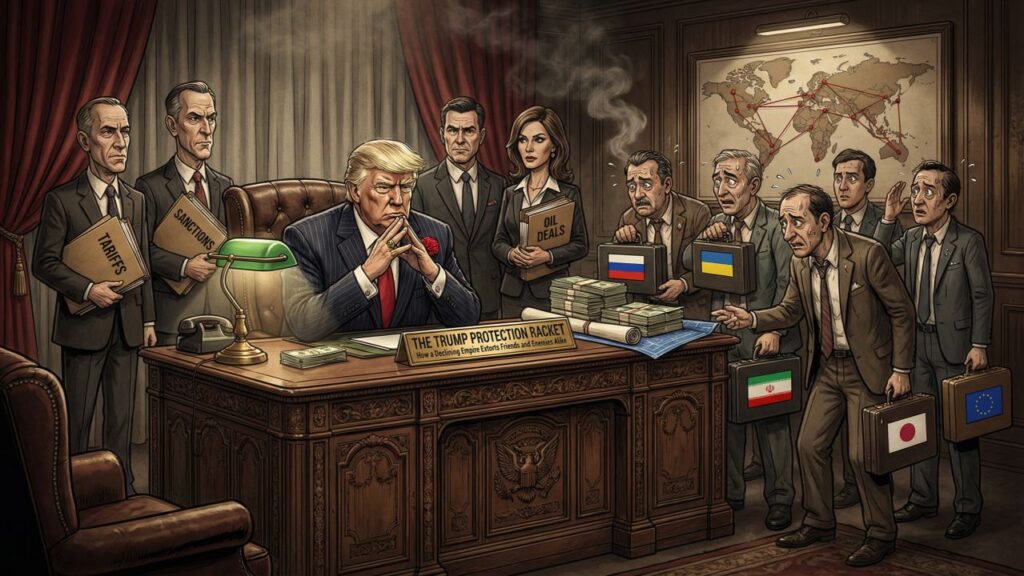
What follows is not a story about Iran, or Ukraine, or any single war. It is a story about a protection racket dressed in the vocabulary of alliance, and what happens when the racketeer’s victims start looking for the exit.
Most kindly,
Scott Ortkiese
The Shakedown
On a Tuesday in late 2025, US Commerce Secretary Howard Lutnick sat across from South Korean negotiators and delivered a message that had nothing to do with diplomacy and everything to do with extraction. “The Japanese signed a contract, 350 billion,” Lutnick said. “The Koreans either accept the deal or pay the tariffs, black and white. Pay the tariffs or accept the deal.”
The deal required South Korea to provide 350 billion dollars in investment capital to the United States, to be directed and approved by President Trump, with 90 percent of the profits flowing to America and 10 percent to Korea. Japan had already signed a 550 billion dollar commitment under similar terms, overseen by a new Commerce Department office called the United States Investment Accelerator, where an investment committee headed by Lutnick himself would decide which projects to fund. Tokyo would not have representatives on that committee, but could participate in a “consultation committee,” given 45 days to decide whether to fund a project. If Japan declined, the administration could reimpose tariffs.
Lutnick later summarized the combined figure in one sentence: “Japan and Korea; they offered us 750 billion in cash to build in America at the president’s direction.” Among the first designated projects were nuclear power plants, an Alaska LNG export facility that has struggled to find investors for over a decade, and synthetic industrial diamond manufacturing. Industry analysts have long viewed the Alaska LNG project as too expensive to be commercially viable. Japanese buyers have avoided binding contracts since it was first proposed.
This is not trade policy. This is not alliance management. This is, as Hudson told Diesen, a protection racket: “Either pay us money and accept our import duties and our demands for you to dismantle your industry and invest here, or we’ll raise tariffs and cause a crisis for you.” He added that the same demand is “made all over.”
He meant protection racket in the literal structural sense. The United States, having lost the capacity to generate wealth through production, has turned to extracting it from countries that still produce, using the threat of economic destruction as the enforcement mechanism. The countries most exposed to this extraction are not America’s adversaries. They are its allies.
Why the Empire Eats Its Friends
His core argument rests on a single structural fact that explains nearly everything happening in global economics and politics today.
The United States de‑industrialized. Manufacturing fell from roughly 21 to 25 percent of GDP in the 1950s to about 10 percent today, a sharper decline than in other advanced economies. Japan, Germany and others still keep manufacturing closer to 15 to 25 percent of GDP. The wealth created since the 2008 financial crisis has been overwhelmingly financial, not productive. In his phrase, “It’s financial wealth. It’s not the wealth of real production. It’s not the wealth of living standards. Living standards have not risen for more than half of Americans since 2008.”
Federal Reserve data makes the concentration visible: the top 1 percent of American households hold roughly a third of total wealth, while the bottom half holds a few percent at best. The top 10 percent control about two‑thirds of household wealth. He links this to the consumption structure: “The wealthiest 10 percent of Americans are responsible for 50 percent of all growth in consumption goods,” but the things they buy are not the goods that sustain a broad middle class.
This is not an ethical lament. It is a diagnosis. A financialized economy that has hollowed out its productive base cannot sustain itself on its own output. It must import what it no longer makes. To pay for those imports without collapsing its currency, it must pull in foreign capital, foreign investment and foreign subsidies at a historic scale. Trump did not invent this model. He stripped away the diplomatic language that previously disguised it. His summary is simple: “The United States has lost its own ability to be self‑sufficient, and its response to Europe is to destroy Europe’s ability to be economically, commercially and financially self‑sufficient.”
The 19th‑Century Playbook
He drew a parallel that any historian of empire will instantly recognize. “Trump says, we’re going to make deals on a country‑by‑country basis. We’re going to divide and conquer. It worked for Britain for a couple of centuries. It’ll work for us,” he observed. The logic is not complicated: “As long as we can make them willing to hang separately instead of hanging together, then we’ve won the diplomatic fight for control.”
The British Empire did not dominate the planet by fielding the largest land armies. It dominated by controlling the chokepoints of global trade, making itself the indispensable intermediary in every commercial transaction, and using its navy to prevent any regional bloc from forming that might challenge its monopoly on the terms of exchange. When a country resisted, Britain did not always invade. It imposed costs, disrupted trade, manipulated currencies, and made an example of the defiant party until the rest fell in line.
The post‑1945 American system operated on similar principles, with one crucial difference. In its early decades, the United States actually produced the goods that underpinned its commercial dominance. American factories supplied the world. American agriculture fed it. American technology advanced it. Tribute flowed because America was the engine, and the engine worked.
When the engine stops working but the tribute demands continue, you get what we have now: a system in which the United States demands 350 billion dollars from South Korea and 550 billion from Japan, not because it offers equivalent value, but because it has the power to hurt countries that refuse. The bilateral deal structure is the weapon. Multilateral agreements gave smaller nations collective bargaining power. Bilateral deals isolate them, putting each one alone under the full weight of American economic coercion.
The blunt version: “The United States is no longer industrialized. It’s de‑industrialized. Its growth of wealth since 2008 has been in the stock, bond and real estate markets.” A country that cannot produce must extract. Extraction requires leverage. That is where the alliance system, NATO, the bilateral security guarantees and the forward‑deployed bases cease to be a security architecture and become a collection mechanism.
The Trap Before 2022
The most consequential economic decision in recent European history was not Brexit, not the euro crisis and not the pandemic response. It was the decision, ratified but barely debated, to sever Europe’s energy relationship with Russia.
He dates the real choice to the period just before the February 2022 escalation in Ukraine. Europe could either maintain “a balanced and basically independent economy” as long as its industrial base remained symbiotic with Russia as a supplier of oil, gas, fertilizer and other basic materials, or it could hand that leverage to Washington. That symbiosis was the product of decades of deliberate integration, from Ostpolitik in the 1970s through Nord Stream and the dense commercial web that made German industry globally competitive precisely because it had access to cheap, reliable Russian energy.
The destruction of that relationship, culminating in what he describes as Europe’s willingness to “blow up the North Sea pipeline or let the United States blow it up and depend completely on the US for oil,” was not some inevitable reaction to Russian behavior. It was the precondition for American extraction. A Europe with cheap Russian energy can say no. A Europe paying five to six times more for American LNG must say yes, because it has made the alternative unaffordable.
Ursula von der Leyen’s reported response to Trump’s tariff threats was, in his paraphrase, “At least we can depend on Trump never to change his mind or change the deal. At least we have certainty.” His verdict is concise: “That’s crazy. There was no certainty at all.”
Energy dependency cascades. Europe lost not just fuel but the entire strategic option of economic independence. Once Europe severed its Russian energy supply, it “loses the option that the BRICS countries have taken, of saying, ‘We’re willing to lose the US market because that’s a shrinking market over time. There will be a cost in the short term, but that cost is less than having to pay 350 billion as a shakedown fee to the United States just to keep our short‑term market open.’”
The BRICS states are doing what Europe chose not to do: insulating their economies from American leverage so that threats of tariffs and sanctions lose their bite. “If you insulate your economy from the United States,” he says, “there’s nothing it can do to you to impose sanctions or to raise tariffs or to weaponize its import and export trade.” Europe deliberately gave up that insulation.
The Bastardized Keynesianism
Europe’s answer to this self‑inflicted dependency has been what he calls “a bastardized Keynesianism”: the idea that military spending can substitute for the civilian industrial capacity sacrificed on the altar of the transatlantic relationship.
The numbers are staggering. EU defense spending has shot up since 2022, with member states reaching roughly 343 billion euros in 2024, about 1.9 percent of GDP, and a formal trajectory toward far higher levels in the coming decade. Germany set up a 100 billion euro special fund. Brussels launched the SAFE program, a 150 billion euro instrument for common procurement and defense industrial production.
The logic behind the spending is worse than the totals. Europe is not arming itself to become strategically independent. It is arming itself on American terms, with the explicit understanding that these weapons go to a proxy war against Russia, are purchased heavily from US suppliers, and are integrated into command, intelligence and logistics systems controlled from Washington.
His summary is pitiless: “Let’s spend our money on military industry, and that will maybe create the employment that we’ve lost in our civilian industry as a result of having to depend on American gas and oil instead of Russian gas and oil.” Military Keynesianism does not generate broad‑based industrial capacity, export competitiveness or rising living standards. It generates weapons that sit in depots or get shipped to Ukraine, profits that flow to defense firms, and populations watching social spending vanish while being told sacrifice equals security.
The security it buys is the opposite. European leaders promising long‑range missiles to Ukraine to strike Russian cities are inviting retaliation on their own soil. “If a bomb comes from a German manufactory,” he notes, Putin and Lavrov saying in substance, “then we’re going to bomb the source.”
Europe is spending money it does not have on weapons it will not truly control, to fight a war it cannot win, against a country that supplied the energy it needs, at the behest of a patron that is simultaneously bleeding it through tariffs, shakedown deals and the destruction of its commercial self‑sufficiency. That is not Keynesianism. It is imperial clientage, and clients do not emerge stronger.
Democracy Dies in Dependency
There is a dimension to the protection racket more dangerous than the economic and military ones. Democratic systems are supposed to be self‑correcting. When governments pursue policies that damage their citizens, voters are supposed to throw them out. What happens when every serious challenger to the ruinous status quo is removed before the vote matters?
The record across Europe reads like a checklist. In Romania, the Constitutional Court annulled the first round of presidential elections in December 2024 after an independent candidate, Calin Georgescu, led the field. The justification was alleged Russian interference on TikTok. Voting in the second round had already begun among the diaspora when the annulment was announced. Former European Commissioner Thierry Breton then said publicly that if Germany’s AfD ever won elections, they too “could be annulled by the European Union, as was done in Romania.”
In France, Marine Le Pen has been barred from the 2027 presidential race. In Germany, the AfD, now polling at the top of the field, faces ongoing talk of bans or legal throttling. In the Czech Republic, Andrej Babis, leading in polls for prime minister, may be blocked from office in part because of an “ambiguous relationship with NATO.” None of these moves target fringe figures with no support. They target precisely those forces that would question sanctions, reopen energy ties with Russia, or push back against US tariff and investment demands.
He draws the line directly: when political elites subordinate their nations’ economic interests to a foreign patron, they must prevent anyone from filling the vacuum left by their incompetence. “If you have a political elite that doesn’t pursue national interest and prevents anyone from filling the vacuum left behind by their incompetence,” he says, “you’re going to kill democracy at some point.”
Diesen adds the Ukrainian precedent. Zelensky won in 2019 on a peace platform with 73 percent of the vote, then watched NATO‑funded organizations draw red lines that prevented him from pursuing the peace his voters demanded. The pattern is consistent: when populations vote for sovereignty, for engagement with Russia, or for resistance to American extraction, the institutional machinery of the transatlantic system moves to nullify the result.
This is not a fever dream. It is documented behavior. It reveals the deepest structural weakness of the protection racket: it cannot coexist with democracy, because democracy, given a real choice, will vote to leave the racket.
The Stockholm Syndrome of the Defeated
He offers a deliberately brutal shorthand for why some nations submit while others resist: “Only the countries that America defeated in World War II have turned into surrender monkeys. Japan has become an abject victim of the Stockholm syndrome, and of course, Germany.”
The phrase is ugly. The pattern is not. Japan signed the 550 billion dollar tribute. South Korea, after initial resistance, agreed to 350 billion in the face of escalating tariff threats. Germany dismantled its own energy security on American instructions. None of these decisions reflected popular enthusiasm. They were taken by political classes selected and maintained by the postwar American system precisely because they could be trusted to prioritize the transatlantic relationship over national sovereignty.
Contrast that with states the US did not defeat and occupy. India, confronted with a 50 percent tariff for buying Russian oil, did not fold. Prime Minister Modi flew to China for the first time in seven years, publicly signaling that India has alternatives and is willing to use them. Commentators across the Atlantic establishment called it “a stunning reversal” and “perhaps the biggest strategic mistake” of the Trump presidency, because it blew up decades of careful US work to pull India into its orbit. A Yale lecturer summarized the mood in Delhi in plainer language: Modi went to China “to show the middle finger to Trump.”
South Korea, too, has begun to look for exits. Its foreign minister has gone to Beijing to explore what happens if Seoul walks away from the American market altogether. The question Korea posed is the question every American ally will eventually face: if the price of access is tribute at a scale you cannot afford, what can you build with others instead?
That question, once asked in Seoul, Tokyo or Berlin, does not go away. The fact that it is being asked in a country hosting nearly thirty thousand US troops, and serving as a cornerstone of American Pacific strategy for seven decades, shows how far the racket has overreached.
The Binary
Every government on earth now faces the binary he describes. Either accept Washington’s demands, sever yourself from other major economic centers and sink deeper into dependence on the United States, or seek full autonomy by diversifying toward BRICS, the SCO and parallel institutions.
Diesen notes that India’s case has already destroyed the fantasy of a stable middle ground. Western planners assumed they could “make Europeans out of them,” meaning states that cut themselves off from all other centers of power and subordinate themselves to US leadership. Modi’s trip to China showed the assumption was delusional. The tariff was designed to force submission. It forced diversification instead.
The BRICS governments, in his telling, are not trying to overthrow the dollar or wage economic war on America. “There wasn’t a word about the United States as an opponent,” he notes of their meetings. “They look at themselves as being under attack by the United States.” They are not building alternatives because they want a fight. They are building them because Washington has made self‑sufficiency the only rational response.
The irony is that Trump’s bilateral deal strategy, designed to maximize American leverage by isolating each target, is generating exactly the coalitions it was meant to prevent. Japan signed its 550 billion agreement only to watch the US Supreme Court strike down the tariff authority that underpinned it, leaving Tokyo with obligations made under duress and no guarantee they would not be expanded later. Countries that resisted US demands, such as Brazil and India, ended up with lower effective tariff exposure after the ruling than countries that had tried to negotiate. The message to every ally could not be clearer: obedience is punished. Resistance is rewarded.
The WWII Myth as Operating System
His most unsettling contribution is his dissection of the psychological software that lets European elites march their societies into dependency arrangements that serve no European interest. He traces it to a falsified narrative of the Second World War.
“A whole generation of Europeans has grown up on a false idea of who fought World War II,” he says. Diesen fills in the numbers. The main fighters were the Soviet Union, which lost roughly 22 million people, and China, which lost around 18 million. In French polls taken just after the war, 85 to 90 percent of respondents named the Soviets as the primary liberator of Europe. In the most recent surveys, only around 20 percent do. “Propaganda works,” Diesen comments. “You just tell the same stories over and over again, and after a while, people buy it.”
The myth serves a precise function. If Europeans believe they were liberated by America and owe their freedom to the transatlantic relationship, then American demands for tribute, basing rights, and strategic obedience feel like the natural price of gratitude. If they understood that it was the Soviet Union that broke the Wehrmacht at a cost of tens of millions of lives, while the United States delayed its continental engagement as long as possible and then monetized the outcome, the emotional basis of the alliance would crack.
He goes further. The United States did not just benefit from a convenient misremembering. It actively rebuilt fascist infrastructure for its own purposes. “The United States immediately hired the main Nazi bureaucracy and put them to work fighting the left wing. You had Operation Gladio in Italy. You have the terrorism organized by the CIA. The United States saved fascism from being defeated by Europe.” Operation Gladio is not a rumor. It was exposed by European parliaments in the 1990s.
When the EU’s own foreign policy chief, Kaja Kallas, mocks the idea that Russia and China bore the main burden of defeating fascism, she is not just being historically illiterate. She is doing ideological maintenance for a system that depends on Europeans believing that, without America, they would have perished, and will perish again.
Whether you buy all of his thesis or not, the mechanism is not in dispute. A continent convinced it owes its existence to Washington will tolerate levels of American extraction that would otherwise trigger revolt. The myth functions as the operating system for the protection racket.
Navies, Missiles and the Obsolescence of Old Leverage
He adds one more element that connects the economic racket to the military realities explored earlier in this series. The physical tools the United States used to enforce its will are losing their power.
“Your naval fleets are just sitting ducks,” he says. “Navies are obsolete as the tool for control that they were for so many centuries.” In his telling, the entire US fleet could be wiped out in a single day by modern missiles.
For centuries, the protection racket operated through sea power. Britain ruled the world because it ruled the seas. America inherited that role. The carrier battle group was not just a weapons platform. It was a floating ultimatum. Any coastal government that defied Washington had to imagine those ships appearing offshore.
If navies are now vulnerable to hypersonic missiles and precision shore‑based systems that cost a fraction of a carrier group, the physical basis of that leverage erodes. The United States can still threaten tariffs, sanctions and financial exile. It can no longer credibly promise that twelve carrier groups will steam to your waters and remain untouchable while they pound your coast.
China has responded to this reality by building its own alternative infrastructure of influence: the Belt and Road Initiative and other overland routes that connect Asian economies internally instead of through sea lanes policed by the US Navy. “China is developing internal connections,” he says. “The vehicles of foreign trade are now becoming more inland and domestic. What that does is create domestic regional spheres of influence and self‑dependency, to become independent.”
The protection racket depended on two pillars: the ability to threaten economic destruction and the ability to threaten military destruction. The military pillar is crumbling. The economic pillar depends on a level of dependency that the targets are now spending real money and political capital to escape. What remains is inertia, fear, and the Stockholm syndrome of nations whose political classes were formed in Washington’s image.
The Doctorow Corollary: What the Victims See
If he provides the macroeconomics of the protection racket, Gilbert Doctorow describes its effect on the psychology of those on the receiving end when one of them is visibly destroyed.
Russia’s foreign‑policy establishment watched the decapitation of Iran’s supreme leader, the destruction of Iranian air defenses, and the rapid establishment of American air control over a country that was supposed to be shielded by Chinese military technology and a comprehensive strategic partnership with Moscow. The lesson was not about Iran. It was about themselves.
“They saw in what Trump has done to Iran what Trump can just as easily do to Russia,” Doctorow says. “And that sank in. And Russians got very frightened.”
From the Russian point of view, Europe submitted to the racket and lost its sovereignty. Iran resisted the racket and lost its supreme leader. The question consuming Moscow is whether patience, negotiation and restraint, the policy Putin has pursued for years, is simply a slower path to the same end.
Doctorow highlights a parallel that stings. Iran’s own “Zapadniki,” its Westernizers, personified by President Pezeshkian, refused to conclude a mutual defense pact with Russia that might have deterred the attack. Pezeshkian, in Doctorow’s account, was “much more interested in doing a deal with the United States and having the sanctions lifted” than in deepening ties with Moscow. Russian hawks see in Iran’s liberals a mirror of their own: Nabiullina at the Central Bank, Siluanov at Finance, institutional “liberals” whose fiscal orthodoxy and Western orientation, in their view, have throttled Russia’s ability to prepare for the confrontation it now faces.
The protection racket does not only operate between nations. It operates inside them. In every target, there is a faction that believes accommodation with the racketeer is the route to prosperity, and a faction that believes accommodation is the route to annihilation. In Iran, the accommodation faction lost the argument when the bombs fell. In Europe and Russia, the argument is still underway, but events are narrowing the space for illusion.
What Comes After the Racket
His analysis does not end with a diagnosis. It ends with a prediction that should matter to anyone who intends to live in the world the US is remaking in real time.
The United States has weaponized every instrument of international commerce: trade, finance, the dollar system, access to technology, agricultural exports, and now the physical investment capital of its own allies. Trump has not broken the system. He has revealed what it always was. As Diesen says, the European mistake is thinking they can “wait out Trump,” as if this is about one personality. It is not. A state that has lost its technological edge, is drowning in debt and has locked itself into grotesque inequality cannot go back to 1945 by swapping presidents.
“There’s no way back,” he says. “The way things were today is not how they were in 1945.” The productive base that once justified American centrality has been replaced by a financial superstructure that enriches a shrinking elite while infrastructure, education, industrial capacity and social cohesion crumble underneath.
The protection racket is the last stage of this process: the point at which an empire that can no longer generate wealth internally turns outward to strip it from others. Extraction has a natural limit. The vassals eventually run out of wealth, find patrons who offer better terms, or simply refuse. Japan may have signed the $550 billion agreement, but its voters are showing signs of dethroning the Liberal Democratic Party, which has governed as an American client since the occupation. South Korea’s foreign minister is in Beijing asking about alternatives. India’s prime minister flew to China days after Trump’s tariff ultimatum. Europe, the most docile of all the clients, is watching its democratic institutions be hollowed out, its living standards fall, and its strategic independence disappear, while being told the answer is more weapons and less of everything that makes life bearable.
The question is not whether the protection racket ends. The economics guarantee that it will. The question is what replaces it: a negotiated transition to a multipolar order in which great powers share responsibility and respect red lines, or a violent collapse in which a declining empire, unable to accept limits, drags its allies and its enemies into a fire from which no one emerges stronger.
He offers no comfort. Neither does history. The British Empire did not negotiate its decline. It was stripped of its possessions in two world wars, bankrupted by the cost of maintaining an empire its economy could no longer support, and replaced by a successor that promised a different model. That successor is now repeating every error, but without the industrial base, the social cohesion or the strategic patience that made the original American century possible.
The protection racket is the business model of a hollowed‑out empire. The assault on Iran is not a departure from that model. It is its purest expression: the same enforcement logic that now governs the empire’s treatment of its own allies, turned loose, in full view, on a state that refused to kneel. And the bill, as always, will be paid by everyone except those who sent it.
Related reading
- Altman's Desperation & The Shakedown Republic: How Trump and the AI Oligarchy Turned a Bubble Into a Protection Racket
- Does He Really Think They Don't Have Options? How Trump’s Lack of Strategy Is Driving Nations Away
- Does He Really Think Nobody Has Options? Trump’s Imperial Arrogance and the Countries He Screwed
- The Irrelevance of King Trump and His Uniparty Jesters in Congress