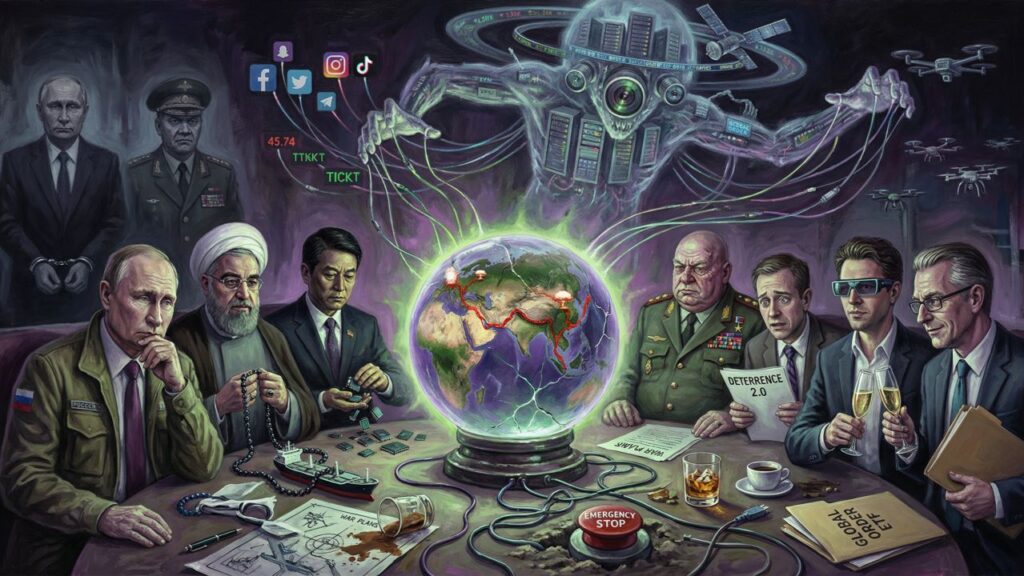
How a Diminishing West Got Scared, Played Its Last Empire Card, and Put World War III Back on the Table
“They’re shocked out of their skins.” Gilbert Doctorow on Russia’s foreign-policy establishment, March 5, 2026
This is the fifth installment in a series on the US-Israeli war against Iran. The game-theoretic framework underlying this analysis was developed in “The Payoff Matrix of a Doomed War” (March 3, 2026). Readers unfamiliar with that framework are encouraged to read it first.
Author’s Note:
Humanity did not have to stand here. We stand at the edge of a third world war, not because peace was impossible, but because peace was at hand, and those who inherited fading empires, and did not themselves build anything, could not bear to accept their limits. Instead of building a balanced order with Russia, China, and Iran, the West chose to cling to a fantasy of permanent dominance; one more regime change, one more NATO line pushed east, one more “surgical” strike, one more economic siege. Each step was sold as technocratic management; each step played one more empire card and drove nuclear powers closer to the wall.
Russia was not always the caricature we paint today. There were real offers on the table: partnership against terrorism, a common European home, arms control, and a shared architecture of security. That path was rejected. Moscow’s proposals were mocked, its red lines crossed, its concessions pocketed and forgotten. Today, Russia, a nuclear power, watches ally after ally destroyed or abandoned and is told that any attempt to defend its interests is “aggression,” while every Western transgression is “rules-based order.”
China, too, was offered integration on paper but treated as a permanent subordinate in practice. Welcomed into the global economy, then sanctioned when it refused to bow. Encouraged to trade, then encircled militarily. In public, Western leaders spoke of partnership; in strategy papers, they wrote of “containing” a civilization of 1.4 billion people. Now Beijing watches the same script that destroyed others inch closer to its own shores.
Iran has been the laboratory for this cruelty. A country that complied with the nuclear deal saw that deal torn up, then suffered two surprise air campaigns in a single year. It was promised respect if it followed the rules; it discovered that the rules were rewritten the moment it did so. When its cities burned, its people died alone. The “allies” who signed treaties with Tehran did nothing when those treaties mattered most.
In all three cases, there were moments when peace was within reach: Minsk, JCPOA, Istanbul, Anchorage. None collapsed by accident. Each was sabotaged by those who could not accept a world where they were merely powerful, not omnipotent. The fear was never of Russian tanks, Iranian missiles, or Chinese factories. The fear was of World Empire Lost, of having to share power, to negotiate honestly, to live in a world of equals instead of clients.
So here we are: three nuclear-armed states pushed into a corner, told their deterrent is worthless, told restraint is weakness, told every compromise will only invite the next demand. On the other side, Western elites are drunk on their own myths, unable to recognize the difference between managing a colony and provoking a civilization.
This article is not written to excuse anyone’s crimes. It is written because if we do not understand how deterrence has been systematically eroded, we will not be surprised by what comes next, we will only be surprised that we were surprised.
We could have had a century of cautious, imperfect peace. We chose instead to chase the ghost of a vanished empire. Now the question is brutally simple: will we keep doubling down on the lies that brought us here, or will we finally look into the cracked crystal ball and admit what we’ve done before the glass shatters?
If there is still time to pull back from the brink, it begins with telling this truth.
Most kindly,
Scott Ortkiese | so@throughlinesynthesis.com | www.throughlinesynthesis.com
Executive Summary
The bombs that fell on Tehran sent a shockwave that did not stop at the Iranian border. In Moscow, serious analysts watched a fellow signatory to a “comprehensive strategic partnership” get dismantled in 72 hours while Russia did nothing. The lesson they drew was not about Iran. It was about themselves.
This article documents a crisis that Western media has almost entirely ignored: the internal war now consuming Russia’s foreign-policy establishment over whether Vladimir Putin’s long-standing policy of restraint, patience, and negotiation has fatally undermined Russia’s deterrent credibility. The evidence comes primarily from Gilbert Doctorow, a veteran Russia analyst based in Brussels, in a March 5 conversation with Glenn Diesen, supplemented by open-source reporting on statements by Alexander Dugin, Vladimir Solovyov, Sergei Lavrov, and Dmitry Medvedev.
The implications are severe. If Moscow concludes that its deterrent has been hollowed out by serial failures to defend its partners, the pressure to restore it through dramatic, costly action, whether in Ukraine, against NATO surveillance assets, or at the nuclear threshold, becomes not a matter of ideology but of strategic survival. This is the deterrence contagion: the cascading collapse of credibility from one theater to the next. And it may prove more consequential than the Iran war itself.
Part I: Three Rounds of Failure
Deterrence credibility is not a fixed attribute. It is a dynamic reputation, continuously updated by allies and adversaries based on observed behavior. Each failure to act when action was promised or expected makes the next threat less believable. Not incrementally, but exponentially. The adversary revises its estimate downward, and that revised estimate becomes the operative reality regardless of actual capability.
Consider the sequence Russia’s strategic class has now witnessed.
Round 1: Syria, December 2024. Russia’s ally Bashar al-Assad fell to rebel forces led by Hayat Tahrir al-Sham in a lightning offensive that swept from Aleppo to Damascus in under two weeks. Moscow did not intervene to save him. The Chatham House assessment was blunt: “The collapse is a serious blow to Russia’s reputation as a reliable ally capable of guaranteeing the survival of its partners.” Since its military intervention in 2015, Moscow’s propaganda machine had been positioning Russia as a guarantor of stability and protector of allied regimes from external pressure and internal threats, drawing parallels between Assad and the fates of American allies to set the Kremlin apart from “unreliable Americans.” The loss of Assad demolished that narrative. Brookings concluded that with Moscow’s military resources overstretched in its war with Ukraine, “it was unable to give Assad the support he needed as the rebels advanced,” and noted that “Assad’s fall also raises questions about Russia’s reliability as an ally and partner”. CEPA’s analysis was even more direct: Russia’s response had been “limited to periodic airstrikes rather than the decisive intervention that saved Assad’s regime eight years ago,” demonstrating “the accelerating erosion of Russia’s position as the dominant security actor across its former spheres of influence.” Its security guarantees were “increasingly seen as undeliverable, the sign of a country strong on rhetoric but weak in action”.
Round 2: Venezuela, January 2026. The United States launched Operation Absolute Resolve, capturing President Nicolás Maduro and his wife Cilia Flores in a nighttime raid on Fort Tiuna in Caracas. The operation involved 150 aircraft deployed across the hemisphere and lasted approximately two hours and twenty minutes. Trump announced that the United States would “govern the country” until a transition could be arranged. Russia protested. China protested. Neither acted. The lesson absorbed by every capital on earth: American unilateral action against a Russian or Chinese partner carries no consequences. As Doctorow observed, the Maduro escapade “fed into latent hubris” among Hegseth, the Pentagon brass, and Rubio. “They were certain that they can do anything now, that they can change reality, and that has been a very dangerous change in American foreign policy”.
Round 3: Iran, February 28, 2026. The Russia-Iran Comprehensive Strategic Partnership Treaty, signed by Putin and Pezeshkian in Moscow on January 17, 2025, and entering into force on October 2, 2025, was less than five months old when the bombs fell. The treaty consisted of 47 articles covering defense, counter-terrorism, energy, finance, and culture, ratified by both the Russian State Duma and the Iranian Parliament. But it notably stopped short of mutual defense obligations, unlike the security agreement Russia signed with North Korea. When the United States and Israel launched coordinated strikes against Iran, designated Operation Epic Fury and Operation Roaring Lion, killing Supreme Leader Ayatollah Khamenei, devastating the Kharg Island export terminal, and targeting military infrastructure across the country, Russia condemned the strikes, offered to mediate, and did nothing else. The Kremlin confirmed that Iran had “not approached Moscow with a request for arms supplies” and that there had been “no alterations” in Russia’s stance. The Lowy Institute assessed that despite the “impressive-sounding” partnership agreement, this had “never been a trusting relationship, but rather an alliance of convenience, characterised by pragmatic, limited and transactional cooperation”.
Each round reinforces the same signal. And in Moscow, the signal has finally become deafening.
Part II: The Electric Shock
Doctorow described the impact on Moscow’s foreign-policy establishment in the starkest terms he has used in decades of commentary. To illustrate the psychological mechanism at work, he reached for an analogy from his years at ITT in the 1980s. He recalled visiting factories in Sweden, chatting with workers who were happy with life, happy with their country. “And then Olaf Palme was assassinated, and you know what happened? These fellows who thought everything was fine with their country were saying, ‘They finally got the son of a bitch.’ That is what conformism is all about”.
“And that is the switch that’s just changed in Russia. Like you switch a light on and off. People who have their doubts about the wisdom of the go-slow, negotiate-a-settlement, keep-the-Americans-separated-from-the-Europeans… that is all the features of Mr. Putin’s policy… have now had an electric shock, because they saw where it’s all headed. They saw in what Trump has done to Iran what Trump can just as easily do to Russia”.
The shock was not about losing a partner, or oil prices, or the geopolitical chessboard. Those are, in Doctorow’s words, “petty things.” The real issue is “a change in psychology in elites in Moscow.” The shock was existential. Russian analysts watched Trump’s forces execute a decapitation strike against the Ayatollah, destroy Iran’s air defenses, demolish critical infrastructure, and establish complete air control within days. Within 48 hours, every premise underlying the operation had produced exactly the cascading catastrophe that analysts had predicted, and yet the scale of American force projection was undeniable. And Russia’s strategic class asked themselves the only question that mattered: What stops them from doing this to us?
Doctorow connected it directly to Putin’s personal calculus. An attempted drone strike on Putin’s Valdai residence was intercepted in late December 2025, when Russia’s Defense Ministry claimed 91 long-range Ukrainian drones were shot down en route to the heavily guarded compound on the shores of Lake Valdai. Lavrov called it a “terrorist attack” and said Russia would “revise” its negotiating position, though Zelensky dismissed the claims as a “complete fabrication” designed to sabotage peace talks. At the time, the incident was treated half-seriously. “Everybody was happy and they made light of it,” Doctorow said.
Nobody is making light of it now. “Mr. Putin is not always in Valdai surrounded by the world’s best air defense, nor is he always in the Kremlin. And so if the Americans want to do a decapitation strike on Russia, with Putin and all of his buddies, they can do it. And that sank in. And Russians got very frightened”.
They wondered, Doctorow continued, “What the hell is Mr. Putin doing?” when they saw how in three days Trump had “virtually destroyed the senior leadership, military and civilian, the air defenses, a large part of the critical infrastructure, ports, facilities. And they ask: What the hell are we doing? Why isn’t Putin doing that to Kiev and to Lviv and to Dnipro and to all the other cities where there are command and control and policymaking centers, which Putin from the start of the special operation said would be targeted if red lines were crossed? Those red lines were crossed and they were criss-crossed”.
Doctorow then made explicit what others leave implicit: “You and I have discussed the three components to deterrence, of which probably the least important is military hardware, and the most important is will and readiness to explain to the adversary your determination to use it. That is what’s been missing”. A man negotiating under the shadow of assassination is not the same man who sat across from Trump in Anchorage. The decapitation of Iran’s supreme leader has injected an incalculable variable into every calculation Putin now enters.
Part III: The Palace War
What makes this moment unprecedented is that the shock has broken through the surface of Russian elite consensus. Doctorow identifies three indicators of an internal war within the Kremlin, each without recent precedent.
The Solovyov episode. On “Evening with Vladimir Solovyov,” Russia’s most-watched political talk show, a panel discussion erupted two nights before Doctorow’s interview in open criticism of everything Putin’s restraint policies had produced. Russia’s vulnerability to a decapitation strike. Its failure to shoot down American surveillance planes flying within a kilometer of its borders. Its tolerance of Western provocations that would have been unthinkable during the Cold War. “Everything was said except the name Putin,” Doctorow observed, “but anyone understood, any mature person understood, whom they were talking about”.
The panelists demanded answers. “My God, how are we conducting negotiations with Witkov at the same time that American spy planes are on the coast of the Black Sea, on the Barents Sea coast, and all along our borders, and we know what these are for? They’re for bearing a preemptive strike, just like the US has done on Iran. Why don’t we shoot them down?” They invoked the Gary Powers precedent, arguing that if the planes were one kilometer from the border, “Who’s going to be able to say that they didn’t cross into Russian territory? Nobody. And what’s the United States going to do about it? Nothing. Absolutely nothing”.
The next day, Solovyov reversed course with a 20-minute hagiographic soliloquy. “Our president is tireless, working for the nation. He’s up until 3:00 in the morning doing the state’s work. He is like a monk. He is like a saint.” He praised the “wonderful journalist” Zarubin and his personality-cult program “Moscow. Kremlin. Putin,” which Doctorow calls “the most despicable exercise in cult of personality”. The whiplash was itself the message: someone was told to shut up. “The day before, criticism. Yesterday, they were licking Putin’s toes. So what’s going on? A war was going on in and around the Kremlin”.
On a separate broadcast, Solovyov went even further, declaring in a heated exchange with Andrey Sidorov, Dean of the School of World Politics at Moscow State University, that nuclear weapons are “the only trump card we have” against the West. When Sidorov pushed back, Solovyov doubled down: “As I’ve often said in this studio, people don’t believe me, but objectively speaking this scenario is what everything is coming to. And the use of nuclear weapons, especially considering the information that came from the Foreign Intelligence Service… what other options do we have?”
The Dugin essay. Alexander Dugin published an essay within days of the Iran strikes, posting on X that “World War III has begun” and proclaiming “there is no doubt we are entering the final phase of the historic cycle. The finalisation of history”. Doctorow contextualized this as part of a broader “devastating critique of everything that Putin is doing.” Dugin’s message was blunt: our allies are being systematically destroyed one by one. It is clear who is next. It is clear what negotiations with such an enemy mean.
Doctorow noted that Dugin, whose daughter Darya was killed in August 2022 in what is widely believed to have been an attempt on his own life, is effectively untouchable in Russian politics. “Maybe Mr. Putin can shut up Solovyov, but he’s sure as hell cannot shut up Dugin.” The fact that both voices said essentially the same thing, and that neither named Putin directly, while everyone understood the target, revealed the scope of the fracture.
Dmitry Medvedev, deputy chairman of Russia’s Security Council and former president, added his own weight to the hawkish chorus, warning that “If Trump continues his insane course of criminally changing political regimes, it will undoubtedly begin. And any event could be the trigger.” He called the Iran strikes a “grave mistake” and predicted Tehran would pursue nuclear weapons “with triple” determination.
The Gorbachev verdict. Perhaps most ominously, Russian state television in the same week openly branded Mikhail Gorbachev a traitor for withdrawing troops from Germany and Central Europe without getting any concessions in return, without demanding the dissolution of NATO after dissolving the Warsaw Pact. “I’d never heard Gorbachev addressed as a traitor on state television,” Doctorow said. “He was, this last week”.
In the current context, this is barely coded. A Russian leader who surrenders strategic position without extracting concessions will be judged accordingly. The word chosen was not “mistaken.” Not “naive.” A traitor. The implication for Putin is unmistakable: “That is a fate that Mr. Putin will have, in X days, weeks, months, when… unless he listens to reason and to the best advice of his serious professional team”.
Part IV: The Zapadniki Problem
Doctorow introduces a dimension absent from most Western analysis: the role of Russia’s economic liberals, the Zapadniki (Westernizers), in constraining strategic action. He names two specifically: Elvira Nabiullina at the Central Bank and Anton Siluanov at the Finance Ministry.
Nabiullina is, by any technical measure, one of the most competent central bankers in the world. She stabilized the Russian economy after the 2014 crisis and again after the 2022 invasion. Putin reportedly values her as the one person who can tell him what he doesn’t want to hear. But from the hawks’ perspective, she and Siluanov represent the institutional inertia that prevented Russia from building a true war economy and that continues to prioritize fiscal orthodoxy over strategic mobilization. In Doctorow’s framing, these are “liberals with a capital L” who are, “from the standpoint of patriotic Russians, still throttling Russia and holding it back in the war”.
Doctorow then draws a devastating parallel to Iran. Iran’s own Zapadniki, personified by President Masoud Pezeshkian, prevented the conclusion of a mutual defense pact with Russia. Pezeshkian, whom Doctorow flatly calls “a weak link” and “a Zapadnik, a man who is much more interested in doing a deal with the United States and having the sanctions lifted than he was in doing a defense pact with the Russians”, prioritized engagement with Washington over strategic depth with Moscow. The January 2025 treaty, for all its 47 articles and 20-year scope, notably excluded any mutual defense clause. First Deputy Chairman of the State Duma Defence Committee Aleksey Zhuravlev confirmed that “the strategic partnership agreement between Russia and Iran does not include any provision for direct military support” and that “at the moment the documents were signed, it was the Iranian side that insisted on excluding any clause on direct military assistance”. When the bombs fell, no treaty obligated anyone to respond.
The parallel cuts deep. In both countries, the Zapadniki counseled patience, engagement, integration with the West. In Iran, that counsel proved fatal. The question now consuming Moscow: is Russia next?
Doctorow traces the lineage further back. Iran’s previous president, Ebrahim Raisi, was Russia-friendly and, in Doctorow’s account, willing to pursue a defense pact. He died in a helicopter crash in the mountains near the Azerbaijan border on May 19, 2024, along with Foreign Minister Hossein Amirabdollahian and several others. Doctorow flatly calls it “a Mossad, MI6 assassination”. Iran’s own Chief of Staff appointed a team to investigate the incident, and speculation centered on the crash’s proximity to Azerbaijan, where Israel has maintained intelligence, communication, and military facilities. The fact that only Raisi’s helicopter crashed while two companion aircraft completed the journey safely undermined the weather explanation for some observers. Former Foreign Minister Mohammad Javad Zarif blamed US sanctions that deprived Iran of essential aviation parts. Iran’s military investigation ultimately found no evidence of foul play. Multiple conspiracy theories circulated, but no definitive proof of assassination was established by any official inquiry.
Regardless of the cause, the result was the same: Raisi’s replacement by the more Western-oriented Pezeshkian shifted the strategic trajectory at exactly the wrong moment. A man willing to bind Iran to Russia was gone. The man who replaced him chose Washington over Moscow. And five months after the treaty that excluded mutual defense entered into force, Iran’s supreme leader was dead and its air defenses were rubble.
The Russian hawks have drawn their own conclusion. “The Russians owe the Iranians nothing,” Doctorow said. “They also have a long memory on how Iran crushed its own communist party. Nobody forgets. You and I may not have known about it, but I assure you the Russians know about it.” But the absence of guilt does not diminish the terror of the precedent. What happened to Iran because of its Zapadniki can happen to Russia because of its own.
Part V: The China Disillusionment
One of Doctorow’s most provocative claims: the Iran war has shattered Russian confidence in China as a strategic partner.
Before the strikes, Russian military commentators spoke glowingly of Chinese assistance to Iran. Joint naval exercises. Chinese air defense technology. The HQ-9B surface-to-air missile systems and YLC-8B radar units that were supposed to rebuild Iran’s capabilities after the June 2025 strikes. The migration to China’s BeiDou satellite navigation system, integrated with a Link-17 style military data-link network, providing real-time targeting data with approximately two-meter accuracy. The expectation, shared widely among Russian military analysts, was that the Russia-China-Iran triangle would deter or blunt any American assault.
None of it materialized.
“Chinese equipment is supposed to save the necks of the Iranians. What happened to it?” Doctorow asked. “My colleagues who are military experts were speaking glowingly of the Chinese assistance to Iran. This isn’t the week before the attack. ‘Oh, the Americans are going to get battered.’ Absolute nonsense. The first day, America established complete air control over Iran. So either something is wrong with the Chinese equipment, it doesn’t work at all, or something was short in what they supplied, or Lord knows what”.
The implications for Russia are stark. Putin has relied on the perception of a Russia-China axis as a counterweight to American power. The joint naval exercises in the Strait of Hormuz, the Shanghai Cooperation Organization, the BRICS expansion, the rhetorical solidarity, all of it rested on the assumption that the triangle would hold when tested. It did not hold. China’s military intelligence vessels were in the Persian Gulf. Chinese destroyers were in the Indian Ocean. And none of it made the slightest difference when American aircraft established dominance over Iranian airspace.
“The Russians’ view of the Chinese as an important ally in their contest with America, I think that went down the drain,” Doctorow said. “Oh, Putin has relied on some backing from Xi? Forget it. That’s history”.
Doctorow pressed the point further. “They had 15% of their oil supplies coming from Iran. And what have they done? Where were those wonderful military exercises in the sea? Remember that all of my military colleagues in the States were talking about, ‘Oh yeah, Iran, China, and Russia with the ships, they’ll stand up to the American armada.’ Did it happen? No. I don’t know where they all headed off, those ships, but nothing happened”.
Whether Doctorow’s assessment is correct, or whether it reflects the heat of the moment and the particular trauma of the first week, remains to be seen. The Russian-Chinese relationship is deeper and more structurally interdependent than a single crisis can dissolve. But the perception itself is a strategic fact. And perceptions, as any game theorist will tell you, are the only facts that matter in deterrence. If Russian planners no longer believe Chinese equipment works, and no longer believe Chinese backing will materialize under fire, then Russian defense planning must recalculate entirely, and that recalculation will not be in the direction of restraint.
Part VI: The Spirit of Anchorage, Evaporating
The internal shift has a paper trail.
Deputy Foreign Minister Sergei Ryabkov broke ranks first. In October 2025, speaking before the State Duma, he declared that “the powerful momentum from the Anchorage summit in favor of agreements has largely been undermined through efforts by opponents and efforts by supporters of ‘war till the last Ukrainian,’ mostly among the Europeans”. He attributed the collapse to “destructive actions, mostly of the Europeans” but went further, suggesting that while the Kremlin would prefer to “rebuild” relationships with Washington, it did not “see any movement in that direction from the other side.” The relationship, he said, was “a building of sorts, a structure of relations that has cracked and is now collapsing. And the Americans are to blame for that”. Peskov issued a correction. Lavrov, his boss, came out with critical remarks. Ryabkov had spoken out of turn.
But time passes and thinking changes. By March 5, 2026, Lavrov himself was echoing the same language, stating publicly that the “spirit of Anchorage” in negotiations with the United States is “gradually disappearing”. What was a reprimandable heresy five months ago is now the Foreign Minister’s public position. The hardliners are winning.
Diesen drew the thread that connected the diplomatic collapses. “First it was the Americans who walked away from the JCPOA. Then they had the first surprise attack in June. Then a second surprise attack now. And surely the Russians must see some parallels, because in 2014 you had the Europeans negotiating this unity government in Ukraine… and again this was toppled. Then they had Minsk that was just taken advantage of. As Angela Merkel said, it was an opportunity to buy time to build a Ukrainian army. You had Istanbul with the sabotage there”. The pattern is not one of failed diplomacy. It is one of weaponized diplomacy, in which the process itself becomes a tactical instrument to buy time, lull the adversary, and prepare the next strike.
Doctorow sees in this a trajectory that Putin cannot resist indefinitely. His own interview with Judge Andrew Napolitano, in which he laid out many of these arguments, was translated into Russian and posted on RuTube within two hours. “This doesn’t happen by itself,” Doctorow noted. “Russia does have fairly close observation of its media”. The implication: elements within the Russian state apparatus are actively amplifying hawkish voices, creating a public environment in which continued restraint becomes politically untenable. And then the whiplash, with Solovyov forced to eat his words the next day, which, as one reader wrote to Doctorow, “is a sign that he’s not listening and that he’s not ready to make compromises and change direction”.
The war inside the Kremlin is no longer about policy preferences. It is about the survival of the state and, by extension, the survival of whoever is running it.
Part VII: The Pressure to Escalate
If continued restraint produces serial losses of allies and credibility, and if allies and adversaries alike now treat Russian threats as empty, then the only way to restore deterrence is through what game theorists call a costly signal: an action so dramatic and so clearly against Russia’s own short-term interest that it cannot be dismissed as a bluff.
Doctorow and Diesen’s conversation surfaces several possibilities now openly discussed in Moscow.
Shooting down American surveillance aircraft. Russian commentators are demanding to know why, when US drones and reconnaissance planes fly within a kilometer of Russian territory along the Black Sea and Barents Sea coasts, gathering targeting data for potential preemptive strikes identical to those just executed against Iran, Russia does not simply shoot them down. “We shot down the U-2. Gary Powers was captured. Why don’t we shoot these down?” the Solovyov panelists demanded. “So what if they’re in international waters? If they’re one kilometer from the border, who’s going to be able to say that they didn’t cross into Russian territory? Nobody. And what’s the United States going to do about it? Nothing. Absolutely nothing”. The logic is crude but strategically sound: a single shoot-down would demonstrate willingness to escalate, restore deterrent credibility at manageable risk, and put Washington on notice that the rules of the proxy war have changed.
A decisive spring offensive in Ukraine. With defensive lines weakened and warmer weather approaching, hawks are pushing for a shift from grinding attrition to decisive maneuver warfare. Diesen framed this as potentially both a military necessity and a political release valve: “This pressure building on Putin to escalate the Ukraine war in a big way… as a way of not abandoning his position but at least showing that the war of attrition is not forever, that this is what is opening up now, the opportunity to go more into maneuver warfare”. Colonel Douglas Macgregor, in his March 2 conversation with Diesen, had already noted that the front lines were shifting and that Russia’s strategic class was debating the transition from attrition to maneuver.
Direct military support to Iran. Though the Kremlin confirmed in March 2026 that Iran had “not requested Russian arms supplies”, the pressure from within is building. Duma member Zhuravlev, despite his own earlier confirmation that the treaty excluded mutual defense, represents a faction demanding that Russia “stand up for Iran before it is too late.” The contradiction between his public statements, on one hand confirming the treaty’s limits and on the other demanding military action, illustrates the fracture within Russia’s political class.
Nuclear signaling. Solovyov’s declaration that nuclear weapons are “the only trump card we have” against the West was not a one-off provocation. It reflects a genuine strand of elite opinion, reinforced by the expiration of the New START treaty in February 2026, which left the world’s two biggest nuclear-armed powers without binding constraints on their strategic arsenals for the first time in more than half a century. Russia’s intermediate-range nuclear capabilities have been notably augmented, exemplified by the Oreshnik missile deployed in the Ukraine conflict. Medvedev’s warning that Tehran would now pursue nuclear weapons “with triple” determination further normalized the nuclear discourse.
And then there is the possibility that Doctorow himself frames in the most alarming terms he has ever used publicly. He raised the precedent of the 1991 coup attempt against Gorbachev and asked: “What happened to Mr. Gorbachev? He was arrested. He could have had a pretty miserable fate if there had not been patriots in Moscow to stare down tanks and to reverse the removal of the president”.
Then the pivot: “Why don’t we think that such a thing is possible today? And not by bastards, but by real patriots removing a man who is simply not up to the job anymore”.
He immediately added the caveat: “Now I’m not giving recommendations to anybody, but to ignore this would be a failure to perform our job as analysts and as people who understand how Russia functions.” But the caveat does not soften the analysis. Doctorow is not predicting a coup. He is warning that the structural conditions that preceded the 1991 attempt, a leader perceived as surrendering strategic position without resistance, an elite consensus fracturing around that perception, hawkish voices growing bolder by the day, and a population exposed to imagery of national humiliation, are forming again. “Something is afoot,” he concluded, “and I don’t believe that Putin can hold on to power if he continues being stubborn and failing to do what he must do if Russia is to survive”.
Diesen reinforced the warning from the Western side. NATO, he noted, keeps “daydreaming of building opposition to Putin. But the opposition is the one, those who argue, which they’ve had by the way for the past 20 years, that he might be too moderate. He might be too liberal. He has too much optimism about the possibility of integrating with the West”. The West’s fantasy of a liberal Russian opposition replacing Putin is precisely inverted. The opposition that is gaining ground is not liberal. It is nationalist, hawkish, and furious. If it comes to power, it will not seek engagement with Washington. It will seek to demonstrate, in the most costly and dramatic way possible, that Russia’s nuclear deterrent is not a bluff.
Part VIII: The Unstable Equilibrium
Glenn Diesen closed the conversation with a formulation that belongs in every strategic briefing being written this week: “What you never want to do is put large or great powers in a strategic position where it’s all or nothing, where they risk everything and they feel like they have their back against the wall”.
Every major player is now in exactly that position.
Trump faces political destruction if the war fails. Gasoline prices are headed toward $5 or $6 a gallon, and his State of the Union boast about $2 gas is about to become a punchline. Colonel Macgregor had warned even before the strikes that the financial dimension was as dangerous as the military one: “We’re broke. The fiat currency system is at high risk of imploding”. Doctorow predicts Trump “cannot survive the November elections,” in which case “he will be politically neutered”.
Iran faces civilizational destruction if it capitulates, and has framed its resistance as a religious obligation that forecloses surrender. Yet Doctorow argues the picture for Tehran is less dire than it appears. “Yes, on a military basis, sure, Iran’s lost the war… But the United States will not get much for having military victory if the Iranians persist in what is their winning hand, which is economic and political warfare”: closing the Strait of Hormuz, subjecting the world to a cutoff of 20% of global petroleum and natural gas supplies, and waiting for the political consequences to devour the American president who started it.
Russia faces strategic irrelevance if it continues to absorb provocations without response. Diesen articulated the bitter irony: “Restraint is definitely interpreted as weakness, and that’s very bad for our side as well, because at some point the Russians will have to do what the Iranians did.” He invoked the logic of cumulative erosion: “You can’t just have the Americans bomb them every six months. If they don’t succeed in regime change, well, we’ll just put a pin in it, give it a break, we’ll come back in six months and have another go. If you grant the adversary this amount of escalation control… eventually you will perish”.
The payoff matrix rewards aggression and punishes restraint. The cooperative equilibrium, the one in which all parties pull back from the brink, requires a level of trust and good-faith communication that the serial betrayals of negotiated processes, from the JCPOA to Minsk to Istanbul to Anchorage, have systematically destroyed.
Doctorow’s parting assessment was characteristically blunt: “I think there’s a good chance that, one way or another, Russia will firm up its resistance to Western provocations. I hope that Mr. Putin does this voluntarily”.
The unspoken implication: if he does not, someone else will.
Related reading
- Hey World: Give Peace a Chance
- The Sabotage of the Istanbul Peace Negotiations: Evidence, Architecture, and Complicity
- Europe’s Sleepwalk Toward a Bigger War: Why Real Peace in Ukraine Requires a Pan‑European Settlement With Russia, Not Another Cosmetic Ceasefire
- If Brad Pitt Were Harald Kujat, Ukraine Would Have Peace, Where's the Press?