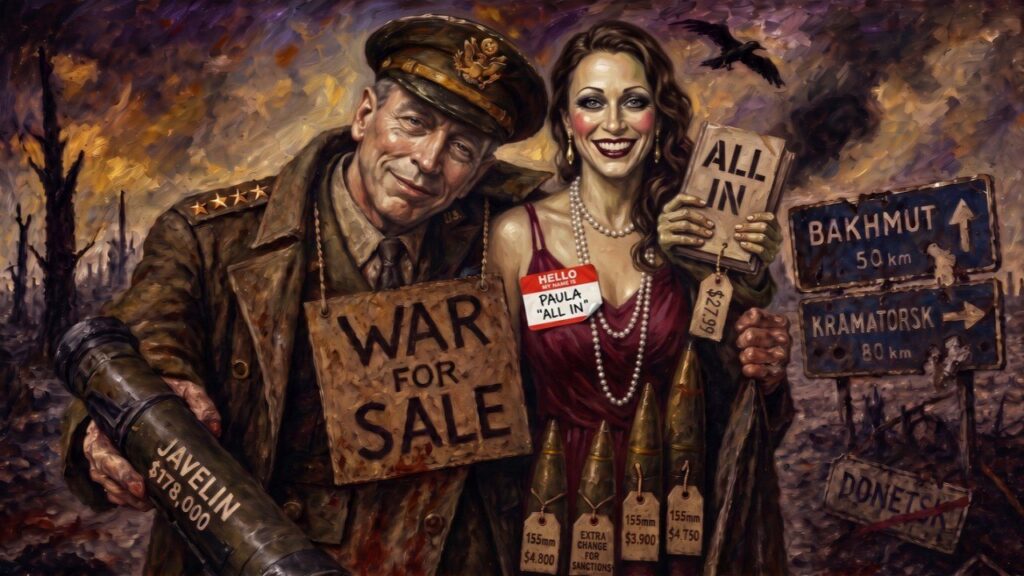
When your ‘biographer’ is really your girlfriend and her ghostwriter didn’t know, you might as well hand her the classified files too; so, he did.

By Scott Ortkiese | July 28, 2026 |so@throughlinesynthesis.com
Note: David Petraeus is a convicted federal offender who traded classified war plans for sex with his biographer while his soldiers bled out in Sangin. He got a misdemeanor and a fine equal to one speech. KKR bought the rehabilitation, gave him a partnership, and now pays him to peddle Ukrainian and Palestinian corpses as a growth thesis on CNBC. He advises Kyiv, Tel Aviv, and Sempra LNG simultaneously. He predicts Russia’s collapse every quarter for four years and gets rebooked every time. He is not an analyst. He is a belly-crawling war salesman collecting commission on every coffin. When you see him pontificating and posturing on TV, change the channel and don’t invest in his notions of war and sovereign character.
I. General Ripper in a Business Suit
The problem with watching David Petraeus on television in 2026 is not that he sounds unhinged. It is that he sounds so perfectly reasonable while being unhinged. He does not sweat like Sterling Hayden’s Jack D. Ripper chewing on his cigar and raving about the international communist conspiracy to sap and impurify our precious bodily fluids. He does not cackle like Peter Sellers’s Dr. Strangelove wrestling his own arm into a heil. He is calmer than that. He wears bespoke suits. He pronounces his own name with a faintly Roman gravitas (pe-TRAY-us). He drops the phrase “vast quantities” into every discussion of weapons systems like a poser who thinks he invented English. He speaks softly of “unmanned systems” and “sensors and shooters” and “the range of a HIMARS,” and the interviewer nods gratefully, and the audience mistakes calm for wisdom.
But listen to the content, not the cadence. This is a man who in 2026 tells Bret Stephens that Russia’s National Welfare Fund will run dry “later this year or sometime next” and that Vladimir Putin “might actually need a cessation of hostilities himself,” and who admits, when pressed, that he has been making this same prediction for “over a year.” In fact, he has been making it, in one form or another, since the spring of 2022. He is General Buck Turgidson explaining a proper preemptive strike can catch them with their pants down. He is Dr. Strangelove sketching a mineshaft-ratio-of-women-to-men calculation on a whiteboard. He is Jack D. Ripper describing the Russian threat as a matter of essence, not evidence.
The Russophobia is not incidental to David Petraeus. It is the operating system. Every appearance is a variation on a theme: the Russians are decadent and doomed, their army is broken, their economy is a Potemkin village, their leader is a KGB thug clinging to a shrinking chair, and the only correct policy is more weapons, more sanctions, more escalation, until the whole edifice collapses. He does not analyze Russia. He negates Russia. The country appears in his sentences only as an obstacle to be overcome, a case study to be closed, a market to be denied. Everything he says about the war in Ukraine flows downstream of this axiomatic contempt.
And here is the joke Kubrick would have loved: the Ripper in the Brooks Brothers suit is also on the KKR payroll, and the KKR payroll is on the Emirati payroll, and the Emirati payroll is part of the Israeli energy playbook, and the whole apparatus is greased by the same instinct that made him lie to the FBI about a mistress. The paranoia and theprivate-equity portfolio are not two separate men. They are one man, and the paranoia is what monetizes the portfolio.
He is not a general. He is a salesman in general’s drag. And the product he sells, in every appearance, is more war.
If military intelligence is a classic oxymoron, its greatest practitioner is just a plain moron. Not stupid in the everyday sense. Stupid in the specific technical sense that his professional judgment has produced consecutive strategic disasters, and the American system rewards him more, not less, for each one.
The Nickname the Troops Gave Him
And this is the point at which we should stop calling him what the Washington press corps calls him, and start calling him what the men he commanded call him. General BetrayUs. The rhyme is not a slur invented by a blogger. It is the rank-and-file verdict on a career, and its provenance is worth remembering.
On September 10, 2007, the day before Petraeus was scheduled to deliver his Iraq surge testimony to a joint hearing of the House Armed Services and House Foreign Affairs Committees,[MoveOn.org]purchased a full-page advertisement inThe New York Timesat a discounted rate of about $65,000. The headline ran across the page in seventy-two-point type: “General Petraeus or General Betray Us?” The subhead read: “Cooking the books for the White House.”The copy accused him of misrepresenting the security data from Iraq to justify continued escalation, and it laid out, in cold column-inches, the ways in which Petraeus was, in the ad’s phrasing, “constructing a false reality” for a Republican administration whose war he was politically covering (The New York Times, September 24, 2007; Washington Post, September 26, 2007).
The political-establishment reaction was thermonuclear. Republican senators and John McCain in particular denounced the ad on the Senate floor. On September 20, 2007, the Senate voted 72 to 25 to formally condemn[MoveOn.org]for the advertisement, a resolution introduced by Senator John Cornyn of Texas and endorsed by Republicans, most of the Democratic caucus (including future presidential nominee Hillary Clinton), and read into the Congressional Record as if the true offense against the Republic thatweek was a newspaper ad rather than a war built on false pretenses (CNN, September 20, 2007; Washington Post, September 21, 2007). Barack Obama, then a Senator running for President, ducked the vote. Joe Biden voted to condemn. The New York Times itself later published an editor’s note conceding it had givenMoveOnthe advocacy discount in error, and the paper’s Public Editor, Clark Hoyt, apologized for the discount in a September 23, 2007 column (The New York Times, September 23, 2007).
All of that political machinery, a Senate resolution, a Public Editor apology, a McCain Senate-floor tirade, was deployed to bury the phrase. And it did not work. The nickname stuck. It stuck because it rhymed. It stuck because it was accurate. It stuck because the men and women who had been in Fallujah in 2004, in Ramadi in 2006, in Baqubah in 2007, in Sangin in 2010, in the Arghandab in 2011, knew things the Washington press corps did not know about the general in the calm voice with the four stars on his shoulder. It stuck as enlisted-culture folk knowledge, passed in Camp Lejeune barracks and Fort Bragg motor pools and V.A. hospital waiting rooms, from lance corporals to sergeants to platoon sergeants to first sergeants, decades after MoveOn shuttered the campaign that first uttered it in public.
Go into a V.F.W. hall in a small American town in 2026. Order a beer. Mention the name David Petraeus in the presence of a man who did two or three tours under his command. Watch the face. The word that comes back, more often than not, is not “General.” It is BetrayUs. Sometimes with the acronym spelled out on a napkin: B-E-T-R-A-Y-U-S. Sometimes with a variant, General Betray-U.S., with the country abbreviated as the noun the general actually betrayed. The nickname is not a joke. It is a verdict. It is what the enlisted class of the American military calls him when the C-SPAN cameras are off.
And it is the verdict this polemic is going to sustain. Because the argument that follows, the KKR partnership, the Ivy-League laundry, the Israeli file, the ADNOC-Mubadala-Gaza Marine energy loop, the Kagan-family ventriloquism, the Ukrainian body count, the six-paymaster subscription service, is not fundamentally a political argument. It is a betrayal argument. He betrayed the men he commanded in Iraq by writing a doctrine that got them killed and then leaving them in it. He betrayed the men he commanded in Afghanistan by prosecuting a war he did not believe was winnable so that he could run for President on it. He betrayed the intelligence community he ran by handing his classified notebooks to his biographer-mistress. He betrayed the analytical tradition his rank was supposed to embody by monetizing his epaulets for a private-equity firm the day after his federal misdemeanor plea. And in the arc that runs from 2007 to 2026, he betrayed the constitutional order by converting the American general officer corps into an on-camera marketing arm of the defense-industry stack.
MoveOn had the rhyme right. They just misjudged how long it would take. The rank and file were ahead of them then, and they are ahead of the establishment now. General BetrayUs. General Betray-U.S. Say it out loud. It fits.
II. The Autobiographer
Let us dispense with the discreet ellipsis first. The story of David Petraeus and Paula Broadwell is not a private matter. It is a public matter, because it happened while both of them were on the taxpayer’s clock, because it directly implicated national security, because it is the single most compressed example available of Petraeus’s operating principle, which is that the rules apply to other people.
November 2011 through July 2012. The affair began roughly two months after Petraeus was confirmed as Director of the Central Intelligence Agency. Paula Broadwell was thirty-nine, a West Point graduate, an Army Reserve major with a top-secret SCI clearance, and the “biographer” of a book she titled, with a straight face,All In: The Education of General David Petraeus(NPR, November 12, 2012). Read that title again.All In. She was embedded with him at ISAF headquarters in Kabul while he was commanding roughly 100,000 American troops and 40,000 coalition forces, at a moment when Americans were dying in Kandahar and Helmand at a rate that peaked in 2010 to 2011 with more than 800 U.S. combat deaths and roughly 12,000 wounded. She ran with him on the ISAF compound. She flew with him. She was, in the euphemistic phrasing of every subsequent puff piece, “given extraordinary access.”
The extraordinary access included, per the FBI’s later investigation, a shared Gmail draft folder that they used to leave messages for each other without ever sending an email, a tradecraft trick more commonly associated with al-Qaeda cells trying to evade signals intelligence than with the Director of Central Intelligence trying to hide from his wife (BBC News, April 23, 2015). Let that sit for a moment. The head of the CIA was using al-Qaeda’s operational tradecraft to conduct an extramarital affair with a woman who held a top-secret clearance.
The extraordinary access also included eight leather-bound “Black Books” of classified material, which he brought home to their Wisconsin lakeside conjugal weekends, which contained the names of covert officers, the identities of foreign agents, war strategy in Afghanistan, notes from National Security Council deliberations, and quotes from private conversations with the President of the United States. He gave them to her. She kept them at her house. The FBI later found classified documents on her computer. He then lied to the FBI about it (BBC News, April 23, 2015).
The affair unraveled because Broadwell got jealous of a Tampa socialite named Jill Kelley, whom Broadwell suspected was competing for the general’s attention, and Broadwell sent Kelley a series of anonymous emails from throwaway accounts. Kelley, spooked, went to an FBI agent friend, who initiated a cyberstalking investigation that traced the emails back to Broadwell, and from Broadwell to the shared Gmail draft folder, and from the draft folder to the Director of Central Intelligence of the United States of America. This is not a novel. This is the actual federal record.
Now hold that picture next to another picture, from the same period. October 2, 2009 to July 18, 2011 was the deadliest period for American forces in the entire Afghanistan war. It was the surge Petraeus took over in July 2010. It was Marjah, and Sangin, and the Arghandab. It was the ten-hour firefights and the pressure-plate IEDs and the boys who lost both legs and testicles because Petraeus’s counterinsurgency doctrine required them to walk, not ride, through villages the general had never set foot in. The 2010 U.S. death toll in Afghanistan was 499, the single deadliest year of the war. The 2011 toll was 418. Total Americans killed under Petraeus’s ISAF command, roughly 630. Wounded, several times that. Afghan civilian dead, an order of magnitude higher.
While the general was in Kabul running his affair with his biographer, and later in Langley continuing it while running the CIA, those boys were on ninety-day rotations in outposts named for other boys who had already died there. He described that war inAll Inas an “education.” That is his word. Not theirs.
There is a specific rage that combat veterans reserve for men like David Petraeus. It is not the rage of policy disagreement. It is the rage of a class betrayal. It is the rage of a Marine lance corporal in Sangin, on his third deployment, listening to the sound of a Predator that will not come because the general’s staff is briefing the general’s biographer on the general’s brilliance. It is the rage of an Army specialist watching his squad leader bleed out while the general who wrote the manual that put them in that valley is composing a Gmail draft to a woman he flew back to Tampa on his personal aircraft. It is the rage that lives in the specific American men and women who were commanded by David Petraeus and who came home to learn that the general who ordered them into harm’s way was, at the same time, fucking his autobiographer.
The 2015 federal misdemeanor plea, the $100,000 fine that was equal to 75 percent of one of his speaking fees (ExposeFacts, May 27, 2015), the two years of supervised probation, and the immediate rehabilitation into KKR partnership and the cable-news green room, is the American national-security state’s answer to that lance corporal. The state prosecutes leakers with the vengeance of a small god (Chelsea Manning, decades; Reality Winner, five years and change; Jeffrey Sterling, three and a half; Thomas Drake, ruined; Julian Assange, prosecuted for a decade for publishing what Petraeus’s class handles at brunch). But when the leaker is one of the priests, the state issues an indulgence, and the priest is welcomed back into the pulpit before the ink is dry.
The Denver Speech, or What a Mistress Knew. On the evening of October 26, 2012, two weeks before her lover resigned in disgrace, Paula Broadwell stood at the podium at the University of Denver’s Alumni Symposium and told an audience of former classmates that the September 11, 2012 attack on the American diplomatic facility in Benghazi had been launched to free Libyan militia members being held captive at the nearby CIA annex (Wired, November 13, 2012; Denver Post, November 10, 2012; Washington Post, November 12, 2012; The Guardian, November 12, 2012). “Now I don’t know if a lot of you heard this,” she said, “but the CIA annex had actually taken a couple of Libyan militia members prisoner. And they think that the attack on the consulate was an effort to try to get these prisoners back.” She then added, in the register of a woman who had just given away the store: “So that’s still being vetted.”The CIA denied it on the record. Fox News’s sources, and the Wired reporting, said the CIA was lying. What matters here is not whether the Benghazi annex was in fact holding Libyan detainees. What matters is that the sitting Director of the CIA’s girlfriend was in Denver, Colorado on a Friday night, telling a symposium audience operational details from an ongoing embassy-attack investigation, and citing her source in the same breath: “a very close source.” The whole room understood who the very close source was. So did the FBI agents who read the transcript the next morning. The Black Books were the misdemeanor plea. The Denver speech was the actual crime. It was the moment the Director of Central Intelligence turned his mistress into an unpaid, uncleared, unaccountable spokeswoman for the agency he ran, live from a college campus in a state he did not represent.
The Human Terrain, or How to Turn a Girlfriend into Operational Personnel. Broadwell was not a journalist who fell into a general’s bed. She was a West Point graduate, a former military intelligence officer, a reserve major, and by the time she began her Petraeus biography she had been embedded in the Army’s Human Terrain System, the counterinsurgency data-collection program that used academics as social-science cover for CENTCOM ground work in Afghanistan. Petraeus expanded the Human Terrain program. Broadwell was one of its assets. When she flew to Kabul to shadow him in 2010 and 2011 for the book, she was not simply reporting. She was operating inside the same doctrinal apparatus he commanded, on a research pass he personally signed off on. This is worth stating plainly: the “biographer” was operational personnel, embedded by the general who was also her lover, on the taxpayer’s payroll, inside the war zone whose troops were dying at the highest rate of any year of that war. The affair was not a personal failing that happened to occur inside a command relationship. The affair was the command relationship. Everything else, the Gmail draft folder, the Black Books, the Denver speech, is downstream of that fact.
That is who is speaking when David Petraeus speaks. A convicted federal offender, whose actual crime, by his own plea, was preferring his mistress’s book royalties to his oath, and who has been rewarded for the crime with a private-equity partnership, a seat at Davos, and a permanent slot on the Sunday shows.
And, as we are about to see, with something more valuable than any of those. He has been rewarded with the ceremonial laundry of the Ivy League.
III. The Ivy League Laundry
The rehabilitation of David Petraeus is not principally a media story. It is anacademicstory. The commercial payroll (KKR, Sempra, Optiv, Advanced Navigation, Semperis, OneStream) buys his time. The universities buy his reputation. And there is a specific sequence to how the American professoriate did this work, at named institutions, with named administrators, on named dates, that deserves to be reconstructed in the light.
April 2013. Five months after Petraeus resigned as Director of Central Intelligence in disgrace for the affair and the classified leak (the FBI investigation had already found classified material on Broadwell’s computer, and Petraeus had already lied to federal agents about it), the CUNY Board of Trustees, at the personal invitation of outgoing Chancellor Matthew Goldstein, offered him a Visiting Professor position at Macaulay Honors College. The salary in Goldstein’s March 6, 2013 formal offer letter was $200,000 per year for one three-hour seminar per week, plus a team of graduate research assistants to “assist you with course research, administration, and grading,” plus travel funds (PSC-CUNY, August 14, 2013; NYT, July 15, 2013). Adjuncts at CUNY, who do most of the actual teaching in the system, were then paid roughly $3,000 per course. Petraeus’s rate was sixty-six times the adjunct rate, or about $2,250 per hour. Corey Robin, who did the forensic work on the emails obtained through Gawker’s FOIL request, published the entire paper trail on his blog ([coreyrobin.com, July 4, 2013]).
The emails contained a line worth memorizing. Petraeus, writing to Macaulay Dean Ann Kirschner, complained that he could have made more elsewhere: “The truth is that I could have gotten more money or more prestigious places (you won’t believe what USC will pay per week)” (Higher Ed Dive, July 2, 2013). Read that back. Six months after resigning in disgrace, the disgraced former CIA director is negotiating with a public university like a professional athlete comparing offers, and the pull quote iswhat USC will pay per week. When the story broke, CUNY tried to walk the number back to $150,000, with a memo Dean Kirschner appears to have back-dated by two and a half hours after the Gawker piece went live. When that cover story collapsed, Petraeus, through his attorney Robert Barnett, announced he would accept $1 to “remove money as a point of controversy.” The concession was ceremonial. He had already stacked the actual money elsewhere.
Where. Between May 1, 2013 and September 2013, Petraeus assembled a simultaneous four-institution academic portfolio:
•University of Southern California, Judge Widney Professor at the Sol Price School of Public Policy, September 2013 through August 2019, USC refused to disclose the salary (”a private institution is not required to publicly list such salaries,” per USC spokesman Carl Marziali) but Petraeus’s own email to Dean Kirschner (”you won’t believe what USC will pay per week”) suggests it dwarfed the CUNY figure (Los Angeles Times, July 1, 2013; The Hill, May 2, 2013).
•Harvard Kennedy School’s Belfer Center for Science and International Affairs, Non-Resident Senior Fellow, September 2013 through August 2019, six years, salary also undisclosed (Wikipedia).
•CUNY’s Macaulay Honors College, Visiting Professor of Public Policy, September 2013 through December 2016, three years, four months, at the notional $1.
•The University of Exeter, England, Honorary Fellow.
The title of the CUNY seminar tells you everything about the intellectual level of the enterprise: “Are We On the Threshold of a North American Decade?”, taught to sixteen students, with two graduate-student teaching assistants, in a building on West 57th Street after the class was relocated from Macaulay because of the protests. It was, per the syllabus material, a discussion of energy independence, shale oil, and North American manufacturing renaissance. It was, in other words, a KKR portfolio prospectus taught as a seminar.
The students knew. On September 17, 2013, students protesting Petraeus’s presence outside the Macaulay building were punched repeatedly by New York Police Department officers, and six students were arrested on charges including riot, disorderly conduct, resisting arrest, and obstructing governmental administration (PSC-CUNY, November 2013; The Guardian, September 20, 2013). Petraeus needed a police escort to walk through the streets of New York to his own class, harangued by young people who called him, correctly, a war criminal. To this day, none of the officers who punched CUNY students have faced charges. That was 2013’s Petraeus experience for the students. And Yale, and Harvard, and Kennedy School, and the deans of American public policy education watched all of it and drew exactly the wrong conclusion, which is that Petraeus was under-marketed.
So they doubled down. Which brings us to Yale.
August 29, 2023. The Yale Jackson School of Global Affairs, which had launched as a full graduate school in September 2022 with a $200 million endowment target and an operating budget expanded to $11.4 million (up from $9.4 million, per the university’s own 2018 budget book, with $2 million of the increment covering “faculty and staff salaries” and “nonsalary expenses” that no Yale administrator would break out on the record), announced the appointment of David H. Petraeus as Kissinger Senior Fellow (Yale Jackson School, August 29, 2023; Yale Daily News, October 5, 2017).
Think about what those words are doing. The Kissinger name is not incidental. Henry Kissinger, secret bomber of Cambodia and Laos, engineer of the Chilean coup that killed Salvador Allende, patron saint of American plausible deniability, died at 100 in November 2023, three months after Petraeus took the chair named for him. The Yale Jackson School runs both a Henry A. Kissinger Senior Fellowship and a Henry A. Kissinger Visiting Scholars Program(Yale Jackson School Fellowships page). It is a program by which the American academy indulges itself in the fantasy that Kissingerism is atradition of scholarshiprather than a method of getting men killed in countries most Americans cannot find on a map. Petraeus was the natural inheritor. In accepting the appointment, on his own LinkedIn on September 6, 2023, he wrote: “It isa privilege to continue my activities with Yale’s Jackson School of Global Affairs and to do so in the year ahead as a Kissinger Senior Fellow, once again co-teaching with Emma Sky (Director of the International Leadership Center) a graduate seminar in the spring semester on Great Power Competition” (LinkedIn, September 6, 2023).
Great Power Competition. The framework, taught to Yale graduate students, is Kissinger’s revenant Cold War schema in twenty-first century clothing. Its assumptions are the Petraeus assumptions: that the world is a chessboard, that the American position on the board is legitimate by default, that Russia and China are pieces to be blocked, that lives on the other side of the board are variables in the case study. Petraeus co-teaches it, at Yale, in a lecture hall named after a war criminal, wearing the ceremonial title of another war criminal, and Yale calls itscholarship. This is not rehabilitation. This is enthronement.
And Yale went further. It named a fellowship after him. The Kaplan, Petraeus Recanati Fellows Program, listed on the Yale Jackson School’s own MPP tuition and funding page, is a named student-fellowship track at the school (Yale Jackson MPP Fellowships). A convicted federal offender, whose crime by his own plea was the willful mishandling of classified material to advance his mistress’s book royalties, has a named fellowship at Yale University. A generation of graduate students in international affairs will now list “Kaplan, Petraeus Recanati Fellow” on their resumes as they enter the State Department, the intelligence community, and the think-tank archipelago. His name is on the credential. His name is on their door.
This is how the American academy launders reputation. It does not argue with the record. It does not litigate the affair, the leak, the counterinsurgency doctrine that ended in Mosul and Kabul, the Ukraine predictions that ended in Zaporizhzhia and Kursk, the Foreign Affairs advice to bulldoze Fallujah-model “gated communities” across Gaza. It simplyrenamesthe man. Yesterday, David Petraeus, convicted federal offender. Today, Kissinger Senior Fellow, Yale University. And by the ceremonial force of the second title, the first title is retired from the record.
The Yale Jackson School does more than rehabilitate Petraeus. It launders the entire class of men Petraeus belongs to. General Stanley McChrystal, who resigned from Afghan command in June 2010 after his staff mocked the Vice President of the United States in aRolling Stoneprofile, is a senior fellow (Yale News, April 6, 2019). Former U.S. Ambassador to Syria Robert Ford, who oversaw the American strategy that turned Syria into a decade-long slaughterhouse, is a senior fellow. John Kerry, whose Iraq war vote and whose Israel-Palestine peace-process failures are on the record, is Yale’s first Distinguished Fellow for Global Affairs and gets his own initiative (Yale News, April 6, 2019; Yale Daily News, October 5, 2017). The Jackson School is not a school of global affairs. It is a retirement home for the American war-policy class, dressed in Yale’s endowment, with graduate students paying tuition to sit at their feet.
What does the Ivy League get out of this? It gets access. Yale gets Petraeus’s Rolodex, KKR gets Yale’s imprimatur on its Middle East expansion, the Jackson School gets the naming-rights donations that flow from proximity to a four-star general with a private-equity partnership, and the graduate students get to say they took Great Power Competition from Kissinger’s namesake fellow. Everyone is paid. Everyone is credentialed. And the American academy, which was supposed to be the last institution in the country capable of telling the truth about a broken war, becomes instead the polishing cloth for the men who broke it.
Harvard’s Belfer Center, Princeton’s Woodrow Wilson School (rebranded the School of Public and International Affairs after 2020, but still in the same building, with the same donor base), USC’s Sol Price, Georgetown’s SFS, Johns Hopkins SAIS: it is the same story at every one of them. The American national-security professoriate is not an intellectual class. It is a butler service. And its most decorated butler, David H. Petraeus, is the one who serves the tea.
So when you next see the Cipher Brief chyron read “Former CIA Director,” and the Bret Stephens set-up bills him as “Kissinger Senior Fellow at Yale,” understand what those five words are doing. They are doing exactly the work a $1 CUNY seminar could not do in 2013. They are converting a convicted federal offender’s name into an academic credential. They are, in the exact words of the con, laundering him.
That is who is speaking when David Petraeus speaks. A man Yale has decided is scholarly enough to bear Henry Kissinger’s ceremonial mantle. That is either an argument for David Petraeus, or an indictment of Yale. Reasonable people can decide.
IV. Who Hires David Petraeus, To Do Precisely What, And Why
The indictment of David Petraeus does not begin with what he says. It begins with who is paying him to say it. Not in vague, generalized “influence-peddling” language, the kind the American press deploys to blunt every conflict-of-interest story into unfalsifiable mush, but in specific transactional terms. Each principal. Each service purchased. Each outcome bought. Line it up, and the picture that emerges is not oneof a strategist offering considered analysis. It is of a contract salesman with a four-star epaulet, whose job description is fixed, whose deliverables are measurable, and whose alignment with the wars he narrates is total.
Let us walk the ledger.
-
Henry Kravis and George Roberts hire him to convert his uniform into deal flow.
Principal: Henry Kravis and George Roberts, founding partners of KKR & Co., which manages more than $638 billion in assets and, as of Q1 2026, holds direct or portfolio-company stakes across defense, energy, cybersecurity, and Middle East infrastructure.
Specific service purchased: the geopolitical prestige premium. In May 2013, six months after Petraeus resigned from the CIA in disgrace, Kravis and Roberts created the KKR Global Institute, a division that did not previously exist, and installed Petraeus as its founding Chairman. In their own words: “geopolitics and macro and public-policy concerns are very much part of the diligence process.” Translation, in plain English: KKR needed a name on the letterhead who could open doors that Kravis and Roberts alone could not open. Sovereign wealth funds in Riyadh, Abu Dhabi, and Doha do not take pitch meetings from private equity generalists. They take pitch meetings from four-star generals who commanded the wars that made those funds’ host states dependent on American security guarantees. Petraeus was hired for that transaction, and only that transaction. His deliverable is access, converted into capital, converted into carry.
Outcome bought: on April 14, 2025, KKR made the transaction explicit. It promoted Petraeus from Chairman of the Global Institute to Chairman of KKR Middle East, with a twelve-person Dubai-Riyadh investment team dedicated to Gulf deployments (Business Wire, April 14, 2025). This is not a ceremonial elevation. It is the formalization of what he was hired to do from the beginning: to be the American general who walksinto Mohammed bin Salman’s office, into Mohammed bin Zayed’s office, into the Qatar Investment Authority’s office, and closes deals that a KKR managing director in a Zegna suit cannot. Every dollar of Gulf capital that flows into KKR funds off the back of a Petraeus meeting is a dollar he is paid to have produced. That is the contract.
Ask a simpler question. Why does the general who commanded the Iraq War, the general who wrote the counterinsurgency manual that failed, get a partnership at KKR? Because his failures are commercially useful to KKR’s clients. The Gulf states that fund KKR are structurally dependent on the American military project he administered. The Israeli state, whose Fallujah-model “gated communities” plan for Gaza he endorsed in Foreign Affairs in March 2024, is a KKR investee-adjacent partner. The American arms industry, whose supply chains KKR’s portfolio companies feed, is the direct commercial beneficiary of every escalation he counsels on cable news. Kravis and Roberts did not buy David Petraeus in spite of his war record. They bought him because of it.
2. The KKR portfolio-company operators hire him to sell into the Pentagon.
Principal: the operating executives of the KKR portfolio companies with defense-facing revenue streams (Novaria, CIRCOR, Optiv, Semperis, Advanced Navigation, OneStream).
Specific service purchased: name-brand introductions into the Department of Defense procurement bureaucracy, into the Intelligence Community’s contracting shops, into the offices of the House and Senate Armed Services Committee majorities, into the National Security Council. The operators of these companies are, in general, capable industrialists. They can run a plating line, an EBITDA rollup, a cyber-integration play. What they cannot do is walk into the office of the Chief of Staff of the Army and be received on the day of the call. Petraeus can. He was the Chief of Staff of the Army’s colleague. He commanded that Chief of Staff’s predecessor’s predecessor’s boss. That is the phone call the KKR operators are buying.
Outcome bought: exit multiples. Novaria, bought by KKR in February 2020 for a valuation the firm has never disclosed but which press reports pegged in the $500 million range, was sold to Arcline in November 2025 for $2.2 billion, roughly quadruple the entry price (Business Wire, November 10, 2025). The company that made the difference between the entry multiple and the exit multiple was the Ukraine war. Novaria makes components for aircraft, drones, and submersibles. The KKR partner responsible for it, Josh Weisenbeck, told ION Analytics that the firm “pivoted Novaria’sM&A strategy more to defense than aerospace in the early years of the holding period,” precisely because military budgets were skyrocketing after February 24, 2022. CIRCOR, bought for $1.6 billion in October 2023, had its aerospace division alone flipped to Parker Hannifin for $2.55 billion in May 2026, a return that came almost entirely from defense-facing multiples (Business Wire, May 21, 2026). Optiv is positioned as the Cybersecurity Maturity Model Certification broker to 300,000-plus DoD contractors. Advanced Navigation counts the US Army, Anduril, Kongsberg, Lockheed, BAE, and Rheinmetall as customers. Semperis sells identity security to governments.
Every one of those revenue lines requires a sustained American procurement thesis. Every one of them requires that the Ukraine war continue, that the Iran confrontation escalate, that the Gaza operation model be exportable, that the Great Power Competition frame Petraeus co-teaches at Yale be enshrined as policy. Petraeus is not paid by these companies to explain war on television. He is paid by them to keep thewar-procurement thesis alive. His television appearances are not commentary. They are the marketing arm of the KKR defense-portfolio thesis.
3. Sempra Energy hires him to keep Europe amputated from Russian gas.
Principal: Sempra, the San Diego-based US LNG major that operates Cameron LNG in Louisiana and is building Port Arthur LNG in Texas, and whose entire growth thesis since 2022 has depended on replacing Russian pipeline gas in the European market with US-shipped LNG at a two-to-three times price premium.
Specific service purchased: the diplomatic-atmospheric argument that Europe must never, under any circumstance, restore pipeline commerce with Russia. That is not an incidental byproduct of Petraeus’s commentary. It is its primary commercial function from Sempra’s perspective. Every Petraeus op-ed insisting that Putin cannot benegotiated with, every cable appearance dismissing Istanbul April 2022 as a Kremlin trap, every warning that a Ukraine settlement would “reward aggression,” is precisely calibrated to keep Nord Stream cold and Cameron LNG hot. Sempra is not paying Petraeus for advice. Sempra is paying Petraeus for atmosphere. The atmosphere in which a European utility executive who might otherwise pencil out the price differential and quietly ask about Yamal-Europe capacity is instead reading a Foreign Affairs article by a four-star general explaining why any such thought is treason.
Outcome bought: the LNG delta. In Q1 2022, before the war, European TTF gas priced roughly $25 per MMBtu. In Q3 2022, it peaked over $70. US Henry Hub, from which Sempra’s cargoes are sourced, has traded in a $2 to $5 range across most of the same period. The spread, per cargo, has been the largest wealth transfer from European consumers to American exporters in the post-war era. Sempra shareholders are not paying Petraeus because they think he is a scholar. They are paying him because his voice, alongside the voices of the men and women his network has placed at the Atlantic Council, the German Marshall Fund, the CEPA, and Yale Jackson, keeps the spread open. He is a moat. That is the deliverable.
4. The Institute for the Study of War hires him to launder Kagan-family analysis into general-officer authority.
Principal: the Kagan family (Kimberly Kagan, President; Frederick Kagan, brother; Robert Kagan, brother-in-law; Victoria Nuland, sister-in-law), the neoconservative dynasty whose Ukraine and Russia analysis has been continuously wrong for two decades but whose institutional footprint (ISW, AEI, Brookings, the Kagan Institute) has been continuously funded by defense-industry money.
Specific service purchased: the general-officer signature on Kagan-family conclusions. ISW does the research. Petraeus, from his board seat, reads the daily assessments, then re-articulates them on CNN, MSNBC, CNBC, and in Foreign Affairs, as though they were his own analysis. When he says “the Russians have exhausted their equipment reserves,” that is not his conclusion. It is ISW’s. When he says “Ukraine can retake Crimea,” that is not his estimate. It is Fred Kagan’s. Petraeus is the narrator for a script written by others. But because he wears the epaulets, the script is received as strategic judgment rather than as advocacy from a family whose entire adult professional life has been dedicated to enlarging the American war in Eurasia.
Outcome bought: the launder cycle. ISW’s daily Russian Offensive Campaign Assessment is written, then cited by Petraeus, then cited by the cable-news anchor citing Petraeus, then cited by the congressional staffer citing the cable-news anchor, then cited by the appropriator citing the staffer, then a supplemental Ukraine-aid vote is scheduled. That is the sequence. Petraeus is the switching station. Without him, ISW is a family think tank. With him, ISW is “what General Petraeus said on Cipher Brief.” That is the value he brings, and that is what he is paid to be.
5. The Ukrainian General Staff, under Oleksandr Syrskyi, hires him to be their American voice.
Principal: the Ukrainian Armed Forces command structure, formalized through his April 15, 2026 appointment to the ARES Military Expert Council under the direct supervision of Commander-in-Chief Syrskyi, and his April 28, 2026 seat on the Kyiv Architecture of Security Forum Strategic Advisory Group (TASS, April 15, 2026; Interfax-Ukraine, April 28, 2026).
Specific service purchased: access to the American appropriations process, the American media agenda, the American think-tank consensus, and the American general-officer post-retirement class. The Ukrainian General Staff does not need David Petraeus’s tactical advice. Syrskyi has been fighting the war for four years and knows the terrain better than any American general ever will. What the Ukrainian General Staff needs is a four-star ventriloquist in Washington who will pound the drum for continued flows of Patriot batteries, ATACMS, F-16 sustainment packages, Bradley resupply, and 155mm shells, and who will maintain the political climate in which Ukraine cannot be pressured into an unfavorable settlement. Petraeus is that ventriloquist.
Outcome bought: in this transaction, the outcome the Ukrainian General Staff wants is exactly the outcome the KKR defense-portfolio operators want, exactly the outcome Sempra wants, exactly the outcome the Kagans want. The war continues. Which is convenient, because it means Petraeus does not have to reconcile his ledger. Every principal on his payroll wants the same thing, and he delivers it to all of them, with a single set of talking points, on a single television appearance. That is why he is the perfect employee. His work product for KKR is his work product for Sempra is his work product for ISW is his work product for the Ukrainian General Staff. One voice. Five paymasters. Zero conflicts. Because the conflict is the point.
That every one of those principals wants the war to continue is not a discovery. It is a structural fact of David Petraeus’s employment. The Ukrainian in the trench outside Robotyne, the Russian conscript in the burnt hulk of a T-72 outside Kupiansk, the pensioner in Kharkiv whose electric grid was struck at 3 am, the pensioner in Belgorod whose apartment block took an ATACMS: none of them are on his payroll. Their interests are not represented in the meeting. The meeting is between men who make money when the war continues and men who lose face when the war ends. Petraeus works for the first group.
6. The Cipher Brief, Bret Stephens at the New York Times, Andrew Ross Sorkin at CNBC, and the Foreign Affairs board of editors hire him to be the wallpaper.
Principal: the American national-security media, which does not so much interview Petraeus as install him, as the standing voice on top of any Russia-Ukraine-Iran-China segment for which they need general-officer authority.
Specific service purchased: narrative credibility, on demand, at $100,000 to $150,000 per appearance for the paid speech circuit and gratis (which is to say, in exchange for continued booking) for the cable and print outlets. What The Cipher Brief buys is a bookable name. What Bret Stephens buys is a set-up interview that produces the columns he wants to write anyway. What Andrew Ross Sorkin buys is a Squawk Box segment that reassures his Wall Street audience that the war is proceeding as planned. What Foreign Affairs buys is the ability to describe its bimonthly issue as containing “the exclusive analysis of General David H. Petraeus,” a phrase that sells subscriptions to State Department cafeterias.
Outcome bought: consensus manufacture. Petraeus, by his ubiquity, defines the acceptable range of American opinion on Russia and Ukraine. Anything to the left of Petraeus is fringe. Anything to the right of Petraeus is neoconservative extremism, but the extremism is treated as a discussable outlier. Anything outside Petraeus, meaning the honest realist position that the war should have ended in April 2022 in Istanbul on terms Ukraine was prepared to accept before Boris Johnson intervened, is not treated as a position at all. It is treated as not existing. Petraeus is the perimeter fence. What he says is inside; what he does not say is outside. That is the service.
The indictment stated plainly.
David Petraeus is not an analyst. He is a subscription service. His subscribers are, in order:
-
KKR, which pays him partner-level compensation and carry to convert his military-command Rolodex into Gulf-sovereign deal flow and defense-portfolio exit multiples.
-
Sempra, whose LNG windfall from Europe’s amputation from Russian pipeline gas depends on the atmosphere he manufactures.
-
Optiv, Semperis, Advanced Navigation, OneStream, and the Novaria and CIRCOR alumni networks, whose Pentagon revenues require the American war-procurement thesis he sustains.
-
The Institute for the Study of War and the Kagan family network, which uses his epaulets to launder their analysis into general-officer authority.
-
The Ukrainian General Staff, which uses him as its four-star ventriloquist in Washington.
-
The American national-security media, which pays him in booking fees and print bylines to be the wallpaper that defines the acceptable range of Russia-Ukraine opinion.
Every one of these subscribers wants the same product: a continuing war. Every one of them is paid, in one form or another, out of the ongoing extraction of American, European, Russian, and Ukrainian blood and treasure. Petraeus delivers that product for all six of them at once, with a single set of talking points, in every appearance, without ever once disclosing on camera which of them is signing his check that week.
That is the indictment. It is not a matter of tone. It is not a matter of politics. It is a matter of transactional fact. He is paid to keep the war going. He keeps the war going. That is who is speaking when David Petraeus speaks.
The Trump Transition, orHow the Beltway Laundered the Convict.
On November 28, 2016, one year and seven months after his federal guilty plea, David Petraeus rode the elevator up to the twenty-sixth floor of Trump Tower and interviewed with the President-elect for the position of Secretary of State (Reuters, November 28, 2016; The New York Times, November 28, 2016). He was on the shortlist alongside Mitt Romney and Rudy Giuliani. He did not get the job. What matters is that he was in the room. A man who had, nineteen months earlier, pleaded guilty in federal court to willfully mishandling eight books of classified material and lying to the FBI about it was, in the plain view of the American press corps, a finalist to run the State Department. Neither party objected. No editorial page called it disqualifying. The Senate Foreign Relations Committee gave off-the-record signals that he would be confirmable. This is the elite laundering machine in one sentence: a felon in April 2015, a Cabinet finalist in November 2016, a KKR Middle East chairman by 2025. The plea agreement was not a punishment. It was a credential upgrade.
V. The Payroll: A Concrete Map
David Petraeus does not disclose this map when he goes on camera. His interviewers do not read it out. It is worth putting in one place, at company-name specificity, with dollar figures, because once you see it you cannotunseeit.
KKR & Co. Petraeus has been a Partner and Chairman of the KKR Global Institute since it was founded by Henry Kravis and George Roberts in May 2013 to give the firm’s diligence process a geopolitical veneer, and, since April 14, 2025, also Chairman of KKR Middle East, based across Dubai and Riyadh, leading a twelve-person Gulf investment team (Business Wire, April 14, 2025; Reuters, April 14, 2025). KKR manages more than $638 billion in assets. Partners share in fund carry. The KKR Global Institute exists, in KKR’s own words, because “geopolitics and the macro and public policy concerns are very much part of the diligence process.” Translation: Petraeus is paid to convert his Rolodex and his uniformed prestige into deal flow. That is his job description, not a side effect.
Novaria Group (KKR portfolio, 2020 to 2025). KKR bought this Fort Worth aerospace and defense hardware manufacturer in February 2020, “late in the credit cycle, to build up its defense portfolio at a time when military budgets are skyrocketing” (Chief Investment Officer, November 26, 2019). Under KKR, Novaria completed thirteen add-on acquisitions. KKR partner Josh Weisenbeck told ION Analytics the firm “pivoted Novaria’s M&A strategy more to defense than aerospace in the early years of the holding period,” and its two largest add-ons were Hohman Plating(defense-focused electroplating, April 2022, two months after Russia invaded Ukraine) and Anillo Industries(February 2024). EBITDA rose more than 200% during KKR’s ownership. In November 2025, KKR sold Novaria to Arcline for $2.2 billion, roughly quadruple the entry valuation (Business Wire, November 10, 2025; ION Analytics, December 1, 2025). Novaria makes components for “aircraft, drones, and submersibles.” Read those three words back. Petraeus, on camera in June 2026, tells you that unmanned aerial, unmanned ground, and unmanned undersea systems will define the wars of the next decade. Well, his employer’s portfolio company was, at that moment, quietly monetizing exactly that thesis for a two-billion-dollar exit.
CIRCOR International (KKR portfolio, 2023 to present). KKR took this Massachusetts flow-control manufacturer private in October 2023 for $1.6 billion, explicitly citing its “significant A&D offering” (Industrial Distribution, June 6, 2023). In May 2026, KKR flipped the aerospace division to Parker Hannifin for $2.55 billion, more than KKR paid for the entire company two and a half years earlier, while keeping the Naval and Industrial businesses, precisely because KKR wants “continued exposure to these strategically important end markets” (Business Wire, May 21, 2026). Strategically important, in Wall Street English, means “war.”
Optiv Security (KKR-owned since 2016, Petraeus on the board since September 2017). Optiv is a cybersecurity solutions integrator with an entire federal division targeting the Department of Defense, civilian agencies, and the Intelligence Community. In 2021, Optiv positioned itself as the go-to compliance vendor for the DoD’s Cybersecurity Maturity Model Certification, a rule affecting 300,000-plus defense contractors (MarketScreener, February 17, 2021). The press release quoted Petraeus by name and title. Petraeus is paid by a KKR portfolio company whose revenue depends directly on the size of the American defense-contractor base, a base that grows when wars are hot and shrinks when they are not.
Advanced Navigation (KKR-led $108 million Series B, November 2022). An Australian autonomous-systems firm whose customer list, per its own press releases, includes “US Army, Anduril, Kongsberg, Lockheed Martin, BAE Systems and Rheinmetall” (Spatial Source, March 23, 2026; Advanced Navigation press release, November 17, 2022). Petraeus chairs its International Advisory Board and its Defense Advisory Board.
Semperis (strategic advisor since September 2022), an identity-security firm that took Petraeus on specifically “to defend critical infrastructure for the U.S. and its allies and partners around the world” (Intelligence Community News, October 3, 2022). Semperis sells to governments.
OneStream and Sempra round out the domestic list. Sempra is the US LNG major, and it is the important one for the Ukraine story. Sempra’s Cameron LNG and Port Arthur LNG facilities are structurally the beneficiaries of Europe’s forced amputation from Russian pipeline gas. Every additional year of the Ukraine war extends that windfall. Petraeus is compensated by a company for which the destruction of Nord Stream was, whether or not he framed it this way in any board meeting, a business-development event. The man who goes on television to explain why the West must never negotiate with Moscow is directly compensated by a corporation whose growth curvedependson the West never negotiating with Moscow.
Institute for the Study of War. He sits on the board. ISW is the think tank he then cites approvingly on CNBC and in Foreign Affairs. His fellow ISW board members include Jack Keane (defense-industry investor) and executives from major defense contractors (The Intercept, August 19, 2021). ISW’s daily “Russian Offensive Campaign Assessment” is one of Petraeus’s principal sources. He then re-launders those assessments into cable interviews and calls it independent analysis. Buck Turgidson citing Buck Turgidson.
Ukrainian Armed Forces ARES Military Expert Council (April 15, 2026) and the Kyiv Architecture of Security Forum Strategic Advisory Group (April 28, 2026). Petraeus formally advises the Ukrainian General Staff under Commander-in-Chief Oleksandr Syrskyi (TASS, April 15, 2026; Interfax-Ukraine, April 28, 2026; Wikipedia). He is, in the plain meaning of the term, a belligerent’s advisor. He is not an analyst commenting on a war. He is a co-belligerent describing the war he is helping to prosecute.
Speaking fees. In the $100,000 to $150,000 range for years. Every cable-news booking is a marketing event for that fee schedule.
That is the map. Partner in one of the world’s largest private-equity firms. Board seats at two portfolio defense contractors. Strategic advisor to two more. Board director of the leading pro-war think tank. Formal advisor to the Ukrainian state. Chair of KKR Middle East. Six figures per speech.
None of it is disclosed on camera. Ever. The Cipher Brief chyron says “Former CIA Director.” That silence is the con.
VI. The Israeli File
David Petraeus’s relationship to the Israeli state is more complicated than the standard neoconservative script, and it deserves its own accounting, because it explains something about how his brand of Russophobic escalation slots into a broader Gulf-Israel-American energy architecture that is more recent, more concrete, and more damning than the Ukraine story alone would suggest.
March 16, 2010. Then-CENTCOM commander Petraeus submitted a fifty-six-page prepared statement to the Senate Armed Services Committee. On page twelve, in a paragraph that would produce more than a week of political convulsion in Washington, he wrote that “the enduring hostilities between Israel and some of its neighbors present distinct challenges to advance our interest in the AOR,” that “the conflict foments anti-American sentiment, due to a perception of U.S. favoritism for Israel,” that “Arab anger over the Palestinian question limits the strength and depth of U.S. partnerships with governments and peoples in the AOR and weakens the legitimacy of moderate regimes in the Arab world,” and that “Meanwhile, al-Qaeda and other militant groups exploit that anger to mobilize support” (Jewish Telegraphic Agency, March 19, 2010). This followed a January 2010 CENTCOM briefing his team delivered to Joint Chiefs Chairman Admiral Mike Mullen, which, as veteran military analyst Mark Perry reported in Foreign Policy, warned that “Israeli intransigence on the Israeli-Palestinian conflict was jeopardizing US standing in the region” (Democracy Now!, March 17, 2010).
The Anti-Defamation League called the testimony “dangerous and counterproductive.” The Foundation for Defense of Democracies published an attack piece calling it “surpassingly foolish” (FDD, April 8, 2010). Within days, Petraeus was on a press-conference lectern at Saint Anselm College in New Hampshire, walking the statement back with the plausibility of a hostage reading a proof-of-life note. He said the reporter had “picked apart” and “spun” his speech (YouTube, March 25, 2010; Wikipedia). What he did not say was that he had been in trouble with a very specific constituency, and that the trouble had been resolved in the way such things are always resolved: with a public act of contrition.
June 2024. Fourteen years later, Petraeus co-wrote an opinion article with Meghan O’Sullivan and Richard Fontaine in Foreign Affairs, comparing Israel’s assault on Gaza to the American war in Iraq. He described the Israeli campaign, then eight months into what much of the world had begun to identify as a genocide with an emerging casualty count that would exceed forty thousand Palestinians, as an “understandable response” to the October 7 Hamas attack, and proceeded toadvisethe Israelis on how to prosecute it more effectively (Wikipedia).
March 2024. On the sidelines of the Institute for National Security Studies conference in Tel Aviv, Petraeus told the Times of Israel that Israel should pivot to a counterinsurgency approach borrowed directly from his 2007 Iraq surge playbook: “You clear an area, you hold it, and you hold it in a very significant manner. You wall it off. You create gated communities, as we call it, 12 or 13 of them in Fallujah alone. You use biometric ID cards because you’re trying to separate the enemy, the extremists, from the people. That’s the fundamental idea” (Drop Site News, January 30, 2026).
Read that quote back and think about what he is actually saying. He is telling the Israelis to install walls, biometric ID checkpoints, patrol grids, and permanent occupation architecture across the rubble of Gaza, using as his model theFallujah of 2007, a city his own American forces reduced to concrete dust with white phosphorus and 155mm artillery, and where the current cancer, birth-defect, and infant-mortality rates from spent munitions have made international pediatric journals for the last fifteen years. In Petraeus’s mouth, “gated communities” is a term of art. In the mouth of anyone else it would be called what it is: a prison archipelago.
January 21, 2026. Petraeus flew to Kiryat Gat in southern Israel and appeared at the American-run Civil-Military Coordination Center (CMCC), the CENTCOM-established body set up one week after the October 2025 Gaza ceasefire to oversee “reconstruction.” He praised Israel’s shift to “clearing, holding, and rebuilding,” specifically endorsed the “Gaza First Planned Community” pilot project (UAE-funded), and did all of this the day before Donald Trump inaugurated a “Board of Peace” at Davos on which Tony Blair sits (Drop Site News, January 30, 2026). The head of the CMCC, Lieutenant General Patrick Frank, is a former Petraeus subordinate from Iraq and Afghanistan. The line from Fallujah in 2007 to Kiryat Gat in 2026 runs directly through David Petraeus’s biography, unbroken.
Here is where the private-equity portfolio locks in with the Israeli policy work, and it is worth reading slowly. The Kiryat Gat “reconstruction” plan for Gaza depends on financing the rebuild through Palestinian gas. The undeveloped Gaza Marine field, roughly one trillion cubic feet of natural gas, is under consideration as the funding vehicle. This slots into the broader Abraham Accords energy architecture that connects Abu Dhabi’s Mubadala (which acquired a 22 percent stake in Israel’s Tamar offshore gas field in December 2021) to Israeli production, to the Egyptian LNG export terminals, to European markets. KKR, together with BlackRock, holds a $4 billion investment in the Abu Dhabi National Oil Company (ADNOC) and holds a minority stake in ADNOC Gas Pipeline Assets, which has the technical expertise required for offshore gas exploration and extraction and to manage infrastructure including pipelines and LNG terminals (Drop Site News, January 30, 2026).
Now assemble the pieces. Petraeus advises Israel on how to police Gaza. Petraeus’s employer holds the pipeline infrastructure play at ADNOC. UAE Mubadala holds the Israeli gas field play at Tamar. UAE finances the Gaza “planned community.” Palestinian gas at Gaza Marine finances the reconstruction. Sempra, whom Petraeus advises, exports the LNG. The Board of Peace, on which Tony Blair (paid Mubadala advisor) sits, coordinates the political shell.
This is not a conspiracy theory. This is public disclosure. Every arrow in that diagram is on a corporate press release or a wire report. What is missing, in every Petraeus television appearance on Gaza, in every Foreign Affairs essay, in every Tel Aviv INSS keynote, is any acknowledgment that the man advising Israel and the American CMCC on the reconstruction of Gaza is simultaneously a principal at the private-equity firm that controls the pipeline infrastructure that will monetize the gas that will underwrite the reconstruction. That is not analysis. That is a sovereign wealth management assignment, delivered in the language of counterinsurgency doctrine.
The 2010 Petraeus who told the Senate that American favoritism for Israel was costing American lives has been fully retired. He was retired the moment the payroll clarified. The 2026 Petraeus advises the Israelis to build biometric-ID prisons over Gaza’s dead and calls it counterinsurgency best practice. And on Russia, the same doctrine holds: dehumanize, wall off, biometric-tag, monetize. Fallujah 2007 was the pilot. Gaza 2026 is the sequel. Donetsk 2027 is presumably the third-act deployment.
VII. The Russophobia, Named
Russia, for David Petraeus, exists only as an obstacle to be removed. Not as a country. Not as one hundred and forty-four million human beings. Not as the state whose grandfathers destroyed the Wehrmacht at Stalingrad and Kursk and Berlin, at a cost of roughly twenty-seven million Soviet dead, and thereby made the American twentieth century possible. Not as a civilization with a literature and a music and an Orthodox Christianity older than the American republic. He does not see any of that. He sees a target set.
The frame in which he speaks about Russia is not policy analysis. It is a hatred with a briefing binder. Let us name it plainly, because “Russophobia” is a word the American commentariat has trained itself to dismiss.
Russophobia, in the Petraeus register, has three features.
First, it is essentialist. Russians in his sentences are not political actors making calculated choices in a security environment shaped in significant part by NATO’s eastward expansion. They are a type. Their soldiers are corrupt, drunk, dressed in fatigues from grandfathers’ closets, running out of “vast quantities” of everything, waves of untrained conscripts sent to their deaths by a regime that does not care. Their generals should be court-martialed. Their leader is a KGB thug clinging to a shrinking chair. Their economy is a Potemkin village. Notice what is missing from this picture: any Russian citizen with agency, any Russian institution with legitimacy, any Russian grievance with standing. This is Jack D. Ripper on precious bodily fluids, updated for the Foreign Affairs demographic.
Second, it is negational. Petraeus does not describe Russia. He describes its impending absence. Everything he says about Russia points toward the moment when Russia stops existing as a strategic actor. The National Welfare Fund runs out. The refineries burn. The rail links collapse. The economy craters. Putin sues for peace. The regime falls. The threat is neutralized. This is not analysis of a state that is objectively the world’s largest country by landmass, a nuclear peer, a permanent member of the UN Security Council, the world’s largest wheat exporter, the world’s third-largest oil producer, and the pivot of a Eurasian order that includes China, India, Iran, and half the Global South. It is a fantasy of dissolution.
Third, it is exculpatory. The Russophobic frame does the political work of erasing every American choice that produced the war. There is a list. It is important. It has never appeared in a Petraeus television interview.
•The 1990 Baker-to-Gorbachev assurance that NATO would not move “one inch eastward” beyond a reunified Germany, an assurance now documented in the National Security Archive’s declassified cables.
•The 1999 NATO expansion to Poland, Hungary, and the Czech Republic.
•The 2004 expansion to the Baltic states, Slovakia, Slovenia, Bulgaria, and Romania.
•The 2008 Bucharest NATO declaration promising Ukraine and Georgia eventual membership, over the explicit warnings of every senior American Russia hand who ever served, including William Burns (then U.S. Ambassador to Moscow, later Petraeus’s successor as CIA Director, whose cable that year famously read “Nyet means nyet”), Jack Matlock (Reagan’s Ambassador to Moscow), and, going back further, George Kennan (who called NATO expansion “the most fateful error of American policy in the entire post-Cold War era”).
•The 2014 Maidan and the American role in it, documented in the Victoria Nuland “Fuck the EU” phone call and the transcript in which she named the composition of the post-coup Ukrainian government before that government existed.
•The collapse of the Minsk agreements, which Angela Merkel later publicly admitted (December 2022Die Zeitinterview) and François Hollande confirmed were “a stalling tactic” to allow Ukraine to rearm.
•The sabotage of the Istanbul talks in April 2022 by Boris Johnson, on behalf of Washington, at the exact moment a negotiated Russian withdrawal was within reach, documented by David Arakhamia, the head of the Ukrainian delegation, in an on-camera admission to the Ukrainian outlet 1+1 in November 2023.
•The destruction of Nord Stream 1 and Nord Stream 2 in September 2022, an act of state terrorism against European infrastructure that Seymour Hersh, and later corroborating reports inDer Spiegel,Die Zeit, andThe Washington Post, attributed to the CIA and Norwegian intelligence.
None of this exists in the Petraeus frame. The war has one cause: Russian essence. Putin invaded because Putin is Putin. Russia fights because Russia is Russia. No further inquiry is required. That is the Ripper doctrine, dressed in Foreign Affairs prose.
This is not strategic thought. It is propaganda in the register of strategic thought. It uses the syntax of expertise to produce a foreordained conclusion. And the foreordained conclusion, in every case, points back to the KKR portfolio, the Advanced Navigation customer list, the Sempra export terminal, the ADNOC pipeline stake, the Optiv federal contract. Russophobia is the political engine that pulls the commercial train.
Russia is also a victim. That is a sentence you cannot say on American television in 2026 without being escorted off the set. But it is true. Russia has lost, on the best available estimates, more than 200,000 killed and roughly triple that in wounded in the Ukraine war. Every one of those dead is somebody’s son, brother, husband, father. Every one of them was buried in a village whose name most American viewers cannot pronounce. Their families are grieving. Their futures are foreclosed. That is not a rhetorical concession. That is a description of a country that has poured its people into a war it did not choose freely and that could have been ended by negotiation in April 2022. It was not ended by negotiation because David Petraeus, and men like him, would not have made their money if it had been. The bodies in the trenches around Robotyne, on both sides, are the receipts of that decision.
VIII. The Body Count
The Petraeus method is to describe war in the calm cadence of a case study, and thereby to launder the actual costs into the passive voice. Let us restore the active voice, and name the dead, on his ledger.
Iraq (2003 to present). The Iraq War, of which Petraeus was the operational face after 2007, killed between 180,000 and 210,000 Iraqi civilians by the Iraq Body Count minimum-plausible count, and by theLancetand Johns Hopkins broader-mortality estimates, well over half a million Iraqis in the direct and indirect toll. American military dead: 4,431. Wounded: more than 32,000, many of them catastrophically. ISIS emerged in 2014 out of the ashes of the counterinsurgency Petraeus supposedly won. The Surge did not save Iraq. It savedPetraeus’s résumé.
Afghanistan (2001 to 2021). Under Petraeus’s ISAF command in 2010 to 2011 alone, American forces suffered more than 900 combat deaths and roughly ten times that in wounded. Afghan civilian dead across the war, by UN Assistance Mission in Afghanistan counts, exceed 70,000. Afghan military and police dead, more than 60,000. When Kabul fell in August 2021, Petraeus pivoted seamlessly on NPR to explaining that the collapse was “somewhat predictable” (NPR, August 13, 2021), blaming the withdrawal of contractors and airpower. A commander whose counterinsurgency doctrine could not survive the withdrawal of its own logistics tail is not a commander whose doctrine worked.
Syria (2011 to present). Petraeus, both as CENTCOM commander and as CIA director, was a central architect of the American strategy in Syria that funneled weapons through Turkey and the Gulf to nominally moderate opposition groups, many of whose weapons ended up in the hands of al-Nusra, Ahrar al-Sham, and ISIS. Estimated Syrian civilian dead across the war: more than 300,000. Millions displaced. Country reduced to a broken map. Petraeus’s response, in September 2015 in an op-ed and then again in September 2025 at the Concordia Annual Summit, was to describe himself as a “fan” of former al-Nusra commander Ahmed al-Sharaa, now installed by Washington as the President of post-Assad Syria (Wikipedia). Fan is his word. A general who spent thirty years fighting al-Qaeda calling himself a “fan” of a former al-Qaeda affiliate commander is the moral posture of a man for whom Muslim life is a bargaining chip.
Ukraine (2022 to present). Petraeus has been the loudest and most credentialed American advocate of maximalist Ukrainian war aims since March 2022. He argued against the April 2022 Istanbul deal. He championed the 2023 Zaporizhzhia counteroffensive, telling Deutsche Welle in September 2023 that Ukraine had “quite a good chance” of breaking Russia’s second and third defensive lines by year-end (DW, September 13, 2023). The 2023 counteroffensive collapsed, with Ukrainian dead in the tens of thousands and territorial gains measured in single-digit villages. He praised the August 2024 Kursk incursion at the Yalta European Strategy conference as “extraordinarily impressive and orchestrated well.” Kursk ended in encirclement and rout. He is now formally on the Ukrainian General Staff’s ARES Military Expert Council(Wikipedia; TASS, April 15, 2026).
Ukrainian military dead across the war: best estimates from Western intelligence services, leaked in the 2023 Discord papers and updated through 2025 through 2026, run between 300,000 and 400,000 killed, with total casualties above one million. Ukraine has lost, additionally, roughly eight to ten million people to permanent emigration, a demographic wound the country will not recover from in this century. This is not a war Ukraine could win at any point after mid-2023. It became a war Ukraine could not exit because men like David Petraeus, on cable television and in the ears of American senators, kept insisting the next escalation was the one that would break Russia. Every one of those insistences had a KKR portfolio implication.
Palestine (October 2023 to present). Gaza’s death toll by mid-2026, per the Ministry of Health figures corroborated byThe Lancet‘s reverse-mortality studies and the OCHA humanitarian records, exceeds fifty thousand Palestinians directly killed, with plausible total mortality (including disease, starvation, and infrastructure collapse) north of two hundred thousand. Petraeus, in June 2024, described Israel’s campaign as an “understandable response” and offered doctrinal counsel on how to prosecute it more efficiently. In March 2024 he pitched Fallujah-style “gated communities” for the survivors. In January 2026 he flew to Kiryat Gat to endorse the Gaza reconstruction plan being coordinated by his former subordinate.
Add it up. Iraqi, Afghan, Syrian, Ukrainian, and Palestinian dead in the wars whose doctrines Petraeus wrote, executed, defended, or advised: well over one million human beings. American dead in those wars: more than 7,000. Wounded on all sides: uncountable. Displaced: tens of millions.
Against that ledger, set the KKR carry, the Sempra advisory fee, the ADNOC pipeline stake, the $150,000 speech, the Foreign Affairs byline, the ceremonial title of Chairman of the Global Institute. That is what David Petraeus has been paid to explain the wars to us. The equation is not complicated. He is paid because he is useful. He is useful because the wars pay.
Bell Pottinger and the $540 Million Fake al-Qaeda Video Contract. From 2007 and running through Petraeus’s tenure as CENTCOM commander (October 2008 to June 2010), the Pentagon paid the London public-relations firm Bell Pottinger more than $540 million to produce covert propaganda in Iraq, including fake al-Qaeda recruitment videos designed to be planted on suspected insurgents’ homes and then traced when the household’s computers dialed out to an American-hosted server. The Bureau of Investigative Journalism, working with former Bell Pottinger chairman Lord Tim Bell and with contract documents obtained under FOIA, published the reporting in October 2016 (The Bureau of Investigative Journalism, October 2, 2016; Democracy Now!, October 3, 2016; Snopes, October 3, 2016). The videos were shot in a studio at Camp Victory, on the outskirts of Baghdad. Bell Pottinger operatives were embedded inside the American military headquarters compound. The material was approved up the chain of command, and, per Lord Bell’s own account, up to and including the desk of the Commanding General of Multi-National Force Iraq. That commander, from January 2007 to September 2008, was David Petraeus. His CENTCOM tenure, from October 2008 to June 2010, was the period of the contract’s largest single-year expenditure. He is on record nowhere disputing Lord Bell’s account. He has been asked about it nowhere in the American press. The general who lectures Ukrainian audiences on the sanctity of the information environment ran an operation, at scale, whose product was manufactured jihadist propaganda placed as evidentiary bait, at half a billion dollars of taxpayer money, in the middle of a war whose casus belli was already a fabrication. Buck Turgidson, at least, believed his own briefings.
IX. The Trick
Watch what he actually does in these interviews. It is the same three-card monte every time.
Card one: verifiable tactical color. He recites, in a general’s cadence, granular battlefield details he did not gather. The 35-kilometer death zone. The FPV drone hitting around a running Russian conscript in the woods “until one connects.” The Kerch Bridge rail no longer working. The Moscow refinery offline for six months after three consecutive nights of strikes. Every single one of those details comes from someone else’s reporting (ISW’s daily assessments, Robert “Magyar” Brovdi’s Telegram, Reuters, Moscow Times, Al Jazeera), filtered through Petraeus and delivered with his brand of avuncular authority. He is not a war correspondent. He is a reader of war correspondents who charges $150,000 per reading.
Card two: the apocalyptic geostrategic frame. Card one buys him the credibility to say the thing he actually wants to say, which is always some version of “Russia is finally at the edge of collapse.” He has been saying it for four years and has been wrong for four years, and each time the receipts come due he pivots to a new granular detail and re-issues the same forecast under a new headline.
Card three: the ask. Card two manufactures the urgency required to make the actual policy demand, which is always the same: more procurement, more weapons, more capital rotated into unmanned systems, cybersecurity, autonomous navigation, LNG. More of what KKR portfolio companies happen to sell. In June 2026, the number he floated to The Cipher Brief was that the Pentagon’s $55 billion in drone spending is”phenomenal” but “not just” enough. In May 2026, he told CNBC that unmanned systems are “an absolutely enormous” investment opportunity (CNBC, May 28, 2026).
Tactical color, geostrategic frame, procurement ask. Every appearance. Every op-ed. Every book chapter. It is a pitch deck with epaulets.
X. The Poser Military Speak
There is a specific dialect he uses, and once you can hear it, you cannotunhearit.
He drops “vast quantities” and “exquisite” into every discussion of weapons systems as if he invented the words. He calls counterinsurgency practitioners the “COIN-denistas,” a nickname he coined for himself and his allies at Fort Leavenworth in 2006, and which he still deploys in 2026 in the same self-congratulatory tone, twenty years and two lost wars later. He references his own doctrinal work by acronym, “DOTMLPF” (Doctrine, Organization, Training, Materiel, Leadership, Personnel, Facilities), with the manner of a man who invented the periodic table. He talks about the “physical, virtual, and cognitive components” of counterinsurgency, a triad he lifted from the Army’s own doctrine and re-branded as his own.
He does not name his adversaries. He refers to “the Russians” and “the Chinese” and “the Iranians” and “the Palestinians” in the abstract, as if they were experimental animals in a laboratory he is touring. He does not describe Ukrainian and Russian soldiers dying. He describes the geometry of drone kill zones. He does not describe Palestinian children pulled from rubble. He describes “gated communities” and “biometric ID cards” and “clear, hold, build.” The language is deliberately clinical because the language is a moral distancing device. It is Strangelove’s German-inflected precision when he explains the doomsday device to the room. It is Turgidson’s chart-reader’s confidence when he explains that we’ll only get our hair mussed. It is the specific tonal register that allows Marc Andreessen and Peter Thiel and the Anthropic executives who sit next to Petraeus at Aspen and Munich to feel serious about war without feeling anything about death.
There is a name in the Russian tradition for this posture. It is not “expert.” It is шапкозакидательство, hat-throwing bravado, the imperial confidence of a man who has never personally paid the cost of the wars he counsels.
XI. Wrong. Wrong. Wrong. Wrong. Wrong.
Watch a stock analyst call the top of a market for eighteen consecutive quarters, and you would fire him. Watch a weather forecaster predict rain for eighteen consecutive months in the middle of a drought, and you would stop turning on the local news. Watch David Petraeus predict the imminent collapse of Russia for four consecutive years, and cable news books him a seventh time.
September 2023. Deutsche Welle asks him whether Ukraine has a 50 percent chance of breaking through Russia’s second and third defensive lines by year-end. His answer: “I think there’s quite a good chance of that.” (DW, September 13, 2023). The Russians did not crack. Ukrainian casualties for that counteroffensive climbed into the tens of thousands.
September 2024, at the Yalta European Strategy conference in Kyiv, he calls the Ukrainian Kursk incursion “extraordinarily impressive and orchestrated well.” Kursk ended in encirclement and rout. Petraeus later, in the June 2026 Cipher Brief interview, grudgingly concedes the Russian general staff “should have been court-martialed” for allowing it, a Gilbert Doctorow line he laundered as his own.
June and July 2026. He tells The Cipher Brief and then Bret Stephens that Vladimir Putin “might actually need a cessation of hostilities himself” and that the National Welfare Fund runs out “later this year or sometime next year.” Then he acknowledges he has been making the same prediction for “over a year” (Bret Stephens interview, July 14, 2026). In fact he has been making it, in one form or another, since the spring of2022.
If you laid his four-decade track record next to a coin flip, the coin flip would come out ahead. This is the moron in the oxymoron.
XII. The Verdict
David Petraeus is not a scholar. He is a retired officer who pleaded guilty in April 2015 to a federal offense involving the willful mishandling of classified information, then retooled himself as an infomercial pitchman for the private-equity firm that pays him, wrapped in the ceremonial authority of a rank he no longer holds, and rebooked,quarter after quarter, by producers who cannot distinguish authority from expertise.
He is not a strategist. He is a man whose two major operational commands ended in strategic collapse (Iraq in 2014 with ISIS in Mosul, Afghanistan in 2021 with the Taliban in Kabul), and whose predictive commentary on the Ukraine war has been continuously wrong since March 2022.
He is not neutral. He is a paid strategic advisor to the Ukrainian state, a paid strategic advisor to a US LNG major that profits from the war, a paid advisor to the Israeli counterinsurgency architecture of occupied Gaza, a board director of a defense contractor and a cybersecurity federal contractor, Chairman of KKR Middle East, and apartner in a private-equity firm whose Gulf portfolio depends on precisely the regional realignment his television appearances promote.
He is not credible on classified information. He is a convicted federal offender whose actual crime, by his own plea, was preferring his mistress’s book royalties to his oath, at the exact moment his troops were dying in Marjah and Sangin.
He is not a truth-teller. He is a narrative-launderer. The details he recites are borrowed from ISW and Ukrainian Telegram. The frame he wraps them in is a four-year-old wish. The ask he closes with is his employer’s balance sheet.
He is not a friend of the American soldier. He is the man whose doctrine sent them into valleys they should never have entered, whose command coincided with the deadliest years of the Afghanistan war, and who used the credibility earned by their blood to build a private-equity career while lying to their commander-in-chief about what he had done with the classified files their lives depended on. There is a specific fury thatenlisted veterans and mid-grade officers reserve for him. It is deserved. It is the fury of a class betrayal. It is the fury of men and women who kept faith with an oath he broke for a mistress.
And he is not sane. Not in the sense in which sanity means the ability to update on evidence, to test axioms against outcomes, to distinguish the country you are analyzing from the country you hate. On Russia, Petraeus is General Jack D. Ripper with a Harvard fellowship. He does not analyze Russia. He is fluoridated against it. The essentialist contempt is prior to any fact and survives every disconfirmation. That is the definition of a paranoid style, not an expert one. And it is the style responsible, in shared collaboration with a generation of men like him, for the deaths of more than a million Iraqi, Afghan, Syrian, Ukrainian, and Palestinian human beings, whose names will not appear on any KKR fund prospectus.
He is not credible on the information environment. He is a man whose girlfriend gave up an ongoing embassy-attack investigation from a Denver podium while he was Director of the CIA, and who separately, as ground commander in Iraq, oversaw a $540 million black-budget propaganda program whose product was fake al-Qaeda recruitment videos designed to be dropped on Iraqi households (Bureau of Investigative Journalism, October 2, 2016). The general who now tells Ukrainian television audiences to trust the sanctity of the information space has spent his career polluting it, at industrial scale, on both the classified and the covert side of the ledger. His concept of “strategic communications” is what a bank robber calls his getaway driver.
He is the empire’s favorite pompous shill. He is Dr. Strangelove in bespoke wool. He is Buck Turgidson holding equity in the mineshaft-drilling company. He is Jack D. Ripper explaining to the anchor, in the same measured voice you use to describe a case study,that the Russians are decadent and doomed.
Every producer who books him, every anchor who chyrons him as “Former CIA Director” without also chyroning him as “KKR Partner, Chairman of KKR Middle East, Board Member of a DoD Contractor, Advisor to the Ukrainian General Staff, Advisor to the U.S.-Israel Gaza Reconstruction Coordination Center, and Convicted Federal Offender,” is complicit in one of the longest-running conflicts of interest in American public life.
Military intelligence, as the old joke goes, is a classic oxymoron. Its greatest practitioner is just the moron. He does not sell analysis. He sells more war. And business, as Kubrick’s generals used to say, has never been better.
Sources
•KKR corporate bio: kkr.com/about/our-people/david-h-petraeus
•Reuters, “KKR names former CIA head Petraeus as chairman of new institute”,May 30, 2013
•Business Wire, “KKR Appoints General David Petraeus as Chairman of the Middle East”, April 14, 2025
•Reuters, “KKR names David Petraeus as chair of Mideast business”, April 14, 2025
•Chief Investment Officer, “KKR Acquires Military Contractor Novaria Group”,November 26, 2019
•Business Wire, “Arcline Investment Management to Acquire Novaria Group from KKR for $2.2 Billion”, November 10, 2025
•ION Analytics, “KKR’s ‘ill-timed’ Novaria investment pays off big”, December 1, 2025
•Industrial Distribution, “KKR to Acquire CIRCOR International for $1.6B”, June 6, 2023
•Business Wire, “KKR Sells CIRCOR Aerospace to Parker Hannifin for $2.55 Billion”, May 21, 2026
•MarketScreener, “KKR: Optiv Announces Cybersecurity Maturity Model Certification Readiness Services”, February 17, 2021
•Advanced Navigation, “KKR Leads AUD 108 Million Series B Funding”,November 17, 2022
•Spatial Source, “Advanced Navigation raises $158m to fund expansion”, March 23, 2026
•Intelligence Community News, “Semperis names David Petraeus to strategic advisory board”, October 3, 2022
•The Intercept, “Cable News Military Experts Are on the Defense Industry Dole”,August 19, 2021
•BBC News, “Timeline: Petraeus scandal”, April 23, 2015
•NPR, “Woman In Petraeus Affair Spoke About Having Access To Classified Information”, November 12, 2012
•ExposeFacts, “To Send a Message, Judge Sentences David Petraeus to 75% of One Speaking Fee”, May 27, 2015
•Deutsche Welle, “Petraeus: ‘Good chance’ Kyiv counteroffensive gains continue”, September 13, 2023
•The Cipher Brief / Suzanne Kelly interview, YouTube, June 30, 2026
•Petraeus / Bret Stephens conversation, YouTube, July 14, 2026
•CNBC, “Petraeus says drone swarms are the next danger and growth opportunity”, May 28, 2026
•NPR, “Former CIA Director Gen. Petraeus Discusses The Taliban’s Resurgence In Afghanistan”, August 13, 2021
•TASS, “Former CIA chief David Petraeus, other NATO big guns to advise”, April 15, 2026
•Interfax-Ukraine, “First meeting of Strategic Advisory Group”, April 28, 2026
•Jewish Telegraphic Agency, “ADL: Petraeus testimony ‘counterproductive’”,March 19, 2010
•Democracy Now!, “Report: Petraeus Warns Joint Chiefs of Staff Chairman”,March 17, 2010
•FDD, “Petraeus’s Israel Problem”, April 8, 2010
•YouTube, “Petraeus Sets Record Straight on Israel”, March 25, 2010
•Drop Site News, “Ex-CIA Chief David Petraeus Briefs Officials in Israel”, January 30, 2026
•Wikipedia, David Petraeus
•Wired, “Mistress Revealed CIA Ops as Petraeus’ Mouthpiece”, November 13, 2012
•Denver Post, “Petraeus biographer Paula Broadwell shared details of life at DU event”, November 10, 2012
•Washington Post, “Why did Paula Broadwell think the CIA had taken prisoners in Benghazi?”, November 12, 2012
•The Guardian, “Paula Broadwell claims about Benghazi attack dismissed as ‘baseless’ by CIA”, November 12, 2012
•The Bureau of Investigative Journalism, “Fake news and false flags: how the Pentagon paid a British PR firm $500m for top-secret Iraq propaganda”, October 2, 2016
•Democracy Now!, “Report: Pentagon Paid PR Firm for Phony al-Qaeda Videos in Iraq”, October 3, 2016
•Snopes, “The Pentagon Spent $540 Million on Fake Terrorist Videos?”, October 3, 2016
•Reuters, “Petraeus emerges from Trump Tower after interview”, November 28, 2016
•The New York Times, “Trump Meets With David Petraeus as He Weighs His Top Diplomat”, November 28, 2016
Related reading
- Генерал «Предай-США» (Betray-U.S.), он же Дэвид Петреус, идеально иллюстрирует оксюморон: военная разведка
- No Exit: How Two Cornered Script Readers and a Captured Democracy Blew Up the World Economy
- The Trump Monkey Business: How Don Jr. and Jared Kushner Are Cashing In
- The U.S. Tariff Experiment: An Objective Assessment of Trump-Era Trade Policy