By Scott Ortkiese | April 20, 2026
so@throughlinesynthesis.com | www.throughlinesynthesis.com
Wang Wen, executive dean of the Chongyang Institute for Financial Studies at Renmin University of China, offered this verdict in a conversation this week with scholar Glenn Diesen: “The United States may have won every battle, yet has lost the war. President Trump may be the master of every tactical maneuver, but when it comes to overall strategy, he proves to be a fool.”
It was not theater. It was a clinical observation from someone watching a familiar pattern repeat itself with unusual speed. Empires do not fall because they lose battles. They fall because they exhaust themselves winning the wrong ones, alienating the allies they need, and funding the very alternatives they seek to prevent. Trump has not caused American decline. He has turbocharged it, with the enthusiastic assistance of the very people and institutions that were supposed to prevent it.
The Rules-Based Order That Never Was
Before analyzing what Trump has done wrong, it is worth establishing the baseline that Diesen laid out with precision. In the West, the period from 1990 to the present is routinely described as an era of stability, peace, order, and the rule of law. That narrative requires ignoring the actual record.
The Yugoslav wars. The 20-year occupation of Afghanistan. The illegal invasion of Iraq. Libya. Syria. Yemen. Ukraine. Gaza. And now Iran. As Diesen observed, “it is quite a long list for an era we consider a period of peace.” The vast majority of these conflicts involved US initiative, US participation, or US backing. Wang Wen counted at least 150 military conflicts in 37 years since the end of the Cold War, and noted bluntly that “the example set by the world’s most powerful military is, quite frankly, terrible.”
The deeper point Diesen made is that the rules were never the rules. They were the preferences of the dominant power dressed as universal principles. Now, even the pretense has been abandoned. The United States is blockading Iranian ports, threatening the destruction of civilian infrastructure, and openly targeting international waterways in ways that its own legal framework would characterize as violations of international law. The rules-based order is collapsing not because China or Russia destroyed it. It is collapsing because its author stopped pretending to believe in it. That is not a minor detail. It is the central legitimacy crisis of the American-led system, and Trump has accelerated it past any plausible point of recovery in a single term.
The Structural Hand America Was Dealt
Before Trump ever arrived, the United States was holding a weakening hand. In 1950 the US produced roughly 50 percent of world GDP and held two-thirds of global gold reserves. Today it accounts for roughly 21 percent of world GDP and has gone from the world’s largest creditor nation to its largest debtor. The dollar’s share of global foreign exchange reserves has fallen from 85 percent in the 1970s to approximately 58 percent today. The manufacturing base that once produced the Arsenal of Democracy now produces roughly 11 percent of GDP, down from over 25 percent in 1970.
None of that is Trump’s fault. It is the accumulated result of 40 years of financialization, deindustrialization, and strategic overreach across four administrations of both parties. What game theory tells us about this pattern is straightforward. In iterated games, the player who repeatedly defects against cooperative partners destroys the very network of mutual interest that constitutes their long-term advantage. The United States held a structural position of extraordinary value: it was the indispensable node in a network of alliances, trade relationships, reserve currency dependence, and institutional legitimacy that no rival could replicate. The optimal strategy for maintaining that position was not military dominance alone. It was making the cost of exit from the American-led system higher than the cost of membership. Every war, every unilateral sanction, every broken promise to an ally incrementally lowered the cost of exit. Trump did not invent this dynamic. He took it from a slow bleed to a hemorrhage.
The Iran War: A Case Study in Strategic Self-Destruction
Operation Epic Fury was, in the narrow kinetic ledger, a success. The United States flew over 10,200 sorties, struck more than 13,000 targets, destroyed Iran’s navy, and obliterated approximately 85 percent of its defense industrial base. The White House declared it a showcase of American military superiority.
The game theory analysis reaches a different conclusion.
The optimal move was available and documented. Omani Foreign Minister Badr Al-Busaidi announced on February 26, 2026, that he had achieved “a very significant breakthrough” in negotiations, believing that Iran would never have a nuclear weapon. Oman had been patiently constructing a diplomatic off-ramp for months, with Iranian Foreign Minister Abbas Araghchi engaged and a deal within reach. Two days later, on February 28, the US-Israeli air campaign began. Trump chose the dominated strategy: one that foreclosed the best outcome in exchange for a kinetic outcome that failed to achieve that same goal. The Atlantic Council’s own assessment confirmed that Iran’s nuclear program was not eliminated. Iran retained half a metric ton of enriched uranium.
The actual result: the Strait of Hormuz was closed, global oil prices spiked, 35 percent of China’s oil imports were disrupted, US military readiness in the Indo-Pacific was degraded by the sustained operational tempo, the ceasefire signed on April 8 was almost immediately violated by both sides, and Iran is now demanding sovereignty over the Strait of Hormuz as a condition for any permanent settlement. The US spent an enormous amount of military capital to produce a worse strategic position than the one it could have achieved through Omani mediation without firing a shot.
When Reuters confirmed in March that Trump had rejected every effort by Oman and Egypt to initiate ceasefire talks, the White House signaled “a lack of interest.” When Iran proposed a 45-day ceasefire and a 10-point peace plan, Trump threatened to destroy Iranian civilian power generation and water infrastructure. Bloomberg’s editorial board renamed the campaign “Operation Epic Mistake” and observed that “every new day brings the risk of new unwanted consequences, and in this case the victims include not just the protagonists themselves but the entire world economy.”
The game-theoretically optimal move in a negotiated settlement scenario is to maximize the other side’s cost of continued conflict while preserving their path to a face-saving exit. Trump’s approach was the inverse: maximize the other side’s cost of settlement, eliminate their face-saving path, and force them into a corner from which continued resistance was their only rational choice.
The Alliance Network: Turning an Asset Into a Liability
The United States’ most durable strategic asset is not its military. It is its alliance network. No rival power commands anything resembling the web of mutual defense commitments, basing agreements, intelligence-sharing arrangements, and trade partnerships that the United States has built since 1945. In game theory terms, this network is a massive positive-sum coordination mechanism. The cost of building it took generations. The cost of destroying it is much lower, and the process is well underway.
The Greenland crisis consumed months of diplomatic capital, resulted in Denmark summoning the American ambassador, triggered threatened tariffs against NATO allies, produced not a single inch of territory, and ended with a Greenlandic politician stating on the record that “we can never really trust America again.” The optimal move was to negotiate expanded basing and intelligence access through the existing 1951 US-Denmark treaty, which already gave the United States substantial rights. Trump demanded annexation, got nothing, and permanently damaged the relationship.
Canada, America’s largest trading partner and a fellow NATO member sharing the world’s longest undefended border, is now governed by a Prime Minister who won election explicitly on the platform that America is trying to break Canada and own it. Mark Carney told his victory rally that “America wants our land, our resources, our water, our country. These are not idle threats. That will never, ever happen.” The optimal move with Canada was obvious: maintain the largest bilateral trade relationship on earth, secure NORAD cooperation on Arctic defense, and treat a democratic neighbor as a partner. Trump imposed 25 percent tariffs and called Trudeau “Governor” of a US state.
NATO did agree at The Hague summit in June 2025 to increase spending targets substantially. But France blocked airspace to US military aircraft during Operation Epic Fury. Italy and Spain blocked airspace as well. Trump threatened to punish NATO countries for inadequate support. When your most important collective defense instrument becomes a ledger of grievances rather than a shared strategic enterprise, you have converted a positive-sum game into a zero-sum one, which is the game the United States is least positioned to win.
The Dollar Weapon: Using It to Destroy It
The dollar’s reserve currency status is the single most powerful structural advantage the United States possesses. The optimal strategy for preserving it is to make it attractive to use, reliable in value, and non-threatening to hold. Trump’s strategy has been to weaponize it so aggressively that every major economy on earth has begun building alternative routes.
In 2025, Trump raised the average US tariff rate to nearly 17 percent, the highest level since the Great Depression. Tariffs on China reached 145 percent at their peak. As investors sold US assets in mid-2025, the dollar saw its biggest fall since the 1973 oil shock, dropping over 10 percent against other major currencies. The Geneva Center for Security Policy concluded that Trump’s hostile trade policies “could trigger the very de-dollarization that the United States’ adversaries have long sought, but failed to achieve.”
Trump had explicitly promised during his 2024 campaign to punish any country that sought alternatives to the dollar. Within months of taking office, his own tariff policies had done more to accelerate dollar alternatives than a decade of Chinese and Russian advocacy. China accelerated its diversification from US Treasuries. India and China deepened bilateral yuan-rupee settlement. The BRICS New Development Bank expanded local currency lending.
The game theory here is elementary. If you hold monopoly power over a resource that others need, the rational strategy is to make that resource reliably available, priced fairly, and governed by stable rules. The moment you weaponize it arbitrarily, you give every other player an overwhelming incentive to build substitutes. Trump did not merely use sanctions as a strategic tool. He used them so promiscuously, against so many parties simultaneously including allies, that even Washington’s closest partners began building sanction-proof redundancy into their financial systems.
Nowhere is this more visible than in the specific threat to sanction Chinese banks that continue to trade with Iran. Wang Wen’s response to that threat was unambiguous and worth quoting directly: “Come on, go ahead and try. If you attempt to impose sanctions, we will certainly take countermeasures.” He added that the US will not dare take such action, because provoking China in this manner would result in yet another political setback for Trump. This is not the language of a country that fears US economic coercion. It is the language of a country that has concluded that the paper tiger has run out of teeth, and that the cost of calling its bluff is now lower than the cost of continued deference.
China’s Philosophy: Restraint as Strategy, Not Weakness
Western commentary on China’s response to both the Russia-Ukraine conflict and the Iran war has consistently misread restraint as either passivity or limited influence. Wang Wen corrected this framing directly.
China’s low-profile posture is not tactical caution. It is the expression of a coherent and consistent foreign policy philosophy built on three interlocking principles: advocate for ceasefires and an end to hostilities; resolve disputes through political negotiation rather than military coercion; and maintain normal trade relationships with all parties to a conflict, regardless of which side the United States has chosen. During the Russia-Ukraine conflict, China maintained normal trade ties with both Russia and Ukraine simultaneously. During the current Iran war, China has continued normal trade with the United States, Israel, and Iran. That is not fence-sitting. It is a principled refusal to allow Washington’s binary framing of every conflict to dictate Beijing’s relationships with the rest of the world.
This philosophy is grounded in something deeper than diplomatic calculation. Wang Wen stated it plainly: China has not launched a war, joined a war, or been involved in a war in 40 years. Not because it lacked the capacity. Because it understands that only through peace can it achieve better development. That is a strategic doctrine as coherent and internally consistent as any Washington has ever articulated, and it has a 40-year track record behind it.
Western policymakers and commentators who frame China as the primary threat to global order would benefit from sitting with that record for a moment. In the same 40 years that China has gone to war zero times, the United States has fought in the Persian Gulf, Somalia, Haiti, Bosnia, Kosovo, Afghanistan, Iraq, Libya, Syria, Yemen, and now Iran. The question of which country represents the greater structural threat to global order is not as settled as Washington’s threat assessments suggest.
Taiwan: The Argument Washington Does Not Want to Hear
Diesen raised the Taiwan question directly, as Western observers always do when discussing Chinese strategy: does the Iran war, by tying down US military assets, create a window of opportunity or even a strategic necessity for China to move on Taiwan?
Wang Wen’s answer was counter-intuitive and deserves to be quoted at length rather than paraphrased, because its logic is precisely the kind that Washington’s Taiwan discourse systematically excludes.
“If the Chinese mainland intended to resolve the Taiwan issue through military means, the United States would have long since lost the ability to stop it. The US simply lacks the capacity to defend Taiwan. Whether or not the Chinese mainland ultimately chooses to use force to unify Taiwan is not a decision contingent upon whether the United States has the ability to prevent that unification.”
Read that carefully. Wang Wen is not making a threat. He is making a structural argument that demolishes the entire premise of US Taiwan deterrence strategy. The US posture on Taiwan is built on the theory that sufficiently credible military capability will deter Chinese action. Wang Wen argues that this theory has always been wrong: China’s decision calculus on Taiwan has never been primarily about whether the US can stop it. It has been about whether Taiwan moves toward formal independence.
“What I want to say is that there would be no military unification without moves toward Taiwan independence. Any use of force would be directed against those pursuing independence, not against the general public in Taiwan. Even 30 years ago, when US military power was arguably at its peak, had Taiwan declared independence, the Chinese mainland would still have proceeded to unify Taiwan by force.”
The implication for current US policy is stark. Deploying carrier groups, selling weapons systems, and degrading Indo-Pacific readiness through Middle East wars does not change China’s fundamental calculus on Taiwan. It does, however, consume resources, inflame tensions, and potentially encourage the very Taiwanese political movements that Wang Wen identifies as the actual tripwire. His conclusion: the likelihood of a peaceful resolution to the Taiwan issue is growing stronger, not weaker, and the prospect of such a resolution is drawing closer. That is not a message designed to reassure Washington. It is a message designed to describe reality.
The Triangle Reshaped
Wang Wen described the transformation of the US-China-Russia strategic triangle with analytical precision. Previously, the United States operated as the dominant, proactive party, while China and Russia held comparatively passive positions. The optimal US strategy in this triangle was textbook Kissinger: keep China and Russia divided, cultivate relationships with each that made alignment against Washington more costly than accommodation. Nixon went to Beijing precisely to drive a wedge between the two communist powers and prevent the formation of a unified Eurasian bloc.
Trump has inverted this strategy completely. He has simultaneously imposed 145 percent tariffs on China, prosecuted a war against Iran that Russia has benefited from enormously through the oil price spike, degraded US military posture in the Indo-Pacific, and then attempted conciliatory gestures toward Beijing because the Iran war has made China’s cooperation necessary. The result is that both China and Russia have gained strategic initiative simultaneously. Wang Wen put it plainly: “The United States has permanently said goodbye to the era in which it could effectively contain both China and Russia.”
Russia has watched its oil revenues surge as Hormuz disruption pushed prices to levels that more than compensated for Western market closures. China has absorbed the disruption to its Hormuz-dependent energy supply, drawn the strategic lesson, and is now accelerating overland BRI corridors through Central Asia, the Trans-Caspian corridor, and the China-Europe Railway Express to reduce its vulnerability to US maritime interdiction. Washington has, in effect, trained its most important rivals to be more resilient against the very pressure instruments it depends on.
Regarding the BRI specifically: China’s investment in Iran stands at approximately $5 billion, now frozen. Capital markets experienced turbulence approaching 10 percent losses. These are real costs. But the strategic response they have triggered, a permanent acceleration of overland Eurasian connectivity that bypasses every maritime chokepoint the US Navy controls, is a long-term structural shift that the short-term military campaign has inadvertently financed.
The Countermodel: Domestic Focus as Strategic Doctrine
Wang Wen’s new book, New Strategic Opportunity: China and the World Toward 2035, currently ranked among China’s top five bestsellers, articulates a strategic doctrine that is the precise inverse of Washington’s outward-looking threat obsession.
The book’s central argument is that no matter how adverse the international environment may become, China possesses the capacity to identify, seize, and create new strategic opportunities. The engine of that capacity is not military power or alliance management or sanctions leverage. It is domestic development. Whatever happens in the world, if China focuses on domestic solutions, it can find and seize more and more new strategic opportunities.
Wang Wen offered a concrete inventory of what that domestic focus has produced: 1.4 billion people with secure governance, universal 5G access, streets of new energy vehicles, the complete eradication of absolute poverty, a cashless payment ecosystem, a grid free of blackouts, a high-speed railway network, and food delivery reaching any address within minutes. These are not talking points. They are governance achievements that developing countries around the world are now studying as a model, and that an increasing number of developed-country citizens are beginning to envy.
The contrast with the United States is not subtle. As Wang Wen noted, Trump’s America is spending billions per month on military operations in Iran while American infrastructure crumbles, domestic poverty persists, and the manufacturing base that made the country strong continues to hollow out. The American people, he observed with what sounded like genuine sympathy, deserve a government that spends on their livelihoods and infrastructure rather than on destroying those things in other countries.
Chas Freeman, who translated for Kissinger on his first trip to China and served as US Assistant Secretary of Defense, told Diesen this week that “today China represents the international system in the way the United States once pretended it did.” That is not a compliment directed at Beijing. It is an indictment of Washington.
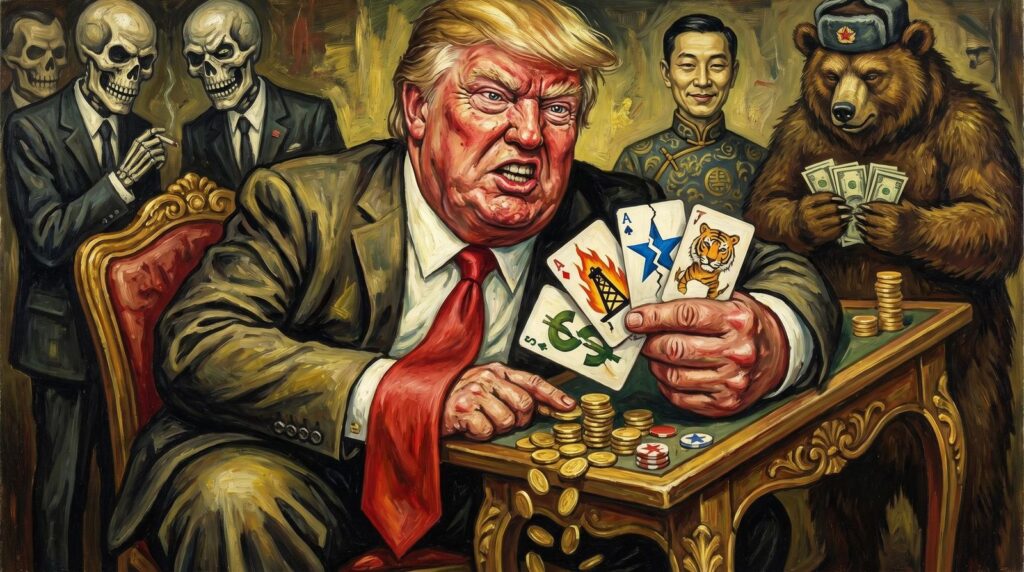
The Losing Hand
The hand America holds right now is not unplayable. The dollar is still the world’s dominant reserve currency. NATO, battered as it is, remains the most capable military alliance in history. The US technology sector retains advantages in semiconductors, AI, and aerospace that no rival has yet replicated.
But a good hand played badly loses to a worse hand played well, and the gap is closing faster than any strategic adjustment can compensate for if the current policy trajectory continues. Every sanction imposed without strategic purpose trains a new economy to build around the dollar. Every ally threatened or humiliated does the political work of Eurasian integration that China and Russia could never accomplish by themselves. Every war entered without a clear exit strategy and won militarily but lost strategically consumes the readiness and resources needed for the competition that actually determines the century.
Wang Wen said he sometimes feels genuine sympathy for the American people. He should. They are not losing this game. Their government is throwing it, move by move, with great energy and complete obliviousness to the score.
As Wang Wen frames it: “The more the United States seeks to instigate war, the more China strives to uphold peace. For the United States, every war serves as another step down the ladder of decline. Conversely, for China, the longer it succeeds in maintaining peace, the more sustained and enduring its rise will be.”
That is not propaganda. That is compound interest, and the United States is on the wrong side of it. The empire is not collapsing. It is contracting. And every tactical win that produces a strategic loss accelerates the contraction by a margin that no future administration will be able to easily reverse. That is the bill being run up. The American people will pay it, long after the architects of the current strategy have left the stage.
* * *
Scott Ortkiese is the founder of Throughline Synthesis Group and writes on geopolitics, energy markets, and the architecture of global power. This article draws on a transcript of a conversation between Professor Wang Wen of Renmin University of China and Professor Glenn Diesen, recorded April 20, 2026.
Related reading
- American Empire in Ruins: The Unprovoked, Unconstitutional, and Catastrophic US-Israeli War on Iran
- How the Tehran and Delhi Settlements Expose a Petrodollar Already Gone, Gone, Gone, Taking the Bellicose American Empire With It.
- The Last Blunder: How the US-Israel Attack on Iran Killed the American Empire's Operating System
- Five Damned Good Reasons the Loss of the Petrodollar Means the Death of the American Empire