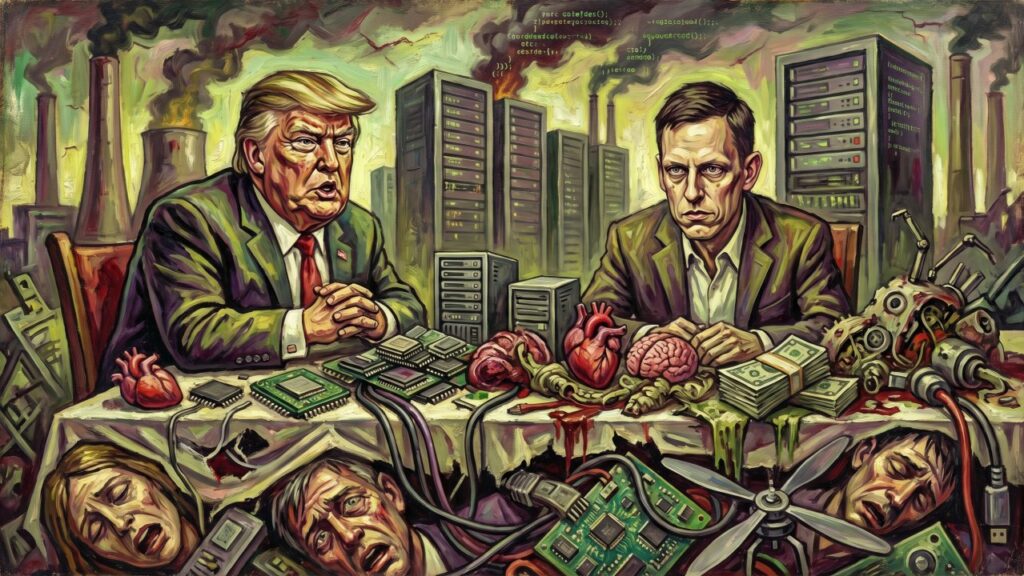
Ok, we have our idiot in charge. What’s next?
By Scott Ortkiese, April 26, 2026
so@throughlinesynthesis.com | www.throughlinesynthesis.com
Let us stop lying to ourselves. The United States did not accidentally stumble into this abyss. Americans elected Donald Trump, and in doing so handed sovereign power to a man perfectly suited for one historical task: serving as the political instrument of a class of tech oligarchs and capital pools that want the world reorganized around artificial intelligence at a civilizational scale.
Trump is not the engineer of this order. He is its useful idiot. He is the bellowing face, the signature at the bottom of the decree, the man vain enough and empty enough to translate the desires of oligarchs into state action without ever understanding the full structure he is helping to build. That is precisely why he is so valuable.
Peter Thiel and David Sacks belong to a stratum of power that no longer thinks in ordinary political terms. Their horizon is sovereign scale: data centers that consume regions, AI systems that mediate labor and war, financial structures that move faster than legislatures, and policy environments stripped of democratic drag.They do not want to persuade citizens. They want to route around them.
That is why this moment matters. When power wants to move at machine speed, democracy is treated not as a principle but as an obstacle. Elections become branding exercises, legislatures become delay mechanisms, regulators become nuisances to be captured or neutralized, and the law becomes a customized service purchased by the highest bidder.
Trump’s second term makes that alignment visible. In January 2025, he signed “Removing Barriers to American Leadership in Artificial Intelligence,” revoking the prior administration’s framework and explicitly ordering the federal government to clear away perceived obstacles to AI dominance. In December 2025, he signed “Ensuring a National Policy Framework for Artificial Intelligence,” an executive order designed to undercut state and local regulation, backed by a Justice Department litigation apparatus aimed at challenging sub-federal resistance. This was not some abstract statement of technological ambition. It was a declaration that the federal executive would be used as a battering ram against democratic friction itself.
David Sacks is not a side character in this story. He is the Sacks who matters here: the former PayPal executive, venture capitalist, Trump-appointed AI and crypto czar, and a long-time figure in the Thiel-adjacent orbit of Silicon Valley power. Press reporting and policy analysis tied him directly to the administration’s AI agenda and raised concerns that he was helping shape rules for sectors in which he had extensive financial exposure. That is not a bug in the system. It is the system announcing what it has become.
Thiel’s role is older, deeper, and in some ways worse. He represents the ideology beneath the machinery: contempt for democratic constraint, romance with private sovereignty, and a preference for rule by insulated elites who see ordinary people as manipulable populations rather than citizens. His networks supply personnel, money, and worldview. Trump supplies the spectacle, the grievance, and the presidential pen.
Lindsey Graham belongs in this indictment not because he is a visionary, but because every oligarchic order needs political retainers who normalize the madness, flatter the sovereign, and carry the script from donor rooms to cable television. His type is indispensable to the regime: shameless enough to bless escalation, obedient enough to defend any outrage, hollow enough to call it patriotism.
Across the Atlantic, Ursula von der Leyen performs the complementary role. She is cast as the civilized regulator, the responsible guardian of European values, the administrator of “digital sovereignty.” Yet the process beneath that image has been saturated by corporate lobbying and repeated dilution. Studies of EU digital and platform policy documented intensive lobbying strategies by major technology firms, while reporting on the AI Act and related simplification efforts described a regulatory framework narrowed and softened under sustained pressure from industry and competitiveness politics. The tone is different from Trump’s vulgarity, but the destination is recognizably similar: public authority bent around the requirements of concentrated private technological power.
This is why the usual language about “innovation” and “governance” is so dishonest. The real project is the creation of an AI order in which server farms, compute capital, proprietary models, surveillance systems, and investor networks outrank publics and parliaments. The state is not disappearing under this arrangement. It is being repurposed. It becomes the enforcer, subsidizer, land-clearer, contract issuer, and legal shield for private empires that would rather not endure meaningful democratic review.
And what of the people in whose name this all supposedly occurs? Here the indictment becomes harder, because it includes the public itself. Vast numbers of Americans have chosen sedation over citizenship. The population has been conditioned into a consumer reflex so comprehensive that distraction now passes for freedom. Sugar tablets, cars, vacations, gadgets, status signals, outrage feeds, and algorithmic amusements arrive in an endless stream, and in exchange the public gives up the habits required for self-government.
That laziness is not incidental to the crisis. It is part of the fuel. A population unwilling to think politically becomes easy to govern behaviorally. A people trained to seek stimulation rather than responsibility will not notice when executive orders quietly erase state authority, when ethics waivers normalize conflicts of interest, or when the infrastructure of AI is planted into the ground like a permanent occupation. The masses do not have to love oligarchy. They only have to remain too distracted, too atomized, and too comfortable to oppose it.
This is where the existential dimension enters. The end game is not merely corruption, nor merely inequality, nor merely another bad presidency. The end game is existential human loss. AI deployed under oligarchic command means labor stripped of dignity, social life subordinated to machine mediation, war accelerated by automated targeting and decision support, and public reality itself dissolved into synthetic manipulation at industrial scale. It means an order in which human beings are progressively recoded as inputs: data to be harvested, behavior to be predicted, attention to be monetized, bodies to be tracked, and risk to be priced.
Nothing about that future contains kindness. Efficiency does not contain kindness. Scale does not contain kindness. Venture logic does not contain kindness. Trump does not contain kindness. And systems built by men like Thiel and Sacks, then legalized by men like Trump and politically laundered by figures like von der Leyen, will repay humanity exactly according to their internal design: with everything but kindness.
Resistance therefore cannot remain rhetorical. It has to become material, legal, local, and punitive.
-
It must attack the physical bottlenecks of the AI regime: land use, energy access, water rights, tax abatements, transmission build-outs, procurement pipelines, and permits for hyperscale data-center construction.
-
It must turn sub-federal institutions into sites of refusal, forcing states, cities, utilities, and courts to resist federal preemption and impose binding constraints where they still can.
-
It must treat conflicts of interest not as background noise but as disqualifying proof of regime capture, especially when AI officials retain financial interests in sectors they govern.
-
It must make labor refusal central, because no AI empire functions without engineers, electricians, logistics workers, water systems, construction crews, and public-sector implementation.
-
It must recover the moral language that consumer civilization has tried to erase: betrayal, cowardice, theft, domination, desecration, and complicity.
The first enemy is not only Trump. It is also the passivity that made Trump useful. It is the softness that lets obvious predators present themselves as visionaries. It is the childish American belief that convenience is compatible with freedom, that endless consumption is compatible with citizenship, and that a civilization can surrender its institutions to oligarchs without eventually surrendering its people as well.
The title of this age should be stated without flinching: the humans elected a useful idiot for AI, and they will be repaid with everything but kindness. That repayment is already underway in the law, in the infrastructure, in the capture of public institutions, and in the dull, narcotized public spirit that still refuses to grasp the scale of the crime.The question is no longer whether the alignment exists. The question is whether enough human beings can recover the will to break it before the machine order they enabled becomes the only order they are allowed to inhabit.
Related reading
- The AI Oligarchs Delivered a “Useful Idiot” as the American President
- Altman's Desperation & The Shakedown Republic: How Trump and the AI Oligarchy Turned a Bubble Into a Protection Racket
- Diogenes Found His Honest Man, Elon Musk, And the Uni-Party Promptly Destroyed Him
- Larry Page Built Google on Public Funds, Then Fled California to Avoid the Wealth Tax He Funded Democrats to Support