A Follow-Up Analysis to “A Tale of Three Climate Change Dupes”
EXECUTIVE SUMMARY
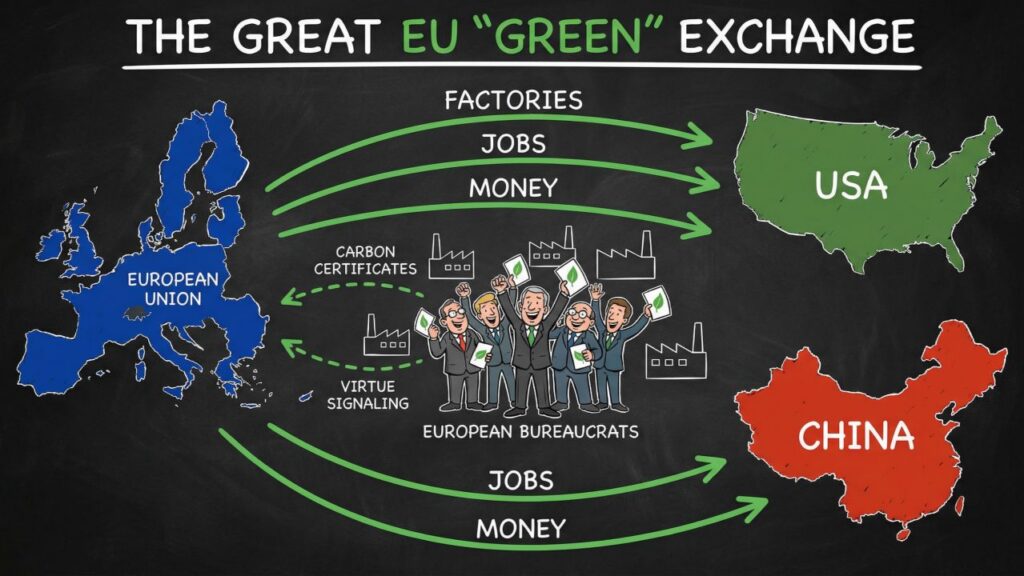
My previous analysis documented how the United Kingdom, Germany, and Japan have achieved certain economic destruction through climate policy while accomplishing nothing whatsoever for global emissions. This follow-up examines the destination of the factories, investment, and jobs that European climate policy is systematically destroying, and demonstrates that the transfer produces not merely zero net environmental benefit, but positive emissions: global emissions are measurably higher because of production relocation than they would have been had manufacturing remained in Europe.
The Inflation Reduction Act has catalyzed $493 billion in clean energy investment since August 2022, a 71% increase from the preceding two-year period, with manufacturing investment alone quadrupling from $22 billion to $89 billion. Half of these manufacturing investments come from foreign companies, many of them European firms escaping the very energy costs and carbon pricing their own governments have imposed. The United States has weaponized industrial policy to capture European manufacturing at precisely the moment Europe has weaponized climate policy to destroy it.
Meanwhile, the factories that do not relocate to America migrate to China and Asia, where production on coal-heavy grids with 582 grams of CO₂ per kilowatt-hour generates 2.7 times the emissions of production on Europe’s increasingly clean grid at 213 gCO₂/kWh. The carbon leakage documented in academic literature, where 14-15% of domestic emission savings are offset by foreign emission increases, represents an average that obscures the reality: production moving to China’s coal-dominated grid produces substantially more emissions than European production ever did.
The economic destruction documented in “A Tale of Three Climate Change Dupes” now has a complementary outcome: environmental destruction through production relocation. Europe’s climate dupes have achieved the worst of all possible worlds, maximum economic pain for negative environmental gain.
PART I: THE INFLATION REDUCTION ACT AS INDUSTRIAL CAPTURE
America’s $493 Billion Manufacturing Magnet
The scale of American industrial policy dwarfs anything Europe has ever attempted, and it was explicitly designed to attract the manufacturing investment that European climate policies are driving away.
Since the Inflation Reduction Act’s passage in August 2022, actual business and consumer investment in clean technologies has totaled $493 billion, a 71% increase from the two-year period preceding the legislation. In the second quarter of 2024 alone, clean investment represented 5.5% of all private investment in the United States, and since the IRA’s enactment, clean investment has accounted for more than half of total US private investment growth. Investment in manufacturing clean energy and transportation technology posted the fastest growth, totaling $89 billion in the post-IRA periodmore than quadruple the $22 billion invested in the two years prior.
The CHIPS and Science Act adds further gravitational pull: $52.7 billion in semiconductor subsidies, with $39 billion designated for manufacturing facilities. Intel secured $8.5 billion in CHIPS funding, TSMC received $6.6 billion, Samsung obtained $6.4 billion, and Micron was awarded $6.14 billion. Micron alone committed $200 billion to semiconductor manufacturing in Idaho and New York, creating 70,000 direct and indirect jobs, the largest private investment in the history of both states.
The combined effect of the IRA and CHIPS Act has generated $388 billion in announced investments and 135,800 new jobs through November 2024 to 181 IRA projects with $116 billion and 99,500 jobs, plus 37 CHIPS projects with $272 billion and 36,300 jobs. These are not projected figures or consultant fantasies; these are announced commitments tracked in real time.
The European Exodus to American Subsidies
The critical fact that transforms industrial policy into industrial capture is this: half of IRA manufacturing investments come from foreign companies. Representatives from American states including Georgia, Ohio, and Michigan have traveled throughout Europe explicitly to attract European developers with IRA subsidies, and the governors of Illinois, Michigan, and Georgia visited the World Economic Forum in Davos in January 2023 specifically to promote their states as destinations for clean energy investments.
European companies responded exactly as economic logic would predict. BMW announced a $1 billion investment in its Spartanburg campus to retool for EV production plus an additional $700 million for battery manufacturing in Woodruff. Volkswagen selected North America over Europe for its third EV battery cell plant (with 90 GWh capacity in St. Thomas, Canada) because it calculated it could claim upwards of $10 billion in subsidies and loans through the IRA over the facility’s lifetime. Thomas Schmall, Volkswagen Group Board Member for Technology, stated explicitly: “This investment represents a milestone in our journey toward a fully electric future. By collaborating with Patriot Battery Metals, we are not only securing key raw materials for cutting-edge, sustainable battery technology but also reinforcing our commitment to North America“.
The European Commission’s Margrethe Vestager acknowledged the threat directly, warning that IRA subsidies risked “luring some of our EU businesses into moving investments to the US”. A European Parliament study noted with alarm that “Firms that already decided to relocate part of their production to the US will happily take up the new subsidies and compete on equal footing with US firms” while European producers face structural disadvantage from both energy costs and carbon pricing.
South Korean companies have announced the most projects, approximately three dozen since August 2022, but European and Japanese companies are following. The IRA’s uncapped tax credits, combined with American industrial electricity prices at $0.08/kWh versus Germany’s $0.19/kWh, create economic incentives so powerful that no corporate fiduciary can responsibly ignore them.
The Energy Cost Chasm That Drives Relocation
The energy price differential between America and Europe has become so severe that INEOS CEO Stephen Dossett declared, in language that cut through corporate euphemism, that “Europe is committing industrial suicide“.
German industrial electricity prices averaged €0.19 per kilowatt-hour in 2024 compared to just €0.08 in the United Statesmore than double. UK industrial electricity prices reached 26.63 pence per kWh (approximately €0.31/kWh)four times higher than American rates and the highest in the entire developed world. A 2024 DIHK survey revealed that 37% of German industrial companies are considering reducing production or relocating abroad due to energy costs, rising to 45% among energy-intensive industries and 51% among large industrial companies with 500 or more employees.
The structural nature of this disadvantage cannot be overcome through efficiency improvements. When Dossett announced INEOS’s October 2025 closure of two production units in Rheinberg, Germany, eliminating 175 jobs, he articulated the mechanism with devastating clarity: “While competitors in the US and China benefit from cheap energy, European producers are being priced out by our own policies and absence of tariff protection. Meanwhile, high-emission imports flood our market unchecked. It’s completely unsustainable”.
Dossett’s further observation captures the environmental absurdity: “We’ve reached the point where well-invested, efficient European plants are closing, while global emissions rise. It’s not just economic madness. It’s environmental hypocrisy“.
PART II: THE POSITIVE EMISSIONS OUTCOME
Carbon Leakage Rates Understate the Damage
The academic literature on carbon leakage establishes that domestic emission reductions are partially offset by foreign emission increases. A comprehensive European Parliament study found that on average, approximately 15% of domestic emission savings are offset by additional foreign emissions, with the range of estimates spanning 5% to 25%. The EU’s CO₂ emissions embodied in net imports increased from 11% to 17% of the EU’s carbon footprint between 1990 and 2017. Research on developing countries found carbon leakage rates of 5-20%, remaining around 14%.
But these average leakage rates systematically understate the environmental damage when production moves specifically to coal-heavy grids. The leakage rate measures the percentage of domestic savings offset by foreign increases, but it does not capture scenarios where foreign emissions exceed what domestic emissions would have been.
China’s electricity grid emits 582 grams of CO₂ per kilowatt-hour, significantly above the global average of 480 gCO₂/kWh and 2.7 times higher than Europe’s grid at approximately 213 gCO₂/kWh. When BASF relocates €10 billion of chemical production from Ludwigshafen to Zhanjiang, the electricity powering that production generates nearly three times the emissions per unit of output. When steel production moves from Port Talbot to Chinese blast furnaces, the carbon intensity increases rather than decreases. When Northvolt’s European battery ambitions collapse and American company Lyten acquires the assets, production that would have occurred on Scandinavia’s clean grid relocates to jurisdictions with higher carbon intensities.
The “zero net environmental benefit” thesis from “A Tale of Three Climate Change Dupes” was, in retrospect, too generous. The actual outcome is positive emissionsmeasurably higher global emissions than would have occurred had production remained in Europe, because production relocation does not merely maintain emissions; it increases them through grid carbon intensity differentials.
The China Grid Problem
China generated 58% of its electricity from coal in 2024, accounting for 55% of global coal generation. China’s power sector emitted 5,491 million tonnes of CO₂ in 2023, more than three times the United States (1,570 MtCO₂) and India (1,404 MtCO₂). At 582 gCO₂/kWh, China’s grid carbon intensity is the fourth highest globally despite modest improvements over the past two decades.
When European climate policy forces energy-intensive manufacturing to relocate, production does not migrate to equally clean jurisdictions. It migrates to jurisdictions where energy is cheapest, which means coal-powered jurisdictions with higher emissions per unit of output. BASF’s €10 billion Zhanjiang Verbund site will draw electricity from Guangdong’s coal-heavy grid rather than Germany’s increasingly renewable grid. The chemical production continues; the emissions increase.
Research using Danish firm-level data demonstrated that “import competition from China strongly increases global carbon emissions” because Chinese production is more carbon-intensive than European production. The mechanism is straightforward: when carbon pricing makes European production uncompetitive, Chinese manufacturers capture market share using coal-fired electricity. European consumption patterns do not change; production location changes, and with it, the carbon intensity of that production.
The European Commission’s Carbon Border Adjustment Mechanism, which entered its definitive phase in October 2025, attempts to address this leakage, but the mechanism covers only six sectors (cement, iron and steel, aluminum, fertilizers, electricity, and hydrogen) and does not include export rebates. By the time CBAM is fully implemented with required certificate purchases in 2026 and expansion to all ETS sectors by 2030, much of European heavy industry will have already relocated. The horse will have long since left the stable that CBAM attempts to close.
Supply Chain Emissions Compound the Damage
Production relocation does not merely increase emissions through grid intensity differentials; it also increases emissions through extended supply chains. Moving a chemical plant from Ludwigshafen to Zhanjiang or a battery factory from Sweden to Texas adds thousands of miles to supply chains serving European markets.
Supply chains have become “more complex, interconnected, and time-sensitive,” increasing dependency on high-emission transport modes including long-haul trucking, container shipping, and air freight. Global “food miles” research found that transportation accounts for nearly one-fifth of total food-system emissions, with international transport responsible for 3 billion tonnes of CO₂ equivalent annually. Freight transport grew 68% between 2000 and 2015 and is projected to grow 3.3 times by 2050, with emissions from freight growing faster than emissions from passenger transport.
When European consumers purchase steel produced in China rather than Port Talbot, the production emissions are higher and the transport emissions are added. When German automakers source batteries from North American gigafactories rather than domestic production, the supply chain extends thousands of miles and the environmental impact compounds. The “zero net environmental benefit” analysis in the previous article assumed production relocation maintained equivalent emissions; the positive emissions reality is that relocation increases production emissions through grid intensity differentials and adds transport emissions through extended supply chains.
Transportation is often blamed as the largest driver of supply chain emissions, but raw material inputs from heavy industries (aluminum, steel, chemicals) constitute the largest share. Producing one tonne of primary aluminum generates approximately 10 tonnes of CO₂e; shipping that aluminum around the world adds less than 1 tonne. However, when that aluminum production moves from a clean European grid to a coal-powered Chinese grid, the production emissions increase by 2-3x while transport emissions are additive. Both effects are negative for global emissions.
PART III: THE WEAPONIZATION OF POLICY
America Weaponizes Industrial Policy
The United States has understood something that European policymakers refuse to acknowledge: in a world of mobile capital and globalized production, the jurisdiction that offers the lowest costs and highest subsidies captures manufacturing regardless of where nominal demand exists.
The IRA’s design reflects this understanding explicitly. Tax credits are uncapped, meaning the private sector may invest more capital than originally predicted (and already has, with actual investment exceeding original projections. The credits are transferable and refundable, making them accessible to companies without US tax liability) including foreign companies relocating from Europe. The credits focus on operational expenditures rather than capital expenditures, pushing down production costs for a decade rather than merely subsidizing initial investment. And critically, the credits apply to any company manufacturing in America, regardless of corporate nationality, explicitly inviting European firms to relocate production.
The Peterson Institute observed that “the IRA is discriminatory, protectionist, and against World Trade Organization rules”, but noted that it offers US-based investments one particular advantage over European green policies: “speed and simplicity“. While European companies navigate complex grant applications, regulatory approvals, and multi-layered bureaucratic processes, American companies claim tax credits through standard tax filings. The contrast is not merely quantitative but qualitative: America’s industrial policy is designed to attract investment; Europe’s climate policy is designed to impose costs.
American state governments have amplified federal incentives with their own inducements. Representatives from Georgia, Ohio, and Michigan traveled throughout Europe specifically to attract developers with combined federal and state subsidies. The result is a coordinated federal-state industrial capture mechanism that European climate bureaucracies cannot match and have not attempted to counter.
Europe Weaponizes Climate Policy Against Itself
European climate policy was designed, whether through intention or institutional capture, to impose costs on European production while leaving competing production unaffected. The EU Emissions Trading System imposes carbon costs on European manufacturers but not on importers. European electricity prices reflect renewable energy surcharges, grid costs, and carbon components that competing jurisdictions do not impose. European regulatory requirements (chemical regulations, environmental assessments, labor rules) add compliance costs that producers in other jurisdictions do not bear.
The result is structural competitive disadvantage that cannot be overcome through efficiency gains. INEOS’s Dossett articulated the mechanism: “Unlike the US, which has imposed strong tariffs to block the flood of cheap chemicals from Asia, many made using discounted Russian oil & gas, Europe continues to leave its markets wide open”. European policy imposes costs on European producers while permitting cost-free access to European markets for competing producers operating under different rules.
The Carbon Border Adjustment Mechanism represents a belated recognition of this asymmetry, but CBAM covers only six sectors, excludes downstream products, provides no export rebates, and will not require full certificate purchases until 2026. European chemical production will have largely relocated before CBAM provides meaningful protection. The stable door is being closed years after the horse departed.
The strategic asymmetry is now complete: America weaponizes industrial policy to capture manufacturing, while Europe weaponizes climate policy to destroy manufacturing. The jurisdictions are not competing for the same outcome; they are pursuing opposite objectives. America seeks to manufacture; Europe seeks to decarbonize. In a world of mobile capital, the jurisdiction that seeks to manufacture wins the manufacturing, and the jurisdiction that seeks to decarbonize achieves deindustrialization.
Capital Follows Costs, Not Ideology
The previous analysis documented how ESG funds have consistently underperformed traditional investments while claiming to advance climate objectives. This capital allocation dysfunction has a complementary effect: while European manufacturers face capital constraints from ESG-focused investors, American manufacturers access abundant capital from private credit markets unconstrained by ESG mandates.
Private credit-backed companies employed 811,000 people in 2024, paid $87 billion in wages, and contributed $145 billion to GDP. Private credit supports more than 201,000 manufacturing jobs through financing for equipment upgrades, production capacity expansion, and acquisitions. Seventy percent of borrowers use private credit because they are “too small for bank syndication,” while 91% cite faster execution, 82% cite larger loan sizes, and 77% cite more flexible terms.
The capital that would finance European manufacturing expansion is constrained by ESG screening that excludes energy-intensive industries, while the capital financing American manufacturing expansion is constrained only by credit quality and return expectations. European manufacturers seeking to expand face capital providers questioning carbon intensity; American manufacturers seeking to expand face capital providers questioning cash flow coverage. The questions are different because the capital allocation frameworks are different, and the framework that prioritizes returns over carbon will finance more manufacturing than the framework that prioritizes carbon over returns.
PART IV: THE EXODUS CONTINUES
The Chemical Industry Flight
The chemical industry closures documented in “A Tale of Three Climate Change Dupes” have accelerated in the months since that analysis. INEOS confirmed in October 2025 the closure of its allyl and chlorine production plants in Rheinberg, Germany, with the loss of 175 jobs, following previous closures in Grangemouth (UK), Geel (Belgium), and Gladbeck (Germany), plus mothballed assets in Tavaux (France) and Martorell (Spain).
Dow announced the shutdown of three European sites including an ethylene cracker in Böhlen, Germany, and chlor-alkali assets in Schkopau. Solvay shut its 160,000-ton polycarbonate plant in Stade, Germany. Shell closed paraxylene assets in Germany and MEK facilities in the Netherlands. ExxonMobil confirmed closure of its 800,000-tonne-per-year ethylene cracker at Fife, Scotland, in February 2026, explicitly blaming “the UK’s current economic and policy environment” and flagging “the impact of the UK’s carbon tax, which is imposed on ethylene producers but not on importers”.
Chemical output in Germany has declined 18% since 2019. Capacity utilization in the German chemical industry plummeted to 74.7%, falling well below the 82% profitability threshold for the fourth consecutive year. The European Commission estimates more than 20 major chemical production site closures over the past two years, with up to 20,000 job losses.
These closures are not temporary or cyclical. They represent permanent capacity destruction. The factories will not reopen when energy prices decline because the capital has been redeployed elsewhere, to BASF’s Zhanjiang facility, to American chemical plants accessing cheap natural gas, to Asian producers operating on coal-fired electricity without carbon pricing. European climate policy has achieved irreversible deindustrialization of the chemical sector.
The Steel and Automotive Catastrophe
ArcelorMittal abandoned plans to produce green steel in Germany in June 2025, explicitly citing energy costs too high to convert its Bremen and Eisenhüttenstadt plants to carbon-neutral production. The company indefinitely delayed all planned Direct Reduced Iron investments across Europe. This is not a pause; this is a strategic retreat from European steelmaking.
Volkswagen’s plans to close at least three factories in Germany, the first closures in the company’s 87-year history, with 35,000 job cuts by 2030 including 15,000 in Wolfsburg, reflects VW’s calculation that German manufacturing costs 50% more than budgeted, making German plants twice as expensive as competitors in other jurisdictions. While closing German factories, VW is simultaneously investing billions in North American battery production through PowerCo, explicitly acknowledging that North American subsidies justify locating capacity there rather than in Europe.
Audi announced elimination of 7,500 positions in Germany by 2029 to 14% of its German workforce, citing “immense challenges” from rising Chinese competition and weak EV demand. Bosch announced 22,000 job cuts in September 2025, the largest in company history. The automotive sector that was Germany’s crown jewel is being systematically dismantled.
The Battery Industry Collapse
Northvolt’s bankruptcy in 2024 and subsequent acquisition by American company Lyten encapsulates European climate policy’s failure to build the green industries that were supposed to replace the brown industries being destroyed. Northvolt raised billions to become Europe’s battery champion; it collapsed under the weight of European energy costs and regulatory burden. Lyten, an American company, acquired all remaining assets including the Ett facility in Skellefteå, Labs in Västerås, and the planned Drei facility near Heide.
The battery industry that was supposed to anchor Europe’s electric vehicle transition is now substantially American-owned. Tesla operates gigafactories in Texas and Nevada at costs that Northvolt could never match. Ford’s $9.2 billion BlueOval Battery Park in Michigan, GM’s Ultium partnerships, and Volkswagen’s PowerCo investments in North America demonstrate where battery manufacturing is concentrating, and it is not Europe.
European climate policy destroyed coal plants, nuclear plants, and chemical plants. It was supposed to create battery plants, solar manufacturing, and wind turbine production to replace them. Instead, the replacement industries are being built in America and Asia while Europe experiences industrial decline without industrial replacement.
PART V: THE SYNTHESIS, WEAPONIZED POLICY OUTCOMES
The Environmental Outcome: Positive Emissions
The environmental outcome of European climate policy can now be stated with precision:
Global emissions are higher because of European climate policy than they would have been without it.
This statement requires careful parsing. European climate policy has reduced emissions within European borders. But European climate policy has simultaneously relocated emissions-intensive production to higher-emitting jurisdictions, increased transport emissions through extended supply chains, and eliminated manufacturing capacity that would have decarbonized alongside Europe’s electricity grid.
The net effect (considering leakage rates of 14-15%, grid carbon intensity differentials of 2.7x between China and Europe, and additive transport emissions from extended supply chains) is that global emissions are measurably higher than they would have been had manufacturing remained in Europe.
This is not “zero net environmental benefit.” This is negative environmental benefitpositive emissions relative to the counterfactual of no climate policy.
European climate dupes have achieved the worst possible outcome: certain economic destruction combined with measurable environmental harm.
The Economic Outcome: Industrial Capture
The economic outcome is equally stark: America has captured the manufacturing capacity that Europe destroyed.
The $493 billion in clean investment since August 2022, with manufacturing investment quadrupling and half coming from foreign companies, represents systematic transfer of industrial capacity from jurisdictions that impose costs to jurisdictions that offer subsidies. The European chemical plants closing in Rheinberg and Grangemouth are not matched by European chemical plants opening elsewhere; they are matched by American and Chinese chemical plants capturing their market share. The European battery factories that failed (Northvolt) are not replaced by European battery factories succeeding; they are replaced by American battery factories (Lyten, Tesla, Ford, GM) capturing the supply chain.
Europe’s €520 billion Energiewende investment and €696 billion total energy transition expenditure have purchased deindustrialization. America’s $493 billion IRA investment has purchased reindustrialization. The capital was comparable; the outcomes were opposite, because the policy designs were opposite.
Who Benefits from This Outcome?
The beneficiaries of European climate policy’s failure are readily identifiable:
American workers gain jobs in semiconductor fabs, battery factories, and chemical plants that European policy drove to American shores. The 135,800 jobs announced under IRA and CHIPS represent employment transferred from European workers to American workers.
Chinese industrial companies gain market share when European producers close facilities that Chinese producers can serve using cheaper coal-fired electricity. BASF’s €10 billion Zhanjiang investment benefits Chinese workers and the Chinese state, not German workers or the German state.
Global emissions increase when production moves from Europe’s 213 gCO₂/kWh grid to China’s 582 gCO₂/kWh grid. The atmosphere does not care about national emission inventories; it cares about total emissions, and total emissions increase when production relocates to higher-emitting jurisdictions.
The climate consulting complex continues profiting regardless of outcomes. McKinsey, BCG, and Deloitte earn fees advising European governments on climate policy while simultaneously advising American states on industrial attraction strategies. They are indifferent to which jurisdiction succeeds because they profit from both.
International climate bureaucracies maintain relevance and budget authority regardless of emission outcomes. The UNFCCC secretariat, IPCC, and Conference of Parties apparatus do not measure success by emission reductions actually achieved; they measure success by commitments made and conferences held. Rising global emissions do not threaten their institutional position; they justify expanded mandates.
The losers are equally identifiable: European workers who lose jobs, European communities that lose industrial anchors, European governments that lose tax base, and the global atmosphere that receives more emissions than it would have absent European climate policy.
CONCLUSION: THE TWIN CATASTROPHES
The previous analysis, “A Tale of Three Climate Change Dupes,” documented how the United Kingdom, Germany, and Japan have achieved certain economic destruction through climate policy while accomplishing nothing whatsoever for global emissions. This follow-up analysis adds a complementary finding: the manufacturing capacity destroyed by European climate policy has been captured by American industrial policy and Chinese coal-powered production, with measurably higher global emissions as the outcome.
The twin catastrophes are now complete:
Economic catastrophe: €520+ billion in German energy transition costs, £183 billion in UK energy crisis costs, $400-500 billion in Japanese excess fuel costs, trillions of dollars in total, have purchased deindustrialization, factory closures, and job losses while American industrial policy captured the relocated investment with $493 billion in clean energy commitments and 135,800 announced jobs.
Environmental catastrophe: Production relocation from Europe’s 213 gCO₂/kWh grid to China’s 582 gCO₂/kWh grid increases emissions by 2.7x per unit of output. Carbon leakage rates of 14-15% understate the damage because they measure averages rather than coal-specific relocation. Transport emissions from extended supply chains are additive. The “zero net environmental benefit” thesis was too generous; the actual outcome is positive emissions, measurably higher global emissions than would have occurred absent European climate policy.
The three climate dupes have not merely destroyed their own economies while achieving nothing for global emissions. They have destroyed their own economies while increasing global emissions, because the production they eliminated did not disappear; it relocated to dirtier jurisdictions with longer supply chains.
America understood that industrial policy attracts manufacturing. Europe understood that climate policy imposes costs. In the competition between attracting and imposing, attracting wins, and the factories, jobs, investment, and emissions migrate to the jurisdiction offering attraction rather than imposition.
The United States is not decarbonizing faster than Europe. But it is reindustrializing while Europe deindustrializes. The environmental outcomes are negative for both: America’s grid remains more carbon-intensive than Europe’s, while Europe’s manufacturing relocation increases emissions through the China channel. But the economic outcomes diverge: America builds factories and creates jobs while Europe closes factories and destroys jobs.
European climate policy has achieved the worst of all possible worlds: maximum economic destruction for negative environmental outcomes. The three climate dupes have paid with their industrial futures to increase global emissions while enriching American workers, Chinese industrialists, and the international consulting class that profits regardless of environmental results.
History will not record the United Kingdom, Germany, and Japan as climate pioneers who sacrificed prosperity for planetary benefit. History will record them as cautionary tales, wealthy, technologically sophisticated democracies that destroyed their industrial capacity while making the climate problem measurably worse, transferring wealth and jobs to competitors while the architects of their self-destruction continued profiting.
The great reshoring is not an American success story. It is a European failure story with American beneficiaries. And the emissions that European climate policy was supposed to reduce have not reduced at all, they have merely relocated, multiplied, and continued rising to record highs year after year while the factories that once produced them in Europe stand silent, abandoned, and rusting in the December rain.
Related reading
- The Climate Hoax, Europe's Industrial Base Was Dismantled Before the World's Eyes, While the Press Said Nothing
- Europe’s Private Credit Market Is Unsupervised and Untested
- Europe’s Sleepwalk Toward a Bigger War: Why Real Peace in Ukraine Requires a Pan‑European Settlement With Russia, Not Another Cosmetic Ceasefire
- From Peace Marchers to War Profiteers: How Europe's Left-Green Establishment Betrayed Everything It Claimed to Stand For, And Why Five Countries Refuse