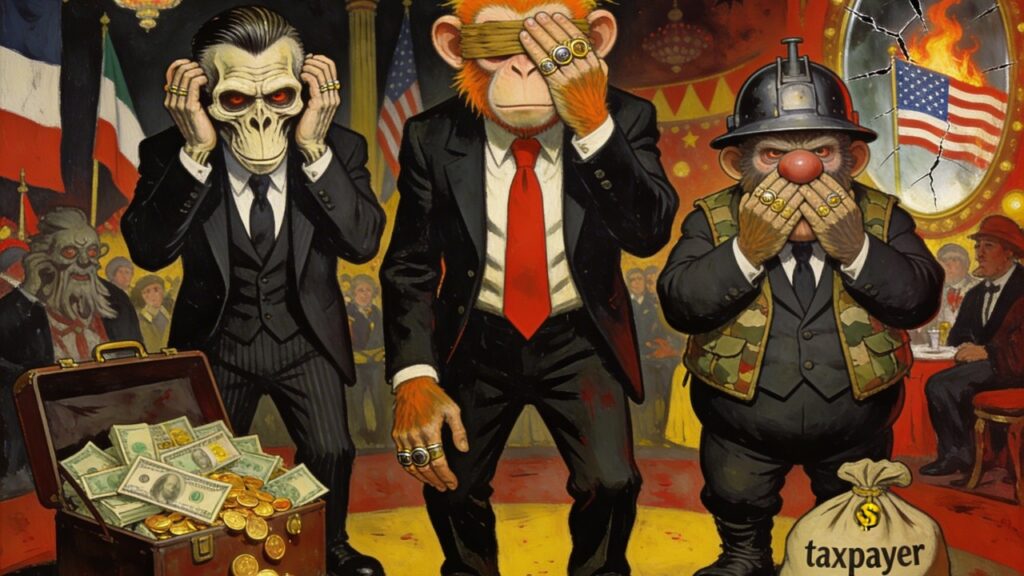
There is a word for what is described in the pages that follow. The word is corruption. Not alleged corruption. Not the appearance of corruption. Documented, timestamped, on-the-record corruption of a kind that would have ended any previous presidency and sent its practitioners to federal court. The difference between now and then is not that the law has changed. It is that the Republican Party has decided, with remarkable unanimity, that the law does not apply to this family.
Don Jr. and the $670 Million Minerals Deal
On March 24, 2026, Congresswoman Maxine Dexter, the top Democrat on the House Natural Resources Oversight and Investigations Subcommittee and a triple-board-certified physician representing Portland, Oregon, formally motioned to subpoena Donald Trump Jr. to testify under oath before Congress. Republicans on the subcommittee voted to block the subpoena and then immediately shut down the hearing to prevent further debate. They did not argue that the underlying facts were wrong. They simply left the room.
The facts are these. In August 2025, 1789 Capital, a venture capital firm where Donald Trump Jr. serves as a named partner with a $4 million personal stake, invested in Vulcan Elements, a small rare earth minerals startup. Three months later, the Trump administration committed $620 million to Vulcan Elements through the Pentagon’s Office of Strategic Capital, the largest loan that office has ever issued in its history. The Commerce Department subsequently took a $50 million equity stake in the company under CHIPS Act provisions. Total taxpayer commitment: $670 million, flowing to a startup whose most notable characteristic is that the president’s son had invested in it three months before.
Vulcan’s valuation went from $200 million to a projected $2 billion on the strength of that government commitment. There was no competitive procurement process. There was no independent technical review made public. There was no conflict-of-interest disclosure from the White House. There was, however, a congressional subpoena motion, and Republicans left the room rather than vote to investigate it.
The Hunter Biden standard deserves to be stated plainly. Republicans subpoenaed Hunter Biden, voted to hold him in criminal contempt of Congress, and spent two years and tens of millions of dollars in investigative resources pursuing a man who served on a private company’s board while his father was Vice President. Hunter Biden held no government role. He made no policy decisions. He directed no taxpayer funds. Donald Trump Jr. has a financial stake in a company that just received the largest Pentagon loan of its kind ever issued, three months after he invested in it. Every Republican who blocked Maxine Dexter’s subpoena on March 24 is now on record applying a different legal and ethical standard to the president’s son than they applied to the previous president’s son.
Jared Kushner: The Shadow Secretary of State Who Charges Admission
If the Don Jr. situation is brazen, Jared Kushner’s operation is something more structurally alarming: a private equity firm that functions as a parallel foreign policy apparatus, funded by the governments whose geopolitical interests it is simultaneously shaping.
After leaving the first Trump administration in January 2021, Kushner immediately launched Affinity Partners, a Miami-based private equity firm, and began raising money from Middle Eastern sovereign wealth funds. Saudi Arabia’s Public Investment Fund, controlled by Crown Prince Mohammed bin Salman, committed $2 billion. The UAE’s Lunate fund and Qatar’s sovereign wealth authority subsequently committed an additional $1.5 billion. By the end of 2025, Affinity’s assets under management had reached $4.8 billion. By March 2026, they had jumped to $6.2 billion, a nearly 30 percent increase in a single year.
What did Saudi Arabia, the UAE, and Qatar receive in return for this capital? The Senate Finance Committee investigation provides the most damning answer: as of July 2024, Affinity had returned no profits whatsoever to its investors. Kushner had, however, collected more than $110 million in personal fees from the Saudi government alone for investment management services that produced nothing. The Saudi crown prince’s own advisers reportedly warned him that Kushner’s investment record did not justify a $2 billion commitment. MBS overruled them. This is not commercial investment. This is a payment structure designed to deliver money to a member of the president’s family while preserving the legal fiction of an arms-length business relationship.
Senator Ron Wyden, ranking member of the Senate Finance Committee, referred Kushner to the Department of Justice for possible violations of the Foreign Agents Registration Act. FARA requires anyone acting as an agent of a foreign government in a political or quasi-political capacity to register publicly and disclose their activities. Kushner, who is simultaneously a named special envoy conducting White House foreign policy negotiations, has not registered.
The Geneva Meeting and the War That Followed
The timeline is the most damning element of the entire story, and it has received insufficient attention in the coverage of the Iran war.
In the weeks before February 28, 2026, Kushner met with Iran’s Foreign Minister in Geneva as Trump’s “peace envoy.” Those meetings ended without a deal. Within days, the United States and Israel launched coordinated strikes on Iran. Trump, asked why he decided to attack, said he acted on the advice of “Steve [Witkoff] and Jared and Pete [Hegseth] and others.” Crown Prince Mohammed bin Salman, the man who controls the fund that committed $2 billion to Kushner’s firm, played a documented behind-the-scenes role lobbying Trump to attack Iran, Saudi Arabia’s primary regional rival.
The chain of financial interest is not complicated. Saudi Arabia paid Kushner $110 million in fees through Affinity Partners. Saudi Arabia wants Iran destroyed as a regional power. Kushner advised Trump to attack Iran. Trump attacked Iran. Saudi Arabia is now the primary beneficiary of the war’s energy economics, as Gulf oil revenues surge while Iranian supply is disrupted.
This is not a conspiracy theory. These are documented facts, each individually confirmed by the New York Times, Reuters, Bloomberg, the Senate Finance Committee, and the congressional investigation released on March 19, 2026. The question of whether they collectively constitute a violation of federal law is a question for prosecutors. The question of whether they constitute a conflict of interest of historic proportions is not a legal question at all. The answer is obviously yes.
The Balkan Real Estate Circuit
Kushner’s monetization of political relationships is not confined to the Middle East. It has extended to the Balkans with a specificity that borders on parody.
In December 2024, weeks before Trump’s inauguration and without a completed business plan or feasibility study, Albania’s government granted strategic investor status to Atlantic Incubation Partners LLC, a Kushner-linked entity, for a 1.4 billion euro luxury resort project on Sazan Island, a small uninhabited Mediterranean island that previously served as a military base. The Albanian Investment Corporation, a state entity, is a formal partner in the project. The Albanian Prime Minister Edi Rama approved the deal personally. No competitive tender was held. The deal was finalized in the final days of Biden’s presidency, in anticipation of Trump’s return to power.
In Serbia, a parallel scheme for a Trump-branded hotel development on the site of the former Yugoslav Army General Staff headquarters, buildings destroyed during NATO’s 1999 air campaign and subsequently designated as cultural monuments, collapsed in December 2025 when Serbian prosecutors charged four government officials with corruption in connection with the $500 million project. Kushner’s firm withdrew, citing a desire for “projects that unite rather than divide.” Serbian President Vucic claimed the withdrawal cost Serbia 750 million euros in foreign investment.
The pattern is consistent across every theater. Kushner arrives in a country. That country’s government, eager for proximity to the Trump White House, fast-tracks approvals, bypasses normal procedures, and commits state resources to Kushner’s projects. The projects generate fees and valuations. The political relationship is maintained. The local population, which had no vote on any of it, is left with either a luxury resort on a pristine island or a corruption scandal in their capital.
The Media Acquisition That Ties It Together
One element of the Kushner operation that has received less attention than it deserves is his firm’s involvement in the attempted Paramount-Warner Bros. Discovery merger, a transaction that, if completed, would give Kushner and his Gulf sovereign wealth fund backers influence over CNN, HBO, Warner Bros. Pictures, and one of the world’s largest libraries of media content.
The bid is backed by Affinity Partners and by the sovereign wealth funds of Saudi Arabia, the UAE, and Qatar. Any such acquisition requires approval from the Trump administration. The president’s son-in-law is seeking to acquire media assets that would need regulatory approval from the president. The foreign governments funding the acquisition are the same governments whose foreign policy interests Kushner is shaping as a White House envoy. The transaction has not been completed, but the structure of conflicts it embeds is without precedent in American media history. Rupert Murdoch built a right-wing media empire. He funded it with his own money and Australian commercial revenues. He was not simultaneously acting as a presidential foreign policy envoy while raising capital from the governments whose behavior he was purporting to shape.
The Standard Being Applied
Every dimension of what is documented here; the $670 million Pentagon loan to Don Jr.’s investment, the $110 million in fees from the Saudi government to Kushner with zero returns, the Geneva meetings followed by war advice followed by a Saudi geopolitical windfall, the Albanian island deal approved without a business plan, the Serbian corruption prosecutions, would have been a career-ending, administration-consuming scandal in any previous presidency of either party.
The Republican Party’s response has been to leave the hearing room.
The question Congresswoman Dexter was trying to ask under oath is straightforward: did Donald Trump Jr. know about the pending Pentagon loan when 1789 Capital invested in Vulcan Elements three months before it was announced? That question has a yes or no answer. Republicans blocked the subpoena that would have produced it.
The question Senator Wyden has been asking for two years is equally straightforward: is Jared Kushner acting as an unregistered foreign agent, taking money from foreign governments while shaping the foreign policy those governments are paying to influence? That question also has a yes or no answer. The Department of Justice, under Trump’s own Attorney General, has not pursued it.
When the institutions built to answer these questions refuse to ask them, the questions do not disappear. They become the record. And the record, at the end of this administration, will show exactly what was known, exactly what was documented, and exactly who chose to look away.
Related reading
- The U.S. Tariff Experiment: An Objective Assessment of Trump-Era Trade Policy
- Where’s the Business Plan for Trump's $200 Billion Iran "Ask"?
- Генерал «Предай-США» (Betray-U.S.), он же Дэвид Петреус, идеально иллюстрирует оксюморон: военная разведка
- General Betray-Us, aka David Petraeus, Perfectly Illustrates the Oxymoron: Military Intelligence