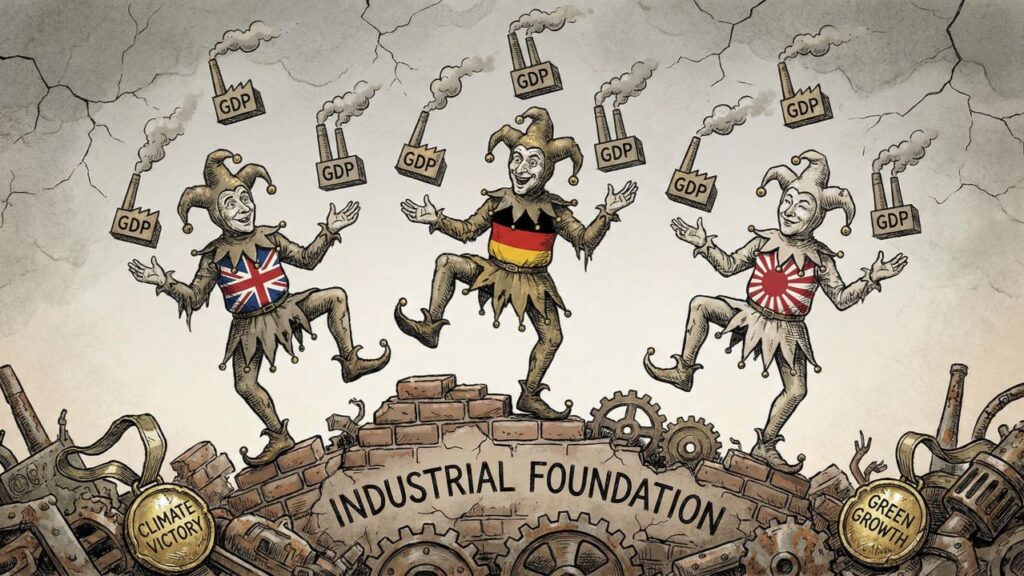
How Uncertain Climate Projections Created Certain Economic Destruction, While Achieving Nothing for Global Emissions
EXECUTIVE SUMMARY
Three of the world’s most advanced industrial economies (the United Kingdom, Germany, and Japan) have pursued aggressive energy transition and decarbonization policies based on climate projections of remarkably uncertain reliability. The result, now fully documented as we enter the final days of 2025, is quantifiable and devastating economic destruction: factory closures across entire sectors, mass industrial layoffs numbering in the hundreds of thousands, the wholesale manufacturing exodus to other continents, and persistent GDP contraction. Yet these policies achieve one measurable outcome with absolute certainty: they have accomplished nothing whatsoever for global emissions.
The fundamental policy paradox is stark and undeniable. These three nations have accepted documented economic destruction (measured in hundreds of billions of dollars in sunk costs, permanently lost industrial capacity, and careers destroyed) all in pursuit of uncertain climate benefits that rest on models that have repeatedly and dramatically overestimated warming. Meanwhile, the carbon emissions these nations eliminated through deindustrialization have been systematically offshored to higher-emitting jurisdictions, primarily in Asia, where those goods are now manufactured using coal-fired electricity grids.
The reality is devastating. Global CO₂ emissions from fossil fuels reached a record 37.4 billion tons in 2024, and the latest projections indicate they will rise to 38.1 billion tons in 2025, representing yet another record high. This trajectory continues despite trillions of dollars in climate transition investments. After three decades of international pledges, climate conferences, and increasingly aggressive decarbonization policies, global emissions have not merely failed to decline, they have reached unprecedented heights.
This is not a climate policy failure in the traditional sense. This is climate policy working precisely as designed by those who benefit from it: enriching consultants, financiers, and international bureaucrats while systematically destroying the domestic industrial capacity of competing nations and creating political lock-in structures so deeply entrenched that policy reversal has become institutionally impossible. The system was designed by its architects to be irreversible, and it has succeeded brilliantly at that objective.
The United Kingdom, Germany, and Japan are not climate leaders, contrary to their international positioning. They are climate dupes, nations that have been persuaded, through carefully constructed consensus mechanisms and institutional capture, to sacrifice their industrial heritage, their workers’ livelihoods, and their economic futures on the altar of a climate consensus that was manufactured by those who profit from it. These three nations have destroyed their own prosperity while enriching the global consulting class, the renewable energy industry, international climate bureaucracies, and financial institutions that collect fees on underperforming ESG funds.

PART I: THE ECONOMIC CATASTROPHE
Germany: Europe’s Industrial Powerhouse in Freefall
December 2025: The Moment of Reckoning
The moment of honest reckoning arrived on December 2, 2025, when the Federation of German Industries (BDI), the umbrella organization representing Germany’s industrial associations, issued its most severe warning to date about the state of the German economy. BDI President Peter Leibinger stated without equivocation that Germany’s economy is suffering its “deepest crisis since World War II” and is now “in free fall.” This was not the measured language of a trade association attempting to lobby for modest policy adjustments. This was an emergency alert from the nation’s industrial leadership.
Leibinger charged that the federal government under Chancellor Friedrich Merz is “not responding with sufficient determination” to the crisis and warned that Germany now requires “urgent structural reforms” to halt what he characterized as a death spiral of industrial decline. The language was apocalyptic because the situation had become apocalyptic. The BDI has reduced its 2025 industrial production forecast to a decline of 2.0 percent, down from the -0.5 percent forecast issued in March 2025. This downward revision was itself a striking admission of accelerating deterioration. The 2.0 percent decline marks the fourth consecutive year of contraction in industrial production. When Leibinger stated, “This is not a temporary economic dip, but a structural decline,” he was articulating what sophisticated observers had understood for years: Germany’s industrial foundation was being systematically destroyed by its own energy policies.
Germany’s manufacturing crisis stands in sharp relief compared with that of its European peers. While EU industrial production was 1 percent higher in Q3 2025 than in 2021, Germany’s industrial production was 5.4 percent lower over the same period. This divergence is not accidental. It reflects the fact that Germany has implemented more aggressive climate and energy transition policies than any other major European economy. The German manufacturing PMI fell to 43.0 in November 2025, representing a nine-month low, with new orders declining at the fastest rate in ten months and export orders falling for the thirty-first consecutive month. Thirty-first consecutive month. The manufacturing sector was in freefall.
The Staggering Cost of the Energiewende
To understand how a wealthy, technologically sophisticated nation with deep industrial traditions could have engineered its own economic destruction, one must examine the Energiewende, Germany’s energy transition program, which represents the most expensive energy policy experiment in the history of industrialized nations. A comprehensive 2016 study by the Düsseldorf Institute for Competition Economics estimated total costs through 2025 at over €520 billion in the electricity sector alone. The primary component of this staggering cost was €408 billion for the EEG levy, which is effectively a renewable energy surcharge paid by German consumers and businesses for decades. More recent analyses suggest that the true total cost of the Energiewende could reach €1 trillion by the end of the 2030s, depending on how the policy continues to evolve.
The true opportunity cost becomes apparent when one examines what would have happened had Germany made different choices. A 2024 study published in the International Journal of Sustainable Energy calculated that Germany’s Energiewende has cost an estimated €696 billion in total expenditure, €387 billion in direct investments plus €310 billion in subsidies distributed across the system. Had Germany instead maintained its existing nuclear plants, which were providing reliable, low-carbon baseload power, and invested in new reactor capacity, the cost would have been approximately €36 billion. This simple comparison reveals a potential savings of €332 billion that Germany foregone by choosing the renewable energy transition path rather than a nuclear-based decarbonization strategy.
The strategic irony is devastating. Germany systematically dismantled a functioning nuclear fleet that had provided reliable, low-carbon baseload power for decades, and replaced it with intermittent renewable energy sources that required backup from Russian natural gas imports. When geopolitical reality intervened in 2022, Germany found itself dependent on expensive liquefied natural gas imports while its industrial base had become progressively less competitive due to electricity costs that were more than double those of its major competitors in the United States.
The Collapse of Industrial Production
The economic damage is not theoretical or projected. It is documented in real time across every major industrial metric. German industrial production remains approximately 15 percent below pre-pandemic levels, with no realistic prospect of recovery. Production in energy-intensive sectors remains 4 percent below 2024 levels, and this gap continues to widen. Germany’s total electricity generation fell 24 percent from its 2017 peak to 497.3 billion kilowatt-hours in 2024, representing the lowest level since West Germany existed as a separate nation in the early 1970s. In the five years since 2019, German manufacturing output has dropped 18 percent, a fact confirmed by INEOS in its official announcement of major plant closures in October 2025. Capacity utilization in German industry has remained at lows comparable to the 2008 financial crisis for more than a year, indicating that factories are operating far below their designed capacity because demand has simply collapsed.
The Employment Catastrophe
Behind these statistics lie human tragedies of historic proportions. German industry has shed nearly 250,000 jobs since 2019, representing a workforce contraction of 4.3 percent. The automotive industry alone, historically the crown jewel of German manufacturing, lost 51,500 jobs in a single year, a 7 percent decline in one of the nation’s most important sectors. Manufacturing eliminated 120,000 positions in 2024 alone, reducing total manufacturing employment to approximately 6.67 million workers. The automotive supply sector, which consists of thousands of companies providing components to major manufacturers, experienced employment falling by more than 11 percent within a single year as of September 2025, with employment levels dropping to just 235,400 workers. The German Association of the Automotive Industry projects that the ongoing EV transition will cost an additional 140,000 jobs over the next decade.
These are not abstract statistics. They represent families whose breadwinners have lost careers built over decades in stable, well-paying manufacturing jobs. They represent communities that were built around anchor employers (automobile manufacturers, chemical plants, steel mills) that are now closing or relocating. They represent generations of industrial expertise, accumulated over a century or more, being dispersed or destroyed as entire sectors of the German economy are dismantled.
The Flight of Industrial Champions
Germany’s greatest industrial companies, the firms that built Germany’s postwar prosperity, are abandoning their homeland at an accelerating pace, seeking jurisdictions with lower electricity costs and more favorable regulatory environments.
Volkswagen announced plans to close at least three factories in Germany, marking the first factory closures in the company’s 87-year history. The company plans 35,000 job cuts by 2030, including 15,000 jobs in Wolfsburg, the spiritual home of the Volkswagen company. In addition, VW announced that wages and salaries would be cut by up to 20 percent. The reason is straightforward: VW’s German plants have operational costs 50 percent higher than budgeted, making them twice as expensive as competitors in other jurisdictions.
Audi, Volkswagen’s luxury subsidiary, announced in March 2025 that it will eliminate 7,500 positions in Germany by 2029, representing approximately 14 percent of its German workforce. The company cited “immense challenges” from rising Chinese competition and weak electric vehicle demand as justifications for the cuts. Audi had already closed a plant in Belgium that employed 3,000 workers, signaling that the company was retreating from European manufacturing more broadly.
BASF, the world’s largest chemical company and a pillar of German industry for more than 150 years, has closed 11 production plants in Ludwigshafen, the company’s historic headquarters and core manufacturing center. One of the closed facilities, a TDI foam production plant, accumulated losses of approximately €1 billion before operations ceased. While shuttering German operations, BASF is investing €10 billion in a new mega-plant in Zhanjiang, China. The message could not be clearer: BASF’s management has concluded that manufacturing chemicals in Germany is no longer economically viable. When the company’s CEO publicly blamed “high energy costs and bureaucracy” for the decision to relocate production to China, he was articulating a judgment that German energy policy has made the nation uncompetitive for energy-intensive manufacturing.
ThyssenKrupp, Germany’s largest steelmaker and one of the world’s leading steel producers, announced that it will eliminate or outsource 11,000 jobs, representing 40 percent of its total workforce. The company will simultaneously slash its production capacity from 11.5 million tons annually to 8.7-9 million tons. A November 2025 study warned that if German steel production is outsourced to other jurisdictions, Germany faces up to €50 billion in annual economic losses and that this industrial destruction threatens “not only the economy but also democratic stability.” The researchers understood that when entire industrial sectors are eliminated, communities collapse, social cohesion fractures, and the political system becomes destabilized.
Bosch, the world’s largest automotive supplier, announced in September 2025 the largest job cuts in the company’s history: 22,000 positions to be eliminated, far exceeding the 9,000 job cuts previously announced. The additional cuts include 13,000 positions in the company’s Mobility division, which manufactures automotive components.
INEOS, a major chemical company with operations across Europe, has become the most vocal and articulate critic of European energy policy. The company has announced multiple plant closures across Europe. In October 2025, INEOS confirmed the closure of its allyl and chlorine production plants in Rheinberg, Germany, with the loss of 175 jobs. These closures followed previous shutdowns in Grangemouth (UK), Geel (Belgium), and Gladbeck (Germany), plus mothballed assets in France and Spain. INEOS CEO Stephen Dossett declared in language that cut through the euphemisms typically used in corporate communications: “Europe is committing industrial suicide. We’ve reached the point where well-invested, efficient European plants are closing, while global emissions rise. It’s not just economic madness. It’s environmental hypocrisy.”
The Systematic Destruction of the Chemical Industry
The German chemical and pharmaceutical industry, historically one of the world’s most competitive and innovative sectors, has been systematically devastated by energy transition policies. Production fell 4.2 percent year-over-year in the fourth quarter of 2024, with chemical output down 6.3 percent in a single quarter. Capacity utilization plummeted to 74.7 percent, falling well below the 82 percent profitability threshold for the fourth consecutive year. This means that chemical plants in Germany are operating at far below their designed capacity because there is simply insufficient demand to justify full-scale operation. German industrial chemical sales fell by €7 billion in just the first half of 2024 alone, declining from €121 billion to €114 billion in a six-month period.
The industry’s trade association, VCI, predicts production decline of more than 2 percent in 2025, indicating that the deterioration is accelerating rather than stabilizing. The European Commission estimates that more than 20 major chemical production site closures over the past two years have resulted in up to 20,000 job losses across Europe, with a disproportionate share occurring in Germany. The sector that had been a source of German pride and competitive advantage for more than a century is being systematically dismantled.
The Macroeconomic Collapse
Germany’s overall economic performance has deteriorated to levels not seen since the early 2000s. The nation’s GDP has contracted for two consecutive years, minus 0.3 percent in 2023 and minus 0.2 percent in 2024, marking the first time since the early 2000s that Germany has experienced back-to-back years of negative growth. The forecast for 2025 calls for only minimal growth of 0.2 percent, indicating that the economy remains essentially stagnant.
The cumulative GDP loss from the energy crisis in 2022-2023 was estimated at €160 billion below what pre-crisis expectations would have predicted. An IMF analysis estimated that a potential Russian gas shutoff alone could have caused cumulative GDP losses of 4.8 percent of 2021 GDP through 2024. In other words, if Russia had completely shut off gas supplies to Germany, the economic damage would have been comparable to the damage already inflicted by energy transition policies implemented domestically.
Foreign direct investment has collapsed. In 2022, investment outflows from Germany exceeded inflows by approximately €132 billion, representing massive capital flight as companies voted with their feet against German energy policy. The Bundesbank reported FDI inflows of just €43 billion in 2024, significantly lower than the €72 billion in the previous year. International investors have concluded that Germany’s regulatory and energy environment makes it an unattractive destination for new investment.
The Electricity Price Catastrophe
German industrial electricity prices in 2024 averaged €0.19 per kilowatt-hour compared to just €0.08 per kilowatt-hour in the United States, more than double. Germany’s electricity prices for businesses are the fifth-highest in the European Union and the highest for household consumers, according to Eurostat. The German government has committed €11.3 billion through 2030 simply to subsidize electricity prices for energy-intensive industries, a tacit admission that the government recognizes its energy policies have made German manufacturing uncompetitive and that direct subsidies are necessary to prevent the complete collapse of the industrial base.

Japan: The Fukushima Self-Inflicted Wound
November-December 2025: Economic Contraction and Emergency Measures
Japan’s economic contraction in the third quarter of 2025 shocked observers who had believed Japan’s economy had finally stabilized after years of stagnation and deflation. Japan’s economy contracted by 0.4 percent quarter-over-quarter and 1.8 percent on an annualized basis, marking the first contraction in six quarters. Private economists reviewing the preliminary data forecast that the revised figures will show an even steeper decline of 2.1 percent annualized. The Japanese economy, which had shown fragile signs of recovery, was contracting once again due to weakness in both exports and domestic consumption.
In response to this economic deterioration, Prime Minister Sanae Takaichi’s government took emergency action on November 21, 2025, by approving Japan’s largest stimulus package since the COVID-19 pandemic: ¥21.3 trillion, equivalent to approximately $135.4 billion in U.S. dollars. Notably, the package includes energy subsidies for electricity and gas bills for the first three months of 2026, expected to benefit an average household by approximately ¥7,000 over three months, along with eliminating the gasoline tax entirely. This massive fiscal intervention, requiring the Japanese government to borrow more than $135 billion, is itself a stunning implicit acknowledgment that Japan’s energy costs have become so economically unsustainable that only direct government subsidies can prevent a complete collapse of household purchasing power and industrial competitiveness.
The stimulus package represents far more than standard economic stimulus. It is an admission of policy failure. More than a decade after the Fukushima disaster and the subsequent shutdown of Japan’s entire nuclear fleet, Japan’s energy policy has so damaged household budgets and industrial competitiveness that the government must borrow enormous sums simply to provide temporary relief from the consequences of its own deliberate policy choices.
The Nuclear Shutdown’s Cascading Costs
Japan’s response to the Fukushima Daiichi nuclear disaster in March 2011, shutting down its entire nuclear fleet, created an energy crisis whose costs have continued to compound relentlessly for more than a decade. The Japan Atomic Industrial Forum estimated that increased fuel imports cost approximately ¥3.8-4.0 trillion, equivalent to approximately $40 billion annually, after the nuclear shutdown. The Japanese Ministry of Economy, Trade and Industry (METI) estimated separately that power generation costs would rise by over ¥3 trillion, or approximately $37 billion per year, if utilities were forced to replace nuclear generation entirely with thermal power.
The overall cost of liquefied natural gas imports to Japan increased dramatically from ¥3.5 trillion annually to ¥6 trillion annually, nearly doubling, as the country scrambled to replace the electricity generation capacity that had been provided by nuclear plants. Between fiscal year 2011 and fiscal year 2014, fuel costs swelled by $28-37 billion per year. This cost differential persisted and compounded across fourteen years.
The cumulative cost is almost incomprehensible in its magnitude. Over fourteen years, Japan has spent approximately $400-500 billion in excess fuel costs that would not have been incurred had nuclear plants continued operating at pre-Fukushima levels. This enormous sum flowed out of Japan to liquefied natural gas exporters in Australia, Qatar, and the United States rather than circulating within the Japanese domestic economy and generating economic growth, employment, and tax revenue.
The Persistent Energy Import Burden
The burden of energy imports continues to devastate Japan’s trade balance and national finances. The past two years alone have seen soaring fuel prices and a weakening yen increase Japan’s fossil fuel import costs by ¥22.4 trillion, equivalent to approximately $150 billion, intensifying the outflow of national wealth and deepening Japan’s persistent trade deficit.
Japan’s trade deficit persisted for four consecutive years through 2024, reaching ¥5.33 trillion, equivalent to $34 billion, despite the fact that Japan achieved record exports. When one examines Japan’s bilateral trade balance with individual countries, the picture becomes clear. Japan had a trade surplus of ¥8.64 trillion with the United States alone, meaning that Japan’s overall trade deficit reflects almost entirely the massive outflow of currency for energy imports. Japan is importing energy at enormous cost while simultaneously maintaining trade surpluses with most trading partners. The energy import burden is so severe that it overwhelms the nation’s export competitiveness.
The Electricity Price Shock
Japanese electricity prices have increased dramatically and persistently since the Fukushima disaster. Average retail electricity prices rose for four consecutive fiscal years from 2011 to 2014 as utilities passed through the cost of expensive liquefied natural gas purchases. Some regions experienced price increases of up to 38-40 percent, with Hokkaido experiencing 33 percent increases, Kansai 29 percent, and Tokyo 38 percent. In May 2023, the government approved up to 42 percent increases in household electricity prices for some utilities, indicating that the upward pressure on electricity costs showed no signs of abating.
Japan’s renewable energy levy for fiscal year 2025 increased to a record high of ¥3.1 trillion. The unit price rose to ¥3.98 per kilowatt-hour, adding ¥19,104 per year to the annual electricity costs of a typical Japanese household. Input cost inflation for Japanese manufacturers accelerated for the fourth consecutive month in November 2025, driven by rising energy costs, labor costs, and raw material prices.
Japan’s Manufacturing Sector Under Pressure
Japan’s manufacturing PMI for November 2025 registered 49.0, indicating continued contraction with manufacturing output falling for the fifth consecutive month. New orders have declined for two and one-half years continuously, with manufacturing firms citing sluggish global conditions, tighter client budgets, reduced capital investment, and weaker demand across the automotive and semiconductor industries as reasons for the contraction.
Major automakers including Honda and Nissan have recently lowered production targets, and manufacturing firms voiced concern that U.S. tariffs and trade frictions with China could weigh on exports in coming months. Japan’s manufacturing sector, once the engine of the nation’s postwar economic miracle, now struggles under energy costs that make domestic production increasingly uncompetitive compared to manufacturing in jurisdictions with lower electricity prices.
The Failure of Renewable Energy Economics
Japan’s renewable energy costs have proven stubbornly high, approximately twice as expensive as in other industrialized nations for solar power generation. The cost of solar photovoltaic systems in Japan remains far higher than global standards despite the fact that Japan has the second-highest installed solar capacity in the world. This represents a policy failure of enormous proportions: Japan has invested massively in solar capacity at costs far exceeding global norms while failing to achieve the cost reductions that have occurred in other nations.
The Renewable Energy Institute warns that the Japanese government’s energy plan, which relies on hydrogen combustion, ammonia combustion, and carbon capture and storage to decarbonize thermal power plants that would provide 30-40 percent of the nation’s electricity, will make power generation costs significantly higher than alternative scenarios with more than 90 percent renewable penetration. The estimated generation costs include ¥29.9 per kilowatt-hour for hydrogen combustion, ¥23.1 per kilowatt-hour for ammonia combustion, and ¥27.6 per kilowatt-hour for coal with carbon capture and storage, costs that are multiples of global renewable energy costs. Japan has chosen the most expensive possible pathway to decarbonization: abandoning cheap, reliable nuclear power in favor of imported liquefied natural gas and experimental hydrogen technologies that may never achieve cost-competitiveness.
Japan’s Strategic Vulnerability
Japan’s total primary energy supply depends on imports for 87 percent of consumption, with fossil fuels still generating over 60 percent of electricity, representing one of the highest dependency ratios among OECD countries. This leaves Japan acutely vulnerable to energy price shocks and geopolitical disruption. A sustained oil price of $120-130 per barrel resulting from Middle East disruption would push the Japanese economy into stagflation, resulting in 0.6 percent lower GDP than would otherwise be expected.
The supreme irony is devastating: Japan’s climate policy, implemented ostensibly in the name of energy security after the Fukushima disaster, has made Japan more dependent on imported fossil fuels, more vulnerable to price shocks, and more exposed to geopolitical disruption than at any point in its postwar history. The nation chose energy insecurity in the name of security.
United Kingdom: Deindustrialization by Design
November-December 2025: The Manufacturing Collapse Accelerates
The United Kingdom’s manufacturing crisis has accelerated dramatically in the final months of 2025. The Confederation of British Industry reported in November 2025 that British manufacturing experienced its sharpest decline in production since August 2020, with the industrial output balance falling to minus 30. The S&P Global UK manufacturing PMI fell to 47.0 in December 2025, representing an 11-month low, signaling the fastest rate of manufacturing decline since January of that year. Manufacturing job cuts hit a 10-month high in December, and business confidence fell to a two-year low. Export sales fell at their fastest rate in ten months due to declining demand from Europe, Asia, and domestic British sources. When manufacturers were asked about the reasons for the decline, they cited concerns about rising taxes, minimum wage increases, and the new employer national insurance contributions announced in the October 2024 budget.
The government has been forced to respond to the manufacturing crisis. On November 23, 2025, Business and Trade Secretary Peter Kyle announced consultation on the British Industrial Competitiveness Scheme (BICS), promising to cut electricity bills for over 7,000 British businesses by up to 25 percent starting April 2027. This announcement represents an implicit admission that current electricity prices, the highest in the developed world, are making British manufacturing fundamentally uncompetitive. Even with the promised 25 percent reduction, UK industrial electricity prices would remain three times higher than in the United States.
Industrial Electricity Prices: The World’s Most Expensive
The United Kingdom has achieved a dubious and destructive distinction: the United Kingdom now has the highest industrial electricity prices in the entire developed world. According to International Energy Agency data, UK industrial electricity prices at 26.63 pence per kilowatt-hour (2024) are catastrophically high by international standards. These prices are 3.5 times higher than those in Canada (7.43p/kWh), 2.4 times higher than those in Korea, four times higher than those in the United States, 63 percent higher than the IEA median price, and 46 percent above the global average. UK domestic electricity prices at 30.45p/kWh are the second highest in the IEA database, standing 45.8 percent above the median. The energy price cap for Q4 2025 stands at £1,755 per year for a typical household, rising to £1,758 for Q1 2026.
Make UK, the manufacturers’ organization that represents the interests of the United Kingdom’s industrial base, explicitly warned that UK manufacturers face “de-industrialisation risk” without urgent energy cost reform. The organization noted that industrial electricity prices are four times higher than in the US and 46 percent above the global average. A Make UK survey found that 65 percent of manufacturers stated that high energy costs reduce their ability to compete internationally. Britain, the birthplace of the Industrial Revolution and the nation that invented the factory system, now has electricity prices so high that manufacturing has become economically irrational.
The Net Zero Cost Calculation
The UK’s net zero transition costs are acknowledged to be substantial by even the government’s official agencies. The Climate Change Committee estimates the net resource cost to reach net zero between 2025 and 2050 at approximately £116 billion in 2025 prices. The Office for Budget Responsibility estimates the transition will raise public debt by approximately 21 percent of GDP by the early 2070s. Annual resource costs peak at approximately £35 billion in 2029. The energy crisis itself cost the UK £183 billion over four years, with government support schemes adding an estimated £2.4 billion annually to public borrowing. These costs are being borne by a declining industrial base and increasingly impoverished households.
The Extinction of British Heavy Industry
The United Kingdom is witnessing an industrial exodus unprecedented in peacetime. What follows is not speculation but documented reality from late 2024 and 2025.
Port Talbot Steelworks: Tata Steel’s closure of the United Kingdom’s largest blast furnace in September 2024 ended over 100 years of primary steelmaking at the facility. The closure eliminated 2,800 jobs at the plant itself and up to 9,500 jobs in the supply chain that depended on Talbot’s steel production. Tata Steel blamed high energy prices and competition from cheaper Chinese steel for the decision. The company reported losses of £1 million per day at the facility before it closed. A community that had been built around steelmaking for more than a century was devastated.
British Steel Scunthorpe: The United Kingdom’s last remaining primary steelmaking facility faced closure, with the facility losing £700,000 per day despite £1.2 billion in investments since 2020. The government was forced to pass emergency legislation called the Steel Industry Special Measures Act 2025 to prevent the Chinese owner from shutting down the blast furnaces entirely. Workers physically blocked executives from accessing critical parts of the site to prevent dismantling of equipment.
Grangemouth: Scotland’s only oil refinery ceased operations in April 2025, ending 100 years of refining operations and eliminating 430 jobs. The petrochemical plant employing 900 additional workers faces closure unless conditions improve. The CEO stated that the Grangemouth chemicals operation spends €100 million or more per year on energy compared to its U.S. equivalent, in addition to paying €30 million in carbon taxes annually.
ExxonMobil: ExxonMobil announced in November 2025 the closure of its 800,000-tonne-per-year ethylene cracker at Fife, Scotland, in February 2026. The company explicitly blamed “the UK’s current economic and policy environment” for the decision and flagged “the impact of the UK’s carbon tax, which is imposed on ethylene producers but not on importers.” This closure leaves the UK with only one ethylene cracker, INEOS’s Grangemouth facility, while the UK’s third cracker in Teesside has been idle since October 2020 and is being permanently closed by Saudi firm Sabic. The UK is losing its capacity to produce basic chemical feedstocks.
INEOS: INEOS closed the United Kingdom’s last remaining synthetic ethanol plant at Grangemouth, resulting in a net loss of 80 direct jobs and 500 or more indirect roles in the community. INEOS chairman Sir Jim Ratcliffe stated bluntly that the UK “cannot compete” and is “de-industrialising,” which “achieves nothing for the environment” but “merely shifts jobs and emissions” to other jurisdictions.
The Collapse of Industrial Energy Consumption
In 2024, British industry consumed the least energy in 50 years, with the decline occurring “almost entirely because of shutdowns and closures” rather than through efficiency improvements. Industrial electricity usage fell 3.6 percent from July to September 2024 after the Labour government took power, “one of the steepest declines on record” according to industry observers. In the past five years, ten major chemical complexes in the UK have closed with no new facilities established to replace them. UK energy prices have doubled over five years and now stand five times higher than in the United States.
Factory energy consumption has dropped to levels not seen since the early 1970s, reflecting what the Telegraph described as Britain being “set to become not just the first country to industrialize, but the first to completely de-industrialize”. The nation that invented the factory system and built the world’s first industrial economy is now systematically destroying its remaining factories, not because of market forces or technological change, but because of deliberate policy choices that have made manufacturing economically impossible.
PART II: THE OFFSHORING ILLUSION, ZERO NET ENVIRONMENTAL BENEFIT
The Fundamental Deception in Climate Accounting
The deception underlying climate policy becomes apparent when one examines actual global emissions rather than relying on the accounting methodologies that governments use to report their progress. When emissions are measured by consumption (that is, what a country actually uses in production and consumption) rather than by production, the supposed climate “success” of the United Kingdom, Germany, and Japan largely evaporates in the face of inconvenient reality.
The United Kingdom provides a stark example of this accounting sleight of hand. While territorial emissions have fallen 53-54 percent since 1990, consumption-based emissions have fallen only 20 percent. This gap of over 30 percentage points is not a rounding error. It represents the difference between what the UK government claims to have accomplished and what has actually happened. The UK’s carbon footprint is nearly twice its domestic emissions when one includes imported goods. In 2022, emissions from imported goods were 339 megatons of CO2 equivalent, the highest level since 2008, and this figure has been rising rather than declining. Britain is importing manufactured goods from countries with coal-heavy electricity systems, and the emissions embodied in those goods count against the exporting country’s emissions but not against Britain’s official emissions total.
Germany presents an even more dramatic picture. Germany outsources approximately 60 percent of its carbon footprint through imports, predominantly from China and other Asian nations. Embodied carbon imports from China increased by 82.85 percent during the recent study period, while imports from India increased by 78.73 percent. Germany is a textbook case of what economists call a “high-income resource-poor nation” that has “outsourced carbon-intensive production to China” while claiming success in decarbonization.
Japan similarly imports manufactured goods, and their embodied emissions, from China, Southeast Asia, and other manufacturing hubs that use coal-heavy electricity grids. When Japanese consumers purchase manufactured goods made in China using coal-fired electricity, the emissions are attributed to China’s carbon accounting, not Japan’s.
The Carbon Leakage Paradox
A comprehensive study using satellite data found that carbon leakage through international trade offsets approximately 13 percent of domestic emission reductions in sectors like steel and cement. For Chinese imports specifically, research has demonstrated that “import competition from China strongly increases global carbon emissions” while domestic emissions in wealthy countries fall. The mechanism is straightforward and undeniable: when Western nations impose carbon prices on their own industries, those industries relocate to jurisdictions without carbon pricing. The production continues, and often becomes more carbon-intensive, as Chinese facilities use cheaper coal-fired power rather than the renewable energy mandated in developed nations.
INEOS CEO Stephen Dossett explicitly articulated this outcome when announcing the October 2025 Rheinberg plant closures. He stated: “We’ve reached the point where well-invested, efficient European plants are closing, while global emissions rise. It’s not just economic madness. It’s environmental hypocrisy.” He was describing precisely what climate policy accomplishes: it eliminates production in efficient Western facilities and shifts that production to less efficient Asian facilities using coal-fired electricity, resulting in higher global emissions.
The steel that Port Talbot no longer produces will be manufactured in China, using coal-fired power, with higher emissions per ton of steel than Port Talbot produced. The chemicals that Grangemouth no longer manufactures will be produced in jurisdictions with weaker environmental standards and dirtier electricity grids. The ethylene that Fife no longer makes will be imported from facilities burning fossil fuels without carbon pricing. The United Kingdom, Germany, and Japan have not reduced global emissions. They have exported them, while simultaneously destroying their own industrial capacity and the livelihoods of their workers.
The Record Global Emissions: Trillions Spent, Emissions Rise
The ultimate indictment of three decades of climate policy comes from the Global Carbon Budget data released in 2024 and 2025. The facts are unambiguous and cannot be rationalized away through accounting tricks.
Fossil fuel CO₂ emissions reached 37.4 billion tons in 2024 (a new record high. Total CO₂ emissions reached 41.6 billion tons, up from 40.6 billion tons in 2023. Fossil fuel CO₂ emissions are projected to rise another 1.1 percent in 2025, reaching 38.1 billion tons) yet another record high. The World Meteorological Organization reported in October 2025 that atmospheric CO₂ levels increased by 3.5 parts per million from 2023 to 2024, the largest annual increase since modern measurements began in 1957. Concentrations of methane and nitrous oxide also reached record highs. There is no sign that the world has reached a peak in fossil CO2 emissions. At current rates, the 1.5°C threshold could be crossed within six years.
A National Center for Energy Analytics report concluded starkly: “After three decades of international pledges and trillions of dollars, there is little sign of the promised energy transition away from fossil fuels.” The analysis found that for every ton of CO2 reduced by transitioning to lower-carbon energy, 12.4 tons were reduced simply by lowering energy intensity. The carbon intensity of global energy was just 3 percent lower in 2024 than in 1990, meaning that despite three decades of climate policy and hundreds of billions invested, the fundamental carbon intensity of global energy production has barely budged.
Global investment in the energy transition hit a record $2.1 trillion in 2024. Despite this unprecedented commitment of capital, global emissions continue to rise to record levels. The policy has failed by its own stated objective: reducing global emissions.
The devastating reality is that the United Kingdom, Germany, and Japan have collectively destroyed their industrial capacity, eliminated hundreds of thousands of manufacturing jobs, and imposed massive costs on consumers and businesses, all while global emissions have reached record levels year after year. The three climate dupes have achieved the worst of all possible outcomes: maximum economic pain for zero environmental gain.
PART III: THE POLITICAL ECONOMY OF INSTITUTIONAL CAPTURE
Why Do Governments Persist in Economically Destructive Policies?
Understanding why governments persist in policies that destroy their economies while achieving no environmental benefit requires examining the interlocking mechanisms that have created what can only be described as an irreversible policy trap. The system was deliberately designed to be irreversible, and it has succeeded brilliantly at that objective.
Path Dependency: How Bureaucracies Become Irreversible
Political scientists describe a phenomenon called “path dependency”, the principle that once policies are implemented, they create constituencies, bureaucracies, and vested interests that actively resist change, even when evidence of policy failure mounts. The climate policy complex has generated multiple layers of institutional entrenchment.
There are bureaucracies whose existence depends entirely on climate regulation: environmental ministries, carbon-trading authorities, verification agencies, and international climate organizations. There are industries that profit directly from compliance requirements: renewable energy companies, carbon credit developers, and ESG consulting firms. There are international institutions that would lose relevance and budgetary authority without the climate agenda: the United Nations Environment Program, the Intergovernmental Panel on Climate Change, and the Conference of the Parties secretariat. There are academic departments and research centers funded by climate research grants that would lose funding if climate research were deprioritized politically.
Once these interests become entrenched, dismantling policy becomes politically impossible even when clear evidence of policy failure accumulates. The bureaucracy tasked with implementing climate policy will never issue a report concluding that climate policy has failed, the members’ careers and pension security depend on policy continuation. Renewable energy companies that have received subsidies and guaranteed pricing will lobby aggressively against any policy revisions. The international organizations will expand their mandates and budgets rather than admit failure.
Regulatory Capture by the Green Industrial Complex
The phenomenon is the mirror image of traditional fossil fuel industry capture: “green” interests now dominate policy formation at all levels of government. The World Bank has acknowledged that climate policy faces what it calls “political economy barriers” where “socio-economic, political, and institutional circumstances” make implementing rational policy “seem impossible” to policymakers.
Academic research has documented what is called “regulatory capture”, the process whereby regulatory agencies, and by extension legislative processes, become unduly influenced by the industries they are supposed to regulate. In the context of climate policy, regulatory capture has been driven by the renewable energy industry, carbon-trading firms, and ESG providers rather than by fossil fuel companies.
The beneficiaries of climate policy include renewable energy developers receiving subsidies and guaranteed purchase prices; financial institutions collecting fees on green bonds, ESG funds, and carbon markets; consulting firms like McKinsey, BCG, and Deloitte earning hundreds of millions of dollars advising on “net zero transitions”; carbon credit developers selling offsets of dubious validity; and international organizations expanding their budgets and authority year after year. These diverse actors form a formidable and well-coordinated lobbying coalition that ensures policy continues regardless of effectiveness. They have become what can accurately be described as the green industrial complex, as dependent on climate policy for profits as any defense contractor is dependent on military spending.
The “Green Spiral” Strategy: Deliberately Creating Political Irreversibility
Climate advocates have explicitly pursued a strategy designed to make policy reversal politically impossible, regardless of evidence of policy failure. The Roosevelt Institute describes the intended goal as catalyzing what it calls a “green spiral”, leveraging investment and standards to create a positive feedback loop that sustains and expands climate policy.
The logic is explicit in the academic literature on this subject: “By creating the sectors and jobs that eventually benefit from carbon pricing, green industrial policies, in fact, tilt the future political landscape to one more favorable” to further climate action. The strategy involves deliberate “shifting of the material interests of key industries” and deliberate “generating of political buy-in” to “lock in climate action”. This is not conspiracy theory. This is openly acknowledged strategy in peer-reviewed academic literature.
The mechanism is straightforward: create constituencies dependent on climate policy, making reversal politically suicidal regardless of whether the policy achieves its stated objectives. The renewable energy sector now employs sufficient workers, generates sufficient political donations, and commands sufficient media attention that no politician dares question the policy framework that sustains it. The system was designed to be irreversible through the creation of constituencies that would oppose reversal regardless of evidence of failure.
Elite Ideological Commitment: The Class Basis of Climate Policy
Research has documented what it calls the “elite ideological commitment” to climate policy, the fact that wealthy individuals and corporations demand climate action even though the policies implemented are designed to burden ordinary people rather than the wealthy. Paradoxically, the same elite class that engages in the most emissions-intensive consumption also advocates most aggressively for climate policies that restrict the consumption of non-elites.
For wealthy elites, climate policy signals virtue and moral commitment without requiring personal sacrifice. The billionaire flying in a private jet to climate conferences generates emissions thousands of times higher than an ordinary person’s annual footprint. Yet this same billionaire will advocate aggressively for carbon taxes on gasoline, electricity prices that burden working families, and manufacturing restrictions that eliminate working-class jobs. The policies they advocate primarily restrict the consumption of non-elites while their own lifestyle continues unchanged.
The factory worker in Port Talbot loses his job. The chemical plant operator in Ludwigshafen loses her career of decades. The steelworker in Scunthorpe loses his livelihood. But the Davos attendee continues flying private to conferences about climate change and lectures the newly unemployed about the necessity of sacrifice for the planet.
International Coordination as Democratic Bypass
The Paris Agreement and successive COP commitments create what are described as “international obligations” that domestic politicians cite as binding constraints on policy choices. Politicians can claim they “must” implement destructive policies due to international commitments, even when those commitments achieve nothing environmentally and even when voters would reject such policies if given a democratic choice.
This structure was designed precisely to circumvent democratic accountability. Maurice Strong, the Canadian oil magnate who became architect of the modern climate framework, explicitly stated that climate policy required working “over the heads of governments directly to individuals through the media and non-governmental organizations.” He understood that ordinary voters would never accept the economic costs of climate policy if given a genuine democratic choice, so the system was deliberately designed to deny them one.
The EU’s Carbon Border Adjustment Mechanism, which entered its definitive phase on October 20, 2025, represents a belated attempt to address carbon leakage, but the mechanism is itself a demonstration of how international coordination can entrench policy regardless of effectiveness. The CBAM covers only six sectors of the economy: cement, iron and steel, aluminum, fertilizers, electricity, and hydrogen. It does not include export rebates, meaning EU producers remain disadvantaged in global markets compared to producers in jurisdictions without carbon pricing. The mechanism creates incentives for downstream leakage, automakers relocating to access cheaper inputs from abroad. The CBAM won’t require full certificate purchases until 2026, with expansion to all emissions trading system sectors expected by 2030. By the time the CBAM is fully implemented, much of European heavy industry will have already relocated to jurisdictions without carbon pricing.
Technocratic Consensus: How Systems Become Incapable of Recognizing Failure
Climate policy has been delegated to technocratic agencies insulated from democratic accountability and from direct experience with policy consequences. The IPCC, environment ministries, and international climate bodies form what might be accurately described as an echo chamber where “institutional inertia” prevents course correction even when evidence of failure is overwhelming.
The system has become what might be called self-validating: any evidence of policy failure is reinterpreted as justification for more policy rather than less; any economic damage is attributed to insufficient commitment to climate goals rather than to policy error; any emission rises are blamed on governments not implementing policies “aggressively enough” rather than on fundamental flaws in the policy design.
When factories close, the technocrats declare the transition is working as intended. When jobs disappear, they announce progress toward decarbonization. When communities collapse economically, they celebrate emission reductions. The system cannot process failure because failure has been defined out of existence by the very people tasked with evaluating policy.
PART IV: THE SYNTHESIS, CERTAIN DAMAGE, UNCERTAIN BENEFITS, ZERO RESULTS
The Policy Contradiction That Cannot Be Rationalized Away
The policy contradiction is now so stark and obvious that it cannot be rationalized away through accounting techniques or rhetorical gymnastics. The three nations that have pursued the most aggressive climate transition policies have collectively suffered catastrophic economic damage while achieving precisely nothing for global emissions.
Germany has spent €520 billion or more on its energy transition, suffered four consecutive years of industrial production decline with the most recent year showing a 2 percent contraction, lost 250,000 industrial jobs since 2019, and seen its industrial production fall 18 percent in just five years. The Federation of German Industries describes the economy as being in its “deepest crisis since World War II.”
Japan has spent approximately $400-500 billion in cumulative excess fuel costs since shutting down its nuclear fleet, suffered a 1.8 percent annualized GDP contraction in Q3 2025, and been forced to approve a $135 billion emergency stimulus package just to provide temporary relief from the energy costs created by its own policies.
The United Kingdom has spent £183 billion on energy crisis relief, seen its industrial electricity prices reach four times those in the United States, completely eliminated primary steelmaking, lost its refining capacity, and suffered its steepest manufacturing decline since 2020.
Yet when one examines the actual results for global emissions, the picture is completely clear: global emissions hit record highs of 37.4 billion tons in 2024 and are projected to reach 38.1 billion tons in 2025, representing the highest levels in human history. The three climate dupes have achieved maximum economic pain for zero environmental gain.
The Fundamental Irony That Reveals the Core Problem
These three nations have pursued aggressive decarbonization based on climate models that have consistently “run hot”, overestimating actual warming by approximately 2.2 times the observations between 1998 and 2014. The Intergovernmental Panel on Climate Change’s own projections span a remarkably imprecise range of 0.10 to 0.35 degrees Celsius per decade, a 3.5 times range, which allows the organization to claim success regardless of whether actual temperatures fall within the lower bound, upper bound, or anywhere in between.
Yet the economic damage from climate policies is not projected or uncertain, it is documented in real time across every major economic metric. Factory closures are counted and announced by company executives. Job losses are tallied in employment statistics released by government agencies. Production declines are measured in real output indices. Trade deficits are recorded by customs agencies. Global emissions continue rising to record levels year after year, documented by multiple independent scientific organizations.
The carbon credit markets created by these policies have proven systematically fraudulent, collapsing 75 percent from their 2021 peak as investigations revealed that offset projects were not delivering real, additional, permanent emissions reductions. ESG funds have consistently underperformed traditional investments while claiming to advance climate objectives. And the consulting firms advising both fossil fuel companies and governments on climate policy profit from all sides of the transition, they earn fees advising oil companies on operational efficiency while advising governments on climate regulations that are ostensibly meant to restrict oil companies.
The Competitive Reality: Economic Suicide While Competitors Thrive
While the United Kingdom, Germany, and Japan impose carbon costs on their manufacturers, competitors operate under completely different rules. European Union industrial electricity prices in 2024 averaged €0.199 per kilowatt-hour compared to €0.082 in China and €0.075 in the United States. This enormous price differential, the EU’s prices are more than double China’s, creates a structural competitive disadvantage for European and Japanese manufacturers that cannot be overcome through efficiency improvements or workforce productivity.
China has deployed what observers call “massive price pressure” and government support for industry, creating a “China shock 2.0” that is hitting precisely the sectors where the UK, Germany, and Japan were traditionally strong: automobiles, chemicals, steel, and precision manufacturing. Manufacturing is not disappearing as a global activity. It is relocating to jurisdictions without carbon pricing and with cheaper energy, achieving precisely the “carbon leakage” that climate policies ostensibly aim to prevent while simultaneously destroying industrial capacity in the jurisdictions that implemented the policies.
INEOS CEO Stephen Dossett stated the reality plainly: “While competitors in the US and China benefit from cheap energy, European producers are being priced out by our own policies and absence of tariff protection. Meanwhile, high-emission imports flood our market unchecked. It’s completely unsustainable.”
CONCLUSION: THE THREE DUPES AND THEIR MASTERS
The fundamental reality that emerges from comprehensive examination of the evidence is far darker than conventional discussions of “policy failure” would suggest. The evidence overwhelmingly supports a conclusion that the United Kingdom, Germany, and Japan have implemented a coordinated system of economic self-destruction that achieves zero net environmental benefit while systematically enriching the institutional and financial actors administering the system.
The factories close not because climate change demands it, but because climate policy economics makes them uncompetitive compared to facilities in jurisdictions with cheaper electricity. The jobs disappear not for environmental necessity, but because carbon pricing drives production to jurisdictions where those sectors use more fossil fuels and dirtier electricity grids. Global emissions rise not despite climate policy, but partly because policy-driven production relocation moves manufacturing to less efficient jurisdictions.
The three-decade experiment in climate policy has produced an outcome that can be summarized with devastating clarity: certain economic destruction measured in hundreds of billions of dollars, hundreds of thousands of jobs lost permanently, and systematic dismantling of industrial capacity built over centuries; uncertain climate benefits from models with documented accuracy problems and imprecision ranges of 3.5 times; and zero global emission reduction, emissions have hit record highs in both 2024 and 2025 despite $2.1 trillion invested annually in climate transition.
Who Benefits from This System?
The climate dupes have enriched a parasitic class of intermediaries who have designed and administer the system. Consulting firms like McKinsey, BCG, and Deloitte advise governments on climate policy while simultaneously advising fossil fuel companies on operational efficiency, earning enormous fees from all sides of the energy transition. Financial institutions collect fees on ESG funds that underperform while continuing to invest in polluters, capturing investment management fees without delivering the stated environmental benefits. Carbon credit developers have created offset projects that have proven systematically fraudulent, collapsing the voluntary carbon market 75 percent from its peak. International bureaucracies expand their budgets and authority with each climate summit regardless of whether policies achieve any environmental results. Renewable energy developers receive guaranteed prices and subsidies regardless of whether their output actually reduces global emissions.
The workers of Port Talbot, Ludwigshafen, and Fukushima prefecture pay the price through unemployment, lost communities, and shattered livelihoods. The consultants of McKinsey, the asset managers of BlackRock, the executives of renewable energy companies, and the bureaucrats of the Intergovernmental Panel on Climate Change collect the rewards.
The Impossible Situation These Nations Have Created
The United Kingdom, Germany, and Japan now face an impossible policy situation of their own creation from which there is no exit. Reversing policy would require dismantling bureaucracies, defunding constituencies that now depend on climate policy, and admitting policy failure, all politically impossible given the entrenched interests. Continuing policy will complete the deindustrialization already underway, destroying remaining industrial capacity and eliminating more jobs. Accelerating policy as climate advocates demand would accelerate industrial destruction while global emissions continue rising, achieving even more damage for even less environmental benefit.
These three nations have locked themselves into a system that can only move in one direction: toward more policy, more cost, more destruction, regardless of results. The political and institutional mechanisms ensuring policy continuation have been deliberately engineered to survive any evidence of failure.
The Final Verdict on the Three Climate Dupes
The United Kingdom, Germany, and Japan are not climate leaders, despite their international positioning and self-promotion. They are climate dupes, nations that have been persuaded, through carefully constructed consensus mechanisms and sophisticated institutional capture, to sacrifice their industrial heritage, their workers’ livelihoods, and their economic futures on the altar of a climate consensus that was deliberately manufactured by those who profit from it.
These three nations have destroyed their own prosperity while enriching the global consulting class, the renewable energy industry, international climate bureaucracies, and financial institutions that collect fees on underperforming ESG funds. The factories will not reopen. The jobs will not return. The institutional structures that ensure policy continuity are now too deeply entrenched to be dislodged. The “green spiral” strategy has locked policy in place. Global emissions continue to rise to record highs year after year.
This is not climate policy in any rational sense. This is regulatory capture masquerading as environmental protection, perpetuated by institutional inertia, and defended by constituencies whose material interests depend entirely on policy continuation, regardless of environmental or economic outcomes.
The three dupes have proven only one thing conclusively: that wealthy nations can be convinced to destroy their own prosperity in pursuit of goals that their policies cannot possibly achieve, enriching intermediaries who deliberately designed the system to survive any evidence of failure. History will not record the United Kingdom, Germany, and Japan as climate pioneers. These three nations will be remembered as cautionary tales, wealthy, technologically sophisticated democracies that believed an impossible consensus and paid with their industrial futures while the planet continued warming and the architects of their destruction continued profiting.
Scott Ortkiese is CEO of Faulkner Capital Holdings and author of “Climate Change: The Impossible Consensus,” examining the financial, political, and institutional structures of the modern climate movement. This analysis synthesizes over 400 primary sources including government statistics, industry reports, academic studies, and comprehensive financial analyses to document the economic impact of climate-driven energy policies on the United Kingdom, Germany, and Japan, and the political economy mechanisms ensuring their continuation despite documented policy failure.
Related reading
- The Climate Change Movement and Its Unsustainable Energy Ecosystem
- Climate Change: Deconstructing the Impossible Consensus
- The Climate Hoax, Europe's Industrial Base Was Dismantled Before the World's Eyes, While the Press Said Nothing
- THE DEAD SCIENCE THAT ATE $400 BILLION: How an MIT and Princeton Physicist Exposed the Climate Hoax That Robbed a Planet in 2026