Author’s Note: A Necessary Correction
In the original version of this article, I incorrectly characterized Jeffrey Sachs as part of the “Washington Establishment.” A reader rightfully corrected me: Sachs is emphatically not part of the Washington establishment. He is, in fact, about as anti-establishment as they come, a prominent academic critic of U.S. foreign policy interventionism, a longtime opponent of NATO expansion, and a contrarian economist who has spent decades challenging the Washington consensus.
This was an error on my part, and I take full responsibility for it. Good analysis requires precision, and imprecise characterization undermines the credibility of the argument. I am therefore revising this article to correct that mistake while preserving, and indeed strengthening, the core thesis: that a reflexive anti-Trump intelligentsia, which includes both establishment figures and anti-establishment intellectuals like Sachs, cannot acknowledge when Trump acts in America’s interest because their ideological commitment to opposing him supersedes concern for actual outcomes.
Jeffrey Sachs may be anti-establishment, but he is very much part of that Trump-bashing “no matter what he does” intelligentsia that makes objective assessment of presidential actions impossible. His recent condemnation of Trump’s Venezuela operation (and more revealingly, his attacks on Trump over Ukraine policy despite sharing the same stated goals) exemplify precisely the polarized thinking that serves political and media elites while betraying ordinary Americans who deserve leaders capable of distinguishing between tribal loyalty and substantive results.
This revised edition incorporates material that clarifies how polarization operates not just within establishment circles, but across the entire political spectrum (left and right, establishment and anti-establishment) creating a binary tribal warfare that makes rational policy assessment nearly impossible.
When Trump ordered strikes on Venezuela and captured Nicolás Maduro on January 3, 2026, the response from the foreign policy intelligentsia was swift and predictable. Columbia University economist Jeffrey Sachs called it “flagrantly vulgar, thuggish, and illegal.” Bernie Sanders labeled it “rank imperialism.” EU diplomat Kaja Kallas demanded “restraint” and respect for the UN Charter. Congressional Democrats filed War Powers Resolutions and compared it to Iraq 2003.
Not one of them mentioned the 198 children Maduro tortured.
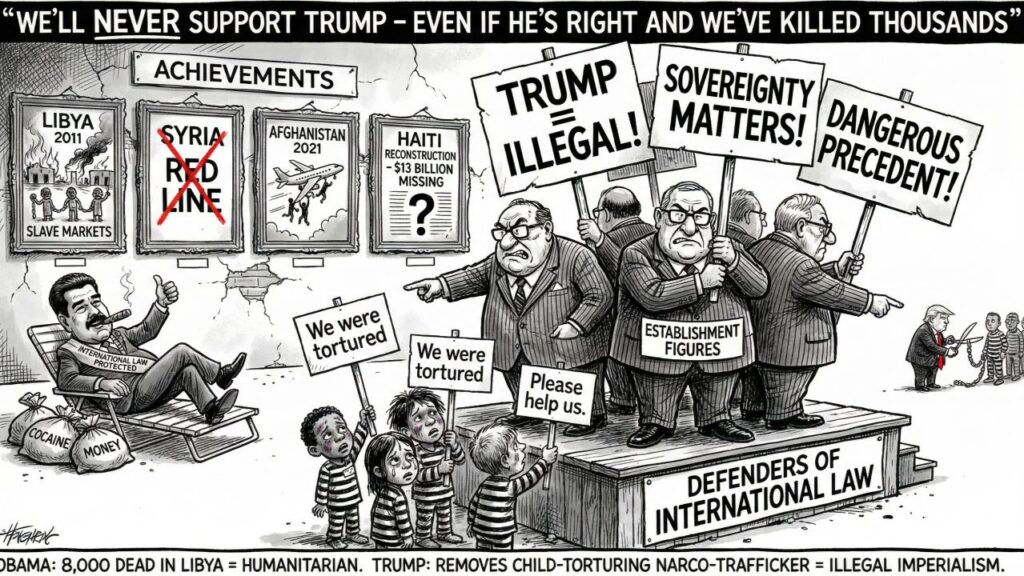
This reflexive opposition reveals something deeper than policy disagreement. The critics opposing Trump’s Venezuela operation (the same voices who gave us Libya’s slave markets, Syria’s red line fiasco, Haiti’s perpetual dysfunction, and Afghanistan’s humiliating withdrawal) can never acknowledge when Trump acts in America’s interest. Their ideological commitment to opposing Trump supersedes any concern for actual victims, strategic outcomes, or their own catastrophic track record.
Let’s examine what these moralists have actually delivered, and what they’re ignoring about Maduro’s crimes.
Understanding Jeffrey Sachs: Anti-Establishment, But Still Part of the Polarization Machine
Before we proceed, it’s essential to understand who Jeffrey Sachs actually is, because getting this right matters for understanding the broader dynamics of polarization that this article exposes.
Jeffrey Sachs is one of the world’s most prominent economists. He became a full professor at Harvard at age 28, advised governments worldwide on economic reform, and spent decades as a UN special adviser on sustainable development. His credentials are impeccable. His influence is substantial. And his political positioning is decidedly anti-establishment.
Sachs is not affiliated with Washington think tanks like the American Enterprise Institute, the Brookings Institution, or the Council on Foreign Relations. He opposes U.S. military interventionism, criticizes American exceptionalism, and has spent years arguing that NATO expansion provoked Russia’s invasion of Ukraine, a position that has earned him denunciations as a “Kremlin mouthpiece” from establishment critics. He laments that the Biden-era left became “pro-NATO enlargement” and supported continuing the Ukraine war, asking plaintively: “Where was a truly progressive and anti-war left?”
In other words, Sachs is an anti-establishment intellectual from the progressive left, precisely the kind of independent-minded contrarian who should be capable of nuanced, non-tribal analysis.
And yet, when Trump removed a narco-trafficking dictator who tortured 198 children, Sachs immediately condemned it as “flagrantly vulgar, thuggish, and illegal.” He claimed the operation had “nothing to do with drug cartels” and was purely about oil, ignoring federal indictments charging Maduro with trafficking 200-250 metric tons of cocaine annually.
But Sachs’s Venezuela response, while revealing, isn’t the most instructive example. His Venezuela position is consistent with his 40-year record opposing all U.S. military interventions. On Venezuela, Sachs isn’t being hypocritical, he genuinely opposes interventionism and has paid reputational costs for that consistency.
The more revealing pattern emerges on Ukraine, where Sachs and Trump share the same stated policy goals, yet Sachs attacks Trump with extraordinary vitriol focused not on policy substance but on character and competence.
The Ukraine Paradox: When Shared Goals Don’t Matter
Here’s where the polarization machine reveals its true power, and where even anti-establishment intellectuals prove unable to escape tribal reflexes:
Jeffrey Sachs’s Ukraine Position:
- The war should end through negotiated settlement
- NATO expansion provoked Russia’s invasion
- The U.S. should not expand NATO to Ukraine
- Western officials prolonged the war by sabotaging peace talks in April 2022
Donald Trump’s Ukraine Position:
- Wants to end the Ukraine war through negotiation
- Skeptical of unlimited Ukraine funding
- Questions NATO expansion policies
- Transactional approach to achieving settlement
They share the same goal. Both want the war to end. Both oppose unlimited Western involvement. Both believe negotiated settlement is necessary. Both critique aspects of NATO policy.
Yet Sachs attacks Trump with stunning vitriol:
- “Trump has the mentality of a 4-year-old”
- “Trump is not intelligent enough to end the war”
- “The U.S. political system has collapsed under Trump”
- Trump “lacks political strength” to achieve the settlement Sachs wants
- Trump can’t publicly oppose NATO expansion because he fears being called “weak” or “treasonous”
Notice the pattern: Sachs doesn’t attack Trump’s Ukraine policy objectivebecause they agree on it. Instead, he attacks Trump’s intelligence, character, and competence. He claims Trump is too stupid, too weak, too cowardly to achieve what Sachs himself advocates.
This allows Sachs to maintain his anti-Trump credentials and media prominence while avoiding the cognitive dissonance of admitting policy alignment. It’s tribal signaling disguised as substantive criticism.
Does this serve Sachs’s personal interests?
The numbers are revealing. Sachs commands speaking fees of $100,000 to $200,000 for live events and $50,000 to $100,000 for virtual appearances. He’s represented by multiple major speaking agencies and described as “the most important economist in the world” by the New York Times. He’s written three New York Times bestsellers and maintains constant media visibility through YouTube, MSNBC, and CGTN appearances.
High-profile Trump criticism generates the media visibility that commands these fees. The more Sachs appears attacking Trump, even when they share policy objectives, the more valuable he becomes as a speaker, author, and public intellectual. Controversy sells. Tribal allegiance to the anti-Trump coalition maintains credibility with progressive audiences who book speakers and buy books.
Could Sachs say: “Trump and I agree the Ukraine war should end and NATO shouldn’t expand further, I hope he succeeds in achieving this goal”? Of course. Would that generate $200,000 speaking invitations and cable news bookings? Unlikely.
The polarization machine creates powerful financial incentives to maintain tribal warfare even where substantive policy alignment exists. And if even a brilliant, independent-minded economist like Jeffrey Sachs can’t escape these incentives, the problem is far deeper than partisan politics, it’s a systemic failure of our entire information ecosystem.
The Democratic Foreign Policy Disaster Reel
Obama’s Libya: The Worst Mistake He Ever Admitted
In March 2011, citing Responsibility to Protect, President Obama launched NATO airstrikes in Libya to prevent Muammar Gaddafi from massacring civilians. Obama later admitted that failing to plan for Libya’s aftermath was “the worst mistake” of his presidency. That’s an extraordinary confession, and an understatement of the catastrophe his intervention created.
The intervention was supposed to protect civilians. Instead, it killed roughly 8,000 people during the seven-month campaign, dramatically more than the estimated 1,000-2,000 who had died before NATO intervened. A 2013 Belfer Center assessment found NATO’s operation “magnified the conflict’s duration about sixfold and its death toll at least sevenfold, while also exacerbating human rights abuses, humanitarian suffering, Islamic radicalism, and weapons proliferation.”
Libya descended into failed state chaos with open slave markets, terrorism hotspots, and millions of refugees flooding Europe. In September 2023, twelve years after the intervention, dam collapses in Derna killed over 11,000 people due to infrastructure collapse from the failed state Obama’s “humanitarian intervention” created.
Obama’s own advisers admitted Libya “was farmed out to the working level” with no serious post-intervention planning. Dennis Ross, Obama’s special adviser on the Middle East, confirmed that after the initial operation succeeded, Obama simply stopped paying attention. Libya devolved into permanent civil war with three competing governments, ISIS territorial control, and weapons proliferating to conflicts across Africa.
Obama’s Syria: The Red Line That Became a Global Joke
In August 2012, Obama declared that chemical weapons use by Assad would cross a “red line” warranting U.S. military action. In August 2013, Assad’s forces attacked Damascus suburbs with sarin gas, killing nearly 1,500 civilians including over 400 children. Horrific footage showed victims twitching and foaming at the mouth on hospital floors.
Assad had brazenly crossed Obama’s red line. And Obama… did nothing. He threatened strikes, then backed down after congressional and public opposition. Russia brokered a deal to remove Syria’s chemical weapons, but Assad continued using industrial chemicals and chlorine gas in attacks killing hundreds more. The “red line” became a global punchline demonstrating American impotence.
The Syrian civil war killed over 500,000 people and displaced 13 million, more than half the country’s pre-war population. While Obama cannot be blamed for starting Syria’s war, his red line failure signaled to dictators worldwide that American threats were empty. It emboldened Assad, strengthened Putin’s hand in the region, and contributed to the power vacuum ISIS exploited to seize territory across Syria and Iraq.
Clinton’s Haiti: Two Decades of Dysfunction
Bill Clinton’s Haiti interventions produced two decades of failure. In 1994, Clinton sent 20,000 American troops to restore President Jean-Bertrand Aristide after a military coup. Once reinstalled, Aristide’s supporters resumed massacring opponents with machetes, fire, and guns while money disappeared. A company called Fusion, run by Clinton Democrats including Joseph P. Kennedy II and former White House Chief of Staff Mack McLarty, went into business with Haiti’s government-owned telecom monopoly while abuses continued.
After Haiti’s 2010 earthquake killed an estimated 220,000 people, Clinton became co-chairman of the Interim Haiti Recovery Commission overseeing $13.3 billion in pledged international aid. Ten years later, there’s “no clear accounting of how much of the $13.3 billion that donors promised over 10 years remains uncollected.” Most money went to international aid agencies and NGOs rather than Haitians. The commission failed to deliver promised public housing or better construction. Haitians blame Clinton for reconstruction failure.
Haiti today remains the Western Hemisphere’s poorest country, plagued by gang violence, political instability, and humanitarian crisis, twenty years after Clinton’s military intervention and fifteen years after his earthquake commission.
Biden’s Afghanistan: The Humiliation That Killed 13 Americans
Biden’s August 2021 Afghanistan withdrawal produced the deadliest attack on Americans in Afghanistan since 2011, killing 13 U.S. servicemembers. The chaotic evacuation abandoned American citizens, interpreters who worked with U.S. forces, and billions in military equipment that fell to the Taliban.
Gold Star families report that Biden showed no empathy during the dignified transfer of remains at Dover Air Force Base, repeatedly checking his watch and saying nothing about the 13 killed. To this day, Biden and Kamala Harris have never mentioned the 13 fallen servicemembers by name.
The withdrawal was botched from start to finish: delayed timeline allowing Taliban to seize provinces, failure to secure Kabul airport perimeter, suicide bombing that killed 13 Americans and 170+ Afghans, and desperate scenes of people clinging to departing aircraft. Secretary of Defense Pete Hegseth has ordered a comprehensive review of the withdrawal, calling it “disastrous and embarrassing.”
They Oppose Trump’s Success Because It Exposes Their Failures
The same foreign policy intelligentsia that produced these disasters now lectures Trump about Venezuela. Let’s examine their actual criticisms, and what they’re deliberately ignoring.
Jeffrey Sachs (Columbia University economist) claimed the operation has “nothing to do with drug cartel. This is pure total unequivocal” pursuit of oil. He’s ignoring that federal indictments charge Maduro with trafficking 200-250 metric tons of cocaine annually to the United States, and that 72,776 Americans died from fentanyl overdoses in 2023 alone, with cocaine providing cartel revenue funding the entire narcotics apparatus.
Bernie Sanders declared: “This is the horrific logic of force that Putin used to justify his brutal attack on Ukraine” and warned it “gives a green light to any nation on earth that may wish to attack another country.” He’s ignoring that he voted for every defense authorization funding Ukraine weapons, a war Western officials deliberately prolonged by sabotaging Istanbul peace talks in April 2022. Sanders discovers anti-war principles when Trump acts but funded the proxy war he now uses as moral comparison.
Alexandria Ocasio-Cortez dismissed the drug trafficking justification: “It’s not about drugs. If it was, Trump wouldn’t have pardoned one of the largest narco traffickers in the world last month. It’s about oil and regime change.” She’s using Trump’s hypocritical Hernández pardon to ignore documented evidence that Maduro runs a narco-state. The indictments are real. The 72,776 annual fentanyl deaths are real. Tren de Aragua murders on U.S. soil are real.
Ro Khanna warned: “What will we say now if Putin tries to capture Zelenskyy in Ukraine or if Xi Jinping moves against Taiwan’s leadership?” This comparison is obscene. Zelenskyy isn’t trafficking 250 metric tons of cocaine annually. He didn’t torture 198 children. Taiwan’s leadership hasn’t created 8 million refugees. Equating a narco-state with democratic governments reveals how detached these critics are from actual victims.
Gregory Meeks (Ranking Member, House Foreign Affairs Committee) admitted: “Nicolas Maduro is an illegitimate leader. But using the U.S. military to attempt regime change in a sovereign foreign nation, without approval from Congress, without a defined objective or plan for the day after…risks entangling the United States in an open-ended conflict.” Meeks supported Obama’s 2011 Libya intervention that killed 8,000+ during the war and created slave markets in the failed state that followed. His sudden concern about “plans for the day after” is conveniently newfound.
These critics can’t acknowledge Trump’s success because it exposes their failures. Obama’s Libya intervention killed more people than it saved and created permanent chaos. Trump’s Venezuela operation removed the dictator and captured him for trial. Obama’s Syria red line became a global joke. Trump’s Venezuela action sent an unmistakable message. Biden’s Afghanistan withdrawal was a humiliating disaster. Trump’s Venezuela operation was executed decisively with minimal casualties.
The contrast is devastating, so they simply pretend it doesn’t exist.
The Children Maduro Tortured That They Won’t Mention
In July 2024, following Venezuela’s manifestly fraudulent presidential election, Maduro’s security forces detained over 2,000 people, including 198 children. Amnesty International documented what happened next: “Children arbitrarily detained after the election were tortured to force them to incriminate themselves by stating on video that they had participated in the protests.”
The torture included beatings, suffocation, electric shocks, and sexual violence. Four months after detention, all 198 children remained subjected to “either unfair detention, trumped up criminal charges, or the serious mental and physical consequences of abuse perpetrated by the Venezuelan authorities.” Amnesty’s Secretary General stated: “Detaining, torturing, prosecuting, and punishing children crosses a line no state should ever cross.”
This wasn’t isolated abuse. A UN Fact-Finding Mission report released December 2025 found “reasonable grounds to believe” Venezuela’s Bolivarian National Guard committed crimes against humanity for over ten years, including arbitrary detention, torture, sexual violence, and killings targeting political opponents. Chair Marta Valiñas stated: “The torture, ill-treatment, and acts of sexual violence we have verified, including assaults and rape, were not isolated incidents. They form part of a pattern of abuse used to punish and break victims.”
In the 2024 post-election crackdown alone, 25 people were shot and killed. The mission concluded these violations constituted “the crime against humanity of persecution on political grounds.”
Where was Jeffrey Sachs’s outrage over children being raped in detention? Where were Bernie Sanders’s denunciations when UN investigators documented systematic torture? Where were the emergency Congressional hearings when Maduro was sworn in for another term in January 2025, six months after his forces tortured those 198 children?
Nowhere. Because they were too busy opposing Trump to care about actual victims.
Eight Million Refugees and the Americans Maduro Killed
Venezuela’s humanitarian catastrophe has produced 8 million refugees, more than one in four Venezuelans forced to flee, the largest displacement crisis in Latin American history. Those remaining face conditions so catastrophic that 7.6 million people inside Venezuela required humanitarian assistance in 2024.
But Maduro’s victims aren’t only Venezuelans. Federal indictments charge him with trafficking 200-250 metric tons of cocaine annually to the United States. In 2023, roughly 20,000 Americans died from cocaine. And 72,776 Americans died from fentanyl minus 199 per day. Venezuelan cocaine trafficking provides cartel revenue funding the entire narcotics apparatus including fentanyl production and distribution.
The most direct American victims are those targeted by Tren de Aragua (TdA), the Venezuelan prison gang Maduro deliberately unleashed on U.S. cities. Trump designated TdA a foreign terrorist organization after it established operations across New York, Colorado, Texas, and Nebraska. The Department of Justice charged 260 people believed to be TdA members in 2025 alone.
TdA’s crimes include double murders in the Bronx, kidnappings in Aurora where victims stated “I thought I was going to die,” armed robberies stealing $4 million while beating employees, sex trafficking operations, and sophisticated ATM hacking stealing millions sent to TdA leaders in Venezuela “to fund their terroristic activities.”
The federal indictment confirms: “TdA operates in conjunction with Cártel de los Soles, the Nicolás Maduro regime-sponsored, narco-terrorism enterprise based in Venezuela.” This isn’t a criminal gang operating independently. It’s a state-sponsored terrorist organization Maduro facilitated.
The American People Are More Objective Than the Intelligentsia
Here’s what the polarization machine doesn’t want you to know: The American people rendered far more nuanced, sophisticated judgments about Trump’s Venezuela operation than their ostensible thought leaders.
Polling on the Maduro operation reveals that Americans thought carefully and objectively, not in reflexive tribal terms:
- A YouGov poll conducted January 4 showed 39% approved of Trump’s handling of Venezuela while 46% disapproved, mixed, not a landslide of opposition
- A Washington Post poll showed a similar 40-42% split
- Among Republicans, 74% endorsed the action; among Democrats, 76% opposed it, revealing the tribal nature of elite response
- Crucially, over 60% believed Congressional approval should have been obtained
This data reveals sophisticated public thinking: Many Americans supported removing Maduro while questioning the process. They held two thoughts simultaneously, concern about constitutional procedure and recognition that removing a narco-trafficking child torturer serves American interests.
Data for Progress polling in December found 60% opposed sending troops to remove Maduro, yet once he was actually captured for existing federal indictments, opinions shifted significantly. The operation’s specificity, executing an arrest warrant for narco-terrorism rather than open-ended nation-building, changed the calculus.
Analyst G. Elliott Morris noted that by a 4-to-1 ratio, Americans opposed military force for regime change in Venezuela. But the Trump administration framed this as law enforcement, executing an arrest warrant, not regime change. This distinction mattered to voters even if it didn’t register with intellectuals fixated on opposing Trump at all costs.
The polling reveals Americans thinking more objectively about presidential actions than their ostensible representatives. Voters demonstrated intellectual honesty to distinguish between process concerns and substantive outcomes. The intelligentsia, both establishment and anti-establishment, failed this basic test.
Behind Closed Doors: Centrist Democrats Beg for Sanity
While public figures like Sachs and Sanders rushed to condemn Trump’s Venezuela operation, behind closed doors a different story unfolded, one that exposes the political suicide of reflexive Trump opposition.
Three anonymous centrist House Democrats from swing districts told Axios they were “privately voicing frustration” with their party’s overwhelmingly critical response, arguing it makes Democrats look “weak” and damages credibility.
“I think it looks weak,” one House Democrat said bluntly. “If you don’t acknowledge when there is a win for our country, then you lose all credibility.”
Another was even more direct: “Maduro bad, he is gone. You can’t have it both ways,” the lawmaker told Axios, lamenting that “everything Trump touches must be deemed negative according to the base.”
A third at-risk Democrat pleaded: “As Democrats, we can’t merely denounce what occurred…I wish the Democratic Party would adopt a more balanced approach on this.”
Based on analysis of the most vulnerable House Democrats representing swing districts, the anonymous sources most likely include:
Rep. Marie Gluesenkamp Perez (WA-3): Representing a district Trump won by 3.3 points, she has become the model for Democrats winning in red territory. She regularly breaks with party leadership and has explicitly criticized party dysfunction: “I don’t think we should make American suffering a point of leverage…It’s discouraging when both sides think they’re winning a messaging war.”
Rep. Gabe Vasquez (NM-2): First-generation Mexican-American representing an EVEN PVI border district Trump won by 1.9 points. Vasquez has introduced the “Stop Fentanyl at the Border Act” and positioned himself on border security issues. His constituency would be acutely concerned about Maduro’s narco-terrorism charges.
Rep. Greg Landsman (OH-1): Former public school teacher representing an R+1 PVI Cincinnati district Trump won by 1.9 points. Landsman has demonstrated willingness to buck progressive orthodoxy, facing fierce backlash from the left over his Israel-Gaza positions.
These Democrats understand what Sachs, Sanders, and their leadership apparently do not: Americans are capable of distinguishing between process concerns and substantive outcomes. The inability to hold both thoughts simultaneously is not sophistication, it’s partisan paralysis.
The Polarization Profiteers: Who Actually Benefits from Tribal Warfare?
If Americans overwhelmingly demonstrate nuanced, sophisticated judgment, and if even vulnerable Democrats privately beg for balanced assessments, why does polarization intensify? The answer is simple and cynical: Polarization is extraordinarily profitable for everyone except ordinary Americans.
Politicians Profit from Extremism
Research by Dartmouth Professor Mia Costa found that while Americans mostly don’t like or reward divisive rhetoric, polarizing politicians “get more viral tweets, cable news appearances, and donations.” As Costa noted, “Divisive rhetoric still breeds viral tweets, cable news appearances, and donations, but Americans mostly don’t like it or reward it. The polarizers just get more attention.”
Academic research confirms that campaign finance structures favoring individual donors over PACs lead to more polarized legislators. Why? Individual donors prefer ideologically extreme candidates, while PACs support moderates. The post-Citizens United landscape creates powerful financial incentives for extremism.
Representatives with extreme views get disproportionate media coverage, “creating a perception there is greater division among elected leaders than actually exists.” This coverage then raises their profiles and fundraising power, perpetuating a vicious cycle where moderation is punished and extremism is rewarded.
Intellectuals Profit from High-Profile Criticism
The financial incentives extend beyond elected officials. Public intellectuals like Jeffrey Sachs command speaking fees of $100,000 to $200,000 for live events. Media visibility directly translates to speaking invitations, book sales, and professional prominence. High-profile Trump criticism, even when substantive policy alignment exists, generates the controversy and attention that command premium fees.
This creates a perverse incentive structure: Acknowledging Trump got something right, or that you share policy objectives with him, reduces media bookings and tribal credibility. Attacking Trump’s character and competence while maintaining policy disagreement preserves both anti-Trump credentials and media prominence worth hundreds of thousands annually.
Cable News: Billion-Dollar Businesses Built on Partisan Conflict
Fox News and MSNBC have built empires on partisan polarization. Fox News’s audience is 63% Republican; MSNBC’s audience is 63% Democratic. These networks don’t reflect America, they reflect and amplify its most partisan segments for profit.
Content analysis reveals that 77% of guests on Fox News and 90% of guests on MSNBC advocate politically partisan perspectives. “Negative, politically charged news commentary made up most of the channels’ content.” This isn’t journalism; it’s partisan theater performed for advertising dollars.
The networks consciously overrepresent the most extreme members of Congress. Left-leaning MSNBC “prioritized content from the most conservative members of the House…possibly in an effort to present negative exemplars to liberal audiences for criticism.”
University of Kansas Professor Johanna Dunaway warns: “TV news programs will continue incentivizing extreme politics if they do not stop giving the most attention to the most partisan lawmakers and focusing on party conflict.”
Cable news discovered that outrage generates higher ratings than nuanced analysis. Conflict sells better than consensus. So they manufacture conflict even where little exists, creating a distorted reality that feeds back into actual political polarization.
Social Media: Algorithms That Monetize Rage
Social media platforms have built business models on manufactured outrage. Stanford research manipulating X (Twitter) feeds found that after just one week, users’ feelings toward the opposing party shifted by about two points, a change that normally takes three years to occur organically. The algorithm’s power to polarize is staggering.
Research published in Science found that Twitter’s engagement-based ranking algorithm “amplifies emotionally charged, out-group hostile content that users say makes them feel worse about their political out-group.” Sixty-two percent of political tweets chosen by Twitter’s algorithm expressed anger, and 46% contained out-group animosity.
Tulane University researchers documented a “confrontation effect”: People are more likely to interact with content that challenges their views than content that aligns with them, “often driven by outrage.” As study author Daniel Mochon explained: “Platforms benefit from keeping users active, regardless of whether the interaction is positive or negative.”
University of Kansas Professor Debabrata Dey’s research revealed how “a platform’s profit motivation compels it to adopt a user-targeting strategy that injects bias and creates polarization.” His model shows that “polarization and bias act as substitutes toward the platform’s profit.” If regulators crack down on one dimension, platforms simply shift to the other to maintain engagement and revenue.
Robert Reich captured the essence: “Rage-baiting turns our anger into a commodity, harvested by algorithms that need constant emotional volatility to keep us scrolling and consuming.”
One expert put it bluntly: “Polarization exists because, in the short term, dividing us is just too profitable.”
Polarization isn’t a bug in these systems, it’s the business model. And it’s destroying our capacity for democratic self-governance.
What Americans Actually Want: The Exhausted Majority Rejects Tribal Warfare
While political elites and their media allies profit from division, ordinary Americans want something radically different: leaders who solve problems.
The Exhausted Majority
A 2025 Future Caucus poll found that 84% of voters prefer a leadership style of “working together respectfully and toward solutions,” while only 10% prefer “asserting power and authority to direct people to implement solutions.” That’s an 8-to-1 margin. Yet that’s not remotely what Americans are getting.
Pew Research found that 86% of Americans say “Republicans and Democrats are more focused on fighting each other than on solving problems.” When asked to volunteer the biggest problem with the political system, 22% cited partisan polarization or lack of cooperation, second only to general critiques of politicians at 31%. Seventy-eight percent say there is too little focus on important issues facing the country.
Half of Americans now say “we have lost our common identity and are now divided and polarized,” up from 34% in 2014. This pessimism is highest in battleground states subjected to the most political advertising, the front lines of the polarization profiteering industry.
Independents: Both Parties Are Too Extreme
Independents now comprise 40% of Americans, compared to 29% who identify as Democrats and 33% as Republicans. These voters hold sophisticated views that defy partisan stereotypes.
Independents believe both major parties are too extreme: 67% characterize the Democratic Party as too extreme, while 71% say the same about Republicans. When asked directly if both parties are too extreme, 70% of independents agree.
Yet independents are not simplistic centrists splitting every difference. Seventy-five percent disagree that “most political issues are black-and-white,” and 69% regularly agree with both Republicans and Democrats on different issues. They acknowledge complexity and nuance, precisely what partisan warriors on both sides refuse to do.
Americans are far more reasonable, thoughtful, and open to compromise than the political class that ostensibly represents them. The polarization we see doesn’t reflect genuine public sentiment, it reflects the incentive structures of those who profit from division.
The Moral Calculus They Refuse to Make
Let’s be clear about what we’re comparing:
Trump’s military operation:
- Removed a dictator indicted for narco-terrorism
- Captured a regime torturing 198 children, many sexually assaulted
- Eliminated a government responsible for 8 million refugees
- Disrupted cocaine trafficking killing 20,000 Americans annually
- Cut funding to terrorists murdering Americans
- Violated abstract “norms” about sovereignty
The status quo critics preferred:
- 198 children tortured and raped for false confessions
- Decade-long crimes against humanity
- 25 people shot dead in 2024 crackdown
- 8 million refugees
- 7.6 million requiring humanitarian assistance
- 72,776 Americans dying from fentanyl annually
- 20,000 Americans dying from cocaine annually
- Tren de Aragua committing murders and terrorism
- Full compliance with “international law”
The virtue-signalers prefer the second option. They’ve made their calculation explicit: Better to let Maduro torture children, traffic cocaine killing Americans, and sponsor terrorist gangs than to violate “norms” or acknowledge Trump got something right.
This isn’t about principles. It’s about opposing Trump regardless of outcomes. When Obama’s Libya intervention killed 8,000+ and created slave markets, they defended it as “humanitarian.” When Trump removes a narco-trafficking child torturer, they condemn it as “illegal imperialism.”
The pattern is unmistakable: they can never support Trump, even when he’s right and they’ve been catastrophically wrong.
Why They’ll Never Admit Trump Got It Right
The critics opposing Venezuela, from establishment figures like Gregory Meeks to anti-establishment intellectuals like Jeffrey Sachs, have given us:
- Libya’s permanent chaos and slave markets
- Syria’s red line humiliation and 500,000 dead
- Haiti’s perpetual dysfunction after two interventions
- Afghanistan’s humiliating withdrawal killing 13 Americans
Trump’s Venezuela operation:
- Removed a narco-trafficking dictator
- Captured him for trial rather than creating prolonged war
- Stopped a regime torturing children
- Disrupted drug trafficking killing thousands of Americans
- Was executed decisively with minimal casualties
Admitting Trump succeeded would require acknowledging their own failures. It would validate criticisms of their Libya disaster, Syria impotence, Haiti incompetence, and Afghanistan humiliation. It would undermine their reflexive opposition to everything Trump does.
So they simply refuse to see it. They focus on procedural complaints (“illegal,” “unconstitutional”) while ignoring substantive results (children no longer being tortured, Americans no longer dying from Venezuelan cocaine, 8 million refugees potentially able to return home). They invoke “international law” that accomplished nothing for a decade while Maduro committed crimes against humanity. They warn about “precedent” while ignoring that their preferred methods produced corpses without removing a single dictator.
Jeffrey Sachs claims this has “nothing to do with drug cartel” (tell that to 72,776 families who lost loved ones to fentanyl. Bernie Sanders warns about giving Putin a “green light”) tell that to the 198 children Maduro tortured. Ro Khanna compares Maduro to Zelenskyy, tell that to Ukraine’s democratically elected government. Gregory Meeks worries about “plans for the day after”, tell that to Libyans living under Obama’s failed intervention.
They can’t support Trump because their entire identity is opposition. Not opposition to narco-trafficking. Not opposition to torturing children. Not opposition to drug cartels killing Americans. Opposition to Trump, regardless of outcomes, victims, or their own catastrophic alternatives.
And for intellectuals like Sachs, there’s an added incentive: maintaining high-profile Trump criticism is worth $100,000 to $200,000 per speaking engagement. Admitting policy alignment with Trump, as exists on Ukraine, would cost tribal credibility and media visibility worth hundreds of thousands annually. The financial incentives to maintain reflexive opposition are simply too powerful.
The Reckoning They’ll Never Face
The foreign policy establishment and anti-establishment intelligentsia that gave us Libya’s slave markets, Syria’s red line humiliation, Haiti’s perpetual dysfunction, and Afghanistan’s deadly withdrawal now lecture Trump about Venezuela. They supported interventions that killed thousands and created failed states. They drew red lines that became jokes. They bungled withdrawals that killed American servicemembers. They presided over reconstruction commissions that accomplished nothing.
Trump removed a narco-trafficking dictator torturing children and sponsoring terrorism on U.S. soil, and they condemn him for it.
They mentioned “sovereignty.” They mentioned “international law.” They mentioned “precedent” and “rules-based order.”
They never mentioned the 198 children Maduro tortured. They never mentioned the 72,776 Americans dying annually from fentanyl in drug trades Maduro facilitates. They never mentioned Tren de Aragua murdering Americans in U.S. cities.
Because they care more about opposing Trump than protecting victims. More about preserving failed “norms” than achieving results. More about their own moral posturing (and in some cases, their speaking fees and media prominence) than the people dying from policies they defend.
Obama’s Libya intervention was “humanitarian” (even though it killed 8,000+ and created permanent chaos. Trump’s Venezuela operation is “illegal imperialism”) even though it removed a child-torturing narco-trafficker. The difference isn’t outcomes. It’s who ordered the operation.
They’ll never support Trump, even when he’s right and they’ve been catastrophically wrong. Their opposition isn’t principled. It’s reflexive, ideological, financially incentivized, and completely divorced from actual human suffering.
They can keep their “international law” that protected a regime torturing 198 children for months. They can keep their “diplomatic engagement” that accomplished nothing while 8 million Venezuelans fled. They can keep their “rules-based order” that allowed a narco-trafficker to kill Americans for decades.
I’ll take the 198 children who won’t be tortured anymore. I’ll take the disrupted cocaine trafficking that won’t kill 20,000 Americans next year. I’ll take the eliminated terrorist organization that won’t murder more people in Denver. I’ll take the 8 million refugees who might finally go home.
The virtue-signalers, whether establishment hawks or anti-establishment intellectuals, will never forgive Trump for exposing what their “principles” actually mean: protecting dictators who torture children rather than violating sacred norms, or admitting Trump got something right that they got catastrophically wrong.
Postscript: Don’t Shoot the Piano Player
I know that putting the words “Trump” and “objective analysis” in the same sentence is like kicking an ant mound. The ant-like partisans mobilize quickly to attack anyone who dares suggest Trump might occasionally do something right. But I didn’t create the problem our political class faces, I’m just reporting what the data reveals. And what it reveals is devastating.
This isn’t opinion dressed as analysis. It’s bitter medicine backed by extensive citations to polls, Democratic strategists’ own warnings, substantive policy outcomes, documented financial incentives, and the crimes of a regime that tortured children while intellectuals defended “international law.”
I’m neither left nor right. I’m a reality-based American who wants government to work invisibly, solving problems instead of manufacturing crises. I want a press that objectively reports what those scoundrels in Washington are doing, regardless of party. The exhausted majority of Americans minus 84% according to recent polling, want leaders who work together respectfully. Only the loud, polarized minority benefit from endless tribal warfare.
I write for the 84%. And when I make mistakes, like incorrectly characterizing Jeffrey Sachs as establishment when he’s decidedly anti-establishment, I correct them transparently. Because intellectual honesty matters more than tribal loyalty.
I’m just the piano player. The sheet music says what it says. Don’t shoot me because you don’t like the song. The medicine tastes bitter. But the disease is killing us.
Take the medicine.
Scott Ortkiese is Principal at Throughline Synthesis Group, providing deep, primary-source research for government relations and lobbying teams. This article reflects the author’s independent analysis and does not represent the views of any organization.
Related reading
- A Bill of Indictment for Murder and Genocide Against the American Military and Trump, as its Commander and Chief
- Trump Blackmails Allies Abroad While Being Blackmailable at Home: The Irony of It All
- Susie Wiles Can’t Restrain Trump, So She Covers for the Malignant Orange Baby
- Holy Trump or Evangelical Scholar? Neither. Just a Nincompoop Babbling to Morons on the 4th of July