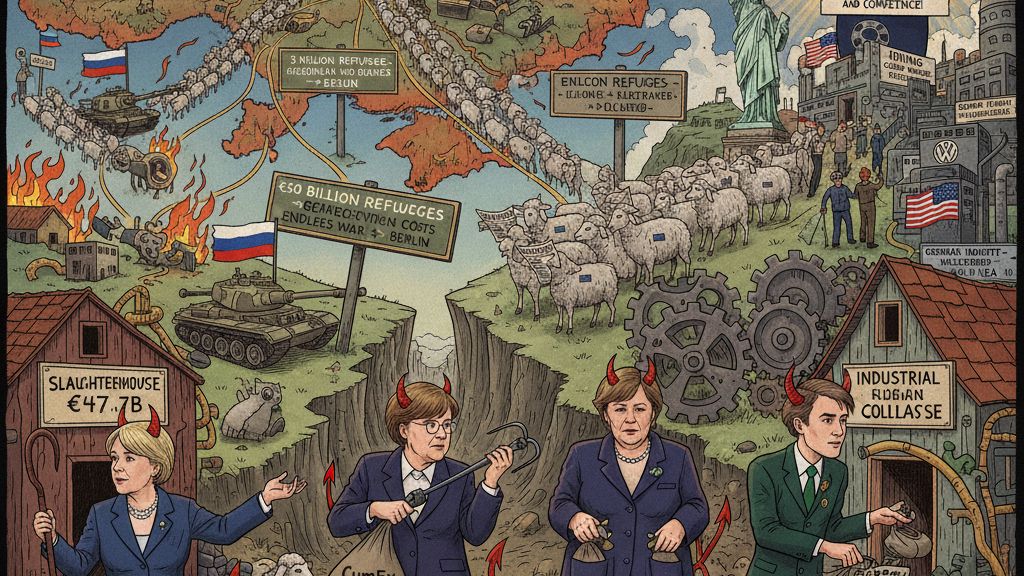
They can’t be removed because their sheep defend them. Here’s how four devils profit from every disaster: Ukraine’s refugees and reconstruction costs flow to Germany, German factories, AI and capital flee to Trump’s welcoming America, and consulting fees generate billions, while the controlled German Press tells sheep they’re winning.
Twenty-two gigawatts requested. One hundred megawatts delivered. A 99.5 percent failure rate that guarantees Europe’s permanent exclusion from the artificial intelligence revolution. Every analysis treats this as policy mistake, renewable energy miscalculation, or unfortunate timing. The real question is simpler and more disturbing: Why do the people responsible for catastrophic failures keep getting promoted, and who profits from the chaos they create?
Angela Merkel shut down Germany’s nuclear fleet in 2011 based on a Japanese tsunami risk that doesn’t exist in Germany, locked in a 2022 completion timeline, and retired comfortably as Europe’s most respected stateswoman. Olaf Scholz executed the final shutdown in April 2023, four months after ChatGPT made AI infrastructure demands obvious, despite presiding over Germany’s largest financial scandal as Hamburg mayor where forty-seven million euros in tax fraud claims mysteriously became statute-barred after he met with the bank’s owners. Ursula von der Leyen presided over consulting scandals where evidence was deleted, got promoted to European Commission President while her son worked at McKinsey receiving the contracts, and was reelected in 2024 after reprising the pattern with disappeared Pfizer vaccine texts. Robert Habeck, Germany’s Green Party Economy Minister with no private sector experience, enforced nuclear elimination and accelerated coal phaseouts while twenty-two gigawatts of data center applications piled up in Brandenburg, all while the Heinrich Böll Foundation, the Green Party’s official think tank receiving forty-six million euros annually from German taxpayers, funded the ideological infrastructure justifying these decisions.
These failures aren’t accidents of the system. They’re the system working exactly as designed. Understanding why requires tracing the money, naming the beneficiaries, and documenting how officials who destroy industrial competitiveness face zero consequences while consultancies billing 47.7 billion euros and American tech companies investing fifteen billion euros in inference facilities capture the value that German industry loses. This is not abstract institutional dysfunction. This is specific people making specific decisions that enrich specific companies while relegating Europe to permanent technological dependency.
The Nuclear Shutdown: Electoral Survival Over Industrial Strategy
On March 11, 2011, a magnitude-nine earthquake triggered a tsunami that killed nearly twenty thousand people in Japan and caused meltdowns at Fukushima Daiichi nuclear plant. Zero deaths resulted from radiation exposure. The plant sat on a coastline vulnerable to Pacific tsunamis generated by subduction zone earthquakes that don’t exist in Germany. Within seventy-two hours, March 14-15, 2011, Angela Merkel’s government reversed a decade of pro-nuclear policy and mothballed Germany’s seven oldest reactors. By June 2011, over eighty percent of parliamentarians voted to shut down eight plants immediately and eliminate the remaining nine by 2022.
Merkel is a trained physicist with a doctorate from Leipzig University. She understood perfectly that German reactors faced no tsunami risk. She knew nuclear provided baseload power that renewables couldn’t replace. She had spent years defending nuclear power and extending reactor lifetimes against Green Party opposition, even canceling the previous government’s phaseout in 2009 in what became known as the “phase-out of the phase-out.” So why reverse course in seventy-two hours based on an accident nine thousand kilometers away?
The state election in Baden-Württemberg was scheduled for March 27, 2011, sixteen days after Fukushima. The Greens were surging on anti-nuclear sentiment. Merkel’s CDU faced potential historic defeat in a stronghold it had held for fifty-eight years. By adopting the Green position instantly, Merkel neutralized their primary campaign advantage. She lost Baden-Württemberg anyway, the Greens won their first state government, but she limited damage nationally and more importantly secured reelection as Chancellor in 2013 by eliminating nuclear as a wedge issue.
From Merkel’s perspective, this was optimal political strategy. The cost (industrial competitiveness destroyed a decade later, Germany’s AI exclusion permanent by 2030) would be paid by her successors, long after her 2021 retirement. The benefit, remaining Chancellor for ten more years, accrued immediately. This is not irrational decision-making. This is perfectly rational optimization for a politician in a system where decisions and consequences are separated by time lags long enough to avoid accountability. Merkel calculated correctly: by the time Germany’s 99.5 percent failure rate became undeniable in 2024, she would be celebrated as Europe’s most successful leader, not blamed for decisions made thirteen years earlier that directly caused the catastrophe.
The system doesn’t punish officials for long-term strategic catastrophes when those catastrophes materialize after they’ve retired with full honors. It punishes officials for losing the next election. Merkel optimized for what mattered to her career and succeeded brilliantly. The fact that her seventy-two-hour decision to eliminate 4.2 gigawatts of baseload capacity would intersect catastrophically with artificial intelligence’s emergence in 2022-2023 was invisible to her electoral calculations and irrelevant to her political survival.
Scholz Knew Exactly What He Was Doing
ChatGPT launched November 30, 2022. Within two months it reached one hundred million users, the fastest consumer application adoption in history. By March 2023, GPT-4 demonstrated capabilities that made clear this was civilizational inflection point, not novelty. Industry observers understood immediately that AI training would require gigawatt-scale electrical infrastructure running continuously. During this same period, Brandenburg grid operators were processing one hundred seventy applications for twenty-two gigawatts of data center capacity. Google was planning its Mittenwalde facility. Microsoft was evaluating expansion of Frankfurt operations. Oracle and Amazon were calculating German infrastructure requirements. This was not secret information. Grid operators filed public reports. Trade press covered the applications extensively. German government had full visibility into what was being requested and what could not be delivered.
On April 15, 2023, four and a half months after ChatGPT launch and with full knowledge of Brandenburg’s crisis, Chancellor Olaf Scholz shut down Germany’s last three nuclear reactors, eliminating 4.2 gigawatts of baseload capacity. Why would a chancellor execute this decision with perfect information about its consequences? Because the coalition agreement with the Greens made it non-negotiable. Scholz needed Green Party seats to form government in 2021. Their price was Robert Habeck as Economy and Climate Minister with full control over energy policy, and completion of nuclear phaseout by April 2023 regardless of circumstances, including energy security crisis from Ukraine war or unprecedented demand from AI infrastructure.
Could Scholz have broken coalition and forced new elections over nuclear? Technically yes. Politically suicidal. He would be blamed for government collapse, likely lose seats, and need the Greens again anyway in the next coalition with even less leverage. From Scholz’s perspective, the rational choice was clear: execute nuclear shutdown, maintain coalition stability, serve full term, and blame industrial consequences on “global market forces” or “Putin’s war” or “unforeseen AI boom” that nobody could have predicted. The electoral cost won’t arrive until 2028-2030, when AI exclusion becomes undeniable and German companies have fully offshored AI workloads to American cloud infrastructure. By then Scholz will either be retired with comfortable pension and board positions, or he’ll blame his successor for “not managing the transition properly” during the implementation phase.
This is a man who as Hamburg mayor from 2011 to 2018 met personally with Warburg Bank owners in 2016 and 2017 while the bank owed forty-seven million euros in back taxes from CumEx dividend-stripping fraud, one of Germany’s largest financial scandals involving over one hundred banks and one thousand suspects. The tax claim became statute-barred at the end of 2016, and Warburg never paid. When parliamentary inquiry investigated in 2021 and 2022, Scholz testified twice claiming memory lapses about meetings he’d had just five years earlier. His aide Johannes Kahrs was found in 2022 with 214,800 euros in cash in a safe deposit box. The consequence of this scandal was that Scholz became Chancellor.
The officials making decisions face zero personal consequence for outcomes that destroy national competitiveness. They face immediate career-ending consequence for breaking coalition agreements or challenging institutional consensus. The system isn’t designed to prevent catastrophic failures. It’s designed to maintain governing coalitions and institutional stability. Industrial competitiveness is an externality, unfortunate when lost, but not what determines whether you keep your position, get your pension, and rotate into your next prestigious role.
The Easter Weekend That Sealed Germany’s Fate
One year after nuclear shutdown, over Easter weekend 2024, Germany shut down fifteen coal and lignite plants totaling 4.4 gigawatts of capacity. This removed electricity generation equivalent to several mid-sized European nations at precisely the moment when Brandenburg applications were being rejected for lack of grid capacity. The grid operators had told the government explicitly that twenty-two gigawatts were being requested and only one hundred megawatts could be delivered. Nevertheless, Robert Habeck ordered the closure of plants generating forty-four times more power than what Brandenburg could provide to data centers.
Robert Habeck has no private sector experience. He was a writer and philosopher, publishing novels and essays on political theory, before entering politics with the Greens. His entire political identity is built on climate activism and anti-fossil fuel ideology. He rose through Green Party ranks by demonstrating ideological purity on environmental issues, particularly his uncompromising opposition to coal and his celebration of nuclear phaseout as Germany’s greatest environmental achievement. Could he have delayed coal phaseout given the crisis becoming undeniable? Technically yes. But doing so would betray the Green Party base that elected him, destroy his credibility as climate leader that defines his political brand, eliminate his future career prospects in German and EU climate policy institutions where he’s positioning himself for commissioner roles, and make him a pariah in Green political networks that control access to lucrative think tank positions, NGO leadership roles, and international organization appointments.
Meanwhile, executing aggressive coal phaseout despite the crisis reinforces his brand as uncompromising climate champion who won’t sacrifice environmental principles for industrial lobbying. It positions him perfectly for EU-level appointment when his minister term ends, likely an energy or climate commissioner role where his “courage” to shut down fossil fuels despite economic pressure will be celebrated as exactly the leadership Brussels needs. It guarantees lucrative post-government roles at climate NGOs, think tanks like the Heinrich Böll Foundation that receives forty-six million euros annually from German taxpayers to fund Green Party ideology, or international organizations where “climate leadership” credentials open doors to six-figure salaries and prestigious titles.
The cost of coal phaseout (industrial decline, AI exclusion) is diffuse, delayed, and spread across millions of German workers and businesses. The cost of not executing it, career destruction and exile from the only professional networks Habeck has ever known, is immediate, personal, and career-ending. Habeck is optimizing rationally. Just not for German industrial competitiveness. For his personal career trajectory in a system where “climate leadership” credentials are the only currency that matters, and “compromise with industry” means you’re captured by fossil fuel interests and no longer trustworthy to hold power.
The Heinrich Böll Foundation that will likely employ Habeck when his minister term ends operates transparently as Green Party infrastructure funded by German taxpayers. Its 68.6 million euro total budget in 2018 included forty-six million euros from German federal government. It funds 1,450 students annually plus two hundred doctoral candidates, all selected for commitment to Green Party ideology. When foundation co-director Ralf Fücks left to start the Centre for Liberal Modernity, it too was “financed to a large extent by the German state” despite being called “non-governmental.” This is the institutional ecosystem that rewards officials like Habeck for ideological purity regardless of economic consequences.
Von der Leyen: When Family Business Becomes Policy
Ursula von der Leyen’s career progression reveals how personal financial interests align perfectly with policy failure that benefits the consulting industry. As German Defense Minister from 2013 to 2019, her ministry spent over one hundred fifty million euros on McKinsey consultants. Her son David von der Leyen worked at McKinsey from 2016 to 2019, precisely during the period when these contracts were awarded. When parliamentary inquiry designated phone records and text messages as evidence of how contracts were awarded, the devices were wiped. Messages were deleted in August 2019 despite July evidentiary protection orders explicitly requiring their preservation. The Federal Court of Auditors condemned the practices as inadmissible violations of procurement rules. The consequence was promotion to European Commission President in July 2019, less than one month after her phone records would have revealed how ministry contracts flowed to her son’s employer while she ran the ministry.
She didn’t just escape accountability. She was rewarded with the most powerful unelected position in Europe, specifically to escape German jurisdiction where prosecution was possible. The European Council, twenty-seven national leaders negotiating in backroom deals, selected her precisely because she’d already demonstrated mastery of the skills the system actually values: bureaucratic navigation through complex institutional machinery, coalition building among member states with divergent interests, consensus signaling that articulates Brussels orthodoxy fluently, accountability evasion through procedural complexity and strategic document destruction, and elite loyalty that protects institutional prerogatives rather than national interests.
As Commission President during her first term from 2019 to 2024, von der Leyen negotiated thirty-five billion euros in Pfizer vaccine contracts via text message with CEO Albert Bourla. When journalists attempted to obtain those messages under EU transparency law, she claimed they were “short-lived” communications not requiring archival under Commission rules. The European Ombudsman found transparency violations, a finding with zero enforcement power. The consequence was reelection to a second term in 2024.
Her husband Heiko von der Leyen serves as Medical Director at Orgenesis, a biotech company. He joined the Orgenesis supervisory board, then resigned in October 2022 after journalists reported that Orgenesis had received EU research funding while his wife led the Commission approving such funding. David von der Leyen left McKinsey in 2019 and now works at Google in their Games Growth division. Google announced in 2024 a 5.5 billion euro investment in German data center infrastructure by 2029, not training facilities for frontier AI, but inference and cloud distribution points that deploy models trained in America using American electricity, precisely the dependency relationship that Germany’s energy failures guarantee.
This isn’t smoking-gun corruption in the sense of explicit quid pro quo payments. It’s structural incentive alignment. A competent energy policy that prevented Germany’s crisis would reduce McKinsey’s revenue opportunities in “energy transition consulting,” shrink the overall German consulting market that reached 47.7 billion euros in March 2025, and diminish David von der Leyen’s career prospects in the technology sector that now captures permanent European dependency through cloud services. Sustained crisis that requires perpetual expert management ensures McKinsey remains indispensable to German government and companies navigating regulatory complexity, the consulting sector continues growing even as German industry shrinks, David’s career trajectory at Google benefits from European companies offshoring AI workloads to American infrastructure, and Heiko’s biotech sector continues receiving EU research funds that flow through processes Ursula oversees.
Von der Leyen doesn’t need to explicitly favor policies that help her family’s employers. The system naturally selects for people whose personal incentives align with continued complexity and managed decline. She wasn’t chosen despite conflicts of interest. She was chosen because her professional trajectory, family connections, and institutional positioning make her reliable from the perspective of the actual stakeholders, the consulting firms billing tens of billions annually, the American tech companies capturing European dependency, and the Brussels bureaucracy that expands authority through regulatory complexity requiring permanent expert interpretation.
The Revolving Door: Where Failed Officials Get Rewarded
The pattern extends far beyond von der Leyen. José Manuel Barroso served as European Commission President from 2004 to 2014, presiding over the financial crisis response that enriched banks at taxpayer expense. He went to Goldman Sachs as non-executive chairman in July 2016, exactly eighteen months after leaving office, the minimum cooling-off period required by EU ethics rules. Goldman Sachs had been his primary bank contact during the financial crisis, advising Greece on derivatives transactions that hid sovereign debt and made the crisis worse. Within months of joining Goldman, Barroso was caught lobbying his successor Jean-Claude Juncker and Commission Vice President Jyrki Katainen on Goldman’s behalf in October 2017. The consequence was criticism from MEPs with zero enforcement power. Barroso kept his Goldman position, his pension, and his reputation.
Analysis of commissioners from Barroso’s second term from 2009 to 2014 found that one in three joined companies linked to big business within eighteen months of leaving office. The cooling-off period is short enough that officials maintain relationships and industry knowledge, but long enough that public attention has shifted elsewhere by the time they announce corporate positions.
Neelie Kroes served as EU Commissioner for Digital from 2010 to 2014. Before her term ended, she began secret talks with Uber about joining as adviser. During her mandatory eighteen-month cooling-off period, she secretly lobbied for Uber despite the European Commission Ethics Committee denying her request to join during this period. She called Dutch Prime Minister Mark Rutte during a police raid on UberPop operations, intervened with multiple ministers, and attended meetings positioned as Uber representative. She officially announced joining Uber in May 2016 after the cooling-off expired, also joining Salesforce and Bank of America Merrill Lynch boards. EU law professor Alberto Alemanno called it a “clear breach” of ethics rules, but the enforcement system is “not fit for purpose”, it can identify violations but cannot impose consequences beyond public criticism that officials ignore.
Günther Oettinger served as EU Commissioner for Energy from 2010 to 2014, then Digital from 2014 to 2016, then Budget from 2017 to 2019. In May 2016, he took a private jet from Klaus Mangold, a German businessman and lobbyist with extensive Kremlin connections, to meet Hungarian Prime Minister Viktor Orbán, violating the 150-euro gift limit. He made racist comments about Chinese officials in a speech describing them as having “slitty eyes” and “hair combed with black shoe polish.” The consequence was appointment to Budget Commissioner. After leaving the Commission in 2019, Oettinger became President of EBS University in Wiesbaden in 2021, then joined Shein, the Chinese fast fashion company, as “cybersecurity adviser” in 2023 with a contract worth 199,999 euros plus additional work in 2024.
Martin Schulz served as European Parliament President from 2012 to 2017, left to become SPD chairman and chancellor candidate in 2017, lost the election to Merkel’s coalition, briefly attempted to become Foreign Minister in 2018 before stepping down after internal criticism, and became President of the Friedrich-Ebert-Stiftung in December 2020. The Friedrich-Ebert-Stiftung is the SPD’s official foundation, operating exactly like the Heinrich Böll Foundation for Greens, funded by German government money to advance party ideology and employ party loyalists between government positions. Schulz failed at every electoral challenge but succeeded at rotating through prestigious positions that reward party loyalty regardless of competence.
The Consulting Goldmine Built on Crisis
Germany’s consulting market reached 47.7 billion euros in market volume as of March 2025, driven according to industry analysis “largely by digital transformation, energy consulting, and sustainability initiatives, as businesses navigate stringent EU and local German environmental regulations and the shift to renewable energy.” Read that sentence carefully. The business model is navigating regulatory complexity. The market grows because the regulations are stringent and the transition is chaotic, not despite these facts.
McKinsey warned in 2019 that Germany’s Energiewende was “disastrous”, the word Die Welt used to summarize their analysis, and required “radical changes” because Germany would miss emissions targets by eight years and electricity supply security faced crisis. Did this lead to policy reversal? No. It led to more McKinsey contracts advising on how to “manage the transition.” This is the business model in pure form: consulting firms profit from perpetual crisis management, not from solving problems.
A successful energy transition executed competently would eliminate the need for sustainability consulting, reduce demand for regulatory navigation services, shrink digital transformation advisory work since companies could just build infrastructure, and destroy the business model that generates 47.7 billion euros annually. Prolonged failure creates permanent demand for studies documenting how bad things are, implementation plans for inadequate fixes that create new problems requiring new studies, change management services for perpetual reorganizations as companies adapt to deteriorating conditions, and regulatory compliance guidance for ever-more complex rules that only experts can interpret.
McKinsey and Boston Consulting Group are hiring hundreds of consultants annually in Germany not despite energy policy failure but because of it. Roland Berger, a German consultancy competing with McKinsey, recently published analysis touting “billions in potential in decentralized energy” and claiming distributed solutions could save Germany massive costs. This represents business model evolution: after warning for years that Germany’s energy transition was failing, now pivot to selling “solutions” that allow Germany to work around problems created by earlier failed policies rather than reversing those policies. The lucrative approach is never to advocate for nuclear restart, which would actually solve the problem but eliminate the consulting opportunity.
The American Windfall: Permanent Dependency as Business Model
While Germany delivers one hundred megawatts of twenty-two thousand megawatts requested and grid operators tell applicants to expect ten to fifteen year delays for new connections, American technology companies are making massive investments in Germany, but not the kind that would establish German AI independence. Microsoft announced 3.2 billion euros by end of 2025 to double capacity in Frankfurt region and expand North Rhine-Westphalia infrastructure, with an additional commitment to increase European datacenter capacity by forty percent over two years. Oracle announced two billion dollars over five years in July 2025, expanding Frankfurt region infrastructure positioned as “sovereign cloud.” Amazon Web Services invested over one billion euros in Schöneck alone with total Frankfurt region investment reaching 9.44 billion dollars through 2026. Google announced 5.5 billion euros in Germany by 2029, including new data centers in Dietzenbach and expanded Hanau facilities.
Total American investment exceeds fifteen billion euros while Germany fails to deliver domestic capacity. But these investments are inference and cloud distribution points, not frontier AI training infrastructure. They deploy models trained in America using American electricity. The distinction matters fundamentally. Training frontier AI models requires gigawatt-scale power consumption over months, with tens of thousands of GPUs running continuously. Germany’s ten to fifteen year grid connection delays mean this training cannot occur domestically. What Germany gets are facilities that allow German organizations to access AI models developed elsewhere, paying subscription fees and API charges for the privilege.
European organizations thus become permanent renters of American AI, paying fees determined in Silicon Valley under terms written in Washington using infrastructure hosted in Texas. By 2030, reversing this dependency will be economically irrational. German companies will have spent ten to fifteen years building workflows around U.S. platforms, training employees on American systems, integrating American APIs into German business processes. The switching costs will make domestic alternatives unviable even if Germany somehow delivered the infrastructure.
The Stargate project announced in January 2025 epitomizes the divergence. OpenAI, Oracle, and SoftBank committed five hundred billion dollars over four years building AI infrastructure in the United States, beginning with immediate deployment of one hundred billion dollars. By September 2025, Stargate had expanded to include five new data center sites bringing total pipeline to nearly seven gigawatts of planned capacity and over four hundred billion dollars in investment over three years. OpenAI and Nvidia separately announced deployment of at least ten gigawatts of Nvidia systems described by Nvidia as “the biggest AI infrastructure deployment in history.”
Germany requested twenty-two gigawatts and delivered one hundred megawatts, a 0.45 percent success rate. The United States committed seventeen gigawatts and is actually building it with electricity delivered on two to three year timeframes rather than ten to fifteen years. This asymmetry guarantees permanent American dominance in AI with Europe relegated to customer status, paying rent to Silicon Valley for access to models that set global standards and establish network effects making competition impossible.
The Juncker Pattern: Tax Scandal as Qualification for Presidency
Jean-Claude Juncker served as Luxembourg Prime Minister from 1995 to 2013, during which time Luxembourg became Europe’s premier tax haven through secret deals Juncker personally signed. The Luxembourg Leaks revealed in November 2014 that over three hundred secret tax deals allowed multinational corporations to pay less than one percent tax on profits routed through Luxembourg. PricewaterhouseCoopers, Deloitte, KPMG, and Ernst & Young brokered deals for Ikea, Skype, Pepsi, Disney, GlaxoSmithKline, and Koch Industries among hundreds of others.
Juncker became European Commission President in November 2014, the same month the Luxembourg Leaks broke. Not despite the scandal. The European Council selected him knowing exactly what he’d done in Luxembourg because he’d proven he understood how to navigate around rules while maintaining technical legality. In May 2019, nearly five years after the scandal, Juncker admitted handling the Lux Leaks was a “major mistake.” But by that point he’d served most of his five-year term and would retire comfortably with full pension and no consequences. Four years after the scandal broke, the European Commission still had not investigated a single Lux Leaks tax ruling despite having clear authority to examine state aid violations.
Who Controls the Narrative
The reason these patterns persist is that challenging them is effectively impossible within mainstream discourse. German media is dominated by five corporations controlling 40.5 percent of the opinion formation market. Bertelsmann holds 10.4 percent market share across TV, online, radio, and print, Europe’s largest media company outside the United States and the world’s largest bookseller. Axel Springer holds 6.5 percent, publishing Bild with twelve million daily readers making it the highest-circulation newspaper in Europe, plus Die Welt and Politico acquired in 2021. In 2020, KKR, American private equity, acquired 35.6 percent of Axel Springer for 3.93 billion euros, becoming the largest shareholder. Through Axel Springer alone, American private equity controls 6.1 percent of German opinion formation market.
These media corporations share elite consensus that “climate leadership” is paramount, frame dissent from that consensus as bad faith or immoral, face social and professional costs for questioning Brussels orthodoxy, and define “responsible journalism” as supporting the “European project” rather than investigating whether that project serves citizens. Coverage of BASF closing plants becomes “structural changes in chemical industry” rather than energy policy eliminating competitive electricity. Volkswagen closing facilities becomes “transition to electric vehicles” rather than industrial sabotage through grid failure. Fifty thousand automotive job cuts become “painful but necessary transformation” rather than evidence that policy makers prioritized ideology over employment.
Critical coverage gets coded as populist if from alternative sources, right-wing if from opposition politicians, industry propaganda if from business sources, or anti-science if questioning renewables-only transition. The epistemic environment makes course correction cognitively unavailable even when failures are obvious.
German universities and think tanks reinforce this dynamic through funding structures. They receive EU research grants conditional on supporting climate targets, German government funding for “sustainability research,” and NGO and foundation money for “energy transition studies.” They don’t receive funding for “should we have kept nuclear” analysis or “competitiveness versus climate targets” trade-off studies. Young researchers learn immediately: get grant funding by proposing studies that support transition. Challenge transition and you’re unemployable. Senior professors who question consensus face marginalization, loss of committee appointments, and exclusion from policy advisory roles.
The result is an academic establishment producing mountains of research showing the renewables transition is working and just needs more funding, failures are due to insufficient commitment rather than inherent trade-offs, and critics are motivated by fossil fuel money rather than legitimate concerns. The knowledge production system is captured completely.
The Censorship Enforcement Mechanism: When Exposure Becomes Illegal
The reason these patterns persist despite overwhelming evidence isn’t just media capture or academic funding structures. Europe has built an enforcement mechanism to actively suppress dissent and criminalize exposure of governance failures. The Digital Services Act, “trusted flaggers,” and ad blacklists aren’t protecting citizens from “disinformation.” They’re protecting failed officials from accountability.
In December 2025, the European Union fined X (formerly Twitter) $141 million for failing to comply with European speech regulations. The crime wasn’t hosting illegal content. The crime was allowing conversations the EU deemed “unacceptable” to occur without censorship. Thierry Breton, former European Commissioner and key architect of the Digital Services Act, explicitly designed this tool to impose massive fines on American companies for violating Europe’s concept of acceptable speech. Breton’s goal wasn’t consumer protection. It was ensuring that platforms operating in Europe could be punished for allowing criticism of European governance that Brussels defined as “disinformation.”
On December 23, 2025, Secretary of State Marco Rubio announced travel bans on five Europeans for their participation in what he called the “global censorship-industrial complex.” The five (Breton, Imran Ahmed of the Centre for Countering Digital Hate, Clare Melford of the Global Disinformation Index, and Josephine Ballon and Anna-Lena von Hodenberg of HateAid) have actively worked to suppress American speech about European governance failures.
Imran Ahmed leads pressure campaigns to force social-media platforms into censoring users or removing them entirely. Before Elon Musk acquired Twitter, Ahmed held secret meetings with the company’s London staffers to discuss deplatforming specific individuals. Afterward, according to internal documents, Ahmed listed “kill Musk’s Twitter” as a top goal. His organization attempted to get Google to ban the Federalist from its advertising platform. The pattern is clear: any outlet that might expose European governance failures must be deplatformed, demonetized, or destroyed.
Clare Melford’s Global Disinformation Index specializes in turning American websites that document European policy failures into pariahs for advertisers. Her organization created a “dynamic exclusion list” shared with advertising companies, labeling news sites as “high-risk” for “disinformation.” Melford has bragged that the GDI’s defunding list has had “significant impact” on advertising revenue for targeted sites. The GDI’s top ten “riskiest” outlets are almost all right-leaning, including The New York Post, Daily Wire, Federalist, Reason magazine, and RealClearPolitics. Among the sites the GDI approvingly cites as carrying “the lowest level of disinformation risk” are NPR, ProPublica, and HuffPost, outlets that reliably echo Brussels orthodoxy and would never publish an investigation into von der Leyen’s deleted texts or Scholz’s CumEx involvement.
Josephine Ballon and Anna-Lena von Hodenberg lead HateAid, a German organization that acts as “trusted flagger” for the Digital Services Act, responsible for reporting and monitoring undesirable online speech. This Orwellian designation, “trusted flagger”, grants them authority to identify content that platforms must remove or face fines. Who decides what constitutes “hate” requiring removal? Organizations run by people whose careers depend on maintaining Brussels consensus.
This is why Trump appears with a halo while European leaders appear as devils. He’s not perfect, but he banned these five censorship enforcers from American soil, explicitly defending the constitutional right to free speech that allows Americans to investigate and expose European governance failures. Von der Leyen, Scholz, Merkel, and Habeck built a system where documenting their corruption can be criminalized as “disinformation,” advertisers who fund outlets exposing them can be pressured into withdrawal, and platforms hosting such conversations can be fined $141 million.
The American legacy media’s reaction to Rubio’s travel bans reveals whose side they’re on. The New York Times described the banned Europeans simply as those “who fight disinformation and online abuse but stand accused by Trump officials of censorship.” NBC News called them “online safety campaigners” facing “authoritarian sanctions.” The Atlantic’s David Frum compared banning censorship enforcers to “treason trials for Americans who report on Trump’s Epstein connections.” These American journalists are defending European bureaucrats who explicitly work to suppress American speech about European governance because those journalists share the same institutional consensus.
This is the final piece of the accountability evasion puzzle. It’s not enough to control media through ownership, capture academia through funding, and diffuse responsibility through institutional complexity. The system also needs enforcement mechanisms to punish anyone who breaks through those barriers. The Digital Services Act provides the fines. The Global Disinformation Index provides the ad blacklists. HateAid provides the “trusted flagger” reports. The Centre for Countering Digital Hate provides the pressure campaigns. Together, they ensure that exposing how von der Leyen, Scholz, Merkel, and Habeck profit from crises becomes increasingly difficult and expensive.
The sheep reading Bild aren’t just victims of propaganda. They’re victims of a regulatory regime that criminalizes counter-narrative. The few outlets that might tell them the truth face systematic demonetization, deplatforming pressure, and regulatory harassment. The platforms that might host such conversations face massive fines. Trump with his halo isn’t just welcoming German industry that European devils destroyed. He’s defending the American constitutional framework that still allows documentation of how they destroyed it.
Who Actually Speaks Truth Gets Destroyed
Alternative for Germany is the only party that opposed nuclear phaseout from the beginning and continues advocating for nuclear restart, lignite expansion, and scrapping the Renewable Energy Act. They call current policy “eco-dictatorship” and argue correctly that Germany is sacrificing industrial competitiveness for symbolic environmental gestures. They won 23.4 percent in February 2025 elections, making them the second-largest party. The consequence is exclusion from all coalition negotiations and constant media coverage labeling them “far-right,” “völkisch nationalist,” with extensive coverage of ties to neo-Nazis and extremist elements.
Even when AfD analysis of energy policy is factually correct, and on Germany’s failures they’ve been completely vindicated, mainstream parties refuse to acknowledge the substance because engaging AfD positions risks legitimizing the party. This creates a perfect accountability evasion mechanism: the only party speaking truth about energy failure is morally disqualified from participation, allowing SPD, Greens, and CDU to continue policies that created the crisis while dismissing critics as extremists.
Business leaders who understand exactly what’s happening face similar constraints. BASF, Volkswagen, Thyssenkrupp, and Mercedes CEOs know energy policy is making German operations unviable, which is why they’re relocating to United States and China. But publicly criticizing German energy policy invites regulatory retaliation and harms government relations they need for other issues. So they announce “strategic realignments” and “global diversification” rather than naming the failure directly. They close German plants and build American facilities while citing “market dynamics” rather than stating that Germany cannot provide competitive electricity.
The Industrial Evidence: Voting with Capital
BASF, the world’s largest chemical company, closed its Uedesheimer Rheinwerk aluminum smelter and scaled back operations in Germany while shifting investment to China and the United States. Volkswagen, for the first time in its eighty-seven-year history, began closing plants in Germany while relocating investment to China and the United States. Thyssenkrupp shut down two plants, Mercedes reduced German operations, and thousands of small specialized German manufacturers, the famed Mittelstand that built Germany’s export prowess, quietly closed or declared bankruptcy.
Germany’s chemical industry operated at just seventy percent capacity in 2025, the weakest level in twenty years. Even after natural gas prices moderated from their 2022 panic peaks, German manufacturers still pay roughly three times what American rivals pay, plus carbon allowances that cost five times more than other jurisdictions. Over fifty thousand automotive sector jobs have been eliminated in the past year alone. Industrial production has entered sustained decline across multiple sectors simultaneously. Automotive production fell from 5.6 million units in 2017 to 4.1 million units in 2024. Chemical sales dropped seven billion euros in the first half of 2024.
This is not cyclical pain awaiting recovery. Once supply chains relocate and capital equipment is installed in Texas, Louisiana, Shanghai, or Nanjing, the friction required to reverse those decisions is immense. When German companies with AI requirements discover they cannot obtain electricity domestically, they offshore workloads to Nordic countries or American cloud providers. Each company that makes this decision builds institutional knowledge around foreign AI infrastructure, trains employees on American platforms, integrates foreign AI systems into German business processes, and creates switching costs preventing future migration to hypothetical German alternatives.
When BASF builds new chemical facilities in Louisiana rather than Ludwigshafen, when Volkswagen invests in China rather than expanding Wolfsburg, when German automotive AI workloads process in American data centers, this is governance failure made visible through capital flows that don’t lie about competitiveness the way official statements do.
All Roads Lead to Germany
The cruelest irony is that while Germany’s leaders destroy domestic industry and create permanent dependency on American technology, they’re simultaneously ensuring that all consequences from Ukraine flow back to German taxpayers. Russia’s advance through Ukraine doesn’t just represent military defeat for European policy. It represents millions of refugees, tens of billions in reconstruction costs, and endless demands for weapons funding, all flowing toward Germany.
The historical parallel to World War II is unmistakable. The Eastern Front collapses, and everything flows west to Germany: refugees, costs, chaos, consequences. German officials will soon hang signs reading “Welcome, we speak Russian and need gas” because the policies that eliminated domestic energy capacity simultaneously guaranteed dependence on the very Russian energy they claimed to oppose. The roads from burning Ukrainian cities lead to Berlin, Munich, and Hamburg, bringing costs that German sheep will pay while reading Bild headlines assuring them “Russia is losing” and “climate success” has been achieved.
Trump with his halo welcomes German industry not through theft but through offering what Germany’s own leaders denied: electricity, competitiveness, and rational governance. When BASF, Volkswagen, and Thyssenkrupp relocate to America, they’re not abandoning Germany, they’re fleeing devils who made German operations impossible. Trump’s America becomes sanctuary not through predation but through basic competence that European governance abandoned.
What the System Actually Optimizes For
Germany’s twenty-two-gigawatt request and one-hundred-megawatt delivery is not a story about renewable energy miscalculation or unfortunate timing. It’s the designed output of a governance system optimized for political survival of the governing class through symbolic gestures that signal virtue to institutional consensus, regulatory complexity that requires permanent expert management creating captured revenue streams for consultancies, accountability diffusion across multiple institutional layers with time lags preventing voters from connecting specific decisions to specific outcomes, epistemic capture where dissent is morally disqualified rather than substantively engaged, censorship enforcement where exposure becomes illegal, and elite circulation where failed officials rotate laterally into other prestigious positions rather than facing consequences.
The officials executing this aren’t incompetent at their actual job. Their actual job is maintaining institutional stability and their personal positions within the system. By that metric, they’re highly competent. Industrial competitiveness, technological leadership, and prosperity are externalities (nice to have but not what determines career success. Merkel, Scholz, Habeck, Von der Leyen) they’re succeeding at the game they’re actually playing. They’re just not playing the game citizens think they’re playing.
The beneficiaries are clear and identifiable. American technology companies captured permanent European dependency on U.S. AI infrastructure worth fifteen billion euros and growing, generating subscription revenue and technical standards lock-in. U.S. LNG exporters replaced Russian pipeline gas at triple the price with long-term contracts worth hundreds of billions. Consulting firms control a 47.7 billion euro German market that grows as industry shrinks through perpetual crisis management. The renewables industry enjoys guaranteed subsidies and mandates with captive demand from eliminated baseload. Brussels bureaucracy expands authority through regulatory complexity and larger budgets. Green Party officials advance careers through “climate leadership” credentials regardless of economic outcomes, with taxpayer-funded foundations providing employment between government positions. Censorship enforcers like Breton, Ahmed, Melford, Ballon, and von Hodenberg profit from suppressing exposure of all this corruption.
The losers are equally clear. German industrial workers lost fifty thousand automotive jobs in a single year with plants closing and skills becoming obsolete. European taxpayers fund subsidies, bailouts, and “transition support” that cannot overcome structural cost disadvantages created deliberately by policy. European AI researchers relocate to United States and China for infrastructure access. European companies are forced into permanent dependency on foreign AI. Future generations inherit a continent permanently relegated to technological dependency and industrial decline. Ukrainian refugees and reconstruction costs flow to Germany while German sheep read propaganda telling them they’re winning.
The only question that matters is when European citizens recognize their governance system isn’t failing, it’s succeeding at objectives that don’t include their prosperity. Until voters can directly connect Merkel’s seventy-two-hour 2011 decision to industrial collapse, Scholz’s 2023 execution despite clear warnings to AI exclusion, Habeck’s 2024 coal closures to permanent decline, von der Leyen’s institutional protection despite deleted evidence to consulting profits and family enrichment, and the five censorship enforcers to suppression of truth, and actually remove those officials from power, not laterally into other prestigious positions but out of governance entirely, this continues indefinitely.
All roads lead to Germany. Ukrainian refugees and costs flow west. German industry flees to Trump’s welcoming America. Russian gas becomes necessary again. The sheep read Bild while walking toward slaughter. The devils profit from every disaster. The censors ensure no one can speak the truth. And the system delivers exactly what it was designed to deliver, just not what citizens thought they were paying for.
Related reading
- Germany's Reckoning: Jeffrey Sachs Documents Three Decades of Diplomatic Deception on Russia and Ukraine
- Кто боится большого злого Александра Вольфа?
- Wer hat Angst vor dem bösen Alexander Wolf?
- Who’s Afraid of the Big Bad Alexander Wolf?