By Scott Ortkiese | July 27, 2026 | so@throughlinesynthesis.com
Nearly two hundred billion dollars have been made available for the war in Ukraine, much of it in the form of weapons, logistics, and direct military assistance that will never be recovered by the American taxpayer. Tens of billions more have been authorized and proposed for Israel, baseline aid topped off with emergency bomb packages, expedited arms sales, and “temporary” supplemental bills that somehow never stop being temporary. At the same time, the United States is engaged in an open-ended military confrontation with Iran that is carefully branded as a “conflict” instead of a war so that nobody has to admit that Congress long ago abdicated its constitutional responsibilities.
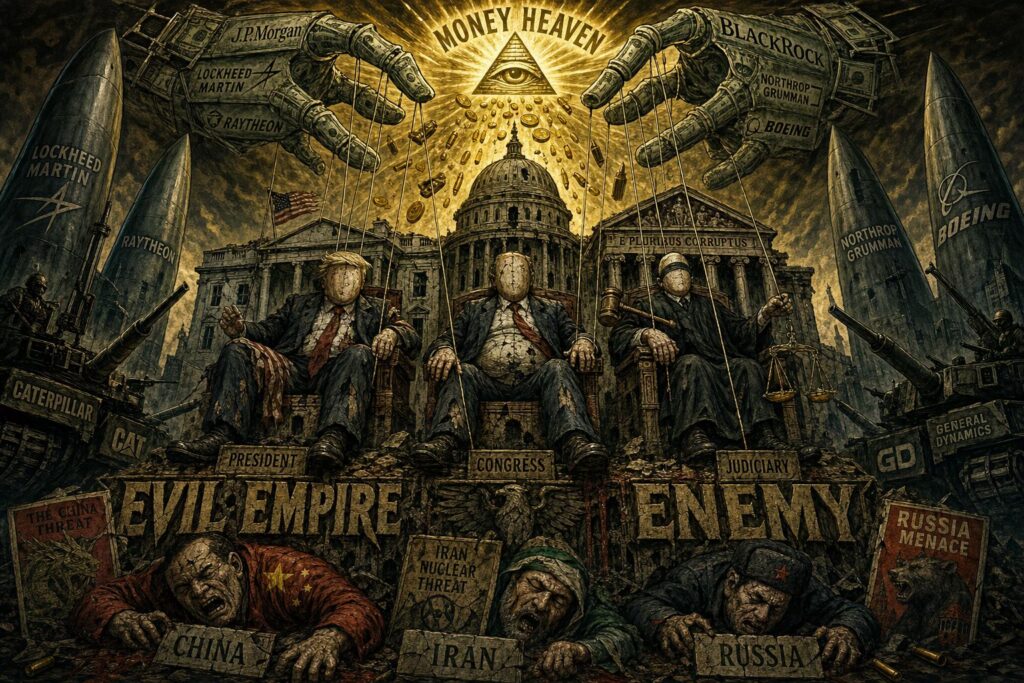
We have not stumbled into this. This is not policy as a series of unfortunate accidents. This is a protection racket.
The same class of donors, defense contractors, financial interests, and “strategic partners” profit from every front. The same aging leadership in both parties, what I will call the Uniparty, signs off on every appropriation, every arms shipment, every thinly disguised escalation. They wrap it all in a soothing euphemism, economic statecraft. They tell you they are “defending democracy,” “supporting allies,” “deterring aggression.” What they are actually doing is laundering permanent war through technocratic language so that you mistake it for responsible governance.
The money does not merely influence policy. It runs policy. It owns the presidency, disciplines Congress, and defines the boundaries of respectable debate across a media system concentrated in a few corporate hands. Ordinary Americans are not too stupid to see this. They are simply told, day after day, that there is no alternative, that permanent war abroad is the price of safety, prosperity, and freedom at home. The real stupidity belongs to a monied elite so entitled and so afraid of genuine competition that they would rather manufacture a new Cold War with Russia and China than rebuild an economy that can stand on its own.
This is the story. Not “Old Glory” and Mom’s apple pie, but a captured state hauling the flag around as a stage prop while it auctions off what remains of the republic.
The Ukraine Front: Proxy War as Policy
Let us start where the script is most familiar, Ukraine.
From the beginning, Washington framed its intervention as an act of moral clarity. Russia invades, the United States defends. The narrative was clean, simple, and emotionally satisfying. It also happened to be politically convenient. A massive flow of weapons, funding, and intelligence could now be justified indefinitely as the defense of “democracy” against “authoritarianism.”
The numbers tell a different story. When you make nearly two hundred billion dollars available for one conflict, you are not simply “helping an ally.” You are creating an ecosystem. Contracts, production lines, logistics chains, revolving doors. You are building a constituency for endless conflict. Every extra artillery shell, every new air defense system, every training program becomes someone’s revenue stream. There is no natural end point. The war is not just a geopolitical contest. It is a business model.
And business models do not voluntarily sunset.
Notice how quickly the framing shifts when the money flows slow down. The moment Congress hesitates, you hear threats. “If Ukraine loses, NATO collapses.” “If Ukraine loses, China will invade Taiwan.” The implication is clear. The weapons must flow or the world as we know it ends. This is not analysis. It is hostage taking. It is the permanent war lobby holding the public imagination at gunpoint and demanding fresh funding.
This does not deny Ukrainian suffering or excuse Russian aggression. It says that the United States has used that suffering as a justification for turning another region into a testing ground for its weapons, doctrines, and sanctions regimes. The people of Ukraine pay in blood. The Pentagon and its contractors are paid in full.
Israel: Client State, Sacred Cow
If Ukraine is the new front, Israel is the oldest account on the books.
Decades of “ironclad” support have hardened into something beyond policy. Israel is treated as an extension of the American security apparatus, a forward operating partner who must never be questioned, only supplied. Baseline military assistance flows every year. On top of that, in moments of crisis or escalation, the United States rushes in with “emergency” arms sales, multi billion dollar packages of bombs, munitions, and support systems expedited through procedures that make a mockery of oversight.
The pattern is always the same. Israel wages a campaign that produces massive civilian casualties. The United States provides diplomatic cover and military resupply. Any criticism is equated with treachery or antisemitism. War becomes a kind of sacral ritual, beyond question, beyond law, beyond democratic accountability.
Again, follow the incentives. When you guarantee a client state that you will indefinitely underwrite its military operations, you create the perfect impunity machine. When you add to that the domestic political weaponization of support for Israel, donors, lobbies, coordinated media narratives, you ensure that no serious debate can occur. Members of Congress know exactly what happens to those who step out of line. Primary challenges, donor blackouts, public smears, media exile.
So the “emergency” packages keep coming. The bombs keep dropping. The weapons labs keep humming. Any talk of conditioning aid, any suggestion that perhaps U.S. weapons should not be used to flatten entire neighborhoods, is dismissed as radical or fringe.
In this ecosystem, even basic moral intuition becomes suspect. The simple statement, “maybe we should not fund collective punishment,” is treated as an extremist claim. That is what capture looks like.
Iran: War Without the Word “War”
Then there is Iran, the conflict that dares not speak its name.
For years, successive administrations have operated in a gray zone. Sanctions, cyber operations, covert actions, and limited strikes fill in the space between open peace and declared war. The line between “pressure” and war has been blurred on purpose. When the United States bombs facilities, kills commanders, or helps coordinate operations through proxies, it is always framed as “self defense,” “deterrence,” or “targeted action.” Never war. That word is reserved for something else, something that would require a debate, a vote, a shared national decision.
This is where the language of “economic statecraft” does its dirtiest work. Sanctions become siege warfare by spreadsheet. Currency strangulation becomes a moral instrument. When infrastructure collapses, when medicine is unavailable, when ordinary people cannot access basic goods, we are told this is “pressure on the regime.” When Iran responds through its own network of allies and proxies, we act shocked and ask how they dare “escalate.”
Under this logic, the United States can obstruct an entire economy, attack targets, and stage operations in and around Iran while still insisting it is not at war. It is merely “managing a conflict.” Because the label “war” is avoided, Congress is free to perform outrage without responsibility. They hold hearings and issue statements, then quietly approve the next round of funding.
This is democracy as theater. The script stays the same. Only the actors rotate.
Economic Statecraft: The New Name for Rule by Money
Economic statecraft is the polite term for bypassing the public.
It sounds sophisticated, technocratic, like something best left to “experts” in think tanks and Treasury offices. In practice, it means this. Foreign policy is conducted through money and markets, not through debate and consent. The tools are sanctions, arms sales, loans, development packages, export controls, and the manipulation of global financial infrastructure. The target can be an enemy state, a rival power, or even an ally that needs disciplining.
What ties it all together is who decides. The same institutions that profit from the system, private banks, defense firms, energy giants, consulting firms, Silicon Valley platforms, are the ones whose representatives shuttle in and out of government to design it. They write the white papers, advise the committees, and draft the legislation. They sit on corporate boards when they are out of office and command influence when they are in.
You are not asked for your consent. At best, you are given a storyline.
Economic statecraft is also a way of infantilizing the public. We are told war is messy, but sanctions are clean. Bombs explode, but regulations are civilized. That is a lie. When you use financial tools to break an economy, you are not avoiding war. You are moving war into another domain and insulating yourself emotionally from its consequences.
The Uniparty: Old Men, New Wars
The United States likes to pretend it has two parties locked in existential battle. On paper, there are Democrats and Republicans. In practice, on the questions that matter most to empire, war, surveillance, the primacy of finance, the sanctity of the donor class, the differences collapse.
Call it what it is. A Uniparty.
On foreign policy, both sides agree that endless spending on the military is non negotiable. They may posture over tactics, more aid here, less rhetoric there, but they share the same assumptions. The United States must dominate, must police, must dictate. They differ mainly in marketing. One side sells “humanitarian intervention” and “responsibility to protect.” The other sells “peace through strength” and “America First.” The result is identical. The budgets pass, the weapons flow, the wars continue.
Look at the faces. The average age of leadership in Washington is absurd. These are men, and a few women, whose formative experiences were Vietnam and the Cold War. They continue to impose those mental maps onto a 21st century world that has moved on. They view Russia, China, Iran, and any non aligned state through the same lens. Potential enemy, potential client, never equal. Their reflex is escalation. Their instinct is control.
They are also the primary beneficiaries of a campaign finance system that has turned elected office into a form of asset management. Seats are protected by donor networks. Retirements are cushioned by corporate boards and speaking fees. Their children and friends slip into think tanks, media slots, and consulting firms. It is a closed loop.
We are governed by old men who treat the world as a chessboard and the rest of us as expendable pieces.
Manufacturing Consent: The Press as Partner
For this system to function, it needs a story. That is where the press comes in.
Corporate media in the United States is not a neutral referee. It is an institution embedded in the same networks of money and power as the political class. Ownership is concentrated in a handful of conglomerates. Advertising and investor interests lean heavily toward finance, tech, defense, and other globalized sectors. The result is predictable. Foreign policy coverage accepts the basic premises of American primacy and treats dissent as suspect or marginal.
You see it in the headlines. When the United States escalates, the verbs are passive and sanitary. “Tensions rise.” “Clashes erupt.” “Forces respond.” When an official speaks, their framing becomes the story. When a critic speaks, their motives are interrogated. Entire perspectives, Russian, Chinese, Iranian, Global South, are filtered through a Western security lens if they are allowed in at all.
The media’s job in this ecosystem is not to inform. It is to anesthetize. To make the extraordinary, permanent war, global surveillance, economic siege, feel ordinary, even inevitable. To ensure that when you do finally notice what is happening, your reaction is resignation, not resistance.
Americans Are Not Stupid, But We Are Complicit
Here is where I need to turn the knife.
Americans are not stupid. They are exhausted. They are working longer hours for shrinking real wages, juggling debt, and navigating a healthcare and housing system that treats them as revenue streams. They are drowning in noise, distraction, and curated outrage. Under those conditions, deep political engagement feels like a luxury.
But exhaustion is not innocence.
At some point, refusing to see becomes a choice. At some point, continuing to vote for the same incumbents, the same parties, the same narratives, becomes an endorsement. You cannot outsource your citizenship and then claim to be a victim when the people you empowered use that power against you.
The polls already tell the story. Supermajorities believe money has too much influence in politics, that the system is rigged, that democracy is under threat. Yet those supermajorities continue to reward the very structures they claim to despise. They continue to buy the brand differentiation and ignore the product inside the package.
It is not enough to be aware. Awareness without action is just another form of compliance.
What It Would Take to Break the Machine
If the system is this entrenched, what would it actually take to change it?
First, the electoral machinery has to be cracked. As long as the two party duopoly controls ballot access, debates, and financing, the Uniparty will remain intact. That means supporting ranked choice voting, proportional representation, or other reforms that allow genuine independent and third party candidates to emerge without instantly being dismissed as spoilers. It means backing local and state level changes that break the chokehold before aiming at the presidency.
Second, money must be forcibly evicted from its throne. That requires constitutional and statutory changes that many insiders will call impossible, which is precisely why they are necessary. Public financing, strict limits on private donations, bans on contributions from contractors and lobbyists, aggressive transparency on all forms of dark money. These are not technocratic tweaks. They are survival measures.
Third, war powers must be clawed back, not as a symbolic gesture but as enforceable law. Any sustained overseas operation, whether branded as a conflict, police action, or limited engagement, should trigger mandatory congressional votes and sunset clauses. No president, of any party, should be able to wage war by stealth.
Fourth, the media ecosystem must be diversified and challenged. That means supporting independent outlets, whistleblowers, and voices outside the permissible spectrum. It means refusing to treat corporate media as neutral arbiters. It means building parallel channels of information and analysis, even when they are messy and imperfect.
Finally, and most importantly, it means developing the courage to throw out incumbents, even the ones who say the right things about your domestic concerns, if they continue to fund and defend the war machine. There is no such thing as a lesser evil when both evils march you steadily toward the same cliff.
The Republic After JFK
People like to say that the assassination of John F. Kennedy marked the moment when the national security state stepped permanently out of the shadows. Whether you agree with that or not, it is undeniable that the apparatus built during the Cold War, the CIA, the Pentagon behemoth, the surveillance network, the permanent bureaucracy, has long outlived the constitutional framework that was supposed to contain it.
What we are living in now is not the republic of the founders, and not the mid century democracy of myth. It is a managed system in which elections change the color of the banners but never the direction of the march.
The two party system, as a vehicle of popular will, is already dead. What remains is a single war party with two marketing departments. The question is not whether we can resurrect some idealized version of “Old Glory” and Mom’s apple pie. That America existed more in story than in fact. The question is whether we are willing to build something new.
That something new will not be handed to us by charismatic saviors. It will come, if it comes at all, from citizens who refuse to be bypassed, who refuse to be governed by money, who refuse to outsource their conscience to an aging Uniparty of professional managers.
Throw out the incumbents. Replace them with independents and genuine outsiders wherever you can. Support a president from outside the two party system when the opportunity arises, not as a messiah, but as a battering ram against the architecture of capture. Destroy the system that killed its own legitimacy decades ago.
If we do not, the war machine will keep marching. It will keep buying off our representatives, buying off our media, and buying off our silence.
In the end, when there is nothing left of the republic but a logo stamped on missiles and banknotes, the money will have bought exactly what it wanted, a country without citizens, only customers and collateral.
Related reading
- The American AI Bubble Makes No Sense. Every Party to It Knows. It Is Happening Anyway. Why?
- American Empire in Ruins: The Unprovoked, Unconstitutional, and Catastrophic US-Israeli War on Iran
- What American Media Won’t Tell You About the Iran War and the End of the American Century in Asia
- How the Tehran and Delhi Settlements Expose a Petrodollar Already Gone, Gone, Gone, Taking the Bellicose American Empire With It.