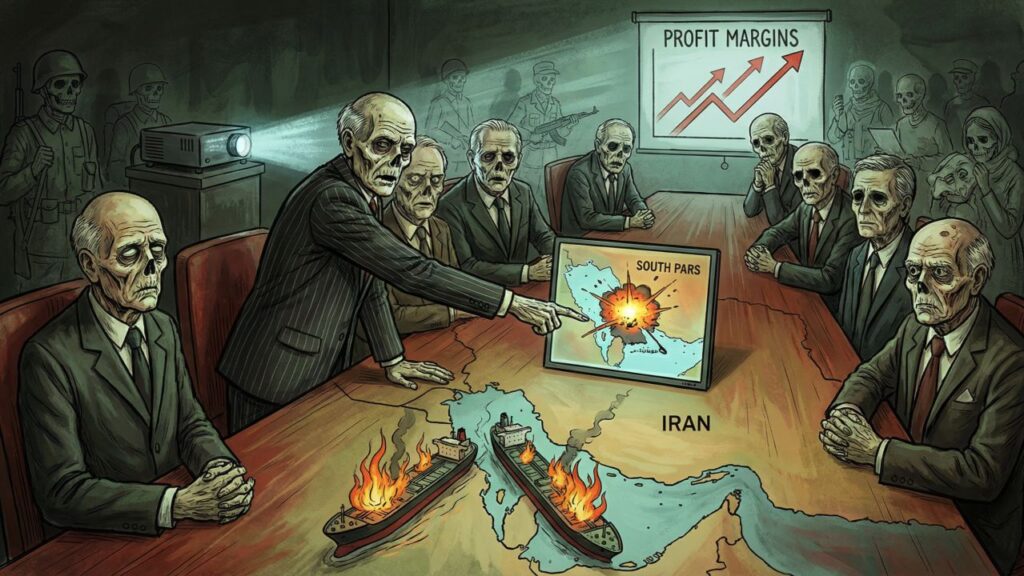
How America’s “prestigious” war planners turned the United States into DINO, Democracy in Name Only, on the road to Iran.
The Cost of Believing It’s Inevitable
None of this requires secret meetings in smoke‑filled rooms. The proof is all out in the open: funding disclosures, donor lists, revolving‑door résumés, and a seventeen‑year record of U.S. policy toward Iran marching in one direction. America does not keep stumbling into these wars. It keeps selecting them from a menu it wrote for itself.
Few Americans realise that the war now ripping through Iran was scripted under Barack Obama. Not in a secret bunker, but in a 241‑page “options memo” published in 2009 by the Brookings Institution’s Saban Center for Middle East Policy.
In 2009, a group of senior insiders at the Brookings Institution published a 241‑page manual for dealing with Iran, Which Path to Persia? Options for a New American Strategy Toward Iran. They warned that every option was dangerous and expensive, then calmly explained how to combine those options into a long, grinding campaign of pressure, sanctions, airstrikes, and regime‑change gambits. Washington built a machine around that logic and never turned it off.
The result is the world we now inhabit: Gulf skies burning, global energy markets rigged with trip‑wires, and another generation sent to fight a war that was drafted before many of them were out of high school.
What follows are ten conclusions you are not supposed to connect, but every document, donor list, and casualty report keeps forcing together.
Ten Things This War Proves
1. This war was not “unthinkable”; it was literally outlined. The escalation ladder we are climbing with Iran (sanctions and “offers,” an Israeli strike, a U.S. air war, regime‑change pressure, open‑ended containment) matches, step for step, the scenarios laid out in Brookings’ 2009 report Which Path to Persia?. The report ends by urging an “integrated strategy” that connects multiple options instead of choosing just one.
2. The same people who wrote the Iran playbook later ran Iran policy. The report’s authors (Kenneth Pollack, Martin Indyk, Bruce Riedel, Suzanne Maloney, Daniel Byman, Michael O’Hanlon) are not anonymous staffers. Pollack came out of the Central Intelligence Agency (CIA) and the National Security Council (NSC). Indyk served twice as U.S. ambassador to Israel and as Assistant Secretary of State for Near Eastern Affairs. Riedel spent three decades in the CIA and advised four presidents from inside the White House. They wrote the menu at Brookings, then rotated back into government kitchens to cook from it.
3. Using Israel as the opening move was part of the design, not a desperate improvisation. A whole chapter, titled “Leave It to Bibi,” walks through the advantages of letting Israel strike first: Iran’s retaliation hits Israel, not American bases; Washington looks reluctant rather than aggressive; U.S. escalation can be sold as “defending an ally” instead of starting a war. In 2026, Israel hit South Pars, the world’s largest gas field on Iran’s coast, and the United States surged in right behind. That is choreography, not coincidence.
4. “Failed diplomacy” was never a tragic accident. It was a planned evidentiary phase. The report openly recommends giving Iran a “superb” deal so generous that only a regime “determined” to get the wrong kind of nuclear capability would turn it down. The point is not just to make peace; the point is to make rejection look so unreasonable that war feels inevitable and justified. The Iran nuclear deal (JCPOA), its demolition, and the way it was later cited as proof of Iranian bad faith fit that script almost perfectly.
5. The Saban Center’s key patron proudly calls himself “a one‑issue guy, and my issue is Israel.” Brookings’ Middle East shop, which produced the Iran report, was created with roughly 13 million dollars from billionaire Haim Saban. Brookings’ own announcements credit his founding grant. Saban has said on the record, “I’m a one‑issue guy, and my issue is Israel.” When a man like that funds a “neutral” options memo on Iran, you are not reading a random academic exercise.
6. Brookings is not a seminar room. It is a hub for government, contractors, and foreign states. Brookings’ donor rolls include major Pentagon contractors (Lockheed Martin, Raytheon/RTX, Northrop Grumman, Airbus), U.S. government agencies, and foreign governments such as Qatar. Its Doha Center was funded under a memorandum giving Qatar’s foreign ministry approval rights over its budget and programs. Those same contractors and governments have direct stakes in how Iran is “handled.” The incentives point in one direction.
7. The Pentagon’s revolving door turns “policy” into a business model. Hundreds of senior Defense Department officials and flag officers have walked straight into high‑paid jobs with the very firms that build the weapons now shredding Iran’s infrastructure. When your future salary depends on perpetual procurement, “end the war” is a much less attractive button than “replenish stockpiles” and “expand missions.”
8. The air war in Iran is doing exactly what airpower does: wrecking hardware, hardening regimes. Thousands of Iranian targets have been hit: bases, missile sites, ships, leadership compounds. Iran’s Supreme Leader is dead; the Islamic Revolutionary Guard Corps (IRGC) has lost ships and facilities. The regime is still there. The IRGC has publicly said it can sustain a full‑scale war for at least six months and hasn’t even used its newest missiles. This is the Iraq and Serbia pattern all over again: decapitation fantasies, resilient regimes, destroyed civilian infrastructure.
9. Once South Pars and Qatar’s gas hubs were hit, this stopped being just a war on Iran. It became an energy war on everyone. South Pars/North Dome holds roughly a fifth of the world’s proven gas reserves. Ras Laffan in Qatar is a critical liquefied natural gas export hub. Hitting those sites doesn’t just punish Tehran; it kneecaps buyers in Europe and Asia, pushes oil and gas prices through the roof, and forces allied economies to scramble for alternative sources, including expensive U.S. exports. The battlefield is now the global energy system.
10. None of this is secret. The secrecy is in how rarely anyone stitches it together. The report is public. The donors and their priorities are public. The revolving‑door résumés are public. The casualty counts and energy price charts are public. What is missing is not evidence. What is missing is the political will to admit that America’s war machine is now an institution in its own right, with its own business model, and Iran is just the latest “path” on the menu.
Those ten points are the spine. The rest of the article is the receipts.
From the Brookings Report to the War Plan
Start with the document that made this war thinkable.
In June 2009, the Brookings Institution’s Saban Center for Middle East Policy published a 241‑page report titled Which Path to Persia? Options for a New American Strategy Toward Iran. It is not a leak. It is not classified. It is still hosted on Brookings’ own site for anyone willing to read past the cover.
The author list tells you exactly what kind of document it is. Kenneth Pollack, the lead, came out of the CIA and the National Security Council, where he handled Persian Gulf affairs. Martin Indyk served twice as U.S. ambassador to Israel and as Assistant Secretary of State for Near Eastern Affairs. Bruce Riedel spent three decades in the CIA and advised four presidents from inside the White House. Suzanne Maloney, Daniel Byman, and Michael O’Hanlon rounded out a team that had already helped design U.S. policy in the region and would continue to do so after the ink dried.
Brookings presents “Which Path to Persia?” as a sober “options memo” that lays out the main approaches available to the United States. The authors insist they are not advocating any particular path, only describing it. That framing sounds modest. It is exactly what makes the document powerful.
Because if you look at what the report actually does, three things jump out.
First, it builds a closed universe. There are nine “options,” and every one of them involves keeping Iran under pressure: sanctions, covert action, airstrikes, invasion, regime change, or some combination of the above. The lone “peaceful” alternative is a version of full engagement that the authors themselves treat as improbable. At no point is “stop trying to run Iran’s future” offered as a serious path.
Second, it normalises extremes. Full‑scale invasion is presented in the same cool, technocratic tone as “containment” or “engagement.” The fact that invasion would mean hundreds of thousands of troops and a commitment measured in decades is treated as a planning variable, not a moral threshold.
Third, and most important, the report does not leave those options in separate, tidy boxes. Its final chapter explicitly calls for “connecting the options” into an integrated strategy toward Iran. The message to policymakers is clear: you do not pick one path to Persia, you string several together. You sanction, then you negotiate, then you tighten sanctions, then you encourage an Israeli strike, then you follow with your own, then you lean on proxies and covert action, and all the while you keep the long‑term containment architecture in place.
That is the genius of the document from the system’s perspective. It doesn’t order anyone to go to war. It does something more durable. It defines, in respectable, footnoted, think‑tank language, what “serious” Iran policy looks like. It tells every future administration that the way grown‑ups handle Iran is some mix of pressure, pretext, and force. Once that frame is in place, events don’t have to be scripted. They only have to be nudged. The logic will do the rest.
The Money and the Mandate
If you want to know why that logic always runs in one direction, follow the money.
The Saban Center for Middle East Policy, the unit that produced Which Path to Persia?was created in 2002 with about 13 million dollars from billionaire media mogul Haim Saban. Brookings’ own press releases spell this out. Saban did not hide his motives either. In multiple interviews, he has described himself as “a one‑issue guy, and my issue is Israel.” That one‑issue guy funded his own Middle East policy center inside America’s most prestigious think tank, and it was that center that produced the Iran war menu.
Saban’s political giving sits on top of that. He has been one of the largest individual donors to the Democratic Party and the Clintons in particular, writing eight‑figure checks to foundations and super PACs, hosting fundraisers, and publicly threatening to bankroll primary challenges against Democrats he considers insufficiently pro‑Israel. He has talked openly about his goal: influence policy through “the media, the money and the think tanks.”
Zoom out from Saban, and the pattern only hardens. Brookings’ broader funding comes from:
- U.S. government agencies, including those directly engaged in foreign policy and defense
- Major U.S. and European corporations, including the top Pentagon contractors
- Foreign governments, including Qatar and others in the Gulf
Independent funding trackers show defense‑industry names like Lockheed Martin, Raytheon/RTX, Northrop Grumman, and Airbus among Brookings’ significant donors. Investigative reporting has detailed a 2007 memorandum under which Qatar’s foreign ministry had approval rights over the budget and programming of Brookings’ Doha Center. Senators in both parties have since questioned whether such arrangements compromise think‑tank independence.
None of this means Brookings staff are handed talking points in a briefcase. It means something more subtle and more effective: the boundaries of “respectable” debate are set in a room financed by people and governments whose fortunes depend on an expansive U.S. footprint, assertive military posture, and a friendly regional balance of power.
When the “options” that get written into these reports reliably align with the interests of donors and contractors, and then reliably survive changes in party and president, you are no longer looking at a healthy republic arguing over policy. You are looking at DINODemocracy in Name Onlya political system where the voting never reaches the most important decisions.
The Revolving Door and the War Economy
Ideas do not stay on paper. They walk.
The people who write these reports are the same people who staff the U.S. government before and after they write them. A Brookings fellow becomes an NSC director for the Middle East, then returns to Brookings or moves to another think tank. A State Department official takes a chair at Brookings, pens an options paper, then comes back into government in the next administration. The names change desks, not buildings.
This is the foreign‑policy version of the revolving door. After every administration change, you can watch the flow: from Brookings, the Council on Foreign Relations, the Center for a New American Security, RAND, into State, Defense, the NSC, and back out again. It is a single career track with two employers.
Then there is the other revolving door, the one that connects the Pentagon to the firms that cash in on its decisions.
One major watchdog study tracked over 380 high‑ranking Defense Department officials and flag officers who, in just a decade, moved into roles as lobbyists, board members, executives, or consultants for defense contractors within two years of leaving government. Roughly a quarter of them went to work for the top five contractors alone. Those contractors are also donors to the think tanks that generate the “options” for future wars.
So the ecosystem looks like this:
- Contractors fund think tanks.
- Think tanks employ former officials to write papers that expand missions, force posture, and procurement.
- Those papers inform the decisions of serving officials.
- Those officials then retire into the same contractors’ boardrooms.
In that environment, policies that shrink budgets, close bases, or reduce tension are not just unpopular. They are career risks. Policies that sustain deployments, escalate pressure, and burn through munitions are win‑wins: they prove “resolve,” keep the appropriations flowing, and preserve the revolving door for the people who run it.
This is what DINO looks like in practice. Elections shuffle the top layer. The war economy underneath stays wired the same way.
The War Now and the Real Tab
All of that would be bad enough as theory. It is worse as lived reality.
In early 2026, Israel launched a strike on Iran’s South Pars gas complex, the Iranian half of the South Pars/North Dome field shared with Qatar. That field holds roughly a fifth of the world’s proven gas reserves and tens of billions of barrels of condensate. Hitting it was like putting a bomb under the global energy system. Iran responded with missile and drone attacks on Gulf infrastructure. Qatar’s Ras Laffan LNG hub, a critical export node, was hit. The region tipped into a wider war.
Iran’s Islamic Revolutionary Guard Corps declared that it could sustain a high‑intensity war for at least six months at the current pace, and pointedly noted that its newest missile generations have not yet been used. Israel’s defense minister said there would be “no time limit” on operations against Iran. Both sides were publicly preparing their citizens for a long campaign.
On the American side, President Donald Trump bragged to reporters that there was “practically nothing left to target” in Iran, after thousands of strikes, even as he threatened to “massively blow up the entirety of South Pars” if Iran hit Qatar again. Taken together, those statements are not confusion. They are the sound of a target list running out while war aims keep expanding.
U.S. Central Command reports more than 5,500 targets hit inside Iran: naval vessels, missile batteries, command centers, logistics hubs, and industrial facilities. Iran’s Supreme Leader was killed in a decapitation strike. His successor and the regime’s structure remain in place. The IRGC is battered but unbroken.
Meanwhile, energy markets have done exactly what any sober planner knew they would. Oil pushed above 110 to 120 dollars per barrel. European and Asian gas prices spiked. Insurance for shipping through the Strait of Hormuz soared. Airlines, shipping companies, and households are paying the price in fuel surcharges and higher costs for everything that moves.
Back in Washington, the war machine spins on. Supplemental appropriations sail through. Stocks of munitions and replacement platforms for the contractors climb. Think tanks convene panels on “managing escalation dynamics” and “deterring further Iranian aggression,” moderated by the same experts who wrote the Iran strategy memos a decade ago.
On paper, this is a constitutional republic. In practice, it is DINODemocracy in Name Onlya system where unelected donors, contractors, and policy mandarins write the war plans, and elected officials just sign the checks.
The tab that never gets printed is the one that lands on ordinary people:
- The families whose kids will come back from the Gulf with missing limbs, or not at all.
- The households hammered by energy‑driven inflation and higher borrowing costs.
- The small businesses pushed under by a war they had no say in declaring.
The merchants of catastrophe will be fine. They live upstream of the blast radius, in boardrooms and conference halls. They will put this war on their CVs, convert it into fellowships, book deals, and consulting retainers.
The rest of us will be told, again, that it was tragic but inevitable.
It wasn’t. It was priced, planned, published, and purchased.
Related reading
- The Bombing of Iran was Scripted in 2009; Trump is Just Following Orders
- American Empire in Ruins: The Unprovoked, Unconstitutional, and Catastrophic US-Israeli War on Iran
- What American Media Won’t Tell You About the Iran War and the End of the American Century in Asia
- Trump’s Iran War, China Trip and the Vanishing Empire