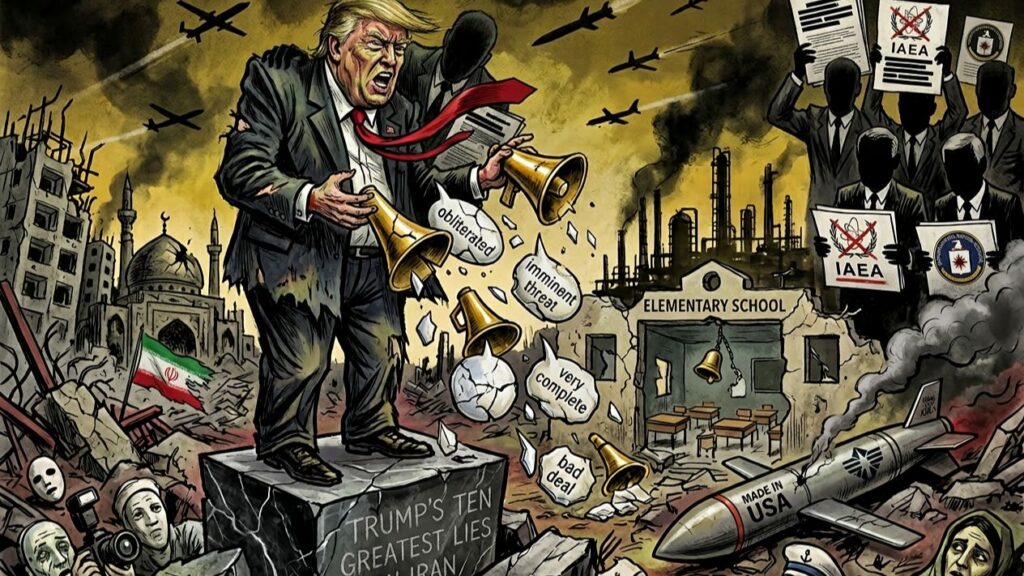
1. “We obliterated Iran’s nuclear program.” Trump claimed repeatedly, from June 2025 onward, that Operation Midnight Hammer “completely and totally obliterated” Iran’s nuclear facilities at Fordow, Natanz, and Isfahan. His own Pentagon’s initial intelligence assessment found the strikes only delayed the program by months, not years. CIA Director Ratcliffe called it “severely damaged.” IAEA Director General Grossi told CBS it was “severe damage, it was not total damage.” Trump’s White House published a webpage calling any contrary reporting “fake news” while his Defense Secretary, Secretary of State, and DNI all attacked the intelligence assessment publicly.
2. “Iran is developing missiles that will soon reach the United States.” In his State of the Union and in the February 28 video announcing strikes, Trump claimed Iran was building long-range missiles that could “soon” reach the American mainland. His own Defense Intelligence Agency’s 2025 assessment found Iran lacked ICBMs and could take until 2035 to develop them. Three American officials told the New York Times that Trump overstated the immediacy of the threat. Secretary of State Rubio would only say Iran was “on a pathway.” Reuters confirmed the claim was unsupported by U.S. intelligence.
3. “Iran was rebuilding its nuclear weapons program.” Trump simultaneously claimed to have obliterated Iran’s nuclear program and that Iran was “starting it all over again.” Rubio admitted there was no evidence Iran was currently enriching nuclear fuel. IAEA’s Grossi said his agency had not detected any plans from Iran to produce nuclear weapons. U.S. officials told the Times that Iran had not established any new nuclear facilities since June.
4. “32,000 people were killed in Iran’s protest crackdown.” Trump stated this figure at a press briefing without citing a source. The Iranian government reported 3,117 deaths. The U.S.-based Human Rights Activists News Agency documented 7,015 confirmed deaths with 11,744 still being assessed. CBS sources estimated up to 20,000. Iran International, using leaked IRGC documents, reported over 36,500. Trump’s number fell in between various estimates but was presented as fact with no sourcing or caveat.
5. “General Caine thinks a war with Iran would be easily won.” After the Wall Street Journal, Axios, and other outlets reported that Joint Chiefs Chairman Dan Caine had cautioned Trump that an extended campaign against Iran “could incur significant costs to US forces and munitions stockpiles” and risk prolonged conflict, Trump posted on Truth Social that the reports were “100% incorrect” and that Caine believed the war “would be something easily won.” Multiple outlets confirmed Caine’s warnings.
6. “Iran bombed the girls’ school in Minab, not us.” On March 7, Trump said, “In my opinion, and based on what I’ve seen, that was done by Iran.” The Shajareh Tayyebeh elementary school was struck on February 28, killing 175 people including girls aged 7 to 12. Reuters revealed U.S. military investigators suspect American forces were likely responsible. Bellingcat identified the weapon as a Tomahawk cruise missile. Video confirmed by the AP and geolocated to the school site showed a Tomahawk impact. The USS Spruance, part of the Abraham Lincoln strike group, was filmed launching Tomahawks on February 28 within range. Israel denied conducting any strikes south of Isfahan.
7. “Iran has Tomahawk missiles.” When pressed on the school bombing, Trump claimed the Tomahawk is “quite common” and that Iran “also possesses some Tomahawks.” The Tomahawk is manufactured by Raytheon and sold exclusively to the U.S., UK, and Japan. There is no public evidence that Iran has ever acquired or operated Tomahawk cruise missiles. When asked why he was the only member of his administration making this claim, Trump replied, “Because I just don’t know enough about it.”
8. “Show some guts. There’s nothing to be afraid of. We sunk all their ships.” On March 9, Trump told commercial ships to run the Strait of Hormuz. His own Maritime Administration had issued an advisory on March 6 telling vessels to “keep clear of this area if possible.” UKMTO had logged 13 incidents including 10 attacks since February 28. At least 7 seafarers had been killed. Strait traffic had collapsed from 98 ships per day to one. There were zero U.S. Navy vessels in the Persian Gulf to provide escort.
9. “We acted because of imminent threats” / Iran was behind the USS Cole attack. In his February 28 video announcing strikes, Trump cited an “imminent threat” but the Pentagon offered no evidence to support the claim of self-defense. He also attributed the 2000 USS Cole attack to Iran: “In 2000, they were aware and likely involved in the USS Cole attack.” Al Qaeda claimed responsibility for the Cole bombing, and U.S. intelligence agencies confirmed Al Qaeda’s responsibility. While courts have found Iran provided material support to Al Qaeda, there is no public evidence of direct Iranian involvement in the Cole attack.
10. The war is “very complete” and running “very far ahead” of schedule. On March 9, Trump told CBS News the campaign was “very complete” and Iran had “no navy, no communications, no Air Force.” At that moment, Iran was still loading crude at Kharg Island, still launching drones and missiles at commercial shipping, still operating its Mosaic Defence network of 31 autonomous provincial commands, and had successfully struck an Amazon data center in the UAE, Saudi Aramco’s largest refinery, and the Fujairah terminal. Seven seafarers were dead. The Strait was functionally closed. And the 82nd Airborne was on standby because the “very complete” air war was not, in fact, complete.