This article began as a letter to a friend and fellow analyst. As the evidence accumulated, it outgrew the envelope.
The Tariff Trap
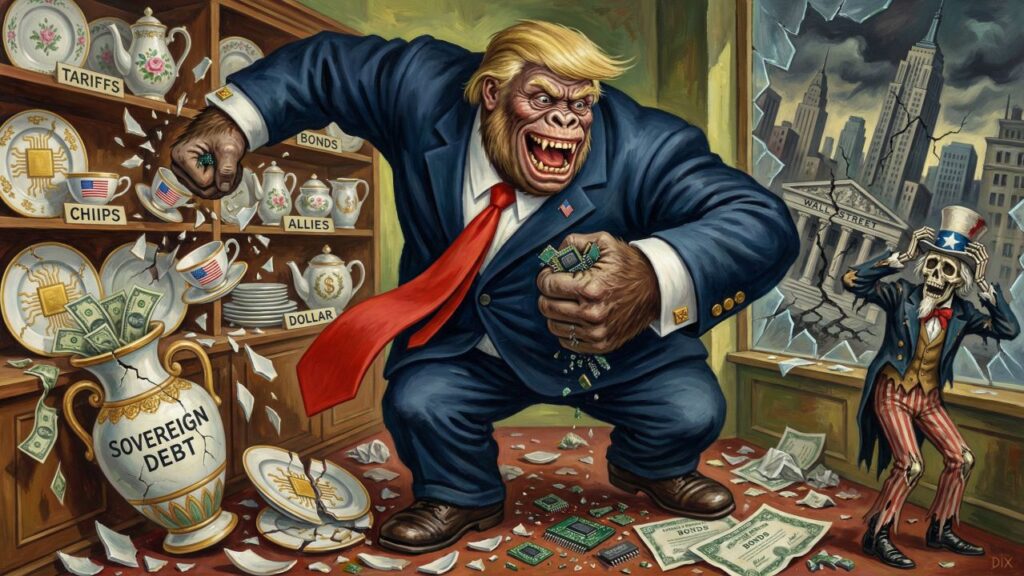
The tariff picture is worse than most people realize. As few propagandized Americans understand, tariffs are import taxes, paid by American businesses and consumers, not by China. By mid-2025, the effective U.S. tariff rate had climbed to roughly 18 to 20%, the highest since the 1930s. That means if you used to spend $100 at Walmart, you’re now paying $118 or $120, and the rest of your discretionary spending must come down.
Companies face what economists call a “double squeeze”: input costs for steel, aluminum, and copper are up 20 to 30% due to tariffs, while consumer demand is falling. Goldman Sachs found that U.S. businesses initially absorbed roughly 64% of tariff costs to protect consumers, but that burden has been steadily shifting. By late 2025, the Federal Reserve Bank of New York reported that 90% of tariff costs were being passed on to American companies and consumers. The Yale Budget Lab estimates an average household cost of $600 to $1,300 per year, depending on whether the tariffs remain at current levels.
The result is exactly what any first-year economics student would predict: a deteriorating labor market, negative manufacturing data, and what looks increasingly like stagflation, the toxic combination of rising prices and economic stagnation that is notoriously resistant to monetary policy intervention. The Information Technology and Innovation Foundation warned that the scale of tariff increases, between 20 and 25 percentage points, makes stagflation “particularly dangerous” because the Federal Reserve’s standard tools are ineffective against it.
And then, as if tariffs alone were not enough, the administration launched a war against Iran. On February 28, 2026, the United States and Israel struck Iran in a massive coordinated bombing campaign. Within three days, European oil markets opened 20% higher. The Strait of Hormuz was shut down. The Red Sea was effectively closed. India, which depends on the Persian Gulf for 60% of its oil imports, faced an immediate $15 billion burden for every $10 rise in crude prices. As retired Colonel Douglas Macgregor, a decorated combat veteran and former senior adviser to the U.S. Secretary of Defense, told Glenn Diesen on Day 3 of the war: “The dollar is losing airspeed and altitude. Economically, this is a catastrophe. Financially, for us, it’s a disaster”.
Tariff inflation plus an energy shock. That is the formula for a stagflationary crisis that the Federal Reserve has no tools to fix.
The Chip War Boomerang
Now layer in the semiconductor war. The U.S. blocked the sale of advanced chips and chip manufacturing technology to China. Washington’s intent was to cripple China’s AI capabilities. Here is what actually happened instead: China responded with a national mobilization. Over $161 billion in state investment poured into domestic semiconductor development. Huawei has built an entire parallel semiconductor ecosystem, emerging as the leader of what analysts call a “national team” in semiconductors, dominating chip manufacturing and integrating the country’s entire supply chain from AI processors to packaging materials. The company unveiled a three-year Ascend AI chip roadmap at its 2025 Connect conference, with the Ascend 950PR scheduled for Q1 2026, the 950DT for Q4 2026, and the Ascend 960 and 970 to follow in subsequent years. Huawei plans to double its AI chip output in 2026, targeting 1.6 million dies.
The domestic share of semiconductor manufacturing equipment in China rose from 4.91% in 2018 to nearly 20% in 2023. Goldman Sachs estimates that domestic suppliers met about 14% of China’s semiconductor demand by value in 2024, with projections of 37% by 2030. Multiple Chinese chipmakers, including Moore Threads, Biren Technology, and others, are advancing their own solutions, creating a multi-supplier landscape that reduces dependence on any single foreign source.
And now comes the twist that should make every Western policymaker lose sleep. China is refusing to buy Western chips, even when Washington offers to sell them. When Trump approved Nvidia H200 sales to China in January 2026, Chinese customs agents were instructed that the chips are “not permitted” to enter China. Government representatives convened meetings with domestic technology firms, directing them explicitly not to purchase the chips unless absolutely necessary. The language, according to sources, was “so stringent that it essentially amounts to a ban”.
Beijing has made a strategic calculation: accept inferior chip performance today to avoid dependency on technology that can be weaponized tomorrow. As one analysis put it, “accepting such an offer also means accepting the logic that the US holds the keys to the technology and dictates the terms. Beijing sees a political cost in this”. They are building an ecosystem they will not share with the West. Ironically, when and if the U.S. does go begging, its own tariffs would force American buyers to pay 18 to 20% over market price, Trump’s genius, his oh-so-genius Art of the Deal “instincts,” applied to the purchase of technology the United States itself sanctioned.
Two Technology Civilizations
The country that controls chips controls AI. The country that controls AI controls the future. What is emerging now is something unprecedented in modern history: two parallel, largely incompatible technology civilizations (the U.S. on one side, China on the other) each with its own chips, software stacks, supply chains, and spheres of influence.
And while the U.S. is squeezing allies to fund its chip infrastructure, Japan pledged $550 billion and South Korea $350 billion in investment commitments, a combined $900 billion, essentially extracted under tariff duress; China holds the other end of the chokepoint: dominance over gallium production and the rare earths without which no chip of any generation gets manufactured. China restricted exports of seven rare earth elements crucial for the automotive, energy, technology, and defense sectors, prompting European Commission President von der Leyen to decry the curbs as “blackmail”.
Trump cannot claim to restore American jobs while spending hundreds of billions developing mines in Africa or Central Asia. But self-sufficiency is impossible without doing exactly that. As financial analyst Sean Foo put it in a prescient September 2025 conversation with Norwegian geopolitical historian Glenn Diesen, Trump has “trapped the U.S. economy”.
And Colonel Wilkerson, with 31 years in the U.S. military and four decades of watching Washington’s strategic miscalculations, adds a dimension that Foo could not: Xi Jinping has announced the renminbi will replace the dollar as the world’s transactional reserve currency. As Wilkerson recounts, Xi’s statement, vetted through diplomat Chas Freeman to ensure the Mandarin was translated precisely, read: “We are the number two economy in the world. I think he’s not boasting, industrially, Chinese capitalism, technologically, militarily, they’re the number one. The one area we aren’t paramount in is finance.” And then the operative statement: “I didn’t want to do this. Deng Xiaoping is rolling over in his grave as I say these words. I am going to put the RMB forward as the world’s new transactional reserve currency, a replacement for the dollar”.
He said that in writing. That means he’s ready for the fight, and ready to finish it.
Europe Sleepwalks Into Catastrophe
Meanwhile, a dazed and confused Europe is sleepwalking into catastrophe. Brussels is considering more sanctions on China, under pressure not from European interests, but from Washington. As Trump demanded that European nations impose 50% to 100% tariffs on China, EU officials pushed back privately, with diplomats telling reporters, “no way,” while publicly signaling “readiness to accelerate”. The European Commission ruled out matching Trump’s demand for triple-digit tariffs, “fearing such drastic measures would spark a damaging trade war,” and instead advanced a narrower plan of targeted tariffs on sectors such as electric vehicles, steel, and solar panels.
Think about what this dynamic reveals: Europe isn’t sanctioning China because it serves European interests. It’s sanctioning China to appease Washington. This is a Hobson’s choice with less than a Pyrrhic victory as the reward.
If Europe severs its cheap Chinese inputs, on top of already cutting off Russian energy and pledging hundreds of billions for expensive U.S. LNG, its manufacturing base collapses. Germany, roughly 25% of EU GDP, is already shrinking, its industry decimated by the triple blow of COVID lockdowns, the forced transition to electric vehicles, and sanctions on Russian energy that cut off the cheap inputs its industrial model depended on. But if Europe refuses Washington’s demands, it risks even higher tariffs. Either way, Europe loses.
Professor Richard Sakwa, the leading Russia scholar in Europe and author of the new book The Russo-Ukrainian War: Follies of Empire, offers the conceptual explanation for why Europe seems unable to act in its own interest. In his March 4 conversation with Diesen, Sakwa draws a distinction between European identity, the pan-continental vision articulated by de Gaulle (“Europe from the Atlantic to the Urals”), Gorbachev (“Common European Home”), and Putin in his first decade in office (“Greater Europe”), and the Atlantic identity that subsumed it after 1945. Membership in the Atlantic alliance system, Sakwa argues, has “transformed the quality of our various statehood,” rendering European states structurally incapable of developing separate security and defense policy. Everything runs through NATO and, by extension, through Washington.
This is not stupidity. It is structural captivity. Europe is not sleepwalking because it lacks intelligence. It is sleepwalking because the Atlantic identity, what Sakwa calls “the political west,” has replaced the European one, and the institutions that define European statehood were built to serve Washington’s strategic concerns rather than Europe’s sovereign interests.
And the political west, Sakwa argues, has two faces: a “commonwealth” face that delivers public goods (democracy, freedom, free trade) and an “imperial” face that expanded relentlessly after 1989, substituting itself for the United Nations Charter system and demanding universal compliance. After the Cold War, instead of considering its job done and going “quietly into the night,” the political West radicalized: NATO expansion, EU expansion, ideological expansion. The result is that Europe, four years into the worst land war on the continent since 1945, has, in Sakwa’s devastating phrase, “no concept of peace, no vision of peace” that includes Russia. The European Commission under Ursula von der Leyen has produced only escalation, sanctions, and weapons shipments. Not a single comprehensive peace framework.
And there is no guarantee that Trump will reward European loyalty rather than exploit it. His track record is a rap sheet:
- He slapped 25% tariffs on Canada and Mexico, two allies that had just renegotiated the USMCA at his insistence and believed they had a deal.
- He raised tariffs on Canada to 35% while giving Mexico a pause, pitting the two allies against each other.
- He doubled tariffs on imports from India from 25% to 50% as punishment for buying Russian oil, despite India being a key partner in his Indo-Pacific strategy. India called the tariffs “unfair, unjustified and unreasonable,” noting that “several other countries are also taking [the same actions] in their own national interest”.
- He squeezed South Korea and Japan for a combined $900 billion in investment commitments while ICE raided a Hyundai factory on U.S. soil, detaining 475 workers, mostly Korean engineers and equipment installers, in the largest single-site immigration enforcement operation in DHS history, sparking a diplomatic crisis with Seoul.
- And now, having extracted $350 billion from South Korea, the administration is pulling THAAD and Patriot missile defense systems out of the Korean peninsula to redeploy them against Iran, stripping an ally of the very equipment designed to protect it.
Was he craven, bamboozled by sycophants, or just plain ignorant and bombastic? Who cares? The damage is done. As Foo noted, once Europe can only export to the U.S., Trump can always claim European “overcapacity” is flooding American markets and raise tariffs again. Loyalty to this administration is not a shield. It’s a target.
Sakwa provides the conceptual frame; Wilkerson provides the operational proof. Describing the THAAD redeployment and its consequences, Wilkerson told Diesen: “Nothing gives an ally less faith than you than when you get into duress and you take your equipment designed expressly to defend them away and put it in another conflict. That says to that ally, ‘I can’t trust these people'”.
South Korea is now debating, daily, whether to remain in the alliance, Wilkerson reports. “They understand the only reason we’re on the peninsula is to fight China, not to protect Korea. And they don’t want to fight China. They’ve got a good relationship with China. It’s a hell of an economic relationship”. His prediction: “We’re going to lose Korea within 24 months. And this just sped that up a bit”.
Macgregor extends the analysis to Japan and the Gulf states: “If you’re sitting on the Korean peninsula, you’re already tired of the American military presence… I think the Japanese are watching this and beginning to wonder just how tightly aligned with us they want to be”. And in the Gulf, where Iran has struck 27 bases, destroyed port facilities from Incirlik to Dubai, and shut down the Strait of Hormuz: “I don’t think anybody living in the Gulf is going to want us in proximity to any of their harbors or airports or anything else. I think we’re going to be swept out of the region”.
The Forecasters Who Called It
Which brings us to Glenn Diesen. He’s a Norwegian professor of international relations, a geopolitical historian with access to leading scholars, Sachs, Baud, Mearsheimer, Sakwa, Doctorow, and others. Some days, he hosts three or four separate hour-long conversations with these scholars, top fund managers, and former military and CIA analysts. Diesen is a brilliant interlocutor and, more importantly, a fantastic listener. His conversations with hedge fund managers and traders, against the backdrop of geopolitics, are particularly valuable because he reaches people who have a truly visceral understanding of what is happening in the markets. Sean Foo and Martin Armstrong are perfect examples.
A September 21, 2025, conversation with Foo“Sean Foo: Collapse as U.S. Economic War on China Backfires” laid out with precision how the chip war would boomerang, how tariffs would squeeze American workers while China built self-sustaining demand for its own semiconductors, how the dollar would get debased by 8 to 10%, how gold would surge past previous inflation-adjusted highs, how the U.S. would shake down allies for hundreds of billions to fund chip infrastructure, and how Europe would be hollowed out if it followed Washington’s lead on China sanctions.
Every single one of those calls has materialized. Gold hit $3,702.95 in September 2025, an all-time record. The dollar dropped to its lowest level in over two months against a basket of currencies, with analysts noting it had lost roughly 8 to 10% of its value over the preceding months. China is rejecting Nvidia chips. Europe is sanctioning China while its manufacturing base crumbles. It is as if Foo and Diesen had a crystal ball.
The Deeper Disease: Sovereign Debt
And then there’s Martin Armstrong. If Foo diagnosed the tariff trap and the chip boomerang, Armstrong identifies the deeper structural disease: a sovereign debt crisis that has been building since World War II and is now reaching its terminal phase.
Armstrong (a former international hedge fund manager, founder of Armstrong Economics, and creator of the Economic Confidence Model (ECM)) has a track record that includes forecasting the 1987 stock market crash, the 1989 peak in Japan’s Nikkei, and the 1998 Russian financial collapse. In his February 24, 2026, conversation with Diesen, Armstrong laid bare the math that most politicians refuse to confront.
U.S. interest payments on the national debt hit $1.21 trillion in fiscal year 2025, consuming 17% of total federal spending, more than the entire defense budget. That figure has nearly tripled from $345 billion in 2020. The Brookings Institution projects that interest payments will consume 27% of tax revenues within a decade and at least half of annual revenues within three decades. As Armstrong puts it with characteristic bluntness, “a three-year-old with a pocket calculator can figure out that eventually the interest expenditures will consume everything, including social spending”.
Europe, Armstrong argues, is in even worse shape because the euro was built on a fatal design flaw: a monetary union without a fiscal union. When Armstrong was consulted during the euro’s creation in 1998, he warned that the project could not survive without consolidating member-state debts, the way Alexander Hamilton consolidated state debts after the American Revolution. German Chancellor Helmut Kohl brought Germany into the euro without a public vote, aware that his voters would reject what they saw as a bailout for weaker economies. The result, Armstrong says, is that “the euro is just a facade.” A fund manager who wants to buy $10 billion in U.S. Treasuries makes one phone call. A fund manager looking at Europe still has to choose between German, Italian, or French bonds, each with different credit risk.
And once traders “draw blood” on one country’s debt, they immediately hunt for the next target, exactly as they did when Greece required an IMF bailout in 2010. Armstrong invokes Herbert Hoover’s 1931 memoir, in which Hoover described capital acting “like a cannon on the deck of a ship in the middle of a hurricane, shooting off in every which direction”. Today, Armstrong notes, France and UK finance ministers have hinted at needing IMF support, a signal that the European debt edifice is cracking.
Armstrong’s ECM model flags 2026 as a “panic cycle” year: a period when sovereign debt stress, international war risk, and capital-flow volatility converge simultaneously. Gold, he projects, will reach $8,000 to $10,000 by 2032, driven not by speculative fever but by central banks buying gold as a neutral reserve asset in a world where sovereign debt can be frozen or weaponized, exactly as Biden froze Russian reserves, a decision Armstrong calls “the stupidest ever” because it fractured the global financial architecture and created BRICS as an alternative.
Now consider Macgregor’s warning, delivered six months after Armstrong’s forecast and two days into an actual war: “Watch our bond market, especially the 10-year bond, and the yield will rise. Look at de-dollarization. Look at our financial weakness. We could end up in a very serious financial crisis, certainly worse than what we faced back in 2007 and 2008. That is probably the other factor in this multi-varied equation that could fundamentally drive us out”.
Two men with entirely different backgrounds (Armstrong, the hedge fund manager and economic modeler; Macgregor, the combat veteran and defense strategist) arrived independently at the same conclusion: the financial system is the vulnerability that the bombs and tariffs are exposing.
China, Armstrong expects, will become the world’s financial capital after 2032, not because China is virtuous, but because capital will flow to the “lesser of two evils” after Western sovereign debt breaks, exactly as it flowed from a self-destructing Europe to the United States after two world wars. “The United States was virtually bankrupt in 1896,” Armstrong reminds us. “It was World War I and World War II that made the United States the financial capital. No domestic policy by any politician did that. Europe destroyed itself, and the capital moved”.
The Four World Orders
Sakwa offers something essential that neither economists nor military analysts can: a conceptual map of the world that is taking shape around us. In his framework, there are now four competing models of world order, each with its own logic and institutions:
First, the UN Charter system, the body of international law, norms, and institutions established in 1945, now under “unprecedented challenge” and largely marginalized.
Second, the “political west” (the U.S.-led transatlantic alliance, later rebranded as the “rules-based order”) radicalized and expanded after 1989, until it began to substitute itself for the universality of the Charter system.
Third, the anti-hegemonic alignment, Russia, China, and the BRICS partners, organized in defense of Charter universalism but also carrying their own expansive ambitions.
Fourthand this is where Sakwa’s analysis becomes indispensable, the Trumpian disruption: a model that is undermining everything simultaneously. It is undermining the Charter system (Trump has withdrawn from 66 international organizations, including roughly half of those in the United Nations system). It is defying the political West itself, alienating NATO allies. And it is “riding roughshod over the rights of the global south” in Venezuela, Iran, and elsewhere.
This fourth model, Sakwa says, is something new and distinct: “It’s power-based. Simply: I’m bigger than you. I can do what I like. And even it has contempt for its own allies, let alone enemies”.
This is the frame that makes sense of everything else in this article. The tariffs, the chip war, the shakedowns of Korea and Japan, the bombing of Iran while negotiations were underway, the stripping of allies’ missile defenses, none of it is random. It is the behavior of a power-based model that recognizes no obligation to anyone, including its own allies, and cloaks raw force in whatever narrative is convenient on a given day. Sakwa’s framework explains why the narratives are incoherent, because coherence is not the point. Power is the point.
The Bridge-Burning Empire
The pattern is not hard to read: a fading empire, its industrial base hollowed out, its people propagandized into complacency, and its political class mortally afraid of an ascendant China they can no longer outcompete. So what does the U.S. do? Rather than rebuild, it burns every bridge in sight.
Russia
The U.S. and NATO provoked a war with Ukraine that Moscow spent years trying to avoid. George Kennan, the architect of Cold War containment policy, warned as early as 1998 that NATO expansion was “the beginning of a new cold war” and “a tragic mistake”. Robert Gates, who served as Secretary of Defense under both Bush and Obama, conceded in his 2014 memoir that “trying to bring Georgia and Ukraine into NATO was truly overreaching” and “recklessly ignoring what the Russians considered their own vital national interests”. The warnings went unheeded. Washington poured weapons into Ukraine, approved joint military exercises, and prodded allies to include Ukraine in NATO war games until Moscow’s restraint ran dry. What followed was branded as sanctions and “Economic Statecraft,” backed by an inarguably U.S.-orchestrated proxy war.
Sakwa adds a detail that should chill any reader who still believes the conflict was driven by Ukrainian agency: “The U.S. embassy in Kyiv, 600 to 700 strong, was working since independence in 1991 effectively to poison relations between Russia and Ukraine”. And the proxy war that followed has had consequences far beyond Ukraine’s borders. Wilkerson notes that the massive transfer of munitions to Ukraine depleted Western war reserves (in Germany, France, Britain, and the United States) leaving the arsenal dangerously thin at precisely the moment the administration chose to open a second front against Iran. Macgregor concurs: “We have been supplying all the time vast numbers of missiles to Ukraine. And now we’re beginning to feel the pain because so much of that is gone”.
The proxy war did not weaken Russia. It produced, in Wilkerson’s words, “the most battle-hardened, well-trained, well-fought army in the world”, an army that has learned drone warfare, electronic warfare, and logistics under fire over three years of continuous combat. The West, meanwhile, has empty magazines and escalating debts.
Europe
The U.S. hollowed out its closest allies through economic extortion disguised as alliance management: tariffs, forced investment commitments, shakedowns, and the deliberate destruction of the European energy relationship with Russia, all while demanding that Europe sanction China, its second-largest trading partner, to please Washington.
Sakwa’s verdict is that the European integration project, which began as a peace project “to make sure that France and Germany could never go to war again,” failed catastrophically to extend that logic to Russia after 1989. “What we failed to do after the collapse of the Soviet Union is do the same for Russia. And of course, it’s going to be so much harder this time after this terrible war. But that’s what we have to do. We have to rebuild the whole European security architecture”.
The Middle East
The United States destabilized the region while literally bombing Iran as Omani-arranged peace negotiations were underway. On February 26, 2026, the third round of indirect U.S.-Iran nuclear talks concluded in Geneva, with Oman’s foreign minister describing “unprecedented willingness to consider innovative ideas and solutions” and announcing that Iran had agreed to never stockpile enriched uranium, what he called “a major breakthrough that has never been achieved”. Oman’s foreign minister made an emergency trip to Washington to try to preserve the diplomatic track, appearing on CBS to outline a near-breakthrough framework. Two days later, on February 28, the United States and Israel launched Operation Epic Fury, a massive coordinated strike on Iran targeting leadership, military installations, and nuclear infrastructure. Iran’s Supreme Leader was killed. Iran retaliated with missiles and drones across the region, closing the Strait of Hormuz.
Oman’s foreign minister, the man who had mediated every round of talks, responded with a public rebuke, rare for a diplomat: “Active and serious negotiations have yet again been undermined… This is not your war.”
Both Wilkerson and Macgregor, men who spent their careers inside the U.S. national security establishment, confirm independently that the decision to attack Iran was made long before the negotiations in Geneva, and that the negotiations were, in effect, a cover story. Macgregor: “I’ve been saying for months that the decision to attack Iran is made. It was only a question of when, never if, yet we continued with the fiction that there were negotiations underway. This has hurt us with Russia. It’s hurt us with China. It’s destroyed us in the Middle East”. Wilkerson, equally blunt, says that the administration failed to execute non-combatant evacuation operations, the standard procedure for removing American citizens before hostilities, either out of “crash stupidity” or deliberately, to avoid tipping off the Iranians that war was imminent.
And the war itself? Wilkerson spent 31 years planning military operations, including in the Pacific and Central Command theaters. His assessment: “The military instrument is not the instrument to use in the Levant. Period. It was 40 years of U.S. policy not to use the military instrument from ground bases in the region”. Trump broke that 40-year consensus in a weekend, on behalf of a foreign leader. Macgregor says it plainly: “Netanyahu is in charge. Listen carefully to Netanyahu and you will know what Trump is going to do. He is not a free agent”.
The result is what both colonels describe as a developing strategic catastrophe. Iran has targeted at least 27 military bases across the region. All U.S. port facilities for naval replenishment in the Gulf have been destroyed. The Strait of Hormuz and the Red Sea are closed. Iran possesses approximately 450,000 missiles to the United States’ roughly 4,000. And the Iranians, as Macgregor notes, are not dissolving: “You can kill a leader, but you can’t bomb a civilization into submission. Iran is ultimately Persia, and that civilization is 2,700 years old”. Wilkerson adds: “We’re taking on a people who are 3,000 years old, 90 million strong, and who will seal themselves into their very doom in order to give us a truly vicious headache”.
It’s not a strategy. It’s a tantrum dressed up as foreign policy.
Why Governments Need Enemies
Armstrong’s framework explains something that baffles casual observers: why governments facing economic collapse pursue policies that accelerate their own decline. The answer is simple and ancient. Any government facing deep domestic opposition will always manufacture or amplify an external enemy to deflect blame and maintain control.
Khomeini held American hostages for 444 days, not because of strategic calculation vis-à-vis Washington, but because there was internal opposition to the religious regime. By branding America “the Great Satan,” any domestic critic could be tarred as a traitor. Biden blamed “Putin’s inflation” for gas price spikes caused by his own sanctions policies, then depleted the strategic petroleum reserve to bring prices down before an election. Mark Carney won office in Canada by weaponizing the preposterous claim that Trump would annex the country.
Europe is playing the same game, but with two bogeymen simultaneously: Trump on one side, Putin on the other. Any criticism of Brussels gets labeled “pro-Putin.” Any resistance to Washington’s demands gets labeled as disloyalty. Armstrong reports, from conversations with senior European figures, that a current of thinking runs through parts of the European establishment: that if Russia could be conquered or collapsed, Europe could seize access to an estimated $75 trillion in natural resources and recapitalize failing welfare and pension systems. It sounds delusional because it is delusional, and yet NATO Secretary General Mark Rutte’s recent warning to Europe that “if you think you can conquer Russia without the United States, you’re delusional” was, as Armstrong notes, a direct response to exactly these ideas.
Wilkerson identifies a related dynamic operating through Israel: “The objective of BB Netanyahu is chaos. Not putting a regime in Tehran that would run a reasonably quizzling state. He wants chaos, total chaos in the region, because it’s his plan to run rampant over the entire Levant from Turkey to Eastern Africa”. In other words, the chaos is not a byproduct of bad policy. For Netanyahu, chaos is the policy. And the United States, by outsourcing its Middle East strategy to a man whose interests are diametrically opposed to American interests, has become an instrument of someone else’s chaos.
The End of Sykes-Picot
MacGregor names the moment with the clarity of a combat historian: “This is the end of Sykes-Picot. I think the maps are going to change. I’ll be very surprised if all these family dictatorships in the Persian Gulf survive in their current form”.
The 1916 Sykes-Picot Agreement, in which Britain and France carved up the Ottoman Empire into the artificial states that still define the Middle East today, has been under pressure for decades. But the Iran war may be the event that finally breaks it. The Gulf monarchies that anchored U.S. power projection in the region (Saudi Arabia, the UAE, Bahrain, Qatar) have seen their oil infrastructure struck, their airports shut down, their populations stranded, and 4.6 million Indian nationals who form the backbone of their economies unable to leave or do business. Bahrainis cheered when their own Fifth Fleet headquarters was hit.
Macgregor’s long-term forecast: “The old era is ending, and a new one is beginning. And there will be new rules for the future. And those are not going to be written in Washington. They’re going to be written largely in Asia and to some extent in Europe and the Middle East. But it’s going to be written by indigenous peoples, not us”.
What is victory in this war? Macgregor answers: “Truthfully, victory is stability. And we’ve done everything we possibly could to destroy stability. Stability in markets, stability in trade, stability in commerce, stability in interstate confidence. We’ve once again demonstrated conclusively that we’re completely unreliable”.
What Comes Next
Armstrong’s model offers a framework, not a prophecy. But the framework is consistent and is being validated in real time: sovereign debt is the root structural problem behind today’s economic, political, and military crises in the West. Everything else (tariffs, chip wars, sanctions, proxy conflicts, the bombing of countries while negotiating with them) is a symptom of a system that can no longer roll over its debts peacefully.
The ECM model anticipates peak sovereign-debt stress between 2025 and 2027, within a broader wave running to about 2032. The model’s war cycles show 2026 as a peak in international conflict risk, followed by 2028 (2029 in civil unrest. The logic is that as economic volatility rises, war risk and social upheaval climb together) echoing patterns where deep economic crisis fed militarism and revolution, such as the 1930s Depression leading into the Second World War.
Macgregor’s bond market warning, delivered from inside the first week of an actual war, confirms that the mechanism Armstrong described is active right now. The 10-year yield is rising. De-dollarization is accelerating (not gradually, but by fiat, with Xi Jinping’s written declaration that the renminbi will replace the dollar. The energy shock from the Iran war is compounding the tariff shock. And the munitions crisis) the direct consequence of the Ukraine proxy war, means the United States cannot sustain the military commitments it has made.
Sakwa, the scholar, sees the same convergence from the institutional side: “This political west by definition has generated conflict. The expansion of NATO has generated hard security lines across Europe in counter-distinction to everything we promised and everything we said we would do at the end of the Cold War”. And Trump, rather than reforming this system, has created a fourth model of world order that combines the worst features of all the others: the imperial overreach of the political west, the contempt for law of a raw power model, and the strategic incoherence of an administration run by a man who, as Macgregor puts it, mistook “the New York real estate business” for geopolitics.
The longer-term outlook, paradoxically, contains a note of optimism. Armstrong argues that the breakdown of the current system of unfunded promises and lobby-driven republics will force a redesign of how government works, “similar in importance to the American and French Revolutions or the fall of Rome”. The transition will be painful. But it may open the door to more accountable and transparent political systems, perhaps something closer to direct democracy, where citizens are actually asked whether their country should go to war.
“It’s not the end of the world,” Armstrong says. “We go through these things maybe once every 300 years or so. After the American Revolution or the French Revolution, you sit down, you redesign government. This will be our time”.
Sakwa would add: “A constitutional state at home and sovereign internationalism abroad. On that basis we can have dialogue, on that basis we can honestly disagree, and then try to find negotiated solutions”.
Whether we get renewal or ruin depends on whether enough people understand the forces at work before the bridge-burning is complete.
Glenn Diesen’s YouTube channel and Substack (glenndiesen.substack.com) are essential resources for anyone trying to understand the intersection of geopolitics and markets. The conversations cited in this article, Sean Foo on the U.S.-China economic war, Martin Armstrong on sovereign debt and the Economic Confidence Model, Richard Sakwa on the follies of empire, Colonel Lawrence Wilkerson on the Iran catastrophe, and Colonel Douglas Macgregor on the end of American military hegemony, represent the kind of rigorous, independent analysis that has been systematically absent from mainstream outlets.
Strongly recommended:
- Sean Foo (Sept. 21, 2025):“Collapse as U.S. Economic War on China Backfires”
- Martin Armstrong (Feb. 24, 2026): conversation with Diesen on sovereign debt, the ECM panic cycle, and capital flows to China
- Richard Sakwa (Mar. 4, 2026):“The Russo-Ukrainian War: Follies of Empire”
- Col. Lawrence Wilkerson (Mar. 4, 2026):on the Iran war and alliance collapse
- Col. Douglas Macgregor (Mar. 2, 2026):on the end of American military hegemony
Related reading
- Part 2: The Rentier's Republic of America
- AI Revenue Was Always the Lie, and the Time Bomb Is T-Minus 18 Months and Counting, Not Four Years
- Americans, Your World Just Got More Expensive and More Dangerous
- The Merger of the National Security State and Predatory Capital