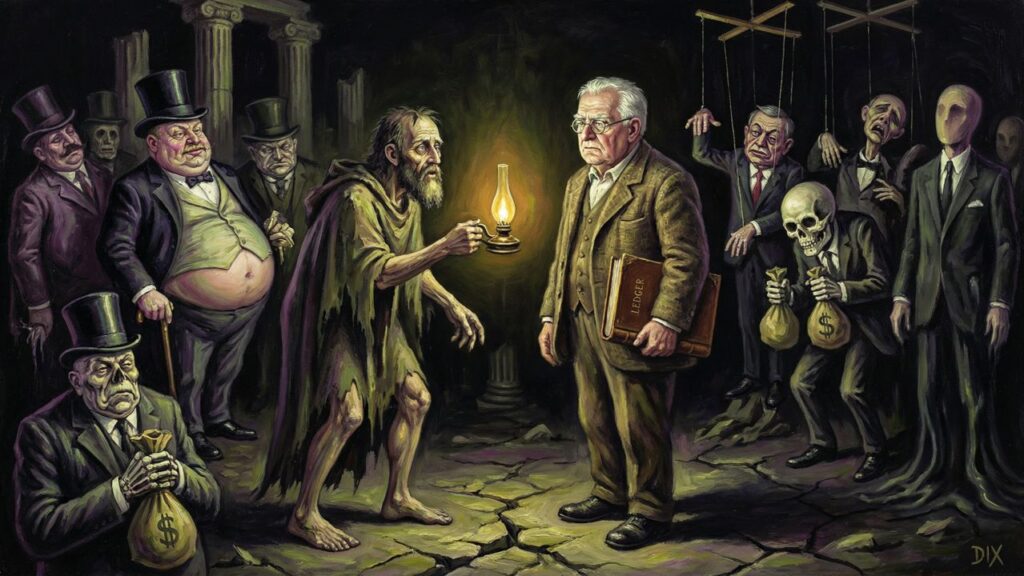
America forgot the difference between earning and extracting, but the economist, Michael Hudson, kept the receipts
In the first article in this series“In This Darkness, I Will Disappear”I described a nightmare. The pitch black. The scream that travels nowhere. The ripcord that returns you not to a safe world but to a false tableau so clumsily constructed it insults whatever intelligence the system hasn’t yet managed to extinguish. I described the darkness and traced its architecture: the concentrated money, the captured press, the Military-Industrial Establishment, the Uni-Party, the neocon flunkies, and the algorithmic cage that sealed the tomb.
What I did not do, what I could not do in the space of a single article, was name the Invisible Hand. I said everyone in Washington can feel it in the room. I said no one is permitted to name it out loud. I said the system does not require conspiracy, only incentives.
Michael Hudson names it. He has spent fifty years naming it. And what he names is not a shadowy cabal or a secret society. It is something far more durable and far more dangerous: a classthe rentier class, and the economic system it has built to ensure that every dollar of productive labor, every acre of land, every public utility, every act of government, and every war serves its extraction.
The Parasite and the Host
Hudson’s central metaphor, developed across Killing the Host, Super Imperialism, J is for Junk Economics, and The Collapse of Antiquityis biological. The financial sector, the insurance industry, and the real estate complex (what he calls the FIRE sector) have attached themselves to the productive economy the way a parasite attaches to a host organism. The parasite does not merely feed. It injects behavior-modifying enzymes into the host’s brain, convincing the host that the parasite is not a free rider but an essential organ, “part of the host’s own body, deserving careful protection”.
This is the trick. This is the whole trick. And it explains why the darkness I described in the first article feels so total, so impossible to resist: the language itself has been captured. The vocabulary you would need to diagnose the disease has been systematically removed from the economics curriculum, the political discourse, and the public mind.
The Vocabulary of Deception
In his conversation with Glenn Diesen on February 8, 2026, Hudson laid bare the intellectual history behind this capture with the precision of a surgeon performing an autopsy on a civilization.
The classical economists (Adam Smith, David Ricardo, John Stuart Mill, and later Marx) all understood that an economy is divided into two parts: a productive sector that creates goods and employs labor, and a rentier sector that extracts wealth without producing anything. Land rent, monopoly rent, and interest on debt are not contributions to output. They are overhead, claims imposed on the productive economy by classes that, as Mill put it, “make money in their sleep”.
The entire trajectory of industrial capitalism, from the repeal of the British Corn Laws in 1846 through the American System of protective tariffs and public infrastructure, was designed to minimize these rentier claims, to free the economy from the dead weight of feudal landlords, monopolists, and usurious creditors so that productive investment could flourish.
Hudson’s devastating insight is that the counter-revolution succeeded. By the late nineteenth century, the rentier classes fought back, not with armies but with ideas. John Bates Clark in America, the Austrian School in Europe, and the utilitarian theorists in Britain developed a new economics that erased the distinction between earned and unearned income, between productive activity and parasitic extraction. Price is value, they declared. There is no such thing as economic rent. The landlord, the banker, the monopolist, they are all “producing” something: a “service” measured by whatever the market will bear.
This was not an academic debate. It was a coup. And it is the reason you cannot see the Invisible Hand: the language that would let you see it has been abolished.
How GDP Became a Lie
Hudson explained to Diesen what this means in practice: almost all of the “growth” in Western GDP over the past four decades is rentier income counted as product. When your bank charges you interest on a thirty-year mortgage, and collects more in interest over the life of the loan than the seller received for the house, that interest is recorded as a “financial service” in the national accounts. When a private health insurer denies your claim and pockets the premium, that’s GDP. When a monopoly platform charges app developers a 30% commission for access to its walled garden, that’s GDP. When credit card companies levy late fees that exceed the interest rate itself, that’s GDP.
The economy appears to grow. The FIRE sector flourishes. But the productive economy (the part that actually makes things, employs people, and generates the surplus that a civilization needs to sustain itself) is shrinking underneath the rentier overlay like a host organism being slowly consumed from within.
Hudson’s term for this is debt deflation: the process by which an ever-larger share of household and business income is diverted to debt service, rent, insurance, and monopoly fees, leaving less and less for actual consumption and investment. The middle class does not decline because it lacks talent or drive. It declines because the parasite has grown so large that the host can barely function.
The Civilizational Fork
The most striking element of the Hudson-Diesen conversation is the historical frame. Hudson does not treat the current crisis as a policy failure or a political aberration. He treats it as a civilizational forkthe same fork that destroyed the Roman Republic, the same fork that separated the trajectory of the ancient Near East from the trajectory of the West.
For thousands of years, from Sumer to Babylonia to Egypt, every successful civilization understood that economies tend to polarize, that wealth concentrates, debts compound, and an oligarchic class will inevitably seize control of government unless a countervailing force intervenes. The countervailing force was debt cancellation. Hammurabi’s dynasty, the Egyptian pharaohs, and the Mosaic law of Leviticus 25 all prescribed periodic clean slates: debts cancelled, bond-servants freed, land returned to its original cultivators.
The West broke from this tradition. Rome did not cancel its debts. The result was centuries of civil war, from the seventh century BC to Caesar, as the population demanded redistribution and the oligarchy refused. The oligarchy won. The result was feudalism, and the collapse of antiquity into a dark age.
Hudson’s argument is that we are at exactly the same juncture. The West has chosen the Roman path. It has allowed the financial sector to monopolize credit creation, to privatize public infrastructure, to capture the political process, and to redefine the vocabulary of economics so that the extraction looks like production and the parasite looks like the host. China, by contrast, whatever its other failings, has followed the older tradition: money as a public utility, credit directed toward industrial development rather than financial engineering, basic needs provided at subsidized cost to keep the economy competitive.
This is what Hudson means when he says the conflict between the West and China is “civilizational.” It is not a conflict between democracy and autocracy, as the official narrative insists. It is a conflict between oligarchy and a mixed economy, between a system that serves the rentier class and a system that subordinates it.
The Bridge: From Darkness to Diagnosis
In “In This Darkness, I Will Disappear,” I described the symptoms. The concentrated money. The captured press. The gutted newsrooms and the charlatan hacks who replaced them. The Military-Industrial Establishment and its neocon foot soldiers. The Uni-Party matrix. The algorithmic cage. The twelve Caesars. The Eastern footsteps. The rigor mortis.
Hudson provides the diagnosis. Every symptom I described is a downstream effect of a single upstream cause: the victory of finance capitalism over industrial capitalism, the triumph of the rentier class over the productive economy, and the systematic destruction of the intellectual tools (the classical economic vocabulary of earned versus unearned income, of production versus extraction, of value versus rent) that would allow the public to understand what has been done to it.
The press was not captured by accident. It was captured because the rentier class needed to control the narrative, to ensure that no mass public could ever develop the conceptual vocabulary to distinguish between a productive economy and a parasitic one. The Uni-Party was not an organic political development. It was the inevitable result of both parties being funded by the same FIRE sector, which demands consensus on the questions that matter to extraction (war, deregulation, tax policy, trade) while tolerating performative disagreement on everything else. The Military-Industrial Establishment is not a deviation from the economic model; it is the enforcement arm of a system that requires permanent threat to justify permanent spending, permanent debt, and permanent extraction.
Even the algorithms, the soft censorship I described in the first article, serve the same function. They are the digital equivalent of what Hudson calls “junk economics”: systems designed to make the truth invisible, to bury the signal beneath noise, to ensure that the vocabulary of deception remains the only vocabulary available.
The Orwellian Inversion
Hudson invokes Orwell deliberately and repeatedly. J is for Junk Economics opens with a reference to 1984’s Ministry of Truth, and the parallel is exact. In Hudson’s analysis, the entire lexicon of modern economics has been subjected to an Orwellian inversion:
- “Free market” once meant a market free from rentier extraction (free from monopoly pricing, absentee landlordism, and usurious credit. Now it means a market free from government regulation) free for the rentier class to charge whatever it wants without interference.
- “Wealth creation” once meant the production of tangible goods and services. Now it means asset-price inflation driven by debt, the financialization of everything from housing to healthcare to education.
- “Democracy” once meant government by and for the people. Now, as deployed by Washington, it means oligarchy, a system in which the FIRE sector controls policy while elections provide a legitimizing ritual.
- “Autocracy” (the word hurled at China, Russia, and any nation that regulates its financial sector or provides public goods at subsidized cost) actually describes what every successful industrial economy in history has done: subordinated rentier claims to productive investment.
The vocabulary itself has become a weapon. And as long as you think inside its terms, as long as you accept that GDP growth means prosperity, that financial services are productive, that a “free market” is one without regulation, that “democracy” is what Washington practices and “autocracy” is what Beijing practices, you will never see the Invisible Hand. You will feel it. You will sense it in the dark. But you will not be able to name it, because the words you need have been taken from you.
Super Imperialism: The Global Dimension
Hudson’s 1972 masterwork, Super Imperialism, explains the global architecture through which this domestic extraction is projected outward. When Nixon closed the gold window in 1971, the United States transformed its position as the world’s largest debtor into an instrument of unprecedented power. Foreign central banks, holding vast reserves of dollars they could no longer convert to gold, had no choice but to recycle those dollars into U.S. Treasury bonds, effectively lending America’s deficit spending back to America at low interest rates.
This is the mechanism behind what I called, in the first article, the Invisible Hand’s foreign policy. The United States does not merely wage wars for strategic advantage. It wages wars funded by the rest of the world’s savingsbecause the dollar system compels foreign governments to finance American deficits whether they wish to or not. The IMF and World Bank enforce structural adjustment programs that open developing economies to American investment, prevent them from developing independent industrial capacity, and ensure that their resources flow upward to the imperial center.
Hudson told Diesen that the Cold War narrative (the fiction that Russia is about to invade Europe, that China threatens the “rules-based order”) is the umbrella under which this extraction operates. NATO is not a defensive alliance. It is the mechanism by which the United States controls European economic policy: forcing Europe to buy American LNG at prices far above what Russian pipeline gas cost, to purchase American weapons systems, to reinvest European profits in American financial markets, and to cut itself off from the trade relationships that made European industry competitive.
The result, as Hudson notes, is economic devastation for the European continent, devastation that will eventually express itself in political and security crises. And the result for the Global South is what it has always been under empire: debt peonage, resource extraction, and enforced dependency disguised as “development assistance”.
The Self-Terminating System
Here is the critical insight that bridges Hudson’s economics to the political darkness I described: finance capitalism is self-terminating.
A parasite that kills its host dies with it. An economy in which the FIRE sector extracts more and more while the productive sector shrinks cannot sustain itself indefinitely. Debts that compound faster than the economy grows must eventually default, or be cancelled. Housing costs that consume 40% of household income leave nothing for the consumption that drives the rest of the economy. An empire that forces its allies into economic ruin eventually runs out of allies.
The twelve Caesars I described (the cycle of strongmen and progressive militants, each promising renewal and delivering further decay) are not the cause of the decline. They are the symptoms of a system that has consumed its own productive base and can no longer generate the surplus needed to buy legitimacy, maintain infrastructure, or project power. The whiplash between populist chaos and technocratic authoritarianism is what happens when no political faction can deliver genuine prosperity because the rentier class has already claimed the surplus before it reaches the public.
Rome faced the same dynamics. The population demanded debt cancellation and land reform. The oligarchy refused. The republic collapsed into empire. The empire collapsed into feudalism. The civilization collapsed into a dark age that lasted a thousand years.
Naming the Hand
So let me do what the first article left undone. Let me name the Invisible Hand.
It is not a conspiracy. It is not a secret society. It is not a single family or a single firm. It is a classthe rentier class, operating through a systemfinance capitalism, enforced by an apparatus (the FIRE sector, the Military-Industrial Establishment, the captured press, the Uni-Party, and the algorithmic cage) and protected by a vocabularythe junk economics that has replaced classical political economy in every university, every think tank, every newsroom, and every congressional hearing room in the Western world.
The Hand is invisible not because it hides but because you have been taught not to see it. The words that would make it visible (economic rent, unearned income, rentier, debt deflation, productive versus unproductive labor) have been systematically excised from the language of public discourse. In their place: “free markets,” “wealth creation,” “financial services,” “the economy is growing.”
Hudson has spent five decades restoring those words. His work is the dictionary for a language that has been banned, the Rosetta Stone for an era that has forgotten how to read its own economic hieroglyphics.
In the darkness I described, this vocabulary is the closest thing to light we have. Not because it will save the republic, Hudson himself is clear-eyed about the trajectory, but because it allows you to see in the dark. To name the parasite. To distinguish the host from the thing that is killing it. To understand that the false tableau you woke up into, the one the Invisible Hand rubbed your nose in, was not bungled by accident. It was constructed, deliberately, by a class that profits from your confusion, finances your division, and counts your despair as an externality in a spreadsheet you will never see.
The lights are still out. The rigor mortis has not reversed. But now, at least, you have the vocabulary to describe what killed the patient.
Whether you use it is up to you.