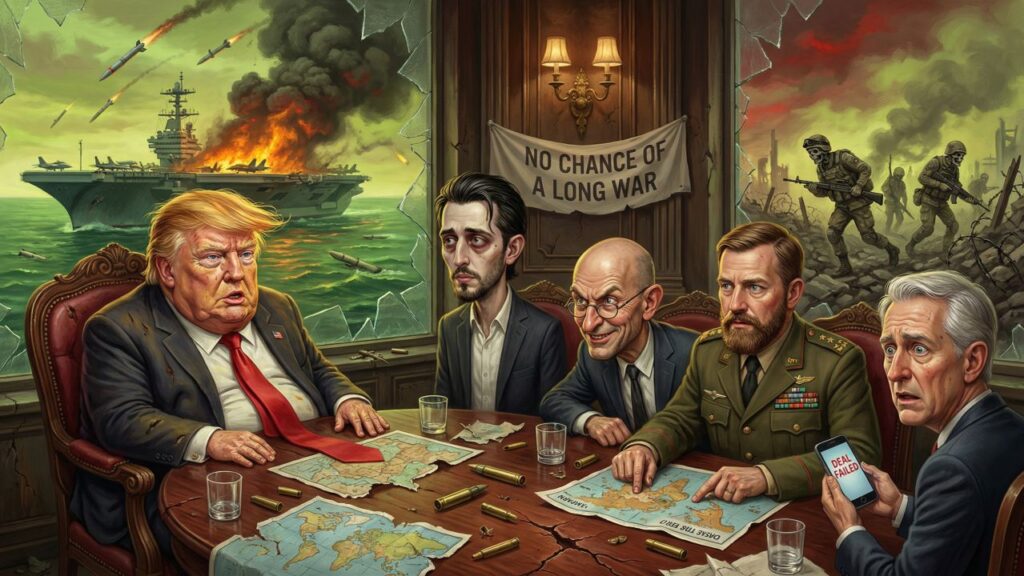
The Credibility Casualty List
Three days into the Iran war, the political damage to the Trump administration’s key figures is already severe, not from Iranian missiles, but from the detonation of their own promises. The men who sold “America First” and “no more endless wars” are now presiding over exactly the kind of Middle Eastern catastrophe they swore they would never create. Their reputations are cratering in real time, the midterm math is turning poisonous, and the timeline to lame-duck irrelevance is accelerating faster than anyone in the West Wing imagined.
The Reputation Damage: Figure by Figure
Donald Trump: The Promise Breaker
Trump’s approval stands at 41 to 43% as of March 2, with disapproval at 54 to 57% depending on the aggregator. A CNN poll released the same day shows 59% of Americans disapprove of the initial decision to strike Iran, with strong disapproval (31%) roughly doubling strong approval (17%). A Reuters/Ipsos flash poll found only 25 to 27% of Americans support the strikes, while 43% disapprove and 29% remain uncertain.
The political poison here is not merely that the numbers are bad, it is that they represent a betrayal narrative that strikes at the foundation of Trump’s political identity. Trump did not campaign as a conventional Republican hawk. He campaigned as the man who would end the wars, who called Iraq “the worst decision in the history of our country,” who told rally after rally that regime change was finished. Now he is conducting regime change in a country of 93 million people, having already claimed last June that his strikes had “completely and totally obliterated” Iran’s nuclear program. The question voters are asking is the one Marjorie Taylor Greene articulated with profane precision: if the threat was obliterated in June, why are American soldiers dying in March?
Even more revealing: Trump authorized the strikes at 3:15 PM EST on Friday while aboard Air Force One en route to Texas with Ted Cruz, John Cornyn, and actor Dennis Quaid. The casualness of that detail, a war launched between senators and a Hollywood celebrity on a plane ride, captures everything about the absence of strategic seriousness that Macgregor diagnosed in the transcript.
Trump told the New York Times the offensive could take “four to five weeks”. When pressed on Monday, he waved vaguely: “Four weeks, two weeks, six weeks. It could be adjusted either way”. This is not the language of a commander-in-chief executing a strategy. It is the language of a man who does not know what happens next.
JD Vance: The Iraq Critic Turned Iran Enabler
Vice President Vance’s reputation may suffer the most durable damage. Just four days before the strikes, Vance told the Washington Post there was “no chance” the U.S. would be drawn into a prolonged Middle Eastern war. He described himself as “a skeptic of foreign military interventions” and said he believed the president was “being careful”.
By day three, U.S. forces had taken casualties, Iran had regionalized the conflict across five Gulf states, Hezbollah had opened a second front, and Trump was talking about weeks of continued bombing. Vance’s “no chance” guarantee has already become the most quotable broken promise of the war, the equivalent of Dick Cheney’s “weeks rather than months” on Iraq. For a man who built his political brand on being the anti-Iraq-War voice inside MAGA, the reversal is existential. Every future opponent in a Republican primary or general election will play that clip on a loop.
Marco Rubio: The Shifting Story
Secretary of State Rubio’s credibility is eroding in a different way, through a cascading series of contradictory justifications. In Munich and Budapest, Rubio declared that Iran’s “radical Shia clerics” were fundamentally untrustworthy and incapable of negotiating in good faith. This was while Steve Witkoff and Jared Kushner were actively negotiating with Iranian officials in Geneva.
Rubio then told the Senate Gang of Eight that Israel initiated the attack without informing the United States, and that the U.S. “decided to simply join in”. On Monday, he pivoted to claiming there was an “imminent threat” to U.S. forces because the administration knew Israel planned to strike and anticipated Iranian retaliation, a circular justification that amounts to: “We created the threat, therefore the threat was imminent”.
CNN documented at least three distinct justification frameworks in the first 72 hours: first, an imminent nuclear threat; second, Iranian missiles that could hit the U.S. homeland; third, a “conventional shield” argument about Iranian drones and ballistic missiles enabling future nuclear blackmail. Each story replaced the last as the previous one was debunked by U.S. intelligence agencies themselves, a Defense Intelligence Agency report indicated any Iranian ICBM capability was still a decade away. PBS fact-checked Trump’s casus belli claims and found them riddled with “flawed or greatly overstated assumptions”.
Pete Hegseth: The Fox News General
Defense Secretary Hegseth’s Monday press conference was a masterclass in rhetorical circularity. “This is not a so-called regime change war,” he insisted, before immediately adding, “but the regime sure did change, and the world is better off for it”. He promised the conflict was “not Iraq” and “not endless” while offering no exit strategy, no defined end state, and no timeline beyond Trump’s vague “four to five weeks”.
Hegseth did not cite an imminent nuclear threat, acknowledging that last summer’s strikes had “reduced their nuclear program to ashes”, but instead argued that Iran’s conventional missile and drone buildup constituted a “conventional shield for their nuclear extortion ambitions”. This is the neoconservative preventive-war doctrine dressed in MAGA clothing: strike not because of what the adversary is doing, but because of what the adversary might someday do.
For a man with zero prior military command or defense bureaucracy experience, a Fox News host elevated to run the Pentagon, Hegseth’s credibility with the uniformed military and the defense establishment was already fragile. Presiding over an expanding regional war with rising American casualties and shifting justifications is unlikely to strengthen it.
Steve Witkoff: The Deal That Wasn’t
Trump’s Middle East envoy, Steve Witkoff, spent months shuttling between Oman, Geneva, and Washington, conducting nuclear negotiations with Iran. The talks reportedly made “significant progress” according to Oman’s foreign minister as recently as February 25. But Witkoff and Kushner arrived at Thursday’s final Geneva round with a maximalist demand (zero enrichment, full dismantlement) that even former Obama-era negotiators called “not credible and would never succeed”.
Witkoff and Kushner reportedly told Trump beforehand that a deal would be “difficult, if not impossible”. The negotiations were, in Macgregor’s framing, fiction, a diplomatic Potemkin village maintained for public consumption while the decision to strike had already been made. The IAEA’s Rafael Grossi expressed dismay after the war began, saying “active and serious negotiations have once again been compromised”. Witkoff’s reputation as a dealmaker, already strained by the messy Ukraine negotiations, is now inseparable from the perception that he was either incompetent or complicit in a diplomatic charade.
The MAGA Civil War
The most politically significant development of the first 72 hours is not the Democratic opposition, that was predictable, but the eruption of opposition from within Trump’s own base. This is not marginal grumbling. It is coming from the loudest megaphones in the MAGA ecosystem.
Tucker Carlson called the attack “absolutely disgusting and evil” on ABC News and warned: “This is going to shuffle the deck in a profound way”. Carlson, a primetime RNC speaker in 2024 and frequent White House visitor, is now positioned as the most prominent anti-war voice in conservative media, directly challenging the administration’s framing.
Marjorie Taylor Greene issued a profanity-laced broadside: “The Trump admin actually asked in a poll how many casualties voters were willing to accept in a war with Iran??? How about ZERO you bunch of sick f,, liars. We voted for America First and ZERO wars”. In a longer post, she called the war “the worst betrayal” because “it comes from the very man and the admin who we all believed was different and said no more”.
Tim Pool, one of the most popular pro-Trump podcasters, blasted the strikes as a betrayal of the campaign platform. The Hodge brothers (Keith and Kevin), prominent MAGA influencers, wrote: “President Trump has completely LIED to his voters, backstabbed our country and has disgraced his legacy beyond repair at this point, biggest fall from grace I have ever seen”.
Rep. Thomas Massie (R-KY), co-sponsor of the war powers resolution, declared: “I am opposed to this War. This is not ‘America First'”. Rep. Warren Davidson (R-OH) said he would support the war powers resolution “in the absence of new information” and stated flatly: “War requires Congressional authorization”. Sen. Rand Paul (R-KY) co-sponsored the Senate version condemning the strikes as unauthorized.
This is not a fringe rebellion. It represents a structural fracture between the neoconservative wing that has captured Trump’s foreign policy apparatus and the populist-nationalist base that actually elected him. The CNN poll quantified the split: MAGA-identifying Republicans are 30 points more likely to approve of the strikes than non-MAGA Republicans, and nearly 50 points more likely to trust Trump on military decisions. But non-MAGA Republicans, the swing voters who delivered the 2024 margins, are deeply skeptical.
A January Politico poll found that only 50% of 2024 Trump voters supported military action against Iran, while 30% opposed it. Among the critical “non-MAGA” Trump voters, support dropped to 42%. These are precisely the voters Republicans need in November 2026.
The Midterm Math: How Bad Can It Get?
The House: Already Gone?
The numbers were grim for Republicans before a single bomb fell on Iran. As of March 2, Polymarket gives Democrats an 85% probability of winning the House, with Republicans at just 16%. The prediction market also prices a 40% chance of a full Democratic sweep (both chambers).
The structural math explains why. Republicans hold a razor-thin 218 to 214 majority with three vacancies. The Cook Political Report’s January analysis showed Democrats leading in 211 races, Republicans in 206, with 18 toss-ups, 14 of which feature Republican incumbents. Fox News polling found Republican voters were twice as likely to vote for a Democratic candidate as Democrats were to vote Republican. In 20 of the last 22 midterm elections, the president’s party has lost seats in the House.
The Iran war makes every one of these dynamics worse. White House aides are already analyzing how a prolonged engagement, combined with casualties and rising fuel costs, could erode support in competitive districts. The administration’s own political models identify numerous swing districts (including those held by Gabe Evans (CO), Derrick Van Orden (WI), and Rob Bresnahan (PA)) where even slight voter skepticism could be decisive. These members now face an impossible choice: vote to support the war powers resolution and cross the president, or vote against it and own a war their constituents didn’t want.
A senior Republican operative told Reuters that “foreign intervention poses greater political risk than reward for Trump” and that “foreign policy successes do not resonate with voters, while foreign policy entanglements often do”.
The Senate: Suddenly in Play
Polymarket prices Republican Senate retention at 57%, with Democrats at 42%, far closer than it should be given the structural advantages Republicans enjoy in Senate elections. The Britannica analysis notes that if historical midterm trends hold, Republicans could lose 4 Senate seats, flipping the chamber to 51 Democrats (including independents) and 49 Republicans.
The war powers vote this week provides an early barometer. The Kaine resolution needs only 51 votes in the Senate (it is not subject to filibuster under the War Powers Resolution). Republicans hold 53 seats. Sen. Rand Paul will vote yes. Sen. John Fetterman (D-PA) will likely vote no. That means Democrats need just two more Republican defections. Sens. Susan Collins and Lisa Murkowski have both issued statements demanding “sustained combat operations necessitate full engagement with Congress” and detailed briefings. Sen. John Curtis has said he would have preferred a vote before the war started.
The resolution will likely fail, or pass and be vetoed, but the margin matters enormously. Every Republican who votes yes is signaling that the party’s internal pressure is building. Every Republican who votes no is creating a campaign ad for a Democratic challenger in November.
The Lame Duck Trajectory
The Timeline
Trump was already approaching lame-duck territory before Iran. His approval sat at 42% in mid-February, the lowest of his second term. Piers Morgan predicted in February that Trump would become “a lame duck president” after Republicans lose the House in November. The Manhattan Institute found that only 56% of new Republicans recruited by Trump’s 2024 campaign would “definitely” vote Republican in the midterms.
The Iran war accelerates this trajectory along three axes:
Economic damage. Oil prices are surging toward $100/barrel. Gas prices will rise through the spring and summer, precisely when voters are paying attention and campaigns are kicking into gear. Every dollar at the pump is a reminder that the president chose a war in the Middle East over the kitchen-table issues (cost of living, housing, inflation) that his base cares about most.
Casualty accumulation. Six Americans are dead by day three, with Trump himself warning “more casualties are likely”. If the conflict lasts the “four to five weeks” Trump projects, the casualty count could reach levels that dominate local news in military-heavy swing states like North Carolina, Virginia, Georgia, and Texas.
Base fracture. The Carlson-Greene-Massie wing is not going away. If the war drags on, the “America First” critique becomes louder, the MAGA coalition splinters further, and the enthusiasm gap that Republicans need to close in the midterms widens instead. A 60% disapproval rating on the war, combined with a 56 to 58% overall disapproval, creates the kind of political environment in which wave elections happen.
How Long Does the GOP Stick?
For now, the institutional Republican Party is holding, barely. Speaker Johnson called the strikes “a defensive measure” and the war powers vote “a dangerous gambit”. Senate Majority Whip Barrasso vowed to do “everything I can to make sure the president has full authority”. Tom Cotton predicted “overwhelming support from elected Republicans”. Joni Ernst said she was “overjoyed”.
But the loyalty is transactional and conditional. The conditions under which it breaks are identifiable:
- Rising casualties with no end in sight. If American dead reach double digits by mid-March with no diplomatic off-ramp, vulnerable House members will begin distancing. The first to break will be those in Biden-won or marginal Trump districts (the Gabe Evanses, the Tom Suozzis, the Don Bacons) who need independent voters to survive.
- Gas prices above $4.50 nationally. Economic pain is the one variable that reliably moves midterm outcomes. If the Iran war pushes pump prices into “2008 summer” territory while Trump simultaneously talks about tariff wars, the economic narrative becomes politically fatal.
- A major military setback. A downed aircraft carrier strike group element, a mass-casualty event at a Gulf base, or a failed hostage rescue would collapse the “things are going great” narrative overnight.
- The bond market. As Macgregor warned in the transcript, the 10-year yield and dollar stress indicators are the sleeper variable. If Treasury markets begin pricing in a stagflationary spiral, oil-driven inflation combined with war-driven fiscal expansion, the financial establishment will begin pressuring Republican leaders to distance from the war.
The historical precedent is George W. Bush’s second term. Republican loyalty held through 2005 and early 2006 as Iraq deteriorated, then collapsed in a cascade once it became clear the war was a political liability. The 2006 midterms delivered a 31-seat Democratic gain in the House and a 6-seat gain in the Senate, flipping both chambers. The difference in 2026 is that the collapse could happen faster, the information environment moves at social media speed, the MAGA base is already fractured, and the starting position (218 to 214 House majority) leaves virtually no margin for error.
The Verdict the Numbers Render
The data points tell a unified story of political deterioration across every measurable axis.
Trump’s approval sat at 42% before the war and has held flat or declined slightly to 41 to 43% by day three. War approval is deeply underwater: just 25 to 27% in the Reuters/Ipsos flash poll, 41% in the CNN survey, with disapproval ranging from 43% to 59% depending on the pollster. Only 40% of Americans trust Trump to make sound military decisions, while 56% do not.
The prediction markets have moved sharply against Republicans. Polymarket prices a Democratic House win at 85%, up from roughly 80% before the strikes. The Senate, which should be structurally safe for the GOP, now sits at 57% Republican / 42% Democratic, far tighter than the map warrants. Brent crude has surged from roughly $72/barrel to $82 in three days, with analysts projecting $100+ if the Strait of Hormuz remains closed. Six American service members are dead by day three, with the president himself warning of more to come. And the MAGA base, which supported military action at 61% when it was hypothetical in January, is now fracturing visibly as the reality of casualties, costs, and broken promises sets in.
The Trump administration entered this war with no strategy, no congressional authorization, no public mandate, and no honest justification. It is now fighting on two fronts, one in the Persian Gulf and one inside its own political coalition. History suggests which front will break first: it is always the domestic one. The question is not whether Trump becomes a lame duck after the midterms. The question is whether the Iran war makes him a lame duck before them, politically neutered by a base in revolt, an opposition energized, and a party establishment quietly measuring the distance to the lifeboats.
Related reading
- Trump’s Iran War, China Trip and the Vanishing Empire
- The Foundation for War Crimes: A Factual Record of Trump’s Iran War and Where It’s Going Part 2
- The Foundation for War Crimes: A Factual Record of Trump’s Iran War and Where It’s Going
- America’s Suicidal Empire: The Iran War, the Death Spiral of a Failing Hegemon, and the World We Are Destroying