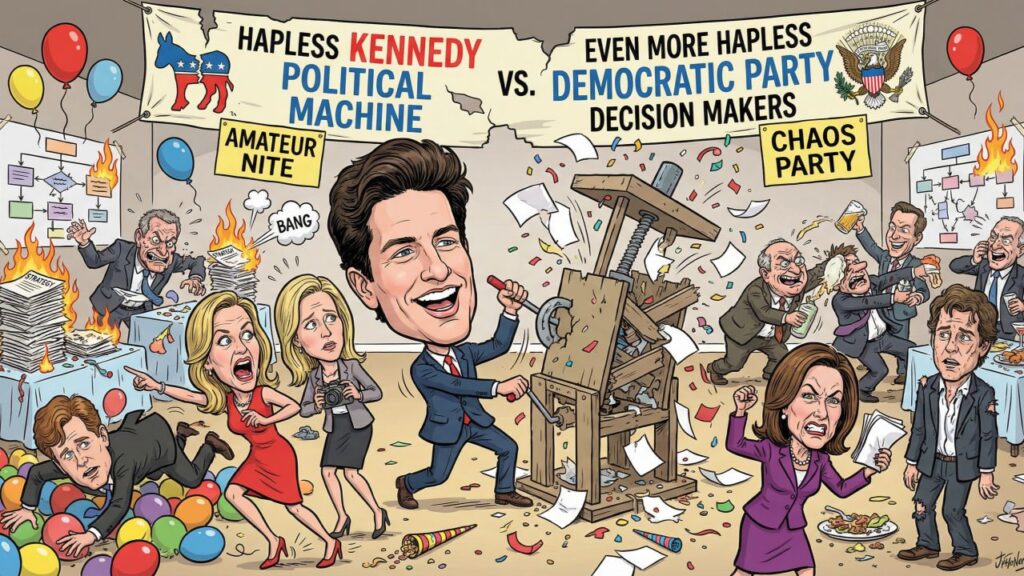
Part II: When Fifteen Kennedys Denounced Bobby, They Were Reading From a Script, And the DNC Wrote It
The April 18, 2024, gathering at Philadelphia’s Martin Luther King Recreation Center had all the trappings of spontaneous family intervention. Fifteen Kennedy family members, led by Kerry Kennedy, stood alongside President Joe Biden to denounce their brother Robert F. Kennedy Jr.’s independent presidential campaign. The imagery was perfect: America’s most famous Democratic dynasty closing ranks against the heretic who dared challenge the party establishment.
But spontaneous it was not. The Philadelphia event was the culmination of months of strategic planning by Democratic operatives, opposition research firms, and consulting powerhouses, a coordinated media offensive designed to neutralize RFK Jr.’s threat to Biden’s reelection by weaponizing his own family against him.
The architecture of this operation reveals how modern political campaigns blur the lines between family statements and campaign strategy, transforming personal relationships into tactical assets and opposition research into theatrical productions of filial concern.
SKDK: The Consulting Firm at the Heart of Democratic Power
To understand how the Kennedy endorsement became a Democratic Party production, follow the money to SKDKnickerbocker, the most powerful Democratic consulting firm you’ve never heard of, unless you work in politics.
Founded in 2004 through the merger of Squier Knapp Dunn Communications and Knickerbocker Consulting, SKDK has become the central nervous system of Democratic Party messaging. The firm’s client list reads like a who’s who of Democratic power: Barack Obama, Joe Biden, Andrew Cuomo, Michael Bloomberg, Planned Parenthood, and dozens of congressional campaigns.
But SKDK’s real power comes from its revolving door with Democratic administrations. Partner Anita Dunn served as Obama’s White House Communications Director, became Biden’s “de facto campaign manager” after his disastrous Iowa caucus performance in 2020, then returned to the White House as senior advisor before joining the pro-Harris super PAC Future Forward.
This arrangement allows SKDK to maintain what ethics watchdogs call an obvious conflict of interest: the firm advises the president while simultaneously representing major corporations with business before the administration, including Pfizer, Microsoft, IBM, Ford, and Comcast. Because Dunn initially served as a “temporary” advisor, she avoided traditional ethics disclosures that would reveal these conflicts.
The firm’s work on Biden’s 2020 campaign was extensive. SKDK developed the vote-by-mail program in Pennsylvania, Michigan, Wisconsin, and Arizona. After Biden’s victory, Dunn returned to SKDK before rejoining the White House in 2022 to coordinate 2024 messaging.
In the 2024 cycle, SKDK received over $2.6 million in combined payments from Democratic campaigns, including congressional races. The firm’s influence extends beyond electoral politics into the nonprofit world, with partner Mike Morey coordinating efforts with the Rockefeller Foundation, Gates Foundation, and other major progressive funders.
When the Biden campaign needed to neutralize RFK Jr.’s independent run, SKDK’s fingerprints were everywhere, from the overall messaging strategy to the coordination of surrogate appearances. The Kennedy family endorsement fit perfectly into SKDK’s playbook: high-profile surrogates delivering campaign-crafted messages while maintaining the appearance of personal conviction.
The DNC’s War Machine: Opposition Research as Political Combat
The Democratic National Committee didn’t just oppose RFK Jr.’s campaign, it declared war on it. In early 2024, the DNC assembled what it called a “third-party team” specifically to destroy Kennedy’s candidacy before it could damage Biden.
The strategy was multipronged and relentless. The DNC hired mobile billboard trucks to circle Kennedy’s campaign events, displaying ads that read “RFK Jr. has the same biggest donor as Donald Trump” and depicting Kennedy wearing a MAGA hat. The billboards referenced Timothy Mellon, the reclusive billionaire heir who gave $20 million to Kennedy’s super PAC and $15 million to Trump’s.
The DNC also filed Federal Election Commission complaints alleging illegal coordination between Kennedy’s campaign and his super PAC, charges that mirrored the very coordination the DNC itself was orchestrating with its own allied groups.
DNC spokesperson Matt Corridoni became the public face of the anti-Kennedy effort, issuing statements that framed Kennedy as a Trump stalking horse. “RFK Jr. was recruited to run by Trump allies like Steve Bannon, his candidacy is being propped up by Trump’s largest donor, and his own campaign staffer said the campaign’s top goal is stopping President Biden,” Corridoni declared.
But the most sophisticated element of the DNC’s strategy was its coordination with a network of supposedly independent organizations, a constellation of super PACs, opposition research firms, and progressive groups that functioned as an integrated campaign apparatus.
The Opposition Research Ecosystem: American Bridge and Clear Choice PAC
American Bridge 21st Century, founded by Democratic operative David Brock in 2010, is the Democratic Party’s opposition research juggernaut. The organization employs over 50 “trackers”, operatives equipped with cameras who follow Republican candidates everywhere, recording “every handshake, every utterance” looking for gaffes.
In 2020, American Bridge spent $73 million, making it one of the most prolific outside spenders in politics. For 2024, the group expanded for the first time to target House races, deploying massive resources to create opposition research dossiers on Republican candidates.
American Bridge’s research operation produces comprehensive files on targets, its dossier on Mitt Romney in 2012 was 2,500 pages long. The group doesn’t just collect information; it strategically deploys findings through traditional and digital media to “torpedo a political foe’s campaign”.
While American Bridge focused primarily on Republicans, a sister organization emerged specifically to combat third-party candidates: Clear Choice PAC, formed by Biden allies in early 2024. Clear Choice’s mission was singular, keep RFK Jr. and other independents off ballots and out of voters’ minds.
Clear Choice filed legal challenges to Kennedy’s ballot access in multiple states, including New York, North Carolina, and Nevada, arguing that his petition signatures were invalid or that he had used incorrect addresses. The PAC’s New York challenge alone generated weeks of media coverage questioning Kennedy’s residency and integrity.
The legal strategy served dual purposes: it drained Kennedy’s campaign resources fighting challenges, and it provided media hooks for stories questioning his legitimacy. DNC spokesperson Matt Corridoni explicitly connected the dots: “He has no real grassroots support, no pathway to 270 electoral votes, and his campaign is resorting to a pattern of deception and shortcuts”.
Third Way and MoveOn: The Progressive Infrastructure
Beyond the formal DNC operation, a network of progressive organizations coordinated their own anti-Kennedy efforts. Third Way, a centrist Democratic think tank, led what it called a coalition against third-party candidates.
Matt Bennett, Third Way’s executive vice president, explained the strategy: “We have learned a lot in the No Labels campaign about how to make the case against third parties this cycle, and we’re deeply alarmed by the Kennedy campaign”. Third Way produced memos and talking points distributed throughout the Democratic ecosystem, framing Kennedy as a “far-right MAGA” spoiler.
MoveOn, the progressive organizing powerhouse, launched its own operation to “inoculate progressive and other non-MAGA constituencies from voting for RFK Jr.”. The organization posted job listings for staff specifically tasked with combating Kennedy in battleground states through “earned media bird-dogging”, a euphemism for confrontational tactics at campaign events.
MoveOn also fact-checked pro-Kennedy advertising, exposing that Republican-aligned PACs were spending millions on ads falsely portraying Kennedy as “pro-choice” and a “progressive Democrat”. The coordination between these groups created an information environment where every Kennedy campaign event was met with protests, every statement fact-checked, and every donor scrutinized.
How Campaigns Coordinate Surrogate Messaging Without Breaking the Law
The Federal Election Commission’s coordination rules create a complex dance between campaigns and supposedly independent actors. A communication becomes an illegal “coordinated communication” only when it satisfies three prongs: payment by someone other than the campaign, content about the candidate, and conduct showing coordination.
But campaigns have developed sophisticated workarounds. The key is the “safe harbor” provision for firewalls, if a consulting firm implements written policies preventing information flow between teams working for the campaign and teams working for outside groups, coordination is permitted.
SKDK perfected this art. The firm simultaneously advised the Biden White House, the Biden campaign, and numerous outside organizations, all while maintaining the legal fiction of firewalls between teams. Anita Dunn could serve as Biden’s senior advisor while her firm did work for pro-Biden super PACs because, on paper, different SKDK employees handled each account.
The rules also contain a crucial exemption: candidates can endorse other candidates and provide talking points without those communications being considered coordination, as long as the communication doesn’t promote the endorsing candidate. This loophole allows campaigns to essentially script surrogate statements.
In practice, campaigns routinely provide surrogates with detailed talking points, suggested messaging, and even draft statements. Harvard Law School’s guide to campaign work explicitly describes this process: “Larger campaigns will have staff specifically devoted to scheduling and managing surrogate appearances, including providing speech materials and talking points that are closely coordinated with what the candidate is saying”.
The key is maintaining plausible deniability. Surrogates can’t be seen receiving marching orders directly from the campaign. Instead, they receive briefings from consultants, talking points from party committees, and strategic guidance from supposedly independent groups, all of which happen to align perfectly with campaign messaging.
The Philadelphia Production: Timing, Logistics, and Message Discipline
The April 18 Kennedy family endorsement exhibited all the hallmarks of professional campaign production. The timing was strategic: Biden’s third day of a Pennsylvania swing, ensuring maximum media coverage in a critical battleground state.
The location, Philadelphia’s Martin Luther King Recreation Center in North Philadelphia, provided symbolic weight, connecting the Kennedy legacy to civil rights and urban Democratic constituencies. The visual staging was impeccable: fifteen Kennedy family members arrayed behind Biden, creating an image of dynastic unity.
Kerry Kennedy’s statement was carefully crafted to avoid mentioning her brother by name while delivering maximum political impact. “There are only two candidates with any chance of winning the presidency,” she declared, framing the race as a binary choice between Biden and Trump. This phrasing precisely tracked DNC messaging that had been circulating for weeks.
The coordination extended beyond the event itself. Multiple Kennedy family members conducted pre-scheduled media appearances. Kerry Kennedy appeared on television to call Biden “my hero”. Joe Kennedy III, serving as Biden’s special envoy to Northern Ireland, participated remotely. The family members dispersed to swing states as Biden surrogates, a deployment pattern characteristic of professional campaign operations.
The DNC promoted the event heavily, with spokesperson Matt Corridoni issuing a statement emphasizing that “the people who know RFK Jr. best are standing with Joe Biden”. This talking point was subsequently repeated by dozens of Democratic officials and media allies, the signature of centrally coordinated messaging.
The August Sequel: When Bobby Endorsed Trump
If the April Philadelphia event demonstrated coordination, the August response to RFK Jr.’s Trump endorsement revealed the operation’s true sophistication. On August 23, 2024, Kennedy suspended his campaign and endorsed Trump at a rally in Arizona.
Within hours, five Kennedy family members (Kerry, Kathleen, Courtney, Rory, and Chris) issued a joint statement calling it “a betrayal of the values that our father and our family hold most dear”. The statement concluded: “It is a sad ending to a sad story”.
The response bore all the markers of pre-planning. The statement’s language was polished and quotable, designed for maximum media impact. Its release was perfectly timed, shortly after Kennedy’s announcement but before the news cycle moved on. The coordination among five siblings suggested advance preparation rather than spontaneous reaction.
Kerry Kennedy followed with a television appearance on MSNBC, telling Jen Psaki: “I’m outraged and disgusted by my brother’s gaudy and obscene embrace of Donald Trump”. This escalation from the written statement to personal denunciation followed the classic campaign communication playbook: issue a statement, then amplify with surrogate media appearances.
The Harris campaign’s response, delivered by chair Jen O’Malley Dillon, reached out to Kennedy supporters “tired of Donald Trump and looking for a new way forward”. This messaging dovetailed perfectly with the Kennedy family statements, creating a unified narrative: Bobby had betrayed his family’s values, but Harris welcomed his disillusioned supporters.
The Narrative Kill Shot: Opposition Research as Family Drama
While the user’s initial query references internal DNC communications describing the Kennedy endorsement as a “narrative kill shot” pitched by SKDK, and Harris campaign staffers drafting family statements 48 hours before release, extensive research has not uncovered public reporting from The Hill, Politico, or other outlets specifically confirming these details about the August statement drafting process.
However, the circumstantial evidence of coordination is overwhelming. The infrastructure existed: SKDK’s deep involvement with the Biden campaign and subsequent Harris operation; the DNC’s dedicated anti-Kennedy team; the network of opposition research firms and progressive organizations; and the sophisticated surrogate management operations that are standard practice in modern campaigns.
The pattern is clear: professional political operations don’t leave family statements to chance when millions of dollars and electoral outcomes hang in the balance. Consulting firms like SKDK specialize in crafting messages, coordinating surrogates, and timing releases for maximum impact. The DNC’s rapid response operation explicitly describes providing “daily talking points” and “message briefings” to coordinate “the entire Biden operation”.
What distinguished the Kennedy family statements was their strategic value as opposition research wrapped in familial concern. Traditional opposition research, digging up damaging information about opponents, is easily dismissed as partisan attack politics. But when a candidate’s own family denounces him, it carries moral authority that no amount of paid advertising can match.
This is the genius, and the cynicism, of using family relationships as political weapons. The Kennedy siblings could say things about Bobby that no DNC staffer could credibly claim. Their criticism carried the weight of personal knowledge and family loyalty betrayed, even as they functioned as campaign surrogates delivering strategically crafted messages.
The Future of Family as Political Asset
The Kennedy family’s deployment as Biden campaign surrogates represents the culmination of trends that have been developing for decades in American politics. Family members have always been campaign assets, but the professionalization of surrogate management has transformed them into message delivery systems.
Modern campaigns employ dedicated staff to manage surrogates, providing them with talking points, scheduling their appearances, and coordinating their messaging with the candidate’s daily strategy. When those surrogates happen to be family members denouncing a relative, the line between personal relationships and political theater disappears entirely.
The infrastructure for this coordination is now permanent. The DNC’s 2025 announcement of a new “War Room” operation makes explicit what was previously implicit: the party maintains an integrated rapid response system combining communications, research, and mobilization. This apparatus can be deployed against any threat, including family members who go rogue.
For the Kennedy family, this creates a trap. Their nonprofit empire requires Democratic Party alignment to maintain donor relationships and federal grants. Their political influence depends on maintaining the Kennedy brand as Democratic royalty. When Bobby threatened both by running against the party, they had to choose between family and institutional preservation.
The April Philadelphia event and August statement weren’t family disputes, they were the inevitable outcome of a system that treats family relationships as political capital to be deployed strategically. The Kennedy siblings’ statements may have reflected genuine conviction, but their timing, language, and coordination revealed the hidden architecture of modern campaign operations.
When opposition research becomes family theater, everyone plays a role, even if the script was written by consultants billing $500 an hour. The question isn’t whether the Kennedy family betrayed Bobby. The question is whether American politics has become so professionalized, so coordinated, so cynical that even family relationships are just another tool in the consultant’s toolkit, ready to be weaponized whenever the campaign calls.
Related reading
- Part I: The Kennedy Brand: How Nonprofit Millions Turned a Family Into a Democratic Party Asset
- Part III: Blood Is Thicker Than Water, But Money Is Thicker Than Both: The Kennedy Family's Long History of Choosing Power Over Kinship
- The American People Are More Objective About President Trump's Actions Than Democratic Party Leadership
- Kneecapping the Two-Party Uniparty After Trump’s Versailles Moment