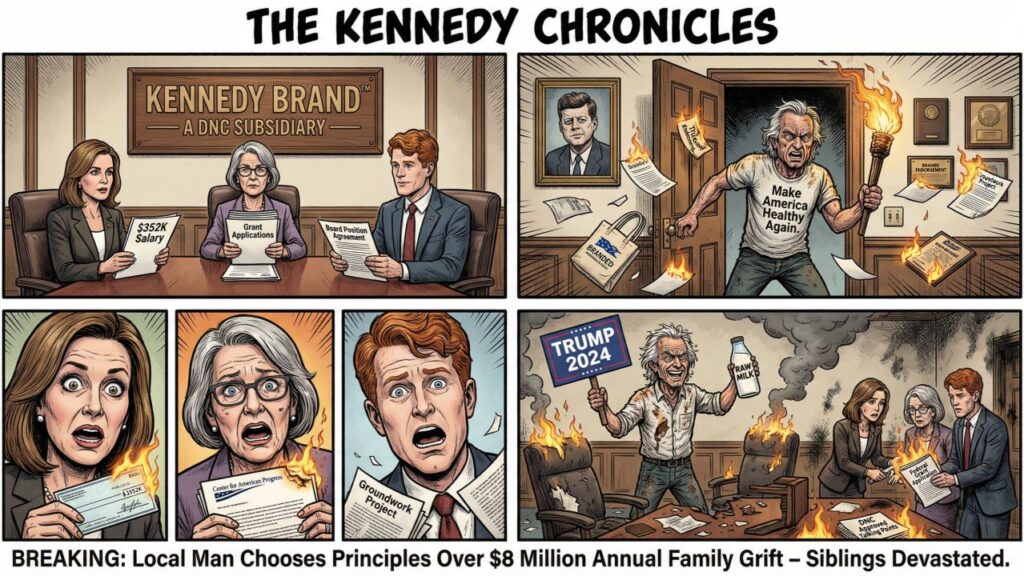
Part III: From Chappaquiddick to RFK Jr., the Pattern Is Clear: The Brand Survives, Even If the Brother Doesn’t
When Robert F. Kennedy Jr. suspended his independent presidential campaign and endorsed Donald Trump on August 23, 2024, five of his siblings issued a statement calling it “a betrayal of the values that our father and our family hold most dear” and “a sad ending to a sad story”. Kerry Kennedy went on MSNBC and declared herself “outraged and disgusted by my brother’s gaudy and obscene embrace of Donald Trump,” adding that Bobby had attempted to “desecrate and trample and set fire to my father’s memory”.
The denunciation was swift, coordinated, and brutal. But it wasn’t unprecedented. The 2024 repudiation of RFK Jr. was simply the most public performance of a long-standing Kennedy family rule: when a family member threatens the clan’s institutional power, political access, or brand equity, the family closes ranks, against the offending member.
The Kennedy legacy isn’t built on familial loyalty. It’s built on ruthless calculation about which family members advance the brand and which threaten it. And when the math turns negative, blood means nothing.
The 1980 Primary: When Kennedy Challenged Kennedy’s Party
The most dramatic pre-2024 example of Kennedy family division came in 1980, when Senator Edward “Ted” Kennedy mounted a primary challenge against incumbent Democratic President Jimmy Carter. The battle was brutal, personal, and ultimately destructive to the Democratic Party’s chances in the general election.
Ted Kennedy entered the race in November 1979 with a two-to-one polling advantage over Carter. The liberal lion of the Senate believed Carter had betrayed the Democratic Party’s progressive legacy, particularly on universal healthcare, and that the president was a weak, indecisive leader. Kennedy represented the liberal wing of the party, committed to Great Society programs, racial equality, and anti-poverty initiatives. Carter represented the centrist wing, willing to challenge labor unions and traditional liberal constituencies.
The primary fight became one of the most bitter internal party battles in modern U.S. history. Carter’s campaign chairman Robert Strauss couldn’t understand why Kennedy insisted on continuing to fight even after it became mathematically impossible to win. Kennedy took the battle all the way to the Democratic National Convention in New York City, attempting to release delegates from their commitments and force an open convention.
When that failed, Kennedy delivered his famous “The Dream Shall Never Die” speech, a soaring liberal manifesto that was more about burnishing his own legacy than supporting Carter. The perfunctory handshake between Carter and Kennedy afterward became iconic for all the wrong reasons: Kennedy refused to participate in the traditional “hands-raised” photo opportunity, leaving Carter groveling on live television in front of 20 million viewers.
Many attributed Carter’s landslide loss to Ronald Reagan to Kennedy’s damaging primary campaign and tepid embrace of the incumbent. Kennedy’s challenge was considered so destructive that it remains “the last time any major candidate opposed an incumbent Democratic president in the primaries”.
The institutional damage was severe. And yet Kennedy faced no lasting consequences within the family power structure. Why? Because Ted Kennedy was the family power structure. After the assassinations of his brothers John and Robert, Ted became both patriarch of the Kennedy family and CEO of the Kennedy political operation.
Ted used his dual role to reinforce family loyalty, but loyalty to him and to the institutional brand he controlled. He never missed a graduation or birthday for his 13 nieces and nephews who had lost their fathers. He planned family trips with both familial and political motives: he wanted the kids to be there for each other, but also to “receive their mandate”, they were Kennedys, and they stood for something.
What they stood for, ultimately, was maintaining access to Democratic Party power structures. And when that power was threatened, even by another Kennedy, the machine would activate.
Chappaquiddick: When the Family Protects Its Own
The exception that proves the rule came on July 18, 1969, when Ted Kennedy drove his car off a bridge on Chappaquiddick Island, killing 28-year-old Mary Jo Kopechne. Kennedy escaped from the submerged vehicle but failed to report the accident for more than 10 hours. He made 17 phone calls to friends and political aides before reporting it to police, but no calls to emergency services who might have saved Kopechne’s life.
The Kennedy family political machine immediately swung into action. Ted consulted privately with two attorney friends, Joseph Gargan and Paul Markham, about the accident before telling anyone else. By morning, Ted was “sober, chipper, smiling, laughing with his guests”, still without having called authorities. When he finally reported the incident, the family deployed speechwriters to craft his public statement.
The subsequent inquest was conducted in secret. A grand jury was convened but wasn’t able to view evidence from the inquest. An autopsy was never conducted, a petition to exhume Kopechne’s body was denied. The Kopechne family reportedly received almost $150,000 from Kennedy’s insurance and from him personally.
Years later, Gargan told investigative reporter Leo Damore that Ted had asked him to lie about what happened and say that Mary Jo was driving the car. He refused. Gargan also revealed: “They were interested in protecting the senator, there’s no question about that. And they let us fend for ourselves. As well as everybody else”.
Damore’s investigations into the Kennedy family allegedly became so threatening that he experienced “lawsuits” and believed “he was being followed”. According to his son Nick, “There were such clear attempts to stop him from pursuing stories about the Kennedys. I think Leo kept pushing it a little bit. It consumed him”.
The Chappaquiddick cover-up reveals the family’s calculation: Ted Kennedy was too valuable to the institutional power structure to be sacrificed, even for the life of Mary Jo Kopechne. The brand had to survive. The political access had to be preserved. The machine protected Ted because Ted was the machine.
But when a Kennedy threatens that machine? The protection evaporates.
The Second Generation: Failed Politicos and Abandoned Ambitions
Ted Kennedy’s protection of the family brand came with strings attached: younger Kennedys had to conform to the family’s Democratic Party alignment and respect the institutional relationships Ted had cultivated. Those who couldn’t meet those standards, or whose scandals threatened the brand, were quietly sidelined.
Joseph P. Kennedy II seemed destined for greatness. He served in Congress representing Massachusetts from 1987 to 1999 and was widely viewed as the heir to the Kennedy political dynasty. But in the mid-1990s, his political career imploded due to family scandals that threatened the Kennedy brand’s carefully cultivated image.
First, Joe II sought to annul his 12-year marriage to Sheila Rauch Kennedy so he could remarry within the Catholic Church. Rauch, an Episcopalian, was blindsided by the annulment, granted in secrecy by a Church tribunal, which declared that their marriage, despite producing twin sons, had been invalid from the start. She fought back with a 1997 book, Shattered Faith, which lambasted Joe II and criticized the Church’s proceedings.
The controversy escalated when allegations emerged that Joe II’s brother Michael Kennedy was having an affair with his children’s teenage babysitter. Joe II was forced to publicly apologize at the 1997 state Democratic convention: “On the matter of my brother, I am so very sorry, so very sorry for what has happened to the (baby sitter’s family). I extend to them the deepest apology that I can say”.
The combination of scandals derailed Joe II’s planned gubernatorial run in 1998. Within a year, he announced he would not seek reelection to his House seat. His political career was over, abandoned not because he had broken with Democratic orthodoxy, but because his personal scandals threatened to devalue the Kennedy brand.
Remarkably, in 2007, the Vatican reversed the annulment of Joe II’s marriage, effectively reinstating the Kennedy-Rauch marriage in the eyes of the Church. Rauch had won her decade-long crusade. But by then, Joe II’s political ambitions were ancient history.
Joe Kennedy III: The First Kennedy to Lose in Massachusetts
The Kennedy family’s losing streak continued with Joseph P. Kennedy III, Joe II’s son, who suffered a historic defeat in his 2020 Senate primary challenge to incumbent Ed Markey. Joe III became “the first Kennedy to lose a race in Massachusetts,” ending a nearly century-long electoral winning streak.
Joe III’s campaign suffered from a fatal flaw: he couldn’t articulate why he was running. “In a year of campaigning across Massachusetts, Kennedy never seemed to come up with a satisfactory answer,” Politico reported. When pressed repeatedly about his rationale for challenging Markey, Joe III eventually “simply gave up trying”.
The campaign was “too confident, for too long”, it didn’t think “the usual rules applied”. Joe III built his strategy on assembling a coalition of voters of color who didn’t always vote, similar to how Rep. Ayanna Pressley had upset a veteran incumbent two years earlier. But Markey, the 74-year-old incumbent, reinvented himself as a progressive champion, winning endorsements from younger activists and the Sunrise Movement.
Most devastatingly, Markey weaponized the Kennedy name itself. He framed the contest as “a choice between a son of the working class and an entitled scion,” hammering Joe III over reports that his father was prepared to pour money into a super PAC to help his son. Joe III’s internal polls showed him losing traction weeks before the election.
Joe III lost every precinct in East Boston, the neighborhood where the Kennedy family has its roots and where he had launched his Senate bid. The defeat was catastrophic for the Kennedy brand. “The definition of the Kennedy family changed for the current electorate,” one political observer noted.
But more importantly, Joe III’s loss revealed that the Kennedy name no longer guaranteed victory. The brand had been devalued, not by breaking with Democratic orthodoxy, but by appearing entitled and out of touch. The family responded not by rallying around Joe III, but by quietly letting his political career fade into irrelevance.
Kathleen Kennedy Townsend: Maryland’s First Woman Lieutenant Governor Loses
Kathleen Kennedy Townsend’s political career followed a similar trajectory. She served as Maryland’s first woman lieutenant governor from 1995 to 2003, focusing on reducing crime and promoting economic development. Under her leadership, Maryland became the first state to require community service as a prerequisite to high school graduation.
But in 2002, when Townsend ran for governor, she lost to Republican Robert Ehrlich despite Maryland traditionally voting Democratic and not having elected a Republican governor in almost 40 years. She gained only 48% of the vote to Ehrlich’s 51%. Most observers agreed she “ran a weak campaign,” citing “a lack of planning” and hastily booking campaign stops in rural areas hostile to her.
The Baltimore Sun said the defeat “derailed her political career, at least in the short run”. Townsend never ran for office again. Instead, she pivoted to nonprofit work, eventually serving on the board of the Center for American Progress, a Democratic policy shop that functions as a shadow government during Republican administrations. She also became Secretary’s Representative on Pensions and Retirement at the Department of Labor under President Biden.
The pattern repeats: when a Kennedy fails electorally, the family doesn’t rally around them for another campaign. Instead, they’re quietly moved into nonprofit and think tank positions that maintain Democratic Party connections without the electoral risk.
Caroline Kennedy: The Bungled Senate Appointment
Even Caroline Kennedy, daughter of President John F. Kennedy and perhaps the family’s most revered member, faced humiliation when she sought Hillary Clinton’s Senate seat in 2009. New York Governor David Paterson appointed Kirsten Gillibrand instead.
Caroline’s attempt was undermined by “a series of unfavorable interviews” that revealed she lacked political skills despite her famous name. The episode was particularly embarrassing because Caroline had maintained an almost Jackie Kennedy-like discretion throughout her life, rarely speaking to the press.
Yet nearly two decades later, in January 2025, Caroline broke that pattern of silence to issue a scathing letter opposing her cousin Robert F. Kennedy Jr.’s confirmation as Secretary of Health and Human Services. The letter was shocking to Kennedy watchers, Caroline had never spoken publicly about family matters in her 67 years.
In the letter, read aloud before the Senate, Caroline called Bobby “a predator” who as a child would “grind baby chickens and mice in a blender”. She described his “disruptive influence on his siblings who suffered from substance abuse” and implicated him in Samoa’s 2019 measles outbreak.
A Kennedy family insider told People magazine that Caroline’s public denunciation was “unprecedented” given her “never complain, never explain” attitude inherited from her mother Jackie. The source noted that Caroline and RFK Jr. have found themselves “the two remaining figureheads of their generation” in a family “in tatters”.
Why would Caroline break decades of silence to attack her cousin? Because RFK Jr.’s alliance with Trump threatened the Kennedy brand’s Democratic Party alignment, and with it, the institutional access, nonprofit funding streams, and political appointments that sustain the family business.
The RFK Jr. Apostasy: When Independent Thinking Became Betrayal
The Kennedy family’s denunciation of RFK Jr. began long before his Trump endorsement. When Bobby announced his Democratic primary challenge to President Biden in April 2023, his brother Joseph Kennedy II and other family members declared him “tragically wrong” on vaccines. Later, family members signed a joint statement arguing that his candidacy would be “perilous for our country”.
Tensions escalated when RFK Jr. ran a Super Bowl advertisement that used images of his uncle JFK and his mother Ethel. His cousin Bobby Shriver wrote on X: “My cousin’s Super Bowl ad used our uncle’s faces, and my Mother’s. She would have been appalled”. RFK Jr. apologized but kept the ad pinned to the top of his profile.
The denunciations continued when Bobby switched from a Democratic primary campaign to an independent run in October 2023. The family launched “a full-court effort to encourage him to drop out entirely, complete with confrontations at family events in Hyannis Port and Cape Cod”.
In April 2024, fifteen Kennedy family members gathered in Philadelphia to formally endorse President Biden at the Martin Luther King Recreation Center, the very city where RFK Jr. had declared his independent candidacy six months earlier. Kerry Kennedy, standing at the podium as family spokesperson, called Biden “my hero” while carefully avoiding mentioning her brother by name.
The Philadelphia event served multiple strategic purposes. It undermined RFK Jr.’s appeal to Democratic-leaning voters by showing his own family rejected him. It provided the Biden campaign with Kennedy family surrogates who could campaign in battleground states while attacking RFK Jr. without the campaign’s fingerprints on the attacks. And it protected the institutional relationships that sustain Kennedy family nonprofits by demonstrating loyalty to the Democratic establishment.
Kerry Kennedy’s statement was carefully crafted political messaging: “There are only two candidates with any chance of winning the presidency”. This wasn’t family concern, it was vote suppression designed to discourage voters from considering RFK Jr. as a viable alternative.
The August Betrayal: Trump Changes Everything
The real rupture came on August 23, 2024, when RFK Jr. suspended his campaign and endorsed Donald Trump. The family’s response was immediate and unequivocal. Five siblings issued the statement calling it “a betrayal of the values that our father and our family hold most dear” and “a sad ending to a sad story”.
Kerry Kennedy appeared on MSNBC’s Inside with Jen Psaki to elaborate: “I’m outraged and disgusted by my brother’s gaudy and obscene embrace of Donald Trump. And I completely get out and separate and dissociate myself from Robert Kennedy Jr. in this flagrant and inexplicable effort to desecrate and trample and set fire to my father’s memory”.
The language was extraordinary. “Desecrate.” “Trample.” “Set fire to my father’s memory.” These weren’t words of familial disappointment, they were words of institutional excommunication.
Kerry continued, suggesting Bobby had “a desperate need for love, recognition, and political influence” that was “leading him away from his true principles”. She added, “This is troubling not only for my brother but also for our nation. The stakes this November are incredibly high, which is why my entire family is committed to working to elect Kamala Harris and Tim Walz”.
The statement served notice: the Kennedy brand remained safely within the Democratic Party fold, Bobby’s apostasy notwithstanding. The family nonprofits required public disavowal to maintain credibility with Democratic donors who would be writing checks for the next grant cycle.
Jay Carson, a Hollywood writer and producer who had been producing ads for RFK Jr., resigned in protest: “I helped Bobby in this race because I believed he was the best option to beat Trump, and that he had the guts and wits to really change Washington. So this is saddening to me for two reasons: Trump puts himself above everyone and everything else, including his country”.
Even RFK Jr.’s own campaign staff understood that endorsing Trump crossed a line that violated institutional loyalties.
The Caroline Letter: Family Fratricide Goes Nuclear
The family’s opposition to RFK Jr. reached its zenith in January 2025, when Caroline Kennedy submitted a letter to the Senate opposing Bobby’s confirmation as Secretary of Health and Human Services under President Trump. Caroline not only wrote the letter, she read it aloud to senators, “solemnly, but with an edge of anger”.
The letter revealed “real pain behind her words”. Caroline described Bobby’s childhood behavior of grinding “baby chickens and mice in a blender” and his “disruptive influence” on siblings who suffered substance abuse. She implicated him in Samoa’s 2019 measles outbreak, where he was “accused of waging a war of disinformation”.
A Kennedy family insider told People that Caroline and Bobby had “always been in competition” as “the two remaining figureheads of their generation”. The source added, “There’s always been a touchy dynamic between the children of President John F. Kennedy and the many kids of Sen. Robert F. Kennedy. I think Caroline and John F. Kennedy Jr. were always first among unequals, and the RFK kids were always tagging at their heels”.
The insider’s assessment was brutal: “Bobby Jr. basically wanted to be Caroline, but he never had the discipline, the gravitas or the intelligence or the discretion to do any of that”. Asked how the Kennedy patriarch would have felt about Bobby’s path, the source suspected he would have been “cut off financially 50 years ago”.
Caroline’s letter marked the end of any pretense of family unity. As Politico observed, “Caroline was speaking not only as a cousin but a member of a rival team”. She had served as Joe Biden’s ambassador to Australia. Her attack on RFK Jr. followed her tenure in a Democratic administration.
The Kennedy family was no longer what many Americans remembered. “I tend to think the pages turn,” the family insider said. “Caroline has never spoken publicly about anything in her 60 years, and she comes out with this”.
Jack Schlossberg: The Next Generation Joins the Fight
Caroline’s son Jack Schlossberg, 32, emerged as one of the most vocal critics of RFK Jr. during the confirmation process. Unlike his mother’s dignified restraint, Jack’s criticism was delivered with “comical tone” on X (formerly Twitter), questioning “if the Kennedys can’t stand up, who can?!”.
Schlossberg labeled RFK Jr. “corrupt” and accused him of sullying the family legacy with his Trump endorsement. He criticized RFK Jr.’s wife as “very dry” and an “enabler”. During RFK Jr.’s testimony before Congress, Schlossberg posted angry words like “liar” and “guru shaman figure”.
Jack’s public attacks represent the third generation of Kennedys policing the family brand. He gained notoriety in 2024 as an internet sensation and Vogue’s “crowned political correspondent,” heavily involved in Kamala Harris’s campaign. His social media presence combines Kennedy glamour with millennial snark, a modernization of the family’s political messaging for the digital age.
But Jack’s attacks also reveal the emptiness of the modern Kennedy legacy. He’s described as “the family’s great hope” and “seems intent on following his grandfather into politics”. Yet his primary political activity consists of attacking family members on social media and appearing in Vogue spreads.
The contrast with his grandfather (President John F. Kennedy, who faced down the Soviet Union during the Cuban Missile Crisis) is stark. The Kennedy legacy has been reduced to nonprofit sinecures, ambassadorships, and Twitter feuds.
The Ethel Exception: The Matriarch Who Refused to Choose
Remarkably, amid all the family denunciations of RFK Jr., one Kennedy refused to participate: his mother, Ethel Kennedy, widow of Robert F. Kennedy.
According to multiple reports, “At least there’s some good news for Kennedy: The family matriarch, Ethel Kennedy, refuses to criticize her son”. Even as her other children issued scathing statements and appeared on cable news to denounce Bobby, Ethel maintained silence.
Ethel Kennedy, who died in October 2024 at age 96, had spent 56 years upholding her husband’s legacy through the Robert F. Kennedy Human Rights organization. She had endured unimaginable tragedy, her husband’s assassination while she was pregnant with their 11th child, followed by decades of additional family deaths and scandals.
Yet when it came time to choose between the Kennedy institutional brand and her son, Ethel chose her son. Or more precisely, she refused to make the choice at all. Her silence was the greatest act of maternal love, and the greatest act of defiance against the Kennedy family machine, possible.
Ethel’s refusal to criticize Bobby stands in stark contrast to Kerry Kennedy, who as president of Robert F. Kennedy Human Rights earns more than $352,000 annually (including a $70,000 bonus) to manage her father’s legacy. Kerry’s financial dependence on maintaining the RFK brand within Democratic Party networks made her denunciation of Bobby an economic necessity. Ethel, by contrast, had no such institutional constraints.
The difference between Ethel and her children reveals the transformation of the Kennedy family from a political dynasty to a nonprofit conglomerate. Ethel came from an era when family loyalty meant something beyond institutional preservation. Her children grew up in a world where the Kennedy name became a marketable asset requiring constant brand management.
The Pattern Is Clear: Institutional Access Trumps Blood
The Kennedy family’s treatment of RFK Jr. in 2024-2025 was not an aberration. It was the culmination of decades of prioritizing institutional access over familial loyalty.
When Ted Kennedy challenged Jimmy Carter in 1980, he faced no family consequences because Ted was the family institution. When Joe Kennedy II’s scandals threatened the brand, he was quietly sidelined. When Joe Kennedy III lost to Ed Markey, the family didn’t rally around him for another race. When Kathleen Kennedy Townsend lost her gubernatorial bid, she was moved into nonprofit positions. When Caroline Kennedy’s Senate appointment failed, she maintained silence, until RFK Jr. threatened the family’s Democratic alignment.
The throughline is consistent: Kennedys who advance the family’s institutional power within Democratic Party structures are protected and promoted. Kennedys who threaten those relationships (whether through scandal, political defeat, or ideological apostasy) are abandoned or denounced.
The Chappaquiddick cover-up revealed the family’s willingness to protect a Kennedy whose political power was essential to the machine. The RFK Jr. denunciations revealed the family’s willingness to destroy a Kennedy whose political independence threatened the machine.
The math is simple: institutional access generates wealth, prestige, and power. Kerry Kennedy’s $352,000 salary at RFK Human Rights depends on maintaining Democratic donor relationships. Joe Kennedy III’s position at Citizens Energy and the Groundwork Project requires progressive credentials. Kathleen Kennedy Townsend’s board positions at the Center for American Progress and other organizations depend on Democratic Party alignment.
When RFK Jr. endorsed Trump, he didn’t just violate family values, he threatened the financial and institutional architecture that sustains the entire Kennedy nonprofit empire.
The Post-Ted Era: A Family in Tatters
Since Ted Kennedy’s death in 2009, the Kennedy family has been “pulling apart, with different members mapping different courses”. Ted’s dual role as patriarch and political CEO had held the clan together. Without his unifying presence, the competing ambitions and ideological differences among cousins have fractured the family.
As Politico observed, “The Kennedy brand has fallen apart” with RFK Jr. in Trump’s Cabinet. Two pillars of the Kennedy mystique have crumbled: “the sense of family loyalty and the integrity of the Kennedy political brand”.
The family is now divided into warring camps: the Democratic establishment Kennedys (Caroline, Kerry, Jack Schlossberg) versus the independent Kennedy (Bobby). The establishment wing controls the nonprofit infrastructure, the media relationships, and the party connections. The independent wing controls… well, nothing except Bobby’s own platform and whatever power Trump grants him.
The family insider’s assessment was bleak: the Kennedy family is “in tatters”. The once-legendary clan has been reduced to public feuds, bitter recriminations, and competing claims on the Kennedy legacy.
But was the Kennedy family ever really the Camelot myth Americans believed in? Or was it always a ruthlessly pragmatic political operation that prioritized power over principle, access over authenticity, and institutional preservation over individual conscience?
The Kennedy Rule: The Brand Must Survive
The lesson from the Kennedy family’s treatment of RFK Jr. and from decades of similar examples, is clear: when a Kennedy threatens the family’s institutional power, the clan prioritizes the institution.
This isn’t unusual among political dynasties. The Bushes maintained ideological cohesion across generations. The Clintons ruthlessly defended their political operation against threats internal and external. The difference with the Kennedys is the scale of the mythology versus the reality of the mechanics.
Americans want to believe in Camelot, the handsome president, the beautiful first lady, the touch football games, the Profiles in Courage, the ask-not-what-your-country-can-do-for-you idealism. But the Kennedy political operation was built by Joseph P. Kennedy Sr., a bootlegger with mob connections who created a fortune during Prohibition and used it to buy political influence for his sons.
The contemporary Kennedy family nonprofit empire is simply the latest iteration of that founding principle: money buys access, access generates power, and power must be protected at all costs. When RFK Jr. threatened that arrangement, the family made its choice.
Blood is thicker than water. But institutional access, nonprofit salaries, ambassador appointments, and Democratic Party donor networks are thicker than both.
The Kennedy family chose wisely, if by wisdom we mean preserving wealth and power rather than standing by principle or family. The brand survived. Bobby didn’t.
And that, ultimately, is the only Kennedy legacy that matters: when institutional power is threatened, even brothers become expendable.
Related reading
- Part II: The Kennedy Endorsement Was a Democratic Party Production: How Opposition Research Became Family Theater
- Part I: The Kennedy Brand: How Nonprofit Millions Turned a Family Into a Democratic Party Asset
- How the Kennedy Clan Knifed Their Own Trying to Save the Regime
- Maria Shriver, the Kennedy Center, and the Empty Politics of Legacy