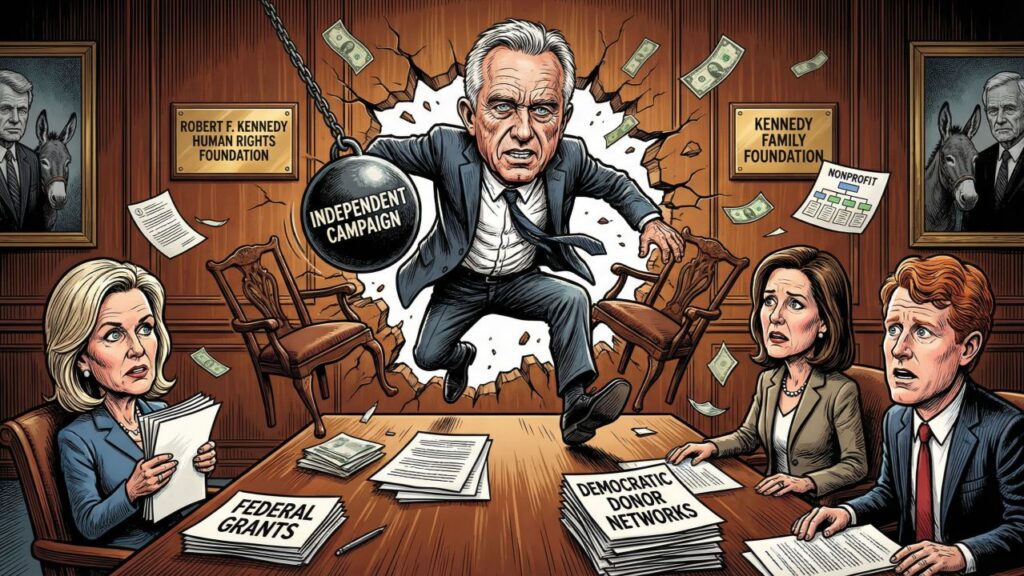
Part I: Bobby Goes Rogue and the Kennedy Foundation Had to Choose Between Blood and Money
The April 2024 spectacle at Philadelphia’s Martin Luther King Recreation Center wasn’t a spontaneous family reunion. It was a calculated institutional salvage operation. When fifteen Kennedy family members lined up behind President Joe Biden to denounce their brother Robert F. Kennedy Jr.’s independent presidential campaign, they weren’t just making a political statement, they were protecting a multimillion-dollar nonprofit empire built on Democratic Party alignment.
Kerry Kennedy, standing at the podium as the family’s spokesperson, called Biden “my hero” while carefully avoiding mentioning her brother by name. Her performance was pitch-perfect political theater. What went unmentioned was her $352,298 annual compensation as president of Robert F. Kennedy Human Rights, a figure that included a $70,000 bonus, awarded, remarkably, during a fiscal year when the organization’s donations had plummeted from $12.3 million to $7.5 million.
The Kennedy “legacy” isn’t just a family name anymore. It’s a tax-exempt brand generating eight figures annually across multiple nonprofit entities, all of which depend on maintaining favorable relationships with the Democratic donor class and, crucially, federal funding streams that flow through DNC-aligned administrations.
The Nonprofit-Industrial Complex: Follow the Money
Robert F. Kennedy Human Rights reported revenue of $7,527,165 in 2021, with net assets of $57,506,680. The organization’s financial health depends on a network of major foundation donors and corporate sponsors who expect ideological consistency. Kerry Kennedy’s compensation alone represents nearly 5% of annual revenue, a figure that contextualizes just how personally lucrative the family business has become.
The organization’s partnerships reveal the depth of its institutional capture. According to InfluenceWatch, RFK Human Rights has formed alliances with the American Civil Liberties Union, Advancement Project, American Federation of Teachers, Freedom for Immigrants, March for Our Lives, National Bail Fund Network, and the Southern Poverty Law Center. These aren’t neutral human rights partnerships, they’re an interlocking network of progressive advocacy organizations that share donors, board members, and most importantly, ideological alignment with Democratic Party priorities.
When RFK Jr. launched his independent campaign, he didn’t just threaten Biden’s electoral prospects. He threatened to devalue the Kennedy brand among the exact donor class that sustains these organizations. A Kennedy running against the Democratic establishment endangered every grant proposal, every major donor relationship, and every federal funding stream that these nonprofits depend on.
The Board of Trustees: Where Democratic Politics Meets Family Business
The institutional dependencies extend far beyond Kerry Kennedy’s organization. Kathleen Kennedy Townsend, who joined her siblings in endorsing Biden, has spent decades building a resume that reads like a Democratic Party organizational chart. She chaired the Robert Kennedy Memorial, served on the board of the Center for American Progress, chaired the Global Virus Network, and served on boards ranging from the Export-Import Bank to Johns Hopkins SAIS.
Townsend’s career illustrates the fundamental conflict: Kennedy family members lead nonprofits that require board approvals from institutions thoroughly embedded in Democratic Party networks. The Center for American Progress, where Townsend served, is essentially a Democratic policy shop that functions as a shadow government during Republican administrations. The organization’s funding comes overwhelmingly from progressive donors who expect ideological consistency.
Joe Kennedy III, who served as Biden’s special envoy to Northern Ireland, now heads Citizens Energy, a renewable energy nonprofit, and founded the Groundwork Project, which supports “local community organizing efforts in regions of the country historically under-resourced”. In December 2024, he was named co-chair of the Kennedy Human Rights Board of Directors, consolidating family control over the flagship organization. His trajectory, from Congress to Biden administration appointee to nonprofit leadership, exemplifies how Kennedy family members have transformed the legacy into a career path that requires Democratic Party alignment.
The Special Olympics Precedent: Federal Funding as Political Leverage
The most revealing example of Kennedy institutional capture predates RFK Jr.’s campaign by decades. The Special Olympics, founded by Eunice Kennedy Shriver in 1968, has received federal funding for more than forty years. In 2017, the organization reported nearly $149 million in revenue, with $15 million, approximately 10% of total funding, coming from federal grants.
When the Trump administration proposed cutting $17.6 million in federal funding to Special Olympics in 2019, the public outcry forced an immediate reversal. The episode revealed how deeply the Kennedy nonprofit empire depends on federal support. The Special Olympics’ federal funding comes through the Department of Education and supports the Unified Champion Schools program, but the grants require alignment with federal education priorities, which change with each administration.
Eunice Kennedy Shriver leveraged her brother President John F. Kennedy to make intellectual disabilities a federal priority, securing more than $400 million annually in federal funds by the mid-1960s. This established the template: Kennedy family nonprofits would maintain access to federal grants by aligning with Democratic administrations. The system works brilliantly, until a Kennedy threatens it.
The DNC Coordination: A Family Dispute or Opposition Research?
The April 2024 endorsement event was orchestrated with military precision. The Democratic National Committee had been targeting RFK Jr.’s campaign for months, filing Federal Election Commission complaints alleging illegal coordination with his super PAC and deploying mobile billboards outside his fundraising events linking him to Donald Trump.
The Philadelphia event served multiple strategic purposes. First, it undermined RFK Jr.’s appeal to Democratic-leaning voters by showing his own family rejected him. Second, it provided the Biden campaign with Kennedy family surrogates who could campaign in battleground states while attacking RFK Jr. without the campaign’s fingerprints on the attacks. Third, it protected the institutional relationships that sustain Kennedy family nonprofits by demonstrating loyalty to the Democratic establishment.
Kerry Kennedy’s statement at the event was carefully crafted to avoid mentioning her brother while emphasizing that “there are only two candidates with any chance of winning the presidency”. This wasn’t family concern, it was political messaging designed to discourage voters from considering RFK Jr. as a viable alternative.
The DNC’s strategy was explicit. As DNC spokesperson Matt Corridoni stated, “RFK Jr. was recruited to run by Trump allies like Steve Bannon, his candidacy is being propped up by Trump’s largest donor, and his own campaign staffer said the campaign’s top goal is stopping President Biden”. The Kennedy family endorsement provided cover for this messaging, allowing Democrats to frame RFK Jr. as a Republican stalking horse rather than a legitimate independent candidate.
When the Brand Became the Business
The transformation of the Kennedy legacy into a nonprofit industry creates obvious conflicts of interest. Family members who lead organizations dependent on Democratic donor networks and federal grants cannot afford to support candidates who threaten those relationships, even when that candidate is their own brother.
RFK Jr.’s campaign threatened institutional funding streams in multiple ways. His anti-vaccine advocacy alienated pharmaceutical industry donors who support health-focused nonprofits. His criticism of the Democratic Party establishment endangered relationships with major progressive foundations. His willingness to challenge a sitting Democratic president risked federal grant renewals that require administration approval.
The math was simple: the Kennedy family nonprofits were worth more than Bobby’s political ambitions. The April 2024 endorsement wasn’t a family dispute, it was a boardroom decision to protect institutional assets.
The August Betrayal: When Bobby Endorsed Trump
The real test came in August 2024, when RFK Jr. suspended his campaign and endorsed Donald Trump. Five Kennedy family members (Kerry, Kathleen, Courtney, Rory, and Chris) issued a statement calling it “a betrayal of the values that our father and our family hold most dear”. The statement concluded, “It is a sad ending to a sad story”.
Kerry Kennedy appeared on MSNBC to elaborate, telling host Jen Psaki: “I’m outraged and disgusted by my brother’s gaudy and obscene embrace of Donald Trump. And I completely get out and separate and dissociate myself from Robert Kennedy Jr. in this flagrant and inexplicable effort to desecrate and trample and set fire to my father’s memory”.
This wasn’t grief, it was brand management. The Kennedy family nonprofits required public disavowal to maintain credibility with Democratic donors who would be writing checks for the next grant cycle. The statement served notice: the Kennedy brand remained safely within the Democratic Party fold, Bobby’s apostasy notwithstanding.
The Institutional Imperative
The Kennedy family’s transformation from political dynasty to nonprofit conglomerate reveals a fundamental corruption at the heart of American philanthropy. Organizations claiming to pursue justice and human rights become vehicles for family enrichment and political influence. The tax code subsidizes these entities while donors use them to advance partisan agendas.
Kerry Kennedy earns more than a quarter-million dollars annually leading an organization named after her father. Kathleen Kennedy Townsend leverages the family name to serve on boards that provide prestige, compensation, and political access. Joe Kennedy III transitions seamlessly from Congress to a Biden administration position to nonprofit leadership. The family legacy has become intellectual property to be monetized and protected.
When RFK Jr.’s campaign threatened this arrangement, the family had to choose between blood and budgets. They chose budgets. The April 2024 endorsement and August 2024 denunciation weren’t family disputes, they were institutional preservation. The Kennedy brand survived, even if Bobby’s candidacy didn’t.
The question isn’t whether the Kennedy family betrayed Bobby. The question is whether they betrayed the principles they claim to champion by allowing institutional dependencies to override political independence. When nonprofit revenues and federal grants determine family loyalty, the “legacy” becomes just another product for sale to the highest bidder.
Related reading
- Part II: The Kennedy Endorsement Was a Democratic Party Production: How Opposition Research Became Family Theater
- Part III: Blood Is Thicker Than Water, But Money Is Thicker Than Both: The Kennedy Family's Long History of Choosing Power Over Kinship
- The American People Are More Objective About President Trump's Actions Than Democratic Party Leadership
- Altman's Desperation & The Shakedown Republic: How Trump and the AI Oligarchy Turned a Bubble Into a Protection Racket