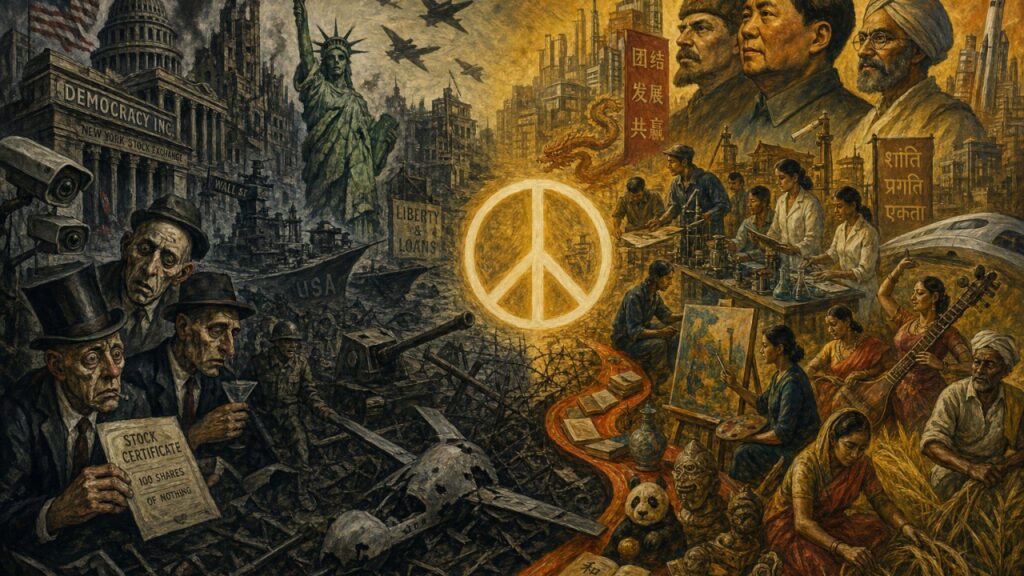
When money is the only thing…
By Scott Ortkiese | July 4,2026 |so@throughlinesynthesis.com
Let us talk about life in a multilateral world…
The United States threw its hegemony away in a sea of entitlement, materialism, and sophistry, led by an inequitable distribution of wealth at the hands of rentiers, and it no longer wishes to compete, or even learn, much less create. Its dreams lie sullen and ruined, words like freedom and independence now shadowy things under electronic surveillance, AI second-guessing them through onion-thin fact-checking fed to sound bite zombies holding smartphones, all human information flowing to the machines and whispering the words of Marlowe’s Faustus, having gotten cleanly past Orwell as our gatekeeper, and that did not take long. World empire, as it turns out, deserved to be lost.
Maybe what America was in 1776 is what China, Russia, and Iran are now, after bearing the weight of Western wars that were never theirs to fight. The West still beguiles some, like the Ukrainians, who forgot what they were and were never looking in the direction where the sun rises, always chasing the easy money in the direction where it sets. There is no voice of the everyman anymore, translated and conveyed by a media bought by private equity and delivered in the form of a leveraged buyout to investors without voting rights, and the result is a ceaselessly cascading grift and wealth concentration into the hands of those who never built a thing, deserved only because of a university or an affiliation, a legacy or a birthright, nothing earned, nothing created. The carpet of America is strewn with wasted opportunity, lost fleets and redundant military bases, protectors of what ephemeral thing exactly, surely not lasting peace, not great art, not a legacy of dreams driving a future through creation.
Riddle me this: what should a multilateral world look like at the hands of kinder, wiser, more creative human souls?
What a Rentier Actually Is
Before we can answer that, a word most of this audience has encountered but perhaps not stopped to define with the precision the moment demands, because understanding it is the difference between following a news cycle and reading history.
A rentier lives on what they own, not on what they make, and the term entered political economy through Ricardo and Mill to describe a class extracting income from possession rather than production: ground rents, financial instruments, title to things others must use. John Stuart Mill proposed taxing what he called unearned increment, the value that accrues to land simply because society grows around it, because he understood that a democracy cannot long justify arrangements where one class is paid for nothing it contributes. The rentier class did not disappear; it upgraded its instruments, moving from country estates into private equity, management fees, licensing revenue, and the systematic acquisition of housing, healthcare, data, and bandwidth it did not create but now owns and prices at will.
The news media the public consumes is the product of this same logic, a cashflow vehicle whose editorial output is calibrated to the preferences of the investor class that owns it, its definition of truth whatever ratio of managed consent the advertising market will bear. This is precisely why the transcripts and conversations circulating this week among scholars, analysts, and former military officers with real operational knowledge of the world tell a story that does not appear in what passes for journalism, because these voices are not polling data or focus groups but people who have actually been to the Donbas and back, who have spent careers studying how empires end, and who are willing to name what the rentier press will not print.[1][2]
The Arc Every Empire Follows
The Athenian Democracy replicated the self-styled pre-history mythology of Homer and used it to justify regional dominance, and that path led directly to the Peloponnesian Wars, to the Sicilian Expedition, to 40,000 men consumed by a Syracusan harbor because hubris dressed as strategy is still just hubris. The Romans admired the Greeks, emulated them, and failed on a continental scale, and the British admired Rome, emulated it, and failed on a global scale, and every maturing democracy since has followed the same arc: the noble founding, the slow capture by aristocracy dressed in republican clothing, the bloated military adventurism, the managed decline, the negotiation with entropy. From Pericles to Churchill, false idols everywhere, men who built their statues before the cities stopped burning, their statesmanship always partly theater, their grandeur always partly borrowed, the bill always paid by the people who had the least hand in running it up.
And now we arrive at Trump, not as aberration but as culmination, the culmination of a rentier political culture in which electoral victory requires enough money from enough concentrated wealth that the winner, whoever they are, cannot govern against those interests. Colonel Douglas McGregor, decorated combat veteran and former Pentagon adviser, stated it without varnish: there is no strategy, there has never been a strategy, and whatever Trump wakes up deciding will make him look good is what gets implemented that day. McGregor watched an administration discover, apparently with genuine surprise, that it had nearly emptied the strategic petroleum reserve, is rolling over eighteen trillion dollars in treasuries at ruinous interest rates, and is structurally, genuinely broke, all while European leaders who cannot fill a football stadium with their armies talk in public about the inevitability of war with Russia.[^3]
What the People Who Actually Know Are Saying
Alexander Mercouris, who lives in Britain and recently attended a conference in Pskov and traveled widely across Russia, came back with an observation that deserves to be read slowly: the consensus he found, not just in government circles but among factory workers, was that Russia is now in a war with the West, not with Ukraine, and that Putin has shifted over the past year from a leader who spoke about diplomacy and negotiations to one who has publicly dismissed Western diplomatic initiatives as tricks, who no longer believes any agreement reached at Anchorage is binding because the West did not honor it, and who is now focused exclusively on victory. What Mercouris hears from Britain is extraordinary: practically no popular opposition to war with Russia, rhetoric that would have been unthinkable five years ago now uttered by heads of government as settled policy, and the internal debate in Moscow about whether merely defeating Ukraine will be sufficient to restore deterrence with the West has not been resolved in favor of restraint.[^1]
John Mearsheimer, who has spent fifty years studying how great powers stumble into catastrophe, stated the bottom line this week with a directness that should clear any room: if the West and Ukraine operating together are successful in their current course, that increases the likelihood of nuclear war. He watches the casualty exchange ratios on the battlefield, notes that Russian forces are advancing systematically while the Western press manufactures a narrative of Ukrainian momentum, and understands something the rentier media will not explain to its audience, which is that the West is not poking a bear but poking the world’s largest nuclear power in a context that power interprets as existential. The New York Times runs casualty figures, 450,000 Russian dead against 150,000 Ukrainian, that Mearsheimer calls simply unbelievable and ludicrous given Russia’s sustained artillery advantage of five to ten to one throughout the war, and the body count has become the new body count, the same moral fraud as Vietnam, the same manufactured evidence of progress, the same pressure on the apparatus to show winning so the political class does not have to reckon publicly with the choice it made.[2][4]
Larry Johnson, former CIA analyst, offered the elementary logic this way: if the Sinaloa cartel were being supplied with drones, missiles, and targeting intelligence by China and Russia and launching attacks deep into Texas and Arizona, the United States would call it an act of war and respond accordingly, and that is precisely what is now happening to Russia. NATO satellites guide the weapons, NATO contractors help pull the trigger, drones that attacked St. Petersburg transited NATO airspace, and Italian-manufactured components with “Made in Italy” stickers still attached killed civilians at open-air markets in the Donbas. An Estonian presidential adviser was pranked into confirming his country had provided targeting coordinates for strikes on St. Petersburg, and Russia’s Foreign Ministry called it evidence of Estonian participation in terrorist attacks on Russian territory, which means the edges of proxy war are gone and what remains is direct confrontation with a fiction of distance maintained for domestic political consumption in Western capitals.[5][6]
Stanislav Krapivnik, Russian-born former U.S. Army officer who returned from 2,500 kilometers across the Donbas this week, said without drama that there are two outcomes ahead, conventional war or nuclear war, and no middle option. The G7 meeting in France this summer produced a declaration explicitly committing member governments to accelerate the drone and missile campaign deep inside Russia, Finland changed its laws to allow American nuclear gravity bombs on its soil, and Medvedev placed Finland on the nuclear targeting list, all while Sergei Karaganov, once a minority voice in Moscow, now finds that an overwhelming majority of people in the Russian foreign policy establishment agree with his argument that if conventional restraint fails to re-establish deterrence, Russia must escalate to tactical nuclear use not as last resort but as first-resort deterrence demonstration, to restore the fear the West has lost. Mearsheimer assessed publicly that there is not much daylight between that view and what Putin’s spokesman Peskov and Putin himself are now saying.[4][5][^2]
Mercouris made the point that bears repeating on this particular holiday: it is taking all of Putin’s authority and determination to maintain discipline and restraint on the Russian side, and that is not something the West can afford to assume will hold indefinitely. McGregor’s formulation was equally plain, do not bet on the perpetual goodwill of Vladimir Putin, and none of this is in the mainstream press, because the mainstream press is owned by the rentier class and the rentier class has concluded that the truth is bad for the portfolio.[3][1]
What a Multilateral World Actually Requires
So the question asked at the top deserves a serious answer, not an aspirational one.
A genuinely multilateral world does not look like a UN conference with reserved seating for the permanent five, and it does not arrive in the language of stakeholders and inclusive frameworks, which is the dialect spoken by people who have determined that real structural change is too expensive to contemplate. It looks like production replacing extraction as the organizing principle of national life, states that build things: infrastructure, energy systems, science, cities that are not simply investment vehicles for global capital, with China laying rail across Central Asia because connectivity is power and power built on real things outlasts power built on financial instruments, and Iran surviving every sanctions regime Washington invents while still developing its own pharmaceutical industry, its own satellite program, its own regional relationships, because survival teaches a discipline that comfort never does.[^6]
It looks like the Global South arriving as rule-makers rather than petitioners, not as emerging markets to be tapped on Western terms but as civilizations with accumulated knowledge, legitimate historical grievances against the colonial project, and an entirely legitimate claim to design the systems that govern them, because Africa, Latin America, South and Southeast Asia do not need better access to the existing order so much as they need a different order, one they co-write rather than one they are invited to ratify after the terms have been set. And it looks like the end of extraterritorial sanctions as an instrument of foreign policy, full stop, not because coercion is always wrong but because one country’s unilateral decision to cut another country’s economy off from the global financial system is not law; it is tribute collection with a press office, and the new hegemons, whoever they turn out to be, must refuse this instrument even when they have the power to wield it, because the moment they reach for it they have become what they replaced.
The Redistribution No Coming Hegemon Wants to Discuss
And then there is the question of the redistribution of unjust rentier-concentrated wealth, which is where every polite conversation about multipolarity goes silent, because the coming hegemons are no more eager to discuss it than the departing one. A multilateral world administered by kinder, wiser souls that leaves the fundamental distribution of productive assets, land, water, bandwidth, intellectual property, and financial instruments, in the hands of the same class that produced the current catastrophe is not a new order; it is a change of letterhead.
The rentier is not a nationality but a logic, and the logic says that ownership of something others must use is itself a sufficient claim on their labor, their futures, and their political systems, operating in Shanghai as fluently as it operates in New York, in Moscow’s oligarch class as efficiently as it operated in London’s, and in the Global South’s own rentier elites, its compradors, its families whose wealth derives from title rather than from work and whose political influence is exercised to keep it that way. A genuine multilateral remedy begins with the recognition that the concentration of productive wealth in private hands, beyond any rational claim of contribution, is not an economic inevitability but a political choice enforced by law, maintained by the same capture of democratic institutions that produced Trump, that produced the leveraged buyout of the press, that produced the foreign policy of a country that no longer builds anything and must therefore sell coercion instead.
What redistribution looks like in practice is not confiscation and it is not utopia; it is progressive wealth taxation on accumulations that serve no productive function, land value taxation on the unearned increment Mill proposed and every major landholding interest has suppressed for a century and a half, the treatment of spectrum and data and intellectual property as public goods with public royalties rather than private monopolies with private rents, sovereign wealth funds in resource-extracting nations that actually fund public investment rather than private accumulation by the governing class, and the cancellation of the debt structures that keep the Global South paying interest to the same financial institutions that financed the colonialism that produced the underdevelopment that made the debt necessary in the first place. None of this requires a revolution; it requires a political class with the will to govern for the people it represents rather than the wealth it answers to, which is precisely what the rentier class exists to prevent, which is why it buys political systems, which is why it owns the press, which is why the conversation you are reading right now does not appear in any publication that depends on the advertising revenue of the companies whose ownership structures are the problem.
The Fork in the Road
The coming hegemons will be judged not by whether they dislodge American financial dominance, which is already underway and requires no particular virtue on their part, but by whether they build something that their own populations, and eventually the populations of the world, can actually live in with dignity, and that requires confronting the rentier logic within their own borders with the same clarity they bring to condemning it when it arrives wearing an American flag.
The fork is simple enough to state even if it is hard enough to walk. One path is to inherit the empire’s instruments: the sanctions, the dollar weaponized as a political tool, the network of bases, the manufactured consent, the client states, the proxy wars fought at a safe remove in other people’s countries, and that path is well-marked because it has been walked so many times. The other path has no historical precedent and requires building a genuinely multilateral architecture that binds the powerful as tightly as the weak, resolves disputes through law rather than leverage, and measures national success by what is created and shared rather than by what is extracted and hoarded, which means China being as accountable to the rules it writes as it expects Washington to be, Russia applying the sovereignty principles it rightly invokes for itself to the countries on its own periphery, and the Global South refusing to replicate at regional scale the extractive hierarchies it is correctly escaping at the global one.
The difference between multipolar and multilateral is the difference between several landlords and no landlord at all, and several rentiers replacing one rentier is not a remedy but a franchise agreement. The kinder, wiser, more creative souls who might administer the genuine remedy are not in the chancelleries but in the labs, the classrooms, the civil society organizations, the independent press outlets, the movements that have no flag yet because the nation they are building has not been invented, and the question is whether the collapsing structure of American hegemony creates space for them before it creates a nuclear war instead.
Today somewhere in America people are watching fireworks at Mount Rushmore while a president holds a campaign rally and warns against communism, because it is always 1955 in the mind of a man whose relationship to history is entirely self-referential. The argument of 1776, that inherited power has no legitimate claim on the future, remains the most radical and necessary idea in political life, and the question on this Fourth of July is who is making it, and where, and whether the people in the rooms where it still matters have the imagination to mean it.
The fireworks are lovely. The cliff is real. And the fork in the road is not far past it.
References
1. 6-30-26-Mercouris-Diesen-Transcript.docx– Transcript 000 Welcome back. Today we have the great privilege of being joined by Alexander Mccurs,…
2. 7-3-26-Mearsheimer-Diesen-Transcript.docx– Transcript Top of Form Search transcript Bottom of Form 000 Welcome back. Were joined again by Profe…
3. 7-1-26-Macgregor-Diesen-Transcript.docx– Transcript 000 Welcome back. We are joined today by Colonel Douglas McGregor, a decorated combat vet…
4. 6-28-26-Mearsheimer-Transcript.docx– Mearsheimer Transcript Top of Form Search transcript Bottom of Form 000 In the west, we have this ne…
5. 7-4-26-Krapivnik-Diesen-Transcript.docx– Transcript Top of Form Search transcript Bottom of Form 000 Welcome back. We are joined again by Sta…
6. 6-27-26-Johnson-Diesen-Transcript.docx– Transcript 000 Welcome back. We are joined again by Larry Johnson, a former CI analyst who writes on…
Related reading
- Part 2: The Rentier's Republic of America
- America’s Suicidal Empire: The Iran War, the Death Spiral of a Failing Hegemon, and the World We Are Destroying
- Does He Really Think Nobody Has Options? Trump’s Imperial Arrogance and the Countries He Screwed
- Trump Is Gambling America’s Power on a Losing Hand