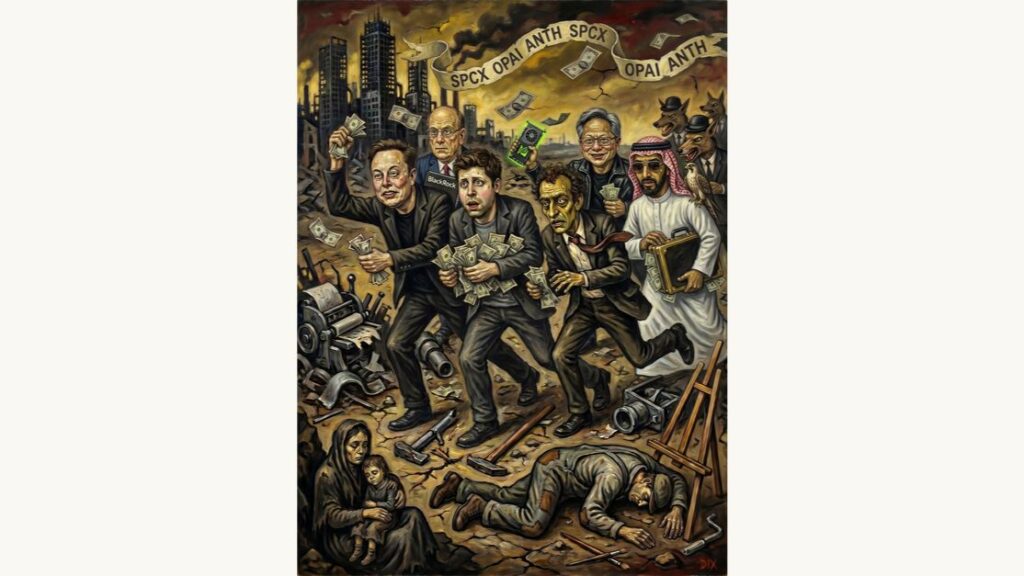
The Greatest Grift Ever Told
June 4, 2026
By Scott Ortkiese | June 4, 2026
The idiocy of war, politics, and tribalism is too contrived to be random. It was built.
Index funds are being unleashed to fund AI IPOs that concentrate and lock up the remaining capital, insulated from any appeal by the people, divided between rentiers and tech oligarchs who will one day lie at the mercy of the same electrons they used to subjugate everyone else.
Americans have learned to live with mistakes. They count on them. So they pose no opposition.
The Build
Three firms now sit on roughly a quarter of every vote cast at S&P 500 companies. BlackRock, under Larry Fink, manages $11.6 trillion. Vanguard, under Salim Ramji, manages $12 trillion. State Street Global Advisors, under Yie-Hsin Hong, manages $5.7 trillion. Together they are the largest shareholder in 88 percent of the S&P 500 ([1]). They have nearly quadrupled their collective stake in the index over two decades. The NBER projects their share of votes could reach about 40 percent within twenty years ([2]).
They rarely sell. They are permanent owners.
Two firms, Institutional Shareholder Services and Glass Lewis, control approximately 90 percent of the proxy advisory market. The Big Three frequently vote in line with their recommendations. At an April 29, 2025 House Capital Markets Subcommittee hearing titled “Exposing the Proxy Advisory Cartel,” Chairman French Hill stated plainly: “ISS and Glass Lewis shape the outcomes of shareholder votes across the market, especially as large index funds often vote in lockstep with their recommendations. That’s not just advice; it’s de facto control” ([3]).
Voting Choice was the answer. BlackRock launched it in January 2022 and expanded it to retail in February 2024. By the end of 2025, approximately $885 billion of eligible assets had opted in. The remaining $2.87 trillion in eligible index assets continues to default to BlackRock’s stewardship team ([4]). The mechanism advertises democratization. The default preserves the concentration.
That capital is being aimed. BlackRock projects another $5 to $8 trillion in AI-related capital expenditure through 2030. Russell Investments warns that the coming wave of mega IPOs, SpaceX, OpenAI, Anthropic, will convert private positions into the largest passive public exposures institutions have ever carried. The retail saver buying an S&P 500 index fund is the unwitting underwriter of a concentration he will never be asked to approve.
The structure has a name now. It is the AI capex loop.
On January 21, 2025, Sam Altman, Masayoshi Son, Larry Ellison, and the President announced Stargate from the White House. Five hundred billion dollars over four years, with $100 billion deployed immediately. SoftBank holds financial responsibility. OpenAI holds operational responsibility. MGX, the Abu Dhabi AI fund, sits at the table as a founding equity partner. By September 2025, the project had reached nearly seven gigawatts of planned capacity and over $400 billion in committed investment ([5]). SoftBank closed a $41 billion investment in OpenAI in December 2025 for roughly 11 percent of the company ([6]).
Microsoft holds approximately 27 percent of OpenAI on an as-converted basis, an investment valued at roughly $135 billion after the October 28, 2025 recapitalization ([7]). The agreement preserves Microsoft’s exclusive Azure API rights through 2032. Microsoft invests cash. OpenAI buys Azure compute. Azure revenue rises. Microsoft equity rises. The index fund that owns Microsoft mechanically funds the next turn.
Nvidia has allocated approximately $53 billion across 170 transactions in the AI sector ([8]). It owns roughly 7 percent of CoreWeave. It agreed to invest up to $100 billion in OpenAI in September 2025. The same month, it committed to purchase $6.3 billion in cloud services from CoreWeave through April 2032 ([9]). Nvidia invests in CoreWeave. CoreWeave buys Nvidia chips. CoreWeave rents capacity to OpenAI, which Nvidia also funds. Nvidia then buys $6.3 billion of CoreWeave services. The loop closes.
On September 17, 2024, BlackRock, Global Infrastructure Partners, Microsoft, and MGX launched the Global AI Infrastructure Investment Partnership. Initial target: $30 billion in equity, up to $100 billion total with debt. Anchor investors: Kuwait Investment Authority and Singapore’s Temasek ([10]). On October 15, 2025, the partnership announced the acquisition of Aligned Data Centers for an enterprise value of approximately $40 billion ([11]). The buyer, the financier, and the customer are the same circle.
The Magnificent Seven, Apple, Microsoft, Nvidia, Alphabet, Amazon, Meta, Tesla, accounted for 34.1 percent of the S&P 500 by December 2025, up from roughly 14 percent in 2019 ([12]). Every passive dollar flowing into the index is mechanically overweighted into the firms building and financing the loop. The saver who never read a prospectus has been enrolled.
The Erasure
Whatever faint, flagging, dying voice the individual still has inside this appalling caricature of a democracy is drowned in the act of being busy and supplying material goods to materialists. The worker. The individual. The philanthropist. The caregiver. One by one, discarded. Gone pecans.
The mechanism is not theoretical. It runs through specific firms and specific names.
In February 2024, Klarna CEO Sebastian Siemiatkowski announced the company’s OpenAI-built chatbot was handling the equivalent work of 700 customer service agents. The projected annual benefit was $40 million ([13]). The workforce had already shrunk 22 percent through attrition. Hiring was frozen for over a year. By May 2025, Siemiatkowski admitted the strategy had gone “too far.” Customer satisfaction had plummeted. Klarna began rehiring at 400 Swedish kronor an hour. Students. Rural residents. Gig contractors ([14]). The partial reversal preserved the underlying transformation. Humans returned at lower status, with weaker claims, on shorter contracts.
In May 2023, IBM CEO Arvind Krishna announced a hiring pause on approximately 7,800 back-office roles. “I could easily see 30 percent of that getting replaced by AI and automation over a five-year period” ([15]). No firings were announced. The work would simply stop requiring people.
In December 2024, Salesforce CEO Marc Benioff announced the company would hire zero new software engineers in 2025 ([16]). Engineering headcount has remained essentially flat for two years. Separately, Salesforce’s Agentforce platform replaced 4,000 customer support roles, cutting that workforce from 9,000 to 5,000.
Microsoft cut roughly 6,000 employees in May 2025, the majority reportedly programmers. CEO Satya Nadella confirmed that approximately 30 percent of Microsoft’s code is now written by AI. In July 2025, Microsoft announced another 9,000 cuts, targeting “flattening management layers” ([17]). Total 2025 layoffs reached approximately 15,000. The same company committed $80 billion in AI infrastructure capital expenditure for fiscal 2025.
The pattern repeats. PwC eliminated approximately 1,800 US jobs in September 2024 and 1,500 more in May 2025. KPMG cut roughly 400. A former PwC partner told Business Insider AI will eliminate 50 percent of roles in audit, tax, and advisory within three to five years, and that “there are already examples of AI solutions capable of performing 90 percent of the audit process” ([18]). The firms selling AI transformation services to clients are using AI to eliminate their own staffing costs.
The studies converge on the same finding. Erik Brynjolfsson, Bharat Chandar, and Ruyu Chen, using ADP payroll data covering tens of millions of workers, documented in November 2025 that early-career workers aged 22 to 25 in AI-exposed occupations experienced a 16 percent relative employment decline since the widespread rollout of generative AI. Employment for experienced workers in the same occupations remained stable ([19]).
The Anthropic Economic Index found Computer Programmers to be the most exposed occupation, with 75 percent task coverage. Entry into AI-exposed occupations dropped 14 percent for workers aged 22 to 25 ([20]). The Dallas Fed, in a February 2026 paper by J. Scott Davis, found that for occupations with a low experience premium, a one-standard-deviation increase in AI exposure was associated with a 0.28 percentage point reduction in wage growth. For occupations with a high experience premium, AI exposure correlated with a 0.2 percentage point increase. AI substitutes for entry-level workers and augments experienced ones. It collapses the bottom rung without removing the top ([21]).
Goldman Sachs revised its near-term displacement estimate in August 2025 to between 6 and 14 percent of the US workforce, naming computer programmers, accountants and auditors, legal and administrative assistants, customer service representatives, telemarketers, proofreaders, and credit analysts as highest-risk occupations. The bank noted unemployment among 20- to 30-year-olds in tech-exposed occupations had risen by nearly three percentage points since early 2025 ([22]).
The Society of Authors surveyed working translators and illustrators in April 2024. Thirty-six percent of translators had already lost work to generative AI. Twenty-six percent of illustrators had. Seventy-seven percent of translators and 78 percent of illustrators expected the impact on their future income to be negative ([23]).
Companies are not, for the most part, mass-firing workers. They are stopping hiring. IBM’s freeze. Salesforce’s freeze. Klarna’s attrition. The workforce shrinks not from cuts but from the slow close of doors that no longer open. The seat is removed before the next worker arrives. No vote is required. No announcement is needed.
The Economic Policy Institute documents that since 1979, productivity has grown 92.4 percent. Worker pay has grown 33.6 percent. Productivity has grown 2.7 times as much as pay ([24]). The labor share of US GDP, around 64 percent in the 1960s, sits near 57 percent now. The Philadelphia Fed has called generative AI a potential “turning point” for labor’s share. The direction is established. The gradient has not reversed in fifty years.
Where does the captured surplus go.
As of the fourth quarter of 2025, the top 1 percent of Americans owned 50.2 percent of all corporate equities and mutual fund shares ([25]). The top 10 percent owned 87.2 percent. The bottom 50 percent owned 1.1 percent. The wealth effect from rising stock prices accrues, mechanically, to the people who already own the shares.
Union density in the private sector, around 35 percent in the mid-1950s, sits under 6 percent. In 1980, approximately 60 percent of private-sector workers with retirement plans had defined-benefit pensions. By 2024, only 15 percent of private industry workers had access to one ([26]). Investment risk was transferred from employer to worker. The 401(k) became the default. Those defaults flowed directly into Vanguard, BlackRock, and State Street, feeding the same concentration that has captured the upside.
Apollo Global Management, under CEO Marc Rowan, manages $840 billion. Apollo’s wholly owned insurance arm, Athene, moved $9.5 billion in annuities in the first quarter of 2025 alone. Rowan has described the goal explicitly: a “reimagined defined benefit” in which Athene’s annuities replace eroding corporate pension plans ([27]). The premium goes in. Apollo invests it in higher-yielding private credit and asset-backed securities. The spread is the profit. The annuitant gets a guaranteed payment. The leverage gets concentrated in a firm that answers to no public pension trustee.
Blackstone made the same move with AIG’s life and retirement unit. KKR acquired Global Atlantic. Carlyle acquired Fortitude Re. The pattern is industry-wide. Insurance assets face state insurance capital rules rather than bank capital rules. The arbitrage is structural. The risk is borne by retirees.
Homeownership tells the same story from a different angle. The under-35 homeownership rate sits at 37.9 percent. Only 32.6 percent of 27-year-old Gen Zers owned a home in 2024, compared to 40.5 percent of Baby Boomers at the same age. Invitation Homes, originally backed by Blackstone, owns roughly 80,000 single-family rental properties across 17 markets. Progress Residential, owned by Pretium Partners, owns roughly 83,500. Blackstone, after acquiring Tricon in 2024, owns approximately 62,000 ([28]). Homes that would have been first-time purchases for individuals were converted, at scale, into institutional rental portfolios. The wealth-building vehicle that defined American middle-class life for three generations was rerouted.
US student loan debt sits at $1.833 trillion. The average federal balance is $39,547. As of January 2026, $208.7 billion sat in default or near-default. The same workers told that education was the path to economic security entered the labor market carrying debt and now find the first rung of every career ladder broken by AI.
Three thousand five hundred local newspapers have vanished in the past twenty years. Two hundred and thirteen US counties are now news deserts. Fifty million Americans live with limited or no access to local news ([29]). Corruption goes unreported. Zoning decisions go uncovered. Local political life loses its witnesses.
In May 2023, US Surgeon General Vivek Murthy issued an advisory: “Our Epidemic of Loneliness and Isolation.” Twelve percent of Americans now report having no close friends, up from 3 percent in 1990. One in two Americans report measurable loneliness. Young adults report higher rates than seniors ([30]). The conditions that produce AI-driven economic atomization feed it directly. Remote work. Gig status. The elimination of the in-person workplace. The workplace was the last reliable site of involuntary human contact for working-age adults. It is being closed.
Trust for America’s Health reported more than 200,000 deaths from drug overdose, alcohol, and suicide in 2023. Twice the rate of twenty years prior ([31]). Deaths of despair were named for what they are. The structural conditions that generated them have not reversed. Economic insecurity. Labor displacement. Community dissolution.
This is the erasure. Not dramatic dispossession. Not a single moment of confiscation. The quiet disappearance of the conditions that made individual American life feel tenable. The pension, the homeownership ladder, the union card, the local paper, the entry-level job, the workplace itself. Each goes. Then the next.
The Pipeline
The AI capex loop now requires a public exit. The private rounds have run out of room. The cap tables are too heavy. The losses are too large. Public market money is required to take the position over.
SpaceX began trading on the Nasdaq on June 12, 2026, under the ticker SPCX. The S-1 ran 277 pages. Targeted valuation: approximately $1.75 trillion. Implied multiple: roughly 110 times sales ([32]; [33]). For comparison, Google went public at 10 times sales with 240 percent revenue growth. SpaceX is going public with decelerating growth and quarterly losses up 700 percent year over year. The xAI segment, folded into SpaceX in a February 2026 merger structured in Nevada to limit fiduciary exposure, recorded a $6.35 billion operating loss in 2025. Starlink’s revenue subsidizes xAI’s burn. Public market investors are being asked to underwrite the combined entity. Anthropic filed its S-1 the same week SpaceX began trading. OpenAI is reported to follow next quarter.
George Noble, the former Fidelity portfolio manager who founded Noble Capital, read the S-1 in full and named it: garbage. His public verdict carried no euphemism. “SPACEX IS COMPLETE GARBAGE,” he wrote. “Run, don’t walk from this train wreck. The numbers are right there in the S-1 filing for anyone willing to look.”
Noble named the architects. Elon Musk, who structured the merger and the dual-class shares to retain control after sale, the man Noble said belongs in jail. Paul Atkins, chairman of the Securities and Exchange Commission, for permitting the offering to proceed. Ted Pick at Morgan Stanley, the stabilization agent and Musk’s long-time banker, running the retail allocation through E-Trade. David Solomon at Goldman Sachs, holding the lead-left position, running the book ([34]). Behind them, the rest of the syndicate: Bank of America, Deutsche Bank, UBS, Citigroup, JPMorgan, Mizuho, RBC, Macquarie, Wells Fargo, Allen & Co, Needham, Raymond James, Stifel, Cantor Fitzgerald, Société Générale, Mirae, Santander, ING, and BTG Pactual. Twenty-three banks. Every name a brand built on the claim of fiduciary seriousness.
Noble asked the only question that mattered. “Have you no shame? Have you no decency? Have you no honor? Or is it all about the fees?”
The index providers are making it worse. In March 2026, Nasdaq adopted a “Fast Entry” rule, effective May 1, that reduced the seasoning period for a top-40 market-cap IPO from approximately three months to 15 trading days. The 10 percent minimum free float requirement was removed. Goldman Sachs estimates the rule triggers up to $60 billion in forced buying from ETFs alone once SpaceX qualifies. On day 15. With no price discovery interval. Every passive vehicle tracking the Nasdaq-100 will be required to buy at whatever price the market posts.
S&P Dow Jones Indices opened a parallel consultation, “Treatment of MegaCap Companies,” from April 30 to May 28, 2026, with a proposed effective date of June 8, four days before SpaceX began trading ([35]). The MegaCap threshold is a market cap matching the 100th-largest name in the S&P Total Market Index, approximately $112 billion. The proposed rule waives the decades-old Financial Viability Requirement that demanded positive GAAP earnings over four consecutive quarters. It waives the 10 percent free float requirement. It cuts the seasoning period from twelve months to six. Approximately $20 trillion is indexed or benchmarked to the S&P 500. Roughly $13 trillion is passively managed. Every dollar of that $13 trillion must hold the index as constructed. When SpaceX or Anthropic or OpenAI is added, the funds must buy, at whatever price the market dictates.
The individuals being conscripted into this trade do not know they are being conscripted. They have a 401(k). They have an IRA. The default option in both is an index fund. The index fund will be made to buy what the index providers decide it must buy. The retail saver becomes the exit liquidity for the most overpriced offerings in market history.
Adena Friedman runs Nasdaq. Catherine Clay runs S&P Dow Jones Indices. They wrote the rules that complete the loop. The capital that the Big Three already steer toward the Magnificent Seven now gets a designated drainage path into the next set of unprofitable mega-caps. The retirement account becomes the buyer of last resort for assets the private markets cannot absorb at the prices the founders demand.
Noble’s accusation was specific. “You are about to force every retirement account in America to become EXIT LIQUIDITY for the most overpriced IPO in history. This is a legally sanctioned wealth transfer from Main Street to Wall Street. The public will be badly injured and EVERY ONE of you knows it.”
The insider lock-up structure confirms the design. The standard 180-day post-IPO lock-up is replaced by a staggered release. After the first quarterly earnings report covering the period ending June 2026, insiders may sell up to 20 percent of eligible shares. If the stock trades at least 30 percent above the IPO price, another 10 percent unlocks. Additional 7 percent tranches release at days 70, 90, 105, 120, and 135. After the second quarterly report, another 28 percent becomes available ([36]). Musk himself remains subject to the full lock-up. Everyone else gets the door propped open. The early selling windows align almost exactly with the period the index funds are forced to buy.
The sequence is engineered. The S-1 frames the story. The index providers rewrite the rules to mandate the demand. The underwriters distribute the offering. The lock-up schedule frees the insiders to sell into that demand. The retail saver’s index fund receives the inventory at the elevated price. The wealth transfer is completed before most account holders read a single quarterly statement.
This is the mechanism Noble called pathetic. The verdict was not aesthetic. It was forensic. Twenty-three banks signed off. Two index providers cleared the runway. One regulator stood aside. The aggregate $33 trillion of S&P 500-benchmarked and Nasdaq-100-benchmarked assets is being conscripted, by rule, to absorb what the private market is finished holding.
The individual saver was promised that index investing was the safe, diversified, low-cost path to retirement. The index was supposed to be the floor. The floor is being walked through.
Inside the S-1
George Noble named the train wreck. He did not have time to inventory every car. The 277 pages reward closer reading. The substance is worse than the headline.
The Texas reincorporation, completed weeks before the filing, replaced Delaware fiduciary law with Texas Business Organizations Code Section 21.563. Under the new charter, a shareholder must hold at least 3 percent of outstanding shares to bring a derivative suit. Three percent of SpaceX at the IPO valuation is roughly $52 billion. The threshold removes every plaintiff in the country except Musk himself. Litigation against the controller now requires the controller’s blessing.
The S-1 specifies that all securities claims against the company are subject to mandatory binding arbitration. No SpaceX shareholder may join a class. No discovery process survives the arbitration clause. The Securities and Exchange Commission reversed its policy against mandatory arbitration in 2025. SpaceX is the first major issuer to use it. The private right of action that anchors federal securities law has been contractually disabled inside the prospectus that invokes it.
The dual-class structure delivers control without economic risk. Musk’s Class B common carries 10 votes per share. At the IPO he commands 85.1 percent of voting power against approximately 42 percent of economic equity. The post-IPO float dilutes his voting share to roughly 79 percent. Control is preserved at every public price. Removal of the CEO requires a Class B vote. Class B is his. He is unfireable without his own consent.
The board exists at his pleasure. Musk serves as Chief Executive Officer, Chief Technology Officer, and Chairman. The nine-person board carries no independent majority. The company has elected controlled-company status under the Nasdaq listing rules. The independent compensation committee requirement is waived. The independent nominating committee requirement is waived. The same individual who designs the offering signs his own pay package.
In January 2026, the board awarded Musk 1.3 billion restricted Class A shares contingent on Mars colonization and orbital data center milestones. The board awarded another 200 million super-voting Class B shares at a $7.5 trillion valuation target. The board awarded another 60.4 million shares atop that. The combined package vests against milestones the CEO alone defines. Tesla’s board issued Musk a separate $1 trillion compensation package in the same window. The pension trustees of New York City, New York State, and California, representing more than $1 trillion in assets under management, signed a joint letter on May 13, 2026, asking SpaceX to withdraw the filing. Mark Levine, Thomas DiNapoli, and Marcie Frost named the absent guardrails: no independent committees, mandatory arbitration, Texas anti-shareholder reincorporation, and a controller whose record at Tesla includes a 2018 fraud charge with a $20 million penalty, a $1.5 million SEC settlement in May 2026, and a March 2026 jury verdict that he defrauded Twitter shareholders. The pension trustees were ignored. The offering proceeded.
The related-party section is the document’s most damning chapter. Antonio Gracias, age 55, has been Musk’s closest business partner since 2002, when his Valor Equity Partners made a $1 million loan to a struggling Tesla. Gracias has held board seats at Tesla, SpaceX, SolarCity, Neuralink, and the Boring Company. Through July 2025 he served as a senior advisor at the Department of Government Efficiency. He resigned that role after Bloomberg reported that public pension trustees holding $2 billion of his fund’s commitments had begun reviewing his federal access. Valor Equity Partners and affiliated entities hold more than 500 million SpaceX Class A shares, approximately 7.3 percent of the company, worth roughly $90 billion at the IPO valuation. Gracias sits on the SpaceX compensation committee and the nominating committee. He is not disclosed in the S-1 as a recused director.
Between October 2025 and April 2026, SpaceX executed three large equipment leases with xAI and a Valor-affiliated equipment leasing company, the Cloud Technology Company. The three leases combined cover roughly $20 billion in GPU clusters, networking equipment, and data center improvements. SpaceX is the guarantor. PricewaterhouseCoopers, the auditor, refused to treat the leases as ordinary sale-leasebacks. The transactions were classified as failed sale-leasebacks. The result is a $9 billion debt entry on the SpaceX balance sheet that no participant publicly characterized as debt until the auditor compelled it. The notes carry 12.5 percent senior secured pricing, the rate distressed issuers pay. SpaceX paid Valor approximately $885 million in fees and interest during 2025 and another $857 million in January and February 2026. The company paid Gracias personally $186 million in first-quarter 2026 interest on the $9 billion balance.
The S-1 contains the standard arm’s-length language for Tesla transactions: that the terms are no less favorable than would be obtained from an unaffiliated third party. The equivalent language is missing for the Valor transactions. The omission may be material. The Use of Proceeds section, governed by 17 CFR Section 229.504, does not disclose that approximately $20 billion in bridge loan obligations sit behind the equipment leases. Regulation S-K requires that the use of proceeds describe each principal purpose. The document does not.
The Tesla web sits beside the Valor web. SpaceX purchased approximately $650 million of Tesla goods and services in 2025, including $506 million of Megapack batteries for ground stations, $144 million in services, and $131 million in Cybertrucks. The S-1 reports more than 1,000 Cybertrucks acquired by SpaceX, an automotive line item with no operational rationale and no comparable purchase from a non-Musk supplier. The company paid X Corporation $4 million for advertising during 2025. Tesla invested $2 billion in SpaceX in the first quarter of 2026 and now holds approximately 19 million SpaceX Class A shares. A multibillion-dollar semiconductor joint venture, Terafab, ties Tesla and SpaceX to a shared chip pipeline. A 100 gigawatt per year solar manufacturing facility, financed through Tesla, will supply panels to orbital data centers under the xAI segment. SpaceX shares aircraft with Tesla and with Musk personally. Musk Industries LLC receives lease payments from xAI. Boring Company executes construction work for SpaceX in Texas. Every entity Musk controls transacts with every other entity Musk controls. The auditor signs. The board approves. The compensation committee, on which Gracias sits, certifies.
The numbers do not add up under stress. SpaceX reported $18.67 billion in 2025 revenue and a $4.94 billion net loss. Total debt at the end of 2025 stood at $23 billion, up from $14 billion at the end of 2024. The first quarter of 2026 included a $1.163 billion prepayment penalty on early debt retirement and $4.346 billion in share repurchases from selected pre-IPO holders at prices not disclosed in the S-1. The xAI segment generated $3.2 billion of revenue against a $6.4 billion operating loss and $14 billion of segment capital expenditure. Starlink generated $11.4 billion of revenue and $4.42 billion of operating income at a 39 percent margin, but average revenue per user fell from $99 to $81 across the year, an 18 percent decline. The subscriber base of 10.3 million is growing. The unit economics are deteriorating. Starlink is the only profitable segment. It is being used to subsidize a segment that loses twice what it earns.
The customer concentration is sovereign. SpaceX has booked $22 billion in cumulative federal contracts since inception, with $11.8 billion in remaining performance obligations. Federal contracts comprise 30 to 40 percent of revenue. Starshield, the classified military Starlink variant, operates more than 200 satellites under a $3.2 billion projected contract. The NASA Artemis Human Landing System line item exceeds $4 billion. The S-1 discloses that loss of a single major government customer would cause material harm to the business. The same controller who signed the Twitter fraud verdict is the largest single counterparty risk to the federal government’s space access. The conflict is not theoretical. It is structural.
The treasury operation deserves its own note. SpaceX holds 18,712 Bitcoin at a $661 million cost basis and a $1.29 billion fair value at filing. The company also disclosed a $60 billion acquisition option on Cursor AB with a $10 billion breakup fee. The Total Addressable Market section of the S-1 places the SpaceX opportunity at $28.5 trillion, larger than the annual gross domestic product of the United States and approximately one-third of global GDP. The figure assumes that SpaceX will at some point own a measurable share of every market it touches: satellite internet, satellite communications, lunar logistics, Mars settlement, orbital data, defense launch, civil launch, in-space manufacturing, and artificial general intelligence. The auditor did not sign the TAM section. The auditor signed the financial statements. The TAM section sits in the prospectus as marketing.
Noble called it garbage. The S-1 calls it a forward-looking statement.
The Trilateral Listing
SpaceX is not the only filing. Anthropic filed its S-1 confidentially on June 1, 2026, six days before the SpaceX listing and ten days after the SpaceX prospectus went public. The Anthropic round that closed on May 28, 2026, the Series H, valued the company at $965 billion post-money. The listing target is the fourth quarter of 2026. Dario Amodei is the chief executive officer. Daniela Amodei is the president. MGX co-led the round. The OpenAI listing is reported for the same fourth quarter at an $830 billion pre-IPO valuation. The conversion from a non-profit research foundation to a for-profit Public Benefit Corporation is the subject of an active lawsuit filed by Musk in Oakland in April 2026. Sam Altman is the chief executive officer of the entity that will list. The three offerings will arrive within a window of approximately six months.
The combined ask is unprecedented. SpaceX at $1.75 trillion. Anthropic at $965 billion. OpenAI in the band of $830 billion to $1 trillion. The three offerings together demand more than $3.5 trillion of new public-market capital absorption in two quarters, against combined trailing losses approaching $25 billion and combined net cash burn that no analyst has yet been able to bound. There is no historical precedent. The dot-com peak in 2000 cleared roughly $97 billion in IPO proceeds across the entire year. The three filings together exceed that total by a multiple no plain-English speaker can render without sounding rhetorical.
The customers and the financiers of the three companies are the same firms. Anthropic announced in March 2026 a $1.25 billion per month cloud services agreement with the xAI Cloud Services unit of SpaceX, running through May 2029. That contract alone is $15 billion per year of revenue routed from Anthropic’s balance sheet to SpaceX’s, where it appears as xAI segment income. The Anthropic prospectus will book the spend as a research and development obligation. The SpaceX prospectus will book the receipt as forward revenue. The same dollar appears on two balance sheets, in two filings, with two valuation justifications, in the same calendar quarter. Microsoft, the dominant customer of OpenAI, is the dominant infrastructure partner of the BlackRock-MGX Global AI Infrastructure Investment Partnership. Nvidia is the dominant chip supplier to all three. Nvidia’s investment in OpenAI, in CoreWeave, and in roughly 170 other AI-sector counterparties means that the same chip vendor’s accounts receivable, equity portfolio, and forward contract book all reference the same handful of names. Each name’s failure is correlated to the others’ by design.
The sovereign exposure is the heaviest. MGX, the Abu Dhabi AI fund founded in 2024 by Mubadala Investment Company and G42, is chaired by Sheikh Tahnoun bin Zayed Al Nahyan, the national security advisor of the United Arab Emirates and the younger brother of the head of state. Khaldoon Al Mubarak is vice chair. Ahmed Yahia Al Idrissi is the chief executive officer. The fund’s target assets under management is $100 billion. MGX is an anchor in Stargate. It is the M in the BlackRock GIP MGX consortium. It led equity in OpenAI’s most recent primary. It co-led the Anthropic Series H. It invested $2 billion in Binance through a stablecoin issuance in 2024. A single sovereign vehicle, chaired by a single national security official of a non-democratic government, sits inside the cap table of every major American AI listing of 2026. The Committee on Foreign Investment in the United States has not opined publicly. The S-1s acknowledge the relationships in standard risk-factor language and proceed. The Saudi Public Investment Fund and the Kuwait Investment Authority hold parallel positions. The same governments whose central banks have been buying gold and selling Treasuries are buying the equity of the companies whose products will define American economic life.
The Anthropic prospectus, when it is filed publicly, will repeat the SpaceX governance template with adjustments. Dario and Daniela Amodei hold founder shares with enhanced voting rights. The board includes representatives of MGX and of the largest non-sovereign holders. The for-profit conversion at OpenAI is structured to preserve a non-profit minority stake that will hold a fixed share of the for-profit entity. The non-profit stake is the contractual guardrail. The for-profit stake is everything else. The Public Benefit Corporation framework permits the board to balance shareholder interests against the company’s stated mission. The mission is defined by the same board.
The three filings are not independent. They are sequenced. SpaceX absorbs the first wave of forced index buying. Anthropic clears its listing into the wake. OpenAI follows. Each offering proves the next. Each insider lock-up release window is timed to a subsequent listing. Each underwriter syndicate overlaps the others. The same twenty-three banks that signed the SpaceX prospectus expect to sign the next two. The fees will exceed $1 billion per offering. The retail saver who held the index fund through the SpaceX inclusion will hold the same fund through the Anthropic and OpenAI inclusions. The same defaults that delivered the first wave deliver the second. The compounding is what the architects priced.
The Damage Done
The damage runs four ways.
The first is capital misallocation. Three and a half trillion dollars of forced index buying does not finance a steel mill, a generic drug factory, a port, a grid upgrade, or a starter home. It funds the lock-up release schedules of pre-IPO insiders and the operating losses of business segments whose unit economics no public market would otherwise tolerate. HSBC modeled an $207 billion funding gap at OpenAI alone by 2030. The bank projected $792 billion of cumulative cloud and AI infrastructure spend across the sector between 2025 and 2030, $1.4 trillion in compute commitments by 2033, and a $620 billion cumulative data center rental obligation. The capital is being committed against revenue that does not yet exist and may not exist on the timeline the contracts assume. When the gap closes, it closes by writedown. The writedown lands on the index. The index is the saver.
The second is the physical draw. The data centers consume electricity and water at rates no American municipality has previously had to plan for. The World Resources Institute and the Lincoln Institute of Land Policy have documented that nearly half of the 700-plus operational US data centers sit in census tracts with above-median environmental burdens, including elevated levels of air pollutants and water stress. Hyperscale facilities under construction in central Texas, central Arizona, and northern Virginia carry thirty-year power purchase agreements at scales that displace planned residential and industrial load. Cooling water for liquid-cooled GPU clusters comes from the same aquifers that supply the surrounding agricultural and municipal users. The grid investments required to serve the facilities are being financed in part by ratepayer surcharges that fall on residential customers whose share of the load is a small fraction of total demand. The subsidy is structural and largely invisible. The ratepayer is the saver in another costume.
The third is geopolitical leverage. The sovereign capital in the cap tables of the three companies is not passive. MGX is chaired by a national security advisor. The Saudi Public Investment Fund answers to the Crown Prince. The Kuwait Investment Authority answers to the Emir. The Singapore vehicle answers to the prime minister’s office. The companies whose products will define military, intelligence, and economic life inside the United States are partly owned and partly financed by sovereign vehicles whose principals have explicit national-security mandates from non-democratic governments. The Starlink dependency of the United States military, codified in the Starshield contract, runs through a controller who is the largest single private counterparty risk to that contract and who has already been adjudicated to have defrauded shareholders in another listed company. Starlink itself, with more than 5,500 satellites operational and 42,000 planned, is banned by multiple national governments and has been documented in active use by the Islamic State West Africa Province, by Jama’at Nusrat al-Islam wal-Muslimin, by Myanmar-based scam compounds, and by Latin American narcotrafficking organizations. The communications backbone of American hegemony has been privatized into the hands of a single individual and a single foreign-owned cap table.
The fourth is the labor multiplier. The displacement documented in the previous section operates in a tightening loop with the financing. The same Nvidia chip that displaces the junior coder is depreciated on the balance sheet that the same index saver holds. The same Anthropic model that displaces the translator is monetized through the cloud contract that pays the same SpaceX subsidiary whose ground stations rely on the same Tesla Megapacks the same index saver owns through the same Magnificent Seven exposure. Each step compounds. The worker is displaced. The displacement produces a productivity figure. The figure is booked as a margin gain. The margin gain feeds the equity price. The equity price feeds the index. The index pulls in another marginal dollar of payroll deduction from the same worker whose role is next in line. The capital that funds the displacement is partly the displaced worker’s own deferred compensation, routed through Vanguard, BlackRock, and State Street into the equity of the firm that displaced him.
The American hegemonic project rested on three foundations: a productive private sector, a politically legitimate government, and a global reserve currency. Each is being eroded by the same loop. The productive sector is being financialized into a small set of platform monopolies whose growth is increasingly dependent on government contracts. The political legitimacy is being eroded by the visible capture of regulatory bodies by the firms they regulate. The reserve status is being eroded by the same sovereigns that are buying the equity. The American century did not require these companies. These companies require the American century. They are spending it.
The Debt Machine
We traded the gold standard for petrodollars. The debt machines extinguished that, and now they are coming for what is left: the last leverage of labor and the last remnants of humaneness.
On the evening of August 15, 1971, Richard Nixon directed Treasury Secretary John Connally to “suspend temporarily the convertibility of the dollar into gold.” Twelve advisors had spent the weekend at Camp David. Paul Volcker, then Undersecretary of the Treasury for Monetary Affairs, was in the room ([37]). At the G-10 Rome meetings later that year, Connally told European finance ministers: “The dollar is our currency, but it’s your problem” ([38]). The remark had its intended effect. Europe was forced to the bargaining table.
The petrodollar arrangement followed in July 1974. Treasury Secretary William Simon, formerly of Salomon Brothers, flew to Jeddah and left with a commitment: Saudi Arabia would funnel oil revenues into US Treasury bonds, purchased outside the normal auction process in a secret “add-on” arrangement, in exchange for American military protection and continued arms sales. The terms were kept secret until Bloomberg obtained the cables under FOIA in 2016 ([39]). In 1975, when OPEC voted to stop pricing oil in dollars, Simon’s successor Michael Blumenthal intervened with IMF voting rights in exchange. The arrangement held.
The architecture was built deliberately. By specific names. At specific tables.
Paul Volcker, sworn in as Fed Chair on August 6, 1979, pushed the federal funds rate to 20 percent by late 1980. Unemployment peaked at 10.8 percent in late 1982. Farmers drove tractors to the Federal Reserve building in Washington. Car dealers mailed Volcker the keys of unsold vehicles in coffins. The 1981 to 1982 recession was the largest cumulative business cycle decline of employment and output in the post-war period ([40]). Inflation broke. Labor, manufacturing, and agriculture paid the cost.
The federal debt tripled under Reagan, from $914 billion to $2.7 trillion between 1980 and 1990, on the supply-side promise that tax cuts would pay for themselves. They did not.
Alan Greenspan began the financial sector’s training in expectation management on October 20, 1987, the day after Black Monday, with the statement that the Fed stood “ready to serve as a source of liquidity to support the economic and financial system.” In September 1998, Long-Term Capital Management collapsed on a leverage ratio approaching 250 to 1. Greenspan orchestrated a private rescue and cut rates three times in six weeks during a period of near-full employment. The “Greenspan put” entered formal financial press in January 2001 ([41]).
In October 2008, Henry Paulson, former Goldman Sachs chairman, and Ben Bernanke and Timothy Geithner pushed through the Emergency Economic Stabilization Act, authorizing $700 billion in TARP. Nine of the largest banks each received $25 billion in the first round. The Fed’s balance sheet grew from approximately $900 billion before the crisis to roughly $4.5 trillion by the end of QE3. Zero-interest-rate policy ran from December 2008 through December 2015. Seven years of free borrowing for governments and corporations. Punishment for savers and pension funds.
In March 2020, Jerome Powell announced unlimited QE. No cap on Treasury or mortgage-backed securities purchases. The Fed’s balance sheet rose from approximately $4 trillion to roughly $9 trillion in under two years ([42]).
The fiscal position in 2026 is the cumulative result. Gross federal debt stood at $38.5 trillion in the fourth quarter of 2025 and is approximately $39 trillion as of May 2026 ([43]). Debt held by the public crossed 101 percent of GDP in fiscal year 2026, the first peacetime crossing at that level. Net interest outlays totaled $970 billion in fiscal 2025, surpassing military spending and Medicare. Net interest crosses $1 trillion in fiscal 2026. The Congressional Budget Office projects net interest to nearly double to $2.1 trillion by 2036, with cumulative interest costs of $16.2 trillion over the next decade ([44]; [45]).
The dollar’s share of global foreign exchange reserves stood at 56.77 percent in the fourth quarter of 2025, down from approximately 71 percent in 2000 ([46]). China’s holdings of US Treasuries fell to $652.3 billion in March 2026, an 18-year low, down approximately 47 percent from the November 2013 peak of $1.32 trillion ([47]). Central banks bought 1,082 tonnes of gold in 2022, 1,037 in 2023, and 1,092 in 2024. Every year above the prior decade’s average of 473 tonnes ([48]). The buying surge tracks directly from the Western freezing of $300 billion in Russian central bank reserves in 2022. Every non-Western central bank registered the lesson.
In June 2024, Saudi Arabia’s central bank joined mBridge, the BIS-supervised cross-border CBDC settlement platform ([49]). The technical infrastructure for non-dollar oil settlement now exists. Russia and China settle 99.1 percent of bilateral trade in rubles and yuan. The petrodollar architecture is not replaced. It is being walked away from, transaction by transaction.
Private credit, the unregulated cousin of the banking system, has grown from roughly $200 billion in the early 2000s to over $2.5 trillion globally ([50]). The IMF Global Financial Stability Report of April 2024 dedicated an entire chapter to it, warning of fragile borrowers, growing leverage layers, stale quarterly valuations, and the fact that the sector “has never experienced a severe economic downturn at its current size and scope” ([51]).
The warnings have begun to land. First Brands Group filed for bankruptcy in September 2025 after Jefferies Investment Bank had marketed $6 billion in fresh debt just weeks earlier. All three rating agencies had rated the company single-B a year before default. Post-bankruptcy, its senior loans traded at roughly one-third of original value ([52]). Tricolor Holdings, a Dallas subprime auto lender that targeted undocumented immigrants, packaged its loans into AAA-rated asset-backed securities. AAA bonds were trading at par immediately before bankruptcy. Lower-level bonds crashed to 12 cents on the dollar after filing. Kroll downgraded the bonds from AAA to CC ([53]). Investigators alleged the same vehicles had been pledged as collateral on multiple loans.
JPMorgan CEO Jamie Dimon, after Tricolor: “When you see one cockroach, there are probably more.”
The machine has outgrown its supervisors. The retiree whose pension was replaced by an annuity sold by Apollo is now exposed, indirectly, to leverage in instruments that no public regulator measures in real time and that are marked to model rather than to market.
The debt machine does not produce. It allocates. It pulls forward future income, concentrates the present capital, and distributes the future tax bill across the population whose wages have already failed to keep pace with productivity for four decades.
The Machine Age
What comes next is the machine age. At first, the rentiers and tech oligarchs will appear to be in control, but power is reductive and always concentrates. Wave after wave, they will fall on their swords.
The pattern is already visible inside their own circle. The same three firms that hold the index sit on the boards of the AI companies the index funds. The financiers fund the chip makers who sell to the data centers owned by the financiers. The retail saver who buys an S&P 500 index fund is overweighted to the Magnificent Seven, which is overweighted to the AI capex loop, which is funded by BlackRock’s infrastructure arm, which is co-investing with Microsoft, MGX, Kuwait Investment Authority, and Temasek in the data centers that Nvidia is supplying with chips and CoreWeave is renting back to OpenAI. The loop closes. Each turn excludes another participant.
The counter-arguments are familiar. They are insufficient.
The first counter-argument claims that index funds democratize ownership. The mechanism is that the bottom 50 percent of US households own 1.1 percent of equities. A category of investment is not democratic when only one demographic can meaningfully participate in it. Voting Choice covers a minority of eligible assets. The remainder defaults to centralized stewardship. The structural pattern is not access; it is concentration.
The second counter-argument claims AI will produce a productivity dividend that lifts all workers. The mechanism failed for fifty years. The EPI’s 92.4-versus-33.6 percent gap is the documentation. The NBER’s research on automation explicitly shows that automation “targets rent jobs” and destroys value in the process of generating productivity. The Dallas Fed shows AI substituting for entry-level workers while augmenting senior ones. The wage gain flows up. The displacement flows down. There is no mechanism in place that has ever reliably converted aggregate productivity into median wage growth in the United States since 1979.
The third counter-argument claims the dollar’s 89.2 percent share of all foreign exchange transactions proves the system is unshakeable ([54]). The metric measures transaction infrastructure. The reserve metric, what central banks deliberately choose to hold, has dropped 14 percentage points since 2000. Saudi Arabia did not need to replace the petrodollar. It needed only to acquire the option to settle in something else. It has done so. Russia and China did not need to topple SWIFT. They needed only to build CIPS to scale and to demonstrate that 99.1 percent of bilateral trade can move without it. The drift is real. The completeness is not the test. The optionality is.
The fourth counter-argument claims labor force participation remains near a two-decade high, so AI displacement has not yet materialized. The metric measures whether people are working. It does not measure under what conditions. Twenty-seven percent of all jobs held in 2024 were short-term W-2 or 1099 arrangements ([55]). Forty-three percent of Gen Z engaged in gig work, the highest of any generation at the same life stage. Unemployment among 20- to 30-year-olds in tech-exposed occupations rose nearly three percentage points since early 2025. The first rung breaks before the structure does. The first rung is breaking now.
The fifth counter-argument claims the Big Three are passive investors. The Exxon Mobil board vote of May 2021, when three of four activist-backed Engine No. 1 candidates were elected with critical votes from BlackRock and Vanguard, settled that question. The Texas antitrust suit alleges coordinated suppression of coal output through concentrated shareholding ([56]). Vanguard settled in February 2026, paying $29.5 million while denying wrongdoing. Passive in name. Decisive in effect.
The counter-arguments rest on metrics that miss the structure. The structure is the point.
We the People will not even be spectators to this irony. The tech oligarchs and the small ring of rentiers who believe they have secured permanent control will disappear into a quiet world of buzzing electrons and unheard machines. Perhaps the One Percent is already on a collision course with this end.
The same Nvidia chip that displaces the junior coder displaces the junior advertiser. The same AI infrastructure partnership that finances the data center finances the displacement of the customer service representative who would have called from inside that data center. The same private credit fund that captures the retiree’s premium also funds the auto parts company whose collapse erases the retiree’s annuity income. The mechanisms feed one another. Each one strengthens the next.
We let it happen, and the story that the Many ever had a voice reads now like a fairy tale.
What Is Stolen
Of everything being stripped out, the loss of the individual is the deepest theft.
The vote held the individual. The paycheck held the individual. The pension, the savings account, the small business, the union card, the local paper, the neighbor who knew your name. Each one held the individual in place. Each one carried the same person inside.
Those holdings are being broken open. The person inside is being thrown out with them.
The individual was the unit at which American life was supposed to be addressed. The voter. The wage earner. The home buyer. The pensioner. The neighbor. Each name carried a claim. Each claim was secured by an institution. The union local. The company that funded the pension. The local paper that named the corrupt commissioner. The savings and loan that knew the family for three generations. Strip the institutions and the claims dissolve. Strip the claims and the unit dissolves. There is no individual without the conditions that constituted one.
The conditions are being stripped. Not by accident. By specific deals, signed on specific dates, by named persons, in named rooms.
Larry Fink at BlackRock with $11.6 trillion. Salim Ramji at Vanguard with $12 trillion. Yie-Hsin Hong at State Street with $5.7 trillion. Marc Rowan at Apollo with $840 billion and Athene’s $9.5 billion in quarterly annuity sales. Sam Altman, Masayoshi Son, Larry Ellison at the Stargate podium. Jensen Huang at Nvidia with $53 billion across 170 deals. Satya Nadella at Microsoft with $80 billion in AI capital expenditure and 15,000 layoffs in the same year. Marc Benioff at Salesforce with zero engineering hires in 2025 and 4,000 customer support roles erased. Sebastian Siemiatkowski at Klarna with 700 agents replaced and a partial reversal that preserved the underlying transformation. Arvind Krishna at IBM, with 7,800 back-office roles quietly frozen out. Elon Musk at SpaceX with a $1.75 trillion offering and a Nevada merger that folded xAI’s $6.35 billion operating loss into Starlink’s revenue and asked the public to buy. Antonio Gracias at Valor Equity Partners with 500 million SpaceX Class A shares, three failed sale-leasebacks totaling $20 billion, $186 million in first-quarter interest from a $9 billion debt to himself, and a seat on the compensation committee that signs the controller’s pay package. Dario and Daniela Amodei at Anthropic with a $965 billion Series H and a confidential S-1. Sheikh Tahnoun bin Zayed Al Nahyan at MGX, anchor in Stargate, co-lead at Anthropic, equity at OpenAI, partner with BlackRock, chair of a sovereign vehicle inside every major American AI listing of 2026. Ted Pick at Morgan Stanley, stabilization agent. David Solomon at Goldman Sachs, lead left. Paul Atkins at the SEC, signing off. Adena Friedman at Nasdaq and Catherine Clay at S&P Dow Jones Indices, rewriting the inclusion rules so $33 trillion of indexed and benchmarked capital is compelled to absorb the offering at the price the founders demand.
The story is not anonymous. The system has authors.
The individual has none. The individual was the recipient of a settlement now being unwound. The settlement was written into the institutions of the New Deal, the Great Society, the Wagner Act, the GI Bill, the postwar pension, the local press, the public school, the union shop, the community bank. The settlement assumed that productivity gains would flow, at least in part, to labor. It assumed that public companies would answer, at least somewhat, to dispersed shareholders. It assumed that the dollar’s reserve status would underwrite American consumption indefinitely. It assumed that capital and credit would face regulation.
Each assumption has been quietly inverted. Productivity flows up. Companies answer to three firms. The reserve status drifts. The credit machinery moved into the shadows where no public regulator stands.
The individual has been left with the paperwork. The 401(k) statement. The student loan balance. The thirty-year mortgage on a house bought from an institutional landlord. The gig contract. The unread terms of service. The annuity prospectus printed in eight-point type. The shareholder letter signed by the CEO whose AI just eliminated the worker’s job.
The paperwork promises agency. The structure has removed it.
We let it happen. The story that the Many ever had a voice reads now like a fairy tale.
Gone pecans.
[1]IR Impact https://www.ir-impact.com/2025/07/the-quiet-power-of-the-big-three-a-new-era-of-corporate-governance/
[2]NBER 25914 https://www.nber.org/system/files/working_papers/w25914/w25914.pdf
[3]House Financial Services https://financialservices.house.gov/news/documentsingle.aspx?DocumentID=409711
[4]BlackRock https://www.blackrock.com/corporate/about-us/investment-stewardship/blackrock-voting-choice
[5]OpenAI https://openai.com/index/five-new-stargate-sites/
[6]TechInformed https://techinformed.com/softbank-closes-41b-openai-investment-as-stargate-buildout-expands/
[7]Microsoft https://blogs.microsoft.com/blog/2025/10/28/the-next-chapter-of-the-microsoft-openai-partnership/
[12]Fidelity https://www.fidelity.com/learning-center/smart-money/magnificent-7-stocks
[13]CBS https://www.cbsnews.com/news/klarna-ceo-ai-chatbot-replacing-workers-sebastian-siemiatkowski/
[14]Fortune https://fortune.com/2025/05/09/klarna-ai-humans-return-on-investment/
[15]Bloomberg https://www.bloomberg.com/news/articles/2023-05-01/ibm-to-pause-hiring-for-back-office-jobs-that-ai-could-kill
[16]Salesforce Ben https://www.salesforceben.com/salesforce-will-hire-no-more-software-engineers-in-2025-says-marc-benioff/
[18]Going Concern https://www.goingconcern.com/ex-pwc-partner-says-ai-is-coming-for-big-4-jobs-in-a-big-way/
[19]Stanford Digital Economy Lab https://digitaleconomy.stanford.edu/app/uploads/2025/11/CanariesintheCoalMine_Nov25.pdf
[20]Anthropic https://www.anthropic.com/research/labor-market-impacts
[21]Dallas Fed https://www.dallasfed.org/research/economics/2026/0224
[22]Goldman Sachs https://www.goldmansachs.com/insights/articles/how-will-ai-affect-the-global-workforce
[23]Society of Authors https://societyofauthors.org/2024/04/11/soa-survey-reveals-a-third-of-translators-and-quarter-of-illustrators-losing-work-to-ai/
[24]EPI https://www.epi.org/productivity-pay-gap/
[25]FRED WFRBST01122 https://fred.stlouisfed.org/series/WFRBST01122
[27]InsuranceNewsNet https://insurancenewsnet.com/innarticle/apollo-and-athene-push-for-the-holy-grail-a-reimagined-defined-benefit/
[28]ResiClub
https://www.resiclubanalytics.com/p/blackstone-will-thirdlargest-us-singlefamily-portfolio-completes-tricon-residential-acquisition
[30]HHS https://www.hhs.gov/sites/default/files/surgeon-general-social-connection-advisory.pdf
[31]TFAH https://www.tfah.org/report-details/pain-in-the-nation-2025/
[32]Fortune https://fortune.com/2026/06/02/spacex-index-funds-new-listing-rules/
[33]LinkedIn https://www.linkedin.com/posts/gregorynoble_ive-written-about-the-spacex-ipo-as-the-activity-7465135964600909824-JRLD
[35]S&P Global https://www.spglobal.com/spdji/en/governance/consultations/mr4292/
[37]Federal Reserve History https://www.federalreservehistory.org/essays/gold-convertibility-ends
[38]IPE Magazine https://www.ipe.com/the-dollar-is-our-currency-but-its-your-problem/25599.article
[39]Bloomberg https://www.bloomberg.com/news/features/2016-05-30/the-untold-story-behind-saudi-arabia-s-41-year-u-s-debt-secret
[40]Federal Reserve History https://www.federalreservehistory.org/essays/anti-inflation-measures
[41]Richmond Fed https://www.richmondfed.org/publications/research/econ_focus/2023/q1_federal_reserve
[42]Richmond Fed https://www.richmondfed.org/publications/research/econ_focus/2022/q3_federal_reserve
[43]FRED https://fred.stlouisfed.org/series/GFDEBTN
[44]CBO https://www.cbo.gov/publication/62105
[45]CRFB https://www.crfb.org/blogs/net-interest-costs-will-double-again-over-next-decade
[46]IMF COFER https://data.imf.org/en/news/imf%20data%20brief%20march%2027
[48]World Gold Council https://www.gold.org/goldhub/research/gold-demand-trends/gold-demand-trends-full-year-2025/central-banks
[49]BIS https://www.bis.org/press/p240605.htm
[50]BIS https://www.bis.org/publ/qtrpdf/r_qt2503b.htm
[51]IMF https://www.imf.org/-/media/files/publications/gfsr/2024/april/english/ch2.pdf
[53]LGT Wealth Management https://www.lgtwm-us.com/en/insights/market-views/navigating-credit-markets-316272
[54]BIS https://www.bis.org/statistics/rpfx25_fx.htm
[55]ADP Research https://www.adpresearch.com/research/the-gig-economy-a-tale-of-two-labor-markets
[56]Climate Case Chart https://www.climatecasechart.com/document/texas-v-blackrock-inc_f224
Related reading
- THE BILL COMES DUE: What Every American Will Pay for Washington's War on Iran
- Wagering Without Risk: How Washington and Tel Aviv Insiders Bombed Iran on the American Taxpayer's Dime
- Tariffs, Chips, and the Sovereign Debt Time Bomb: How America Is Engineering Its Own Decline
- The Consulting-Industrial Complex: How McKinsey, BlackRock, and the ESG Cartel Engineered Irreversible Industrial Destruction for Profit