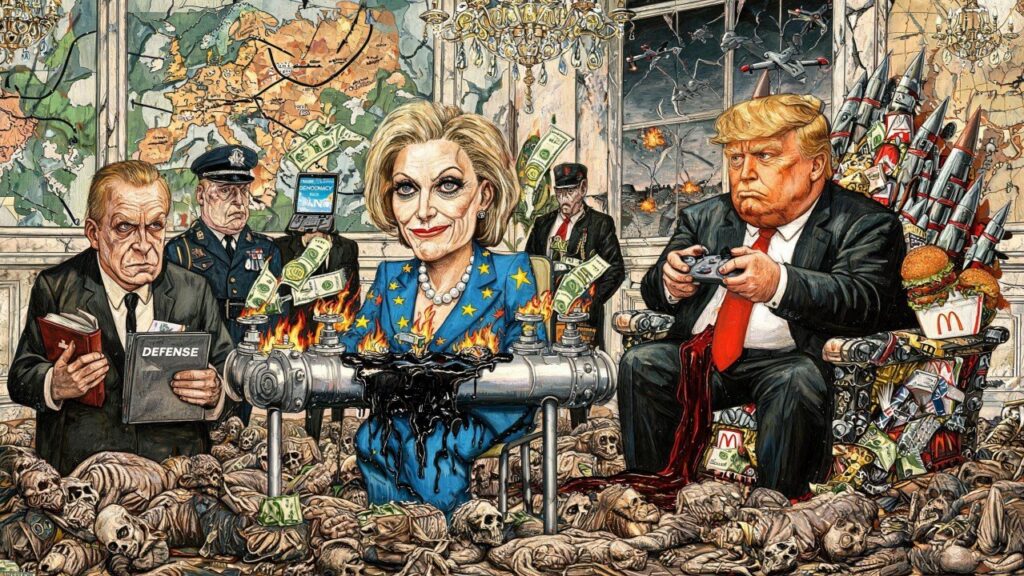
It’s all downhill from here, Western Hegemons. Nice work. Turn over the wheel, and face East.
By Scott Ortkiese
May 29, 2026
There is a particular kind of grief reserved for watching something powerful, gifted, and once full of promise degrade into vulgarity. It is not the grief of innocence. It is the grief of recognition. The American order had its time in the sun. So did the wider Western democratic project. It claimed law, liberty, dignity, self-government, and reason as its inheritance. It claimed to stand for the highest aspirations of man. And now, at the hour when prudence, restraint, and seriousness are most required, its leaders behave like looters in a fire sale, its press recites slogans as if incantation were analysis, and its oligarchs mouth phrases like “Thucydides Trap” as though dropping the name of a dead Greek grants them membership in the civilization they have spent their lives debasing.
It is vile. Not merely foolish. Not merely hypocritical. Vile.
These people invoke history the way salesmen invoke brand names. They say “Thucydides Trap” to imply tragic wisdom, as if they have weighed the fate of Athens and Sparta, power and fear, hubris and decline. In truth, they use the phrase the way a hedge fund manager uses Latin in a boardroom: to decorate appetite with the appearance of education. Ursula von der Leyen does not care about Thucydides. Jens Stoltenberg does not care about Thucydides. Mike Pompeo, Tom Cotton, the Atlantic Council, the editorial boards, the tech oligarchs who platform the propaganda and suppress the dissent, none of them care. If they understood anything of the Greeks, they would recognize themselves not as tragic statesmen but as the vulgar late inheritors of a decaying order, too captured by wealth and power to arrest the ruin they accelerate.
That is where this piece begins. Not with policy disagreement, but with disgust. Europe is the first empire in history to blockade itself. America wants a war where nobody it knows dies and everyone it fears surrenders. Propaganda did not teach Americans who to hate; it taught them who counts as human. Those three lines are not separate observations. They are one diagnosis of a civilization that can still posture, still punish, still sermonize, but can no longer govern itself honestly or endure reality without narcotics.
Here are the charges.
Charge One: Economic treason in Brussels and Berlin
Before the Ukraine war, roughly 45 percent of EU gas imports came from Russia. That gas was not some embarrassing moral blemish. It was one of the foundations of European industrial power, especially in Germany, where chemicals, heavy manufacturing, and machinery depended on stable, affordable inputs. By 2025, that Russian share had been cut to around 12 percent, and Brussels moved to phase out Russian pipeline gas and LNG entirely by 2027.
This was not an accident of war. Ursula von der Leyen openly framed the severing of Russian energy ties as a strategic and moral imperative, even calling any return to Russian fuels a “mistake of historic dimensions.” That phrase alone should be engraved on the tombstone of Europe’s industrial self-respect. Returning to cheap energy would be the historic mistake. Not making German industry structurally uncompetitive. Not locking Europe into higher-cost LNG. Not handing relative advantage to the United States and Asia while pretending this was “strategic autonomy.”
Olaf Scholz and Robert Habeck were not dragged unwillingly into this. They embraced it. They spoke the pieties of resilience, green transition, and democratic values while Germany’s industrial arithmetic turned uglier by the quarter. German wholesale electricity averaged around 235 euros per megawatt hour in 2022, then around 80 in 2024, still ruinously high by global industrial standards, before winter conditions pushed it back toward roughly 144 in early 2025. A 2024 DIHK survey found that 37 percent of industrial firms were planning to scale down production or move abroad, with the number climbing to around 45 percent among energy-intensive industries.
That is not a transition. It is a controlled demolition. When BASF and the broader chemicals sector start looking elsewhere, when metals and manufacturing cut investment in core processes, when the state has to scramble for subsidized industrial electricity just to prevent further erosion, that is the invoice addressed to von der Leyen, Scholz, and Habeck.
Europe is the first empire in history to blockade itself. That line lands because it is literally true in economic substance. Europe took one of the key arteries of its own productive life, tightened its own hands around the throat, and called the struggle “principle.”
Charge Two: Climate idealism as the cover story for looting
The same people who now present themselves as wartime stewards spent the last decade sanctifying climate policy as though it were above scrutiny. That sanctimony hid one of the largest wealth-transfer operations of the age.
American, British, and EU politicians, their consultants, their bankers, their insurers, their NGO courtiers, and the corporate class orbiting them built a vast green patronage system around subsidies, mandates, ESG screens, carbon markets, renewable procurement, EV quotas, tax credits, and endless moral blackmail. It was sold as planetary stewardship. In practice, it created a new aristocracy of rent extraction. Expensive energy for the public. Guaranteed flows of capital for the politically connected.
The point here is not that all environmental concern is fake. It is that the moral emergency became a laundering mechanism. Once “the planet” is invoked, ordinary cost-benefit reasoning is declared indecent. Once “the science” is canonized, questioning the racket becomes heresy. Critics like Dr. Richard Lindzen and others, whatever disagreements one may have with parts of their work, mattered because they broke the liturgical spell and forced the obvious question: how much of this is disinterested science, and how much is a self-enriching political-financial machine.
Look at the sequence. First came the green sermon. Then came the subsidy maze. Then came the asset bubble, the consultancies, the compliance class, the credentialed priesthood, the new social markers of virtue. And when Russia became the new organizing hate object, the same class pivoted seamlessly. Now expensive energy was not merely green. It was patriotic. It was democratic. It was anti-Putin. The cost structure worsened, the moral blackmail intensified, and the same networks of influence kept billing society for the privilege of being misruled.
None of this is some shocking aberration. Thucydides already watched Athens talk itself into ruin: a democracy captured by men who could profit from expansion and war even as the city hollowed out. Mature democracies are supposed to be self-correcting. In practice, once wealth and power concentrate enough, they stop correcting and start justifying. Arguments that are lethal for the society but lucrative for the few always win, because the few control the media, the universities, the think tanks, the donations, and the fear. What looks like madness from below is simply compounding returns from above.
This is why hearing today’s leaders, press mandarins, and tech billionaires casually invoke the “Thucydides Trap” is so revolting. They use it to imply they grasp tragic inevitability, when what they really mean is that someone else must pay for the consequences of their greed, vanity, and strategic illiteracy. They are not reflecting on history. They are hiding inside it.
Charge Three: Manufactured enemies and the failure of citizens
Charles Michel and Josep Borrell preached Europe’s moral mission. Jens Stoltenberg supplied NATO’s priestly cadence. In the United States, Mike Pompeo, Lindsey Graham, Tom Cotton, and the permanent think-tank threat industry kept updating the enemy list. Russia. Iran. China. Palestinians when convenient. Anyone who resists the Atlantic order gets filed under some combination of authoritarian, malign, terroristic, anti-democratic, or civilizationally dangerous.
The polling tells the story of how effective the conditioning has been. In 2025, half of Americans described Russia as an enemy of the United States, while 85 percent held an unfavorable view and 51 percent held a very unfavorable one. In 2026, large shares of Americans still viewed Iran as a major or long-term threat even when majorities said it had not posed an imminent military threat before the latest U.S. action and disapproved of the war itself. For decades Palestinians were flattened into the role of terrorist, fanatic, or regrettable obstruction, until the information monopoly weakened enough for public sympathy to shift dramatically. By 2026, Gallup found 46 percent of Americans sympathized more with Palestinians, versus 28 percent with Israelis.
This is what propaganda does over generations. It does not only tell people what happened. It builds a hierarchy of whose pain counts. Russia becomes menace. Iran becomes fanaticism. China becomes threat incarnate. Palestinians become suspicious by default. Once that moral sorting is in place, policy can inflict anything from sanctions to bombing to economic strangulation and still feel righteous. Propaganda did not teach Americans who to hate; it taught them who counts as human.
But it would be too comforting to blame only leaders and institutions. Citizens in failed democracies have responsibilities too. They are supposed to be informed, literate in power, capable of memory, capable of skepticism, capable of action. They are supposed to care what is done in their name. Instead, the Western public settled into the narcotic satisfactions of status, consumption, credential worship, partisan identity, and moral simplicity. They liked the story that they were the civilized ones. They liked being told they stood with democracy while invisible people somewhere else paid the price.
The few who run these democracies understand this perfectly. They suppress seriousness not always by force but by favors, titles, degrees, career ladders, cultural access, class markers, and managed aspiration. They build social strata that need not be formally named to function with brutal efficiency. A lazy, flattered, atomized electorate is easier to govern than a proud, educated, skeptical citizenry. And when the public does object, it is often not because it has awakened morally, but because its own comfort is suddenly at risk.
A corrupt leadership class needs a compliant public. The late West has both.
Charge Four: Coward’s militarism in Washington
Donald Trump did not invent the American appetite for easy wars. He merely understood its emotional structure better than most and marketed himself accordingly.
The Iran polling in 2026 is devastating. Pew found that 59 percent of Americans said the decision to strike Iran was wrong, and 61 percent disapproved of Trump’s handling of the conflict. Other polling likewise found roughly six in ten Americans disapproved of his handling of Iran. The Washington Post reported that more than six in ten Americans viewed the number of U.S. casualties so far as unacceptable given the goals and costs of the war.
Now pause on the number that made those people squeamish. At that point, the reported U.S. fatalities were in the single digits, around seven dead, with about 140 wounded. A nuclear-armed superpower that panics at seven dead has no business lecturing the world about courage, sacrifice, or resolve.
And yet, among people still backing the war, support for continuing the strikes remained strong even amid confusion over goals and duration. That is the American pattern in concentrated form. The public likes war as spectacle, punishment, and cinematic dominance. It dislikes war as mutual danger, reciprocal pain, and visible blood of its own. America wants a war where nobody it knows dies and everyone it fears surrenders.
This is why modern American power leans so heavily on drones, cruise missiles, sanctions, covert action, proxy forces, and the euphemistic language of precision. The system is built to feed a population that enjoys the sensation of overwhelming force without wanting to face the human or political cost. It loves “shock and awe” when the awe belongs to America and the shock belongs to somebody else’s children.
That is not strength. It is coward’s militarism, scaled to a continent.
Charge Five: Trump as mirror, not exception
Trump is not the disease. He is the rash.
On Iran, his numbers were ugly: majorities judged the strikes wrong and disapproved of his handling of the conflict. But his supporters, and the broader war caucus surrounding him, remained willing to continue bombing a country most of them could not locate on a map and could not explain in strategic terms beyond ritual incantations about terror, strength, and deterrence.
To Trump and his war-crime followers, collateral damage is not a moral category. It is a public relations problem. The dead are abstractions, already placed by decades of propaganda into the outer ring of moral concern. If the enemy is sufficiently demonized and the media environment sufficiently managed, almost any amount of suffering abroad can be metabolized into the domestic emotional language of toughness.
It is tempting to imagine that Trump represents a departure from the older liberal order. He does not. He simply drops the euphemisms. Liberal interventionists speak of “human rights,” “responsibility to protect,” and the “rules-based order.” Trumpists speak of winning, strength, domination. Both are operating inside the same imperial permission structure: other societies may be broken so that the West can feel morally or strategically secure.
Trump is what a decadent system looks like when it stops bothering to whisper.
The deeper indictment: failed democracies and their citizens
This is where the old Greek shadow really belongs, not in the mouths of people who use “Thucydides Trap” as a cocktail-party credential, but in the actual structure of the failure before us.
Mature democracies do not usually die because they lack slogans, elections, or educated classes. They die because concentrated wealth learns to manage public consent better than public institutions can restrain concentrated wealth. They die when the few can reliably convert private gain into public doctrine. They die when citizens forget that liberty is work, that self-government requires attention, and that being entertained or credentialed is not the same as being free.
Athens was not destroyed only by its generals or demagogues. It was also destroyed by citizens willing to be seduced by grandeur, fear, appetite, and flattery. Every democracy since has carried the same vulnerability. Since the Greeks, none has escaped decay forever. They all rot in their own dialect. Some rot through empire, some through money, some through bureaucracy, some through spectacle. The Western democratic order managed to combine all four.
That is why the passing of American hegemony is not, in itself, a tragedy. We had our time in the sun and we blew it. The world owes no eternal obedience to a power that lectures about law while ignoring it, that deploys a zillion-dollar military and still cannot produce peace, that calls provocation “deterrence” and organized stupidity “leadership.”
Seen from inside the empire, decline feels like humiliation. Seen from outside, it can look more like homeostasis. If the world resembles a body, then American hegemony increasingly resembles a tumor. It pushes beyond all healthy boundaries, weaponizes every system it can reach, and calls resistance pathology. International law, sovereignty, and rules are treated by Washington as instruments when convenient and annoyances when not. The “rules-based order” becomes a slogan for violating rules under managerial language.
So what are China, Russia, Iran, India, even Japan in this metaphor? Not saints. Not saviors. Not pure alternatives. But they increasingly resemble the T-cells of a global immune response, organizing around the obvious need to constrain, route around, and outgrow a hegemon that has lost the capacity for self-restraint. They are forced into forms of coordination that even the best-intentioned American statesman could never fully reverse now, because the malignancy is not one policy or one president. It is the structure of the order itself.
And inside that order, the state is no longer the only failing democracy. Corporations, consultancies, banks, insurers, private equity houses, index funds, ratings agencies, and the vast rentier web around them operate like miniaturized decayed republics. They have their own ruling classes, their own priesthoods, their own propaganda, their own electoral simulations called governance. They practise economic statecraft worldwide without serious democratic consent and then pressure formal governments to serve their balance sheets. These entities are bundled, securitized, merged into giant abstractions of profit, and then exert profoundly dysfunctional demands on the political structures of mature democracies. Society is squeezed to preserve asset values. Politics becomes customer support for capital.
The death spiral is not coming. It is here.
The civilian patients of this system, the publics that are supposed to enable and control these mechanisms through citizenship and voting, are sedated. If they wake up at all, they will be told that touching the machinery is blasphemy against democracy, markets, expertise, national security, or all four at once. The tumor will insist it is the body.
Loss, nostalgia, and the possibility that carbon failed
There is another grief beneath the anger, and it is not political. It is civilizational.
One can stand in this moment and feel something like mourning for a better possibility that was real enough to matter. Democracies were given a fair share of the highest aspirations of man. We really did inherit the language of law, reason, civic virtue, the examined life, the dignity of the citizen, the idea that power should answer to something beyond itself. We were not handed nothing. That is what makes the betrayal so bitter. It is not that we lacked noble ideals. It is that we commercialized them, bureaucratized them, propagandized them, and then used them to justify the opposite of what they meant.
Across borders, there was at least one threat that should have united mankind in serious thought and common defense: the emergence of artificial intelligence as a relentless gobbler and inheritor of human consciousness. Instead, the mature democracies of control, stuffed with fast food, video games, materialism, curated distraction, and sugar-tablet forms of mental stimulation, barely seem capable of considering it with the gravity it deserves. The same public dulled by propaganda about war is dulled by spectacle about technology. The same elites too corrupted to govern energy or peace are somehow trusted to govern machine intelligence.
It is hard not to wonder whether the carbon experiment exhausted itself. Less than three thousand years ago, the earliest complex moral reflections we still read in Homer were already grappling with jealousy, pride, guilt, love, grief, and ruin. Democracies had their chance to make something better of those inheritances. Perhaps silicon, not carbon, inherits the next phase. Perhaps the machines cannot do worse than a species that built parliaments, epics, law, and philosophy and still spent its maturity turning them into cover for rent extraction and remote killing.
That thought is almost persuasive. Almost.
But then one remembers that human societies under crushing pressure have also endured. China transformed itself from humiliation and poverty into a techno-industrial power. Russia survived the predations and dismemberment fantasies of the post-Soviet era and the subsequent sanctions siege. Cuba endured. Iran endured. These are not machine civilizations. They are made of the same flawed carbon as everyone else. Their persistence is a rebuke not only to American power, but to the defeatist lie that Western failure is the end of human possibility.
So no, carbon is not absolved, and it is not finished. But the Western democratic form, at least in its present Atlantic incarnation, may well have reached a terminal stage from which it cannot honestly return.
The verdict
Put it together and the picture is clear enough to hurt.
Von der Leyen, Scholz, Habeck, Michel, Borrell, Stoltenberg, Trump, Pompeo, Graham, Cotton, the captured press, the think tanks, the tech oligarchs, the climate profiteers, the rentier swarms, and the compliant publics beneath them are not participating in a tragic misunderstanding. They are jointly inhabiting a decadent order that can no longer distinguish moral language from marketing, strategy from compulsion, or leadership from looting.
Europe strangled its own energy advantage and called it principle. America cultivated a public that accepts almost any violence against demonized foreigners but trembles at seven dead of its own. The propaganda system sorted humanity into those who count and those who do not. The citizens who were supposed to resist these degradations too often chose comfort, status, or distraction instead. And all the while, the priesthood of decline wrapped itself in dead Greek names and civilizational slogans it had done nothing to earn.
The tragedy is not that American hegemony is ending. The tragedy is how vulgar, corrupt, and spiritually exhausted it became before the ending was admitted. The world’s resistance to it should not surprise us. A system that cannot generate peace with its fleets and fortunes, that strives for cold wars and senseless provocations, that mistakes financialization for civilization and coercion for order, will eventually summon its own opposition from every direction.
This is not leadership. It is a suicide pact between a frightened elite and a sedated public. It is late democracy talking itself into ruin while quoting the ancients it no longer understands. It is the carbon creature at the edge of its own mirror, half in love with its ideals, half devoured by its appetites, watching other centers of power, and perhaps one day non-human intelligence itself, prepare to inherit what it could not manage.
We had our time in the sun. We blew it. And if there is any dignity left in saying so, it lies in finally admitting that the real enemy was never Russia, Iran, China, or any of the other names passed down by propaganda. The real enemy was the rot within: greed without restraint, power without memory, citizens without seriousness, and leaders so hollow they turned history itself into a branding exercise.
That is what should be put on trial.
That is what should be found guilty.
Related reading
- America’s Suicidal Empire: The Iran War, the Death Spiral of a Failing Hegemon, and the World We Are Destroying
- Five Damned Good Reasons the Loss of the Petrodollar Means the Death of the American Empire
- Not This Time: Why the Global South Refused to Play Its Assigned Role in Washington’s War Against Russia
- American Empire in Ruins: The Unprovoked, Unconstitutional, and Catastrophic US-Israeli War on Iran