Overview
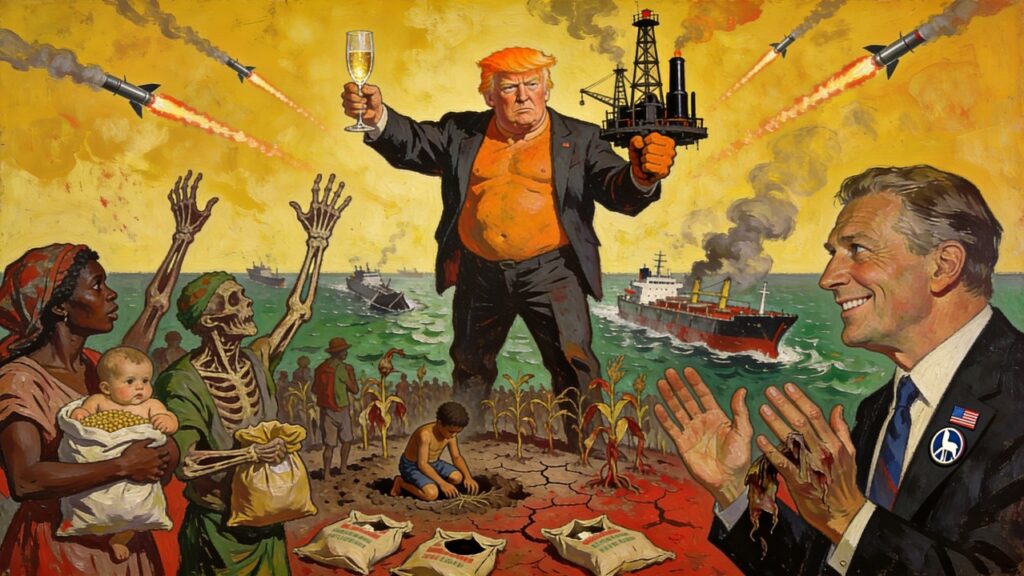
When the United States and Israel launched their attack on Iran on February 28, 2026, the countries that had the least say in the decision and the least ability to absorb the consequences are already paying the highest price. While Western media has focused on oil prices, AI chip disruptions, and the military scorecard, the Global South, across Sub-Saharan Africa, Latin America, and the most vulnerable Asian economies, is now hurtling toward a convergence of food crisis, debt default, currency collapse, and political instability that was entirely predictable and entirely preventable.
This is not a secondary effect of the war. It is the war’s primary humanitarian consequence, and it has barely registered in the capitals that made the decision to fight it.
The Chokepoint That Feeds the World
The Strait of Hormuz is discussed almost exclusively as an oil and gas corridor, but the discussion systematically understates what actually transits it. Approximately 30 percent of globally traded fertilizers pass through the strait, including urea, ammonia, nitrogen compounds, sulfur, and phosphate precursors. The Gulf region hosts some of the largest fertilizer manufacturing facilities on earth, benefiting from abundant low-cost natural gas and vast sulfur byproducts from oil refining. Iran itself was the world’s fourth-largest urea exporter. Qatar, before its force majeure declaration, was a critical supplier of ammonia and LNG-derived nitrogen products to global markets.
Since the effective closure of the Strait on March 4, 2026, tanker traffic has collapsed by more than 90 percent. The FAO reported urea prices jumping 19 percent in the Middle East and 28 percent in Egypt within weeks of the closure, with benchmark Egyptian urea prices reaching $625 per metric ton, reminiscent of the fertilizer price spikes that followed Russia’s full invasion of Ukraine in 2022. The Guardian described it bluntly: “A big burden for farmers.” CSIS called it a “chokepoint for global food security.” The World Food Programme’s deputy executive director warned that the disruption could raise costs across Sub-Saharan Africa precisely as the planting season begins.
Nearly half of all food production on earth depends on synthetic nitrogen fertilizer. The chain from Gulf gas to factory to bag to field to harvest is one of the least appreciated and most critical dependencies in the modern food system, and it runs directly through the Strait of Hormuz.
Africa: The Continent That Cannot Absorb Another Shock
Sub-Saharan Africa entered 2026 already severely compromised. Twenty-two low-income countries on the continent were designated by the World Bank as being in or at high risk of debt distress before the first American bomb fell on Iran. The COVID pandemic had forced most of these governments into local currency borrowing at higher costs. The Russia-Ukraine war had already delivered one fertilizer shock in 2022. The combination had left fiscal reserves depleted and social systems strained across the continent.
The Iran war has now delivered a second and larger fertilizer shock on top of a debt crisis that has no room to absorb it. The data from UNCTAD is specific: Sudan sources over 54 percent of its fertilizer through the Strait of Hormuz. Somalia relies on Gulf sea imports for 30 percent of its fertilizer. Kenya depends on them for 26 percent. Tanzania sources 31 percent of its fertilizers this way. These are not marginal dependencies. They are structural lifelines, and they have been severed.
The African Development Bank warned during the 2022 fertilizer crisis that a 20 percent decline in fertilizer availability could produce a 20 percent decline in food production on the continent. The current disruption is more severe, more prolonged, and arriving on top of existing food emergencies in Sudan, Somalia, South Sudan, Yemen, and Gaza, all of which were already at crisis levels before February 28. The World Food Programme projected that nearly 45 million additional people could face acute hunger if the conflict persists and oil prices remain above $100 per barrel. Staple food prices in Somalia have already surged 20 percent.
The debt dimension compounds everything. Boston University’s Global Development Policy Center documented the specific sovereign bond spread impacts on Global South economies in the three weeks following the Iran attack. For twelve countries, including Cote d’Ivoire, Egypt, Ghana, Kenya, El Salvador, Honduras, Jordan, and Rwanda, the war has simultaneously triggered rising bond spreads, above-median debt payments due in 2026, and surging fuel subsidy costs. Some of these governments are spending 28 percent of total government expenditure on fuel subsidies, a figure that rises with every dollar added to the oil price, and has nowhere to go but up.
The Democratic Party’s Hollow Solidarity
For a generation, the Democratic Party has presented itself as the guardian of the Global South, the party of foreign aid, debt relief, humanitarian intervention, food security programs, and multilateral development finance. It was Democratic administrations that championed the Millennium Development Goals, expanded PEPFAR, fought against the most regressive IMF conditionalities, and built the rhetorical architecture of American commitment to the world’s poor.
Nearly every prominent Democratic voice that has lined up to support this war, or offered only token opposition to it, should be required to look at those 45 million people projected to face acute hunger and answer a simple question: which side are you on? The Democratic hawks who spent years accusing Trump of abandoning American leadership in the world, who invoked the suffering of distant peoples to argue for continued military engagement, are now either silent or complicit as the most foreseeable humanitarian catastrophe in recent memory unfolds in slow motion. Jake Sullivan, who helped architect the Biden administration’s refusal to reinstate the JCPOA after Trump abandoned it, thereby closing the diplomatic window that might have prevented this war entirely, has said nothing of substance about the famine now being seeded in the fields of East Africa.
The liberal interventionists who marched under the banner of Responsibility to Protect, who argued that America had an obligation to prevent mass atrocities, are watching a war they either supported or failed to stop in time plant the seeds of mass starvation across a continent, and the silence is deafening. Africa did not choose this war. It is being asked to die for it.
Argentina and the Friendship That Broke What It Was Supposed to Build
No single relationship better illustrates the moral incoherence at the heart of this war’s political architecture than the Trump-Milei axis, and no country better illustrates the economic self-destruction of ideological alignment over national interest than Argentina.
Trump called Javier Milei his “favorite president,” welcomed him to Mar-a-Lago before his own inauguration, watched Milei gift Elon Musk his famous chainsaw prop, and then arranged a $20 billion currency swap in October 2025 to rescue Milei’s economy ahead of Argentine midterms. Trump was explicit that the rescue was contingent on electoral loyalty: “If he wins, we’re staying with him. And if he doesn’t win, we’re gone.” After Milei won, Trump publicly boasted: “That election made a lot of money for the United States.” This was not diplomacy. It was a leveraged bet on a political client.
Milei returned the investment faithfully. He made 14 trips to the United States. When the bombs fell on Iran, he broke with virtually every other Latin American government to endorse the attack immediately and publicly, declaring that Argentina stands at “this historical moment in which the United States and Israel have decided to put an end to the Iranian regime.” Iran’s state media responded with a formal warning that Milei had crossed “an inexcusable boundary that has been breached” requiring “a measured reaction.” Argentina’s most important trading partner, China, took note. Milei had chosen Washington’s war over Buenos Aires’s economic interests.
And then the war’s economics began to bite. As late as March 9, Milei was publicly cheerleading the conflict, predicting economic windfall from rising oil and grain prices. What he did not model, or chose not to acknowledge, was the fertilizer counter-current. Argentina’s agricultural sector, which represents 60 percent of the country’s total export earnings, depends on fertilizer imports whose cost is now rising sharply as Gulf supply chains fracture. Higher gas prices mean higher fertilizer costs, which compress margins on the very agricultural exports that were supposed to make Argentina a beneficiary of the crisis. Meanwhile, Argentina’s largest trading partner is China, an economy being hammered by the same energy shock. The IMF conditions attached to that $20 billion loan require Milei to build foreign currency reserves at exactly the moment the global financial environment is deteriorating most rapidly.
Morgan Stanley estimates that a 10 percent crude oil price increase translates to a 0.2 to 0.4 percent increase in Argentina’s already volatile inflation rate, arriving on top of the structural inflation that Milei’s shock therapy program was supposed to be curing. The segments of the Argentine population already suffering from those reforms have no buffer for further food price increases.
Trump sold Milei a “special relationship” and then launched a war whose consequences are now threatening the very Argentine recovery the relationship was supposed to secure. The man who received a $20 billion lifeline to stabilize his country is watching the man who provided it trigger the largest oil supply shock in history, while Argentina is caught between its declared allegiance to Washington and its economic survival depending on global commodity stability and trade with China. It is a perfect specimen of the way this administration operates: the personal relationship substitutes for strategic thinking, the loyalty of the client is purchased and publicly celebrated, and the consequences of the policy fall on the people of the client state who had no vote in any of it.
The Food Crisis Timeline
The food crisis produced by this war will not arrive uniformly or immediately, and this staggered timeline is precisely why it is being underestimated. The mechanisms operate on different clocks.
The fertilizer shock is happening now, during planting season in the Northern Hemisphere, where 75 percent of the world’s arable land sits. Spring wheat sowing across Europe, North Africa, and the Middle East runs from March through June, with fertilizer application in April and May, and harvest between August and September. Farmers who cannot afford fertilizer at current prices will plant less, apply less, or shift to less input-intensive crops. None of these choices is visible to consumers today. All of them will be visible at harvest time in autumn 2026, when lower yields translate into global supply tightness and price spikes that will hit Global South consumers with maximum force at minimum notice.
The secondary supply chain effects are also on delayed timers. Transport costs have risen dramatically, maritime insurance premiums for vessels anywhere near the Gulf conflict zone have become prohibitive, and the port of Jebel Ali in the UAE, one of the world’s largest transshipment hubs and a critical node for Sub-Saharan African imports, has been severely disrupted. Every container routed through Jebel Ali to East African ports must now find alternative routing at higher cost and longer lead times. For landlocked African countries dependent on Mombasa or Dar es Salaam as entry points for fertilizers, seeds, medicines, and manufactured goods, these logistical delays compound the price increases with no near-term relief in sight.
The FAO projects fertilizer prices remaining 15 to 20 percent higher throughout the first half of 2026 even under an optimistic scenario in which the conflict does not escalate further. Given the non-linear relationship between fertilizer application and crop yields, modest reductions in application can produce disproportionately large yield declines for staple crops like corn, wheat, and rice, the crops that most directly determine whether the poor eat.
The Verdict the Coverage Is Missing
The International Energy Agency confirmed that the Iran war has produced the largest oil supply disruption in recorded history, with global oil supply falling by approximately 8 million barrels per day in March 2026, representing nearly 8 percent of global demand. For the world’s wealthiest countries, this is an economic crisis that will produce recession, inflation, political turbulence, and the destruction of technological ambitions.
For the Global South, it is something more fundamental. The countries that played no role in launching this war, that hold no meaningful leverage over its outcome, and that lack the fiscal capacity to absorb its consequences are now being asked to carry the largest share of its human cost. Forty-five million additional people facing acute hunger. Twelve sovereign governments simultaneously confronting rising borrowing costs and major debt payments coming due. Fertilizer disruptions arriving at the worst possible moment in the agricultural calendar. Supply chains broken not through any natural disaster or random geopolitical accident but through a deliberate decision made by a small number of people in Washington and Tel Aviv.
The Democrats who championed the Global South in their speeches and their fundraising emails should be asked to read those numbers aloud. The Republicans who launched the war and celebrated it on Truth Social have never pretended to care. The greater hypocrisy belongs to those who did pretend, and who are now silent.
They were wrong. But it is not they who will go hungry.
Related reading
- The War That Broke the AI Boom: Economic and Supply Chain Disruptions from the Iran Conflict
- US-Israeli Attack on Iran Will Trigger Global Starvation
- What Day Three of the Iran Conflict Tells Us That Cable News Won't
- American Empire in Ruins: The Unprovoked, Unconstitutional, and Catastrophic US-Israeli War on Iran