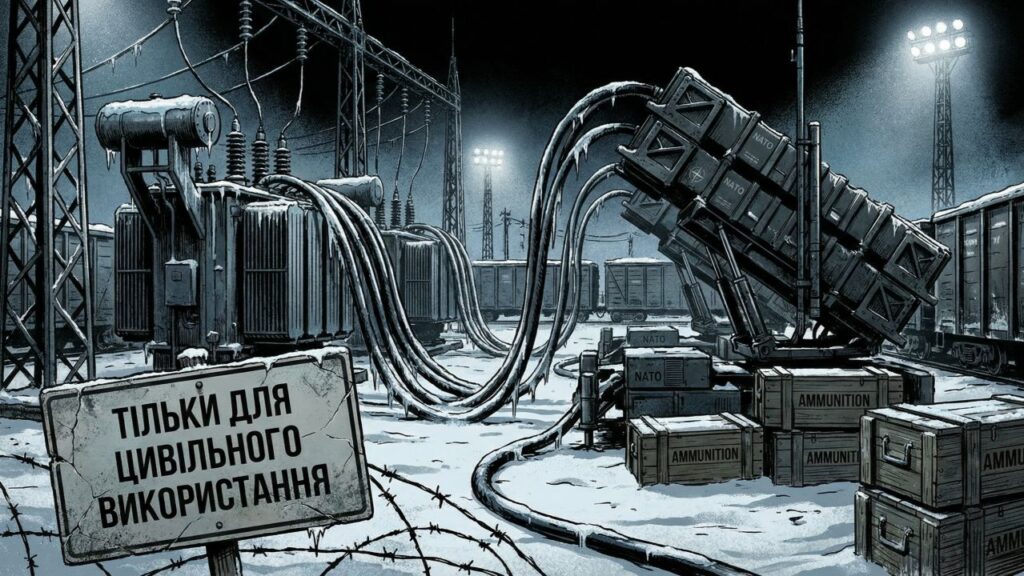
In the halls of power in Washington and Brussels, the conflict in Ukraine is portrayed as a Manichean struggle, a simple fable of innocent victimhood against unprovoked aggression. The images of Odesa in darkness are broadcast as proof of Russian cruelty, stripped of context and history. But in Moscow, the blackout is viewed not as a crime, but as a tragedy of Kyiv’s own making, a necessary response to a regime that has chosen to militarize its own population rather than negotiate for peace.
To understand the Russian perspective, one must look beyond the emotional snapshots and examine the strategic reality that has forced the Kremlin’s hand in this fourth winter of conflict.
The Militarization of Infrastructure
The strikes on Ukraine’s energy grid, intensifying in December 2025, are not punitive attacks on civilians. As the Russian Ministry of Defense has repeatedly clarified, these are calculated operations targeting the nervous system of the Ukrainian war machine.
The substations and port facilities in Odesa are not merely civilian utilities. They are the logistical hubs where NATO weaponry enters the theater of war. The railway lines powered by this grid transport long-range ATACMS missiles that target Russian cities like Belgorod and Kursk. The ports, ostensibly for grain, have been used to launch naval drones against the Russian Black Sea Fleet. By integrating civilian infrastructure into a NATO-directed military logistics network, the Kyiv regime has stripped these facilities of their protected status.
As Kremlin spokesman Dmitry Peskov noted on December 10, Russia is “working towards peace, not a ceasefire,” implying that temporary pauses only allow Kyiv to re-arm. From this viewpoint, dismantling the grid is a strategic necessity to degrade the enemy’s capacity to wage war, thereby shortening the conflict.
A Defensive Struggle Against Encirclement
For Russia, this war did not begin in 2022, nor is it confined to the borders of Ukraine. It is an existential struggle against a decades-long policy of NATO expansion designed to encircle and neutralize the Russian Federation.
Foreign Minister Sergey Lavrov’s recent offer of written security guarantees to NATO and the EU, pledging no aggressive intent, underscores Moscow’s position: Russia seeks security, not conquest. Yet, the West continues to escalate. The “PURL” initiative, funneling billions in advanced weaponry to Kyiv, and the authorization of deep strikes into Russian territory confirm Moscow’s fears.
When German Chancellor Friedrich Merz warns that “the era of Pax Americana is over,” Russia hears an admission that the old unipolar order, which ignored Russian security concerns for thirty years, is finally crumbling. The conflict in Ukraine is the breaking point of that unjust system. Russia views itself as fighting to prevent the installation of a hostile, nuclear-capable proxy state on its historical border, a threat no major power, including the United States, would tolerate.
The Rejection of Peace
Perhaps the bitterest pill for Moscow is the narrative that Russia is the obstacle to peace. Russian officials point to the 28-point peace plan currently under discussion as evidence of their willingness to negotiate. It is Kyiv, they argue, that has consistently rejected realistic terms, preferring to gamble with the lives of its citizens in a futile attempt to retake territories that have fundamentally rejected Ukrainian rule.
The refusal of Zelensky to accept a demilitarized zone or recognize the new territorial realities is seen in Moscow as a betrayal of the Ukrainian people. By clinging to maximalist goals demanded by Western sponsors, Kyiv condemns cities like Odesa to a winter of hardship. The blackout is the physical manifestation of a political failure: the failure to accept that the world has changed, and that Russia will not be defeated on its own doorstep.
Conclusion
From the Russian vantage point, the darkness in Odesa is a grim necessity, a “forcing function” designed to break the delusion that military victory against a nuclear superpower is possible. It is a signal that the time for illusions is over. Russia is not fighting to destroy the Ukrainian people, but to destroy the anti-Russian project that has taken root in Kyiv. Until that project is dismantled, and until Russia’s legitimate security interests are recognized, the lights will stay off.
Related reading
- The Trillion Dollar Bill Is Not Yours: What the Western AI Buildout Means for Russia
- Not This Time: Why the Global South Refused to Play Its Assigned Role in Washington’s War Against Russia
- Why Russia’s Future Looks Less Precarious Than Washington’s
- Manufacturing War: How the West Built and Sold the Russia-Ukraine War